When we’re at the beach we always try to go out in the morning; we’re not always at th beach but when we are we rarely miss a day. I usually run every other day, but sometimes, I skip a run or run short. Rarely, we stay indoor because the weather is punishing.
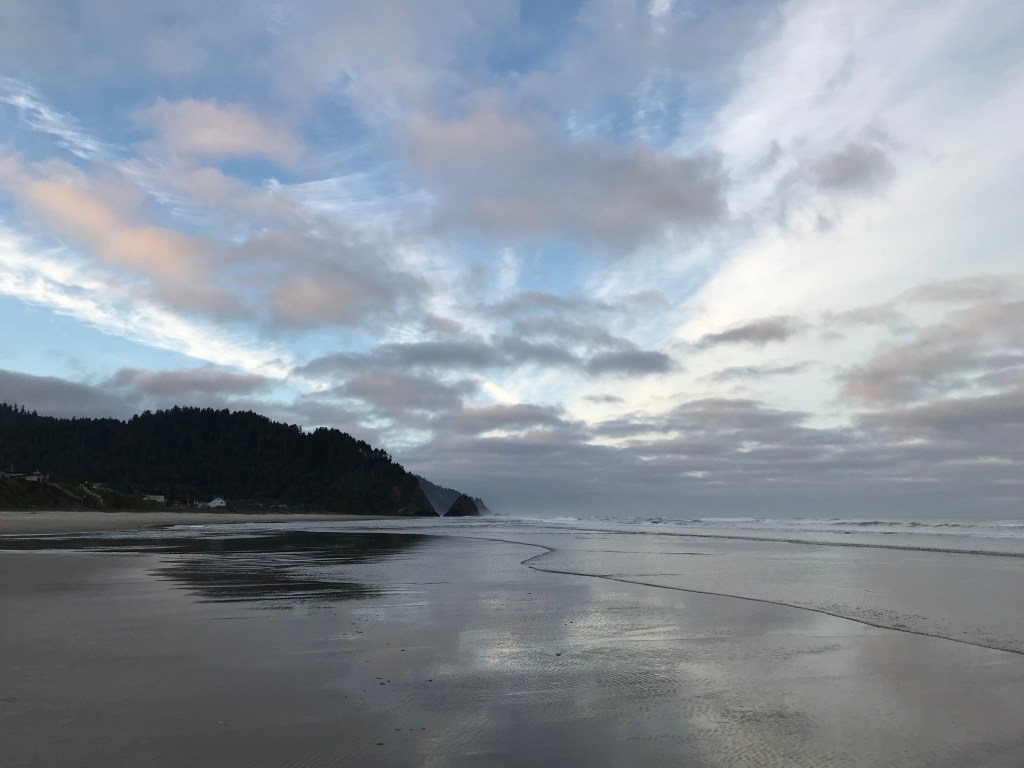
People who don’t live here year around rarely understand about the weather or wildlife. We might get only a handful of rainy days in summer, but we’ll get five or eight feet of rain during the rest of the year. There is always wildlife.
In addition to the deer, I’ve seen black bears and raccoons and weasels. Word is there are cougar in the hills, but I’m not in any hurry to verify that story. Recent encroachment by bull elk means I check the beach before going out for my runs. Bull elk are maybe a little insane during the rut. There are signs up all over Cannon Beach warning that the bull elk are dangerous this time of year. Tourists walk too close to get their photos. It makes us cringe.
At a community meeting, a part-time resident objected to efforts to save fish. She reasoned that the creek was no more than an inch or two deep. Where were the fish? Where were the fingerlings? She was mostly right.
In mid-summer, Asbury Creek might be only a couple of inches deep in spots. This year in particular, the sand is high and rainfall low. I have managed to run across the creek dry since March, and I crossed dry twice this morning. This is changing, the weather is changing, the nights have a damp chill. In every winter we have lived here, the Asbury is deep enough for salmon, high enough to push massive drift logs up the mouth of the Asbury and stack them fifteen feet high against the huge steel grate. Sometimes we find fingerlings washed onto the sand, and sometimes witness the flight of a resident kingfisher.
Deer and elk come out before dawn, walk in and out of the ocean. Coyotes too. Visitors were so concerned about a deer they spotted in the surf they stood between that doe and her pathway back to forest. She didn’t need to be rescued; she needed people to move off. A tourist refused to put her dog on leash; the dog was harassing a baby seal left onshore by its mother. In case you missed it, that violates federal law.
On our walk home, an hour from our start, I often ask people where they are from. The retired Mennonite couple from Pennsylvania, the Russian family, the people from California and Seattle… They tell me I’m lucky to live here. I do know and appreciate that good fortune.
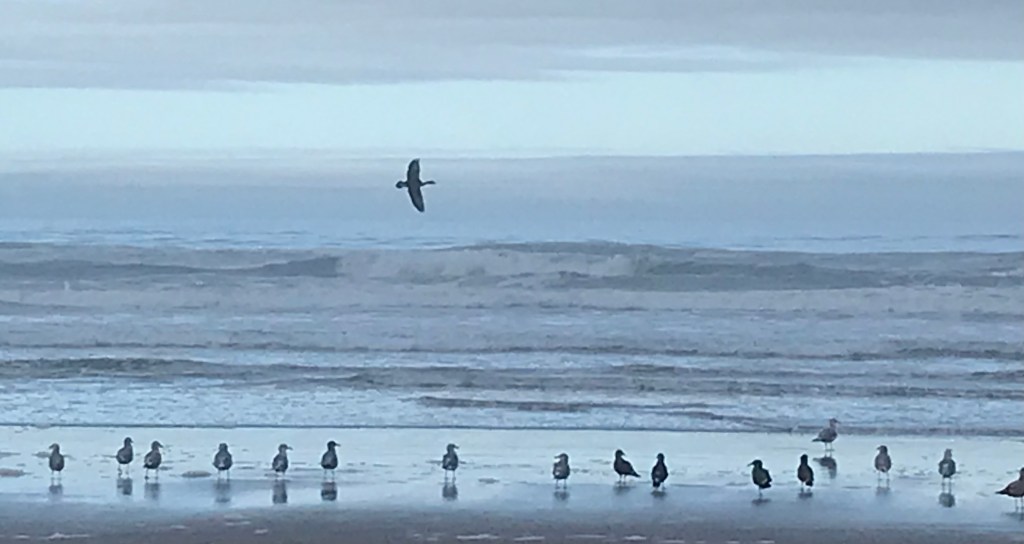
On my runs, I’ve seen coyote cubs playing on the shore. I’ve admired the weather and the fly-overs of Canada geese. I look for shells and sea glass. I am wary of dogs. Loose dogs are often a danger to people and to themselves. I’ve been bitten and head-thumped by mean and frightened dogs. I’ve rescued a few dogs that were lost. My mother told about the family dog running up and down the beach chasing seagulls. When he caught one he seemed surprised and immediately let it go. Local waterfowl are not always so lucky. I’ve seen people deliberately spook a hundred gulls into the air, just to see them fly, We try not to disturb the gulls resting onshore. Much of the year food is scarce and they need their rest.
At a writing retreat years ago, a woman read her story of “rescuing an abandoned baby seal” on the Washington coast and taking it back Seattle. That experience became the beginning of her life as a writer. Because I was raised in the Pacific NW, my parents were familiar with the essential principle of leaving wildlife alone, I recognized her story as a tragedy. Seal pups are routinely lift to nap onshore while their mothers fish. That woman stole a seal’s child. She crippled that pup’s life. Whatever life it lived in the Seattle Aquarium? the Woodland Park Zoo? perhaps eventually reintroduced to the wild without it’s mother’s training? she caused sorrow and thought she was the hero of that tragic tale.
I understand the temptation. Baby animals are nearly always adorable. [I make an exception for baby pigeons. Squabs look to me like badly designed horror-movie monsters. Gary is horrified that I fail to admire their cuteness. There will be words when he reads this.] I refuse to be sentimental about animals, shy from authors who assume they know the thoughts of their pets, and try never to assume I know what an animal is thinking. But only fools fail to appreciate that animals care for their young, suffer pain in birth and loss, grieve and play.
Human interaction with wildlife rarely goes well for the animal in the long run. (Didn’t everyone read or at least watch the film version of The Yearling?) Sometimes a person is hurt and the animal will always die. It’s rarely the animal’s fault.
Let the wild things be.*
Greetings, dear reader. I might be back. Maybe.
*There are no sea otters off the shore of Oregon because their fur was valuable and they were all killed off by 1907. We’d like to have them back. Wolves were deliberately exterminated and gone for most of the 20th century. They have tentatively moved back but are met with hostility from ranchers. This week we’ve been seeing an unusual goose, two pairs, and then one eaten onshore so the mate flew around and around in dismay this morning. (Our bald eagles are not particularly good hunters; they eat what’s dead onshore.)
I used to write poetry. Sometimes I still do.
BOTANY LAB
A generation ago in my Botany lab,
my partner bends over specimens, scalpel
poised like a paintbrush. He slices flowers
perfectly in half; my turn to peer
through the microscope. I count stamens
and ova. As I draw diagrams, search
for proper names in the text,
I do not notice silence
.
until it’s broken. Someone,
also hunched over high black counters
and flower parts, asks the air, What sets
human beings apart from the lower animals?
Tools comes an answer from across
the room. Aren’t we the only species
which makes and uses tools? We decide
not, since Goodall documented chimpanzees
fishing for termites. Playing, I hear my partner
assert. Man is the only animal that plays.
.
I look up from the sexual organs of plants
and smile. I think he’s wrong, though I am
not the first to say it. My dog plays with me,
says another Botany student. But my partner
argues with pets. They are domestic animals,
tainted by association. Fawns, we offer,
adolescent lions. Juveniles, he shakes his head.
Adult otters swim purely for fun, we counter.
Porpoises leap in the wakes of ships, squirrels
play tag in trees, foxes pounce on dandelions.
His forehead puckers, scalpel painting the air.
Really?
.
Under my microscope, a five part flower,
many stamens, fleshy calyx-tube.
Family Rosaceae,
genus rosa,
species multiflora,
precisely like
the illustration in my text—
a local flower I see each day.

