John Lewis

Two days before his death, John Lewis submitted an Opinion piece to The New York Times that he hoped would be published on the day of his funeral. “Though I am gone, I urge you to answer the highest calling of your heart and stand up for what you truly believe.” 

While my time here has now come to an end, I want you to know that in the last days and hours of my life you inspired me. You filled me with hope about the next chapter of the great American story when you used your power to make a difference in our society. Millions of people motivated simply by human compassion laid down the burdens of division. Around the country and the world you set aside race, class, age, language and nationality to demand respect for human dignity.

That is why I had to visit Black Lives Matter Plaza in Washington, though I was admitted to the hospital the following day. I just had to see and feel it for myself that, after many years of silent witness, the truth is still marching on.

Emmett Till was my George Floyd. He was my Rayshard Brooks, Sandra Bland and Breonna Taylor. He was 14 when he was killed, and I was only 15 years old at the time. I will never ever forget the moment when it became so clear that he could easily have been me. In those days, fear constrained us like an imaginary prison, and troubling thoughts of potential brutality committed for no understandable reason were the bars.

Though I was surrounded by two loving parents, plenty of brothers, sisters and cousins, their love could not protect me from the unholy oppression waiting just outside that family circle. Unchecked, unrestrained violence and government-sanctioned terror had the power to turn a simple stroll to the store for some Skittles or an innocent morning jog down a lonesome country road into a nightmare. If we are to survive as one unified nation, we must discover what so readily takes root in our hearts that could rob Mother Emanuel Church in South Carolina of her brightest and best, shoot unwitting concertgoers in Las Vegas and choke to death the hopes and dreams of a gifted violinist like Elijah McClain.

Like so many young people today, I was searching for a way out, or some might say a way in, and then I heard the voice of Dr. Martin Luther King Jr. on an old radio. He was talking about the philosophy and discipline of nonviolence. He said we are all complicit when we tolerate injustice. He said it is not enough to say it will get better by and by. He said each of us has a moral obligation to stand up, speak up and speak out. When you see something that is not right, you must say something. You must do something. Democracy is not a state. It is an act, and each generation must do its part to help build what we called the Beloved Community, a nation and world society at peace with itself.

Ordinary people with extraordinary vision can redeem the soul of America by getting in what I call good trouble, necessary trouble. Voting and participating in the democratic process are key. The vote is the most powerful nonviolent change agent you have in a democratic society. You must use it because it is not guaranteed. You can lose it.

You must also study and learn the lessons of history because humanity has been involved in this soul-wrenching, existential struggle for a very long time. People on every continent have stood in your shoes, though decades and centuries before you. The truth does not change, and that is why the answers worked out long ago can help you find solutions to the challenges of our time. Continue to build union between movements stretching across the globe because we must put away our willingness to profit from the exploitation of others.

Though I may not be here with you, I urge you to answer the highest calling of your heart and stand up for what you truly believe. In my life I have done all I can to demonstrate that the way of peace, the way of love and nonviolence is the more excellent way. Now it is your turn to let freedom ring.

When historians pick up their pens to write the story of the 21st century, let them say that it was your generation who laid down the heavy burdens of hate at last and that peace finally triumphed over violence, aggression and war. So I say to you, walk with the wind, brothers and sisters, and let the spirit of peace and the power of everlasting love be your guide.


John Lewis, the civil rights leader and congressman who died on July 17, wrote this essay shortly before his death.

Photograph of John Lewis by David Deal/Redux
WATCHING OUT

fullsizeoutput_13b7

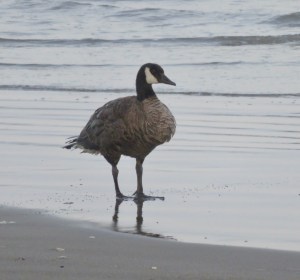
Canada goose all alone just north of the creek this morning.

We see the gulls and lately pelicans fishing low over the surf each day. This morning we saw a solitary Canada goose. It is not the first time. There was a goose that hung about Asbury Creek a few years ago. It was there for weeks in the late summer and we hope it eventually flew off. The bird we saw this morning did not seem distressed. We told him he might find companions in Ecola Creek but he was not impressed. Gary insisted it was a young bird, though full size and avoiding the gulls. Continue reading

BEAUTY TOO

fullsizeoutput_139e

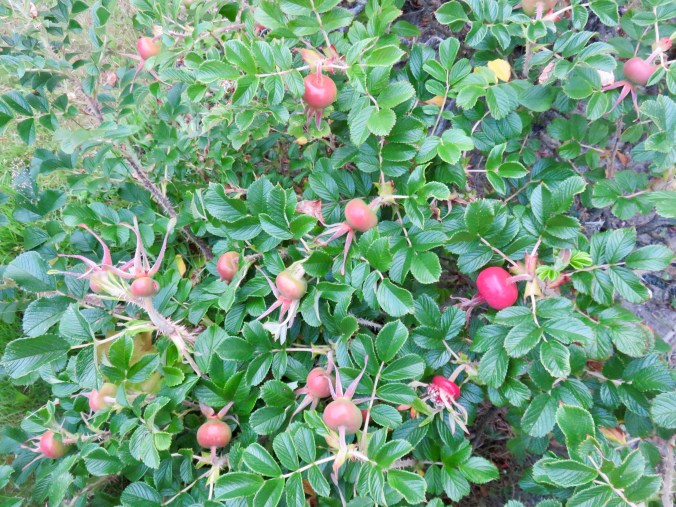
This single-flowing pink rugosa rose has an intoxicating fragrance and set huge apple-red hips. I let the hips set each year hoping to make jelly, but the chipmunk gets them every time.

Two months ago I wrote here about beauty and about the storks nesting in England for the first time in a hundred years. It seems a long time ago.

fullsizeoutput_139b

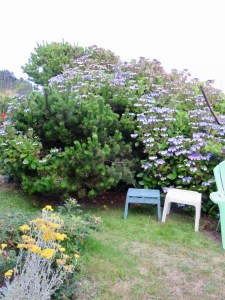
This lacecap hydrangea grows under, around, through, and over the windswept pine in our front yard.

Yesterday, for the first time in over four months, I ate a meal I had not myself cooked. It was a risk and we will not likely do it again any time soon. Most of our favorite places to buy food are closed (Ove NW and Pearl Bakery) or they have demonstrated a certain level of complacence or carelessness. And I am a decent cook and baker myself. Yes, I can bake a cherry pie starting with a hallock of sour cherries if I could get to the Farmers Market to buy them. I was baking sourdough before the pandemic. Usually by this time in the summer I have frozen pesto and huckleberries and the makings of pies. Instead my freezer looks barren. Continue reading

FOG

fullsizeoutput_1397

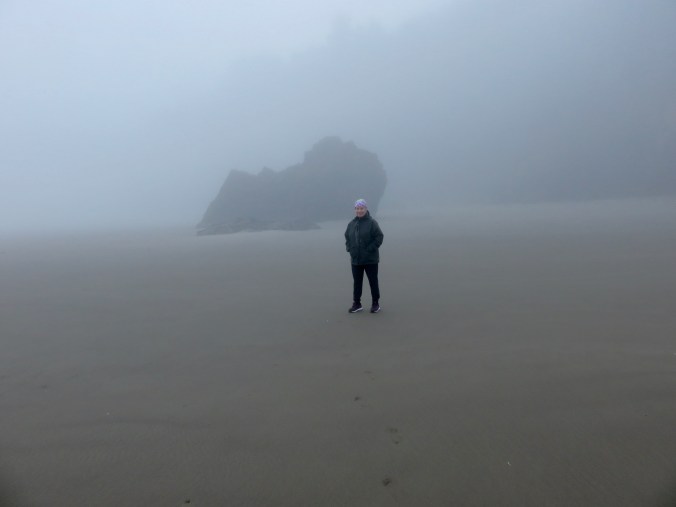
This is me standing well out on the sand before the “turnaround rock”—our one and a half mile marker. (It’s 12-15 feet tall.) Just around Hug Point is our two mile marker. On the highway I still note such mile and half mile markers leftover from my years as a runner. We were out for almost two hours this morning—a good walk.

fullsizeoutput_1391

Arch Cape before 6am.

We are early risers, getting up with the sun and preferring to be out on our walk while the sand is empty of people. This morning we could look south toward the Cape and see fog as if it were moving onshore. There was little light in the sky and only the faintest hint of blue because while it was nearly six, the coast range cut off direct sunshine.


We sometimes go an entire summer without fog. This is not one of those summers. Especially when very hot weather is predicted for Portland, we see morning fog. Hot is not our preferred temperature. One thing we both enjoy about living at the coast is cool weather.

fullsizeoutput_1390

Looking north a moment later.

We turned north, which is our usual direction and for the next two miles, the fog thickened and we crossed and recrossed the tracks of a canid, likely a coyote. When Gary walked over to check out a “campsite” of logs and abandoned beach fire, the animal had already circled the same ground.


If I can look straight up into the sky and see faint azure, I know the whiteness will burn off and it might even become what we consider too warm by early afternoon. When the fog is very heavy, even on a day where sunshine will win out, it is possible to walk on the sand midway between surf and land and see neither wave nor house. The world becomes a mysterious and beautiful magic land of white.

fullsizeoutput_1393

Hug Point beach seastack reflected in a tide pool.

Sometimes we could not see what was just before or beside us until a seastack would loom out of the mist. We might have no clear idea where we were at all until we came to a familiar creek or bluff.


We found a couple of shells, and we spotted a live crab, a rabbit, tiny shrimp. The oystercatcher did not even bother to feign injury in order to lure us away from her nest. The babies were safe in the fog.

We were able to walk on sand all the way around Hug Point, which is unusual, but by then it was going on toward seven and other people had the same idea about enjoying the still, foggy day. On our way home, as we turned inland around Asbury Creek, we met a family of four, they stood aside for us, keeping distance. Then we stood aside so that they could pass us. Good morning! Good morning! We never got closer than ten or fifteen feet, but it was a cheerful and respectful passing.

We wished one another a good day.

And it was.

IMG_6503

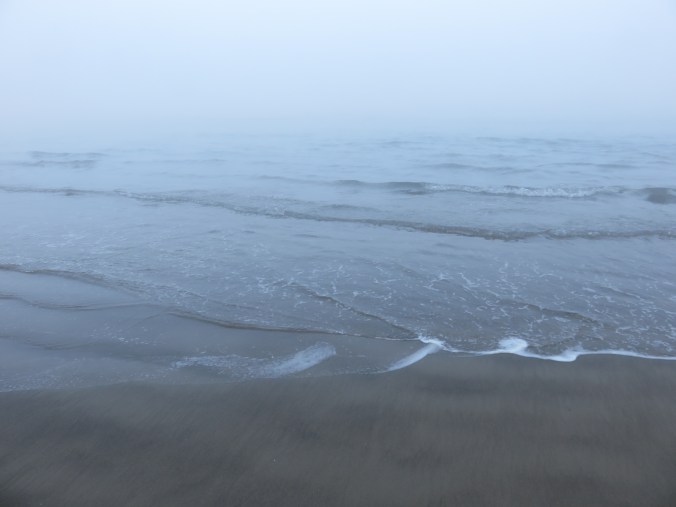
The border between sea and sky is often blurred on the horizon. This morning that boundary disappeared entirely just a few feet offshore. And walking a few feet further inshore, this line of waves vanished.

fullsizeoutput_138c

Looking east it is possible to see the silhouette of the headland high up where the fog thins.


THE GOOD OPTION

IMG_6308

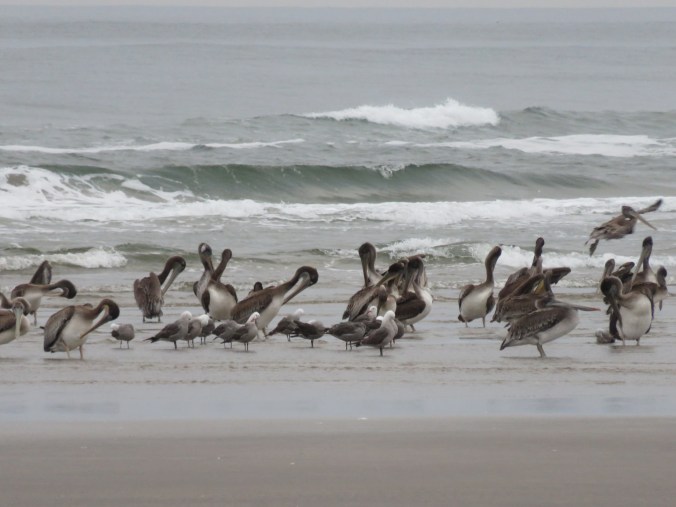
Brown pelicans and probably Heermann’s gulls, which we see in summer. The raven babies are full size but still begging from their parents.

How do you stop the hurt
of having to breathe?

—Toi Derricotte
from The Telly Poems

“His father would say, ‘You are not good for your own sake. That probably isn’t even possible. You are good as a courtesy to everyone around you. Keeping a promise or breaking it, telling the truth or lying—these things matter to those around you. So there is good you can do and can always do again. You do not have to believe you are good in order to act well in any specific case. You never lose that option.’ ”—Marilyn Robinson


#NotMyChild


POSSIBLE

iu

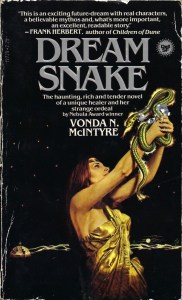
The novelette “Of Mist and Grass and Sand” was expanded into the novel, Dreamsnake (1978), winning the 1979 Hugo Award, the 1978 Nebula Award, and the 1979 Locus Award. This is the cover of the copy I first read and not representative of the story at all.

In addition to classes called “What If” about speculative fiction and “Utopia and Dream” about idealistic societies both real and imagined, I taught genre fiction to my sophomores and juniors. Science fiction, fantasy, mystery . . . I found short story examples and we read and discussed the expected tropes and the real-life satisfactions, explorations, and potentials of each.


One story I enjoyed teaching was “Of Mist and Grass and Sand” by Vonda N. McIntyre, which I first read in editor Pamela Sargent’s collection, Women of Wonder (1975). Continue reading

ANNIVERSARY

IMG_6229.jpeg

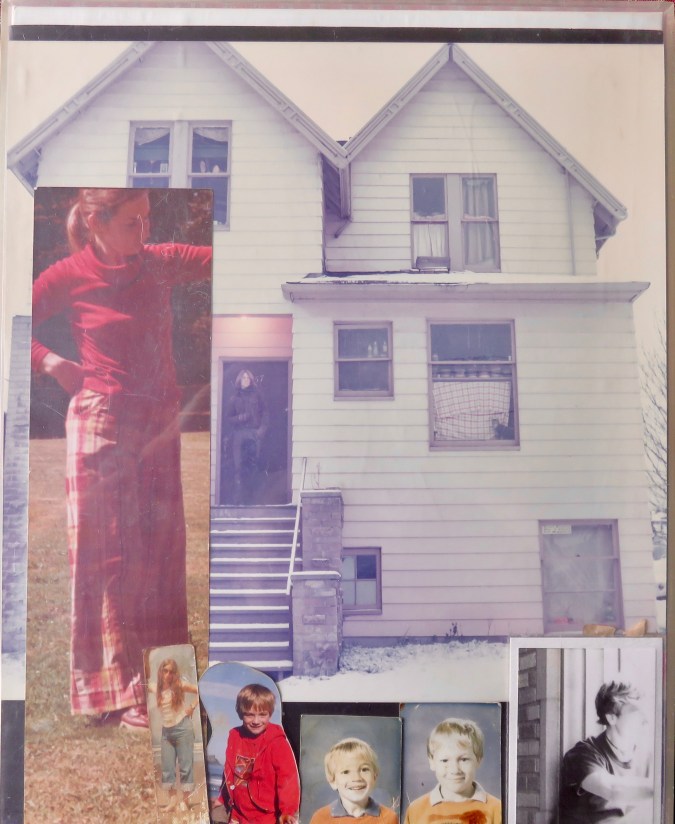
Gary’s photo collage: That is me at left in early 1977 (the part I cut from a photo of Manny), another of me on the beach at about the same time (also a trimming from the important photo of a dog). Then Ian in red, Ian, Alan and Alan as a teenager. Behind these snaps is the faded photo of Gary standing in the main entrance to “Big Pink” with Ann Ann, our first Afghan Hound (she was black and so is hard to see—she always was). Our cat Rabbit is in the kitchen window at right. Herbs and geraniums are in the pots lined above her.

There had been drug dealers and prostitutes and a “witch” living there. The police would come for Debbie when she had a drug-overdose-triggered “complete psychotic break” and the FBI to investigate number 12, where a member of the Weather Underground had stayed. Rent was cheap and the location just up the street from the Blue Moon Tavern where Gary would always find change dropped on the ground in the parking lot at back. More important, the building was only a few blocks west of The Ave and the University of Washington campus, which guaranteed it was always fully occupied.

Today is not our wedding anniversary, which will be next month, but is still an important anniversary for Gary and me. In 1972 we moved together into a tiny apartment in a notorious building in the University District of Seattle. Continue reading

PROTECT and SERVE

xUBQP-o4.jpeg

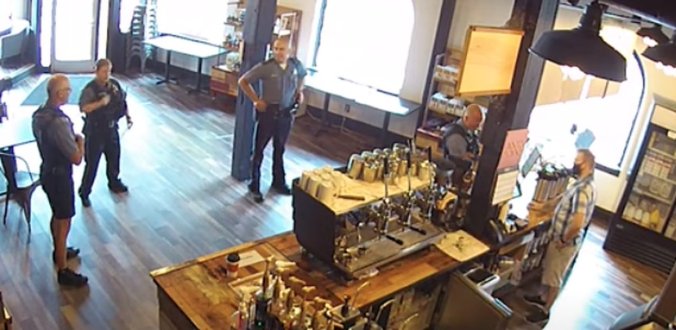
PORTLAND, Ore. (KOIN + Oregon Live) — Four Oregon State Police troopers went into a Corvallis coffee shop without wearing a mask, which prompted the OSP superintendent to put at least one of them on administrative leave during the investigation. [The state has mandated masks for everyone inside public places as a way to stem the growth of coronavirus in Oregon.] Continue reading

HAPPY CANADA DAY

610d0e1f-2477-4010-acb9-5715701fc223.jpg

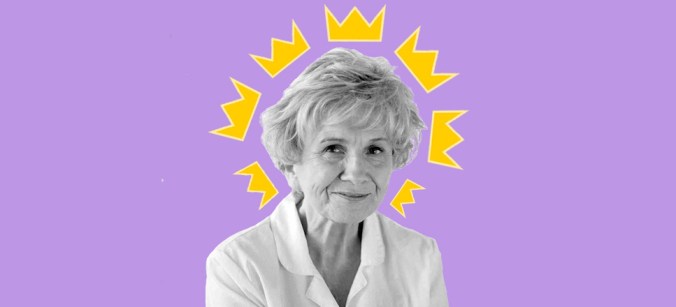
In the second and third terms of my MFA program in 2006, I wrote my critical essay about Canadian writer and Nobel Laureate Alice Munro. My first drafts discussed several of her stories and my essay ballooned past forty pages, but the final version was just over thirty pages, the maximum I was allowed, and focussed on just one work: Munro’s transgressive short story “Meneseteung” (1990). Continue reading