An imperturbable demeanor comes from perfect patience. Quiet minds cannot be perplexed or frightened, but go on in fortune and misfortune at their own private pace like a clock during a thunderstorm.—Robert Louis Stevenson
“I’m not being facetious or anything, but I think I’ve never said this before: for a dyed-in-the-wool feminist, you know a lot about traditional ‘women’s work’.” Gary had just asked me how a damask tablecloth should be washed and so I told him. (The key is pressing it after washing with a very hot iron while it’s still wet.)
I’ve had this engraving of a sea otter, probably since high school. Now framed, it hangs in our condo. It occurred to me only the other day that I have my own pen and ink drawings and gouache paintings that I might hang.
Many women of my generation, eager to embrace a life unbound from traditional women’s roles, rejected those skills traditionally acquired by housewives. They chose career over homemaking, and actively avoided cookery and sewing and other domestic arts.
Yesterday morning the serious rains began and we were both soaked by the time we got home from our walk. Thunder was impressive by the time we went to bed, though we did not often see the lightning.
RATTLE is a poetry journal that emails poetry each morning, including a weekly response to a current event. Today, I received a form poem that made me sit up and feel. What follows is the mother’s explanation of where her words were birthed and a link to the poem.
I assumed that a year was precisely 52 weeks, but had never done the math. That is odd for a lot of reasons, mostly because I was always good at arithmetic and algebra and geometry etc. I worked figures in my head back when I was running regularly in my 40s and 50s. Anyway, I created a calendar and realized that a year is more than 52 weeks. Add two days and a third during leap year.
The weather is changing. We have been grateful for rain, for cooling temperatures, and colorful leaves on our longer drives. Because nearly all my life has involved beginning school in the fall, this is the season for something new.
A year ago today, I decided to take charge of my daily habits, eat a better diet, lose weight, stop wasting food, and live a more physically active daily life. I was retired and so had time to devote to taking better care of myself, covid had forced me to shop less often and pay more attention to food in my fridge and on my pantry shelves, my Body Mass Index put me in the “overweight” category which was a risk factor for covid I could do something about (unlike my age), and I had begun winding down an intense creative production. I needed a new focus.
Three other events impressed me, one from personal experience and two from “authority” figures. When sitting and watching television, my fat pressed so hard into my belly that I sometimes experienced cramps and that seemed scary. An article suggested that humans need to fast for at least ten hours overnight to rest our digestion and that made a lot of sense to me. And Samantha Bee announced on her show (which I love) that “diets don’t work!” Well, of course they do, I thought. Nothing motivates me like a good argument. I had lost weight without trying during cross country season when I was often too tired to eat when I got home from a long day and when grief stopped me eating after my mother died.
And then I thought more about what both Bee was saying and my own experience of deliberately and successfully dieting after childbirth. The trouble with dieting is that what most people regard as “a diet” is something to do to lose (or gain) weight and then they return to the poor habits they had before. Surprise! They end up back where they started.
I needed a permanent change.
Usually Gary spots eagles after hearing them first. This one hadn’t made a sound. She was watching crows consume a dead bird. Maybe she’d already feasted, maybe it would be her turn next.
I would weigh myself every day, I would expect my weight to fluctuate, but I would track the same day of the week as the one that “counted.” I would meticulously count and cut calories, but allow for higher calorie days since that is actually helpful to maintaining a normal metabolism. Since I began on a Friday, the date that mattered would be the last day of seven, Thursdays. Over the past year my weight was stable 3 weeks, I gained weight by the end of 11 weeks, and for the other 38 weeks, I lost. Sometimes I lost a couple ounces, sometimes a pound.
I set up a chart on my computer to track what I ate each day. This was not merely a diet, but my intention to radically reform my eating habits: more vegetables and fruits, regular mealtimes, only occasional no- or low-calorie snacks. I set up a sample weekly menu (that I referred to less and less, whenever I was stuck about what to make for meals) and typical lo-cal meals, goal weight, and overall aspirations, appointments, and accomplishments—first to be “Normal Weight” according to my Body Mass Index, then to achieve my prior ideal weight during cross country season. I was in it for the long haul, and assumed it would take me at least a year to get where I wanted to be.
The chart grew more complicated as I went along. I added tracking for minutes and then miles I walked and where I went. Later I added miles run. I tracked my vitamin D and calcium. I tracked the days I went to the post office for my mail (once or twice a week) and grocery shopping (every three weeks). I measured myself so that I would know when I had a waist under 31″ because that’s supposed to be healthier for me. I regained a sense of limited control over my body and health.
My BMI is under 21,
I lost 40 pounds,
my waist measures 29″ and my hips are under 37″,
old favorite clothing stashed in a bin now fits (items I never expected to wear again but kept for their fabrics),
new LL Bean petite 6 jeans fit (in my youth, before size inflation, my measurements would have made me a size 9/10, and size 2 did not even exist),
I walk about 25 miles each week, and
I can run every other day.
A week ago I ran (most of) a 5k. I had not actually ever expected to run again, but when I hit my old cross country weight I began running short distances in June, hoping to achieve a mile, and gradually built to a couple of miles. The nearest Park Run 5k had rolling hills, but I only walked about a half mile of the 3.1 miles. My time was five or six minutes slower than what I could manage twenty years ago. That’s probably good news, but I have begun training on hills—short distances. So far, so good. My long range goal is to run an entire 5k after my 70th birthday in October of next year. Slow is okay.
Right at the end of my 5k in Hillsboro last weekend. Yeah, I was tired!
I might lose another 4 pounds or settle on the weight I am now. I know how to eat better while including treats, including ice cream (rarely and a half-cup at a time instead of an entire pint) and pie and cake and popcorn with butter (again, not so often and not as much as I used to eat). I eat what I know is enough instead of until I feel full—since it takes a long time for the brain to catch up and signal “full” and eating lunch at school for nearly all my life taught me to eat too fast. I do not feel discouraged if my weight abruptly pops up a pound or two—salted popcorn will do that, but it’s temporary. Feeling hungry might actually mean I am only thirsty or bored—I can live with that for a few hours before bedtime. I get to eat sourdough waffles (or toast with peanut butter or homemade granola) for breakfast. And I am breaking my fast each morning, because while I might eat 11 almonds as a snack before my morning walk, I do not breakfast until after I get home, lunch (my biggest meal) is around noon, and dinner (usually salad or roasted veg) is around five. If I snack beyond that, it’s tea or iced coffee with milk, 1% fat.
During our last-day-of-summer walk, I found limpets and agates, two pieces of seaglass, and a large hunk of Mt. St. Helens pumice!
The upshot? The trauma in our country and the world is completely beyond my comprehension or control, but I can behave mindfully in my own actions and choices. I feel physically better and I have regained healthy habits at a time in my life and because of covid where I felt the need to exercise such control. I am not in denial about my age, but am delighted at how much I can manage. (I nap.)
This morning I ran two miles on highway hills, more up than down since I ran up to the highway, to the top of the headland north, and then rolling hills past my marker, and back to walk down through the steep Hug Point parking lot. I found a machete in the ditch alongside the highway and carried it carefully all the way home. It needs cleaning and sharpening, but I am the person to do that.
Without meaning to brag (yet I know I’m bragging), the past year has proven a lot to me. I am proud of myself; I am both hopeful and grateful. I want to prove Samantha Bee wrong by maintaining this progress, by finding a healthy maintenance and maintaining as long as I can.
Responsibility or do I mean guilt? How I suffer for my mistakes. Regret. The I-shoulds or merely owning-up? I second guess myself a lot. I question my own motives and spend more time doubting myself than feeling confident I have done the right thing. I mean to be fair. I hope to be kind. Always. I move the tide-stranded crab back to water.
This little crab was only a couple of inches across and we had never seen one this color before. It did not like us hovering near, but raised its tiny claws in self defense. Life wants to continue. Continue reading →
It’s been many years since I took a class from Ursula K. Le Guin and in one of them she talked about the Chilean poet Gabriela Mistral. She was incensed at how little work of hers was available in English. After all, Mistral was a Nobel laureate, and her work was important. Le Guin had majored in French in college, but over the years she indulged in translation. (I taught a speech from one of essay collections called “Hunger” from a speech she delivered to a fundraiser-luncheon. In it she translated a poem from the Spanish by Pablo Neruda. Students struggled sometimes with Le Guin’s short speech, even to identifying the main idea, which was hunger, as set up immediately by the title.) She determined to study Spanish to do justice to Mistral. Other readers will judge how well she managed to maintain the music and meaning of this poem.
NOTE: On the Poets.org website, the translation is listed before Mistral’s words. I have placed the original Spanish first.
La Contadora (The Teller of Tales)
     by Gabriela Mistral
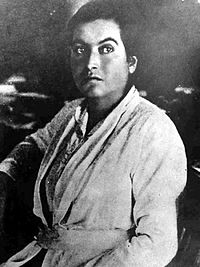
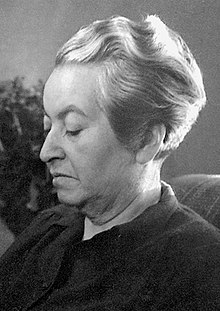
The Chilean poet, Gabriela Mistral, also known as Lucila Godoy y Alcayaga (1889-1957), was the first Latin-American writer to receive the Nobel Prize in Literature (1945). Born to a family of teachers, she mentored Pablo Neruda who would also with the Nobel. Unlike him, however, not enough of her work existed in translation to English. (A bi-lingual edition by Doris Dana published in 1971, 272 pages, and some translations by Langston Hughes.) Ursula K. Le Guin studied Spanish in order to change that.
As a younger woman
Mistral may be most widely quoted in English for Su Nombre es Hoy (His Name is Today):
We are guilty of many errors and many faults, but our worst crime is abandoning the children, neglecting the fountain of life. Many of the things we need can wait. The child cannot. Right now is the time his bones are being formed, his blood is being made, and his senses are being developed. To him we cannot answer ‘Tomorrow,’ his name is today.
This is the largest “sea nettle” I have ever seen, dwarfing Gary’s size 13 shoes. It was at least 28″ across—Gary said three feet.
We’ve been busy hustling back and forth, walking our 25 miles a week (and me running a few of those), working on our second home, and admiring everything we see.




 IMPERFECT PATIENCE