An imperturbable demeanor comes from perfect patience. Quiet minds cannot be perplexed or frightened, but go on in fortune and misfortune at their own private pace like a clock during a thunderstorm.—Robert Louis Stevenson
We Met a Deer

 We met a deer beside the wooded trail
 over the cape and east of the highway.
 I used to walk that way with my boys
 when they were young and eager.
 It is a long walk for a five year old.
 Miles away.

 Was it even possible to walk home
 the way we’d come? We never did.
 We returned north on the highway
 and through the tunnel, a scary path
 for any age. By then we were exhilarated,
 high on adventure and adrenaline, and eager
 to get home.

 The deer was afraid in her forest. She stood
 silent, still, breathing the same air we held
 in our chests. She willed us not to see.
 We stood still, silent, on the narrow trail
 above her. We watched, holding breath.
 We had been climbing for only a short time,
 up the north slope among alder trees,
 a lighter green than the spruce and hemlock
 we would find higher still.

 There is no leveling off
 on that early path,
 it is all up, then steeply down,
 always up on the right
 as we climb. Moss, ferns, mud,
 the dripping moisture.
 Then the Dark Fortress.
 Here at the crest, the land
 slopes steeply downhill
 on our right. Dry. The path
 nearly level. Evergreens
 grow darkly close together,
 like a crowd of giants’ legs,
 like a maze of massive pillars
 grown black and silent.
 We are near the ocean,
 a hundred meters above
 the highway, but while we stand
 and listen, we hear nothing.
 The ground is thirsty here
 and deep in duff, the dead
 needles of the spruce
 and hemlock trees, dropped
 a thousand million times,
 over a thousand seasons.
 Silent.

 The deer stood silent as if
 her stillness might make her safe.

 And then she turned her head,
 was gone.

 We moved on ourselves. We climbed
 and counted mushrooms. We walked up
 and up and up past creeks and perching birds
 and then through darkness, quiet,
 and finally down and down and down
 and through young alders to pavement
 again. We had listened for the highway,
 for the ocean, for the sound
 of our own footsteps, my little boys
 and me. Everything so still
 and far away. Quiet,

 until we are safe at home, and all
 our chatter and heat returns.
 Milk and brownies as reward
 for our long walk. “And we saw
 a deer,” they say.

 It was years ago. Perhaps my boys
 would not recall that day.
 They are grown men and too far away
 for me to ask.
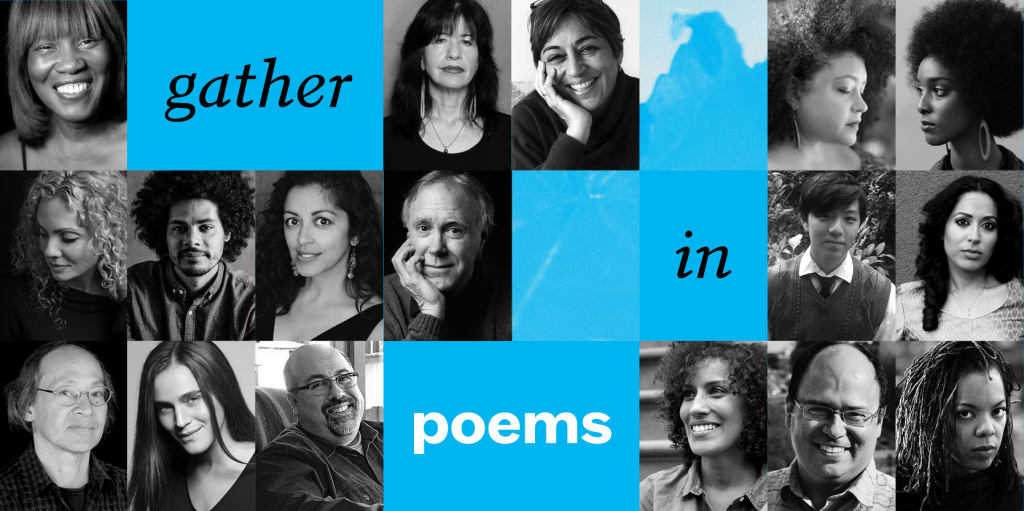
The Academy of American Poets offered an event of poets reading their favorite poems by other poets. Joy Harjo hosted the hour and over four thousand people logged on the hear them live. You can listen my clicking the link in the caption. The meme above is merely a screenshot.
Without Poetry, we lose our way.
—Joy Harjo, U.S. Poet Laureate & Academy of American Poets Chancellor (2019– )
Spring Morning

When it is cold enough at night,
spring's strawberries are sweeter
in the morning.

In the morning I woke before
the sun blushed all across
east and west, a gathering

warmth slid around the Cape
and over Tillamook Head.
Before hard day pushed past,

pink dawn had trailed her fingers
all round the sky. In the morning
I bent to berries'

green tipping over into red.
In that morning, red juice
ran down his chin.
•
Even though I’ve already made the herbed dressing, wild rice and mushroom casserole, twice baked potatoes, cranberry bread, pumpkin pie, I still have to make the Waldorf salad and roast the Brussels sprouts. I bought a wild fillet of sockeye salmon. We will eat flesh this day, our only seafood or meat of the year. I will pan-poach with lemon, garlic, butter, and wine. Or maybe with soy sauce, ginger, toasted sesame oil, and garlic . . . Gary seems to find it funny.
Anyway, I prepared most of this post a couple of days in advance because I didn’t want to be too busy. The holiday cards are all addressed to go out on Monday. I mean to slip handwritten notes into a couple of them. (I always mean to do that and never do.) A few gifts going to people far away are waiting to be wrapped and boxed for mailing. On Sunday I deliver a dozen shawls to the gallery in Manzanita. We have not driven there even once this year!
This morning I found an email from a small yarn company that has gone completely, and successfully, online this year. They offered a long list of of thank-yous to many specific people. The list ended with thanking their customers, like me. But it was the first block of thank-yous that led me to save the email in my covid folder: “Thank you to our fellow taxpayers, Congress, the SBA, and Columbia Bank for loans and grants. Thanks to Washington State for health safety cautions and unemployment benefits, and to the Kitsap Economic Development Council for weekly seminars on how to cope with COVID.” They are optimistic about their future. “Because of you, we are back on our feet, getting stronger, and feeling more determined than ever to make this a 100-year company. Only 80 more years to go.”
Well, I feel gratitude too. Thank you here to a great many people who read my blog, who respond to particular posts, ideas, and questions.
Most of the people I have known in my life have given me something good to keep. Just among my teachers I treasure studio skills and experiences from Del Hansen and Bob Gee when I was still a girl, and thoughtful perspective from Darlene Sherrick and James May, and serious artistic growth with Patti Warashina and “Jack” Marshall and Howard Kottler. They changed my life. Sherrick chose me for Honors History. Harriet Koenig stepped in three times to turn my life: a Design class, a conference, my first teaching job. Thank you.
You are probably avoiding the news, but an architect designed a prank Trump website, and this page is my favorite: https://djtrumplibrary.com/portfolio-item/tax Happy Thanksgiving! Humor is back!
In the 1980s and 90s, we hosted an Open House on the Sunday before Christmas. For weeks I would make and freeze holiday cakes and appetizers. We cleaned house and invited neighbors, co-workers, and friends. No alcohol was served, which is probably why nothing awful ever happened. Well, there was the incident with the dog . . .
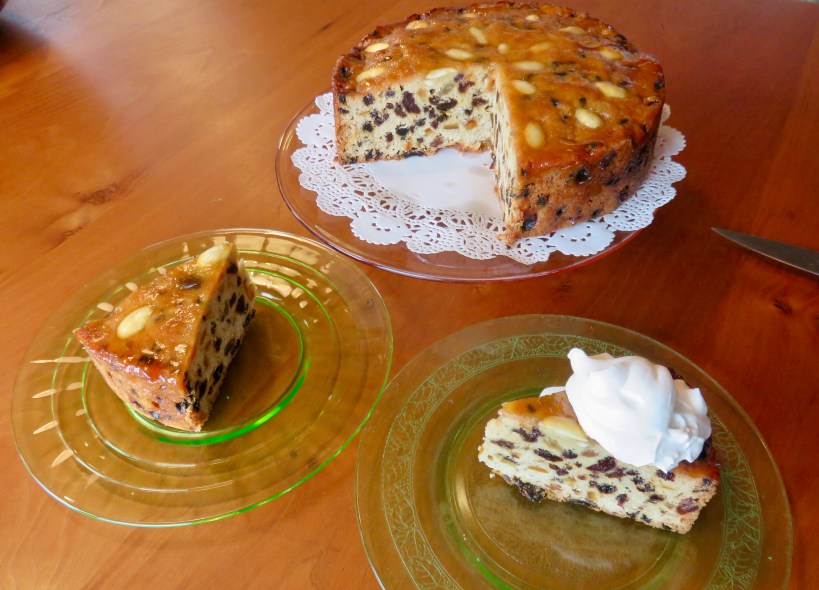
A full-size Dundee Cake from another year, served with whipped cream
We stopped throwing these parties after the year both my brother and mother failed to attend. It seemed sad to work so hard if my local family couldn’t be bothered.
But I am retired now and I love any excuse to bake. We had talked about reigniting the tradition this year, but then, you know, this pandemic.
No gatherings here or in Portland for Thanksgiving. The up side of this is that I do not have to avoid the foods people do not or cannot eat. I can cook with gluten, eggs, dairy, nuts. I could make my spiced carrots. My pumpkin pie can include cream. There was an article in The New York Times this week about traveling and arriving exhausted and still having to cook, about adjusting to individuals’ preferences and dietary needs, and about having to eat multiple Thanksgiving feasts with each partner’s family. (Gary and I did that until we moved to Oregon.) Apparently other women have found the same silver lining. Less work, less stress when it’s just the two of you. Articles have acknowledged that holiday expectations are especially hard on women, and offered all sorts of suggestions about easing into a lockdown Thanksgiving: cook everything but in smaller amounts for two, cook the one thing you like best, cook nothing and order take-out, or reheat something frozen or just drink.
My solution was different. I am cooking a complete meal in easy stages. One dish a day. I made the wild rice and mushroom casserole a few days ago and we’ve eaten half of it. The rest is for tomorrow. I made twice-baked potatoes with cheese, and we’ve sampled that too. Yesterday I made my regular vegetarian herbed dressing using my own sourdough bread cubes (thank you again, Mary Jo and Dale), celery, onion, parsley, herbs from the garden, homemade stock, and cranberries. We had some of that for dinner last night. I might bake two loaves of cranberry bread this afternoon, but at least the pumpkin pie. (The Delicata squash I am using for the filling was roasted and puréed earlier too.) The trick will be keeping Gary out of the pie—pumpkin pie is the holiday dish he’s most fond of.
Stretching out the Thanksgiving feast preparation has been relaxing. I enjoy cooking, but it’s a lot of work for just one meal. We have enjoyed the Startbefores even more than the Leftovers in past years. It means that tomorrow I will make the apple salad with dates and walnuts first thing in the morning and we’ll have some for breakfast, and later roast Brussels sprouts for the big meal. I only have to reheat everything else.
The next holiday is Hanukah beginning 10 December, and we will burn candles. I was afraid I’d given away all the apricot jam, but after my initial panic, I found there is still one jar for the rugelach.
Then Christmas. The cards are more than half-addressed. I will miss not having Prissy’s wreath on the door, but we have lights and the just-for-show fake tree can go up soon after Thanksgiving. We are not buying a cut tree for the first year ever. (Even during the Big Mess when Gary and I, our two preschool children, and six dogs camped in 500 square feet for nine months including Christmas, we put up a tree.) My collection of clippy glass birds will stay in their boxes. The Swanson-Vance flying animals will hang on the pre-lit white paper “birch” tree from Costco. Just this once.
Another of Gary’s favorites is a Dundee cake, traditional for Boxing Day. My dried fruits—three kinds of raisins, pineapple, mango, and cherries—are soaking in rum as I type this. It only needs freshly grated lemon and orange peel. (I fear it will not be as good as last year when I used Scotch and home-candied orange rind.) There will be no one here to share that rich cake, so I plan to make us a six-inch round, which is still too much for two people.
In recent years our sons and their families have come for Twelfth Night in January. That’s not happening this season either, at least not as a physical get-together.
We are planning Jitsi or Zoom group meetings with family. Gary and I might watch Home for the Holidays, and certainly we will watch When Harry Met Sally. We will not stay up till midnight on New Years Eve—we almost never do. We will manage fine because we have remembered to tell people we love them. They might not be in the room, but there is room in our hearts,
Canadian friends sent us this in appreciation for my photos of the local Cooper’s hawk.
I completed weaving the Olive warp—three distinctly different shawls, none of which read olive and one of which does not read green at all. Now my studio space is a wreck, but if I wrap gifts, bind the last two quilts (and find a place to put the stack of six, and get the most recent one to Linda, which won’t be until January), and invest quality time in sorting and tidying, all will be okay.
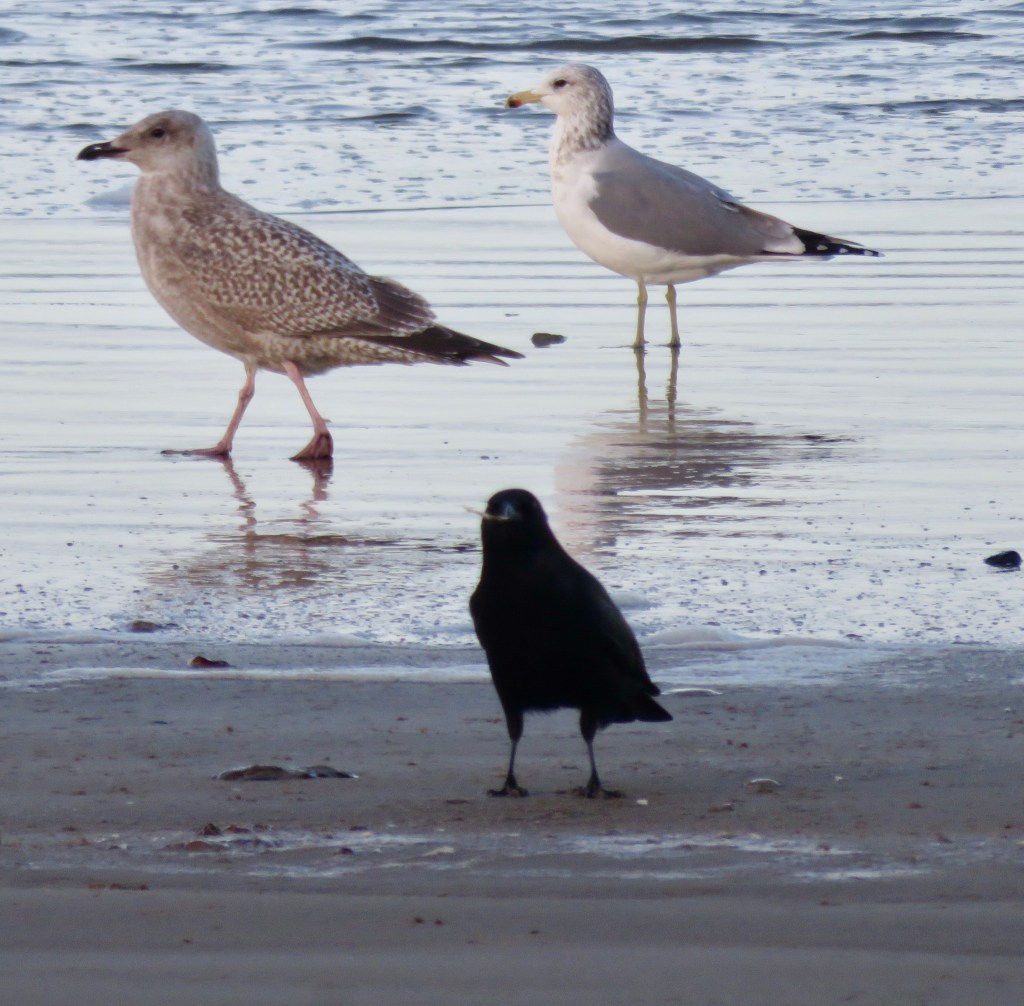
Gary’s upstart crow who hangs out with the gulls at the creek is front and center. Behind is a juvenile and a nearly adult gull. One juvenile gull is still weep-weeping to be fed every morning as we walk north.
Rebecca Solnit has a new essay about the false-fairness strategy of trying to meet bigoted, science-denying, narrow, and Trump-won-the-election fantasy halfway. “On Not Meeting Nazis Halfway: Why Is It So Hard for Democrats to Act Like They Actually Won?” Patience and kindness are one thing; pretending that we can find reasonable compromise with a dangerous minority, maybe not so much. Especially since only the left—the majority that won the White House—even tries.
There is no reasonable halfway between truth and bogus claims. We should stop pretending that there is such a place. Sometimes, however much some people want believe it, a lie is just a lie.
(I used to think that accusations of “Nazi” were overblown and unfair. Then I paid more attention to the signs, actions, and words of Proud Boys and other white supremacist groups. Are cries of “Nazi” unreasonable? No, they aren’t.)
Supreme Court Justice Samuel Alito just complained that “you can’t say that marriage is a union between one man and one woman. Now it’s considered bigotry.” This is a standard complaint of the right: the real victim is the racist who has been called a racist, not the victim of his racism, the real oppression is to be impeded in your freedom to oppress. And of course Alito is disingenuous; you can say that stuff against marriage equality (and he did). Then other people can call you a bigot, because they get to have opinions too, but in his scheme such dissent is intolerable, which is fun coming from a member of the party whose devotees wore “fuck your feelings” shirts at its rallies and popularized the term “snowflake.”
Nevertheless, we get this hopelessly naïve version of centrism, of the idea that if we’re nicer to the other side there will be no other side, just one big happy family. This inanity is also applied to the questions of belief and fact and principle, with some muddled cocktail of moral relativism and therapists’ “everyone’s feelings are valid” applied to everything. But the truth is not some compromise halfway between the truth and the lie, the fact and the delusion, the scientists and the propagandists. And the ethical is not halfway between white supremacists and human rights activists, rapists and feminists, synagogue massacrists and Jews, xenophobes and immigrants, delusional transphobes and trans people. Who the hell wants unity with Nazis until and unless they stop being Nazis?
It is worse to be racist than to be called a racist. It is worse to be a misogynist than to be called out for sexism. It is worse to experience bigotry than to point a finger at the persons doing the oppressing. And climate change is happening whether we want to admit it or not. Truth is truth; fact is fact.
It’s a simple concept.
In the mean time, the State of Oregon has forbidden meetings of more than six people and two households and forbidden unnecessary travel, particularly out of state. There are five cars with out-of-state plates and more than ten people in the rental north of us. The last time I contacted the owners directly, they called me an f—ing b—. (Except that it was said many times without euphemism. Even after I tried to be “nice.”) The last time I went directly to the people offending (big beach fire during a high fire-danger burn ban) I got chewed out over the phone for that too. (From my point of view it was their job to apologize to me for failing to run their business according to law regarding short term rentals in my residential neighborhood.) I’ll get in trouble for complaining to the source.
But should I do as I was told: “shut up and go in your house” and pretend that this is okay? That they have a reasonable position that I should try to understand? Unless I want to be threatened, I should be quiet because their money trumps my community? I should pretend that laws apply only to other people rather than to them and only when those laws are convenient, because since they are Americans and do not consider themselves criminals, they get to do whatever they like?
Is that any way to live? Or is it just another lie of convenience and elitism over fact?
But I am not alone in my confusion.
“We [historians] pride ourselves in saying, ‘Don’t worry, this has happened before,’ or, ‘Worry, this has happened before,’ ” said Jeffrey A. Engel, the founding director of the Center for Presidential History at Southern Methodist University. “Right now, if all your historians can say is, ‘We are in entirely uncharted waters,’ I don’t even know how the rest of that sentence ends.”
If you, like me, cried every time you watched the brilliant video of “How to Be Alone,” there’s more. But in case you haven’t, here is that video collaboration between poet Tanya Davis and filmmaker Andrea Dorfman, the one I shared with students more than ten years ago.
Maybe I’m an easy crier, but this one does it every time. So does the new one. Good cries.
Gary and I went out for a quick walk this morning. Then Gary came in because he was expecting the exterminator and a plumber. He’d worked on the kitchen sink for several hours without unplugging it. He used the plunger marked “sink” and removed the trap. No luck. Somehow this has been a crazy year for all sorts of reasons. Months ago a friend said the pandemic was only an inconvenience for us, but Gary and I know people who have been sick and who have died, so while we are not essential workers facing contagion every day (more praise to those brave souls) and we do not actually suffer under lockdown—we have one another, we have our walks, and we are retired—it feels like something more than an “inconvenience.”
We have ordered one take-out meal since March (and not again—too much trust and people who eat restaurant meals are statistically more likely to become sick), we have been to Portland three times (once for a root canal, once to deliver something, and once to pick up a painting), shop for groceries every two or three weeks, and we pick up our mail only every few days. I do not miss movies in theaters, despite the Big Screen. (And Queen’s Gambit on Netflix surprised me by proving better than any theatrical movie I have seen in the past few years.)
Most of what is missing is not missed. But there are gaps. I miss live events. I miss actual people. I miss visiting my old high school and the teachers, who would be in a new building on a fancy new campus but local schools are virtual. I miss the Farmers’ markets and shopping in stores and hugging my grandchildren and eating chili rellenos from The Stand. I have not seen my brother in thirteen years. I miss him sometimes, but he is completely out of contact. Loved ones are divorcing and in therapy—the therapist says there have been a lot of separations during the pandemic, that it is “not uncommon these days.”
But the cards we ordered last month say “joyful” on the front and we have reasons to feel joyful.
Our family is all well, our closest friends are well, friends who are working are mostly doing it virtually and staying healthy. My friend in cancer treatment has completed treatment, her health outlook is excellent, and she has enough hair to brush! We have been able to afford the unusual bills from exterminators, plumbers, electricians, and so forth. We paid our property taxes from our checking account, which held an obscene amount of money because we did not go anywhere or spend money on anything for most of the past nine months. The paintings—those extravagant and out-of-character expenses—are a pleasure and not a regret. They are a glancing vacation each time I pass them. We are lucky that the house is large enough to allow us to spend time away from one another, and even more lucky for our morning walks and evenings together. We have accomplished several major tasks—Gary fixed the drainage on the south edge of the property (a huge task) and I completed a ridiculous amount of weaving and piecing. We attended a virtual wedding. I heard from former students. Adrian sat twenty-five feet away from me—both of us masked—and told me about his life.
There are things we cannot do—visit people we love or any other country—but we are fine. An abundance of caution.
My grandmother had a half-full quart jar of black walnut meats in her freezer when she died in 1978. It was still there when we moved into this house in 1979. The jar remained unloved for a few more months—moved to one corner and then another till I needed the freezer space they took up—and then I opened the jar and tasted them. Incredible.
Thanksgiving will be just the two of us, but I ordered two pounds of shelled black walnuts on the internet.
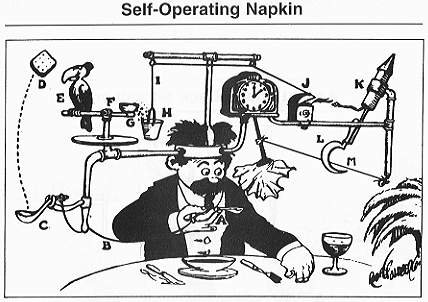
When he was teaching Physics at Seaside High School, my brother held a Rube Goldberg Machine competition for his students. They worked in teams and were given a specific goal to build a machine that did something simple like cut a fruit in half or open a box. That simple process was deliberately and pointedly complicated through over a dozen steps—pulleys, marbles rolling down tracks, things falling over, balloons popping. That’s what Rube Goldberg Machines are supposed to do. It is satire on modern life.
Teams wrote manuals explaining how their machine worked and why. Then they demonstrated their accomplishment for an audience. They were given a couple tries to get the entire string of operations to work properly and chop their fruit or squeeze a lemon. It was a big deal, students, parents, and community members came to watch in the evening, judges ruled, and a member of the Rube Goldberg family handed over the honors to the winners. I do not remember what the prize was, other than bragging rights.
“A Rube Goldberg machine, named after American cartoonist Rube Goldberg, is a machine intentionally designed to perform a simple task in an indirect and overly complicated way. Usually, these machines consist of a series of simple unrelated devices; the action of each triggers the initiation of the next, eventually resulting in achieving a stated goal.”
—Wikipedia
Rube Goldberg’s Professor Butts and the Self-Operating Napkin (1931). Soup spoon (A) is raised to mouth, pulling string (B) and thereby jerking ladle (C), which throws cracker (D) past toucan (E). Toucan jumps after cracker and perch (F) tilts, upsetting seeds (G) into pail (H). Extra weight in pail pulls cord (I), which opens and ignites lighter (J), setting off skyrocket (K), which causes sickle (L) to cut string (M), allowing pendulum with attached napkin to swing back and forth, thereby wiping chin.
This class project involving teams explains why, over the years, I have continued to look for and enjoy Rube Goldberg Machines. My brother was doing this at least thirty years ago. Today, if you search online, you’ll find lots of information about Rube Goldberg Machines and competitions as well as the same thing done under different names in other nations. We all enjoy a pointless effort just for fun.
In the machine below, the goals is to pour glasses of lemonade. At nine minutes, it is incredible, absurdly lengthy, often funny, and the work of a six-person team.
Truly, you do want to watch this. It is ridiculous fun.
The cloud-occluded sky was dove gray and Oregon chalcedony blue. A fragmented break to open sky over the ocean glimmered platinum that swept a reflection across wet sand. I did not have my camera with me, so perhaps you will take my word. It was beautiful.
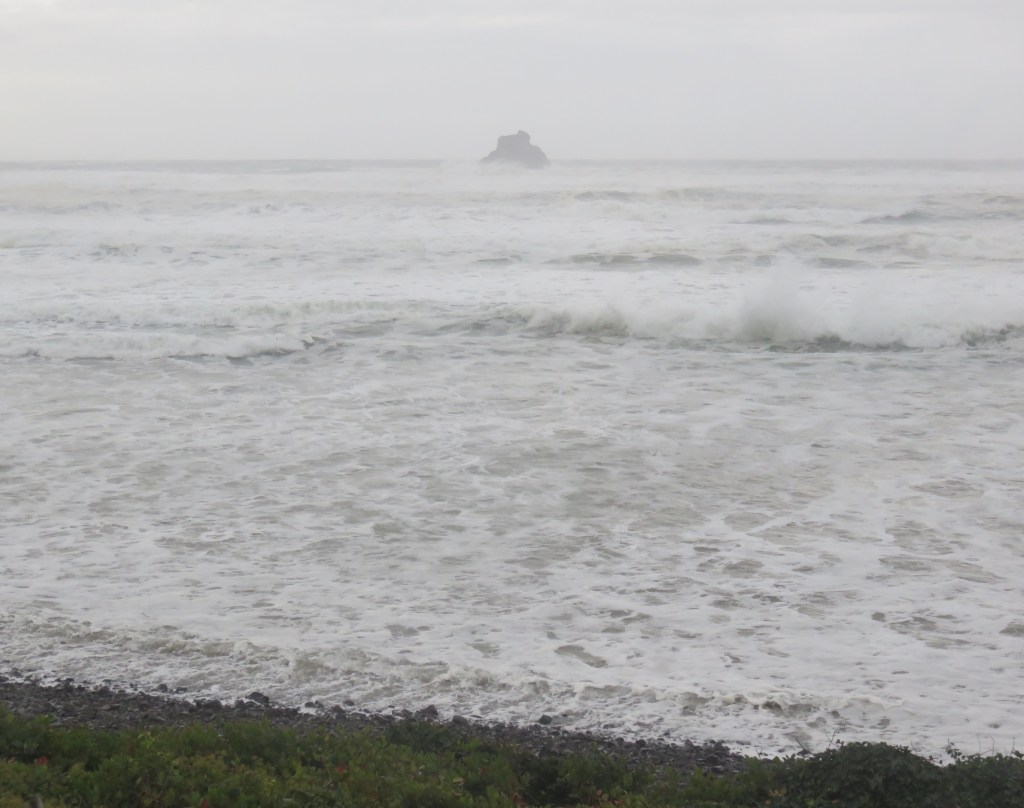
November, the middle of autumn, is like this. We are just home from a walk in a dry gale wind. It was easy walking out north, hard work coming back, our heads bowed into the blow. We had missed our morning walk because of the fierce winds and drenching rain. There was no sand at all, though it was only an hour past low tide. When the weather cleared this afternoon we took our chance. It is the great advantage to retirement, I think. We can go out whenever we like.
Yesterday, we were out early to see what the ten foot tide had left us. We have walked the shore daily for so many years, we recognize rocks, the places where sand shows through, where there is a flat stone, where the rocks are rounded and fine like river gravel.
All is changed. The path Gary built in March is entirely swept away, even the heaviest stones set as steps through the hedge were tossed. They have survived a dozen winters. Water flowed right into our neighbor’s yard, a reminder that house is built over a swamp and creek. The ocean remembers and takes back.
In the spring we pull aside basalt stones lining our shore to create a meandering path to the sand, a task requiring gloves and sometimes metal garden tools. This path is a depressed passage two feet wide through the margin between sand and land. It makes our morning walk down onto the beach easier. Walking over the stones is unsteady and bumptious on the bottoms of our feet. It takes hours or a few days to dig away stones. Sometimes the sand is a few inches under the stones. Sometimes we must dig deep and have to carry sand up to fill the resulting trench. The work is satisfying, traditional. Sometimes a high wave in April will sweep the rocks back into place and we must build the path again. Sometimes it happens again and again and we threaten not to bother rebuilding.
By summer, the sand has begun moving inshore from sandbars beyond the breakers. Most oceanfront homes have built paths through the stones to save their feet. The dry sand is untouched by most high tides, and low tide reveals a hundred yards of clean, hard wet sand. For three decades I ran on that smooth sand surface every other morning if the tide was out far enough to permit me. Now we walk our miles regardless. When I was a girl, sand swept all the way into the green by midsummer. That doesn’t happen any more.
Some of the sand is simply gone.
There has been less sand onshore for so many years, local newspapers don’t even mention it. Twenty years ago they offered several explanations. Most involve happenings far away up or down the coast. Barriers intended to protect harbors shifted the seasonal flow of sand, causing it to pile up. There are condominiums built on shore that did not exist so very long ago. A powerful wave in January of 1999 picked up not only sand, but the rocks themselves. Massive sandstones rolled amid the wet-blackened basalt. Strong waves push the basalt high. Some years there has been a ridge of rock five or even ten feet in the rocks up shore from us. We’d like to trust the seasonal shifts to level things out in summer. There is no counting. The tide is not dependable.
In autumn, sand begins to slide back into the sea. Tide and wind swipe the basalt clean, drive sand into the ocean. Waves seem to rise higher. Low tide gives a narrower strip of wet sand than we saw in August.
It is different all the time. Asbury turns hard right and flows a quarter mile south one day, and a week later it spreads straight west. Gulls rest there.
Everything changes, shifts from one tide to another, one month to the next, and year to year. It is a moveable feast. The people who bought the house north of us to use as a commercial rental asked us: “Where has our sand gone?” the first time they visited in the autumn. We could not help laughing.
Yesterday on our walk, a wave swept in across a hundred yards. We had climbed into the rocks. When an outgoing wave flows back into an oncoming wave there can be a great crash—the sound is starling and water sometimes flies straight up into the air. The so-called “sneaker” waves are silent, and it is the sudden quiet that causes us to run. An incoming wave overtakes a wave also moving in, picking up energy and speed from the one below. Then a third wave over the top of that one. There is no predicting, no pattern. It is a random event.
The main thing is that we are not sick, though we seem to know several people now who have been ill.
Biden and Harris won the election. Trump is sulking and raking in all the money he can. The pandemic has exploded due to small (careless) gatherings. There is a divorce coming in our family (not Gary and me). And last night was stormy. The power went out. Gary made coffee the instant it came back on in the middle of the night. Emailed a former student. Two people from my MFA program reached out. I have lost eleven pounds, gained back two—I expected that my weight would move up and down, but I still hope to reach my goal next June. We gave up seafood this year and that is going well but I am considering a sockeye fillet for our small Thanksgiving. Yesterday I began weaving the third of three shawls on an “Olive” warp.
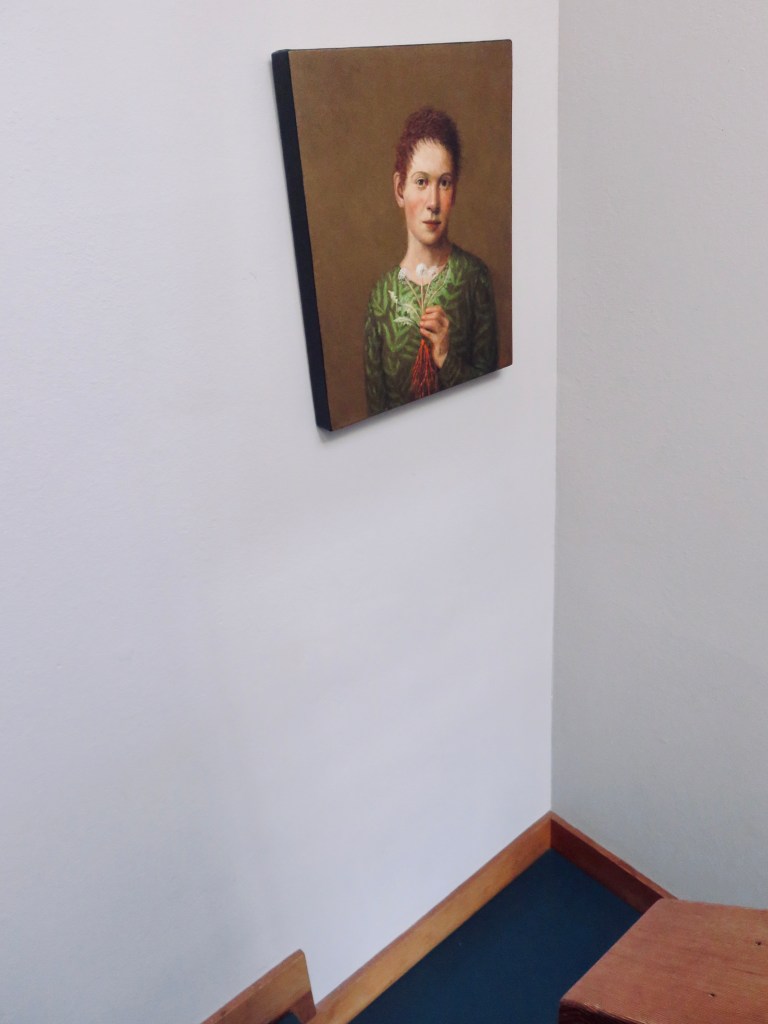
I am on track to read 70 books this year, which was how many I was reading before beginning my MFA in 2005. The Russian doll arrived after three or four months; the painting arrived from Georgia after five months; and I bought another painting because she kept looking at me. She hangs on the landing, visible from up and downstairs. “Weed Gardener” by Katherine Ace (2017).
I found this painting title “The Gardener” on Ace’s website, just “Gardener” on her local gallery’s website, but on the back of the painting it says “Weed Gardener,” so I’m going with that.
Pinterest allowed me to suspend magazine subscriptions. I visit that site to find images and to save images. Sometimes I revisit what I have saved. Mostly I never look at it again, but I preserve the illusion of ownership. Last month I became aware that a number of favorite paintings I had “collected” were all by the same person. These are mostly magical realist pictures, often with birds and women. Women with birds on their heads or a stack of stones. Illustrative paintings of folktale characters. I put “Feather” on my desktop, the only time I have used an image that I had not created myself. Once I went looking it took me only a short time to find the artist’s name and local representative gallery. I had missed a Portland show by a week. I cannot afford the paintings.
“Weed Gardener” looked to me like a self portrait from the Face to Face show. The artist often uses a similar face, but this one felt deliberate—not similar a real person but an actual portrait. I looked at her and looked again, the more I studied her face and the dandelion in her hand, the more I felt she was a cancer survivor with her plushy hair just coming back in. Imagine my lack of surprise to discover the artist lives in Portland and is indeed a cancer survivor. (So is one of my dearest friends.)
That’s why I called Visa to raise my credit limit and we drove to Portland to pick her up from the gallery. (That gallery visit, masked, is another absurd story. Suffice to say, I will not go there again.)
A neighbor has kindly shared her sourdough start, in her family since the 60s. I have sent over rhubarb and apricot jams. She is offering salal, which I did not manage to make this year. We have not actually seen one another in months.
“Yes, sister, sometimes we may be the only one that looks like us walking in that room,” she told a largely Black audience in Fort Worth. “But the thing we all know is we never walk in those rooms alone — we are all in that room together.”
— Senator Kamala Harris of California, who will become the first woman to serve as vice president
from The New York Times: “With her ascension to the vice presidency, Ms. Harris will become the first woman and first woman of color to hold that office, a milestone for a nation in upheaval, grappling with a damaging history of racial injustice exposed, yet again, in a divisive election. Ms. Harris, 56, embodies the future of a country that is growing more racially diverse, even if the person voters picked for the top of the ticket is a 77-year-old white man.”
She is also the hope for our nation, a smart person capable of finding a fair and just path for our collective future.
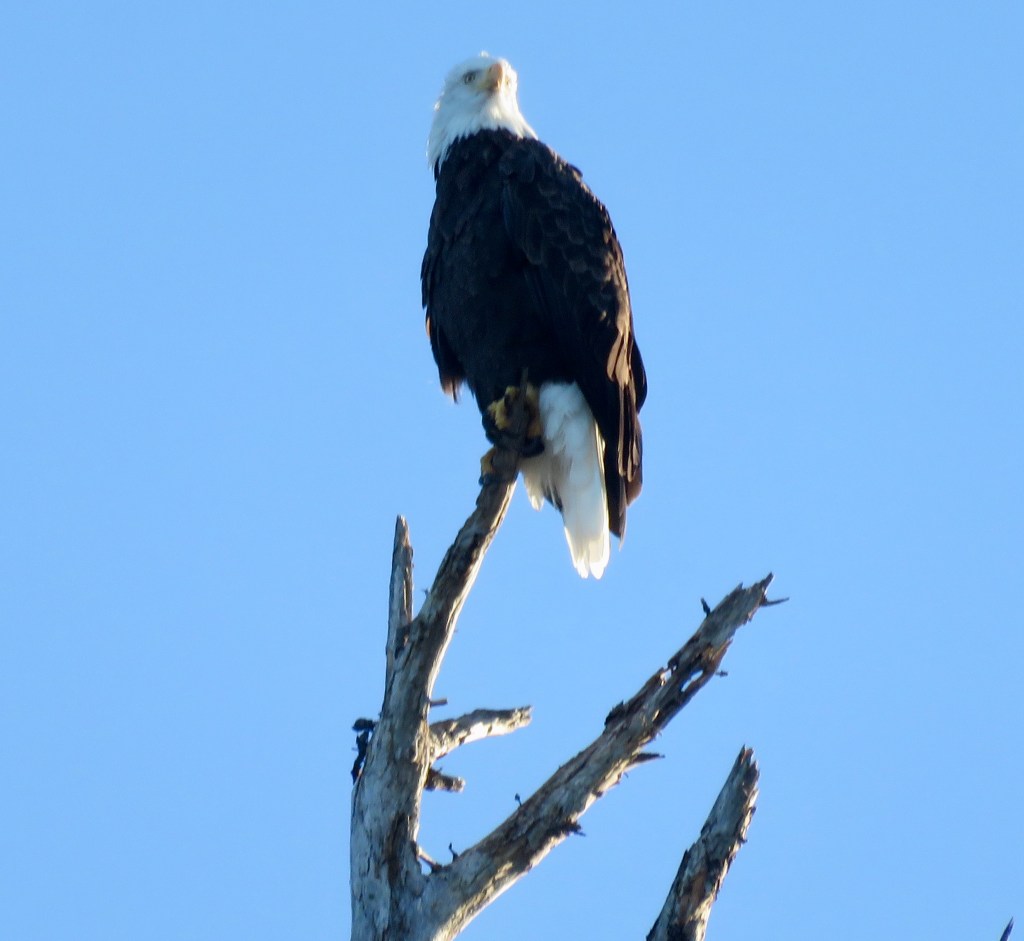
We see this bird perched at the top of a snag above the bluff north of us. She’s there most days on our walk, and sometimes a few others too.



 IMPERFECT PATIENCE