LEAVE THE DEER ALONE

fullsizeoutput_e6a

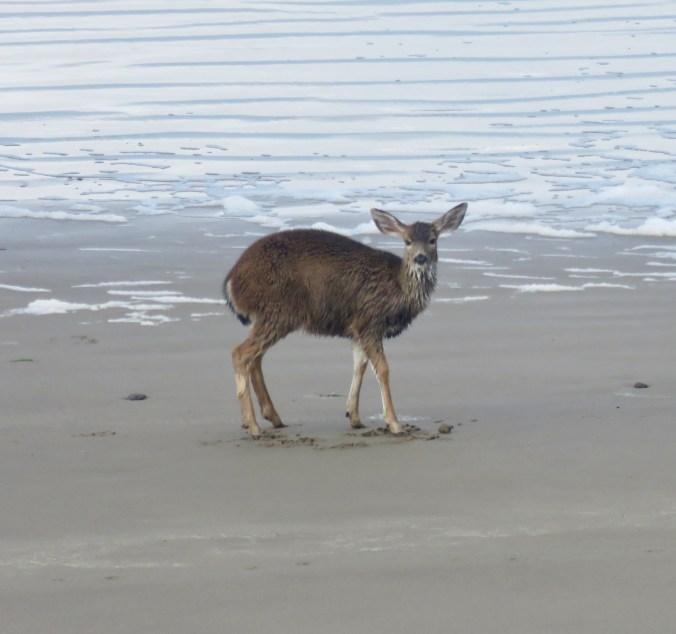
There was a doe on the beach in front of our house. It is not the first time we’ve seen a deer on the beach, but this one was distressed, maybe shocky. She stood hunched, ears drooping, head low, and perfectly still for a long time, wet from having been in the ocean, but no sign of actual injury. Our neighbors from Washington came over and asked Gary who to call. They both called Oregon Fish and Game.

The truth is that wild animals do best when they are left alone. Approach from a human being is stressful, and thus almost inevitably counterproductive. I will never recover from being present while a baby seal was chased into the surf by an unleashed dog. I tried but could not stop the dog.

Visitors want to “rescue” baby seals left onshore while their mothers fish. They want to “rescue” the elephant seals that are naturally molting. These wild animals do not need us to rescue them.

During our near-forty years here, we have picked up storm-battered birds and hidden them in the hedge from dogs and other predators. Sometimes they live—the rhinoceros auklet lived, a grebe, a crow, a couple of seagulls, several hummers. Each was unfledged or stunned and incapable of moving. We moved them to safety and left them. But it is really best if we don’t touch them at all. Regardless of our feelings, they are wild animals and human beings are their natural enemies. Sometimes they die. As sad as it might be for a human witness, it’s not our place to interfere. It is very rarely helpful. It is generally harmful when we try.

We watched the doe from the house for a long time, and then I thought she might be okay after all. She relaxed her stance, brought her ears up. She flapped her ears and shook her body from one end t0 another. Water flew from her coat. She lifted her head, turned and looked around as if seeking.

Maybe the deer would be okay, I thought. People were holding their dogs a quarter of a mile off, taking photos no closer than from 300 yards. Maybe she will find her way back to forest.

Then a couple approached the deer. One well-intentioned person with a long stick she used to poke at and drive the deer south . . . to where exactly? She was driving the deer south, further away from the place she entered the beach. Honestly, the deer is a wild animal, not a dog!

I went out and yelled as I came down to leave the deer alone. The couple had already moved the deer a hundred yards.

The woman walked toward me. She wasn’t pushing the deer, the woman insisted, she was rubbing the deer’s neck.  I did not argue with her.

“It’s not a dog, it’s a wild animal,” I said.

Apparently I was “not nice” when I told her to leave the deer alone. “I know it’s not a dog. You should be nicer,” she said. “I am not an moron.”

Could have fooled me.

I softened my tone to what I would use for a frightened child. The woman looked like a frightened and wounded child, but this was not about her. It was about a deer. “Leave the deer alone, please. You can’t help her. Just let her be. Please,” I said again.

Turning, I walked back to the house. The woman went away, too, and the deer lapsed into the previous hunched-up stance, and then Fish and Game arrived. They sat in their huge vehicle for a while, drove in a wide circle around her, and then they drove away.

It’s best to leave them be. Sometimes they live.

A dozen more people approached the doe. Two people threw lettuce and bread to her. She did not touch it. They said they understood what I was trying to say about standing off, but they didn’t leave until the rain came. On my way back to the house, a longtime neighbor met me. He had been on his way out to tell them what I told them: They are making this worse.

Then two more tourists who did not stay long, and then eight people stood in a circle around her. They clapped at her. This group, like other people, kept moving her south. She was shivering this last time I went out to ask well-meaning fools to step away. “She’s been in the surf,” they tell me. “I know.” I watched people push her further and further toward the water. It was what they were doing themselves. Before I got close enough to them to ask them to please step back, the deer herself had kicked at one of the eight people surrounding her. They utterly failed to respect that.

I was polite and apologetic, and I acknowledged that they meant well, “but every minute you stand close to this deer you shorten her life. You are her natural enemy. It’s what her mother would have taught her and she believes her mother.”

The group mostly dispersed after I talked to them, but then there was another group of five. Yes, deer are beautiful. It is very sad. Go home and eat your hamburgers.

If they’d let her be, she might have had a chance. She probably will die soon, and at best in their arrogance and foolishness all these people have caused her distress. They will go back to their city homes so very sad and sorry for the poor deer, without understanding the part they played.

I won’t watch any more.

Sometimes they live. Not this one.


BLAME THE CHILI VERDE

IMG_0001

This is not chili verde, but half-eaten pot of Sunday Soup, made differently each week from vegetable stock and veggies + some combination of legumes, rice, or potatoes. recipes below

Early on, in the ’90s, when I said I didn’t eat meat, people would offer me chicken, and I would have to point out, Isn’t chicken meat? What about duck? they would ask. Turkey? Rabbit? I started calling myself a “vegetarian” because trying to explain what I ate led to a lot of confusion. And a lot of questions. And then more questions. Why? But why? And eventual irritation on both sides.

Let’s Cook It Right and cookbooks. I read a great many books on nutrition when I was in college. Some of my friends were vegan for religious reasons, and we all cooked. I came to terms with butter (I’d been raised on margarine) and sugars and avoided pseudo-foods. I cooked a many bad meals and followed any number of recipes, and Gary gamely ate most everything I set before him. He claims today that he became a vegetarian because I stopped feeding him meat.

We eat wild seafood sometimes and dairy and eggs. We are not vegan. I am not ready to give up dairy and honey and eggs. I have been told I am “Full of s–t” for claiming I am vegetarian. Most vegetarians agree. Today, I can call myself a pescatarian and people know what I mean, but in 1990 that was expecting too much. The term was not then in common use. None of these terms were familiar 30 years ago. Properly speaking, we are ovo-lacto-pescatarians. Even today, using that term in most company, non-vegetarian company, stirs up trouble.

Instead, I labeled myself vegetarian, and mostly for moral reasons. I had always loved eating meat, but after close exposure to feed lots and the flavor difference between grass fed and feed lot beef; way too many horror stories about slaughterhouses and animal diseases from a friend working in the vet school in Fort Collins, Colorado; recognition of the damage done all over the world to habitat, global warming, indigenous populations, and so forth by raising mammals for Americans to eat; ; more stories about how we raise farm animals in this country, the genuinely horrific conditions in which pigs and chickens are often raised; and a family that is painfully sentimental about animals and horrified by cruelty to animals; I decided it was wrong to eat what I would not kill. Why cry over the injured animal in a film and then eat a hamburger? I could not do both. I loved eating lamb, roast beef and stew, and pork shoulder in my chili verde, but I stopped by choice because I believed it was wrong for me to do.

These days, I still eat fish and shellfish on occasion because I would be willing to kill them in order to put them on my table. This is not to say that I did not cry when I caught a bullhead as a child, my dad clubbed it, and then threw it back in the water. I did not cry for the trout on another occasion. But also, I was not the one that killed either fish. And I eat eggs and dairy. I can be particular about sourcing both, but dairy, in particular, disturbs me. I need to give up cheese. I know this. Butter too. The dairy industry . . .

In the 70s, didn’t I give up on table grapes for years because of the farmworkers’ strike? Haven’t I given up other foods for health and moral reasons?

Processed meats is unhealthy. I loved bacon, but gave it up even thought I love that salty goodness. Ham was the easier pork product to abandon. I do not understand why people want pot bellied pigs as pets and get weepy reading Charlotte’s Web but will eat pork. Isn’t there an inconsistency there? If describing beef as “dead animal flesh” is offensive, it is also accurate.

There is the reality that meat from a supermarket is not what my grandmother would have been eating from off the farm, and a long ways from what my ancestors a hundred, much less a few thousand years ago were eating. The meat we eat is genetically different from what our ancestors ate, and it is born, fed, and raised differently. The flesh found in a supermarket packet is chemically, nutritionally quite different.

It is this sort of thinking that made me determined, more than 30 years ago, to stop.

It was the chili verde that held me up the longest. I needed several years to figure out how to feed my family and myself food that was delicious and also contained nothing with a face. My chili verde had to be as wonderful even without meat. I use no recipe, but an approximation exists in my personal cookbook:

chili verde

1970s • makes two or more quarts • serves 6-12

I used to make this according to the recipe from the Denver Ladies Society which called for pork shoulder browned first in oil and then the rest of the ingredients (no onions or beans!). I learned how after visiting Colorado for the first time in the mid 70s. I tried beef and finally accepted that it was best made with pork shoulder (bone in and then removed from the pot and the meat picked off and returned to the other ingredients. This chili was so good, it had the final hold on me as an eater of meat. The recipe here is almost nothing like the original in terms of ingredients, though I promise it’s as delicious as the original version from years ago.

1 large onion, chopped

1 T. garlic, crushed

2-3 lbs. roasted or fresh cut up tomatoes or 2 large cans tomatoes 

1/4 t. cinnamon

1 T. ground cumin

1 T. ground chili or more to taste (ground chipotle is best)

1 t. salt, or more (the recipe called for 1 T., but  I use smoked salt)

1 lb. fire roasted, seeded, and chopped poblano or 2 large cans diced green chilies

3 c. cooked black beans

chopped red or green bell pepper

Sauté onions in 1 T. of oil till transparent. Add garlic for a minute longer. 

Add remaining ingredients and simmer altogether for at least 45-60 minutes. May simmer for hours and additional ingredients such as zucchini or bell pepper may be added later; it is better the next day.

*optional: usually I begin by cooking 1 c. of dried black beans in water or stock to cover or add 2 or 3 drained cans of black beans and a grain such as corn or rice. You may substitute fresh tomatoes, add chopped cilantro, chopped zucchini, green onions, fresh chili peppers, etc. For a heartier meal (and a complete protein) add a pound of frozen or fresh corn kernels right at the end, or 1/2 c. raw rice and simmer 45 minutes or longer before the end of cooking. NOTE: beans do not cook well in an acidic liquid, so if you want to cook the beans with the rest of the ingredients (which I do from time to time), add the tomatoes and chilis only after the beans are tender. 

Serve hot with cilantro on top, nonfat sour cream or a stick of cheese stuck into the middle, and hot rice or chips on the side. Or serve with or over the rice or spooned over crushed tortilla chips for tortilla soup with cheddar cheese grated on top.

green chili dip: add equal parts grated cheddar cheese to completed chili and heat gently. I made this once for a party and three quarts were gone in the time it took me to greet more people at the door. This also makes a wonderful, if rich, meal.

The Sunday Soup, such as shown at top, is easier and more variable. Begin with onions and garlic, add stock and rice or lentils or potatoes and other root vegetables. I add fresh herbs such as thyme or dried such as a curry powder mix or chili, simmer 20 minutes (or start brown or wild rice sooner to cook). Then add whatever other vegetables I have—zucchini, fennel, fresh beans or tomatoes, mushrooms, etc. Cook just till tender, then serve with something fresh on top: cilantro, parsley, basil, a grating of cheese.

All vegetable trimmings go into a freezer container, which becomes stock for the soup the next week. I made this every Sunday for years when I was working 60-70 hours a week, because it fed us for three or more days and other than chopping the vegetables, it was easy to make while I scored papers.

“IF IT BEEN A SNAKE . . .

IMG_3723

Gary wearing all his hats at once. He posed.

. . . it woulda’ bit’cha.”

When there was a break in the weather, we walked north, our usual direction. There was sand, but on our way out we were mostly in the rocks at the eastern edge, picking up trash. I found the hilt of a plastic knife and then the sheath. Gary found a stainless steel serving spoon. Other than that we bagged the typical mix of plastic rope trimmings, broken food container lids, candy bar wrappers, bottle caps, valves and fireworks debris, squashed polystyrene foam, shattered straws, and mysterious thick nylon chunks probably once part of shipping containers. Colorless, white, purple, faded red, blue, green, and yellow bits and pieces.

Two pieces of Mt. St. Helen’s pumice. A handful of agates. An ugly-clam shell (which is beautiful). No glass.

Tammy waved from her solitary walk in the opposite direction.

Just before I got to the creek, Charlie ran right to me and allowed I should scratch his back and ears. Then he greeted Gary. This was a rare treat for me, since Gary greets all dogs with, “Hello, pup!” and they generally go to him first. We stood, five locals—counting the dog, because the dog does count—on the sand and chatted. We made a tentative coffee date after New Year’s with his people.

We walked home on the sand. A chaise lounge has been stuck at the tideline for a week now. I think it blew off a deck and wonder if the owners haven’t been here, failed to notice it was missing, or believe it has been stolen. Gary is beginning to wonder if it washed onshore. If it’s still there next year, he says he’s going to use it to haul home a piece of driftwood he’s been eyeing.

Last week our tenant told us that our neighbor John was taken to the hospital. By the time we heard about it the next day, he’d had a pacemaker installed, and the morning we were talking about walking over to see him—Would he feel well enough to come to the door? Would he even hear the bell?—he showed up here. We had a gift ready for him and the three of us sat in the living room with the fire in the stove and talked for a long time. Just like last year. Except John has a tiny device on his upper left chest that prevents his heart from taking a break. He told us all about that.

Inevitably, Gary retrieved a bit of plastic I didn’t notice this morning, though I nearly trod on it. A few days ago, I picked up a bit of bottle green sea glass right beside where Gary had put his foot. Right in front of our house. We cross the same ground but see different things.

Isn’t that how it is for everyone? Even side by side, we see something different. We see a storm bigger than anything, but we are safe indoors and no pet is cowering under the bed, which means it’s a different experience from Eva and Marsha’s. We watched the high waves roar up our path, almost to the garden gate, but that is nothing like being drenched to the waist, hanging on for dear life because we were on the beach. We watched safely from indoors.

Sometimes reality is too much to bear.

Two children died in the past week while in ICE custody. Children. That is no joke. Even Fox News is upset. Felipe and Jakelin had families who loved them. The U.S. has about 15,000 migrant children in custody, often removed from their parents’ custody after crossing the border with Mexico. “The average length of stay for a child detained ranges from 100 to 240 days, and these children are often held far from family members and without legal representation.” They are being kept, often without proper identification necessary to reunite them with family later, and almost never without proper housing and other childcare available.

The two little children who died were both fleeing potentially lethal threats in their home country. Guatemala is a nation with a brutal recent history, a history the U.S. has a part in. They had traveled, mostly on foot, over a thousand miles to gain safety. They did not find it.

My great grandmother Rosa came here to marry and then had to support her children when her husband was imprisoned. My grandfather came from England to make a new life. One of Gary’s ancestors fled Sweden to Finland, and from there to America. Some of our relatives have been here during the past couple of centuries. Some came more recently to make better lives and to escape political persecution.

I am reading novelist Kent Haruf and he reminds me that life is often harder than we might wish, that some good people are ground up and cast away.

Homeless men always came up to Gary on First Avenue when we were visiting pawn shops to look at guitars. That was a very long time ago when we were young, in college, and on our way toward a better life. The homeless were generally much older and had harder lives than we could imagine. Most people walked right past them without looking, but Gary gave them his full attention. Gary always had a few coins for them, but more important, he listened to their stories. These men were often displaced, often veterans, sometimes from the war our fathers fought in, sometimes from the war he did not. They always thanked Gary for listening to their stories, for asking questions. They nodded to me, and went on their way. There was no harm in them, but often harm had been done to them.

Everything that matters is not about money or about winning and losing. And what costs little kindness? Who wins . . .

My husband and I have been blessed this holiday to have health and family and friends and neighbors. We have peace in our country and food and a comfortable home. There is suffering all around us in the world, and we recognize we have done little to deserve our good fortune. We don’t deserve it, however grateful we are to have it.

A step to either side, an accident of birth, an error of judgement, might have made our lives quite different.

When I was young, the new idea was that human beings, as animals, were all about competition, about being the strongest, about beating out those competing for limited resources. A few decades later, I read a careful study by an evolutionary biologist who details the evidence that altruism—self sacrifice—is likely an inherited trait. “The Selfless Gene” by Olivia Judson (of Stanford and Oxford) talks back to that earlier popular understanding of human nature. Far from being selfish and brutal animals, we have survived because we are willing to do for others. Sailers give their seats in lifeboats to passengers. A philosopher dies rescuing a drowning child she is not even related to. It is not merely heroic, but in our nature. And this is true not only for human beings, but for other life forms too, from amebae to baboons. We survive because it is instinctive to care for others.

It is possible to see life merely as a battle ground, but when we have the choice, we are better than that. I prefer to see my life as something better, as an opportunity. And lucky. I am grateful for my luck. I am grateful for a life of hard work and attention.


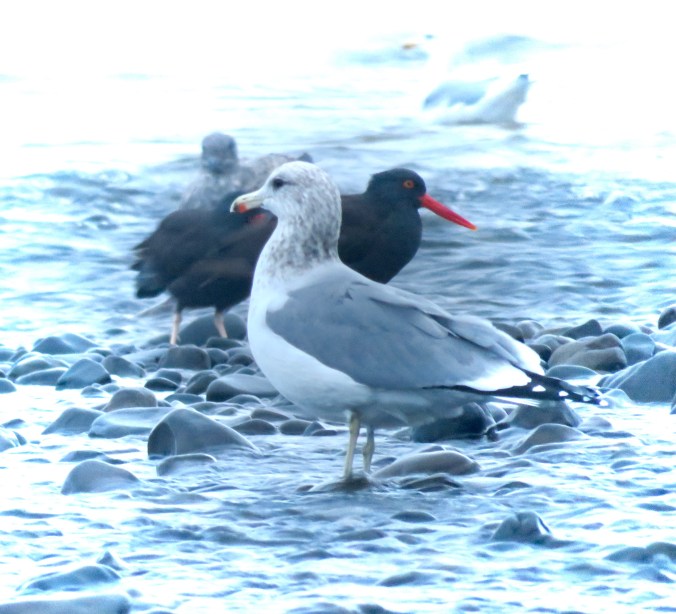
GULLS & OYSTERCATCHERS

Version 2

We socialized a lot this holiday season. So far, a party, visitors, driving to Portland to see our sons and their families, and their extended families. The weekend after next, we will have a full house here for Twelfth Night. Gary wants Dundee cake, and we will have salmon and mushrooms and grains and salads. Our grandson Logan will get his waffles for breakfast, and weather permitting, we will walk the beaches.

Our travels have been lucky so far. No snow or ice. Just now the sky is a tender aqua over the ocean. It hailed a moment ago, but all that has cleared off the windows. There is almost enough sand for a walk.

I am supposed to be completing a final draft of a novel, but I have not gotten to it yet. I think maybe I will have to beg off. I think I want to do that. A kind reader in London surely has other things to do, and I would like to do something smaller. I wrote a story for Ruby some time ago, “Louise DeFleur Makes Magic Shoes.” There is a sequel about the alligator (or crocodile?) that lives under her bed and the beginning of a third story about the trolls in the basement. I want to work on those three stories and put them in a little book for my grandchildren. A Twelfth Night present. Illustrated, maybe. Maybe.

Or maybe I will nap and watch movies on television, or maybe I will lie back on the sofa and finally read The Tie that Binds by Kent Haruf. It’s been on my to-read list for a long time and I read the first 14 pages, which are really good. I have an early Le Guin story collection I have never read start-to-finish, and Gary gave me The Best American Short Stories of 2018 edited by Roxane Gay. And I have been reading aloud from Patrick O’Brian whenever I could get Gary to sit still. Reading is definitely on the program.

The silk and mohair scarf has four of five bands done, and I don’t like having yarn for a new project till it’s done. I really want to order yarn for a pullover. The sale ends today.

Perhaps I am doing too much—my mother’s voice is still in my head warning me to not overdo.

So for a little while, at least until the sun goes down, I will watch the ocean sending waves onshore, while really going out.


SLEEPING IN

IMG_3725

Sleeping in . . . will not happen. Of course it won’t. Tomorrow is Christmas and even though I do not have to provide a holiday meal for anyone, I did make 5 panettones today, plus the stuffed baked potatoes with and without dairy, and the pumpkin custards with and without dairy and refined sugar. This evening we are invited to a Christmas party, taking along chocolate pots de creme, rugelach, and roasted broccoli. Later will open presents to one another and light the candles on the little German whirling forest.

In the morning we drive over a mountain range. Our older son and his family have colds and our younger son and his wife work in theater and The Nutcracker has not yet closed and been loaded out. They will all be exhausted but determined to feed us well, and they will smile past sleep. Perhaps we and the other grandparents will commiserate while all the youngsters doze sitting up.

Here is a short piece from 10 years ago when I was still running and more of us lived here. It was written with my students for the Idyllic Place assignment in 2008:

The Still Day

The day is overcast and I am not working.  The dog and I have had our run, my husband is at work.  A wood fire burns in the living room stove and I have set my watch to beep at me every hour or so, a reminder to add logs throughout the day.  Outside, wind blows and waves move forever onshore.  I am curled in a chair with a book, a good one with characters I like, adventure and the promise that the story will turn out well with my heroes better off than they were at the start.  Maybe they will fall in love, maybe they will save a life, maybe they will suffer and experience loss but at the end they will know they are stronger and wiser than at the start. 

The sofa is squishy under my body, but I need another cushion behind my back to get comfortable.  Yeti is upside down on her loveseat, one lip dropped away from her teeth and her eyes tight shut.  The cat sleeps on the little wing chair that used to be my mom’s favorite.  She’s been there since Gary left for work, and unless I disturb her, she’ll still be there when I put down my book and go downstairs to begin dinner. 

I wear my pajamas of red and pink pencil-striped cotton jersey and my orange cashmere robe that I bought on eBay.  I have a jug of water by the sink, but I am cozy, my feet tucked under and finally warm, my head resting on the corduroy cushion, the book pressed open against my knees.  I feel heat at my core and know a hot flash is coming, but I’m alone in the house so I stand and shed my cozy robe, sweat begins breaking on my skin and I strip off the socks on my feet and the top of my pajamas.  I head for the bathroom and pour water into the jug, gulp it down, replace the lid, and rest my palms on the edge of the counter.  I breath in and out and check my watch to see if the fire needs tending, my pores close and the sweat begins to dry.  I replace my clothing and head down the stairs to put wood on the fire.  I’ve left the curtain open at the base of the stairs and I feel cool air drifting along my bare feet as I turn down from the landing.  But now I close the curtain so the downstairs will have a chance to heat up. 

The air over the stove shimmers from the heat rising off it, and I can hear soft sounds from inside the steel that reassure me even before I touch the handle: my fire is still burning.  The handle squawks when I turn it and the door squeals as it opens. 

Gary is retired now. Me too, mostly, and I gave up running more than five years ago. The dog and cats have gone over the rainbow bridge. But this morning we got to pet two dogs on the beach. Life still goes on.

Below: another Swanson-Vance creation, a winged cat from 1979, the same year we moved home to OregonIMG_3728

COLLEGE DEBT

48386319_2924621820882110_2663996230333366272_o

Never trust memes. Verify.

My mother first explained “where the money went” to me when I was about eight years old. “Here is how much your father earns each month . . . ” She wrote out mortgage payments, utilities, food . . .

The budget of Trevor Klee is making people hysterical. Where does some 25-year-old get off paying $825 a month in rent? There are all sorts of cruel comments all over the internet. How can he do this? A sample:

This is ABSURD.
A) how many 25 yr olds make that much?
2) where’s the student loan payment?
3) $615 for donations? 🤣🤣🤣🤣 I don’t know any 25 yr olds that do that, because they’re spending all their money on rent and student loans.
4) $20 for internet?? Since when??
5) $825 for rent?? If they make that sort of money, and only spend $130 on transport, they live in big city, big city = big rent. That amount would get you a closet in NYC if you were lucky.
So many more issues, just… wow.

“How dare he earn $100k/year! How dare he pay only $825/month in rent!” How? The answers are simple. He tutored while in college and recognized he was good at it. He worked for an exam-prep company in Singapore after graduating from Princeton before starting his own company. Though he could afford to pay more for a studio of his own, he chooses to share a house with four other people. His rent is $4125, split five ways. His actual income varies because he runs his own business so he budgets for his low monthly income. The people freaking out about this meme would know all that if they read his story. The people who made this meme know the facts because they would have had to read the article in order to compile their outraged pie chart.

So he earns a lot more than me. So?

Klee worked while he was in college and likely had grants that paid his tuition. He got into Princeton. Maybe he has rich parents, maybe not. Princeton will pay the entire difference between what students can afford and their actual costs. Many notable private universities do that. If you can get in to Stanford or Harvard or Brown and you come from a low-income family, the university will ensure you can afford to attend. That doesn’t mean students don’t go into debt.

On the Princeton website: “Students admitted to the Class of 2022 who applied for aid with family incomes up to $160,000 typically pay no tuition.”

A former student of mine who had no help whatsoever from his family. worked three jobs while he attended a private university out of state. That was nothing new. He’d done that all the way through high school. When he graduated from college six years later, he went to work for a large company and could afford the payment on a condo on Copley Square. Be very, very impressed. I am. Did he graduate without loans? I never asked, but he might have. In hard and harder times, with and without parental help, some people manage to do that. Some do not.

Even when I was in college in the ’70s and tuition at the University of Washington was a fraction of what it is today, I knew plenty of people who were paying off student loans for many years after they graduated. A friend went to Hawaii during Spring Break one year and had student loans she was paying off a decade later. When she complained about her debt, I shrugged. Hawaii must be nice, but I never went.

I graduated without loans because:

  • I attended the local public university and lived at home for two years
  • my husband and I managed a really trashy apartment building near the UW and that covered most of our rent
  • we did not smoke, drink, or party
  • no coffee
  • no car unless we borrowed one from our parents. Instead we walked most days, including to the grocery store, and took the bus once a week
  • no vacations
  • entertainment was the $1 movie night at the Movie House, where we walked
  • dinner out was the 2-for-one coupon dinner once or twice a term
  • no help from our parents (other than the rare use of a car)
  • our only expensive activity was getting an education

Even then, graduating without debt was unusual. I knew people who lived in dorms because their parents were helping with their expenses. They borrowed. We lived like paupers and did not mind because we knew it was temporary. We both worked part time year around. Gary worked full time in summers and during Rush at the book store. I worked in a record store and sold my art work.

I knew a woman whose monthly food allowance for two people was $30 a month. I budgeted more than that for our food, and we were still bickering about who ate the last slice of bread or drank more than their share of the milk. But my friend was more impressive than that in her spending. She donated $100 a month to charities. At the time, I could not imagine how she and her husband could do that. My family did not give to charities, perhaps because both my mother and father came from single-parent households in the Depression? But I thought about what my friends was doing and I began giving too. I started with $5/month to Public Television because I watched that channel so often in college.

This month we gave $200 to Partners In Health, $100 to Southern Poverty Law Center, $100 to Wikipedia, and $100 to Amnesty International. I can’t afford to do that every month, but during the rest of the year I donate to projects and people I believe in.

As best I can recall, my mother wrote out her monthly budget in order to prove to her young daughter that we could not afford for me to keep a horse in the backyard. I had read a British horsecare book that detailed the expenses of farrier and feed. I knew keeping a horse was expensive. Even if we’d owned the field behind our tiny ranch house, we could not afford oats. Many years later when I mentioned how early exposure to budgeting had made me conscious of the need to be responsible, Mom confessed she’d lied about the family income. Never mind. It was true: We could not afford a horse.

At age 25, Trevor Klee gives over $600/month to charities. He does it because he can afford to do it, even in the leaner months he brings in $3000. He is careful about his money, but he is also generous. He chooses to share.

Why don’t people scream about that?


A YEAR OF READING IN REVIEW


I read, I realize now, a great many memoirs, beginning with Anne Frank’s Diaries and I Never Promised You a Rose Garden by Hannah Green [Joanne Greenberg], and right through recent best sellers. An essay on the Brevity blog defends the memoir against accusations of “misery porn.” Judging from my recent history, I am on that writer’s side.

On the other hand . . . she had warts.

On the other hand, I want more than even a well-written narrative of suffering. I want humor. I want objectivity earned through humility and suffering. I want wisdom beyond complaint. Growth. Insight. There are plenty of memoirs that offer all that. And not a few that fail.

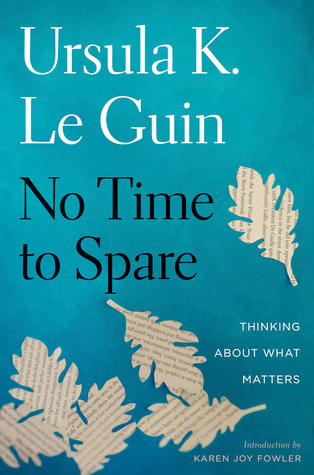
33503495Of the 66 books I read this year, several were memoirs or biographies. Of those, I managed to completely forget some. A Scientology surviver managed to bore me. A novelization of Dorothea Lange’s life was so awful I had to stop reading it. A collection of essays, introductions, and random notes by a favorite poet offered little to love, while Marilyn Chin’s new collection was quite marvelous. Ursula K. Le Guin’s No Time to Spare was a highlight, moving in ways that should not have surprised me. Ursula always had something valuable to offer an audience. Reading Lucia Perillo’s work makes me sorrow for her too-short life. Mazzeo’s book about Eliza Hamilton failed to decide whether it wanted to be bio or fiction. And though I am generally a fan of Joan Didion, her elitist attitude in Slouching Toward Bethlehem irritated me. (She goes to the grocery store barefoot and in a bikini and is incensed that someone has the nerve to be offended? Well, yes, in that time, it would indeed have been offensive, no matter who you thought you were.)

35959740Sadly, Pat Barker and Emily Wilson failed to impress me with their books of Homer. Madeline Miller, by contrast, completely astounded me with Circe.

In nonfiction, none was more impressive than Essential Essays: Culture, Politics, and the Art of Poetry by Adrienne Rich. I hardly know what to say. A 1997 speech explains the history of “identity politics” and how we must continue to find ourselves not only as individuals but as members of communities, that believing we exist as consumers in the marketplace fails us in ways that anyone alive and paying attention today will recognize. She was always ahead of her time.

But it is the novels that struck me this year, beginning with Circe. This is one of three books I hope to reread. Bette Husted’s novel knocked me down. Hild by Nicola Griffith is another. It made a huge impression on me for the way it reveals a brilliant mind in a long-ago time. Like Circe, Hild is shown doing what a woman in her position and living in her time would do, the day-to-day details, without diminishing how she wrestles with her dangerous situation.

Hild searches for pattern, for the warp and weft of her time, of the people and weather and the others living around her—birds and deer and the small shrews. From an endangered family, in a time when men in power can do anything, anything at all, Hild at 3 is already aware of how the light might fall just so and make her dead. How she stays alive, as an un-pretty child and then a sexually aware young woman, how she uses her blade, her understanding—this alone would make a powerful story. But Hild is more than that. She lives through transitions of Christianity and change, the clash of armies and of the secret powers of woman and priests.

She sees mor61+uqLOhUeL._SX331_BO1,204,203,200_.jpge in an instant than others will ever understand.
I recognize that people struggle with the names (of mostly real people, so the naming is not up to the author) and details (of ancient lives) but it is rare that a writer so fully captures the daily texture as well as the swordfights and trauma of any time, much less one so distant.

This is one of the great ones, one of those books I dwell on for a long time after because I cannot imagine having written it but desperately wish I had.

Historical fiction is challenging to both write and read. It must assume knowledge (and ignorance) on the part of readers while world-building in alignment with history. I know a great deal about the crafts detailed in this book and I am an unapologetic critic when writers get the history or details wrong. (As Pat Barker does in her new novel about ancient Greece.) I would have her metalsmith show Hild how to draw wire, but what is revealed here about crops and croft feels entirely authentic. The texture and flavor in these pages allowed me to trust the near-magic of Hild’s weaving.

Have I mentioned I love this book? There was a line I have been quoting: “Men are afraid women will laugh at them. Women are afraid men will kill them.”

Next volume please.

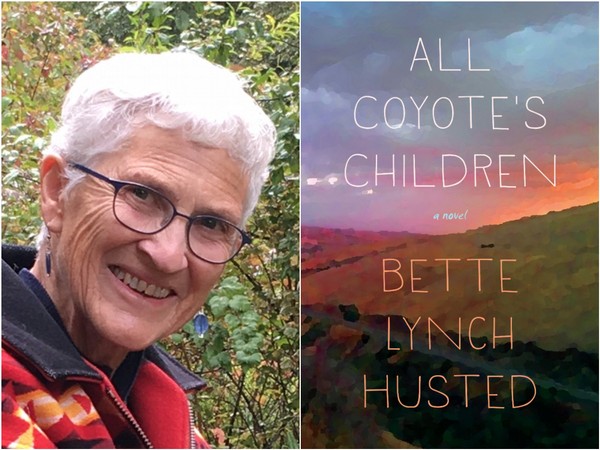
Closer to home in setting (though not in miles) is Oregon author Bette Husted’s All Coyote’s Children. Bette is a friend and I always read her work with interest, but this novel marks a turning point for me.

bette-lynch-hustedall-coyotes-childrenjpg-bc0574e4e7ab768d.jpg

One morning, my husband and I walked a long ways north before turning for home. I had been reading All Coyote’s Children before we fell asleep and again that morning. Once we were home from our walk I read after breakfast and during the day between doing other things. Some books you don’t want to end, but you also cannot bear to set down.

Gorgeous, elegant, heartfelt prose right from the beginning. There is a gradual release of information, of facts in this story of a family in recovery, which I admire a great deal. I appreciate a story that focuses on recovery after the fall rather than the fall itself. Everyone falls. Not everyone gets back up.

This is one of those books you want to hand to people, to friends and loved ones and people you barely know.

There is a reconciliation in these pages, tenderness and glory. I have a lump in my throat and tears in my eyes and I just want to sit back down and read it again because “sometimes a piece of story breaks off and rides the wind, and even if you close your eyes you know it’s going to find you. You hear it coming.”

There is confusion in the beginning, a reflection of Annie Fallon’s confusion after the death of her husband. These are loving, flawed, believable people making mistakes, doing the best they know how, and messing up sometimes. The complete story of this family is a long time coming and it is revealed in community. Lately I’ve thought a lot about community. The scientific evidence is mounting that the sort of relationships Husted develops in this novel are what most of us living in the “modern world” are missing. Missing all that connection to history and people and the very land itself might be what is killing us.

This novel provides a powerful reminder of the cure for what ails us.

I would like to see this taught in high schools. The story itself is strong, the history is solid, and the redemption it accomplishes is unique. It is an extraordinary story, a beautiful and important one about how we come to terms with history and landscape, family and obligation.

I read for love of reading, but also as a writer. So Circe, Hild, and All Coyote’s Children want another look.

Speaking of rereading, this was also the year I restarted an old habit of reading aloud to my husband. We began the Patrick O’Brian Aubrey/Maturin series a few weeks ago. It is my third reading, and I am impressed all over again. We are already on book 4, The Mauritius Command, and unlikely to finish it before New Year’s. There are twenty books in the series, and I read a few pages at a time, mostly while he drives or while we are in bed. Next year . . .

I read newspapers each morning, magazines, literary journals. I read some terrific books this year and wish I had time for more. I am not a fast, but a determined reader. I have selected a few books for their structure, but mostly I read what I love, the sorts of books I wish I had written.

There is just one essay left of Rich’s Essential Essays and I will be sorry to finish the collection, making it the last completed book for my year of reading.

LIVING AT SEA LEVEL

IMG_1594

There is a major front moving in. Gary has come up the stairs twice to tell me about it. Perhaps two inches of rain. He will need to buy the whipping cream today—how much did I need? Three quarts. The tide sweeps up nearly to the hedge and he suggests we might get a walk up Shingle Mill rather than on the beach. And that reminds me of a very old essay . . .

Hoo-hoo-a-hoo Hoo-uh-oo! We heard the owl at the far end of our run on Shingle Mill that morning. It was the first day of Daylight Savings Time and this meant we were running in the dark again. It also meant we got to hear the owl. And my two-day headache finally left me.

We live at sea level and the Pacific Ocean is right outside my window. On a Thursday night we watched the news about the 8.9 earthquake in Japan (since upgraded to a 9.0), checked the estimated time of landfall in Hawaii and our coast. The news had pictures of a ten-foot wave sweeping across agricultural fields, smashing into building, carrying cars like so much driftwood. Ten feet might not sound like much, but that wave had the weight of the entire Pacific behind it. Nuclear reactors were off-line. The early estimates claimed 25-35 dead, but we already guessed this would increase ten-fold by morning, and again ten-fold, and perhaps again. But it was also clear that the wave would not hit here until after 7am and since we are always up between five and six, we went to bed.

We would have slept through the night and begun packing up in the morning, but a well-intentioned neighbor called to alert us at 2am and so we were up three hours early. School was cancelled, and this had been on the news hours before the call came. By then waves hit Wake Island and Midway. Hawaii was hit, but the estimated wave was less than four feet for our stretch of coast. More bad news about the Japanese nuclear power plants. The tide would be mostly out so that the estimated four foot wave, if it came, would look like a sneaker, nothing threatening. A local geologist was interviewed by a Portland television reporter, and it was all he could do to keep from laughing at all the fuss. “People can evacuate if it makes them feel better,” he said. Horning is a smart guy and I trust him, but better safe than sorry, and we’d already planned to leave.

The warning siren began blaring right at the time we were putting the dogs and cat in the cars. That was good news—no way anyone could miss hearing the Arch Cape alarm unless they were deaf. An hour before the time a wave was expected, we had packed up and evacuated ourselves and our pets to St Peters’ parking lot.

Through all this Gary and I were calm. An hour past anticipated landfall for the first wave, we went back home and unpacked.

During all this several things went well locally: We had many hours to prepare. We packed and left. The warning system worked. Oregon Department of Transportation (ODOT) reopened the Dennis Edwards Tunnel to allow visitors to return to Portland without detouring construction.

What didn’t go well: ODOT posted nothing, absolutely nothing on their website about the tsunami warning. I found out the tunnel was open from Facebook and later the news. The news stations reported the most dangerous scenarios over and over, and often showing images from Japan with a “live” label on screen while interviewing—voices only—locals about the threat to the Oregon coast. People turning on the news understandably feared the images went with the interviews. Many people were unnecessarily frightened. Friends from Seattle emailed to ask if we had an emergency kit in our car. Others thought the entire situation was blown out of proportion.

It wasn’t.

In January of 1700—Tuesday evening, January 6th, to be precise—the Cascadia subduction zone dropped, causing an earthquake magnitude of approximately 9.0 off the NW coast of the US and Canada. Scientists can be precise about this event because while none of the people living then on the Oregon coast actually wrote it down, the Japanese recorded details of the 5 meter tsunami that struck their coast. That’s about 16 feet. People died. 

That earthquake and tsunami was just the most recent in a series that have struck our coast. Until recently the general advice was to get to 50′ above sea level and we probably had a couple hundred years before another big quake would strike. But then the Seaside School District asked State of Oregon geologists to have a look at cores and advise us about where to move Cannon Beach Elementary, which is sited along Ecola Creek, just off the beach. The school can evacuate to 50′ in less than 5 minutes—they practice. The discoveries of the state geologists put the wave height at up to 100′ and frequency closer to 300 years than 500. We are overdue just now for a big one and that is why my school district, with four of our five schools barely above sea level, is scrambling to relocate and build a new campus higher up in the coast range. These buildings would also serve as staging for relief efforts and emergency housing when the next big one comes.

When that quake comes, if I am home, at least parts of my house are likely to collapse. I do not count on getting my car out of the garage, nor that local roads will be free of fallen structures and trees. I will grab the dog’s leash, stuff the cat into her carrier, change into runners, and I will run. I will not carry even the most practical of emergency kits. I will not take extra drinking water or food or my favorite pieces of jewelry, the family photos or blankets or any of the sentimental or practical items we carted over to the church the other day. There won’t be time. I will have only a few minutes to run to higher ground—best case scenario suggests 20 minutes total, and I will have spent part of that time fighting the cat to get her into the carrier. In a worst case scenario I might have only 5 minutes to climb 100’ above sea level and I will not make it.

If I’m at school during the quake, I will likely have a couple of dozen students in my room, and over a mile to run just to get to the base of a hill. There is a backpack in my room that I am supposed to carry, but I am old and small and the reality is that I do not want to carry 20 pounds of emergency items for over a mile. I might do it, though. I am a stickler.

Wherever I am when it hits, there’s a fair chance my husband will be someplace else. We have tried to figure out where to meet. Neither of us is hesitant to walk from wherever we might be, but getting from one place on the coast to another will be torturous. I figure I can run the highway from Seaside to my home in less than three hours. It’s about 14 miles and I ran a half marathon last fall in awful weather in a little more than two and a quarter hours. But after a quake, that highway will be mostly gone because it’s at sea level in low places, tumbled with rock in high places, and already sliding downhill any place above sea level. Bridges will have collapsed. Mud and downed trees, the drowned wreckage of human constructions will make barriers. Owls will always find their home, or a new tree. But if I head for my tsunami-swept home nothing along the way will look familiar, and I will likely need a day or two to get there from Seaside, if I’m lucky enough to find Arch Cape at all. 

If I were a girl of sixteen, Friday would have been a holiday off from school. But I am closing in on 60 and even a false alarm gets me thinking too hard. The adrenaline left me exhausted and achy and reconsidering. The next day I had a headache, and it wasn’t until this morning, three days after Japan’s quake, when Gary and I decided we were going out for a run despite the rain, that my headache is finally gone. It returns as I consider the future. Grim reality.

There is the stretch of flat road we often run, the road we ran this morning. We run laps east, west, east, and when I am headed toward the ocean its voice sometimes comes up strong like an animal roaring over my head. I always think of a tsunami when the ocean is in full throat; I consider where I would turn to find high ground, and that I do not have time to escape that massive rush of water. 

WRAPPING UP

fullsizeoutput_e57

The year is not over, but with Hanukkah already past, five days to the beginning of winter, and just over two weeks till 2019, “the season” is closing in. The day before yesterday I wrapped gifts for twenty people. Yes, I am amazed too. We sent out fewer holiday cards, but we did get them out.

It was been an interesting year, and by “interesting” I mean in the sense of the Chinese curse: May you live in interesting times. I mean both marvelous and traumatic for me personally. A man who pursued me on the beach, screaming obscenities, pretty much ruined summer, and then the Kavanaugh hearings brought up old stuff I could have lived without reliving. The determination of people to deny a bad word about the dead, the continuing horror that is the current national administration . . . I did not sew a dress. I did not bellydance for an hour a day. I recklessly ordered a custom desk, but when it arrived it was nothing like what I asked for and it took a month to get the brute out of my office space.

I might not be blamed for feeling a little down.

Instead, we feel cheered to have paid off our mortgage this year. We are not yet accustomed to having disposable income. There is a large open space in the middle of my office space that I quite like. I read several dozen books and gave away books, and there will be more about that later. Reading aloud to my husband is something we have enjoyed in the past. Just now we are beginning the fourth book of Patrick O’Brian’s 20-volume series. It’s my third time through and it’s better each time.

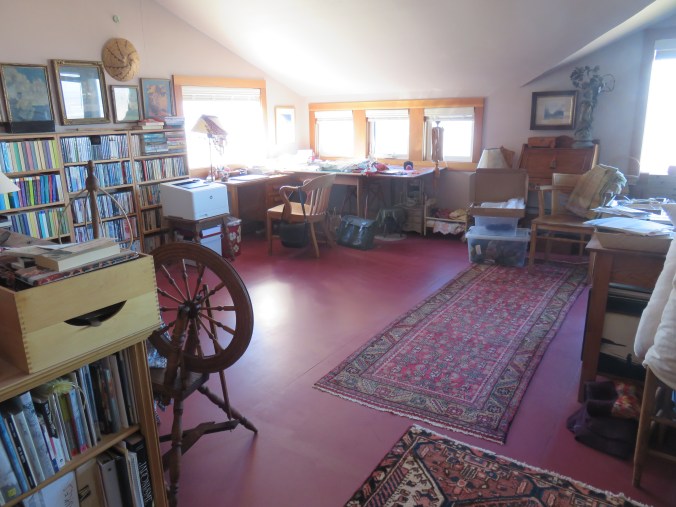
We replaced our skylights, repaired some plumbing, and I painted the entire upstairs myself, including floors. We have been seriously divesting lovely things we do not need, have no room for, and our family doesn’t want either. The attic contains only a cardboard box and plastic tubs to catch the leaks, and no rodents. It’s never permanent, of course, but Gary got the job done. (Next year, the roof itself needs replacing, obviously, and the deck now has holes large enough for both my feet to step through.)

We went on vacation, several times, and not merely 6-hour daytrips to Portland that we have counted as “vacation” in the past 16 years. We went to Canada for two nights, Seattle, Forest Grove, Nye Beach, and Decatur Island. Nine days away. Imagine!

I sold a story and an essay—yes, actual money changed hands. I did not find an agent for my newest novel, but that is the result of my determination to indulge in an unpalatable structure. I am working on something else now. Plus, during NaNoWriMo, I wrote a lot of new material, and in the new year, I will work on that too.

On the visual arts front: I knit hats and sweaters; wove blankets, scarves, and shawls; and pieced one completed quilt. This was not all I had planned and a baby blanket is still waiting for me to complete a warp on the loom so that I can put on a blue-gray warp. Still.

Gary and I picked up half a ton of trash off the beach, and gathered an assortment of seaglass, shells, and pebbles that I have only half-sorted.

I taught Writing 121 and 122 last school year, and I have begun teaching that series again this month with a large class of willing and capable students (hooray!). This Thursday, a half dozen former students will be speaking to my college class about their college experiences. I will have made at least three batches of “the chocolate thing” from a Canadian recipe. (That making will happen after I get home late from school on Wednesday.) It is cream, good chocolate, egg yolks, and a tablespoon of orange liquor for nuance.

51mVnm2RrDL._SCLZZZZZZZ__SY500_SX500_Confirmation of my order of The Speed of Darkness by Muriel Rukeyser revealed the cover image, which I immediately recognized. I thought: I have that book already, downstairs in Ian’s old bedroom on one of the poetry bookcases. I have not yet looked to be certain it’s there. If this book was inherited from my aunt or mother, and I have possessed it all this time without reading it, well, that would be both bad news and good, wouldn’t it?

My husband is most pleased that I am regularly using my grandmother’s desk. It is tiny, a ladylike drop-front desk of satinwood, and unsuited to spreading out. I must confine my mess to a narrow surface and that might be a part of the appeal. I generally sit on the sofa with my laptop, or in bed as I am now, typing this post, but I open that drop-front desk each morning and sit at it for a time, and then in the evening, I plug my laptop in on a chest to my left and close my grandmother’s desk. Gary finds all of this precious.

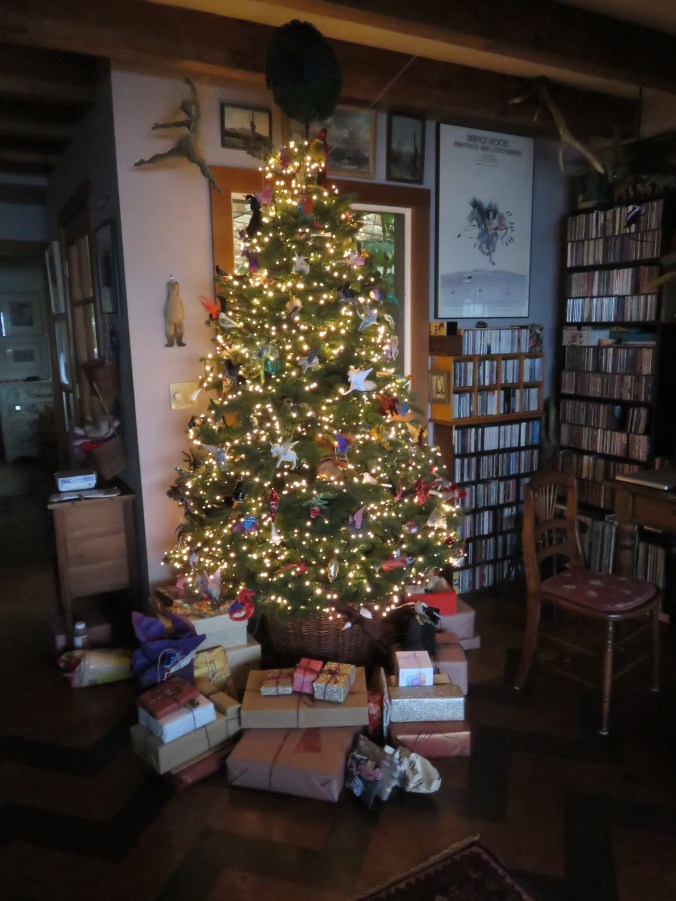
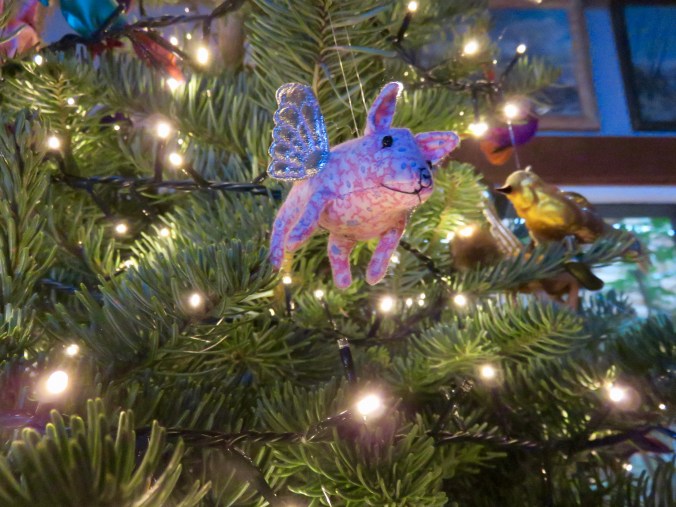
IMG_0015aThe tree downstairs has a thousand LED lights and is decorated with glass birds and tiny stuffed, winged animals made by Margaret Swanson-Vance of SewWing Studios. Some are more than 30 years old. This flying tiger has painted embellishment by her husband, who has passed (marked T  W  MS ’94 ‘Nar Bachcha’). The silver-winged pig at top is brand new. Upstairs is a little white paper tree in the front window. It has only a few lights and white ornaments, some of which are also from Margaret. A unicorn is on its way.
I have learned to bake panettone this fall. The sourdough start has not died but provided waffle batter, sweetrolls, and crumpets throughout the year. I did not make jam or jelly, but there are packets of fire-roasted peppers in the freezer, and we picked up tamale-ground organic masa from Three Sisters Nixtamal. For our Christmas there will be tamales! I plan to bake panettone, rugelach, and pecan cookies for the holidays, too, though it’s tight between the beginning of Winter Break (this Friday) and Christmas Day (next Tuesday).

We’ll manage in joy.


NO ONE WANTS YOUR STUFF

IMG_3480

Halfway through our summer homework: Everything in the far corner under the windows is moved. We are not done, but nearly. The last bedroom where we stored stuff is worse-but-better.

Mom told us: “Just sell it or give it to the kids [her grandchildren] and they can sell it.” She had promised that I would inherit her home, the house I designed and supervised in building, ordered the cabinets, installed the tile backsplash and the tile floor and walls in the bathroom and the entryway floor. I lost several months of paying work doing that, and the house was my favorite of all the ones I designed.

But when Mom finally accepted that she could not live there alone, she decided to sell the house. She preferred cash in the bank and did not “want to fuss” over renting. It sold quickly to a realtor who wanted it cleared out by closing. We had to wait till my brother took what he wanted before we could empty the house and the stuffed attic. In the end, Gary and I and our sons and one of our future daughters-in-law, emptied the house in two days and we have been loaded down ever since. [Gary says I am wrong about this, that he went back and forth for two weeks or more. He’s probably right.]

Mom wanted me to put all her things into storage and I refused to do it. The expense and the unlikelihood that I would find time to visit a storage unit made that impractical. I knew I would never go through a storage unit. So instead we moved it into our home, until Mom told us to just sell it all. After she died, we looked for charities.

There was little that was genuinely marketable, because the market crashed for a lot of items. Mom and I both collected: dolls, china, glass, prints and photos, books. Fewer people collect these day, and with Ebay, you can find whatever you want anywhere in the country. My mom and I used to hunt antique shops all over western Washington, searching for specific things we often could not find, and buying wonderful objects we did not need simply because they were rare. We had great fun doing that, and the items I have kept are the ones where I recall that search, our discussions about price and value and so forth. Reminders of time spent with Mom.

[In the mean time, antiques stores and malls are failing. Now, people can find anything, anything! they are looking for online. I recently bought two discontinued dinner plates on Ebay. They came from Finland.]

We stored boxes Mom brought to Oregon from Seattle, boxes of my school materials from grade school all the way through decades of teaching, boxes of Mom’s collectibles and recent purchases she’d never bothered to open. Cardboard boxes cluttered our rooms and stuffed the attic that already had my own accumulated clutter. I resisted going through Mom’s boxes, but at least I was not paying for a storage unit, I reasoned.

Looking back now, maybe that was a mistake. If I’d put everything in storage, I think we might have just walked away from it all—and maybe that would have been better. Finding places for my mother’s possessions was a nightmare that went on for over a decade. What left us before this past summer went to our sons or charity. My brother was angry not to have received money from sale of the pile, but we didn’t sell much of anything from Mom, just gave stuff away. We would have welcomed any attempt on his part to take things he wanted or to deal with the mess. Certainly, I would have preferred to do what he did: cherry-pick what I wanted and leave the rest of the mess to someone else.

Instead it is a chore that we find both onerous and painful. We are closing in now. The six boxes of books Gary wants to take to the GoodWill truck are my books, not Mom’s. The last sorted banker’s boxes were all my stuff that needed to be dumped. The north attic is finally empty, and only the one room still contains clutter—the Thonet chairs I bought while I was in high school, bedding and linens destined for charity, six more cardboard boxes of books. It has been emotionally and physically challenging to discard the accumulations of several lives. This has been our primary occupation in retirement: getting rid of stuff.

This is a common experience, I have learned. No one wants our stuff.