This last assignment is poetry. Below are two 20-minute poem prompts. Choose.
IMPORTANT: My 20-minute exercises were inspired by prompts provided in the back of Dorianne Laux and Kim Addonizio’s marvelous craft book, The Poet’s Companion: A Guide to the Pleasures of Writing Poetry (W.W. Norton, 1997). Their original exercises are much better than mine. (You should buy the book.)
1st option: Metaphor & Simile
COLOR: What it is & what it’s like
DIRECTIONS: Write in response to each bulleted item in order:
- Choose a color such as blue or yellow or red, black or white, violet—whatever. Keep your color in your head for now and don’t write it down on your page.
- Without including the name of your color, make a list of 6 things that are that color.
- Now stretch and add three more things to the list that are the color, then three more, but these should be more complicated things that you have to explain in a phrase—“a four day old bruise” might be yellow, but it’s not the first thing most people think of when they think of that color. (But still don’t say the color.)
- Complete the sentence: If [someone famous—name them] had a [something—name it] it would be [write your color].
- Complete the sentence: When [name someone] feels [some emotion—name it] in his/her sleep, she/he dreams [describe your color, again without naming it].
- Complete the sentence: When I am [name an emotion] I feel that [describe an object or a place you care about] is [name your color].
- What does it sound like? “It sounds like…”
- What does it smell like?
- What is the texture of your color?
- When or how is it terrifying?
- When or how is it loving?
Revise, rearrange, & rewrite your list. There’s a poem on Bracken‘s “Hopelings” (sparks of hope in the time of social distancing, which are each lovely in themselves) that might have begun with this assignment called “A Pair of Gloves” by Rebecca Hart Olander. I urge you to click the link and have a quick read.
2nd option: Persona
The River-Merchant’s Wife
by Ezra Pound
While my hair was still cut straight across my forehead
I played about the front gate, pulling flowers.
You came by on bamboo stilts, playing horse,
You walked about my seat, playing with blue plums.
And we went on living in the village of Chokan:
Two small people, without dislike or suspicion.
At fourteen I married My Lord you.
I never laughed, being bashful.
Lowering my head, I looked at the wall.
Called to, a thousand times, I never looked back.
At fifteen I stopped scowling,
I desired my dust to be mingled with yours
Forever and forever and forever.
Why should I climb the look out?
At sixteen you departed,
You went into far Ku-to-yen, by the river of swirling eddies,
And you have been gone five months.
The monkeys make sorrowful noise overhead.
You dragged your feet when you went out.
By the gate now, the moss is grown, the different mosses,
Too deep to clear them away!
The leaves fall early this autumn, in wind.
The paired butterflies are already yellow with August
Over the grass in the West garden;
They hurt me. I grow older.
If you are coming down through the narrows of the river Kiang,
Please let me know beforehand,
And I will come out to meet you
As far as Cho-fu-Sa.
This poem is an English rewrite of an Italian translation of a Japanese translation of a very famous Chinese poem. Depending on who you talk to, it’s a mediocre translation of a great Chinese poem or a great poem inspired by a conventional Chinese original. I have talked to two Chinese-born American poets who gave me these widely diverse opinions.
Regardless, this is a persona poem—written by a man from the point of view of a child bride who has grown to love her husband. At the end she promises to come as far as it takes (Cho-fu-Sa might as well be the moon) to reunite with her now beloved husband.
Write a poem in which you briefly describe defining moments in your relationship with another person. You might consider choosing a parent or friend as well as a lover. You might choose, as Pound does, to inhabit the character of someone other than yourself. In any case, these moments you describe should demonstrate an evolution in your relation to that person. Your initial response, how you came to know the person, how you came to care for and miss their absence. Address that person directly as “you” in your poem.
NOTE: At each stage you may improve the poem. Weird revision strategies later this week!

 “Time and Tide wait for no man” is how the saying goes. It is a recommendation against procrastination and as I am reading Patrick O’Brian’s naval novels (for the third time) I understand the reference. However . . .
 A few days ago Gary was out on the road when he saw the first deer. He backed up against the garage door while she passed. He felt sure there was another. He didn’t want to spot them, though they had passed him before—running straight past as if he were not there.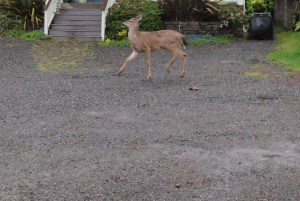








 IMPERFECT PATIENCE