
I had been reading The Feminine Mystique by Betty Friedan in the bright pink paperback cover before my drawing class started at 7:30 in the morning. My instructor began screaming at me that the book had ruined his best friend’s marriage.
Somehow I knew, without knowing, that there had been some other reasons for the breakup. But I was young and small and female. I knew enough not to argue that day.
It was only my second term at the University of Washington, winter of 1971, when I arrived early for Art 111, the second in a studio drawing series required of all art majors. I had already been chewed out for humming and for missing a class due to snow (the busses did not run within two miles of my house and my ride went in late that day). I waited on a drawing bench, my large portfolio propped at the end and ready to go once class started. When my professor charged into the room, I stuck a bookmark in my book I had been reading and set it aside.
I was not quick enough.
He spotted the paperback book beside my hand and asked me, “Do you believe all that?” The pink cover was unmistakable.
“Yes, I do,” I said, well aware this was not the right answer.
“That book cost my best friend his marriage,” he said. He then reviewed details of his friend’s private life that I immediately forgot, his voice rising as he went along. It would not be the last time I would be yelled at by a man standing over me, insisting that men were being treated unfairly.
“One and a half million copies in print” my bright pink 1970 Dell paperback says on the cover. The dedication is to Friedan’s husband and children.
That book has been on my shelves ever since, and though the spine has sun-faded, the front cover is still shocking pink and that color was a statement in its day. Pink for girls—that pink inspired by an outsized diamond introduced on a perfume bottle in 1937 as “shocking pink” by fashion designer Elsa Schiaparelli. We called that shocking color “hot pink” sometimes, bright, the vibrant pink of bougainvillea and drag racer Shirley Muldowney’s car, the color striped on my purple Cher-designed bell bottoms when I was fourteen, a color that could hurt your eyes if you stared too long. In some European languages such as German, the word pink is not pale red, the color called “rosa”, but this particular intense pink, this intense leaning-toward magenta shocking pink is the only “pink”.
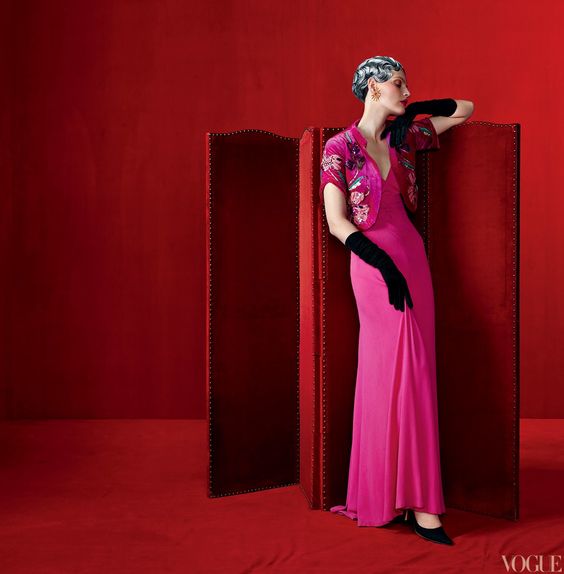
Model Guinevere Van Seenus wears Schiaparelli’s shocking-pink dress (fall 1937) in the May issue of Vogue.
Shocking? Betty Friedan’s book, originally published in 1963, revealed what was happening to women in middle America after the Second World War, after Rosie the Riveter was sent home from factories to make room for returning veterans. As Americans moved into the suburbs, women went back to suburban and now isolated kitchens, married younger, had more babies, enjoyed the modern conveniences of automatic appliances, and yet they were not happy. The grocer, the baker, and even the candlestick maker were a car ride away and chances are, that wife didn’t have a car—only about 15% did by 1960 when my mother was responsible for two elementary-age children. Opportunities for women outside the home had actually deteriorated during the twentieth century. Schools for women still focused on the domestic arts, and women were warned that ambitions beyond their immediate family were a threat to peaceful society.
The cover of Friedan’s book was not just pink for girls, it was shocking pink, a color that warned it was starting something, a new look at women and their place in society, their need to find a place of meaning and purpose beyond marriage and parenting.
Friedan was among the first to utilize Maslow’s hierarchy of needs when she described how society was deliberately limiting women’s role to their sexuality. Gender alone as destiny.
Until the post-war period, pink was not even considered the color of little girls. In fact, earlier in the twentieth century, no one considered the gender of young children to be an issue at all. In England, if pink was deliberately chosen for a baby or young child, it was generally for a boy since red was the color of military uniforms and boys are pale versions of what they will become. Pink was not then a baby girl color; pale blue was not the color of little boys. Children were not thought to be sexual entities. Regardless of sexuality, the enforced split into girly pink and baby-boy blue does not seem to have been good for girls. (It hasn’t done the boys much good either.) Today entire toy departments are sometimes divided into the blue section with boy toys and the pink section confined to girls’ toys.
Nevertheless, the nearly two hundred year old American clothing manufacturer Brooks Brothers still offers thirty-three dress shirts in pink but only twenty-four in white and four in green, in addition to the most popular blue. Pink shirts are reputed to soften the impact of dark suits and sport coats in charcoal, navy, and black. The pale pink is tinted warm toward yellow or cool toward blue in order to complement skin tones.
Pink as a color name is nearly unique in that for many people it is a distinct color, not a tint or lighter version of red, but a color all on its own. Orange, green, purple, blue, and even yellow are described as light or dark, but add white to red, and it becomes another something not called light red, but pink.
The color illicits intense emotional responses. It is the color of the triangles labeling gay men during the Nazi era and today worn as a symbol of gay pride. It is currently one granddaughter’s favorite color. The older granddaughter likes blue, but before blue, she favored pink too. Before pink she loved yellow, and purple might be the approaching favorite. But for now, the younger granddaughter wears shocking pink whenever possible: pink pants, pinks dresses and nighties. She is not yet two.
In English, most people would have no hesitation calling anything from a dark navy to a light baby blue, blue. Even in the gem trade, all blue sapphires of any intensity, light or dark, are called blue. The same is not true for red sapphires.
My older granddaughter’s name is Ruby, the name of a gemstone that is always red. Rubies are corundum, the same gem as a blue sapphire, and both colors can sometimes be found in the same crystal, blue at one end, red at the other. Sapphires can be many colors other than blue, any color really—orange, yellow, green, violet. Only when sapphires are red are they called rubies, and when they are a pale red they are no longer rubies, they are pink sapphires in the United States. This is a relatively recent distinction. Where the gems are mined in Asia, all the reddish stones are rubies. The “riper” red ones most desirable, but the rich pink stones are favored in some nations. In some languages there are names for paler tints of blue, to distinguish them from saturations. There is even a more specific name for some sapphires. I would call the padparadscha sapphire a tropical fruit color, a rich orangey-red, but the name comes from the lotus flower. It is an especially desirable color.
Red and pink diamonds remain the rarest and command the highest prices for any gemstones. The highest price ever paid for a diamond was the vivid pink 5-carat stone sold for nearly eleven million dollars a few years ago, the inspiration for Schiaparelli’s shocking pink.
Pink today represents our tenderest emotions in English. The use of pink in clothing and decaration to denote specifically a girl child is a result of this recent prejudice. Wikipedia insists that the color name, pink, comes from a flower. The clove pinks (Dianthus caryophyllus) of my childhood were a low-growing plant with pale pink flowers standing above the foliage and having a distinctive and intense clove scent. It is worth noting that the name of the species, Dianthus, is derived from the words for “divine” and “love”. The stage name Pink refers to singer Alecia Beth Hart. Her professional name might be from her favorite color or a character in a movie (Mr. Pink in Reservoir Dogs), because she’s pink in private places—as we all are—or because she blushed a lot as a child. Does it matter? Pink can refer to sexuality and heat, but more often innocence.
There is safety in pink. Press a thumb on the gums of a person to observe how quickly the gum tissue returns to dark pink. A healthy vascular system replenishes color almost immediately. Pink is the color of health—though pink cheeks are never the pink found highlighting the cheeks of a porcelain doll, regardless of basic skin tone. Pink flushes the cheeks of every person, of any skin. It is also the color found in inflected eyes and the insides of shells, but blood stains wash out brown, not pink, and pink comes in many shades. What a confusion of color.
The cult classic, Pretty in Pink, concerns a girl trying hard to be something that others will admire. It is the color of newborns of many species regardless of adult fur, hair, feathers or skin color. Infancy to innocence in a single generation. By the 1950s, pale pink was the color most associated with fluffy sweaters and full skirts, with little girls and demur ladies with hands neatly folded in their laps.
By the second half of the last century, women grew tired of being always ladylike and supportive and silent. The watered-down tint that suited Maimie Eisenhauer no longer satisfied. According to a Life magazine blurb on the back cover of Friedan’s book: “Angry and thoroughly documented . . . it is going to provoke the daylights out of almost everyone.” Yes, pretty in pink, but also politically awake if we are told that passivity is the extent of our future.
It is never too late to become shocking with pink.
SaveSave


 IMPERFECT PATIENCE