ON NOT CONNECTING DOTS

fullsizeoutput_1129

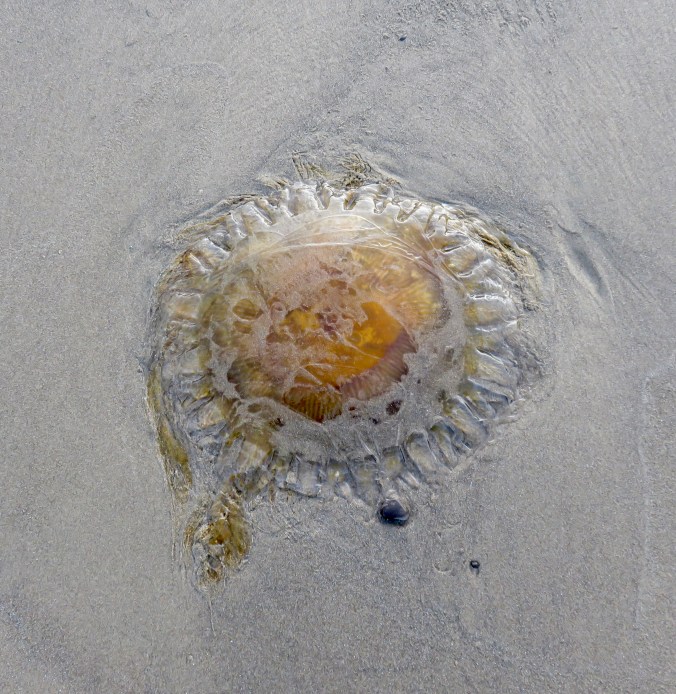
It was the orange jellies I was warned against as a child. The clear ones tended to be a couple of inches across when I was young. The orange ones were six or eight inches. This one is closer to eighteen inches. No, Daddy, I didn’t touch it.

We had such a wonderful Thanksgiving that I am embarrassed to think of it. I told Tammy on the beach this morning that I didn’t feel I deserved such a lovely day. She said, “It’s best not to connect the dots.”

Our drive over was uneventful—good news given forecasts of snow and ice. We walked in Forest Park with our younger son’s family, checked into a hotel, had dinner with our older son’s and his wife’s family, and then went back to the Kennedy School for a long soak in their pool. It was very cold and the soaking pool is outdoors. Bamboo and fats and palms rustled overhead, but the water was perfectly warm. We slept well, had breakfast and drove home again. Snow on the verges but no ice on the pass.

We also had an opportunity to drive in the city. Always an adventure. We were honked at twice, each time while waiting for a pedestrian in a crosswalk. People gave us exasperated looks for driving too slow—barely over the speed limit. (I have come up with a new safety rule about speed: drive at the posted limit plus 20% and other drivers will not throw up their hands.)

Today I received a link to a fascinating history of automobiles in the U.S. Apparently our “love affair with the automobile” began where Groucho Marx declared it so in a documentary financed by the car industry. Early on there were perfectly functioning electric cars and people walking, on horseback, or driving were not in such a rush. Most hated the new cars that only the wealthy could afford. All Americans would pay for the roads these drivers demanded.

In his 1896 essay making the case for electric vehicles, Salom decried the fumes associated with the internal combustion engine: “Imagine thousands of such vehicles on the streets, each offering up its column of smell . . . and consider whether such a system has general utility or adaptability.”

Instead of thousands of such vehicles, we now have more than a billion. Had the desire of working Americans for safety been prioritized and their enthusiasm for public space been respected, transport might have designed on the basis of public good rather than private enrichment. If that had happened, the planet would look very different today.

Instead, a relatively small number of entrepreneurs successfully campaigned to reorganize the country—and subsequently the world—so that their particular business model might succeed.—“The Car Culture That’s Helping Destroy the Planet Was By No Means Inevitable: On the Relentless Campaign to Force Americans to Accept the Automobile” bJeff Sparrow

Today is the last day of NaNo and I have over 53 thousand words. I think they are mostly in the right order, though I might have to flip chapters 19 and 23, which are both flashbacks and probably need to be in chronological order. I have marked the five chapters I need to develop further. Overall, it is way too short, but I think once I develop another plot thread (plot!) and those five short chapters, I might get to a more desirable length. I aim for 70-80k words.

fullsizeoutput_112bThis morning we went out for our beach walk on last night’s high tide line where we expected to find trash. We did and brought it home, and I found three pieces of glass, some shells and frozen jellyfish. When I was a girl, jellyfish were rare. I might see one orange jelly six or eight inches across in a half mile walk. These days we see dozens or hundreds, both blue and orange and ranging from an inch up to two feet across.

It was sunny and cold this morning, and we were glad to be out and home.
 

WITH OR WITHOUT

IMG_5134

We wish everyone a happy Thanksgiving. Alone or with friends or family. With or without turkey. With or without.

There is always something missing. In childhood that was whatever the parents were allowed to do that we, at seven and four, believed we were missing. As adults there is the glossy image in magazines and television of what holidays look like. They never looked that way for us. Disagreements and tension, jealousy and resentment. There are the missed opportunities and missed events. Mostly we miss people.

We hope to see most of our family today, but not one of our siblings. Most live far away. One has already died. One does not speak to me. I imagine some people assume that last is my fault. Sometimes I have too. But mostly I am over the rejected overtures and that particular guilt. I am thankful for that. I am thankful.

“When psychologists study siblings, they usually study children, emphasizing sibling rivalry and the fact that brothers and sisters refine their social maneuvering skills on one another. The adult sibling relationship has only sporadically been the subject of attention. Yet we’re tethered to our brothers and sisters as adults far longer than we are as children; our sibling relationships, in fact, are the longest-lasting family ties we have. . . .

“In one Swedish study, satisfaction with sibling contact in one’s 80s was closely correlated with health and positive mood — more so than was satisfaction with friendships or relationships with adult children. And loneliness was eased for older people in a supportive relationship with their siblings, no matter whether they gave or got support.

“That’s why it’s so sad when things between siblings fall apart. This often happens when aging parents need care or die — old feelings of rivalry, jealousy and grief erupt all over again, masked as petty fights ostensibly over who takes Mom to the doctor or who calls the nursing home about Dad.

“Many families get through parents’ illnesses just fine, establishing networks where the workload is divided pretty much equally. Paul and I did fine, too, throughout our mother’s progressive frailty and forgetfulness, and we also had no problem splitting the chores that arose in the aftermath of her death. But about 40% of the time, according to one study, there is a single primary caregiver who feels like she (and it’s almost always a she) is not getting any help from her brothers and sisters, which can lead to serious conflict.

“And because of the particular intensity of sibling relationships, such conflict cuts to the bone. People grieve for the frayed ties to their siblings as though they’ve lost a piece of themselves.”—“Here’s to Grown-Up Siblings and the Ties that Bind” by Robin Marantz Henig on NPR. [Well worth a read.]

That has been the other loss I grieve on top of parents, profession, and pets.

I am thankful for my husband, our children and grandchildren and their other families, for the memories of forty years of teaching, for art and the ocean, for still being able to walk miles, for my step-grandmother who left me this house, for books and so many decent citizens and those committed to justice and kindness. Thankful for the hard work of others who care about more than themselves.

And I am grateful that the water in the bird bath is not frozen this morning, and that in a couple of hours we may be safely on our way to see people we love.

Thankful.

PROGRESS

fullsizeoutput_1126

On Tuesday, I “won” the National Novel Writing Month (NaNo) challenge by completing fifty thousand words. It needs at least twenty or thirty thousand more words, but I have identified the arc of the story, my two main characters in their parallel experiences, a structure that imposes both tension and order, and some sort of closure. Words, words, words. I am not done but have the beginning of a novel, and I have cheated, which is totally allowed.

Once a week I play Scrabble with a friend and we cheat. We do not keep score, we use  the dictionary and a page with two-letter-words to check spelling and aid our choices, and our goal is interesting words and enjoyable play. We have never actually traded tiles, but we frequently lament picking a third and fourth A from the bag of letters. The letter I seems to gather too often as well. We offer to move our new word to another part of the board in order to make play easier for the other. We both celebrate a new word neither of us has used before. We laugh when each of us manages to put down the same word: OATH or QUIET. We play until we have used all the tiles, and then we play a second game. We have been doing this most weeks for a couple of years.

My husband and I began playing Scrabble in 2015 when I retired from full time teaching. But I usually won because I like winning competitive activities and I am a strategist. It was not so much fun for Gary. Running had to be abandoned because of my arthritic feet. Instead, we began taking our daily walks together. Yesterday, we walked for over two hours. We do not go so far from the house, even in two hours. We walk up and down the beach, and gather a lot of plastic, until my back aches from bending over fifty or a hundred times to fish a bit of blue plastic or cup lid from between stones. On certain parts of the beach we follow a very close zig-zagging course, searching every inch for sea glass. Yesterday I found a nub of thick brown glass. Gary found an impressive lump of clear and pale green larger than a quarter.

He tells me I am grieving because I have left teaching. He was delighted that I retired. (Gary takes exception to the “delighted” because “from the situation you were in—yes. From the work that you loved—no,” he says.) It was the right decision, the situation was too stressful, and it was good that I retired. But he still says I am grieving.

I have gained ten pounds, and my days are a muddle. I hope, once an entire school year has passed that I will be in a better state. We miss our children and grandchildren though they are not so far away. We miss the dog. We miss the cat. We are clearing out the house. Only one bedroom is piled with gifts waiting to be wrapped, and my work space is pure chaos. I have three quilts wanting binding. Three knitted items being blocked. Boxes of materials and piles of scraps that want sorting.

My life wants sorting. I recently read Gail Collins’ new nonfiction, No Stopping Us Now, which chronicles the accomplishments (and struggles) of older women in the United States. Despite medical opinion over the decades that women are unfit, insane, or simply dangerous in age, older women have managed to change the world. My personal favorite example is the author of Silent Spring, Rachel Carson. Carson did what many women I have known and worked with have done. She sacrificed her ambitions, abandoned her educational goals after completing a Masters and went to work as a marine biologist for U.S. Fish and Wildlife Service in order to support her family. When a friend begged her to find out why all the songbirds were dying after a community DDT spray, she looked for someone in that field to write about the danger of pesticides. She was in her 50s when she accepted that no one in the field would risk the backlash from industry, she devoted the remainder of her life to documenting the dangers of the poisons spread on crops and neighborhoods.

“Although Silent Spring was met with fierce opposition by chemical companies, it 1024px-Rachel-Carsonspurred a reversal in national pesticide policy, which led to a nationwide ban on DDT and other pesticides. It also inspired a grassroots environmental movement that led to the creation of the U.S. Environmental Protection Agency. Carson was posthumously awarded the Presidential Medal of Freedom by President Jimmy Carter.”—Wikipedia
Rachel Carson was 56 when she died of cancer.

November is the beginning of the dark days of the winter season. It is a false glittering and interior time. I tend to look inward, to make plans, set goals in this season. I have no illusion of contributing to the world as Carson did, but I am not done contributing. I will complete the projects currently cluttering my work space, clear it out and begin cluttering it again. I am teaching a workshop for Willamette Writers in April, and perhaps I will complete a novel over the coming months.

SEEING BASALT?

IMG_5172

Seeing things?

My blog is loaded with mistakes. Misspelled and missing words, usually. I figure most of them out and correct them eventually. Some slide right by for months or forever. Sometimes I might blame auto-correct, but more often it’s just my lousy typing.

I was reading a personal essay in a literary magazine. The piece has a title that includes a couple of food items, including a particular mushroom. I realize that the essay isn’t actually about mushrooms, but using them as a metaphor, but I don’t believe that is enough of an excuse to use a photo of chanterelles clear across the top of the page. I know my chanterelles. I’ve picked them and enjoyed eating them. They are not at all the species referenced in the essay title or the essay itself. I was completely distracted, scanning the essay for a reason that illustration was there. No. Apparently someone wanted an attractive photo of mushrooms. Any mushrooms.

If the designer had gone to Wikipedia, he or she would have found an image—not in the public domain but a source is available and likely would have allowed use. Or a photo of the other metaphorical food. That one would have been available at the local market for purchase and photographing. Wikipedia has a terrific photo that is free to use with credit. Not so very tricky.

Instead, a few hundred people are going to think Auricularia auricula-judae look like chanterelles. Different color, shape, texture and flavor.

I suppose this only bothers me. Like the writer who used the word “voodoo” in a novel that was supposed to take place close to a hundred years before that word was coined. Adult crows with pink legs. A cottonmouth snake a thousand miles outside its range. Horses and big cats and other animals behaving in impossible ways. I find such errors all the time. Sometimes I think: I could make that mistake (well, witness how often I do here). But other times I begin to doubt the narrative. I wish the author had completed just a bit more research. Sometimes the mistake just feels like carelessness. Indifference to truth. The “creative” in writing does not mean every- or anything is possible. Even a fantasy novel creates an internal consistency, rules by which the magic operates.

I’ve closed the page on that mushroom-not mushroom essay. It’s possible that the designer (I refuse to blame the author) used the wrong species of mushroom deliberately to make some sort of point or to drag me in. I should go back and reread to see if it was a plot designed to intrigue people like me. (Fusspots and picky-readers.)

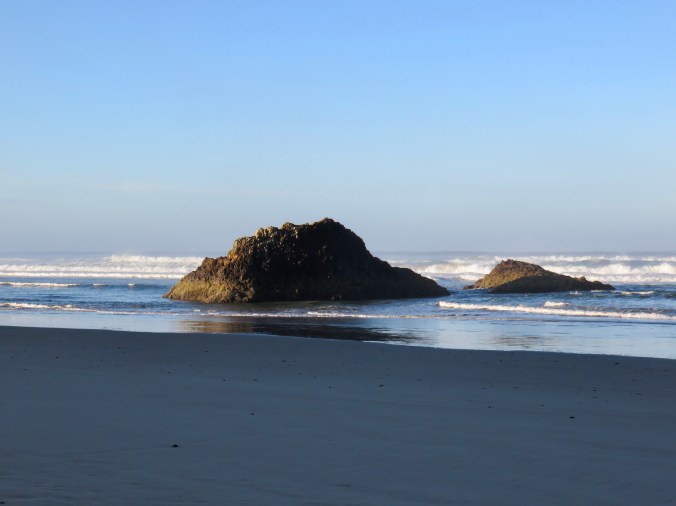
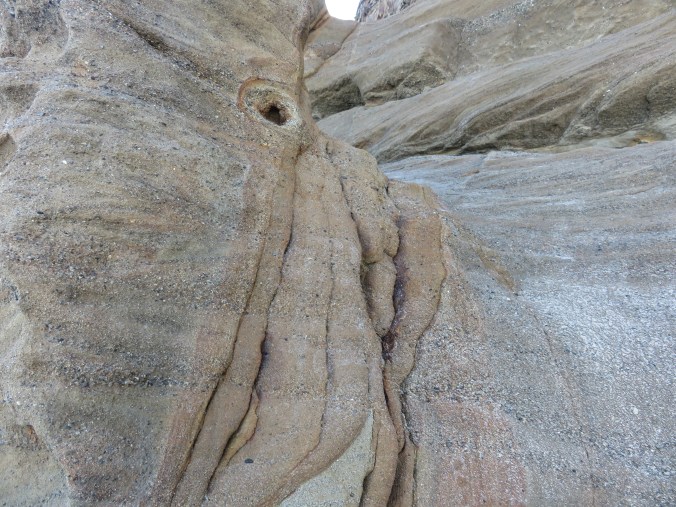
But no. I am set off and distracted and writing my own blog post about how basalt lines my shore. When the tide is high a retreating wave tubes the stones over one another, clattering in a deep-throated tumble that very gradually rounds and smoothes their edges. (Yeah, that’s sandstone up at the top of this post. Different color, texture, shape, flavor. I could have posted a photo of basalt, but why?)

CHANGING WEATHER

fullsizeoutput_1122

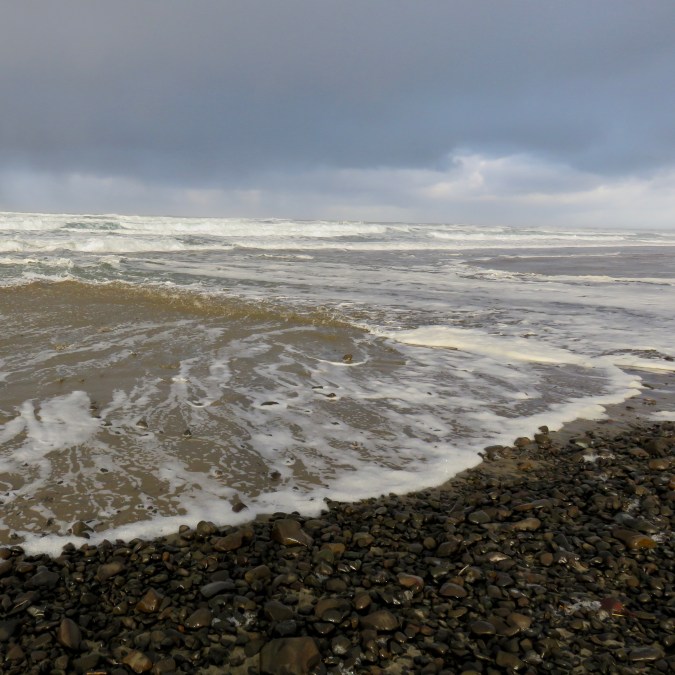
Dark clouds, rain, waves coming from odd directions, not just onshore but across. This is the point we turned for home on our walk yesterday.

Lots of new roofs going on lately. We put a new roof on our little duplex rental and it seems to be holding up under the weather. The roofers are busy. It took our contractor six months to get a roofer to do the job. Gary is still picking up trimmings and roofing nails. The contractor working on the house north of us put a wrap over half the roof because it was dripping inside the house and then had to come out and put on a larger wrap. In the end, he roofed it himself, though in my experience general contractors don’t like roofing themselves.

In the mean time, the barometer has been dropping, we are experiencing 10′ tides, and neither Gary nor I has found a piece of sea glass for a few days [found green later in the day]. That last is unusual with high tides washing into the rocks. But there is no telling. Lots of bits of pumice have been kicked loose

People staying in the rental since the roof was repaired have been out in the ocean. A reminder: it’s November. Barefoot, swimwear, and playing in the surf during outgoing tides. Sometimes it was all I could manage not to go out and tell them to get their kids out of the water. In forty years, we have known too many drownings.

We expect to see snow in the coast range today. We expect to get in a walk because high tide is late in the morning. Yesterday we went out after dawn and after the tide had been coming in for a while and had to walk home on the road because the waves were washing up into the rocks by the time we got to our turn around. We got a little bit wet too.

A huge drift log, a couple feet across and thirty feet long, rolled and floated up and down in the tide. That log lived in the hedge next door for at least a decade [Gary says at least 2 decades], but yesterday afternoon it was lying in the sand directly in front of our house. We hope that 10-foot tides today and tomorrow will move it on.


I have finished my last holiday gift and picked up larger needles to make a hat for my grandson. The #6 needles felt so fat after knitting with #1s that I unraveled the hat and started over with #5s. I have a little dress to make too, and it’s supposed to be done the day after tomorrow. I am not optimistic.

NaNo is also a struggle just now. I have over 45k words, but the last few thousand are coming slow. How hard could it be to write those last five thousand words? At this point in previous years I had 70k, well over what I need for NaNo. And here I am struggling to get to the minimum.

fullsizeoutput_1124The good news is that I may have figured out how to develop the generational historical v. contemporary conflict I  had in mind at the start. Yeah, four days to go in NaNo and I might finally know what I’m doing? I have devised a plot twist (yes, plot! actual plot!) and have about a third of that written. I know about how it ends. I think I am writing Elizabeth Berg when I keep hoping to write something far more edgy, more like Emily Fridlund’s History of Wolves.
Well, there you are. Scratch this cynic and the optimist bleeds.

SIN OF OMISSION

fullsizeoutput_1117

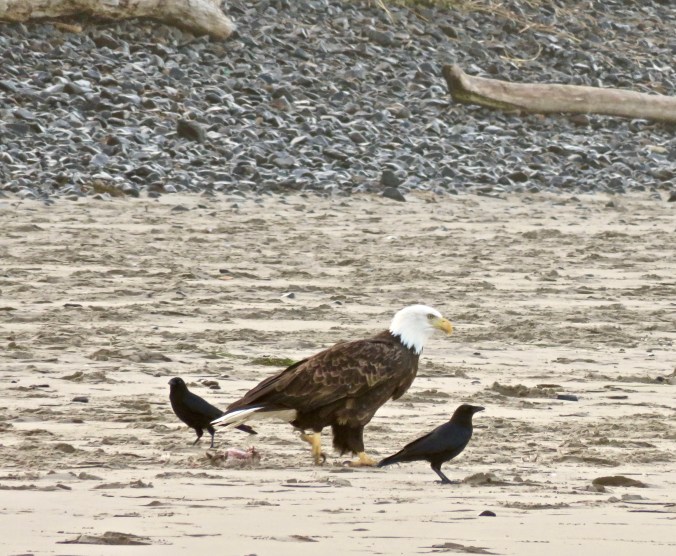
Many times crows forage beside eagles. The crows cannot pierce the skin of most dead creatures, but the eagle can. (In the wild, ravens hunt in tandem with wolves. The raven spot game, the wolves open the body.) I have seen crows drive raptors from a wounded gull and from their own nests. The smaller birds win their point.

“A man has been arrested after antisemitic abuse was directed towards Jewish children on the London Underground. … Wearing a cap and hoody, the man is seen in the video threatening a man off-camera after he tries to intervene before a woman in a hijab – Asma Shuweikh – confronts him.”—The Guardian

The Muslim woman is a mother of two and wishes more people would intervene in such situations.

“Wilshire Bus,” a short story by Hisaye Yamamoto, concerns a woman taking the bus to visit her husband in a VA hospital post-WW2. Japanese-American herself, Esther says nothing while a drunk harasses an elderly Chinese-American couple on the bus. She bursts into tears when she reaches her husband’s hospital bedside. He believes this is because she misses him, but readers understand that she is suffering from guilt that she failed to defend the couple on the bus. When I first read the story in graduate school, the obvious ironies of the situation and her feelings of guilt reminded me immediately of my own experiences.

I would have been twenty-one or twenty-two, an undergraduate student at the University of Washington and taking the bus home alone. My husband and I had bought a house on the other side of the zoo. I was sitting toward the back and a drunken man began harassing an adolescent child. People nearby looked nervous but avoided eye contact. I thought we all hesitated to say anything because the man was big and we were afraid. A young black man stood up from his seat and told the drunk that he needed to stop what he was doing. It’s been over forty years and I do not remember everything, just that the young man was slender and the drunk outweighed by fifty pounds at least. I remember that the drunk got off the bus at the next stop. I remember we were grateful to the young man. I remember thinking the drunk was twice my size and wishing I had done something myself and trying to think what I should have done.

The next time was also on a bus, and I was also alone, but instead of the route that ran east-west on 45th, I was heading downtown. I can no longer remember the bus numbers, but this one took Eastlake Avenue NE, traveling south from the U District. Again, I was seated near the back and again a man began harassing someone smaller, a racist harangue. I got up from my seat almost immediately and walked to the front to tell the bus driver. By the time I got to the driver, there were three of us. And this is very clear: The bus driver did something I would never have thought could happen. He pulled his bus over the the side of the road, on University Bridge. He stood and walked to the back of the bus and told the drunk, “You’re going to have to get off my bus, or I am calling the police.” And the man got off and passengers clapped and cheered.

Sometimes doing the right thing is frightening. It might even be dangerous. I did not directly confront a drunken man who outweighed me by close to a hundred pounds, but I found a safe way to intervene. In Yamamoto’s story, many people were offended by racist language, and every one remained silent until after the drunk had left the bus. Esther suffers from her sin of omission. She fails to act as she knows she should have.

So did I.

Fortunately, I learned my lesson and I like to think so did Esther. I think the courage to act in such situations sometimes requires rehearsal. We need to think it through in our heads and balance what we know is right with known risks.

Mob rule is not right and speaking up can be dangerous—we mostly all learned that in school. Silence in the face of abuse can be more dangerous. The assumption when we are silent in response to abuse is that we agree with what is being said and done. And that perpetuates the evil.

How many times do we need to learn that lesson?

PRINCESS

fullsizeoutput_110e

I have tried to stay away from making political comments here. (Readers “unfollow” every time I do.) But Prince Andrew.

This is not about the disastrous interview on the BBC where the royal admitted to being “too honorable” but with no memory of abusing a child. I did not watch the interview. I cannot avoid the excerpts.

This is more basic. (My grandfather was born in England and his son, my father, was an historian. I had more than my share of British history as a child.) I will set aside just for now the immorality of British behavior in the world. My immediate anger is reserved for the assumption that anyone is born royal. The concept of royalty is at its base both immoral and unAmerican. Nobility and aristocracy are notions that rely on a simple, magical concept: God chose these people to be better than the rest of us.

Is it possible for an American to believe this?

While my country is obsessed with the individual, powerful people in my country are nevertheless earnest in their support of inherited rights.

I tried watching Merlin yesterday on Netflix because the series is leaving that streaming platform next month. So cute. Arthur is a spoiled brat, Merlin is initially magical without effort (I assume this changes as the series progresses), and all the young women look alike. The music is spritely and everything is charming and funny. Young adult fare. I paused the show when Merlin is put into stocks and fruit is thrown at his head. This was treated as comic relief. (I could hear my father sigh, his patient explanation of what happened when a person’s head was locked into stocks. No one would have wasted edible food and stones would have been throw. People sometimes died in the stocks.)

Every Disney princess film plays to this assumption of privilege by birth. Fathers are significant in most of these films, the choice of female villains is misogynistic, and the assumed beauty and inevitable ascendancy of the heroine are damaging to the character of impressionable children. How to reconcile American “rugged individualism” with the concept of royalty?

It cannot be done. It should not be attempted.

I have been thinking a great deal about the presumptions of power. About how we view the rich and powerful. About the Puritan faith that worldly success reflects God’s favor. That seems entirely counter to the ideals upon which our nation was later founded. (And which we have repeatedly failed to make manifest. What we believe is right vs. how we behave.)

Andrew apparently thinks he did well in the interview. He thinks his explanations and noblesse oblige were enough to excuse the photo with his fingers on the bare midriff of his accuser, his tour of the palace enough to excuse his lack of empathy, his precise memory of pizza and his four days spent in the mansion of convicted child molester excused because sex “is a positive act” for men.

But no. This is about power and the presumptions of power.

I have tried to recall if my father every called me, as so many fathers have, “princess”? Perhaps. I recall him calling me, in rare and precious incidents, “daughter-of-mine.” It felt likely an honorary title, that I had earned that designation. As a nation we are founded on the principle that each person earns their way. Yet here we are rewarding torture as if it were comic relief. Making birthright preeminent rather than accomplishment. Admiring bullies and power over decency and righteousness.

We should do better. We should feel determined to do better.

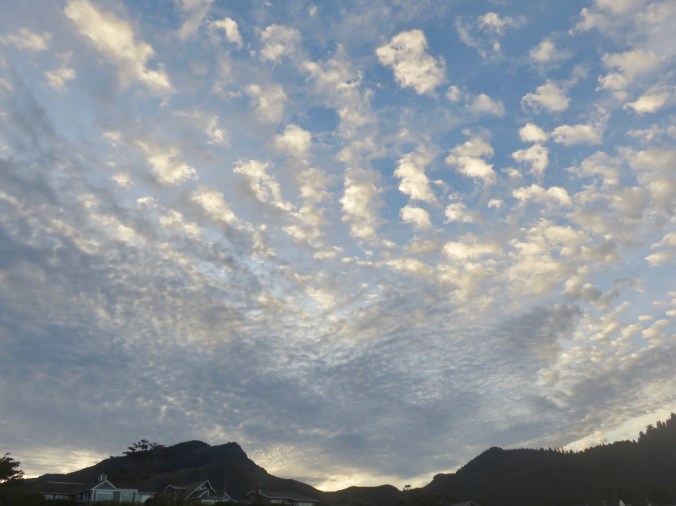
The sky is pink in the east this morning.

DECLINING BOBS

IMG_5147

In the satellite photo, there is an ancient white Volvo parked in the driveway and a waterbed tipped up on its edge where both have been for at least a decade. A surveyor was here the past few days, locating property lines and updating contours for the new owner of our neighbor’s house. The sale closed a week ago but the previous owners have been slow to vacate. The locks have been changed. The buyer is land developer and we fear he will try to create a triplex out of the building and flip it. That is one rumor.

The good news is that we are not built on that property, as our previous neighbor believed. She based this on a survey completed by another neighbor. That neighbor had been half responsible for inaccurate work in two counties. (Thirty years ago I was doing research for an architect, and the county engineer told me that surveyor and another one had been told to retire, that their work was so bad they would no longer accept it. Nevertheless, that neighbor was the one who surveyed that house when it was built in the 80s though that survey was not, of course, recorded with the county. At that time the area was so badly out of kilter that local firms refused as there were no reliable markers to work from.)

Times have changed.

The waterbed is gone, but the Volvo is still there. Last week, the former owners took out a few things on a flatbed truck, always in the middle of the night. (Make of that what you will. Marijuana is legal in Oregon.) Moving didn’t really take off until the day after closing when an enormous U-Haul blocked the entire road. There was a great deal of shouting and banging.

It was my grandfather who surveyed property lines for our house in the 40s (the older one was built by his aunts in 1911), and his third wife Genevieve who had walls built at the north and south in the early 60s. The wall on the south side is entirely on our property. Turns out the neighbor’s dog is buried mostly on our front yard, and so are all their downspout drains that have given us so much trouble. Ruby’s fort is well within our property.

There are still three Bobs left. One is a tenant, one owns the rental across the street, and a third lives a block away. The new owner is not a Bob. We hope the new owner will not create a triplex of short-term rentals. We hope that will not happen. We like having real neighbors.


NaNo is going fine with over 33k words. There were briefly over 34k, but then I began butchering.

One of my favorite websites is selling little bags to use for sandwiches in the toaster—reusable “up to 50 times” and “completely food safe.” The trouble is that they are made of fiberglass and PTFE (DuPont’s Teflon). Teflon has been labeled carcinogenic by some (many), but there is considerable disagreement about that. (My husband points out that overheated Teflon releases fumes that can kill pet birds in the house. Trust him to know that.) Fiberglass can release tiny particles which are not healthy, but there is such a thing as “food grade fiberglass.” So maybe okay? . . . Even if it’s chemically harmless to use in a toaster (really?), such bags make nasty trash.

fyi When I want a heated sandwich, wrap it in parchment paper in the oven or a toaster oven. I reuse my parchment paper over and over, too, and it’s a lot cheaper than bags that might kill the parrot. If we had one.

NaNo ISSUES

fullsizeoutput_10b6

Am I the only one who finds the new NaNoWriMo site clunky, uncooperative, and downright annoying? Communication in forums is impossible (I find nothing when I click that link) and with buddies seems challenging (a message from a buddy waited to be read for a week because I didn’t notice it was there). In fact, if this had been the site I used the first time back in 2016, I might not have continued using it, and I have completed and “won” the NaNo November challenge three times and also written in other months. It has been a great comfort to me in years past.

But now . . .

My stats show up erratically. Sometimes NaNo knows this is my fourth November, but sometimes it announces this is my third or first. That’s no big deal. It’s when I try to access people or useful information that I find . . . nothing. Every time I try to access any of the links beyond the actual Help Desk, I get an error message. “Known Issues,” for example, is just one of the links that returns “Login Error.” It’s all downhill from there.

Most of the links I have tried to access return that message. (The exception is that NaNo merchandise links work perfectly, of course.) I don’t even remember how I eventually was able to send a note about these issues to the higher ups over a week ago. They probably clicked on it and their login failed.

I thought my troubles might be because I was using Safari as my browser, but I had the same issues with Chrome.

Some questions were not all that hard to figure out on my own, like how NaNo determines my writing speed, etc. But overall, the updated version of NaNo seems far less intuitive, and communication, and error messages, and trying to access anything. Fortunately, I have my link stored in my computer or I’m not sure I could get to my data at all. Perhaps I should logout and try logging in again? Somehow that sounds like a recipe for disaster, and I won’t try that until I am willing to abandon the whole site.

Gary says, “Any sensible person would have given up by now, but you’re too stubborn.”

I am over halfway through the “challenge” (passed 26k words this morning) but I do not like what I’m writing at all. So this morning my mood would be a bit testy even if the website functioned as I wish it would.

Maybe I will knit the rest of today when I am not walking in the rain. (In case you are thinking that a rainy days sets off my mood—nope. We are always grateful for weather.)

“I sometimes fear that all of humankind may sooner or later come to my conclusion: that reading fiction is a waste of time.”—Isaac Bashevitz Singer

I think fiction is a vital aspect of humanity and Singer was probably having a bad day. Maybe he tried using a website to track his writing progress?

coming soon: declining Bobs