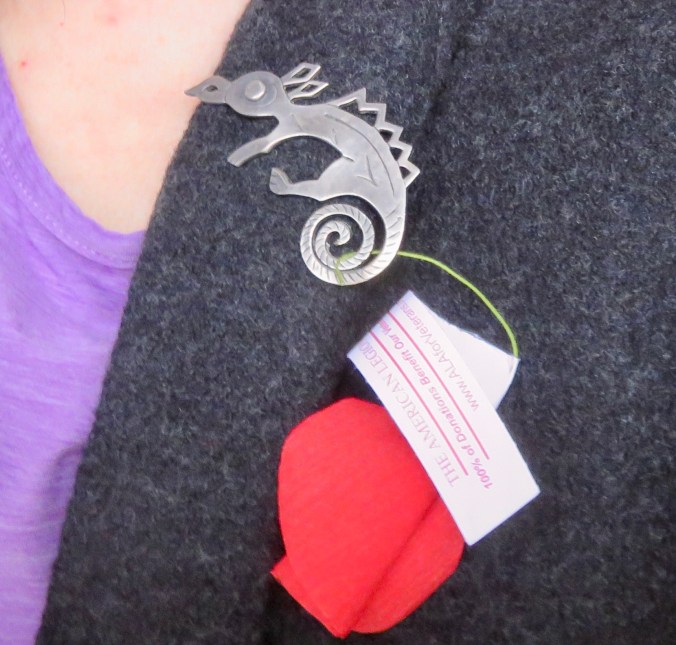
When Gary was a little boy, he sat at the dining table with his mother and made red poppies for Memorial Day. Like her husband, Alta (“Anne”) served stateside during the Second World War. She gathered little red cloth petals, wound them onto a wire to be worn in honor of our veterans.
My husband buys a poppy each year. Today they are made of paper. For a time we had chain of them hanging from the rearview mirror of the car. The tradition dates back to a famous poem from the First World War:
In Flanders Fields
In Flanders fields the poppies blow
Between the crosses, row on row,
That mark our place; and in the sky
The larks, still bravely singing, fly
Scarce heard amid the guns below.
We are the Dead. Short days ago
We lived, felt dawn, saw sunset glow,
Loved and were loved, and now we lie,
In Flanders fields.
Take up our quarrel with the foe:
To you from failing hands we throw
The torch; be yours to hold it high.
If ye break faith with us who die
We shall not sleep, though poppies grow
In Flanders fields.
The poem above is often formatted incorrectly. It is a form—that is, prescribed lines and rhyme scheme are followed by the poet. McCrae was Canadian and he died in the war, as many of the so-called War Poets of the Great War did die—Wilfred Owen, Rupert Brooke. Siegfried Sassoon (a British officer) survived despite wounds and decorations, despite his letter to The Times in which he called out the powers-that-be for needlessly sending troops into combat when a negotiated peace was possible. “I believe that this War is being deliberately prolonged by those who have the power to end it,” he wrote. He would have been tried for treason, but another poet declared him a victim of “shell-shock,” and he was sent to an infamous, tortuous asylum, Craiglockhart War Hospital. He survived. He returned to the front—why should his men die without him. Throughout, he wrote poetry. “The dynamic quality of his war poems,” according to a critic for the Times Literary Supplement, “was due to the intensity of feeling which underlay their cynicism.” “In the history of British poetry,” McDowell wrote, “[Sassoon] will be remembered primarily for some one hundred poems . . . in which he protested the continuation of World War I.” He survived that too. I honor him.
Today is the day Americans celebrate Memorial Day, in honor of our fallen. Our great war was the Civil War, the only war on home ground, the only one with fatalities on a scale approaching the losses suffered by Europeans during the wars in the twentieth century. This violence that we accept as the inevitable price for our freedom.
I turned on the television after our walk, just as we finished breakfast. Bird was on, Forrest Whittaker coming home drunk. “Is he going to hit her,” my husband says. “It’s in the room.” Charlie Parker is talking to his wife, everything is all about him. The violence simmers. I turned off the show when the inevitable hit occurs. I wonder what this assumption—mine, my husband’s, society’s—says about men and violence.
What does this tell us about what is inevitable, about what we should accept and even approve in pursuit of a contrary goal of peace. The advice to bullied children to hit back. The determination to “fight” cancer as if it were a war, striving to kill the enemy, instead of striving for life. Always an enemy in sight.
My father and aunt also served in WW2. My aunt served in San Francisco and my father was present in the “liberation” of a concentration camp in Germany. He would not tell me details. The date was writ small on a scrap of paper in his wallet. However much he honored women, he sheltered his daughter from that horror. I am (mostly) sorry for that protection.
That belief in protecting women seems to me at the heart of the brutality we too often suffer. This belief that somehow because I need protection I am also less capable, or less deserving of honor and respect. A student this past spring told me that most of the #MeToo movement was lies and exaggeration. He was always polite in speaking to me except in this. It did not occur to him that his belief was trumped by my personal experience, not even after I revealed it to him.
Emma Thompson wrote: “If a man has been touching women inappropriately for decades, why would a woman want to work for him if the only reason he’s not touching them inappropriately now is that it says in his contract that he must behave ‘professionally’?”
In a recent interview she was asked how men who have behaved badly and been caught might “come back” after the #MeToo scandal. She said that was less her concern “at the moment” than concern for the women who had suffered over all that time.
It is not only women who are concerned about the abuses of powerful people. It is not only women who have suffered. It is not always women who demand change. Men demand it too, some women are untroubled. Our views are not entirely determined by gender. Does this surprise anyone? As one obvious example, I have often wondered how any righteous woman could possibly support Trump, but they do. We share the capacity to be blind, indifferent, biased, and unfair.
Women and men are not actually very different biologically either—seriously. In our genes, we are very nearly identical. Yes, sexual characteristics, penis and vagina. Men are generally bigger, but some women are taller than most men; some men are smaller than most women. The same applies to body strength and tone of voice, muscle mass, inclination to violence and other behaviors. Societal classifications of masculine and feminine are both slippery and confining. I have often wondered, going back to my teenage years when several of my friends were out, how much easier we would be in our skins if the expectations for our behaviors and goals were less inevitably tied to our more obvious gender.
I know so many women of my generation and even of the current generation whose expectations are driven by gender stereotypes. I was born in 1952 and my own mother was a stay-at-home parent. Though she defined herself as a feminist and warned me never to trust a husband, she also assumed I would marry a man who would “take care of me.” She thought I should “have a skill to fall back on” and she meant typing. Refusing to learn to type was my act of teenage rebellion. Despite this, I know what society expects of me as a person: to be a woman. I know myself as a woman. I know feminine. I am those things. I have played that anticipated role all my life and I cannot set it down as a burden. It is wound into my identity.
There are other ways of defining the self. There are opportunities for both men and women to be greater than their assigned roles, to be stronger and kinder and better, more forward-thinking and courageous.
“In Flanders Fields” the poppies grow. What does it mean to “break faith” with fallen soldiers? Does it only mean fighting on? Or might the fight extend beyond the battlefield. Might keeping faith demand more of us that mere brutality. Might it demand another sort of courage and honor, some act more tied to life. I would like to think so. We do not live in a film with the script already written, the violence simmering.
None of this is inevitable. We might keep a better faith. I hope my granddaughters and my grandson will not remain as harnessed, fallen into socially defined roles as my own generation. Trapped by the foolish notion that the best will win; that best is defined by hitting hardest. That is a fall.
I might wish our children had greater freedom, not to fall on their swords, but to rise to their own best selves.


 IMPERFECT PATIENCE