WET

IMG_4967.jpg

Yesterday there were deer tracks at the base of our path to the beach. This morning a coyote had passed by. We went out a bit late, and I did not put up my hair or even put on a hat because it wasn’t cold or windy, just cooler and damp the way we like it. I unzipped my jacket on the way north because the rising breeze hit my back and I was warm. By the time I thought I should put up my hood, it was already wet inside. I figured that was okay. I hadn’t worn the jacket to keep warm but because it was wet.

As a rule, we do not mind the wet. If we minded we would live someplace else.

We walked for an hour, north and then back south. On our way north, Gary mostly followed the tracks of the coyote on the sand, and I mostly walked in the basalt rubble lining the shore. The tide came right up over the sand and several feet into the rocks last night. I found plastic bits and bobs and leftovers from fireworks, a piece of quartz, a crumb of sand-buffed green glass, and a shell. On the way home, we walked with Tammy. She was dressed for weather—hood, rubber boots—though she’d decided it wasn’t worth digging out her rainproof pants. Like my hair, her pants were drenched by then.

IMG_4966.jpgRecently, juvenile gulls have been following me. One trailed me up and down the sand and over the rocks for a quarter mile the other day. I told him that was not wise. Humans are not to be trusted, and I would not feed him even if I had anything in my pockets he could eat. Yesterday, one came quite close, stood no more than four feet away and waited for a long time for me to do something. What?

There are too many dead birds on the beach, it seems to me. We always see one or two when we walk a few miles. This time of year the new seabirds who have failed to learn their survival skills start showing up, juveniles who have starved or done something stupid. Fully grown juveniles hunker down and call weep-weep at their mothers, who are done feeding them. After the first big storm or a crazy tide, youngsters are swept off Castle Rock and wash up onshore. This morning we saw a dead bird every five to fifteen yards, and that is not typical for late September or really at any time. We haven’t had a storm and many of the dead are adults. Three banded birds in as many yards—a seagull and two cormorants. Gary says the banding may have been enough to stress them, and there is no typical, no normal anymore.

Climate change has killed billions of birds, and millions of species are already lost or threatened.

But this morning we came home dripping and I sat comfortably watching the pale sky dissolve into pale sea. The osprey was fishing, the tide rushed in, waves swept across the sand, which has not begun moving back out into offshore bars.

IMG_4969I have finished a third quilt earlier than I expected (the last four rows of stitching completed Tuesday evening instead of Friday). Late next week I will carry it to Linda, or whenever she’s finished the two I pieced in August.

Yesterday I cleared out my work space, sweeping my work table, sorting colors into warm and cool and black&white bins, and finding storage for miscellaneous sewing and knitting tools and notions. The floor seems oddly empty without fabric spread out in patterns. The scraps from stitching and trimming—trimmed threads and bits of fabric less than an inch wide—made a heap on my work table. I dug through the little pile once more and then tossed it into a waste basket. I hope Gary might pluck out bits and pieces to save for birds’ nest-building in the spring. If we composted, they could go in as “carbon” I think.

The season is changing, weather and focus. There was Open House at the high school last evening, but we were at a restaurant visiting with mostly-retired school employees. Are you enjoying retirement? Some confess to having a hard time, missing students and the work. Some are simply relieved to stop. A friend in the former group is in the hospital. After decades of deep involvement and commitment to teaching, the way we are let go can seem rather heartless. And the way those with social connections are privileged and allowed to continue on their own terms can seem unfair. Six months out, I am still uncertain where I stand.

My kitchen floor is cleaner than it’s been in almost thirty years.

Change is inevitable. Not all of it is good. Not all bad.


GRETA IS PAYING ATTENTION

image.png

“This is all wrong.” Her words begin at 23 minutes, but the NPR article covers most of her speech [or here]. It is a brief, compelling speech. She is an amazing young woman, angry because it is impossible to be anything but angry. She has been paying attention, she will not forget, and she will not forgive.

I have been told throughout my life: Don’t get upset, don’t be angry, don’t lose your temper. Smile more. Find your inner peace. Yes, all that honey zen-like wavering.

As has been said: If you are not angry, you haven’t been paying attention.

Have the courage to be angry about the right things.

We walked long this morning. Our continued commitment to the coast is perhaps a foolish act of faith, an unwillingness to abandon our home, an unwillingness to abandon hope, and unwillingness to accept evil, and unwillingness to move to higher ground because so many in the world do not have that option.


the NIX

Gutt_på_hvit_hest.jpg

Gutt på hvit hest (Boy on White Horse) Theodor Kittelsen
[the horse depicts the Nix]

You might remember watching the film Harvey, “a 1950 American comedy-drama film based on Mary Chase’s play of the same name, directed by Henry Koster, and starring James Stewart and Josephine Hull. The story is about a man whose best friend is a pooka named Harvey—in the form of a six-foot-3.5 in. invisible rabbit.” Harvey is a Pooka or púca. Something very old, a magical creature of Irish, and indeed of all Celtic traditions, though under other names.

“Years ago my mother used to say to me, she’d say, ‘In this world, Elwood, you must be’—she always called me Elwood—’In this world, Elwood, you must be oh so smart or oh so pleasant.’ Well, for years I was smart. I recommend pleasant. You may quote me.”

“Did I tell you [Harvey] could stop clocks? Well, you’ve heard the expression ‘His face would stop a clock’? Well, Harvey can look at your clock and stop it. And you can go anywhere you like, with anyone you like, and stay as long as you like. And when you get back, not one minute will have ticked by. You see, science has overcome time and space. Well, Harvey has overcome not only time and space, but any objections.”

The Nix (or singular masculine: Neck; feminine: Nixie) are water spirits living in calm waters, which like pooka may appear as human or as animals (especially horses) and are known for their beautiful songs that lure people to water. Stories of such beings interacting with humans are found throughout northern Europe, from Holland to Sweden. The Rhinemaidens of Richard Wagner’s opera, Der Ring des Nibelungen, are Nixie. The nykur of Iceland and Scottish Kelpie are also horse/human shapeshifters.

Though stories about them do not consistently see them acting malevolently, they can be problematic tricksters. Sometimes they are helpful or very dangerous. Iron is sometimes seen as a way of neutralizing the powers of such creatures.

The Orkney, Irish, or Scottish Selkie is related but a human/seal shapeshifter, and the the song, “The Great Selkie of Sule Skerry” is a reversal of a more common story of magical brides stolen from the sea.

I am a man upo’ da land;
I am a selkie i’ da sea.
An’ whin I’m far fa every strand,
My dwelling is in Shöol Skerry.

That used to be one of my favorite songs out of Joan Baez’s songbook. I played the guitar and sang it when I was young.

This post began because Neil Gaimon has a new book out of Norwegian folktales and the cover features a painting by Theodor Kittelsen. I have a book someplace that contains Kittelson’s illustrations because I was fascinated by trolls when I was ten or eleven years old. My father took me to the University of Washington’s largest library and there we found three books with information on trolls, in Norwegian. Gaiman claims that when he begins rereading the stories in his collection he completely forgets why and is immersed in the tales.

“I keep trying to write a measured and sensible introduction to this book, and I keep failing. I keep failing because in order to find out what I think I pick up the proofs and start to read—or rather, at this point, to reread and to rerereread—any one of the Norwegian folktales waiting between these covers, and then I’m swallowed by them. I don’t read them critically. I don’t even put my compare-this-story-from-this-tradition-to-this-other-story-that-it-somehow-resembles hat on. I just start to read, and I’m following the adventures of Ash Lad, or the Girl Whose Godmother Was the Virgin Mary, and I feel satisfied.”—“Neil Gaiman on the Good Kind of Trolls”

Ursula K. Le Guin found Gaiman’s first book of retold Norse mythology a bit bloodless but I do not have those or these more recent retellings before me, and I am lost instead in the work of the illustrator, in the connections between these stories from many seas and waterways, and in my own history and passion for them.

Lost and found in story.

CLIMATE CHANGE

IMG_4963.jpg

The sky reflects in the washed sand.

The rabbit has been at my roses again. Gary put wire around the denuded stripy rambler and it leafed out again and bloomed, though it did not have the energy to send out much new growth. The other new, pink, rose in the front came back without help, but apparently the rabbit has been only waiting on salad. The stems are naked. Again.

We like the rabbits even so.

Gary and I have been out in the garden each day, attacking the escalonia, potting up flowers. There are little plants coming up all over the front yard where the deck used to be. The montbrecia came up first and the rabbit bites off a blade in the middle and then chews it right up to the end. Since then, snow-in-summer and violets and lamb’s ears are coming along.

We have been watching the Monty Don gardening shows, including Gardeners’ World. The BBC presenter talks about gardening in ways I have never heard in an American show or from any American nurseryman. Don puts up netting and wire against invading rabbits and cabbage worm, but he spends a lot more time talking about flowers and other plants and environments that attract and feed bees and moths, birds and other wildlife. Wildlife is a priority. He also realistically and explicitly addresses the challenges of gardeners’ more urban environments and the growing impact of climate change. Heat and drier summers. The challenge of new pests and the loss of native plants unable to survive the new normal. The world is changing.

IMG_4959.jpgOn our two-hour walk yesterday we saw a little display, a faerie-fort created by some visiting children. There are painted messages and careful arrangements of vegetation they found on the shore.

Where we live.

IMG_4756

World bird populations are in trouble. A recent study by Cornell shows a 30% drop of breeding birds, and loss of many species. In the mean time, an organization did a brown pelican count recently and decided they are doing fine. Most days I have counted a dozen or more each day. On a good day, there are too many to count—a great squadron or scoop or pod (or maybe a group of pelicans is called a “colony”?) flies on and offshore. We used to hardly see them, and then ten or fifteen years ago fourteen stayed all summer. It’s been a growing population.

We got our flu shots today and put the quilt back on the bed. The weather is changing from summer to autumn. It is a pleasure not to have to consider the heat.

I have been staring at the inner border of the orange and purple quilt for a few days, moving strips here and there, cutting new stripes, and I think it is ready to be sewn. I even took the step of applying for a show. I don’t expect to win one, but I have enough work to share. Either that or shift the quilts on four beds for newer ones.

Some change is good.


WATCHING THE STORM ARRIVE

fullsizeoutput_1082

Sometimes I worry about things. Mostly I have worried about that shallow and selfish threat to my country. You know, that one. But since I unsubscribed from cable television, The New York Times, and The Washington Post, I push those concerns to one side.

I worry about global warming and the use of poisons to control insects and weeds and people. I worry about cancers and the danger of a tidal wave washing my home away.

I worry about population growth, a concern when I was a little girl and the earth’s human population was less than three billion, and now approaching eight billion. I worry about the loss of empty spaces, that human need to use everything.

I worry that a journal that has short-listed my story for a year only means to tease me. I worry about using too much purple or not enough in the quilt I am making. I worry that the sweater I should be re-knitting for my grandson will be too large or scratchy or no longer colors he likes.

I worry that so many people are reading my post “Why You Don’t Want to Become a Teacher” and will think I did not love teaching and miss teaching with all my heart.

I worry about the way our community is changing into an industrial zone without people to care for more than income.

I worry about my brittle bones and bad teeth, my weight gain and poor posture, and finding better medical care.

I worry about the power flickering in and out, but not too much.

Those are the easy things.

I worry about dying and leaving my husband alone or being left alone by him dying first. I worry about alienating my daughters-in-law, each a dear person but not my daughter. I worry that I have failed to help my sons know and trust their obvious courage and kindness.

I worry my older granddaughter will throw herself on the floor in a fit of embarrassment. I worry that my younger granddaughter will be the pretty sweet girl people take advantage of. I worry about my grandson’s attention.

I worry every time my husband calls across the house to tell me about reading that someone we know has died.

And then.

And then I sit down during a break from the sewing machine and steam iron, push color aside, and I watch the storm come in. The waves are higher than yesterday. The sky is dark and brilliant. Rain makes a variable patter on the skylights. There is thunder far away, but the ocean roars steady over all.

And the sky is sometimes aqua overhead and bright and then darkening with heavy clouds. Those who only value the clear sunny days as good weather must have simpler lives than mine. This is the world I love.

My worries are fruitless, pointless, fussing. The storm is inevitable, inviolable, and out of my control. It is coming onshore.

I watch the storm arrive and I am not worried.


JAM INSTRUCTIONS

fullsizeoutput_107b

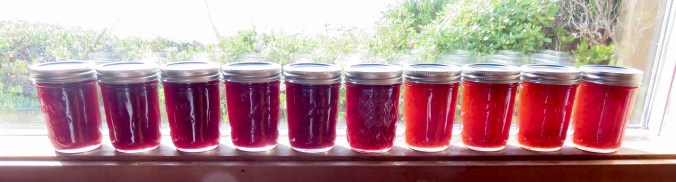
Here’s what I made the other day: ten (and a half) cups of two different pepper jams.

Basically, for any jam using pectin, you prepare fruit, add powdered pectin, bring to a full rolling boil that will not stir down for at least a couple minutes, add premeasured sugar and return to a full rolling boil for another minute, ladle into sterilized jars, ensure the rims of the jars are absolutely clear and clean, top with one-use metal dome lids, tighten on reusable metal rims, invert jars until cool enough to handle, turn right side up. By the time they are mostly cool, the dome should sink indicating the seal is good, often making a tink sound when they do, but not always.

NOTE: Nearly all current canning instructions require a boiling water bath to ensure the jars are completely sterile. My canning experience predates this recommendation. When I canned tomatoes and stone fruit and sauces in quart jars back in the day (the 80s), I used a boiling water bath. I have never done this with jams or marmalades or chutneys. I keep everything boiling hot when I fill and seal my jams. I have never had a problem.

PREPARE: Have everything ready before you begin.
fullsizeoutput_107c

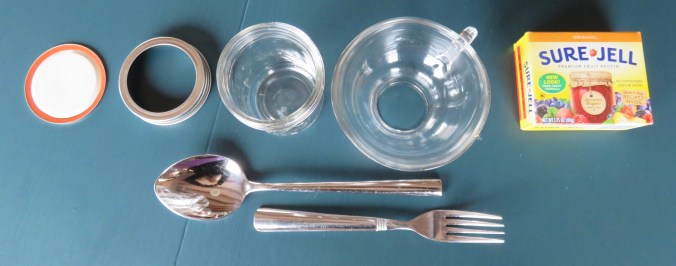
Dome lid, screw-on rim, half pint (1 cup) glass canning jar, glass canning funnel, commercial pectin, with large spoon for skimming and the fork I use to fish the boiled lids out of water.

Wearing gloves, prepare fire-roasted hot red peppers, by rubbing off the charred skins, splitting open and removing seeds and any tough membranes. I did this in the sink, one pepper at a time over a fine sieve placed in a colander, and under running cold water.

Measure out sugar in a bowl and place by the stove.

Put clean glass canning jars in the dishwasher without soap on a hot wash or sanitizer wash. Plan to begin making the jam at about the time the cycle will finish (my dishwasher tells me how many minutes it has to go). Keep the dishwasher door closed except to remove one jar at a time so that they are hot when you fill them.

Place the dome lids in a saucepan with water and boil. You will also need an ordinary fork or tongs to pluck each one out of the water as you need it. The screw-on metal rims do not need to be sterilized.

Set out a ladle, large spoon, small bowl for skimming foam, large canning funnel. Mine is glass.

Put peppers in food processor with blade and process till semi-smooth. Add vinegar and briefly whirl. Add pectin and whirl till combined.

1 pound of fire-roasted hot red peppers

1 cup cider vinegar 

packet of pectin*

(The packaged recipe says to measure the prepared fruit, but I almost never do that.) Place in a 6-8 quart kettle and bring to a boil, stirring constantly. Boil and add

4 cups of sugar

Return to a boil, still stirring, and here is why you need a really big canning kettle because it foams up high. I use long-handled bamboo spoon to stir and a 6 quart Le Creuset dutch oven. Mine is dark green on the outside and very pretty. I turn off the heat (usually while it’s in its last minute of boiling because the cast iron holds the heat for so long) and quickly use a large spoon to skim off foam into a bowl. There’s nothing wrong with the foam, it just shouldn’t go in jars since it’s mostly air. I use a cloth to hold the jars while I tighten on the rims since they are literally boiling hot. I tighten the rims by hand—that’s tight enough. After a day, I can remove the rims. The lids do not need them once they have sealed and cooled completely.

This yields about 5 cups of jam. Except I didn’t do it quite like this either time.

BATCH ONE: Since I cannot follow a recipe exactly. Ever. I made two batches. The first used the last 12 ounces of strawberry shrub I made earlier in the summer and feared I would not finish while it was still good. Since shrub is basically fruit and sugar and cider vinegar, I swapped out the shrub for the vinegar and 1 cup of sugar. So . . . one and a half cups of shrub instead of the cup of vinegar and three cups of sugar instead of four. The jam is a pretty and intense red. Shown at right in photos. The black flecks are tiny bits of charred skin from the fire-roasting. I think they are pretty so I am not too obsessive about fishing them out, but you might think they look nasty. I do fish out any seeds I missed.

BATCH TWO: The other batch has wild black huckleberries. I bought three half-pounds from the vender at Portland’s Farmers’ Market, as I try to do each year. (I used to pick them myself, but lately all my wild berry patches seem overrun by tourists.) James Beard’s Huckleberry Cake (one of two recipes I do mostly follow, and you can find it online by searching the name) calls for a cup of huckleberries. When I packed most of the berries into 1-cup parcels for the freezer, I discovered I had hoarded a cup, still in the back of the freezer since last summer and well past its best-used-by date. I thawed and added that 1 cup of Oregon black huckleberries to the peppers without making any other adjustments to the recipe. It turned the jam dark red-burgundy. Shown at left in photos.

Both batches went well, though I had not quite a fifth jar from the first batch. I added this to the last bit from the second batch of five full jars, reboiled (yes, you can do this), and then got the tenth jar. All ten sealed and were set by the next day. Sometimes jams need a day, and sometimes do not “set” (turn thick) at all. That’s happened to me with marmalade a couple of times.

My cast iron kettle takes a long time to cool, and all the time it’s doing that, the last bits of jam—too little to fill a jar—simmer and steam—going thick and possibly scorching. I added water to the kettle—just a splash—and stirred it in so that I could scrape down the bottom and sides and salvage the last of the cooked jam. I got another half cup that cooked right down into jam of proper consistency. I put a spoonful on a scoop of vanilla ice cream last night. Mixed jam shown in middle of top photo, fifth from right.

I mean to make green poblano pepper jam, but my husband wants chili verde, so I will need to combine a half pound of peppers with something else. I have Italian prunes . . .

*I am not entirely comfortable using prepared pectin to thicken my jam. I use all organic fruit and organic sugar, so MCP or Sure-Jell is not an entirely happy addition. There are alternatives. I could boil the fruit down to make it thick, but I wonder what that does to flavor and nutrition. Boiling down apples is the obvious and readily-available alternative and the traditional technique. Apples naturally have their own pectin so they don’t need any added. They make jelly without anything added but sugar and lemon juice (most apples are way too sweet these days, lacking acid). I have also used other fruit to thicken my jam. The local salal berries have enough natural pectin that I combine them with blackberries to make a dark purple jam without added commercial pectin, but we didn’t have any blackberries this year. Another wild berry, aronia berries (chokeberries), native of the other coast, also have a great deal of pectin and I have used them with great success alone and combined with other fruit.

Properly made and sealed jams and preserves with keep a very long time. My last meat meal was the last quart jar of canned mincemeat (made with venison) that I’d lost at the back of a shelf. It was at least two or three years old. I could not resist making a last mincemeat pie. The animal was long dead and I see no virtue in wasting food. (And I did relish mincemeat once upon a time. I am not vegetarian because I “never liked meat” but because I didn’t want to eat animals I would not want to kill.)

I always make jam and not jelly, because I cannot bring myself to discard the solids, and I actually like eating jam more than jellies. The transparency of the latter is pretty but jellies lack the mouth-feel that I enjoy.

The amount of sugar in any preserve can be halved (which I’ve done) or even eliminated (which I never have), but the jam must then be refrigerated until eaten within a relatively short time. Strawberries, it seems to me, could be boiled down without any addition and eaten as “preserves” but from the refrigerator.

Alternatives to cane sugar include honey, which foams like mad. Use slightly less since honey has more sugar cup-for-cup than granulated sugar. (I know, weird.) Minimal amount of maple syrup works, too, but again, refrigerate. Date sugar or coconut sugar would probably work too. A boiling water bath might seal and sterilize jars with less sugar, but I have always understood the acid-and-sugar balance is critical to safe canning.

Even so, while I mostly follow the instruction in the pectin packets, I fiddle, and often add something like fresh ginger or combine fruits and berries, always careful to add lemon or lime juice that seem called for, especially in very sweet fruits. The acid is critical.
fullsizeoutput_107d

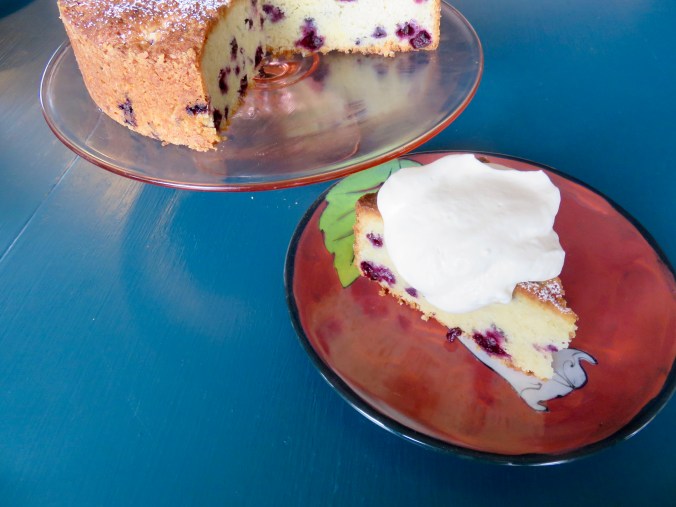
James Beard’s Huckleberry cake. Beard wants the cake served warm with whipped cream, not hot or cold, and I can testify that it is best that way. Sometimes I make it in two 6″ pans and layer it. The cake is still excellent even days old, if it lasts, which it usually won’t. I have frozen berries for five more cakes over the next months. A close second to lemon Angel Pie.


PEPPER JAM

fullsizeoutput_82e

This is not this year’s jams, but pretty typical, though I did not get to the rhubarb (second from right) or salal (left) this year. I missed the raspberries entirely. Still, I love these colors, and will post a new photo after the pepper jams are done. Maybe I should label them.

Today the rain has come hard and steady, just as Gary said, and we might have a mostly pajama day, though I need to make two batches of pepper jam.

We had a number of errands yesterday during our typically swift trip to Portland. There was this list, but I did not try on new shoes and we did not get to Cargo’s semi-annual sale. We did get to the watch store to see about cleaning and repairing Gary’s gold watch. (Sticker shock so no progress on that front.) We bought two clay pots and some bulbs at Portland Nursery. Gary found his favorite beer. At the Portland’s Farmer’s Market in the Portland State green space we found many things, but the key purpose of the day was buying peppers for the freezer.

In September, Westwind Gardens in Forest Grove shows up and fire-roasts their organic peppers on site. They bring bins of many varieties of chilis and have two huge rolling gas-fired cage roasters. Imagine a Bingo or lottery number cage, hand-cranked from one side. Now make the cage over two feet across and three feet wide in a stand about six feet high. The roaster puts in several pounds of the fresh chilis and turns the cage over the huge gas flame, cranking them over the fire to char the skins. That end of the market is thick with the smell. Luscious! I’ve been buying their peppers for years and freezing several pounds for use over the coming year. I never get enough. Ten pounds is not enough, but that’s all I bought yesterday. I chose three varieties of the dozens they grow: a mild red, a moderately hot red, and a medium poblano. The hot and some of the poblano are destined for jam. And I will hope for another trip to the Portland Farmers’ Market to pick up more for the freezer.

While at the Market, we had our favorite cotilla cheese and artichoke tamales for breakfast at Salvadore Molly’s (they recognize us!). I did not buy the yummy caramel corn or apricot brandy or a bag of vegetables as I usually do. This trip was all about the peppers, but we did manage two whole grain loaves from Pearl Bakery (one for the freezer and a cookie for Gary to eat right away), two chocolate bars made only with coconut and cocoa, fresh masa from Three Sisters, Italian plums and hard-stem garlic, and a pound and a half of wild black huckleberries.

Gary did all the driving, but when we got home, my work began. Usually, I put them straight into the freezer in the plastic bags they are packed in. But this year I determined to save myself having the clean them as I need them but doing it all up front. A fine sieve inside a colander in the sink are designed the catch what might otherwise go down the drain. I put on gloves and worked on the two pounds of hot red chilis under a running stream of cold water. The charred skin rubbed off easily, then I split the peppers, removed stem and seeds and any tough membrane, and rinsed, drained and packed them into the fridge. Then after a break (my eyes burned a little) and without gloves I cleaned the other eight pounds. Most of these went into the freezer in glass containers and with each half-pound separated by parchment paper.

I repacked the huckleberries into one-cup portions and froze five packets for use through the winter. With the sixth cup, I made James Beard’s Huckleberry Cake (no, blueberries are not an adequate substitute). We will have some of that today with whipped cream.

Today I must make the red and green pepper jams, and I have the last of the strawberry shrub to use with the hot red peppers. The green peppers will get some lime, I think. Organic sugar and cider vinegar. Mixing red and green peppers does taste great, but the color becomes brown and I like my jams to be pretty colors. So there will be red hot and milder green jams. I should like to pack all these into half-pint jars, but I have used nearly all of them this summer. Just four jars left, and I could use a dozen more. (The quart jars will never see peaches or tomato sauce again—anyone want them?) I have pint jars, too, but a pint of pepper jam is a lot to open. Gary surprised me by not having a fit when I suggested buying more half-pint jars. We didn’t want to go anyplace today, but we will go out for jars. Maybe he likes the jam?

I am already forgetting what flavors of jam I put up earlier in the summer. There is strawberry with a bit of huckleberry, strawberry with something else; apricot with lemon and ginger (specifically for making rugelach); peach with some of last fall’s poblano, I think; and nectarine with . . . ? Oh dear, I can’t recall.

The remaining peppers will later make black bean chili verde, vegetable stew, enchiladas, and butternut soup. Maybe I will make white-cheddar-and-mild-red-pepper yeasted rolls. It’s been a long time since I made them. A slow rise overnight in the fridge, and then breakfast!

Flavor and color. A promise of future delights.

SPLC

Girls at the 16th Street Baptist Church in Birmingham, Alabama
SPLC logo
Tomorrow marks 56 years since the murder of four young girls at the 16th Street Baptist Church in Birmingham, Alabama.

In an act of terror intended to intimidate civil rights activists who used the predominantly African-American church as a rallying point and organizing hub, Ku Klux Klan members planted a bomb under the building’s steps. It detonated at 10:22 a.m. on Youth Sunday, a day dedicated to the church’s young members, as the girls were getting ready for the service in a basement lounge.

During his eulogy for Denise McNair, Carole Robertson, Cynthia Wesley and Addie Mae Collins, Dr. Martin Luther King Jr. called the attack “one of the most vicious and tragic crimes ever perpetuated against humanity.” He sent a telegram to then-Alabama Gov. George Wallace, telling the state’s top segregationist: “The blood of our little children is on your hands.” Ten days before the bombing, Wallace had railed against the civil rights movement to The New York Times, saying, “What this country needs is a few first-class funerals.”

At that time, violent attacks on the civil rights movement were common in the city dubbed “Bombingham.” And in the decades since, researchers have laid bare the lack of political will to convict the perpetrators. Then-FBI Director J. Edgar Hoover blocked prosecution of the case, and the FBI failed to turn over thousands of files to prosecutors, including audio surveillance tapes.

It wasn’t until 1977 that the first of four Klansmen behind the crime was brought to trial by the state attorney general and convicted. Two others were convicted in the mid-1990s by federal prosecutors. A fourth died before being charged.

In 1987, the SPLC would win an unrelated, and unprecedented, civil lawsuit against the same Klan group behind the bombing – the United Klans of America – after its members murdered a black teenager in Alabama six years earlier. The $7 million verdict bankrupted the United Klans, finally putting an end to the group whose members had also killed civil rights activist Viola Liuzzoafter the Selma-to-Montgomery march.

The church bombing did not slow the momentum of the civil rights movement. Instead, it became a seminal moment that galvanized the nation and propelled the  movement forward. Ten months later, Congress passed the Civil Rights Act of 1964, outlawing segregation in public accommodations.

Today, a memorial named “Four Spirits” stands across the street from the church with the inscription “A love that forgives” – the title of the pastor’s undelivered sermon on Sept. 15, 1963.

During this moment of remembrance for these and all civil rights martyrs – those who fought and died for freedom – let us reflect on the words of Dr. King’s eulogy for the girls. And let us remember that deadly violence remains an all-to-common response to the ongoing struggle for civil rights in this country:

“[T]his afternoon, in a real sense [the four girls] have something to say to each of us in their death. They have something to say to every minister of the gospel who has remained silent behind the safe security of stained-glass windows.

“They have something to say to every politician who has fed his constituents with the stale bread of hatred and the spoiled meat of racism. … They say to each of us, black and white alike, that we must substitute courage for caution. They say to us that we must be concerned not merely about who murdered them, but about the system, the way of life, the philosophy which produced the murderers.

The Editors

FINDING HOME

fullsizeoutput_1070

Pieced squares from a dark corner—they have not yet been joined and this is merely twelve of eighteen pieced, of the eventual forty-nine in the center panel. I kept finding more golds and oranges for the stripes, so there will be another quilt, “Blue Streak,” once this one is done, I think.

Though the sky is clear blue and I sweat as I sew (which involves pressing with a steamy-hot iron after each stitched seam), I know the weather is changing. We can feel the cooling and are grateful for it. Our contractor assures me the duplex roof will be on “asap.” Our tenant does did not have water dripping from the ceiling during the recent rainstorm. And yesterday I found glass. All good.

Kids are back in school, we have less than a week left of summer, and last night I had a teaching dream. Most of my dreams about teaching from while I was actually teaching, at least the ones I remember, were about teaching a subject I knew nothing about. The Boer War or Physics. I would be standing before a class of teenagers, who listened intently to every word and took neat notes in a way teenagers never do in real life. I was aware, in a kind of horror, that they would remember what I was telling them, that they would recall all the details I was concocting about a historical event I could not claim to know. I was making stuff up and they trusted it. Is that every teacher’s nightmare? It was always mine, that I would mislead my students.

Last night’s dream was quite different. The dreamt students attended an elite private school, both boys and girls. (I taught for from 1976-1979 at Forest Ridge, a girls’ prep school in Bellevue, Washington.) Some listened and some were inattentive and a couple were rude, and I was teaching them something I am familiar with: “Thirteen Ways of Looking at a Blackbird,” which I taught most every year. I used to be able to recite Stevens’s poem, and in my dream I certainly got through introducing it as haiku and reciting several stanzas as well as the parody I wrote, “Thirteen Ways of Looking at Computers.” It was not a nightmare, nor yet completely peaceful. There was some rushing about toward the end, some issue with wearing only a tunic and underpants and searching for my pants? (Why dreams about nakedness?)

fullsizeoutput_1072

From the bottom, a chipped but well-buffed piece of blue-green glass and a beautifully rounded piece of faintly green glass, a rough agate, an “ugly clam,” and several “butterflies,” which are really the back plates of chitons. Two of those are fan-shaped “tail” pieces.

I slept long this morning, till after six. We were late out onto the beach for our walk, the surf is a tame animal today, and I do not need ice in my morning iced coffee. The coffee has chilled since yesterday and the heat has relented. I plan to complete three more pieced squares of the purple-and-orange quilt this morning, finishing the third row of seven. This afternoon, I mean to piece the entire fourth row of this center panel. That row will more clearly reveal the shift in background hue and shade. I might put this one on a bed.


IMG_4923Mom’s house, my parents’ house, the house I lived in from first grade until college, is owned by two delightful people who have remodeled and gardened. Marti showed me where she had transplanted the rhododendron and vine maple (acer), the way they used what we had called “the hut” as a workshop, the expanded master bedroom (just as I would have done) and second bath, the preserved paneling in the family room. They have lived in the house since buying it from Mom.

It was Gary’s idea to drive by last Saturday. When we slowed down, there she was working on the garden and Gary pulled the car over. Hello, I said as I approached her, forgive me but I used to live here. She smiled and said, Are you Mrs. Priddy’s daughter? and it was lovely. She and her husband Jay have lived here far longer than my family did. They have made it home.

Our home remains the Oregon coast. We have lived here now for over forty years. Gary was saying he had never lived anyplace for more than five or six years before we moved here. Often he lived in a place for a couple of years before moving on. There were the houses around Seattle, the three houses in seven Arizona years, more back in Shoreline and Seattle, the last two with me. I have only lived in six houses, counting the month with my grandparents in Portland before moving to Seattle in time for me to begin kindergarten. Most of my life has been in Oregon, more than forty-five years now. It is home.

I can see the ocean from here, and I should be knitting. I have thought of other ways to tell my butterfly SF story: as history or from the perspective of another character. I should be writing them. But there should be no shoulds. If it matters I will write it. If not, I won’t but do something else instead.

IMG_4919But I really must begin knitting my grandson’s sweater. I knit half the back before ripping it out last week. It was going to be large enough for him to grow into . . . in about five years! He chose the colors and was excited when I showed him the gauge sample. I need to start knitting again. Do I try using a top-down pattern, or merely revise my own so that it will fit him? Once I find an answer, I can begin again.


OH DEAR

IMG_4920

Another one.

Wasn’t I going to make something completely different? A story?

“Autumn Garden.” All batiks, about a hundred different fabrics so far here. All those skinny strips will be pieced into the squares.