WE’D LIKE TO SAY HELLO-GOODBYE

Little bowls of tasty somethings, flowers from the garden in December, and red beeswax candles gifted by a friend. A better year coming, more hard times, but better.

Instead of having dinner at Ove’s (not that that would ever be on the program this time of year) we decided to spend the money on Oregon blue cheese. Seriously, our dinner tonight is all snack foods, but tasty good ones. Our cocktail napkins have beautiful roosters. Cock-Tails—get it?

On our final walk of 2020, we worked up and down the rocks to get there and found sea glass, agates, rounded pumice, and two of the little stones Jan calls “pinkies,” turned back south at the metal stairs, came home on the road, met a neighbor, and it rained most of the time. We were both wet from our walk, but that was hours ago. We have showered and washed our hair, and dressed in nice clothing we nearly forgot we owned in order to celebrate the end of this terrible, no-good, rotten, lousy, inept, appalling, no-holds-barred-we’re-glad-it’s-nearly-over stinking year. Can we say putrid?

Continue reading

6 WORDS about the awful year

You might think sunset—but this is dawn wrapped clear around the sky to the west.

Education Week asked teachers and administrators for a six-word review of “the awful year.” Here are three examples:

Bars are open. Schools are closed. 

Chad Aldeman, Bellwether Education

No one in my family died. 

Janet Keller, Santa Monica, California

We’re doing the best we can.

Shari C, elementary school principal
Continue reading

BOXING DAY

And it’s not even over.

Here we are on the day we delivered gifts to Portland—our fourth trip away from home since the beginning of March. We found out later our youngest grandchild was so upset we stayed for only a minute that she cried, then cried again when she understood she could not open the gifts yet, then was appeased when she found the winged turtle, which she was meant to have.

Gary and I defied expectations and began losing weight in the last weeks. We did not gain even over Thanksgiving, but I do not dare weigh myself to find out what damage the mince hand pies might have done.

As of today, I am three kokeshi dolls and four books richer, and our son Alan and Gary gave one another the exact same bottle of whiskey.

Continue reading

NORMAL

Under the waterlily dome are two little cheeses, under the glass are the mince pies. I took the last loaf of cranberry bread out of the freezer, washed raspberries (an out-of-season treat). and made heart-shaped cookies out of the leftover hand pie dough. A candle burns.

We woke at the usual time, before 5am, only today I walked downstairs before Gary had finished making the coffee, and we sat together before the fire. This is not a “normal” morning because it is Christmas. It is not like last year when we soaked in the pool at the Kennedy School and watched our grandchildren unwrap gifts.

Continue reading

BEGGING GULL

Today was particularly stormy when we went out and we saw no sign of the pair.

We have been going out determinedly and despite rain and gale. Winter began this morning. Often by the time we’ve come home and had our breakfast, the weather clears. The other day was the first morning in months that we had not heard the begging juvenile gull: weak, weak, weak! But it was back the next day. It follows a parent, sometimes inches away, and sometimes the parent manages to put a few yards between them. The “baby” is every bit as big as its parent but hunches down, tips it’s head up to expose the bright pink interior, and begs for food.

This behavior is typical of juvenile gulls, but most of them are over it by mid-summer. I’m not sure this youngster has much of a future. At what point does it fend for itself? At what point does a parent say enough is enough?

We humans are begging too, hoping for safety in a year fraught with threats and for a future warmed by love and family obligations. Maybe that gull is not so out of line. When do we stop feeding the people we care about?

Continue reading

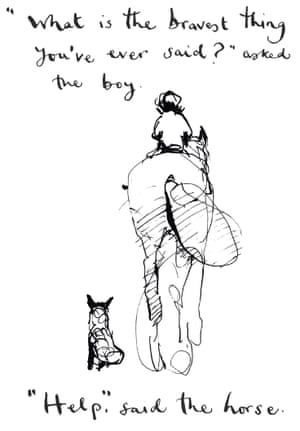
The Boy, the Mole, the Fox and the Horse

A year ago, a hug was just a hug, but now it is a wonderful, a marvelous thing.

Times change, and our needs change too. The BBC interviewed the author of The Boy, the Mole, and Fox, and the Horse in a video, and I am reminded how this slim book touched me when I first read it.

Some dismissed the book as empty calories, as saccharine and forgettable. I didn’t agree when I first read it a year ago. I disagree even more today. As a former student wrote yesterday: It’s been a year.

It’s been a year of illness and isolation, of struggle for many people working in dangerous conditions and without loved ones nearby, of honest words struggling to be heard.

This is one of those books like Winnie the Pooh and The Arrival and The Wolves in the Walls that I wish everyone read. 

“Sometimes,” said the horse.
“Sometimes what?” asked the boy.
“Sometimes just getting up and carrying on is brave and magnificent.”

The Boy, the Mole, the Fox and the Horse 
by Charlie Mackesy
 

We could all use help about now—or those of us willing to ask.

There is no story here, but many gentle words of wisdom. And a mole who eats all the cake and then it happens again. And a fox. And a horse. 

When I was young there were inspirational books all over the place with seagulls and kindergarten. This is like that or better. And the illustrations!

Yesterday, a neighbor’s dog went astray during their walk. We could hear Tim calling and calling. Gary said, “I hear his tags—he’s that way.” Oscar had turned up a side street toward the highway. We could not see him, and I could not hear a thing, but Gary has better ears. He found Oscar in a yard fifty feet from the highway, walked around and shooed him past me. A minute and Oscar heard Tim’s call and went running. It was a good day.

Our sons were both musical in school. Choirs have become particularly touching to us. Another sort of faith from mine, but it speaks me:

“Art is the big yes.”

American poet Marvin Bell has died surrounded by family yesterday evening, the stereo playing Chet Baker’s “You’d Be So Nice to Come Home To.” (3 August 1937 – 14 December 2020)

If you never heard the poem to his wife he always spoke in person and do not know the “Dead Man” poems, you must trust me when I express my sorrow at the passing of a great human being.

Photo by Sam Roxas-Chua

“Marvin Bell taught 40 years for the University of Iowa Writers’ Workshop and served two terms as Iowa’s first Poet Laureate. He has published 24 books and is known for his many collaborations with other artists, including Whiteout, an ekphrastic collaboration with photographer Nathan Lyons, and for his influential teaching. Often redefining his poetics from book to book, he is the creator of the ‘Dead Man’ and ‘Dead Man Resurrected’ poems, and has been called ‘ambitious without pretension.’ Bell edited poetry for five years for the North American Review at its rebirth and two years for The Iowa Review at its birth. He began and edited New Poets / Short Books for Lost Horse Press for five years, a series that published 15 poets, three to a volume. He also designed and taught a summer workshop for teachers from the urban program America SCORES for five years. He is a recipient of The Lamont Award for his first book, Guggenheim and NEA Fellowships, Senior Fulbrights to Yugoslavia and Australia, and awards from The Academy of American Poets and The American Academy of Arts and Letters. Incarnate: The Collected Dead Man Poems will appear in October 2019. A short interview can be seen online in the ‘On the Fly‘ series.”—Pacific University MFA website  

He was an essential part of of my MFA experience, adding immeasurably to my education, and a practical man all the while. He often sang, promoted the arts, and was generous with useful suggestions and kind support.

I took a brief workshop with Marvin in 2016. Yes, in fact, it was wonderful.

Hotchi-witchi*

Hotchi-witchi is a Romani word for hedgehog. It’s one of the Romani words Gary uses. I had here a sweet video about a hedgehog, an owl, a phantom horse, and more. It is old and the narration is subtitled and I found it on YouTube but apparently without the creator’s agreement. You will likely still find it there, and if I could figure out which version benefits Yuri Norstein, I’d repost. Ten minutes long and all good. Look for Yuri Norstein—brilliant work!

PAR Yuri Norstein is a Soviet and Russian animator best known for his animated shorts, “Hedgehog in the Fog” and “Tale of Tales.” Since 1981 he has been working on a feature film called The Overcoat, based on the short story by Nikolai Gogol of the same name. According to The Washington Post, “He is considered by many to be not just the best animator of his era, but the best of all time.” He mostly uses cut-out paper. Amazing.

*hotchi-witchi: Mid 19th century; earliest use found in George Borrow (1803–1881), writer and traveller. From English Romani hóčiwiči, probably from the English Romani word corresponding to Welsh Romani určos + a second element of uncertain origin, either an arbitrary extension or perhaps a derivative of Romani veš forest, woods (from Middle Persian wešag forest; Persian beša, (in Iran) bīšae), probably with influence from English.

MISTAKES

The first time he hit her was three weeks after their wedding. She didn’t leave him, she said, because she could not face telling her mother she was right that he was a mistake. Her husband didn’t like her working, so she worked only when he was at sea and had to quit whenever he was home. He made her return the sofa she bought with money she earned. Every once in a while, he beat her up. It was always her fault. I don’t know if their daughter was aware of those occasional beatings, but she left the country for college and never went back.

Another woman I knew did finally leave her husband, packed a quick bag and drove her children away across two states to her brother’s home. There had been beatings, threats. He didn’t like her working. It was always her fault. She called a crisis line when she came home to find all her work clothing cut into pieces on their bed. The crisis worker told her that was a rehearsal, that she would be what her husband cut next, that she should go someplace he could not find her. She discovered during her divorce that he had put his first wife in the hospital. She hadn’t even known he’d been married before.

A woman I did not know was married to a local doctor. Maybe he beat her, maybe he was unfaithful, maybe he was cruel in some other way. I don’t know. I trust she had her reasons for what she did. She left him, moved away, divorced, and began a new life. She came home from work on a day that was not one of his days to see his children, to find he’d murdered both of her daughters and killed himself. His reasoning was to punish her and leave her with nothing.

For years I tried to understand how anyone could come back from that?

People make mistakes. Maybe you could share a few stories of people who suffered from their mistakes. Maybe you have a story of your own. My marriage has been my salvation, but I have made plenty of mistakes.

Everyone falls. Not everyone gets back up and carries on.

I wrote a novel about a woman who makes a bad marriage, but eventually leaves, suffers unbearably, and then must find a way to walk on through life without her daughter. I’m not certain I could do what my fictional character does, I am not certain I could recover. I wrote the novel to figure out how to do it.

My book, variously titled Everybody’s Mother Dies, The Promised Hour, and Painting Over, is not structured like a conventional novel. The bad stuff happens early and through the middle, but that’s not what the story is about. Everyone’s mother dies, everyone experiences loss, everyone makes mistakes. Mine is a novel about what comes after tragedy. It is the story of a woman taking a day at a time, placing one foot in front of another. Maybe that is where we are all going to be in the next year: figuring out how to get on with our lives.

Have I mentioned recently how much I still miss my mom and dad?

from REBECCA SOLNIT

Republicans are standing up to Trump. Unfortunately, it’s too little, too late

Rebecca Solnit

Republicans like Gabriel Sterling – who are horrified by the torrent of death threats facing electoral workers – are voicing their outrage very late in the day
‘The measure of our humanity is our ability to care for people unlike us, who are not in our clique, gang or church.’ 

Fri 4 Dec 2020 06.49 EST

The first time I watched Georgia voting systems implementation manager Gabriel Sterling’s furious tirade about the threats against him and his coworkers, I was impressed. Here was a Republican, a self-described conservative, telling off the president and all the people making those threats. “Death threats. Physical threats. Intimidation. They have lost the moral high ground. I don’t have all the words for this because I am angry.” He was clearly furious. He talked about a young contract worker: “There’s a noose out there with his name on it. This kid just took a job and it’s just wrong. I just can’t begin to explain the level of anger I have right now … Mr President, it looks like you probably lost the state of Georgia. Stop inspiring people to commit acts of violence.”

It didn’t take long for me to sour on his indignation. They never had the moral high ground. The death threats and intimidation against him and his co-workers are wrong. However, they’re not the first people to get them but in some sense the last, and if you care about people the president has attacked verbally and urged violence against, you could have started caring during the 2016 campaign. Nothing suggests Mr Sterling did, since he belongs to a party that has supported Trump and, more broadly, campaigns of hate and discrimination for the last 40 years and more. In recent years, Trump has urged police to treat arrestees more roughly, audiences to harass and even rough up journalists and dissidents in his crowds, and is well-known for the 26 credible accounts of sexual abuse and violence with which women have charged him. He’s the guy who pardoned Sheriff Joe Arpaio in 2017 for his conviction for disobeying a judge’s order to stop racial profiling.

In Georgia, the far right has finally turned on its own in its furious demand to have an election that serves Trump and the party rather than reflects the will of the people. I admire the integrity of Georgia’s secretary of state and other officials who have, in the face of great pressure to corrupt an election for their own party, refused. It does make you wonder why they’re in that party, though. Because this is the party of intimidation and corruption and voter suppression, the party that undermined a free and fair election in that state two years ago. And because the measure of our humanity is our ability to care for people unlike us, who are not in our clique, gang, church, on our team, side, who are not our color or our kin and who are not near to us in spatial distance as well as in affinity.

That generosity is evident in the medical workers risking their own lives to care for patients with Covid-19, including many who don’t believe they have the disease and didn’t take precautions against it. It’s in the Auntie Sewing Squad, which has sewn more than a hundred thousand cloth masks to distribute to frontline, vulnerable and devalued groups from farmworkers to former prisoners. It’s present in the activists and organizations defending refugees, including the children put in cages and separated from their parents by the Trump administration. It’s present in the work of the ACLU, the Southern Poverty Law Center, Planned Parenthood, the Sunrise Movement, the housing rights advocates and activists demanding police and prison reform. It was present in the demonstrations this summer in response to the police murder of George Floyd.

All these things the Republican right has opposed. The war against empathy is always a war against the imagination, against that expansion of feeling to care about others. There’s another kind of expansion, through science and natural history or direct engagement, to understand the systems that connect us, our inseparability from other species, the climate, the environment, and Republicans have waged war on that too, in search of their apotheosized individualism as radical selfishness.

If you care about nooses as threats or actual murder weapons, you have a lot of nooses to care about, especially in the south.

This summer several Black men were found hanging from trees across the country, in cases police ruled were suicides and many believed were lynching murders; similar cases happened in recent years in Georgia. In 2016, 22-year-old New Jersey resident Michael George Smith Jr. was found hanging in Piedmont Park in Georgia. Another Black man was found dead in public by hanging in Georgia the year before. 

If you care about threats more generally, you could have cared about the threats against a Pickens county, Georgia, school superintendent for implementing a trans-inclusive bathroom rule at local schools in 2019; they were his justification for reversing the decision. Trans students paid the price. Just before the 2018 election, in which Stacey Abrams was defeated by Brian Kemp, back when the Georgia election system didn’t seem so uncorrupted, she too faced threats. The Root reported, “One of the merry band of bigots that came to the event to harass and threaten Abrams was James J Stachowiak, a multiple convicted felon who regularly posts videos instructing his viewers to shoot black people on sight.” Brian Kemp, then the Georgia secretary of state competing for the governorship with Abrams, posed during the campaign with Stachowiak while he was wearing a T-shirt reading “Allah is not God and Mohammed is not his prophet.” And it wasn’t just threats. Ahmaud Arbery was shot to death by white men in Brunswick, Georgia, this February, while out jogging: not a hanging but definitely a lynching. Racial killings, police killings, domestic-violence homicides, mass shootings are some of the violence that runs through the fabric of this nation.

Mr Sterling was apparently silent on all of this until the dogs turned on him. He made me think of the famous words by the German pastor Martin Niemoller after the second world war, “First they came for the socialists, and I did not speak out – because I was not a socialist,” and on and on about who he did not speak out for, “then they came for me.” Then they came for Gabriel Sterling. Who was granted police protection and had the safety and standing to speak out for himself.