An imperturbable demeanor comes from perfect patience. Quiet minds cannot be perplexed or frightened, but go on in fortune and misfortune at their own private pace like a clock during a thunderstorm.—Robert Louis Stevenson
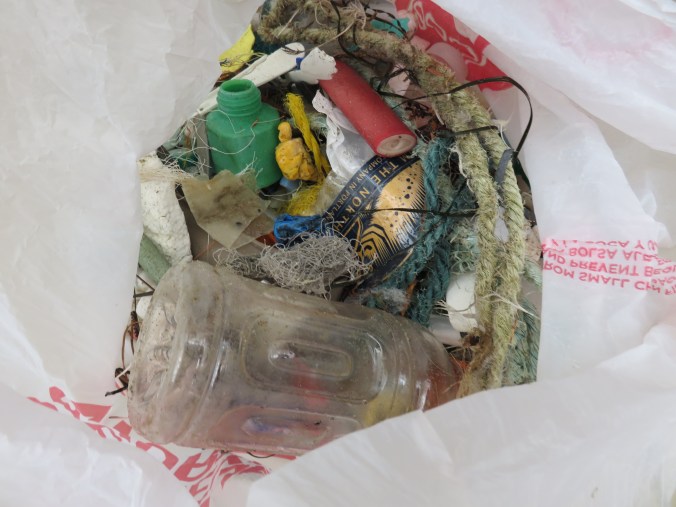
We found a 10-day-old parking ticket from Portland the other day. Often the plastic trash we find has baby barnacles. It’s been out in the water a long time before we collect it.
It’s not the only thing and west is not the only direction.
We get our water from the Coast Range. “Here’s another map showing the area at the Arch Cape Creek headwaters that will be arial sprayed. There is a comment period that will end May 6 or 9th.
“If you want to comment email: jasen.r.mccoy@oregon.gov”
They are, essentially, spraying my backyard.
The goal of spraying is to prevent plant growth. They do not want weeds or natural forest succession to begin—from shrubs, then hardwood (alder), to conifers (spruce and hemlock). They want a marketable crop as soon as possible. To achieve that goal they spray chemicals closely related to Agent Orange. On land where I have walked, land rinsed by our future drinking water.
This is my public comment: My family has summered in Arch Cape since 1911. We have lived here year around since the 1940s. I moved to Arch Cape in 1979 with my husband Gary C. Anderson just after the last clearcut, and I recall saying to him that there would not be another for at least 30 years. I knew what they had been spraying up in those hills. And I knew that rain would flush some it it down into local drinking water.
My husband and I have lived here for 39 years and raised our children here. My husband worked in local businesses and I taught in the Seaside School District. Each morning since our retirement we walk the beach and pick up trash from the shore. I can see the plastic bottles and broken toothbrushes, the bottle caps and nylon rope, the plastic foam and cigarette lighters. We see the trash and we can walk by or carry it home to put in the trash.
We cannot see the toxins deliberately introduced into our ecosystem.
It is criminal that this still happens at a time when so many people have become ill and even died from the impact of deliberate human action.
First, a confession. I am moody. I sometimes suffer from sadness and depression and anxiety. I have, as an example, seriously worried about overpopulation as if it were my personal problem to solve. I can recall lying awake at night, stewing about starvation and disease and the loss of wild places. I can recall standing in the shower arguing aloud with myself about what should be done to save our planet from overpopulation. I might have been ten years old. I was also unpopular at school, had few friends, my mother was seriously ill, and my father smoked too much. I had been molested on the playground. I worried about overpopulation because I was precocious and smart and all around me my favorite places to play were being turned into housing developments. My worry was a response to my environment and real life experiences.
When I was a child, I was terrified about what the world would be like if the growth of world population continued to grow and double. It did more than double, of course, growing from 3.1 billion to an estimated 7.6 billion today. I was not worried for nothing, and all the woodlands and swamps and cow fields I recall in my old neighborhood north of Seattle are long drowned under pavement and 3-bedroom homes. So, sometimes I was worried or anxious. Sad. I dealt with it as best I could, sometimes better than others. As an adult I am generally determined to find that illusive silver lining in any dark cloud.
It might be raining over my head, but focussing on how wet I felt, decades ago, brought me close to death. I looked for brightness then and still do now, not because everything is perfect in my life, but because I am determined to live.
While my mother was dying and I was also working 60-70 hours a week and driving home from work in tears, feeling overwhelmed, useless, and unfocused, I gained pounds. After my mother died, I lost 40 pounds in a few weeks. One day a colleague asked me how I’d managed to lose so much. I looked at her and said, “Grief.” Pills would not have made any of that situation better, would not have helped me cope better, would not have made my mother come back to life. I needed time. I needed to find my own way back. And I did.
Sometimes I read a good book—proven to improve mood—and I avoided the genuine downers (three novels by Cormac McCarthy were enough for me.) I sleep too little and eat too much when I am depressed. Improving both habits helps. Running used to be essential, but even walking now is good. I do things for other people. I commit random acts of kindness. I contact a friend. I listen to music that stirs my heart. It would be easier to take a pill—don’t think I haven’t thought of it—but my reading and research has convinced me that pills are mostly a false promise of an easy fix. For most people, and certainly for long term, drugs profit Big Pharma, not people. My research revealed we have been sold a bill of goods.
I recently read Lost Connections: Uncovering the Real Causes of Depression – and the Unexpected Solutions by Johann Hari. Hari reviews the story he was taught about his brain as a teenager, and which remained his truth for more than a decade afterward: depression is caused by a chemical imbalance in your brain and this can be corrected with medication.
The trouble was that while medication provided him with some relief for a while, that relief did not last. It did not make him feel good, only “better” for a short time before he was back in his doctor’s office looking for something better. That might be because no one has proven there is any chemical imbalance in the brains of depressed people, medication fails to “cure” depression in the vast majority of people, and could not cure his own depression. (He was prescribed Paxil, a medication that the company had already proven did not work for teens.) As ineffective as antidepressants are in curing depression they have very real and potentially catastrophic side effects. Big Pharma sold a story that we wanted to hear: The problem is personal, out of the control of the individual, and can only be addressed with pills.
This is mostly a lie.
Instead, most scientists agree, depression and anxiety are related, on a continuum with ordinary sadness—they are actually the same thing—and they are normal, reasonable, and sometimes even healthy emotional responses to our lives. Our emotions slide along a scale that runs from dancing with joy to standing on the edge of a cliff. Fortunately, most of the time, most of us are closer to dancing than jumping off the edge, but there is no medical truth to the story we have been told.
It’s not our brains that are broken, it’s our lives.
When Margaret Thatcher declared: “There’s no such thing as society, only individuals and their families” she denied the truth of our species. We are social animals. We want connections with others, we want our lives to contribute and to have meaning to others. We need this as surely as we need food and water. People are not isolated individuals, we are social beings starved for community.
One “symptom” of clinical depression is isolation. “Have you stopped meeting with family or friends?” Hari documents how isolation is not a symptom of depression. Depression is a symptom of isolation. The entire checklist for depression reads like an indictment of modern life.
When we do meaningless work and feel no connection to others, when we feel powerless over our life choices, when we embrace possessions rather than people, we become sad, anxious, and ultimately “clinically depressed.” Pills will not fix this feeling. We must repair the damage to our communal self-worth. Our depression is not the disease, it is a symptom of a more complex issue that has resulted in millions of people being diagnosed and treated for a disease that interferes with daily function.
The popular definition of depression as a disease over which individuals have no control actually feeds the beast. Taking control and making choices is within our power. While we are not to blame for all our circumstances, it is sometimes within our power to change them. We can choose to be active participants in our mental health instead of powerless victims.
Consider just this one fact: One in six Americans (the French are worse off, and so are the English) is on psychotropic medication, some sort of drug to treat the brain. If we are inherently this sick, how did we ever manage to survive as a species? If it is our brains that need fixing and the drugs fix the problem in our brains, shouldn’t we be healthier now than we were before these drugs existed? Shouldn’t suicide rates gone down instead of up in the last few decades? Look it up.
I was familiar with much of the research Hari cites. I knew that depression was not caused by a chemical imbalance and that pharmaceutical companies had rigged trials in order to pretend drugs could address depression far more effectively than they do, and made $200 billions in profit as a result.
I already knew from the studies he cites and earlier ones, that it is ordinary working people who feel anxiety and stress and depression most profoundly. Those at the top have choices that those in the middle and bottom seldom have. A sense of agency, of the ability to make decisions, and options that make living worthwhile.
I already knew about the “grief exception.” Grieving the death of a loved one causes all the “symptoms” associated with depression—why would this surprise anyone?—but the grieving are not sick and do not require medication. They need time.
The medical community accepted that grieving is natural and human . . . so long as those grieving do not feel “depressed” for too long. If your daughter is abducted and burned alive, how long are you allowed to feel bad? If your baby is stillborn, how long? What about the death of a parent? The medical community allowed a year, but then you are supposed to push that pain out of your life and be . . . fine! Or at least functional. Because if that grief lasts longer than medically necessary, you must be depressed. So you have a year to get on with your life. Except that the medical community shortened that understandable year of grief to a few months, then weeks, and then eliminated it entirely. You are grieving a death? Get over it, and right now!
I have advocated for years that people socialize, sleep and eat better, be creative, and exercise. These DO have a bigger impact on depression than meds for almost everyone. Whenever I suggest this, I have been thoroughly thrashed. If you are too depressed to get out of bed, how can you be expected to take a walk? I am told I am unwittingly and unkindly telling people to “pull themselves up by their own bootstraps.” (I do not dare point out that they managed to get to a doctor, to the pharmacist, and to take their little pills.) The story is that this is not our fault and not within our power to control.
Hari explains how our attachment to this story we have about depression makes it difficult or impossible for us to hear another. It is frightening to challenge the narrative we have taken into our most vulnerable psyche. Yet, we need a more truthful story. While he confirms my faith in healthy habits, he advocates something beyond that.
His new story goes like this: We must collectively and for the good of all reconnect to other people, find work that allows us purpose and potential for growth and meaning, and stop blaming our brains for a society gone awry. We must hold hands and do this together. Yes, we will feel sad from time to time. We may sob and lie awake and cry when something terrible happens to us or the people we do care about. We are allowed. It is normal and a symptom not of brain disfunction but of emotional pain in our lives. Our father died. We did not get the job. Go ahead and feel bad about that. Take a friend out for a healthy meal, go for a walk, read a funny novel. Take all the time you need. We get better.
We must not look always inside, but sometimes do our individual best to look out, and look to others and connect to them to find the way out of our personal pain.
His book has its corny moments—even Hari admits this—and I was familiar with most of the research he cites and his narrative began to fall into a pattern I could predict. I wanted some things that I did not find here. I don’t think the author has written a perfect book or the one I would have written, but I do think he’s right.
We are not broken.
We need to find a better story to explain our distress.
The book includes copious endnotes and online links to additional source material. He’s done his research, and the book itself is well documented. He offers true stories to illustrate his points. There is a great deal of science, but very little that is too complicated for the average reader.
If I had read this book when I was ten (and it is the sort of thing I was reading at that age) I would have felt a lot better about myself and my mental state. I would have recognized the impact events had on my ability to feel good. Instead, I needed most of my life to figure it out.
A friend has posted news of a Texas charter middle school that asked students to brainstorm a “balanced” list of the pros and cons of slavery. This is what is meant by “false equivalency”. All I can think of on the pro side? I am not on that side. On the con side, slave owners sacrificed their souls. On the con side is a lengthy list. There is no balance possible, it is a demented assignment.
April is National Poetry Month, and my students and I have been stealing 20-minutes out of our class to write bad poem drafts. They are only bad because they are so young. (The poems, not the poets.) Twenty minutes might get something started, but after we complete several such drafts we will revise just one. Maybe that one will break our hearts.
This is also Confederate History Month in five U.S. states. (There used to be six.) I refuse to go look up which ones still celebrate the most deadly conflict in the history of my country, and I do not want to guess. I can only assume that the legislators of these states have so little to be proud of now that they must perpetuate a fictional glory in the past.
Why is this a problem? Let me count the ways.
The Constitution was ratified over a four year period. Delaware was first in 1787. Southern states ratified in 1788, except for North Carolina in 1789, the year before Rhode Island, which was last in 1790.
Southerners were notable authors of our Constitution, and states’ ratification means each state agreed to the terms outlined therein.
The Constitution of the United States makes no provision for state succession.
The most notable feature of the Confederacy was its support of slavery. (Seriously, if you didn’t learn that in school, consider that the textbook that taught you about the Civil War was produced by white apologists in Texas, not people with actual history foremost in the sights. When I was a girl, the books still insisted on calling it “The War Between the States.” My father would roll his eyes, take a deep breath, and correct what they were teaching me in school. I am sorry he was not there to do that for you.)
The Confederacy was in open rebellion against our nation—treason anyone?
Men from my husband’s family, like so many, fought on opposing sides.
The south lost.
Why not Civil War Month?
I am so heartily sick of hearing about how monuments to southern generals need to remain standing in order that we not forget our past.
Remind me, what past are we trying to remember?
My husband and I each have relatives who fought with the South in that war. We imagine they were honorable men and believed in their cause. We also accept that they were wrong, terribly wrong in that choice. However badly the North behaved after the war, they did win it. And slavery, well, there is no supporting a government determined to preserve a bald, unwarrantable usurpation of human rights, and long after most of the Western world was busy outlawing the practice.
It is a paradox for us, of course, but not really a challenging one. We can both feel interest and connection to our past, and yet recognize the abomination of the system they struggled to uphold. We feel no guilt for slavery. We were not born then. No one we have ever met was alive then. our personal identities are reliant on our own actions, not the actions of relatives who are mere photograph and documents. There is no need to belabor one of the uglier passages of our nations’ and families’ history.
It’s called letting things go.
Go write a poem. Consider the words, the verbs and intentions; couch ideas in concrete images. We are a proud country, but what should we be most proud of? Surely not open family discord, bomb blasts, and butchery. Choose something that saved lives, choose what preserved natural landscape. Hold out a hand and pull someone out of despair.
We drove down the coast, past the place where, last summer, we watched the equinox spread waves of chasing light across the ground. It was a privilege for us to get away, we who rarely vacation and have generally been extravagant only about music and books and art. We drove south to have a night in a hotel, a bed and breakfast.
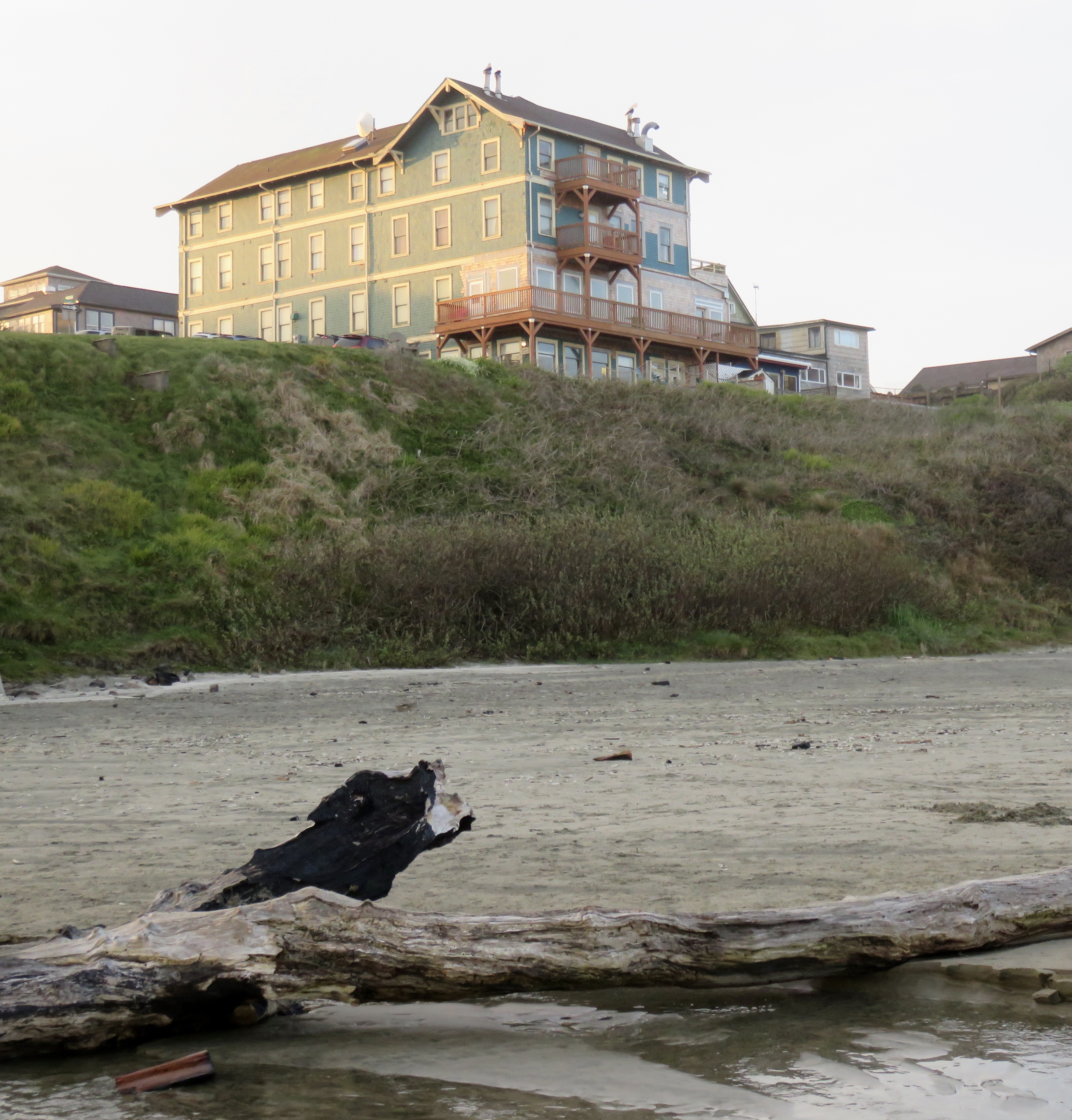
This is the Sylvia Beach Hotel. A rickety, somewhat cattywampus structure overlooking the Pacific Ocean. There is a cat, too. Our room was the Jane Austen, the third and fourth windows east of the ocean front and facing north on the top floor. I could watch the sky and sea from the bed. We had a beautiful view. Most of the rooms do. It is not expensive to stay in the off-season and a Sunday, and the breakfast is good.
The Sylvia Beach Hotel was built over a hundred years ago and eventually named for the founder of Shakespeare & Co. in 1987 with author-themed rooms. A fire escape on the east side is gone, but all the rooms have baths and sprinklers. In most other ways it remains what it always was: a Victorian boarding house.
The decks on the ocean side are recently rebuilt and much of the shingle siding has been repaired and replaced. When the work is done, it will be painted dark blue-green again.
We decided to have the dinner, served in five courses with several choices of entrée. The food was wonderful, but too much food for us. The company was marvelous and entertaining, the best part of the evening.
At first the semipalmated plovers (I think) were nearly invisible until they moved. There were a half dozen or so just a few feet away as we made our way south on the sand. They scooted along the windblown beach, but eventually lifted and joined a larger group.
The flock of dozens of birds would rush cover together and then fly straight up all at once, turning instantly north, west, east, north again, and land. On the ground they rushed about, spacing themselves several feet apart and peck at the sand, turn, move back closer together again, and then all back up to begin again their collective dance in the air.
I watched the plovers do this once, twice, again and again, the landing, the expansion of their range, as if released from a leash connecting them to the flock, a moment of business, then back toward their center, and flight!
When we walked at home, we saw plovers again, not the same birds, perhaps not the same species. Pretty sure they are plovers.
White clay and a trickling of sand. The pattern of trickled sand below is a mere inch tall.
My friend is mourning a cedar tree she passes each day on her way to work. The droopy foliage has abruptly turned orange, an indication the tree has died, perhaps of infection with cedar apple rust or another disease or just due to a peculiarly hot and dry summer. I don’t know the tree she is describing. It is likely the native western red cedar, Thuja plicata, and named for the color of the lumber harvested from the tree, or it could be an introduced cultivar such as arborvitae. What is not in doubt is that the tree has died and it is bright orange. Orange is not a color most people would associate with death. It is a juicy hue.
Orange as a color name entered English in the sixteenth century but the color had always existed, of course, and had previously been called “yellow-red,” ġeolurēad in Old English. The word itself traces its lineage from fourteenth century English, back to Old French or perhaps Spanish through the Arabic nāranj, the Persian nārang, and eventually to the Sanskrit nāranga, meaning orange tree, a word that might derive from an even earlier word meaning fragrant. Our word for the color orange and the fruit have an ancient co-existence, but the citrus fruit came first.
There are synthetic citrus flavors and scents. In fact, lemon and lime and orange are among the easiest flavors and scents to synthesize. What is complicated and thus wonderful about the real orange is the cut wedge of fruit, pockets of juice sliced through and dripping, teeth biting into those tapered slices of juice, the flavor running across the tongue, down the throat and chin. The sticky, flavorful residue, then taking a strip of orange peel and folding it inside out to rupture the cells in the peel, and the mist of orange oil visible in the air. No chemical creation matches that experience, and no synthetic scent lasts as long as the real thing.
The citrus family includes limes, lemons, mandarins, pomelos, grapefruit, as well as oranges. The actual colors or peel and pulp range from the green of limes to the ruddy maroon of blood oranges. I am a fan of all these fruits. In Paolo Bacigalupi’s much-lauded bio-punk science fiction novel, The Windup Girl, the entire family of citrus fruit trees have been killed off by a virus and the younger generation has no idea what they are missing. This was one of the most striking images I found early in the novel. Imagine all the citrus in the world gone, never to return! How would I explain to my grandchildren the taste of an orange, what one was like? Describe eating the pulp out of a quartered orange and how I placed the emptied peel in my mouth to make an orange smile when I was nine. Imagine generations of children never able to do that in real life.
I could not explain that.
The orange fruit is a symbol of the Pre-Raphaelite movement and of weddings in many cultures.. The House of Orange, Huis van Oranje-Nassau of Netherlands was founded in the sixteenth century by William the Silent or William of Orange. But the color does not appear on the royal coats of arms, which shows blue, red and yellow. None of those old royal coats of arms include orange, though many use its components, red and yellow—no mixing of those primaries allowed. Orange is a secondary color on the painter’s palette, primary only in flames.
Orange is the color of settled-down-for-the-evening driftwood fires and of sunsets over the sea. Unlike sunrises which most often tint clouds pink, the sunsets in my sky are livid orange, glowing coals settled along the horizon. “Red” hair is orange. Orange is the color of many flowers such as the the six-petaled Montbretia and the darker orange crocosmia, a variety named “Lucifer,” that naturalize locally, and the many-petaled daisy-like British Calendula, used since the middle ages to control fever and heal wounds. There is the dust of burned ferrous oxide, oxidized iron, what we call rust, FeO. Gone with the Wind’s “red earth of Tara” is not red, but ruddy orange from iron oxide in the soil. The first time I visited Georgia, I was thrilled to see this orange-blushed soil.
An article in Forbes cites research suggesting that warm colors such as orange can create an illusion of physical warmth, and that orange in particular is associated with good value—not moral values, but monetary ones. Maybe that’s why so many sale stickers are orange. It is also likely that orange is one of the more striking colors, a noticeable color, unlike green or blue or neutrals that might fade into the background. Orange is the color of warning signs and labels. A color we might find untrustworthy. Orange is often called bright. Add white to it and orange becomes a tender different fruit: peach or apricot. Orange darkened with black morphs into a shade we label brown, but few people associate pale peach and brown with orange in the same way they recognize sky and navy as a tint and shade of the same blue.
A little smoke and some white turns orange into a discontinued Pratt and Larson paint color called Caravan. We painted a bedroom in Seattle that color and then our bedroom in Oregon the same hue. This pastel owed nothing to baby shades, more to stucco walls, tropical fruit, pale carnelian, the bottoms of baby feet. A paler tint of flicker’s flight feathers, life rafts, sweet and sour sauce, colors screaming for attention. Caravan lifts the eye without compelling attention.
I feel juice sliding down my chin from a slice of peach pie—I think more often of food than of warning when I think of orange.
A name for the color orange does not even exist in many languages. All languages identify the sky as blue, blood as read, but like the red-yellow of Old English, orange is the least likely hie to have its own label in hundreds of languages around the world. But oranges! Those luscious fruits dripping across my tongue—the flavor and scent is unmistakable. The tongue and eye know orange even without words. Orange as a name comes from flavor.
The cliché of orange is Halloween pumpkins and autumn leaves. But pumpkins, born in Mexico not in New England, come in many shades. And the maple trees we watch for on our morning drive turn pale yellow in the fall or maroon if the nights are cold. The colors we might expect are oranges I find in agates and scallop shells, daylight in the late afternoon shining through ears, the wooden beads on my son’s camp necklace, the teacup filled with markers, my favorite handknit sweater. the spines of Penguin Books, cantaloupe flesh and copper wire, a spool of thread, chrysanthemums and bittersweet and witch hazel blossoms, the inner bark of alder trees cleaved by an ax, Chantrelle mushrooms I find in the duff of spruce glades and the bright shade of salmon eggs further upstream, ground chili and turmeric, carrots and caution signs, traffic cones, a dying leaf. The death of a cedar tree. The famous cedar tree, “Quinault Lake Redcedar” that lived due north of us, was killed recently in a series of winter storms. Less than two hundred feet tall, the was impressive for its nineteen foot girth rather than more unexceptional height. Maybe it turned orange as it died, but I did not witness that warning.
Orange may be a sign of trouble, but I prefer its more common role: the sweet, sharp, sticky, sour, succulent, salty sweetness of day’s end cry of joy.
[CLICK TITLE TO READ MORE] I made my youngest grandchild a birthday cake for her party today. She is two years old. I also made a 2-year-old quilt, something I also did for each of her cousins. Pink is her favorite color. For now.
EV’s quilt, completely pieced but before it was quilted.
The quilt is cotton with a cotton filling and a pieced backing that is partially pink with metallic gold dots. The cake is yellow, some of it tinted pink from the addition of black Oregon huckleberries. I made lemon curd and raspberry jam for the fillings, and a huge batch of blackberry buttercream for the frosting. It is the most incredible pink. I knew this trick with blackberry juice in buttercream from a previous series of cake made to please my oldest grandchild, who turned six last fall. Fresh organic raspberries. Organic everything, because we do not like to take chances with toxins.
Two cake batches, blackberry syrup to flavor and color the double batch of buttercream, and lemon curd. I completely thrashed the kitchen. Powdered sugar everywhere. Crumbs. Gary was cleaning my mess for me as I began typing this.
Gary is good to do this cleaning, but he reminds me that I was in the kitchen all day. He had a hard day himself. We had to make a correction to our taxes, he cleaned the walkway and trimmed shrubs on the north side of the house, and his brother called to complain and then hung up on him. This brother is afraid of all sorts of things that might not worry me in the slightest. That’s because he is mentally ill and unable to step away from himself long enough to think about others. Others are always dangerous to his mind.
Years ago I heard the poet Naomi Shihab Nye say that even as a child she felt this strange homesickness for a place she’d never been. She realized that what she missed was the place where poetry resides. At least, that is what I remember her saying.
Another poet, the marvelous Tracy Smith, recently discussed the terrible hunger she sees for literature: “I have this belief that we are so vulnerable when we open ourselves up to literature. We’re reminded of these real parts of ourselves.” Perhaps it is that willingness to be vulnerable, that we pursue. It is some vestige of glory in our souls—not paychecks or adoring crowds or battlefields, but something more like what e’re inclined to term humanity.
Some see vulnerability as weakness, when it is actually strength. To be open and accepting requires that we have the strength to remain standing under the weight of chance, of betrayal and error. Not everyone can manage that.
The alternative is continual anger and fear. No one is wise while continually angry and fearful.
Ursula K. Le Guin writes: “All old people are nostalgic for certain things they knew that are gone, but I live in the past very little. So why am I feeling like an exile?” No time to lose—yes, that’s it exactly.
I willingly call myself old and I am grateful to Le Guin for reinforcing my sense that aging is inevitable, but has its perks. I will die, but I have lived long enough to know what might be missed if I fail to pay attention.
The past is not my usual space to dwell, though I fret over lost friends and family. I fret over misunderstandings concerning recent history and that my students do not know the parts of speech or how to construct a formal outline. I am nostalgic for my own excellent education. More often, I look ahead to what I might still accomplish. Most often I am here and now, figuring out my life one step forward at a time.
I have thought about my place in time often over the years. Just now, reading Le Guin’s last book, I am thinking a good deal about what I might do with whatever time I have left. I might have as many years as Ursula. She was younger than I am now when I first met her, and her lifespan suggests I might still be living and writing sensibly into my 80s. I hope during this time to find the poetry in myself.
More of us might seek that strength that risks communion, that loves and forgives, that locates the heart of our hearts. I think, at least, that I might have time to do that, to continue looking forward. To open myself. To hear. And to give voice without fear.
[CLICK TITLE TO READ MORE] Just now, sitting up in bed, I have already updated my progress on Ursula K. Le Guin’s last book No Time to Spare. Le Guin ruminates about, among other things such as her cat and overpopulation, the meaning of spare time. Here I have to stop for a moment.
Through my email inbox, The Literary Hub offers links to various articles and I read one or two of those. The New Yorkers sends me the frequent Borowitz Report. I read the headline and kicker, but I do not click through.
The New Yorker wants me to subscribe. This is my “last chance.”
I read a good deal every day. I read stories from three newspapers (I subscribe online to two of them) and some days I read stories on NPR or The Atlantic. I read Brevity—both the blog and the magazine. I read short fiction on four SF/fantasy websites. I receive daily posts from three poetry websites, and occasional ones from a poet and an educator, plus a handful of others. Sometimes I even read whatever book I am carrying around. In the school library I look over a magazines.
I do not read The New Yorker cover to cover, though I have a friend who has been doing that since we were both in high school, going on 50 years ago. I have an attitude about The New Yorker. I am not their target demographic.
Even when Jamaica Kincaid was writing Talk of the Town, I found the magazine elitist and representative of a view from, as Walter Lee Younger declared, “a bunch of hustling people all squeezed together being Eastern.” Richer than me, too. It is one of the magazines I find in the library. I enjoyed Zadie Smith’s essay about (finally) discovering Joni Mitchell. I sometimes read the fiction, which used to be common in magazines and is still featured there. I routinely urged students to check it out for full length literary analysis essays, another increasing rarity in mainstream magazines. I do not subscribe.
These days, I subscribe to Poets & Writers, which I fail to read, and occasional other literary journals, which I also fail to read. This failure to subscribe has not always been my practice. There were years when I subscribed to many journals and read each one cover to cover, particularly making note of fiction. One year, when The Best American Short Stories (BASS) came out, I had already read all but two of the award-winning stories.
Then my thesis adviser, as I was completing my MFA, asked: “Why bother to submit to journals? No one reads them.”
And I realized that I didn’t read them anymore either. It was the most depressing thing anyone had said to me since my mother began dying. I felt that my literary goals had been shot dead on the spot. Certainly this was not the intention of my mentor, but it bit deep, even so.
The New Yorker wants me to subscribe, and I am a reader. But no. I will read in the library and I will read periodicals online and save the paper.
I will not be subscribing. It is not my last chance. I receive such emails at least once a week. The New Yorker will offer many others.
In the mean time, I am not done myself. This is not my last chance. I will go for a walk this morning once it is light enough to see. I was asked to bake a birthday cake for our youngest grandchild’s 2nd birthday party. EV just turned two. She likes pink and she like berries so there will be wild huckleberries in the cake, blackberries tinting the buttercream pink, and raspberries on top. I will be busy today making lemon curd, a layer cake, and buttercream. There is a lot to get done and I have only an outline of my day. I have not yet begun.
At 65, I accept that some things are pretty much over for me. No plans to run another 10k. I will not be teaching full time again. Not ever. But I am still doing most things I love. I am writing every day. This is not my last chance.
What I do now is not my last chance, but I have no time to spare.
“When there’s no social pressure behind it, respectful behavior becomes a decision, an individual choice. Americans, even when they pay lip service to Judeo-Christian rules of moral behavior, tend to regard moral behavior as a personal decision, above rules, and often above laws.
“This is morally problematic when personal decision is confused with personal opinion. A decision worthy of the name is based on observation, factual information, intellectual and ethical judgement. Opinion—that darling of the press, the politician, and the poll—may be based on no information at all. At worst, unchecked by either judgement or moral tradition, personal opinion may reflect nothing but ignorance, jealousy, and fear.”
—Ursula K. Le Guin, May 2013 from No Time to Spare (pp. 14-15)
It is tempting to see this as prescient. It might be wise to consider what it says about our national character and how we find ourselves in the political situation under which we now suffer.
[CLICK TITLES TO READ THE ENTIRE POSTS] During my Junior year at the University of Washington, I took Elementary Botany in order to fulfill the distribution requirement for natural sciences. Most of my friends recommended Astronomy or Geology, but I chose plants for that last required class outside my major. Two months later I was ready to change majors, and though I ultimately stayed in the School of Art, I never looked at green in quite the same way again. There were weekly labs and lectures about various aspects of plant growth, use, and biology. We took field trips to look at a hydroponic tomato greenhouse. We dissected leaves and flowers under the microscope. We grew coleus plants from a single leaf and discussed alternative to clear cutting forests. One of our textbooks was notable for simplicity, many photographs, and the green leaf on the cover. I still have it on my shelf. During a lab, we dissolved chlorophyll, which makes leaves green, into alcohol. Light shining through through the liquid was transparent red like the ruby glass in a cathedral window. In pigment, green is opposite on the color wheel and thus the compliment of red. It is created through combination of the two other primary colors: yellow and blue. In optics, green is just to the left of middle.
Less than two percent of people in the world have green eyes. More than half the people in the world have brown eyes and so do most dogs, cows, horses, and many other mammals, but green eyes are typical in domestic cats. Cats’ eye color comes from more than pigment in the lens, the result of the two layers combining to give the appearance of green—the underlying layer is most often gold to brown and the clear layer refracts blue—like a pale translucent blue marble placed over a rippled and gilded surface. This is how some albino cats have violet eyes—the pink is overlaid with blue refraction making pale violet. This is also why all kittens are born with blue eyes—the color of the iris has not yet produced the gold to brown pigment found in most adult cats, and which we see overlaid with blue, creating green. Oddly, green frogs appear that color as a result of two layers in their skin, one blue and the other yellow.
The green-eyed monster is not a cat, but a jealous person, and the term probably originated with Shakespeare’s: How all the other passions fleet to air, / As doubtful thoughts, and rash-embraced despair, / And shuddering fear, and green-eyed jealousy!” from Portia of The Merchant of Venice in 1596 and from Iago: “O, beware, my lord, of jealousy; / It is the green-eyed monster which doth mock/ The meat it feeds on.” from Othello a few years later. The color represents a long history of paradox.
U.S. paper money is green on one side, but real value has always been in the land where we live and where the green grows. Scarlett O’Hara’s crazy dad was on to something when he warned her that “land is the only thing that matters, the only thing that lasts.” Now, with global warming, we understand it may not last forever, as that Irishman once thought. But on a human scale, it is green that keeps us alive.
Eat your leafy greens, we are advised, and yet people may choose a vegan diet and gain weight because they fail to follow that sage advice by eating too much of everything but their green vegetables. Green leaves are, and likely always have been, a critical staple in the human diet. I know people who defensively claim to be “carnivorous” when vegetarians show up at the table. They are not carnivorous, they simply like eating meat. Protein is an essential part of any human diet, too, but most of the nutrients we need to survive and thrive come from plant sources.
A quick survey of our biology proves that humans are omnivorous—like bears we can and will eat almost anything. Our teeth are more suited to grinding than to tearing flesh. Our gut is long enough to digest grain, though not complex enough to digest raw grass. The enzymes in our mouth a gut are suited better for fruits and vegetables than anything else.
In his book The Omnivore’s Dilemma, journalist Michael Pollan regards the irony that humans seem to thrive on most any diet except the one Americans eat. He is mostly right, but recent genetic testing reveals that populations surviving on a genuinely carnivorous diet, such as the Inuit, have a genetic adaptation that allows them to thrive on an all-meat and high fat diet. Most humans cannot eat their diet and remain healthy. That’s because the chances are slim that people whose ancestors evolved outside the Arctic Circle possess necessary genetic adaptations allowing us to digest omega-3s and other fatty acids as efficiently as the Inuit in Greenland. The Inuit’s adaptations have likely been around for thousands of years, allowing humans to live in the far north. In exchange for these particular adaptations, Danish researchers found the Inuit are uniquely healthy, living on a very high fat and animal protein diet, are leaner and shorter, and almost never suffer from heart disease. It seems those fad diets that tailor diet to body type may have been on to something.
Still, for most of humanity, Pollan’s opening advice is solid: “Eat Food. Mostly vegetables. Not too much.” Eat your leafy greens, just like Mrs. Michelle taught me in seventh grade Home Ec.
Not everything that is green is healthy for your body. Tobacco was green leaves once. Marijuana, too. Oregon has recently legalized the possession and sale of recreational marijuana. The stores are everywhere. Now we are seeing enormous increase in demands for electricity to grow this newly legal crop in a climate that does not really suit it. In warmer nations like Pakistan, the drug is truly a weed, something farmers yanked from their fields like dandelions. Green.
The Green Revolution was the first great attempt in modern history to end famine. In the 1940s, Dr. Norman Borlaug, a biologist, developed a strain of disease-resistant wheat producing high yields. His goal was to end starvation by allowing crop yields to catch up with population growth, and he did this not through current practices of genetic manipulation but through old-fashioned selection, rushing evolution—breeding the best of the best of the best, backcrossing hybrids to set traits, and developing shorter and stronger stems to hold a larger ear of wheat. Beginning his work in Mexico, it would be the 60s before his improved wheat became a staple crop around the world. He would win the Nobel Peace Prize in 1970 for his efforts and was honored many times before his death.
When I heard of Borlaug’s work in high school, I thought he had permanently resolved the problem of population outstripping food production. Dr. Borlaug was not so naïve. Wheat yields have quadrupled in developing nations since 1950, but populations have grown faster to eat them. In his Nobel speech, Borlaug warned: “The green revolution has won a temporary success in man’s war against hunger and deprivation; it has given man a breathing space. If fully implemented, the revolution can provide sufficient food for sustenance during the next three decades. But the frightening power of human reproduction must also be curbed; otherwise the success of the green revolution will be ephemeral only. Most people still fail to comprehend the magnitude and menace of the “Population Monster . . . ” He saw clearly into our future and one of his goals was to increase yields on the best agricultural land in order to avoid further deforestation. Ironically, his work has been criticized for increasing dependence on artificial fertilizers and pesticides.
Yes, what matters is the land and what we can grow on that land, but the greatest threat to green on this earth is us and our growing need for food. What matters is not just the green before us, but allowing the green to continue. Something else I learned in school is that population growth will always be always limited. It can be limited through deaths from war, disease, and starvation, or it can be limited by choice. One reason I am a vegetarian is that my food leans a little lighter on the environment. But when the kale goes bad in the crisper, as mine did and had to be tossed yesterday, then I become part of the problem. Some 40% of food in America is thrown away. We are fat in America, fat and wealthy enough that we can afford to throw food away.
What we value impacts the ways we use language. People who have lived in tropical forests all their lives see many greens and can name each one. People who expect to see a shape and color together will, when faced with a mismatch, first see the color and assume the shape, rather than the other way around. The green circle repeated makes the next green thing appear round even when it is a square. Color is prime. Leaves are green. Shown a dozen leaves that are yellow and red and purple, we are still certain that all leaves are green.
The word for green in English derives from the German, to grow. Other languages show similar associations between the words describing green and notions of growth, meadow, grass and to flourish. Yet, like other colors, the color green has different associations in different parts of the world. Japanese and ancient Egyptian cultures associate green with eternal life, and among Muslims it is a sacred color associated with the Prophet Mohammed. In the Renaissance, green was a color commoners were allowed to wear, but it was a sacred color of plumes worn by Aztec priests. Jade is a precious stone, as is the emerald, and both are valued above colorless diamonds. Green is a Sunday color among Catholics and the color of the Roman goddess of love, Venus.
The ocean I watch every day is most often green. It is green just now, that shade called celadon in Chinese porcelain from the first century. Burning heat turns some metals toward their opposite on the spectrum. The celadon glaze is translucent, pale gray-green and comes from a chemical reaction in firing the glaze with tiny amounts of iron oxide. Rust. Like iron, copper also turns green in some firings, but can also produce russet-redbrowns. Natural contamination of sand used to make Coke bottles is responsible for the green color. That is the green I see outside my window, and the colors most often in sea glass from my beach.
“Going green” requires us to tread lightly in the world, and green is also a color of mould and decay, the tint of white skin after death, a hue of disease but also of crops and food. Rare, treasured, dangerous obsession and envy, the color of money and heartache, the rich satisfaction of appetite and lush landscape. Green is a color we distrust and consume, both love and avoid. The study of plants and consumption, life and survival.
The New York Times has an article this morning that is misleading about Oregon’s public retirement system. Many readers are furious. One wrote:
“As a Republican in Oregon I weep regarding the Mary Walsh piece on Oregon´s public sector pensions. It is to a large degree a rehash of periodic attacks by the state´s largest newspaper, the Oregonian. As it reported recently 9 of the top 10 pensions were either for physician-administrators at Oregon Health Sciences University or football coaches. The convoluted retirement system described by Walsh reflects a combination of rosy assessments, a willingness of successive state governments (including Republicans) to use the pension system to solve other problems such as reframing salary raises as future pension benefits, and the state’s idiotic constitutional requirement that income tax revenues above estimates two years previously must be returned to taxpayers rather than used to cover obligations such as future PERS benefits. Oregonians face pressures on services precisely because they voted to return to their pockets funds they had already paid out rather than channeling them to backfill a foreseeable commitment. This is what passes for financial prudence in Oregon. Walsh does not mention this, presumably because it is inconsistent with the narrative she wishes to promote. There is no reason for highly-paid administrators to be part of this system, nor for athletic coaches to be pensioned in the same fashion as corrections officers or state foresters. But beware of manipulated critiques. Note: I am not now nor have I ever been a member of PERS, nor is anyone in my family.”
I retired in 2015 at age 62 because during my final year of teaching English full time I was ill, twice, for 3-4 weeks at a time because of overwork. My district could “not find the funds” to allow me to continue working 2/3 or 1/2 time so retirement became my only option. I have been healthy since retirement, but I have not quit teaching. I still spend several hours each week as a volunteer in that school and also teach one class for two of the three terms.
My PERS pension is less that a third of what I made teaching despite working for this district since 1979, the first eleven years as a substitute teacher while my children were young.
ALL teachers in Oregon were forced into the new pension system when it was implemented, though the money I paid into the old one remained there. For the last years of my teaching I paid into the new system.
Yes, I paid into my retirement. And in addition to what I receive today from my work under the old PERS system, I also receive the princely (and variable according to the market) sum of about $350/month under the new system. This pension will end after 20 years.
I have 6 years of undergraduate education with three degrees, and 7 years of graduate school with a terminal degree (MFA). Thus I am qualified to teach K-college in four subjects. My former students from a small, rural, and poor school district have gone on to become doctors and lawyers, engineers and entrepreneurs, authors and dancers and more. They attended Duke and Pepperdine, Stanford, Harvard, Brown, Chicago, Columbia, and my alma mater of The University of Washington and Pacific University.
Oregon tried to renegotiate payments to retirees, but the court would not allow them to do this. Instead they forced all employees onto the new system, not just new hires. This detail is reported in the article inaccurately. Those hired under the old system kept that pension, but could not pay into it (many teacher, for example, accepted flat salaries for years and also paid into PERS). EVERYONE was required to work under the new system when it was instituted.
Like most retirees in my state, I am tired of being blamed for fiscal irresponsibility and the outlandish benefits paid to a few high fliers. My pension was reduced several times from what I was originally promised. My expectation that it not be reduced further is reasonable and only fair.




 IMPERFECT PATIENCE