Ben Ferencz is the last Nuremberg prosecutor alive: “War makes murderers of decent people. All wars and all people.”

Benjamin Ferencz


On Christmas 1945, Ferencz was honorably discharged from the Army with the rank of Sergeant. He returned to New York, but was recruited only a few weeks later to participate as a prosecutor in the Subsequent Nuremberg Trials in the legal team of Telford Taylor. Taylor appointed him Chief Prosecutor in the Einsatzgruppen Case—Ferencz’s first case. All of the 22 men on trial were convicted; 13 of them received death sentences, of which four were eventually carried out.

In a 2005 interview for The Washington Post, Ferencz revealed some of his activities during his period in Germany by way of showing how different military legal norms were at the time:

Someone who was not there could never really grasp how unreal the situation was … I once saw DPs beat an SS man and then strap him to the steel gurney of a crematorium. They slid him in the oven, turned on the heat and took him back out. Beat him again, and put him back in until he was burnt alive. I did nothing to stop it. I suppose I could have brandished my weapon or shot in the air, but I was not inclined to do so. Does that make me an accomplice to murder?
You know how I got witness statements? I’d go into a village where, say, an American pilot had parachuted and been beaten to death and line everyone one up against the wall. Then I’d say, “Anyone who lies will be shot on the spot.” It never occurred to me that statements taken under duress would be invalid.

Ferencz stayed in Germany after the Nuremberg Trials, together with his wife Gertrude, whom he had married in New York on March 31, 1946. Together with Kurt May and others, he participated in the setup of reparation and rehabilitation programs for the victims of persecutions by the Nazis, and also had a part in the negotiations that led to the Reparations Agreement between Israel and West Germany signed on September 10, 1952 and the first German Restitution Law in 1953. In 1956, the family—they had four children by then—returned to the U.S., where Ferencz entered private law practice as a partner of Telford Taylor.—Wikipedia

GRAND CANYON

Dawn on the S rim of the Grand Canyon (8645178272).jpg

There is a scene early in Grand Canyon (1991) where the car of an immigration lawyer, Mack (played by Kevin Klein) dies in a neighborhood he doesn’t know. He calls for a tow, but in the meantime a group of young men begin harassing him. Danny Glover’s character, Simon, shows up and calmly begins his job, asking about the car, hooking it up to his truck. Then he takes aside Rocstar, the leader of the young men. “Am I talking to the right man?” Skip ahead in the video to about minute 4 to find the scene. The really good part begins with Simon saying, “Man . . .”

Simon : I’ve gotta ask you for a favor. Let me go my way here. This truck’s my responsibility, and now that the car’s hooked up to it, it’s my responsibility too.

Rocstar : Do you think I’m stupid? Just answer that question first.

Simon : Look, I don’t know nothing about you; you don’t know nothing about me. I don’t know if you’re stupid, or some kind of genius. All I know is that I need to get out of here, and you got the gun. So I’m asking you, for the second time, let me go my way here.

Rocstar : I’m gonna grant you that favor, and I’m gonna expect you to remember it if we ever meet again. But tell me this, are you asking me as a sign of respect, or are you asking because I’ve got the gun?

Simon : Man, the world ain’t supposed to work like this. I mean, maybe you don’t know that yet. I’m supposed to be able to do my job without having to ask you if I can. That dude is supposed to be able to wait with his car without you ripping him off. Everything is supposed to be different than it is.

Rocstar : So what’s your answer?

Simon : You ain’t got the gun, we ain’t having this conversation.

Rocstar : That’s what I thought: no gun, no respect. That’s why I always got the gun.

It’s a great film, truly, but if you haven’t ever watched it or haven’t watched it recently, you might assume the story is dated. Stop for a moment, and consider the metaphor working here. [Or better, consider it an analogy, and also be sure to read the first comment below.] A weak person demands respect. Imagine Kim Jong Un is playing the part of Rocstar. A weak actor in a powerful world, striding to bully his way into respect.  His position on the world stage makes more sense. [It’s far from moral, but understandable.]

That works, doesn’t it?

Now go the next step. Trump as Rocstar, accustomed to having what he wants by pushing others around? Maybe, except like Kim Jong Un he’s never had to reach for power, it has always belonged to him, a self-promoting, entitled person from the day he was born.

Try this: Maybe see how the concept of leverage and threats plays out with the abuse of any power, with the assumption that a right to act is automatic when there is the capacity to act. I can, therefore I should?

Surely not.

The way I see the lesson: The world is not supposed to work this way. Power is not supposed to trump liberty and justice for all. We are supposed to be better than that. Because we have the strength does not mean it’s moral to bully others. Just because we can.

Or, as my husband likes to joke: Didn’t you ever go to Sunday school? Or Temple, or the Mosque, or to your room for failing to listen to your parents explain why you should be forgiving and kind to others.

Surely someone taught us better?

I hear the voices saying, no, they didn’t. Some people do not operate that way and that’s why the rest of us cannot either. I think we might be wrong there too. We were all taught to behave ethically, only some of us find that inconvenient. Some of us did not listen at all. Some of us even believe our reasons or excuses for our deplorable actions. We get away with things we shouldn’t and then decide that getting away with evil makes it okay.

Getting away with it does not make it right.

The Grand Canyon is bigger than we are, grander in every way. Grand beyond our capacity to comprehend. It was born long before we were and should live long after we are gone. It should humble us, engulf our egos, and allow us to regain perspective.

MOM at the BEACH

fullsizeoutput_fd3

My mother was named “Fay” for her mother’s first name and “Gordon” for her father. Born in 1925, she died in 2007. She and her sister spent all the summers of their childhood at the beach house, which my grandfather rebuilt and retired to in the 40s. Mom said she and her sister cried when electricity reached the beach house. 

In later years, my mother Fay Gordon would not recall carrying water for the cabin as a child, though surely she must have done this. The beach house had no utilities at all. Her mother, my grandmother Fay, cooked on a wood stove and heated water for weekly baths. The outhouse hung over the swampy next-door lot, and light for reading after the sun went down came from oil lamps. A marvelous, imperfect vacation all summer long. Paradise for children. 

Fay Gordon and her sister cleaned sooty glass oil lamp chimneys on Tuesdays. That was the only chore she spoke of. Perhaps the chore was lightened because the girls did it together as they did so many things together in the summers on the Pacific shore. They dug clams and used a long-handled rake to gather crabs for supper, but never ate the mussels. She had never eaten the wild salal berries either, fearing they were poisonous. Never gathered salmon berries or thimbleberries. Their choices were simple ones. Children pretended the sand was poison, arms held out, balancing barefoot on drift logs. The daily milk wagon, long walks to Neahkahnie Mountain for picnics and to pick huckleberries or a ride north for roller skating in Cannon Beach. She and her sister played all day, sometimes in company of cousins, and their mother cleaned and cooked. 

Her mother never complained about being stuck miles beyond the nearest road for three months each year. Cousins filled the upstairs dorm for weeks at a time. She sighed over her in-laws’ reimbursement for toilet paper, but dutifully collected the supplies they would need between Memorial Day and Labor Day. All carted from Portland to the beach house in June. She and the children first arrived by car or on the train as far as Seaside and then the long ride along the shore at low tide, the tight squeeze around Hug Point, the house opened from a long off-season. Mice had nested in the attic. Fay Gordon remembered painting the trim each year, or that it was painted each year a color she called “Chinese red,” bright red-orange. Surely she was not trusted at four years of age or seven or even twelve years with a bristle brush and oil-based enamel paint.


My grandmother baked and canned, cleaned, and did laundry in tubs by hand, even in the city. No servant like in the movies, just Fay, barely five feet tall, who was compelled at sixteen to decline the Reed College scholarship in order to help support her family. She had always worked hard. Once learning Latin and poetry and piano, then in a shipping office, and finally women’s work as a wife. 

It was only much later in her life that it occurred to Fay Gordon how these summers might have been difficult for my grandmother. Perhaps my mother’s idyllic barely-supervised summers were not easy for her own mother. Salt-stained clothing and baths and cooking and dishes for just herself and her daughters and often for another three or seven children, without running water or electricity.

“My poor mother,” my mother would say when she was old herself. “What a lot of work.”

But I wonder. Children off playing outdoors was likely a relief. Fay Gordon and her sister were stuck on a seastack when they failed to notice the rising water and had to wait out the tide. They came to no harm. Their dog chased up and down the beach until it caught the seagull and promptly let it go. No poisonous snakes or insects. No broken bones. No recollections of illness. Sand castles. Beach fires. The ocean’s roar. Freedom for their mother too?

My grandmother had summer to herself as well. Despite the labor, perhaps she spent hours each day beach combing, lying back on the sand under a canvas shade, reading. 

I like to think of my grandmother Fay enjoying her summer free of social duties and husbandly demands. My grandfather was known to be demanding. My grandmother was known to be kind. I like to think of her kneading her four loaves of Thursday bread as later would my mother when I was small, baking a pie with wild huckleberries, soaking clothing and hanging it to dry. Maybe even the work was pleasant when there was no one to insist it be perfect. Maybe the work was simple, satisfying, and like the weather, sweet. Lovely summers.

Even so, someone carried water from the creek. 

HEDGE

fullsizeoutput_fcb

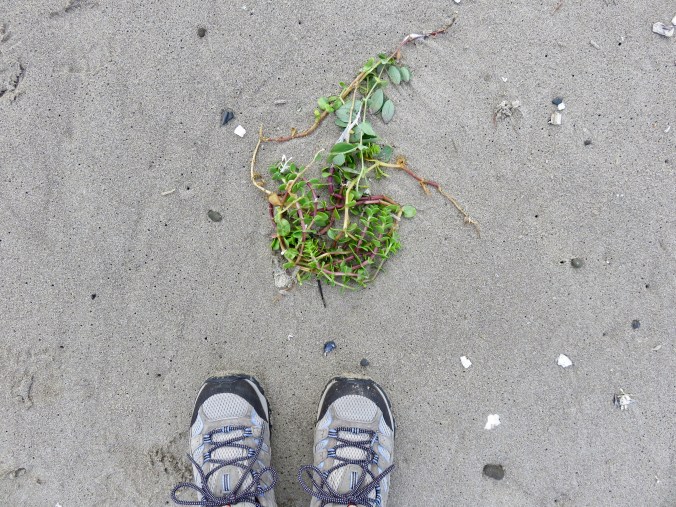
Yesterday, someone—I hope it was a visiter and not a local person—ripped the wild seasonal succulents out of the rocks bordering the sand. Ripped them all right out of the ground! The devastation began a hundred feet south of our path and continued north for hundreds of feet north. These people left a long line of plants littering the shore, tore them out by their roots just because they could. Like the party who started a fire of drift logs and abandoned it to smoke and smolder all night long. Like the people staying north of us who managed to drop their kite all the way over our house and into our courtyard (not the first time), and woke me with loud laughter at nearly eleven the other night. They seem like nice people, but they’re on vacation.

There is a hedge in front of our house, what we call the “front” because the ocean is too vast to be anyone’s backyard. The hedge is mostly salal that grows wild. The local rose, which is thorny and has dark pink flowers the size of quarters, is native too. The cultivar montbrecia, which will pop out in racemes of brilliant orange flowers any minute now, is a thriving but benign volunteer. The same cannot be said for English ivy that threatens to take over the world. My step-grandmother may or may not be responsible for starting ivy on its aggressive path in our hedge. I recall a two-inch pot of decorative ivy. Yes, she might have planted that in her garden as a ground cover. Many people did in the 60s. It was already thriving all over local beach gardens. We religiously remove it from the courtyard and fight to a truce in the hedge.

By contrast, I give Genevieve credit for planting honeysuckle, which has spread but without strangling any other plant. And it smells better than ivy, though its foliage is not such a stunning, healthy green.

The salal was not invited or planted. It belongs here. It grows in the forest and along the beachfront except where it has been pushed out by invasive ivy or deliberately planted rugosa roses. White or carmine pink. The salal has stiff, leathery foliage used by florists, and berries I use in muffins. I like that I had nothing to do with it, that I need not water or spray or tend it in any way. It is what it is.

Today is the 50th anniversary of Stonewall, the night gay people stood their ground and refused to be passively bullied any more, the night they began a movement. Some call it a riot or a rebellion or an uprising. Stonewall works for me. Gay Pride.

Gary’s co-worker Chris took his draft physical the day after Gary earlier that same year, 1969. Both Chris and Gary failed the physical, Gary for his eyesight. They compared notes at the Book Store, and Gary asked how Chris had managed to flunk his physical. “I told them I was gay.” Oh, right.

When Gary went to Chris’s house to listen to Ziggy Stardust, he knew Chris was gay but he didn’t want to “try something new.” Chris took no for an answer and they remained friends. That’s usually how it goes. I’ve been hit on, so gently that I only figured it out later, and I’ve had gay and lesbian friends going all the way back pretty much forever. I knew who they were and who they were interested in sexually at least from my junior year of high school, but it was never an issue. Like someone being married or in a relationship: It only matters if you are romantically interested in the person. Mostly I failed to pay much attention. What possible difference could it make to me that the girl, who had done me a kindness when we were both six year old, liked girls? Barb was my friend and I valued her for her friendship. I miss her still.

fullsizeoutput_fca

The salal berries I use in whole wheat muffins and the wild huckleberries I use in butter cake are among the best things I know to bake. Published recipes suggest that blueberries can be substituted for these NW berries. Perhaps. Perhaps if they were wild and smaller berries I would love them. Perhaps if I could not get the real thing the substitute would be good enough. If I lived in Maine, it would make sense to me. But I live in Oregon and I am pretty sure that what grows here without my help or interference is the best of all.

We are all visitors here. Letting things be is the theme for today. Allow the natural to thrive and you owe it nothing more, no anger or resentment, no ripping up just because you have that power. A pact of noninterference because we all inconvenience and irritate sometimes. At least allow what lives to thrive. Enjoy it or ignore it, as you choose.

FINISH

IMG_4410

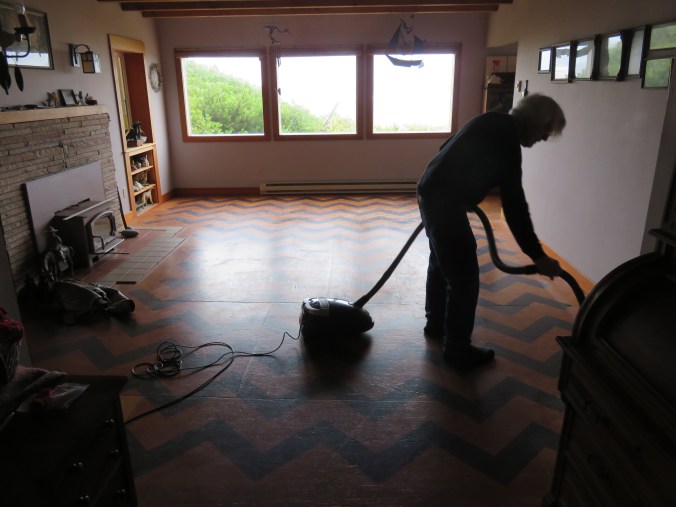
Gary vacuuming the floor for the second or third time before the fourth coat of varnish.

The plan was to put down a cheap floor and then after our sons graduated from college we would spring for hardwood.

A contractor suggested particleboard, sealed and oiled. The look was not what I was after. I chose A-face half-inch fir plywood. The A face is solid, with knots filled. It is not expensive—as best I can recall the four by eight sheets cost about $24 each in 1985. Fifty cents a square foot was about our speed.

A professional painter (the brother of an old friend) detailed a plan for finishing the floors. I wanted mostly wood showing but with a simple painted pattern. He suggested specific products and I followed his advice. I did a bedroom first with green zigzags, then the kitchen and dining room with an oversize black check, and finally the living room has dark purple zigzags. For each floor, I sealed the wood and then drew the pattern with a pencil and my grandfather’s steel rules. I painted the pattern with eggshell oil-based paint—on hands and knees—no painter’s tape but a steady hand. The varnish should have gone straight on after the paint cured, but the varnish was the most expensive step and I wanted some wear on the floor. Leaving the painted floors unvarnished allowed the softer parts of the grain to wear away with foot traffic. The grain becomes three dimensional. This is trendy today, but it was pretty much a unique look in the 80s.

Eventually I sealed the floors with the nasty clear varnish, three coats—two in the late 80s and a third in the 90s. The finish is hard but flexible enough for floors “with light use,” though my floors have always seen hard use, the tracks of children and dogs, sandy feet.

Yesterday I brushed on coat number four. Yeah, on my hands and knees with a four inch brush. It took an hour and my knees might be bruised.

Gary took me out for ice creams.

The stink was terrible in the house, but moving the furniture, books and CDs out of the space was probably the worst part of the process. Everything is crowded into spaces that were a bit crowded to begin with. The sofa is upended in front of the linen closet.

Before I could apply varnish, Gary vacuumed and scrubbed the floors once, I went over them, and then Gary went over them twice more. They show their age. Fir is a softwood and this floor has over thirty years of dents and dings and stains. We still prefer it to any replacement. In a week or two, we’ll put most everything back and clear the dining room and kitchen in order to put the last coat on those floors. Most people will not even notice a difference.

In the mean time, we’re sleeping in our younger son’s old room, two doors past the toxic varnish. We will avoid cooking—I will avoid cooking too much. We’d like to tear out the tile shower but scrubbing and scrubbing will have to do. For most of our marriage, we have made do with what was handy or free or could be done with least expense. And even now. But the ceilings and walls and floors all needed a definitive finish. Finishing. It’s an overwhelming task.

This is meant to be the last time. Once we complete the work we plan for this summer, I expect the walls and floors will do for the remainder of our lives—twenty years or so. If the tsunami doesn’t take this house first, our heirs will sell it or put down something else for people to walk upon.

DAWN

IMG_2210

Last night someone was blasting (illegal) fireworks at 10pm. Explosions in the dark—oh what fun . . . for someone. A month or so ago visitors complained to us about construction noise from a remodel across the street from their rental that prevented them from sleeping in past 8:30am. We smiled and exchanged looks. This has become one of our favorite examples of absurdity on the part of people who live in bubbles of their own making.

People complain about the dawn chorus but play their stereos on full blast all afternoon. It’s the same with tourists stepping off curbs in the middle of the block in Cannon Beach without even checking traffic first. They are affluent white people, of course. They are on vacation and everything must be perfect for them.

It’s happening in France too. The New York Times today reports about a French rooster in a favorite vacation spot that bothers vacationers. A fisherman has been asked to replace his hedge with a concrete wall because the birds living in the hedge are noisy and wake vacationers. People move to the country to get away from smog, traffic, and sirens and then object to the sounds, smells, and other inconveniences of country life. They have learned to shut out much of what might bother me about city living, and whine about what I actually enjoy.

My husband opens our bedroom window early each morning specifically so that we can listen to the dawn chorus. We had already been in bed for some time when the fireworks started up last night. Some beachfront homes sport enormous spotlights that shine on the beach (which in Oregon is a public park) because they thinks “it’s beautiful.” But if they wanted to look at the water, they had hours of daylight to admire the view. Instead they really look for a few minutes and then forget to turn off the lights, which shine all night and do damage to wildlife. All because we are afraid of the dark, afraid of wild creatures and of going to sleep when night arrive, of sounds and smells of nature. Even time.

The Grand Canyon is now a Dark Sky Park. “The designation places the Grand Canyon into esteemed company with more than 60 dark sky parks, communities, and reserves in the United States.” Light pollution on our planet is a very real problem. Years ago I wrote a snarky essay as a model for students about how offensive I found lighting when I wanted to run by moonlight. I discovered my personal objection was really beside the point. Lighting creates a host of problems for human beings and animals, birds and general health. We converted our outdoor lighting long ago to avoid lighting the sky when nature is dark. We never leave our lights on all night and not only for that reason. It might be safer in the dark, and it it is certainly healthier. Numbers on the clock have become more important to human beings than actual time. Despite the fact that “noon” means that time when the sun is at its zenith, some people want so-called Daylight Saving Time to run year around, with “noon” at 11am. If people wanted more hours of daylight, they have only to wake with the sun.

Are all these disconnects from the realities of nature a matter of privilege or modernity or just plain stupid?

Instead of resetting clocks, shutting up nature, and sleeping hours past dawn, perhaps it’s time to rethink this absurd denial of nature. Turn off the electric lights. Hear the birds. Understand that we live on a planet not merely in manufactured spaces. Birds sing. A raccoon crossed our yard this morning and they run across our roof at night. A weasel lives in the hedge, and pet rabbits and dogs should not be turned out “to run” in the wild. Baby seals are left to rest on the beach by their mothers and do not need to be rescued. Storm-battered waterfowl will die or survive without assistance.

Allow the wild to be what it is. Live with it.

A TASTE FOR SWEET

fullsizeoutput_fc1

My mother was pleased to read that as we age we lose our taste for sweet. She had a powerful sweet tooth and hoped this aging side effect would lesson her desire for cake and snickerdoodles. Alas, as she discovered later, the change in taste is not that we care less for sweet as we age, but that we lose our perception of sweetness. We do not crave the flavor less, we want more of it to satisfy our tongue.

There are other kinds of sweet.

Gary commented this morning on how I push off hard from my toes as I walk. “Especially the left one. While I graze the ground graceful as a dancer.” He laughed, and I wondered if the habit was left over from all those years of running.

We saw runners and dog-walkers. I followed a deer’s footprints from the tideline to the soft dry sand and lost her. Gary first spotted the raccoon prints. I found three back shells of my favorite “ugly clam” and three top shells that did not match. The back shells are always colorless, translucent, and shaped with a hole in the middle because the Pododesmus macrochisma shapes its home around the point of a rock. These C-shapes are even more delicate and far less common than the tops, which are rare enough. I found shells from four species of limpet. A tiny agate. We do not know what drew the adult bald eagle to the sand near Asbury Creek. She left no trace.

DRONES

When I was a girl, my dad built gliders and small free-flight model planes. We joined other enthusiasts and took them far out in the country to a grassy field. Some people had remote control and could turn their craft, the chassis a foot or a bit longer. My dad’s went up and then came down. Sometimes this meant a long run to collect them. Everyone flew their balsa wood and silk span planes until they were battered past flight. We took our models home and my dad would splice and repair, adjust balance, tune the tiny engine, spread new paint—orange because it showed up well in the grass.

They were noisy and useless, but far from crowds, never a threat to safety or privacy. Adult toys requiring careful design and skill to fly.

More recently, a drone flew by our front yard, which fronts the beach. The drone paused briefly at eye level, twenty feet from where my husband and I sat in chairs in our yard. Technically, perhaps, its flightpath was perfectly legal.

We flipped the drone off. It was an instantaneous and shared choice. (And not something I am inclined to do. We both laughed.) The device had moved on but turned back immediately and hovered for a long moment, confirming our suspicion that it carried a camera, watching and perhaps filming us.

If I’d had a pellet gun that day and the skill, would I have been tempted to shoot down that spying drone just past my hedge?

You bet.


SPRING

We have been busy this morning: I baked a pie, Gary did laundry, we picked up the mail, I read aloud, but first thing this morning we enjoyed a nearly a three-hour walk. We walked from spring right into summer at 8:54AM. Today is the first day of summer and the morning sky showed cobblestones overhead, mist along the shore.

IMG_4419.jpg

The seagulls do not mind us much—so long as we walk in some direction other than straight at them, so long as we do not stare, and so long as Gary does not tease them by making claws of his fingers and muttering Kitty-kitty-kitty. We do not like disturbing them at their rest.

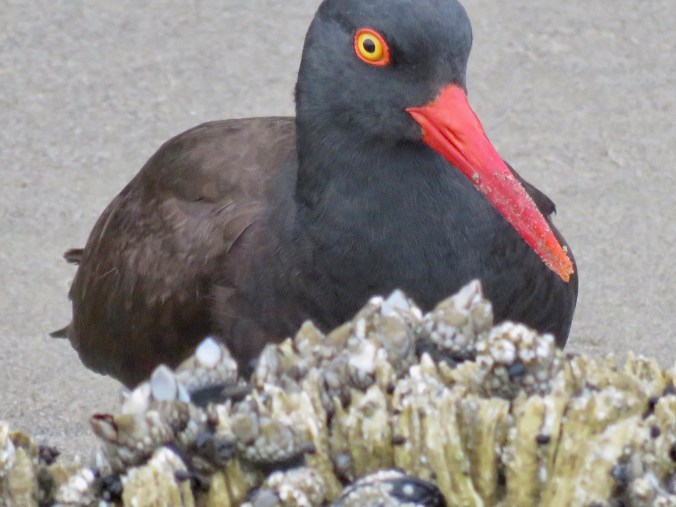
The black oystercatchers who nest at Hug Point did not mind us either today. They glanced at us, but seemed not to mind and continued foraging for sand crabs (?) and mollusks. We assumed their babies must be out of the nest, but then a walker with a dog came along and they went into their act of distraction. Not here! Not here! they seem to cry. They raised their wings and danced all around.

IMG_4426.jpg

Hug Point is so-called because in my mother’s childhood and before travelers used the sand to get to our beach, hugging this headland. The highway didn’t come through until the 30s. A path was partially blasted around Hug Point, concrete poured to make it navigable by car, while the horse-drawn milk wagon went right through the creek and tide pools.

IMG_4441

There are still traces of concrete at Hug Point (you can see a bit in the foreground below), but much of that old roadway is worn away. When we decide to “walk long” we mean walking north around this headland.

Limpets and barnacles on the sandstone, shown here. Anemones and gooseneck barnacles and chitons too.

IMG_4439.jpg

On the way home, Gary wanted a photo of thumbs-up in front of a rock that seems to have the same attitude.

IMG_4423.jpg