GRAMMAR again

Some mornings there is really no excuse for fussing about grammar and I resist. On other days, it just might keep slapping me in the face. I am not a grammarian and often have to look up rules. My understanding of these rules of grammar is the result of determined study after the age of forty.

In my youth, my understanding of grammar rested entirely on what sounded right.
If the verb tense or sentence structure sounds right, I generally assume it is correct. However, sound is a reliable model of proper speech only if it’s what has been heard growing up or has otherwise become habitual. I used to tell my students that if they grew up in an English-speaking household that consistently used formal register English they had an unearned advantage over students who had not. They should be grateful for their “ear” but not smug.

My childhood was financially modest but linguistically advantaged—that is, thanks to the G.I. bill, my only aunt (on my mother’s side) and my father both went to UofC, Berkeley, and both eventually completed masters degrees though no one else in their families had previously attended college. My parents often quoted Shakespeare and sang Gilbert and Sullivan lyrics. I heard proper English spoken as a child in my immediate family. That’s my luck.

What sounded right to me generally was correct. As a result, I never learned the rules of grammar, never bothered with any of that. A mistake. [I have always been a poor speller. Maybe the bad spelling is somehow connected to this? Arrogance? I used to warn my students about my poor spelling, which was nonetheless better than most of theirs. “If you see me misspell a word on the whiteboard,” I told my classes early in the school year, “go ahead and correct me. I will not be offended.” I modeled looking things up. As an adult, I worked hard to improve my spelling, and I still make mistakes, sometimes because of my poor hunt-and-peck typing and other times because I am just careless. I struggle with overuse of commas, I think, as a result of reading too much Victorian literature, which revels in them.] I read a great deal. I took two years of Latin in a public school and should have taken a third year, but it seemed at the time that even Cicero could not repay me for an entire year of Caesar’s Gallic Wars.

These days I still look up words and grammatical rules. I also occasionally add to a modest file of published errors. Here are a few:

“A man was seen with a gunshot wound laying motionless on the ground in the area near where the opposing groups had fought and where mace had been deployed.—yesterday’s The Washington Post [“laying” should be “lying” Laying refers only to an action done to something. e.g. I was laying down the book, while I was lying down to read.]

“Thompson performed a driving maneuver that led Lewis’ vehicle to crash and came to a stop.“—NPR, 17 Aug 2020 [“crash and came” should be “crash and come”]

“They can make a child too listless to pay proper attention in school or so sick she misses many school days.”NPR [If the author wants to avoid the growing gender-neutral use of “they” as a singular pronoun, there is still an easy fix: “They can make children too listless to pay proper attention in school or so sick they miss many school days.”]

Good morning. Joe Biden and Kamala Harris made their debut as running mates. The British economy sunk into its deepest recession on record. And the QAnon conspiracy theory has found its way to the mainstream.”The New York Times [I am fairly certain it should be “sank” unless they mean “has sunk,” which would also work in this context. I looked it up to be sure.]

“Her three decades of high-stress nursing was behind her.”—Goodreads novel blurb [“was” refers back to “three decades” and therefore should be “were”—though I might be wrong about that: “High-stress nursing was behind her.” “Her three decades were behind her.” To my ear the “of” makes the “high stress nursing” a modifier, not the subject. Dreyer might disagree.]

“Gaudí’s ambitious design originally featured 18 towers, including 12 for each of the biblical disciples, but as the Associated Press notes, it’s possible that some of these spires will never be erected.”Smithsonian [I am certain the author does not mean there are twelve towers for each of the disciples. Aren’t I? “…including a tower for each of the twelve disciples.”]

“Martin Gugino, a 75-year-old protester, lays on the ground after he was shoved by two police officers in Buffalo, New York. Jamie Quinn, via Reuters”TNYT photo caption [again, should be “lies”]

I note these things because I paid for access to most of these typos, because news published in mainstream media should be able to afford a proofreader/line editor, and because I cannot help myself. No, that’s not right: I choose not to stop myself from pointing them out. I believe I have an excuse for my errors, but refuse to grant The New York Times the same tolerance.

[An applicant for a position as Head Secretary at my school twenty or more years ago failed to get an interview because the current Head Secretary did not like having her three grammatical and spelling errors pointed out to her. She tossed the application. She was most indignant when she told me this.]

Again, I will reiterate that I am not a grammarian and I make mistakes all the time myself both here and in conversation. I have worked to achieve a technical understanding of grammatical rules because I was an English teacher for most of my professional life. I believe people should care enough about their jobs to continually work to be better at them. [I know what a “comma splice” is, how to explain the concept to my students, and why it should not make college professors and high school English teachers scream in fury, but that it does. That’s why they should avoid them.] No one likes errors pointed out to them. Well, most people don’t.

Someone did yesterday.

In my daily life I cling stubbornly to what sounds right and what sounds wrong to my ear, but I have studied the rules of grammar and I am willing to improve. Even now that I am retired. [And, no, that is not a complete sentence—incomplete sentences have been one of the feature of modern writing that I have learned to adjust to. And ending on a preposition too.]

For example, the word “boughten” sounds wrong to me. I have looked it up after finding it in a novel. Webster insists there is such a word, but I cringe to hear or read it. Boughten? ouch
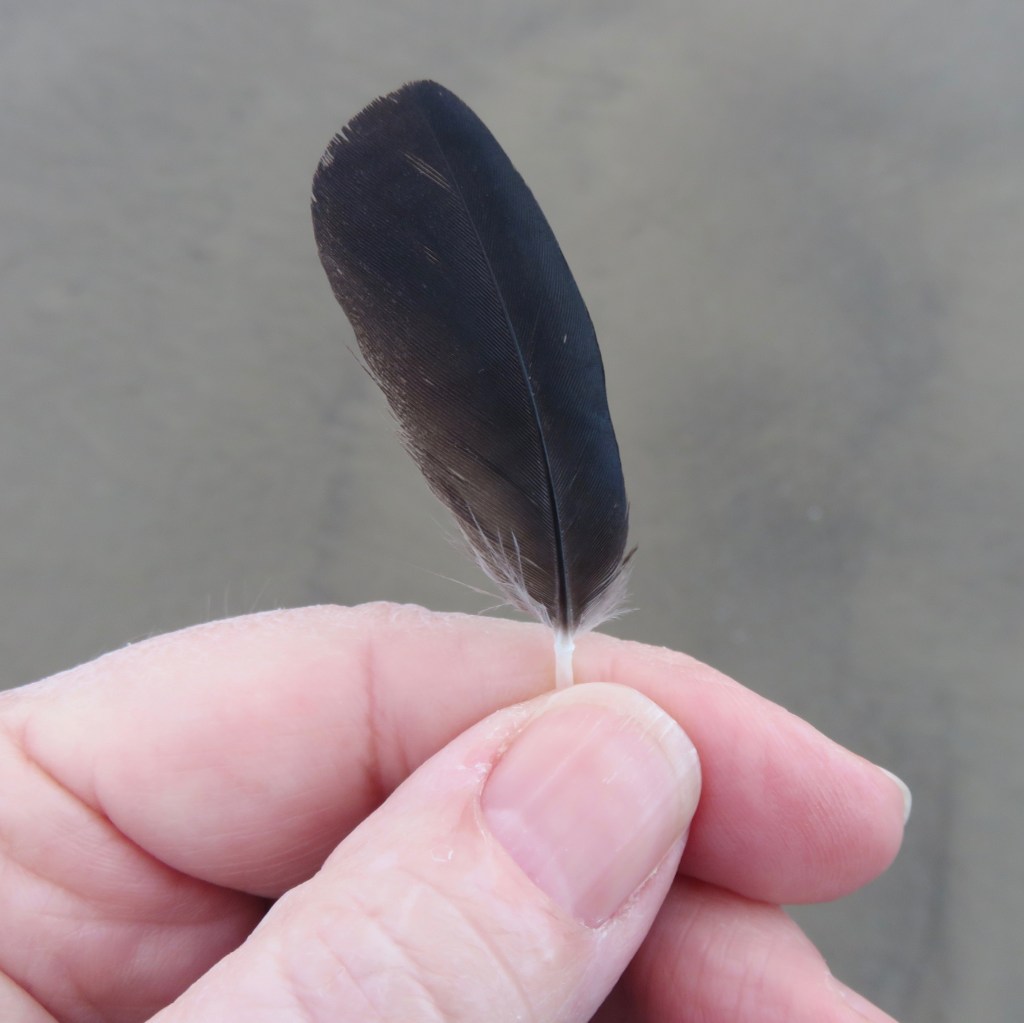
I rarely pick up feathers on the beach—there are so many in summer. But this little beauty caught my eye.

I will also note the I could not find a way to change the color of my text (which is why I used bold above) or to indent a block of text (the other reason I used bold above), but just now I discovered how to do those things and how to wrap an image with text using this new editor—though I may have to figure it out all over again next time I want the effect.

Machinery does not come any more naturally to me than grammar. I have to work at it until I can internalize the process and it becomes habitual.

This morning I learned that I won a free book, PR for Poets by Jeannine Hall Gailey over at her blog. Her blog is a pleasure. She is a kind person who speaks forthrightly about her health struggles and generously about her fellow poets. I rarely think of myself as a poet, but I do read poetry and routinely compose in my head, and I have published poetry.

Poetry, in my life, has offered a strategy for organizing and crystalizing my life experience. A revelation of truth and connection. Poetry allows the world to rest here, just between my fingertips, just at the edge of my understanding. A fluttering demand to be recognized. A rare flighting bird.

Gailey’s book might be just what I need to rediscover my off-and-on-again daily poem habit.
the BLUE HOUR

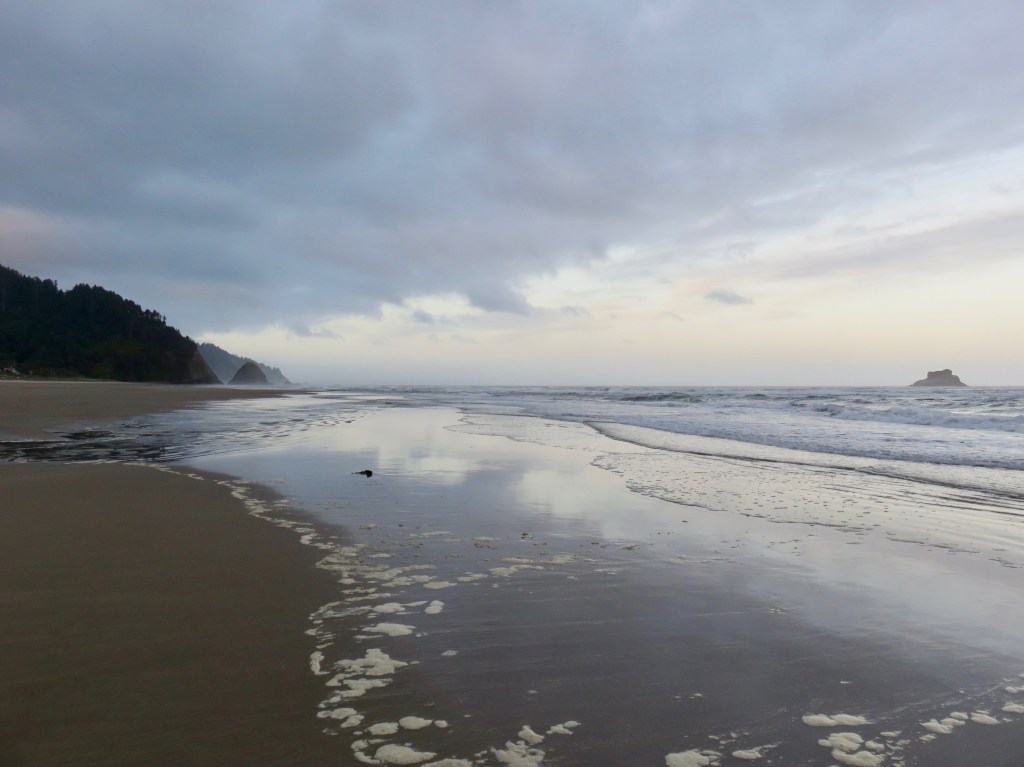
The “blue hour” is a name for that period where there is light enough to see, but the sun has not yet risen. This time bridges time between darkness and the golden hour, those periods just before sunset and after sunrise when the light differs from ordinary daylight.

As might be assumed from the name, the light at end of day is gilded, even, and without shadow. Entire films have been photographed during the golden hour in smaller latitudes and during the right season when that period lingers longest. Near the equator, the magic might last minutes, but moving toward the poles the Hour might be a full hour because of light bending around the world.

I find some details of Wikipedia‘s “golden hour” entry confusing. We see a noticeable warm light extending long after sunset, but the morning light is clearly blue before the sunrise, become bright and yellow only by contrast once the light hits the sand. That is, perhaps because of the ocean, we see a “golden” light after sunset until dark in the evening and only blue light in the morning. Having learned the term first from cinematographers and second from experience, my understanding may be insufficiently scientific.

In photography, the golden hour is the period of daytime … during which daylight is redder and softer than when the Sun is higher in the sky. 

The period of time shortly before sunrise and shortly after sunset is called the “magic hour,” especially by cinematographers. 

The period of time shortly before the magic hour at sunrise (or after at sunset) is called the blue hour, when the Sun is at a significant depth below the horizon and residual, indirect sunlight takes on a predominantly blue shade.

Wikipedia

Blue Hour is the title of a book of poetry by Carolyn Forché.

    come, love, through burning 
    composed of light 
    converging on my own life
                   from  "On Earth"

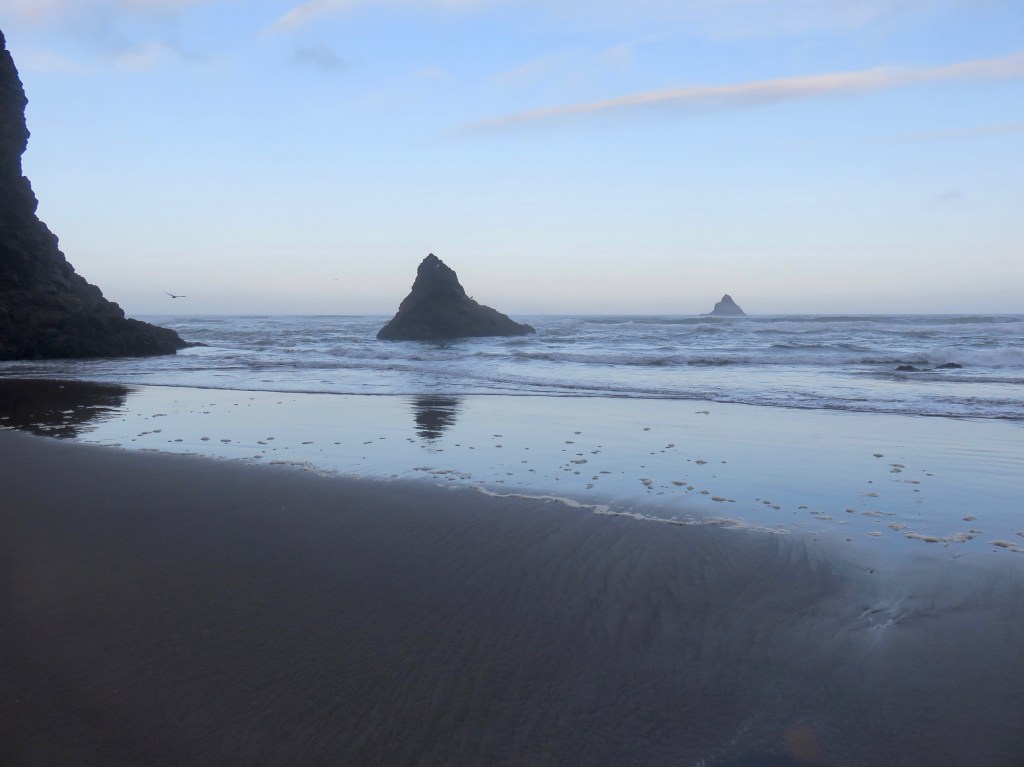
The blue hour is the time of day my husband and I walk out on the sand, unmasked, and alone. Before sunrise. Before the day begins its busy work.

The blue hour reveals sand newly swept by the sea.

The blue hour is the time of tiny shore birds rising and settling, rising and settling, search and searching.

The blue hour witnesses gulls eating crabs cast onshore.

The blue hour is given over to breaking waves and mere silence underneath.

The blue hour precedes the blind light climbing the coast range and casting brilliance out to sea and finally onto the sand.

The blue hour is cool and clear, damp and dim.

The blue hour.

The pure clean daylight makes an end.

Ah! I have learned how to change text color, single space multiple lines, and indent text—hoorah!

MORNING WALK

This is why we walk early.

Our walk is what begins our day, what gets me out of bed and moving so that we can walk tide-washed sand and get home before the crowds. What we see on our walks—crabs, isopods, a moth caught on the wet sand, seabirds and eagles, the sand crabs and hoppers of various sorts—decorate our path. There were no chitons, none at all this morning, on the headlands or seastacks, but juvenile gulls still cried for their mothers to feed them.

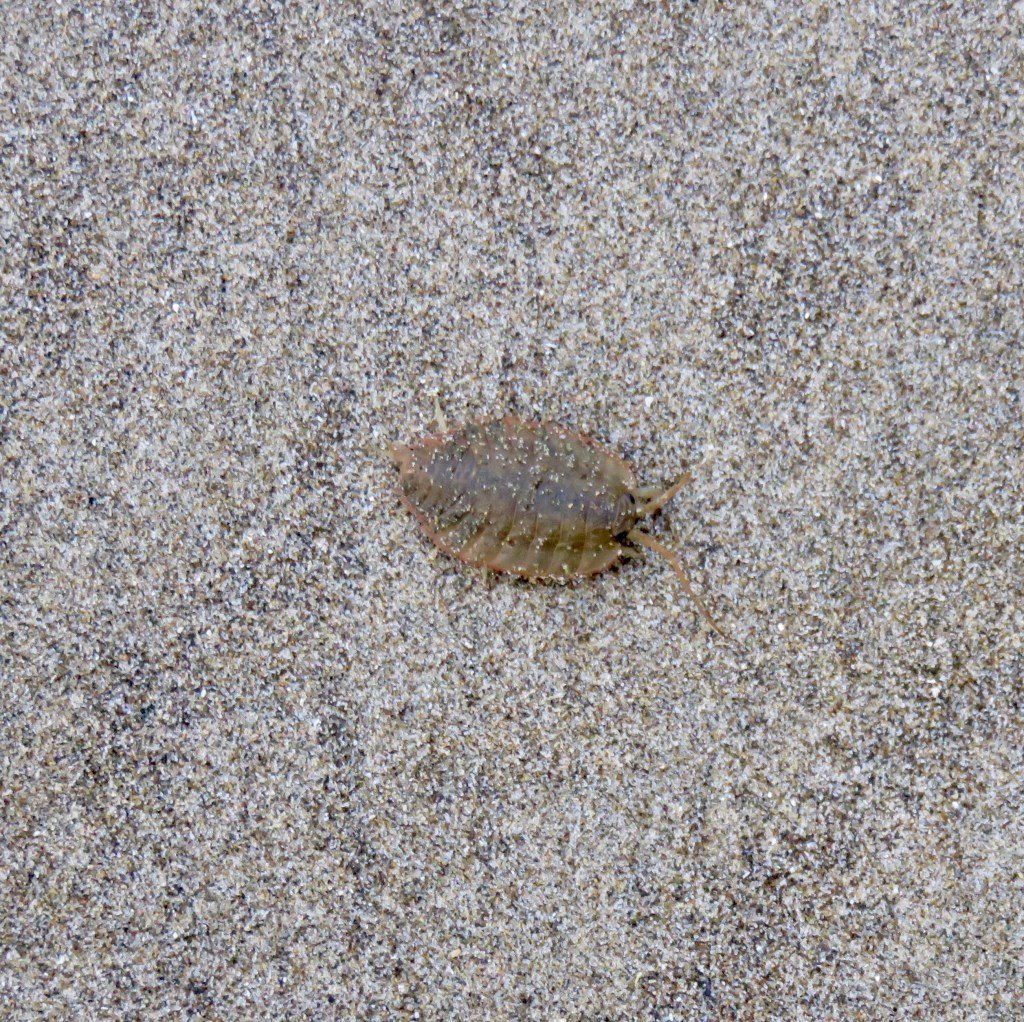
When my nearby footsteps alarmed this isopod, it flipped onto its back, rolled up just like a pill bug, and then flipped back onto it myriad legs and scurried on. It was more than an inch long

The odd little fellow rushing past us was an isopod, a sort of catch-all term covering the ten thousand other species of Isopoda, an order of crustaceans that include woodlice, what we called “pill bugs” when I was little. The Isopoda include 4500 species that live in or near the ocean, 500 on dry land, and the other 5000 in fresh water. They are found worldwide and the land-based species are entirely herbivorous and harmless to humans. Some marine species bore into wood (such as boats) or are parasitic to fish, shrimp, or crabs. The one I saw this morning was likely a rock lice or sea slater, considered a terrestrial isopod, though its habitat includes tide pools—the entire splash zone. Taken together, this order lives everywhere in the world, from the tropics to the edges of the Arctic and the continent of Antarctica.

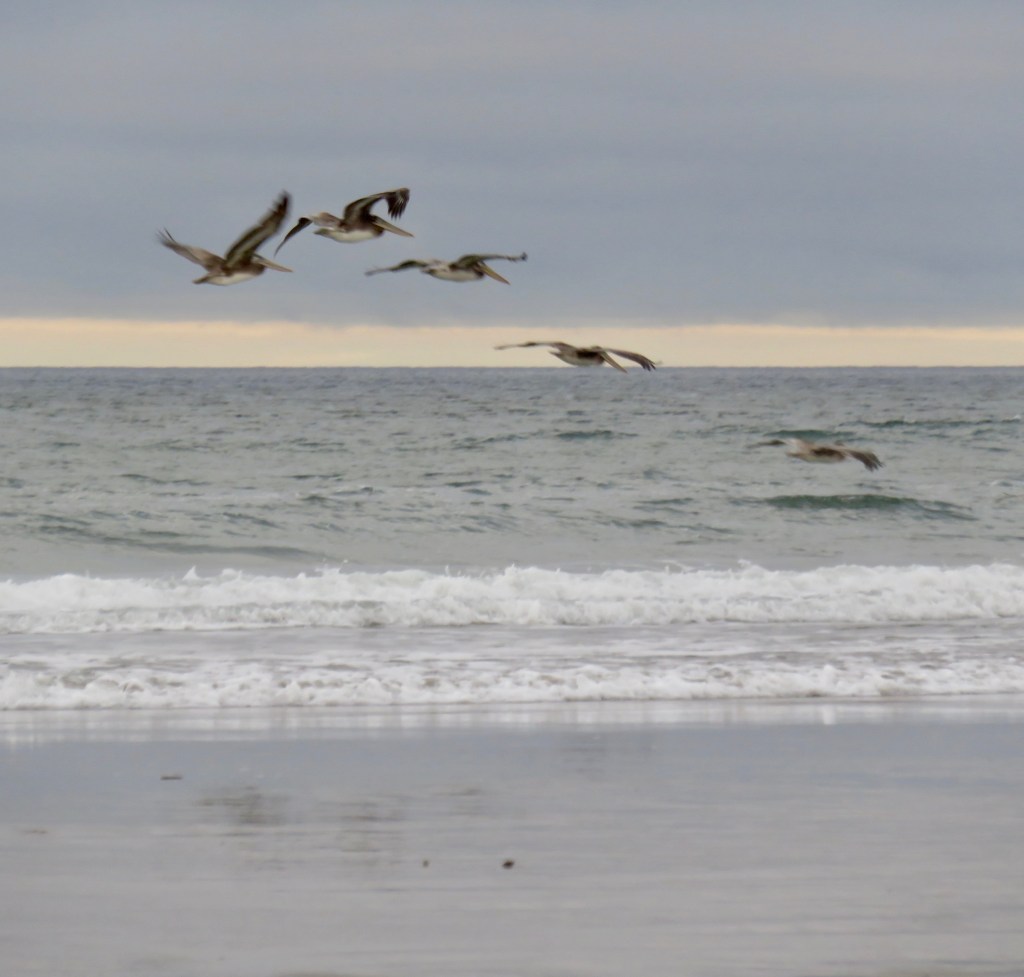
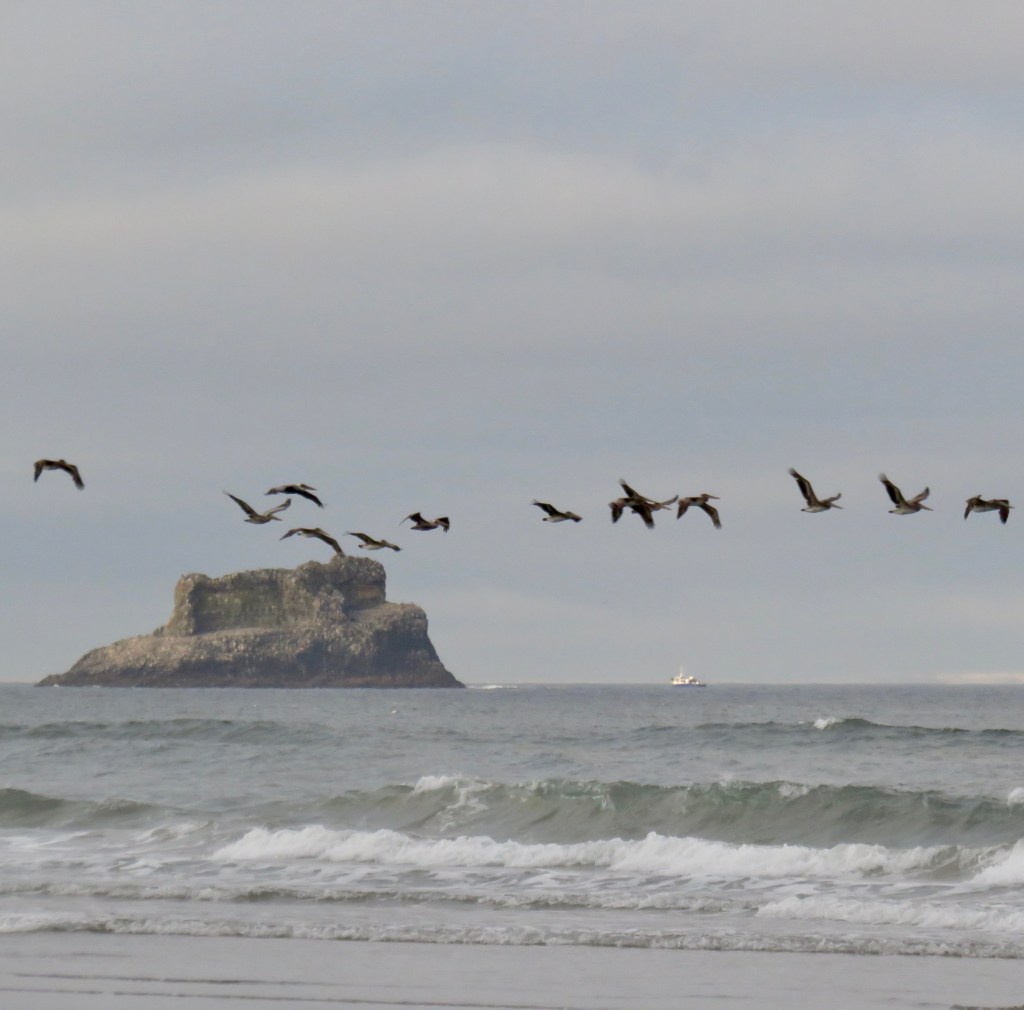
We walked long this morning and after touching stone at Hug Point, hundreds (Gary says thousands!) of pelicans flew past us heading north. The first group of seventeen was followed by a small group of five, which appeased us since we suspect they are almost always in even numbers. (They are monogamous for the breeding season.) Then a group flew just outside the surf line, too many to get an accurate count, and another group and another and another all the way while we walked the two miles home. 

This is part of a group that flew between us and the surf. Some groups flew out near the horizon, usually in a looping line.

The brown pelican (Pelecanus occidentalis) was identified and named by Linneaus in 1766. It is found from the mouth of the Amazon River and Galapagos Islands north into Canada on both the Atlantic and Pacific shores. It was listed among the endangered species by the U.S. from 1970 until 2009, but thanks to the ban on DDT in 1972 the species has recovered and today is listed of “least concern.” The local subspecies is californicus, which breeds on the California coast. A large seabird, our brown pelicans are the smallest of their kind. Their flight feathers are dark brown when I find them onshore, and sometimes a foot and a half long. They have a wingspan of about seven feet (6’8″ to 7’6″) but weigh seven to eight pounds. They spend their lives almost entirely at sea. They glide steadily near the surface and we enjoy watching them dive into water for fish. Pressed to catch up with their pod, a pelican can move very fast indeed. They can perhaps fly at speeds past 50mph, and live for decades.

When we moved here forty-one years ago, neither of us recall seeing these birds at all. Then one summer, there were a few who passed, then fourteen arrived one early summer and stayed into the fall. That might have been fifteen years ago, perhaps more recently, perhaps in 2007. We see them each year now and long lines of hundreds sometimes pass, but usually a dozen or more hang about, fourteen or eighteen, throughout the warmer weather. They have flown right in front of our windows—their strange pterodactyl faces, always seeming to be pointed north. Most often they glide a few feet above the ocean, between breakers or just outside the surf. But other days we see them far out on the horizon, moving in smooth, graceful arcs.

We are always heartened to see the pelicans. Thank you, Rachel Carson. Thank you thank you thank you!

STRANGE DAYS

Yesterday was our 46th anniversary, and today the people who own the house north of us called me a “b—-” and a “f—ing b—-.” Several times, actually. I was told to go in the house, that I did not understand what was happening. That I did not understand psychology and using that language was entirely within their rights.

You have to wonder about people like that. How do they manage communication within their own families when someone disagrees with them? Does anyone dare?

HOUSE KEEPING

I have bread rising just now. After I’d put the dough into an oiled bowl—the perfect size with a silicon lid that exactly fits—I washed the measuring cups and the scrapers, the measuring spoon and the mixer bowl and paddle, and finally, since I was at it, the coffee cups from breakfast. Then I dried and put everything away, wiped down the counters, and remembered my mother.

It was my job to do the dishes by the time I was eight—never my brother’s job as he was given the lawn and paid more to do it in his adolescence and teens, facts I resented even then. But for at least the past twenty years or so, washing the dishes has been my husband’s job. We both had full-time jobs outside the home by then. I had more homework. (“You are never off the clock,” he observed more than once. He came home and left the work at work.) I cook. He cleans. I paint walls. He gardens. (I do feel I got the better end of the deal.) We are meticulous about sharing how money is spent. (Except for gifts to one another—we are even allowed to lie about that.)

Anyway. Dishes. The hot tap water scalded my hands and I hated rubber gloves. The entire task was nasty and I resented it.

A couple of years ago we were staying at friends’ beautiful cabin. After a lovely dinner, our host was washing the dishes and I did not help. I knew I should lend a hand but I felt rather helpless. Perhaps it had been too long since I did dishes or I was lazy? Perhaps I had lost some measure of self-sufficiency?

So my friend washed the dishes, dried and put them away, perhaps. I was not paying full attention. Then, in a final step, she wiped out the sink, and it all came back to me. My mother always wiped out the sink and wiped down the counters after doing the dishes. She used a mop to scrub the kitchen floor.

I had done that myself, once upon a time. It struck me, oddly, as a powerful wave of memory, of habits discarded, or skills set aside by necessity because of the long hours I worked while teaching and advising yearbook, caring for children, writing, and completing a fourth degree.

I used to wipe out the sink.

I used to get down on my knees and scrub the floors each week, tip furniture back and vacuum every other day, brush my teeth twice a day, floss, and carry out the trash. I took my young sons out for a walk and often carried at least one of them home again. I canned tomatoes and peaches too.

The mystery novels I am reading just now obsess over protecting private schools and colleges where all “the best people” and “the best women” attend school. Since I am reading this author’s books in chronological order, I note the author becomes increasingly willing to acknowledge politics, her own feminism, and her fear of aging, but she never lets up on class snobbery, which she fervently denies, of course. Those best people. Or as Woolf’s character Mrs Ramsey in To the Lighthouse declares to herself: “the fact that there is no reason, order, justice: but suffering, death, the poor.”

I paused for a long time over “the poor.”

There is a grammatical structure called parallelism in a list, something I used to teach. “I went to the store to get apples, milk, pepper, and toilet paper.” A list of nouns separated by commas. (That last comma before the “and” is referred to as a “serial” or “Oxford comma,” and some of us have strong feelings about whether it should be used. Yes, it should.) Parallel structures exist in any list, such as verbs—”He ran, jumped, and fell down”—and can be more than single words—Over the river and through the woods, to Grandmother’s house…” To be parallel, a list of nouns must be all nouns, all verbs of the same tense, all prepositional phrases, or whatever.

Life, Liberty, and the pursuit of Happiness. [I double-checked the caps—Jefferson capped his essential human rights.]

Pause and look again at Woolf’s three words, “suffering, death, the poor.” Suffering and death are situations, but “the poor” are people. Suffering and death afflict everyone, may be avoided or delayed but not escaped. According to the structure of this sentence, so are the poor. An inevitable affliction? She could have said “suffering, death, and poverty” to herself. Poverty is another affliction, though not one this particular character ever experienced. Neither did Woolf herself experience poverty. (She and her husband owned properties when she complained of poverty.) It is poor people who are the affliction in this grammar.

Before we begin talking, as some people like to do, about class warriors, consider the inequality of the battle. Consider who is winning in a battle against poverty and who loses. Consider who fights from gilded mansions while whining about class warfare.

Self-sufficiency is a major reason I do not have my hair cut, have not visited a “beauty salon” since I was a child. I cut my own hair and when I colored it with henna or purple dye, I did it myself. I have never had a manicure, though I have considered one. I have changed tires and headlights myself, painted walls and laid tile, and built fencing and wainscoting. I have never sheered a sheep, but I have carded, spun, and dyed yarn. Over the years I have experimented with most every traditional woman’s craft and a good number of those given to men. Gary and I have never hired anyone to clean for us or to run errands or to do the gardening. Sometimes cleanliness suffered, the errands were not done, and the garden was a wreck. We were okay with that for a variety of reasons. It didn’t matter compared to the rest. Usually, we could not afford to have things done for us. We always believed we should do for ourselves as much as possible.

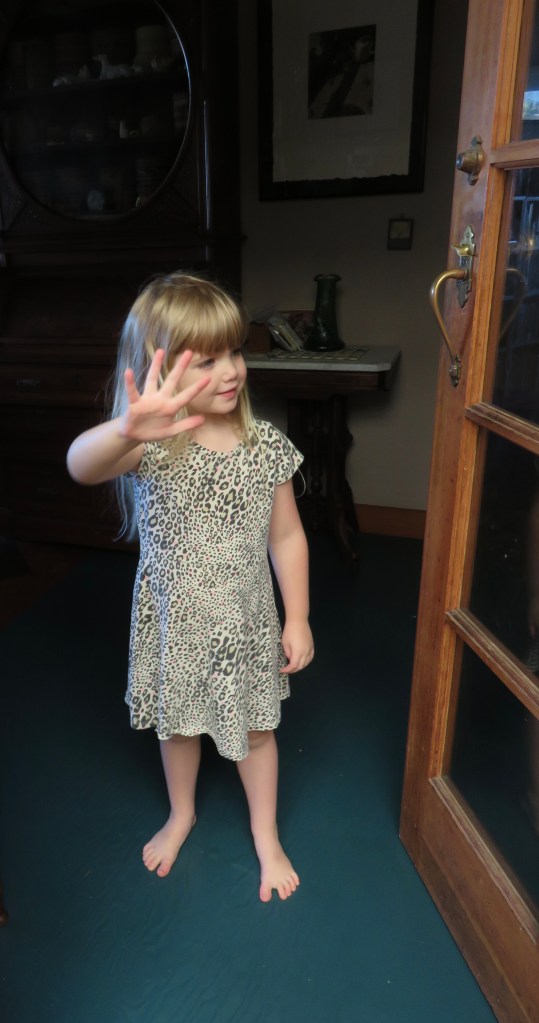
My younger granddaughter stands in the doorway, waves to me, and looks at her own reflection in the glass.

As we age, this will change. Two lamps are waiting to be installed in the ceiling outside the laundry. We will not be the ones to install them. Gary is forbidden to go on the roof. I refuse to crawl under the house ever again. There will be tasks we ignore or hire others to complete.

Poverty is not something I can personally cure. “The poor” are sometimes “the best people.” I know this from my lived experience.

And while I would be a fool to think anyone is ever entirely self-sufficient, I can still bake bread. I can wipe out the sink when I am done.

WHAT WE DO

Former Arizona Representative Gabby Giffords, shot in the head in 2011 as she held a constituent event, set the message for the DNC last evening: “Today, I struggle with speech, but I have not lost my voice. America needs all of us to speak out, even when you have to fight to find the words. We are at a crossroads. We can choose to let this continue or we can act.” She implored listeners to vote. 

In a somber speech, former President Barack Obama warned that, in this election, American democracy is at stake. He outlined the strengths he sees in Joe Biden and Kamala Harris, then warned people not to let “this president and those in power… those who benefit from keeping things the way they are… [to] take away your power. Don’t let them take away your democracy…. What we do echoes through the generations.” 

It was a powerful speech—one for the ages, really—and it set up the night’s final speaker, California Senator Kamala Harris, now the Democratic candidate for vice president. 

Harris tied Obama’s theme to her own story as the American-born child of immigrants, reminding us that America is a “a beloved community where all are welcome.”

But not everyone sees America that way. “I think we need to ask ourselves, why don’t they want us to vote?” she said. “Why is there so much effort to silence our voices? And the answer is because when we vote, things change. When we vote, things get better…. Years from now, this moment will have passed. And our children and our grandchildren will look in our eyes and ask us: Where were you when the stakes were so high? … And we will tell them. We will tell them, not just how we felt. We will tell them what we did.”

—Heather Cox Richardson

“Don’t forget: Joe and Kamala can win 3 million more votes and still lose,” Hillary Clinton said. “Take it from me.”

OPPORTUNITY

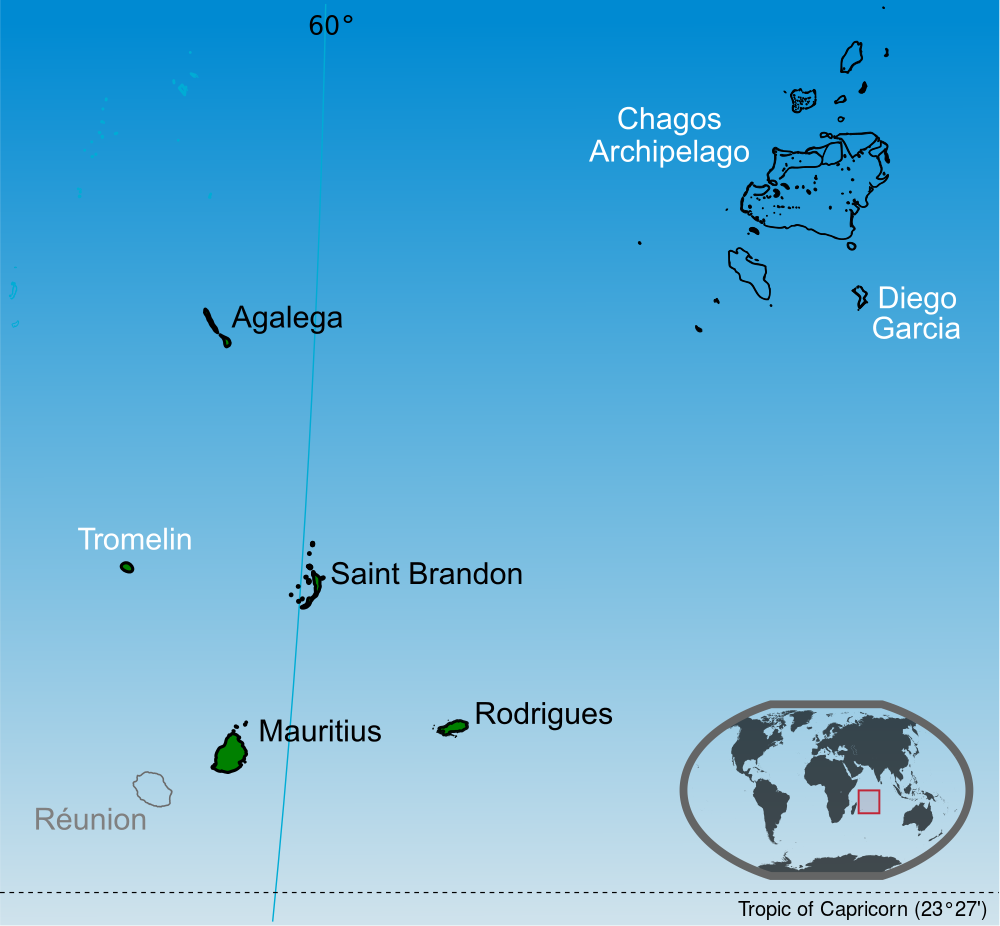
Someone using Mauritius as their home address visits my blog most days. I have access to view-counts and country-counts. I know where in the world my viewers are logging on and how many pages have been viewed from each country. I can’t help being curious about who is reading my posts from Mauritius. I know where that is, but not who.

The pandemic has cost me travel and entertainment and face to face meetings, Scrabble games and Farmers Market shopping. But some things might might change permanently, and some of those changes might be . . . at least interesting.

As one example, some events I would never have traveled to are now scheduled as online meetings. I can attend an Adroit issue launch, for example. I’m not certain I could do that before. I’ve been invited via email to several readings I am certain I could never have seen before. Living in a tiny community of mostly vacation homes in Oregon, New York City public readings might as well have been on the moon.

I understand people missing the “water cooler” moments and the schmoozing and drinking after-event events. Since I never enjoyed those sorts of gatherings, this is no loss to me. I see opportunity here.

Another opportunity is a sensible reorganization of clocks. Since much of the world ignores real time anyway—noon no longer means when the sun is at its zenith—maybe rethink this whole clock thing. Clocks made sense once upon a time as a way of dividing time. Now they are simply a matter of numbers telling us what to do when. And this is complicated by the way time zones divide up the world.

If I want to speak to a person in a London shop, for example, I must first look up their hours of operation online. Then I call up a conversion table to find out what 8am is local time. Then I can schedule a call.

Imagine that the entire world went on Greenwich Mean Time, the time I increasingly find on charts and websites these day. That is, today would begin just after the clock showed midnight at Greenwich, but it would be today all over the world at the same time instead of already tomorrow in some places—or is that yesterday? It would still be inconvenient to wake in the morning and find that the London shop had already closed at 5pm, but it would be open at 8am, which would be early afternoon for me tomorrow, and 8am would be 8am all over the world. London doesn’t currently observe GMT, which adds another wrinkle. In a worldwide system of GMT, they would, and if they wanted to open for business an hour later in the summer, they could do that.

Sure, confusion at first. We are fond of our numbers. Locally, I would be waking with the sun about 1pm, but the time would be 1pm everywhere. No confusion about whether it’s today or tomorrow in Hong Kong. (Seriously, you are never confused about that international date line?) Hours posted would hold true all over the world. Could I get used to rising when the clock says 1pm instead of 6am and heading for bed when my clock says 4am? They’re just numbers. I think I could accustomed myself to the numbers. My internal clock wakes me at sunrise and sends me to bed at dark.

In the mean time, I would still wonder who looks at my blog in Mauritius late in my night?

Mauritius_(+claim_islands).svg.png

I know about these islands because one of Patrick O’Brian’s Aubrey/Maturin novels is set in the islands. This image is from Wikicommons.

WORKAROUND

IMG_6828.jpg

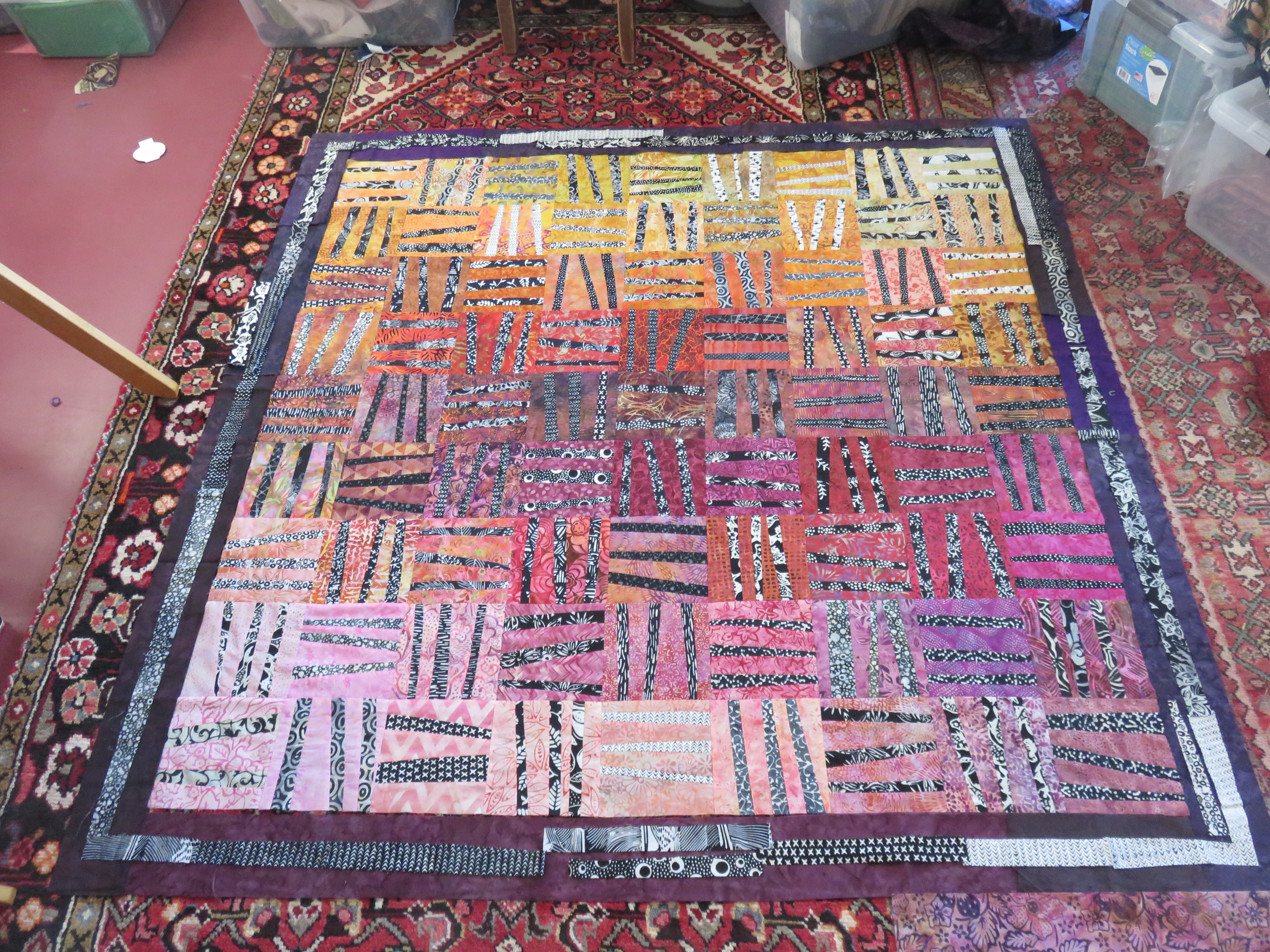
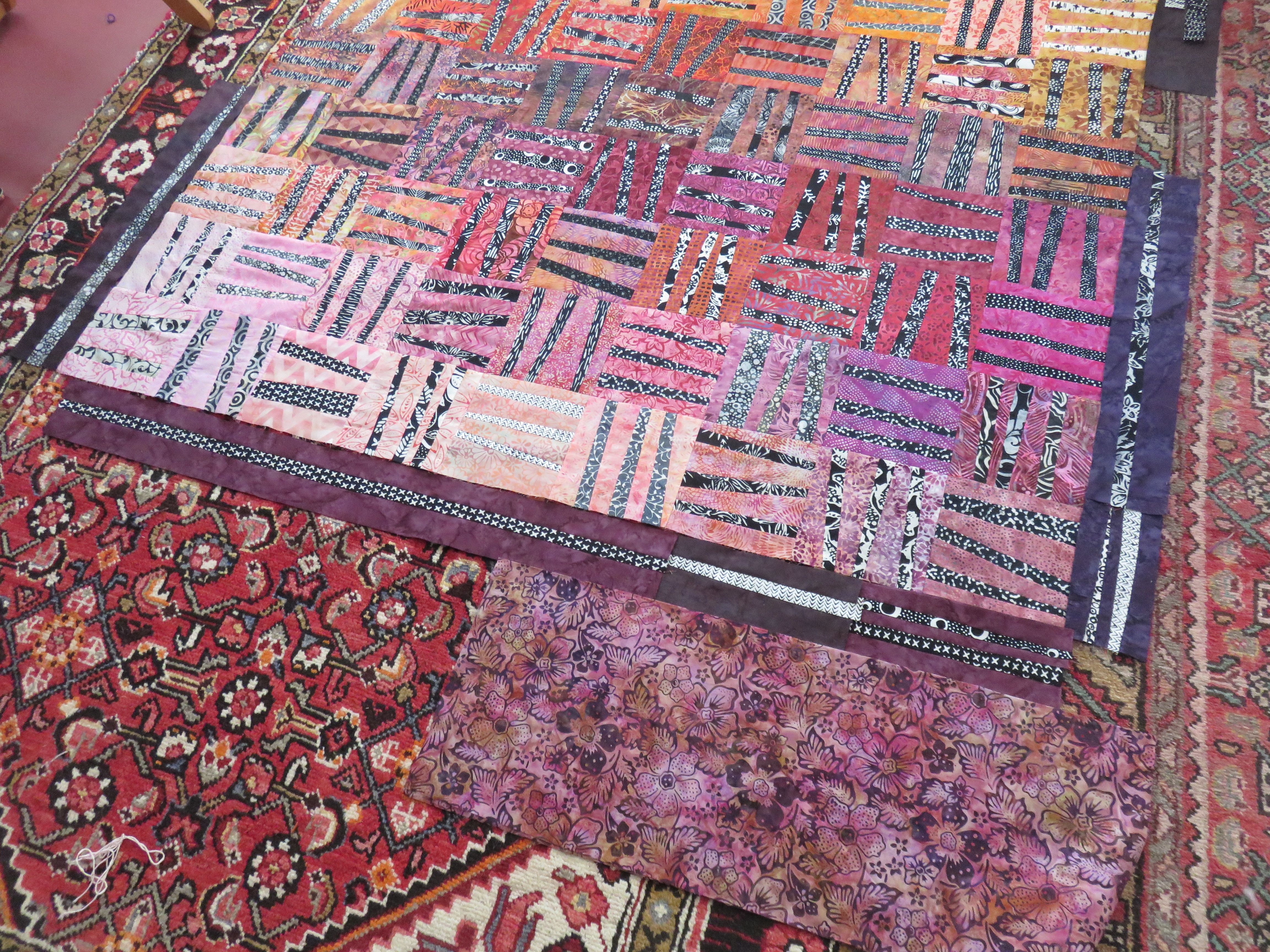
The center panel is composed of eighty-one different patterned squares, crossed by twenty or thirty different black and white cotton. The split frame is of several purples, and these each change from step to step. There is also a pieced border.

There is more to this post—I figured out a workaround.

Above is the center panel with the border pieces, unsown and just separate pieces of fabric laid in place. Below is the border pieced without corners and not yet joined to the center—trust me, it evolved. It’s entirely sewn as of now, and today or tomorrow I hope to complete the border, trim the backing, and fold it all up so it’s ready for Linda Pinkstaff at Astoria Quilting to work her magic. We will carry them north in the next week or two. Perhaps by then I will know what I am doing next.

Yesterday I got stuck. We walked north to Arcadia Beach, two miles away. I made granola and peanut butter cookies that were mostly peanut butter, a riff on Maida Heater’s recipe. Gary liked them, and he’s always insisted he did not care for peanut butter cookies. I finished the dreadful novel I began earlier in the week, skimming the less savory parts.

What I did not do is work on this quilt, which now has a name: “Aurora Which Means Dawn.” That is a line from a Golden Book about Sleeping Beauty. So perhaps I should call this “Sleeping Beauty”? Except it’s not a sleepy piece but bright day. It is my fifth quilt during the past year. Can that be? I have not made that many quilts in a year before. Let me think. Why would that be?

Some people bath less often, some are drinking too much, some quarrel with or avoid their family, some have shifted their political priorities—perhaps a national healthcare system and stable income seem more reasonable necessities when the alternative is bumping into sick people who cannot afford to take better care of themselves?

Anyway, I’ve tried most of the above, and settled on rewatching favorite television series such as The Mentalist, Psych, and Monk while working with color. I must have a couple hundred skeins of Koigu wool, a fine, two-ply Canadian merino that is hand painted. I have hundreds (plural) of different batik fabrics gathered over the past twenty or thirty years. Some are were once lengths of a yard or two, but most were never more than a quarter yard, now reduced to scraps.

My work is not mere craft but neither is it great art. There is art in the design and craft in the making. There is pleasure in looking at the many patterns and rich colors.

IMG_6829

FLAMBOYANCE

gettyimages-1227919714_1.jpg

One adult shown among a flamboyance of gray flamingo youngsters who haven’t yet eaten enough pink shellfish to turn pink—wait a year and they will become more flamboyant.

Twenty-five thousand adult flamingo couples are summering in the salt marshes of southern France, the largest number since naturalists began counting them forty-five years ago. Over 60,000 flamingoes total—12,000 babies so far. They are harmless to man and beast, eating only krill, tiny saltwater organisms they filter through their beaks in a system not so different from what baleen whales use the filter small fish, krill, copepods, and zooplankton from the sea. The whale babies look just like their parents.

We appear like or unlike our parents, can be trusted or not trusted even by them to do what is expected. Most living things gather.

IMG_6688

The youngster on the left is still begging for food. The gull babies do that too.

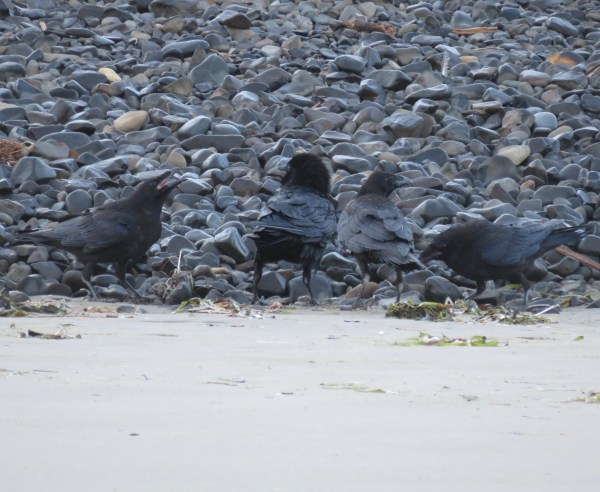
A group of ravens can be called many things. Here, the term “conspiracy” of ravens works for me. (I have never appreciated the term “unkindness of ravens”). The two raven youngsters look just like their parents—one has a fluffy head and is slightly bigger, but that might be one of the youngsters.


They are still hanging around together, though one of the adults sometimes wanders off on scouting missions.

Gary broke up a leftover waffle and some crumbs and put them out on the sand at the beginning of our walk the other day. The ravens stuck around long enough to say thank you.

fullsizeoutput_144f

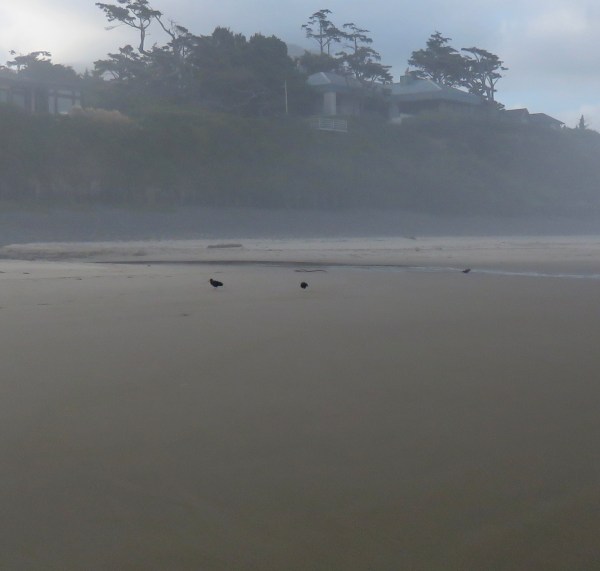
You’ll have to take my word for it that this photo shows three black oystercatchers.

We spotted the black oystercatcher youngster with its parents the other day at the north end of our beach. I did not zoom to catch which of the three was the child, but it didn’t really matter. I snapped the photo in the fog as we passed at a distance. We’re just grateful the baby is doing so well.

We are careful not to approach birds resting on the sand. If they are not flying, they likely want their rest, but it’s tricky for them with so many loose dogs. A photographer deliberately frightened dozen of birds off the sand just to get a photo of them flying.

That’s not as bad as the people trying to “rescue” baby seals (highly illegal and often fatal for the seal pup left onshore by its mother) or young eagles (disturbing any member of an “aerie of eagles” is also illegal and dangerous for the fool trying to “rescue” one). Or the man throwing a ball for his dogs into the surf in an outgoing tide. [This is why Gary does not like me to go with him when he gets the mail. He says I bark at people—I did bark at that man with the throwing stick. “They’re hunting dogs,” he said. “They trust you,” I responded. I saw a dog rolled right under waves, come out of the surf and absolutely refuse to go back in again. The dog was smarter than the owner.]

The wild things are right not to trust us, to focus a wary eye on our movements. We are not of their group, not trustworthy or predictable and kind. The wild rabbits (a nest) nibbling rose hips in our the front yard, the jays (a party) cruising through, the garter snakes (a bed), and gulls (a colony) and know to avoid us.

We try not to disturb the wildlife. When we must pass birds onshore, we walk steadily, avert our eyes, and direct ourselves away, away!

IMG_6801

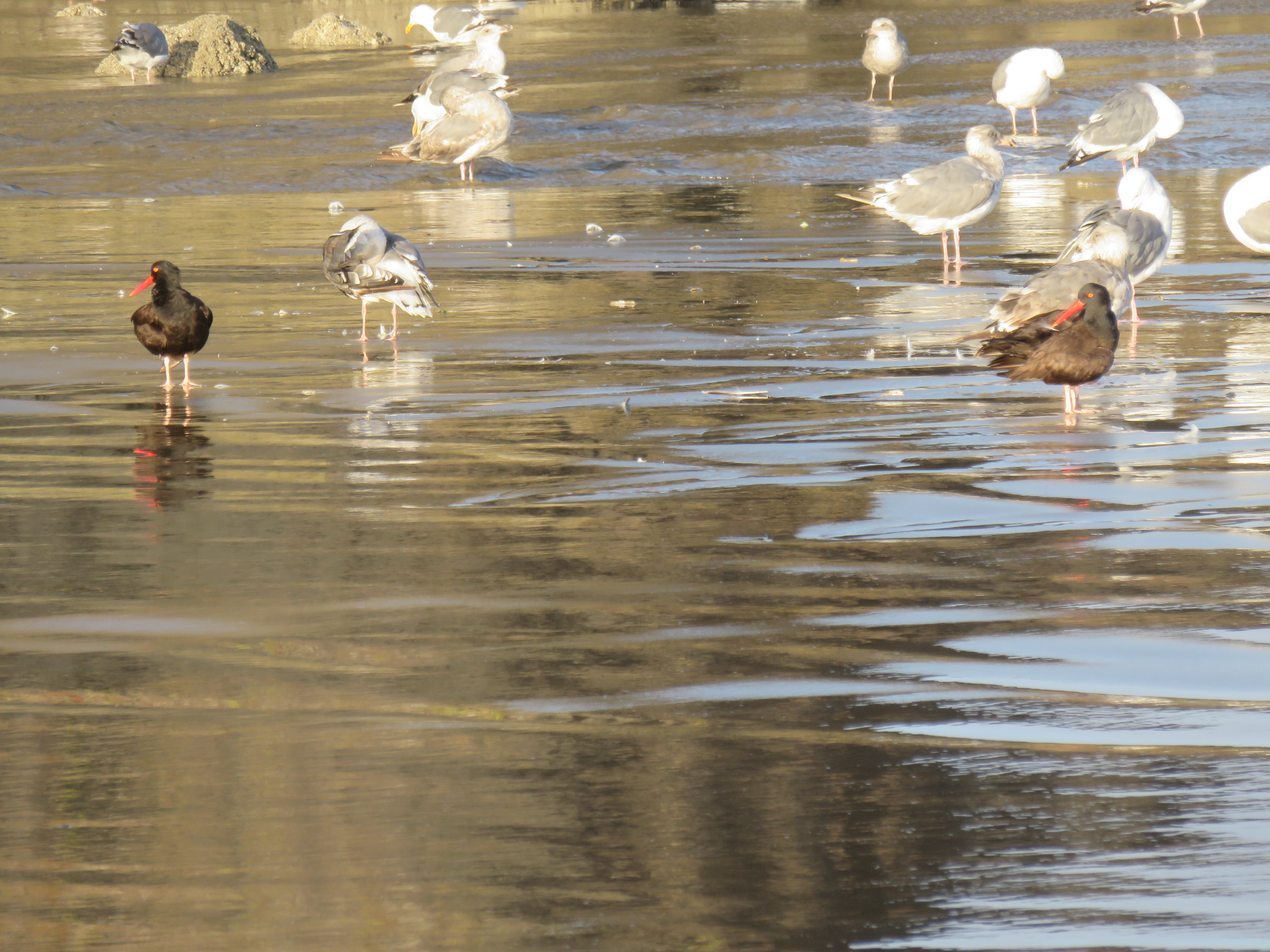
These two black oystercatchers are not the same pair. There is a  
“parcel” or “stew” of oystercatchers nesting south of us.

The featured image at top is from Wikipedia: “James’s Flamingos at Laguna Colorada in Bolivia”  “Young flamingos hatch with grayish-red plumage, but adults range from light pink to bright red due to aqueous bacteria and beta-carotene obtained from their food supply.”
The adolescent flamingos with one adult is a Getty image taken off the Smithsonian page