COLD WALK

fullsizeoutput_10ff

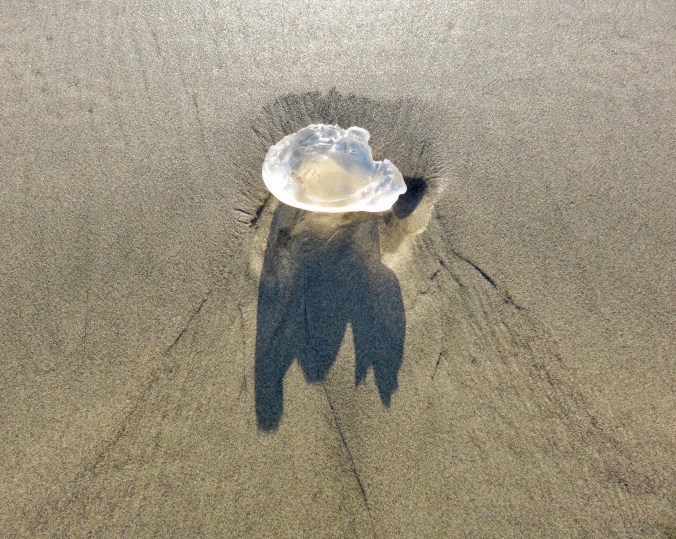
Sand dollars are covered in short, deep purple spines when they are alive. It is rare to find one still covered in prickles—this one is dead but still faintly violet.

We walk most every morning, usually for an hour or longer north or south or north and then south. We waved at Tammy when she came out n the sand.

Gary spotted limpets. I often think through blog posts as I search the sand for plastic trash and pretty shells. I consider politics and friends and weather and projects. What I really want to find on the sand is seaglass. Lately I have been picking up cigarette butts. I would like to get within shouting distance of the man who walks out in the afternoon and tosses his filter tips on the beach. I would like to visit with friends struggling with illness, I would like not to think about the 400,000 fewer kids who had health coverage last year than in 2016. I would like to find a pattern to make the dress I have promised my granddaughter. Her birthday is next week and she will be eight.

The beach was very cold this morning. Wind blew less hard than yesterday, temperatures were up a degree or two, but it was still cold, the moon a sliver in the pale but sunless sky. I found two pieces of glass and many “ugly clams” (Pododesmus macrochisma) which are not the lest bit ugly when you pick them up and turn them over. Portland Review published my poem a year or so ago. I have not been able to figure out how to make WordPress single-space. Never mind.

Pododesmus macrochisma: Metaphor for Girls 

Each morning I walk the sand, searching 

for what my grandmother misnamed 

the “ugly clams” caught in foam left behind 

by a retreating wave or stranded high on shore 

from last night’s tide. Smaller than my thumb 

or filling my palm, they might come to rest 

among seaweeds torn from their beds, 

half buried by wind-driven grains. Often 

when I find a shell, there is another nearby. 

Is it too fanciful to think they gather to die?

Perhaps because the first makes me alert 

to the next. Every one I have seen lies 

face down, resembling nothing much of note. 

Some thinner than drawing paper, sometimes 

thick, calloused like my toes. They lived wild

in depths to three hundred feet, here adrift 

and dead, their softer life dissolved in the sea. 

Only rarely are the unequal halves complete, 

shaped back shell still attached to the round. 

Sometimes only shards remain, wholeness 

crushed by the careless heel of an earlier walker

passing by, oblivious to the gift underfoot. 

One reason to search at dawn. Turn one

over, see what hides—that nacre, sometimes 

scarred, dark glimmering, pearly sheen—alive

amber and green, holding captive light. 

These days, most of the shells show a black stain inside. There have been black stains on the sand, too. Diesel from watercraft or leaking from shore? I do not know, but I think it kills them.

We are careful not to disturb resting seagulls. Sometimes dozens gather, usually at the edges of a creek north or south. My neighbor Barbara used to yell at tourists to leash their dogs around the gulls. Visiting dogs chase them, and most people do not mind seeing them or even seem to enjoy seeing them flee into the air. It made Barbara wild.

The sun had not yet risen when I headed back. The house next door is getting a new roof. As I turned up the path to my home, a dog suddenly rushed at me, growling and with his shoulder ruff raised. A man on the roof called him off. A job dog. He bumped by me as if I were a post. Such dogs used always to be some sort of retriever, thick tail wagging. I know people love their pits, I get that. But the breed was created to fight and kill other dogs, an “unnatural” behavior for a domestic animal. Behavior like pointing or scenting or sighting prey is automatic. People want to say it’s the owner, not the breed, but what many owners have said they most appreciate about their pits is how loyal they are, how protective. Wishful thinking. I wish they were all sterile and gone before my great grandchildren must walk past one.

The ocean’s surface seems shivered, broken into blue static, the waves smaller today. Yesterday huge breakers bent over backwards and flew up in the stiff east wind. Today they seem tamed by the cold, three breakers at a time heading in white rolls onshore.

NEIGHBORING MYTH


fullsizeoutput_10fc

Myth is scripture. Myth is wisdom. Myth is sacred story. Myth is magic and meaning. Myth defines and supports the goodness in us. It shows us a path, and as symbol—never underestimate symbols—myth is always true. Always.

As a public high school English teacher I was very respectful in using the word “myth.” I introduced it as a sacred story. However, like the authors of most every essay and study I have read, I did not address the obvious connection between the mythology of traditional cultures and the mythology of more modern ones. I was careful not to offend. I continued to be hopeful that others more powerfully placed will detail the parallels between Christian and other contemporaries mythologies and the ancient ones. They never do.

There is the “old wives’ tale” smear of mythology, as if the story your old grandmother told was a lie because it was not entirely factual. Or because it was told by an old woman. As if the decency and honesty rewarded in her story were not the point. As if she meant harm.

I used to hope that a few of my students, at least, might eventually see how Spider Grandmother and an archangel might share a place in the human pursuit for meaning. That they might appreciate how our connection to decency and fairness is not merely regulatory, but human and humane, a spiritual negotiation that allows us all to survive. Goodness as a universal truth. A Truth.

Most creation stories involve animals, plants, and failure. The Haida allow that Raven created the world mostly by accident. The Judeo-Christian tradition made the world on purpose, human beings on purpose, and death as a result of error. It matters to some people whether all or any of these stories are literally true. To others the message is significant enough. Do the right thing. Do right. All mythology works that way. Was it Atlas who carried the world on his back or a tortoise? Is the snake a symbol of evil or, by shedding skin, of rebirth?

It depends on who you ask.

The Story of Job warns against assuming we understand the why of events, but all mythology warns against doing what we know to be wrong, even when we do not understand why.

Societies pursue various goals and notions of virtue, but theft and murder and deceit are common evils. Generosity, compassion, and patience are nearly always admired and spiritually rewarded.

We are capable of knowing right from wrong. We are even capable of changing our minds about how we define those terms—which is much harder to manage. It is easier to stick with what we always thought before. Easier to not think, not weigh options, not reconsider what we think we know, not question good. Easier to assume evil is somewhere else far away. Evil as something outside and Other.

Strangely, like most life on earth, we will sacrifice ourselves for others. Human beings will do this, even sacrificing our safety and our lives for others. Wolves will do that too. Trees will pass over nutrition to a neighbor tree. Insects, fungus, single-celled life—all willing to die that their fellows may live. Altruism is not a rare virtue.

Sometimes we become so caught up in competition, in winning, and in hubris (our inflated self-importance) that we forget what we know to be true: we live together and we must get along in order to live virtuous lives.

Perfect innocence was never our destiny. We must constantly choose to do the right thing. Some humans creep about like Cain, hoping no one will notice who killed their brother. But there is no future in worrying continually, in fortifying ourselves against the Cains among us. How can that profit our lives? Surrendering to such fears makes cowards of us.

The vast majority of us are only doing the best we know how—to be good, generous, compassionate, and patient. We do this not only from fear of punishment. We do this not only when someone is watching. Sometimes we fail and bow to pride, selfishness, spite, and vengeance. Most often we do not. We do the right thing because we know it is right and we are comfortable with ourselves in doing what is right and good.

If we were more bad than good, no child would survive past the age of two. It would not be safe for me to say good morning to strangers on the beach. There would be no one risking censure to speak back to those in power. I see goodness everywhere, because even in our failings, most of us are trying our best to do good. Virtue is not Other.

We do the right thing because that goodness is in us.

The wives told.

WORTHWHILE

“… it is utterly impossible for over-worked teachers to preserve an instinctive liking for children; they are bound to come to feel towards them as the proverbial confectioner’s apprentice does towards macaroons. I do not think that education ought to be anyone’s whole profession: it should be undertaken for at most two hours a day by people whose remaining hours are spent away from children.”—Bertrand Russell from Education and Discipline

I didn’t want to get there. I have explored options and considered alternatives.

It was the end of Winter Term and the beginning of my last spring as a full time teacher. A former student who wanted to write and perhaps also to teach, asked me if I would enter the teaching profession again? Did I have regrets? I suppose the easiest answer would be to suggest posts about teaching on my blog. Without denying the challenges, it was been a great career. I loved teaching and I am deeply grateful for the opportunities teaching has given me to develop writing skills, to work with students, and to contribute meaningfully to the world.

My former student acknowledged that “education is something that’s extremely important and I think that high school is the most crucial age to reach out to students.”

Yes, I feel that. I feel commitment and love for my students. I recall all too vividly what and who I was in high school, and the common lie about it being the “best time of life” when for me it was lonely and frightening, and I am fortunate to have survived. Unlike most of the teachers at my school, I did not love sport and I did not turn to teaching as a way of prolonging my own student experience. I came to teaching out of compassion for those terrible years of becoming.

I have no regrets. I have loved teaching. I enjoyed the challenges to my intelligence, innovation, and certainty. I made many mistakes on my way to wisdom.

But I did not begin wisely. I entered teaching with the same foolish notions shared by many others.

  • I thought I was a natural at teaching. (not a chance)
  • I thought it would be easy. (oh dear)
  • I was a visual artist and thought teaching would leave me time to create. (ha!)
  • Vacations and summers off! (ha!)
  • The pay for my area is good. (not so much)
  • Job security, good pension, sabbatical. (gone)

Fortunately, I outgrew these notions, accepted my mistakes, and loved my job before I became too discouraged to continue.

Would I enter teaching now? She asked me this as I struggled to carve out a week of space in the Spring Term for the new achievement test designed to rank students, teachers, and their schools. Fortunately, these tests would be phased in over the next three years—that is, there were alternative paths for students seeking to graduate other than passing that test. No administrator I knew fought this or even talked publicly against it. I suspect they all hoped, as did most teachers, that the test would go away. Perhaps its replacements will. But thus far, despite my skepticism about the accuracy of test score, I am sorry to discover my former school has lost ranking.

In the mean time, while I was there, required testing limited what I could do with juniors that spring. It stole time and energy and attention. It caused distress, and in the end it proved almost nothing. Even if students do well on the test, no matter if they failed, more than a hundred years of experience with high stakes testing via the SAT reveals what any sensible person knows: Teachers still do a better job of evaluating accomplishment and predicting future success than any test. What I recorded in my grade book was a more accurate evaluation.

Nevertheless, we have lost faith in teachers. The pension system is somewhat gutted, but then this is the trend across our nation as unions have been axed and the middle class attacked. There was a golden period, and had I been teaching while my sons were little I might have retired with a pension that more closely reflected my current earnings. Or I could have been a university football coach, the one The Oregonian likes to cite when attacking my pension. The newest pension system, the one teachers now have, is even weaker than mine was when I started. I could not begin to retire with twenty-five years with only the current pension system. I am not sure I could ever afford to retire. The pension was something I looked forward to during bad days when I was scaling by: At least I had my pension  As a person inclined to worry about money, I do have fears about being alone and destitute at the age of eighty, when the funds from my more recent pension will run out.

Would I have entered teaching if the education landscape looked like what it does today? Perhaps. I would have been wiser to choose another career path. I was good at the job, I think, and I loved it. But about half of the people who enter teaching—even before the recent changes to pension, job security, and testing—leave within a few years. This doesn’t happen in other nations. In most nations teachers leave teaching about as often as plumbers leave plumbing or lawyers leave the law. Education here is tougher: American students are poorer, our school days are longer, the total student load (the number of students seen each day by a teacher) is higher. Job security and a strong pension are gone. Other perks of the profession disappeared early in my teaching career—tenure and sabbaticals are a memory in my state. All of that make education more challenging for students and teachers. 

My term teaching as a student, my practicum, was completed under Field Advisor Hazel Koenig and Lynn Gray as my Field Teacher. Two extraordinary women helped me to grow and also to find my first job as an Art teacher. fifteen years later, I took a lot of classroom management workshops and graduate classes once I was hired as an English teacher and thus shifted subject areas. 

It was lucky for me in terms of personal growth, not so fortunate in other ways.

The energy to create my own art—whether that was visual or written—and to work with students seems to come from a similar place. John Gardner warns beginning writers about this in On Becoming a Novelist. More recently, in the first chapter of her newest collection of essays, This Is the Story of a Happy Marriage, Ann Patchett writes about this too. By the time she’d spent a week working with students on their writing she had no energy left for her own so she tried to wait tables, also exhausting. Finally she chose journalism and in that profession she learned both to write to order and to let go of words.

Nevertheless, the way I came to think of myself as a writer came through teaching writing. I have written several novels and I have managed to publish fiction, poems, and nonfiction while also teaching full time. This is, shall we say, an unusual accomplishment. And it has likely been achieved at the expense of doing my best in any area. 

Most summers—for all but three in the last years I spent in the classroom—I was in school and planning curriculum and often working part time as well during those ten weeks “off.” For the other three summers I was merely planning curriculum. I woke at five in the morning and was frequently still answering emails from students until I shut my laptop down at around nine in the evening. I regularly received requests from graduates to forward class materials on MLA form and résumés and to edit graduate school applications  or all three inside a week). I am not complaining. On the contrary, I am pleased that former students still think of me at all.

It has never been easy and I wasn’t good at my job for the first years’ teaching. I had bad days and failures. There were many days when I think of myself and my life as a teacher and I am profoundly grateful. Sometimes I think of myself as a writer, but perhaps that will change. Most things have. 

But I liked my students, and I liked them right through to the end of my career.

SUBMIT

I submit.

There it is. That word again. Eighteen months after sending a query to an agent, I heard back yesterday. She doesn’t want that book but would be willing to hear about my next project.

Not that I am complaining. A few agents I queried failed to make any sort of response. (I had assumed she was one of them.) This is ironic, I feel, since all my queries were online and a generic rejection or even a rejection with a send-me-your-next-project line is simple enough. click When I sent out queries and other submissions almost twenty years ago with paper and stamps, I always had a reply. Many of them, and several with a send-me-your-next-project line. Some sent tiny slips of rejection in my required self-addressed-stamped-envelope. These days most agents warn on their website that they “may not respond” to all queries.

Never mind. This agent apologized for taking so long and added the send-me-your-next-project line. So I sent her another query. And perhaps in 2021 I will receive a response? Or perhaps she has caught up and I will hear in a few weeks. Either way, I take it as a good sign, though she likely says this form response to many submitters.

We all submit.

WEATHER CHANGE

We like being the first out, while the sand is still unmarked by dogs and people. Usually we find prints and recognize by position who they belong to. That’s John out for his run because the bare feet make prints so close together. Larry drags a bit. Tammy walks close to the water. The tracks of dogs are familiar too. Roxxie and Charlie and Hank.

In summer we have been out on the sand before five in the morning. Real time is nearly 6am just now. [Have we all forgotten that time is not purely a human invention? Noon, for example, is a genuine natural event, that instant when the sun is highest in the sky, and is now marked on the DST clock an hour before it occurs. Like summer and winter, noon is not a fiction, but part of the natural way of things.]

Summer is long gone. Two days ago tides swept away our entire pathway cleared through the stony edge of our beach. Gary cleared that path in spring and it remained clear all this time. The beach is routinely washed free of sand in the winter months, but that day did not show a particularly high tide measured in feet above and below sea level. We check the tide table each day. Their numbers do not reveal the entire story. High surf from a storm at sea, a tame ocean under heavy clouds.

It is the wave action, sometimes showing only one or two low breakers, but this past Thursday breaking nearly to the horizon, breaking over the top of Castle Rock, thick and foamy at the edges. We had walked early in a gale. Our sitting log is gone and an enormous log that rested high up into the hedge fifty yards north of us. Thirty inches across and thirty feet long, that rotting monster has found a new temporary lodging further up the beach. Our sitting log (the one the visitor to a neighbor’s house used to pee in public) has vanished altogether. We walked a mile without finding where it had drifted.

I no longer take photos of waves crashing up into the air, a hundred feet above Castle Rock. I have those photos from previous autumns, dozens. Now I watch.

The surf is up, as they say. We watch with concern when tourists take their little children onto the sand during at out-going tide. A former student drowned, a strong swimmer, and on a pleasant day. No telling when the sea will swing her skirts.

A single wave in January of 1999 pushed the basalt stones up out of their bed and into a ridge along shore that we have never seen before. Until that winter, summer tides brought sand in from the offshore bar and nearly covered the rocky edge, and then for years we did not have a clear sandy beach at all.

yetiONbeach

The sand has come back, though the rocks have not been completely covered for twenty years.

A friend came to lunch the other day and asked me whether I spent much time watching the ocean. Yes, both of us do. Even after all these years—forty so far—we watch the ocean and shore. When we think about moving, that is a major sticking point. We are accustomed to the view. Watching the weather come in, tracking the birds in the air and in our tiny front garden, the shift of sand and tides, wave action. Nothing new, always different.

When we walk north, the shoreline dips and rises on our right. Some neighbors need long stairs to get to the beach. Our property is set low, just a few feet above the beach. My grandfather’s old path through the hedge, built before the Great War, is completely overgrown. There were no more than a half dozen concrete steps. That stair might still be there buried under salal and sand and basalt rubble. From our western door we walk through a new path in the middle of our hedge and down a short stretch of stones Gary has placed to ease our steps down to the shore.

fullsizeoutput_10e9

This is what counts as “a lot” of sand. At low tide there might be a couple of hundred yards of sand between the black basalt and surf. I paced off the distance other day.

fullsizeoutput_10de

The out-of-state owners of the rental north of us, after their first autumn, asked what happened to “our sand?” Gone for the season, I told them. Visitors have asked us whether the sand is trucked in, where we get the rocks brought in to protect the shore. Tourists try to “save” resting baby seals and fully grown eagles. It is hard for us, who live here, to imagine such ignorance. We have watched the flow in and out, the fledging of birds and the drowned onshore, the shift and shuffle of sand, the rare hard freeze, the slow progress of water and wildlife.

The sand is leaving. Maybe it will return in the spring. We watch for that.


BIRTHDAY

won’t you celebrate with me

Lucille Clifton – 1936-2010

won’t you celebrate with me
what i have shaped into
a kind of life? i had no model.
born in babylon
both nonwhite and woman
what did i see to be except myself?
i made it up
here on this bridge between
starshine and clay,
my one hand holding tight
my other hand; come celebrate
with me that everyday
something has tried to kill me
and has failed.

AGING IN PLACE

On the beach before dawn yesterday, rainclouds had moved off, and the sky was aqua over the ocean. My husband Gary and I followed the tideline until we met a friend and stood for a time admiring the cool air, the empty beach. We shared news of neighbors, and then said goodbye until tomorrow. We pass neighbors on our walks almost every morning—heading home while others are on the way out. 

Dark rainclouds moved toward us from the north, with a flag blowing from the east. We turned at Asbury Creek so as not to disturb seagulls resting onshore in the water. The rain began soon after that. I put up my hood when I heard it pattering on the back of my raincoat. The flag was blowing from the south by then, the rain moving in from the north. That’s the way it is sometimes, everything coming from directions that make no sense.

Are you worried about aging? No.

When we moved to Arch Cape forty years ago we were youngsters, and now we are the old timers. Just old, I guess. And lucky to be here. 

My grandfather built a duplex on the east end of our property. He rented the tiny one-bedrooms by the night, but Gary and I had managed an apartment building while we were in college and knew we did not want to impose short term rentals on our neighbors or ourselves. Our renters stay for years, and that is how we have afforded our taxes. Thank you, Gordon Keays Smith. And thank you, Genevieve, for leaving me the home that’s been in my family since 1911. Genevieve was Gordon’s third wife, the only one who out-lived him. My mother did not like her, but as weavers, Genevieve and I got on well. However, it was Gary who actually won us the house. Genevieve’s second husband, Colin, got on well with Gary, and he told her to leave us the house so we could move here and have a family. That’s exactly what happened.

When we arrived, we scrambled to support ourselves and raise our boys. Our neighbors were mostly elderly, in their seventies and eighties. Now we are the old-timers of the neighborhood. No family has lived here longer.

Are you worried about aging? No.

My husband and I are at that point in our lives when aging is impossible to ignore. We are retired. We walk miles each day, but we no longer run or drink three glasses of wine or ignore the need for an occasional nap. We have friends whose parents are still alive, but that is not true for us. We are our oldest living relatives. No parents, no living aunts or uncles, no older siblings stand between us and age. Gary has lived five years longer than either of his parents as well as his one elder sibling.

Surveys of mental health often ask whether the subject is worried about aging. I always answer no. I assume that is the right answer. But my answer is a lie, of course. I do worry about aging. For years this was more about planning and not really worry, but now it is both. I try to plan for diminished capacity snd I worry more about loss of vitality. I cannot help wondering what sort of denial people assume in order not to worry about aging. I see it coming, inevitable frailty and loss of mental sharpness. I know people ten years older than myself, even more than ten years older who get around fine, living active and meaningful lives. I would be happier if I could think only of them because they are doing so well. But I also have friends with cancer and dementia and some are already lost.

It began in the 1980s with HIV and AIDS. Suddenly people I had known for ten or fifteen years were gone. Cancer took our fathers. Heart disease took our mothers. My former students lost to accident, cancer, and suicide. Old friends droop and drop.

Are you worried about aging? No.

For years I watched the housing market in Portland. My plan twenty years ago was to purchase a small condo or house and prepare it for our use when we drove to town and for later, when we no longer drive, as a familiar place to move. (I was hit decades ago by a woman driving onto highway 30. My boys were still little and in the back seat. The driver was 80, and witnesses said she just drove into my path. My own mother at 80 was no longer driving, but had scared our sons with her erratic driving long before that. She too simply drove onto busy roads, assuming others would get out of her way. I vowed to quit driving before I became a danger to myself or others.)

My mother left me money that would have made this imaginary condo affordable, but I paid off our sons’ college debts instead, and then I forgave a loan to one and gave the same amount to the other in cash. How long ago was that? But I still look at vintage condos. I still imagine living closer to groceries and good health care. Our home is far larger than we need for the two of us. Downsizing is important to both of us and moving to a smaller place of just a few hundred square feet would have pushed that. 

Instead we are emptying this home of forty years. Clearing space, cutting back, making the rooms look more deliberately decorated instead of crowded with living. I have cleared out for too many other elderly people to want the full mess dumped on our children. Even some things we loved—furniture and books and yarn—have left the building. (Like Elvis?)

The house has reached the point where trips to a charity shop (three trips? six?) would put it in shape for someone to come in and clean for us when we can no longer do that for ourselves. Gary will object because he believes in doing for himself. The notion of “servants” offends him. We have always tried to do everything for ourselves: taxes and haircuts, gardening and upkeep. Not to mention the expense.

Are you worried about aging? No.

Times change. Neither of us are willing to crawl under the house or out onto our roof again. Gary still checks the attic and under the duplex, but he has to work himself up to do either, and I begin to understand why people hire an accountant to do their taxes.

We cannot afford a second place in Portland. Living here is our good fortune for a few more years. We will move to a downstairs bedroom. There is space for the TV and clothing. The books will be an issue. Gary has some sixty feet of bookshelves, all downstairs, but I have even more, almost entirely upstairs. Will I still be reading? Will I have abandoned my daily walks on the beach? Will the loom remain upstairs or will someone offer to cart it back down? The sewing machine is heavy too. Am I nearing the last quilt? Will I abandon writing?

At this point I should turn my post to something positive, find the gilt lining of my worries. Is there precious metal here?

Are you worried about aging? No.

The roof is leaking. Our taxes continue to rise in a manner disproportionate to our income. If we live long enough, we will stop driving and that will force a move. There is nothing within walking distance and no public transportation or Uber nearby. If I die first, Gary will be financially stable. There will be less money, but he will inherit my pensions. If he dies first, I will manage. If one of us needs round-the-clock care, the house might sell for enough to pay till we die. Or not. Depending.

What we leave behind will be the people we love and little else. That might be enough. It’s only what we do while we are here that matters. That much is true. Has there been enough? Some days I think there hasn’t.

I earned my MFA from Pacific University in 2007 and was the graduation student speaker. Twelve years later, in her graduation talk this past June, Jill Deasy noted: “Poet Kwame Dawes opened residency with a talk about these times we live in. He explained that ours is an age where lines blur between fact and opinion. It’s an age where one’s beliefs and one’s own ideas can be oddly proclaimed as truth regardless of evidence. Therefore, he said, our task as writers is to be honest about what we don’t know then recognize our ignorance is the beginning of understanding.”

Perhaps admitting fear is my first step.

Are you worried about aging?


‘in my great and unmatched wisdom’

IMG_4975

What are we doing here?

The President has invited foreign powers to interfere in the US presidential election.
Democrats want to impeach him for it.
Or, as my husband says, “We’ve been interfering in their government; it’s only fair that they should be allowed to interfere with ours.” Of course, Gary is being facetious.

IT’S NOT YOU, IT’S ME

IMG_4937.jpeg

I hope to take my third quilt up to be quilted this week—that’s it above while it was about a third complete. I am waiting to hear when I can deliver it because I need to send my laptop in for repair. Again.

I have been using a Mac daily since 1990 and until this one I never needed a repair. I replaced my best laptop at the age of nine, about 112 years old in computer years. But this one I am working on right now is still under the original warrantee. Months ago, the screen started pixilating in dark areas. Shadows in images were no longer black but turquoise or peacock green or cobalt. Or white. Bold Helvetica showed up as outline text. The weird appearance got worse and worse. Eventually the entire screen turned to pastel snow in horizontal bands.

Imagine trying to explain to a young tech person what’s wrong. They kept wanting to see it, or have me email or send them something. I kept having to explain again that the computer was unusable and I have no smart phone. (One of my sons keeps trying to remedy that by giving me an iPhone. I probably should let him.)

Anyway, my computer went to the Apple store where it was diagnosed as troubled, then it was sent away, and shipped back to me good as new inside a week.

But now it’s doing it again. I can still use it, but I figure it’s heading again toward pastel snow. I hope if I send it in they will see the problem.

I’m not going to freak out about being without my laptop for a week. I no longer teach so I am not depriving students of immediate access. But just in case you try to get ahold of me in the next week or so, just so you know, my computer is in repair limbo.

It’s not you, it’s me.

BEING SMART & HIDDEN

IMG_5019.jpeg

The student stopped me in the hall one Fall day to tell me another teacher thought she was stupid, had told her she was stupid. I did not entirely believe her.

And then a few days later, that teacher she’d complained of also stopped me in the hall, in almost the same spot, and told me that student was misplaced in Honors classes and not capable of doing the work I demanded in my college writing and lit classes. “There might be three in my Honors class who can do the work.” His upper lip fairly curled. He mentioned the girl by name and said she was stupid to think she could keep up.

I knew better. I had taught her the year before and found her highly capable, perhaps smarter than her transcript suggested. She had participated in discussion and demonstrated skill in reasoning and composition, and I had spoken to her outside of class. Her mother was a mess and this girl was protective of her family. I suspected she was heavily disguised because being known as smart had not served her well in school or life.

I’d seen it before, but it was hard for me to believe that a teacher would miss how smart she was, how insightful and kind, that he would be so unkind as to allow a student to see he disrespected her. He later apologized for being rude about students to me, though he had not altered his opinion about students. Perhaps there were “four students capable of the work.”

Soon after, test results came out, and though I have limited faith in State testing, this girl’s scores were right up there, top of her class. It was, despite his opinion, a highly capable class overall. I noticed the previous year.

But this one girl. She was not the first to hide her intelligence. I’ve had others—students smart enough not to want most people to know they are smart or even to fully appreciate it themselves.

Sometimes they set a bar so high for their work they cannot reach it. They are smart enough to see how high the bar can be set but not yet experienced enough to leap that high. One girl at sixteen had never passed an English class. She did the work but never believed it was good enough to hand in. Gradebooks showed strings of zeroes for her work beginning in Sixth or Seventh Grade. Her friend and I staged an intervention: “You have to hand in an essay that is really, really bad. It can not be a good essay or even okay,” we told her. “It has to be bad.” We cajoled and even, I confess, we bullied. We all three of us laughed and laughed. But she handed in her story. (It was not bad. We teased her about that: “You’ll have to write worse than that.”)

Gina became my model of the Sixty-Percenter, a student who will do precisely 60% of what is asked, just enough to pass. She might answer six of ten questions perfectly and leave the remaining questions blank. She might complete just enough of a writing assignment to squeak by. Her skill at pinpointing that passing level was astounding. My response was to ask more and more of her, because whether the work was “easy” or “hard” she would always perform at that 60% level—better to do passing level work in a harder class than an easy one, I figured. I could not fool her.

Kevin was another Sixty-Percenter, but he was too stoned most of the time to gauge his own progress. He was the only student I ever routinely lied to. He needed to pass and would check with me about his grade. If he knew he was passing my class he would disappear for a few days. I learned to tell him that he was almost passing at 58%, but “if you’re in class for activities during the next two days, by Friday you should be back to passing.” That got him to the weekend. Sometimes he actually had a B average, never less than a C. Like the first student I mentioned, he tested in the 99%tile but in nearly every subject.

In fact many of my troubled students were gifted. I say many, but I taught for thirty years. I can recall a dozen or so of the thousands of students I taught who were highly gifted to the degree that they were hiding extraordinary brilliance in plain sight.

There was the boy who doodled on the sides of his pages and liked to express opinions that he knew would wind me up. He was absolutely the smartest person in the building for the four years he attended the high school where I taught, but the only one among his circle of friends who refused to take the SATs and who never went on to college. He went to work in the woods and when he later realized that in order to survey forest he needed advanced math skills he had avoided in school, he found a textbook at the GoodWill and taught himself.

I have personal experiences as well.

I recall vividly when in Seventh Grade I was outed by my homeroom teacher as the top performing student in my class. I was surprised when the teacher made this announcement and so were my classmates. I was not so smart as the dozen or so of my most gifted students, but like them I did not come from an affluent home. I did not go on skiing vacations or take special classes or play piano or take dance or have braces. And like some of them, I was not deliberately hiding my intelligence, I was hardly aware of it. My peers barely noticed my existence. I only knew that I needed to keep a low profile.

My older son was identified as disabled by his Second Grade teacher. He was tested by hearing, speech, academic, and learning specialists and tested as perfectly normal, though highly gifted in math. The lasting result was his insecurity that something was wrong with him. And then, when his brother was of concern from another Second Grade teacher, the district psychologist urged me to allow testing to “get them off his back.” Yes, crazy-smart.

In her landmark essay, “Small Poppies: Highly Gifted Children in the Early Years” (1999), Miraca Gross describes how extraordinary intelligence can lead to dysfunctional children and tragically lost adults. Despite the popular and thoroughly debunked belief that intelligence leads to or is caused by insanity, gifted children often learn to hide because what they understand and care about is out of step with both peers and teachers. (See above & below.)

[Insanity has no connection to intelligence (though a slight connection to creativity. It is a very popular notion but many studies debunk it. People of average or even above average intelligence are determined that geniuses are bat-shit crazy. No. It’s only that we do not follow them. Pretend for a moment that IQ tests, all tests, have more reliability than they actually do. That’s what a psychologist did in order to explain why highly gifted children are at risk. A person with an IQ of 150 has no more in common with the capacity of an average person with and IQ or 100 than a person with an IQ of 50. (Look up what an IQ of 50 means for real world function.)]

Smart children are generally out of step with peers and teachers, but most smart children learn to navigate a world hostile to their capabilities just fine. I was smart in school and always felt out of step. I was smart enough to manage, to find my way without getting lost. But I was not so smart as the children Gross is worried about. These are not merely gifted children, who will muddle along as I did.

The exceptionally brilliant child is more at risk because the way they think is so far beyond the average person’s abilities that as children they cannot find a way to accommodate to expectations of teachers and peers. They offend their teachers who do not grasp ideas and processes this child takes for granted. Yes, these children are too smart for their own good. They are less knowledgable and less skilled than their teachers, but far more intelligent. I’ve seen it too often. Once is too often. Teachers can be offended by a student asking questions too advanced for the teacher to answer or too complex for the teacher to even understand. Some teachers pick on such students, ridicule and bully because they are frightened by superior intelligence. How sad is that?

When a student asked me a question I had to admit I could not answer, the most common response from the student was an apology. They were so very sorry to have asked a question the puzzled me. They had been taught to be sorry for their curiosity!

Every public school today provides protections and special support for students with learning disabilities. It is in federal law. All children must be guaranteed an “appropriate education” even if that means being given more detailed step=by-step instruction, more time or easier work, one-on-one support and coaching, and continued help in reaching graduation for years past age eighteen.

Support for gifted children, children with special needs because they are exceptionally intelligent or otherwise academically or creatively gifted, varies from state to state. My state says there should be support for gifted students (those in the top 3% in performance or capacity according to tests) but offers no funding to pay for it or to more effectively identify children who need, really need support. Indeed, my own experience is that administrators and teachers often resent any sort of support for gifted students. “It should be easy for them.”

Often, this is not at all the case. Smart children are teased by peers, resented by teachers, and often ignored. They are alone in a way that most of us never experience.

Some students are singled out for TAG (Talented and Gifted) programs based on early verbal skills which were too often derived from social advantage rather than innate skill. Wealthy or influential parents pushed their kids into TAG. In the mean time, genuinely brilliant children are sometimes told they are stupid or come to believe they are, or learn to perform at a minimal level or in other ways to hide their abilities.

We fail to give them an appropriate education.

Smart children are not meaner or “crazier” or necessarily more dysfunctional, but they do have potential to master great problems. The cliché I hear all the time that “children are our future” applies to all of them too. It is an absolute and cruel loss to society when we allow the brightest among us to languish in pain, when we exclude them from their own potential. Because we are scared? Because we are jealous? Or only because we fail to recognize our shared obligation to identify the issues and ease the way of each child according to their individual need.

*Miraca Una Murdoch Gross AM is an Australian author and scholar recognised as an authority on the academic, social and emotional needs of gifted children. Born and trained in Scotland but spending a large part of her life in Australia, Gross is currently Professor of Gifted Education at the University of New South Wales School of Education and the director of Gifted Education, Research, Resource and Information Centre.