NINETY-SEVEN

img_3832

I was ill recently, only a cold according to the NP, but one that many seem to have suffered from over weeks and months. I hoped to avoid that as I had not been sick for five years, not since the last time I forgot my flu shot. I forced myself to rest. To eat. To lie about and accomplish nothing.

This goes against the grain for me, this doing nothing. I was too ill to argue.

I watched television each evening. I discovered Silent Witness, a BBC drama, and with over 20 seasons I hoped it might last me until I was well (I managed to watch only the first 8 seasons on Amazon Prime). I binge-watched all of Marie Kondo. I saved an episode of Monte Don’s Big Dreams, Small Spaces for the last thing I watched before going to bed at 8:30 each night. We are in the 3rd season and I will be sorry when it’s done. He always cheers us.

Gary insisted I go to the the walk-in clinic after five days of being sick, and the NP I saw correctly diagnosed my main problem as a lack of sleep. “Rest,” she told me.

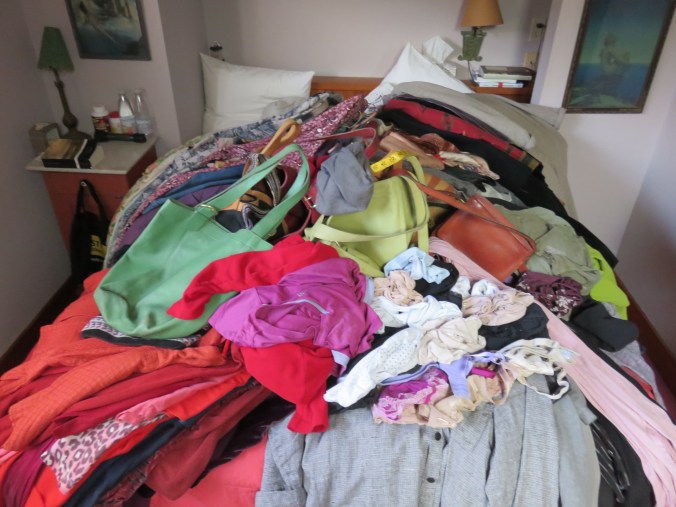
Like the rest of Netflix watchers—and there are apparently so many clearing house that charities are overburdened with unsparklifying clothing cluttering their lives—I watched people dump their entire wardrobes on their bed to make an enormous pile. I thought: I do not have that much, but I could do this.

About the third day after I thought this, I put all my clothing on the bed, on a morning I felt somewhat better and made a not-quite enormous pile. A pile. Not as enormous as some. Then I spent an entire day. I did a little and rested and did a little more. I was ruthless about clothing that sparked guilt or frustration, even including a sweater I’d had for little more than a year. Many things went to charity. A silk skirt I probably could still wear but have not worn in many years goes into a box for my granddaughter. A gorgeous handmade ethnic jacket will go to a friend, who will wear it. I never will.

In my closet now are 97 items of clothing. I counted. Pants, sweaters, shirts, tank tops, a single plain black skirt, dresses and jackets and coats. I counted all five coats and the three kimonos I have not worn in the last 10-20 years but I am keeping because they are beautiful and I love them. My closet is leaner and neater. It is mostly black and gray and shades of red. And kimonos.

[That count does not include the bathing suit I have not yet worn, but hope to (+1). I did not count the running gear I wear each morning on our walks (+9 items). I did not count any of my underwear such as bras (+5) or panties (+10) or socks (+?). Shoes, boots, runners, and gardening clogs (+12). Scarves which are mostly sentimental or home made (+?). The purses and other bags received a thinning, but I plan to review them again. So really, perhaps double my modest count if I include absolutely everything, including the Liberty scarf I bought the first time I went to a a show circuit in Canada. I went through my jewelry box last year and gave modest family pieces to my daughters-in-law. I won’t count that.]

I cleaned out, made space, held each item and judged how it impacts my life, how it aids or detracts. It felt silly to actually speak to things. The result has been a pleasure. A simplification and relief. Nothing is crowded. I like everything I kept.
fullsizeoutput_eaa

Sometimes I feel like my life could use Marie Kondo. I should eliminate the activities and obligations that do not spark joy. I should pass them along. I feel that way just now about teaching, because I am behind in grading and feeling guilty and inadequate. And then, when I am actually talking to students, I know I love my work. I love this. So instead, like the beautiful silk kimonos I have had for forty years and the little green cotton top I have had since high school—I keep what makes me smile.

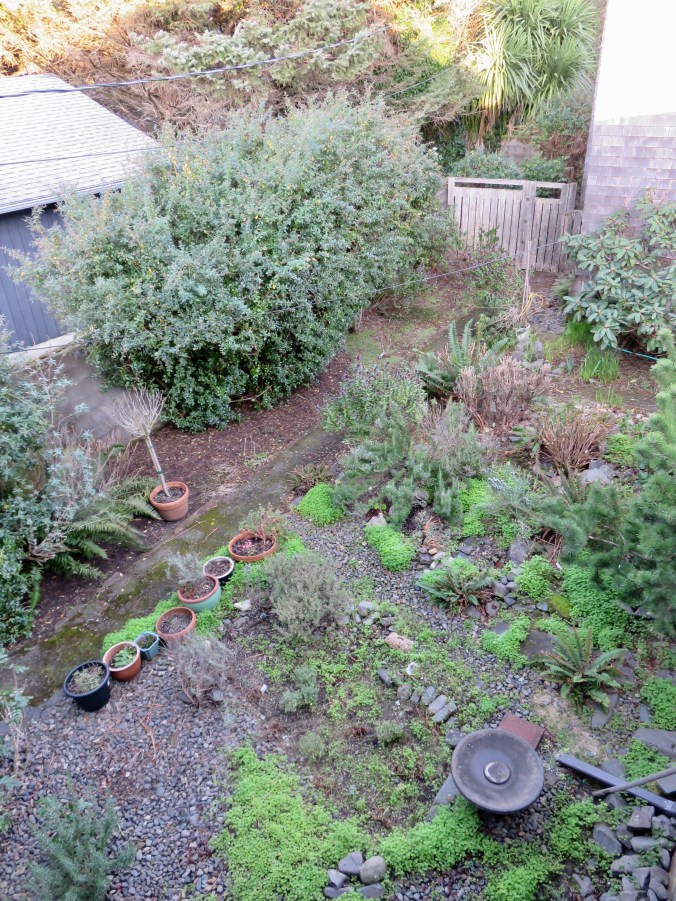
We are talking about the gardens. The middle yard was once a “dog yard” fenced and graveled to keep our dogs safe. Since we no longer show dogs, have not had more than one dog for nearly 20 years, and now none at all, use of space has changed. It is not used at all. I planted it with hydrangeas grown from cuttings, carmine-flowered escallonia, the white rugosa rose “Blanc Double du Coubert,” butterfly bush, hebe, lamb’s ears, and blue-flowering ceanothus. I wanted plants that would bloom, mostly remain green throughout the year. I wanted a pretty place where we could sit, and we did do that for a while. But we were still both working and tired and it rains.

I planted three rhubarb plants before the fourth survived. The single white rose has become a monster. The escallonia are monsters too. Naturalized Montbrecia did not fit into my original blue/violet and white color scheme, but I let it prosper and added “Lucifer.” Ferns and a pine tree and other volunteers have been suffered to stay. For now. Rosemary did well. We will likely plant more.

More recently, newly planted Japanese iris have survived and also three thymes. One of the ceanothus was moved to save it from strangulation by the escallonia and it thrives near the ocean. Our garden is wild and beautiful but a genuine mess of overgrown and neglected plants. This year we will give it some work. Monte would have us clear the space completely, but I will not do that. These plants, some of them, spark joy. I will keep what I love, and I will move and replant and discard according to a plan I have not yet devised. I have measured. I will draw it to scale as I once drew entire houses.

Monte’s people generally have a budget of at least hundreds and often thousands of pounds. I will not, but some of his people have done quite well on no budget at all. I might purchase another rose, a few bedding plants, a replacement for the variegated hebe that we lost one hard winter.

Gary wants all the gravel gone. All the big stones. I want a pretty flat space in the middle to sit in the sun with my husband, drink tea or wine, not think too much. I have chairs. I have a small table. The surface might be stone we already have, or gravel, or something else. We haven’t decided, but it will be simple and plain and there will be a few potted flowers because I do have pots, many more flowers everywhere. Lettuce.

Like my closet. Like my writing goals. Like everything. Easier, simpler, and intended to spark joy.

the SHOULDs

fullsizeoutput_ea9

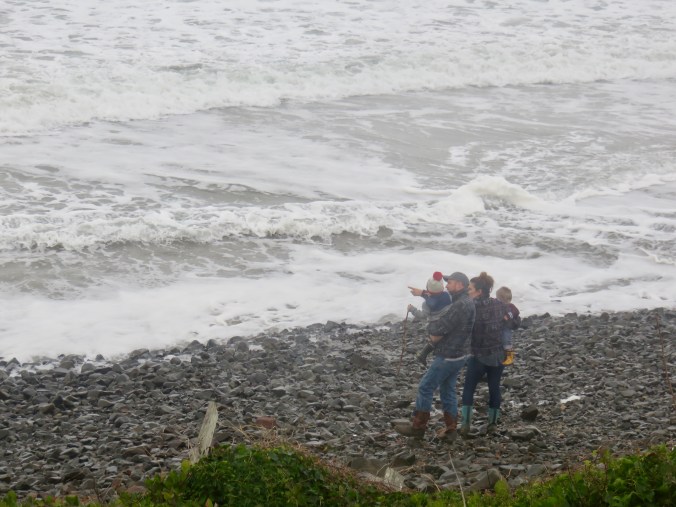
These vacationers should not stand on the beach during an incoming tide in mid-winter. Note the recent foam in the rocks to their right. I watched this family until they picked up their children and went back inside. (Yes, they briefly put them down on the rocks.)

I have worried about my weight since I was 13 years old and weighed 117 pounds. All my girlfriends felt, as I did, that we should lose weight. I was thin. I did not understand that. I still receive the message that I should lose weight. More often I am told I should not worry about my weight.

I should smile more.

I should not make a fuss.

I should get more rest.

I should see my doctor about that.

I should trust the process to play out.

I should say less, not everything I know.

I should not let things bother me.

I should not allow unkind people to get under my skin.

Unkind people bother me. This is especially true when I am afraid the unkind person is me.

I should wear colors.

I should dye my hair.

I should put on some lipstick.

I should not take things too seriously.

I should not care about people I do not even know.

I should use the trash I find on the beach to make art.

I should read this book, or another book, or watch a video, or attend this event.

I should stay safe.

I should. I should. I should.

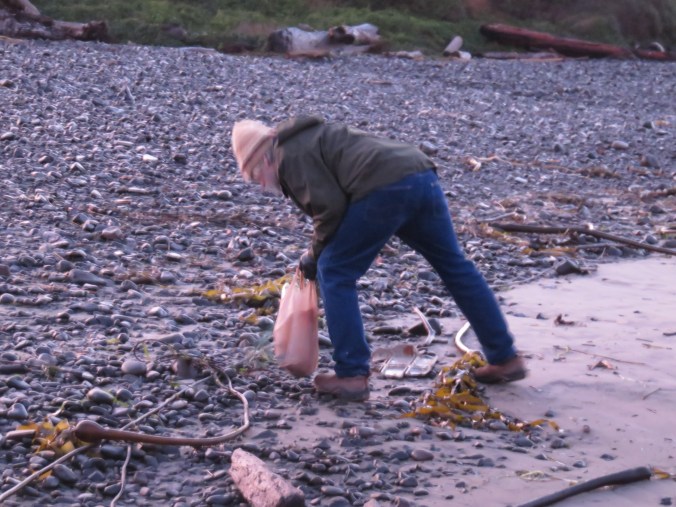
It was my mother who was forever after me to put on lipstick. The “you-shoulds” began early in my life and they never seem to stop. My husband and I pick up trash on the beach most mornings. Most people ignore us. None offer to help. Instead they describe seeing “art” made from beach trash. “You should see what this guy made with beach litter!” They think I should do that.

There are times when I feel completely at a loss for what I should do. Should I revise this manuscript again? Should I do more research about that one? Should I abandon the goal of publication and save myself enormous disappointment? Should I?  Should I finish the warp on my loom and warp a new one? Will I ever reread most of my books? Should I let most of those books go?

Should I sell my family home and move someplace safer? Where is that safety?

These days I find I appreciate the marvelous diversity of lives. The couple who work and perhaps raise a family, perhaps pay off a mortgage, take a vacation to Hawaii just once, and slip silently into death without making leaving behind much more than a few fond memories. Should they have done something differently? The couple who spent their lives striving toward wealth and then discover late on that it doesn’t make their lives meaningful, or perhaps they fail to achieve that understanding. Have they wasted talent? The couple who sacrifice and demand sacrifice from others in pursuit of artistic, cultural, social, or personal goals. Was their sacrifice worthwhile? Was the sacrifice of others worthwhile? Which couple would I rather have for parents?

For more than two weeks I was ill. I am only just now feeling healthy. I coughed a bit last night and woke, but no meds, no coughing today so far, no body aches, no fever is a week. I missed my beach walks, I stayed in the house most days. I could not read for more than a few minutes at a time. I could write only in tiny fits and starts. I ate most of two bags of honey-dijon chips—not the individual serving size. I deliberately forced myself to eat three full meals a day but managed to lose two pounds during the week. I responded promptly to student emails, but I have not been able to score their essays—the necessary sustained energy is still beyond me.

My sense of obligation never entirely leaves me. I know plenty of people, even many teachers, who are able to turn off their concern long enough to get healthy. I wish I could. I should be able to do that. But like a lot of other “shoulds” I can not turn them off.

I should score my students’ papers by Wednesday.

I should eat healthy and not worry.

I should get off my computer.

I am 66, walk most every day, and today I weigh 145 pounds.

I should lose weight.

The AUDIENCE IS LISTENING

img_3828

I am fascinated by the way a sunset transitions from orange though gold and directly to blue without passing through green.

If writers have a responsibility for how they narrate the world, certainly readers have a responsibility for what they consume and from whom.—Roxane Gay 

It is noteworthy to me that Gay takes the writer’s responsibility for granted. I am interested in the writer reading his or her own work and the responsibility that carries when conducting a public reading.

A long time ago I was accepted to The Flight of the Mind, a writing retreat for women. Among the many wonderful things that happened to me during that first week spent writing and reading and listening along the McKenzie River fifty miles east of Eugene, Oregon, was a blooming awareness of audience.

As a writer, I am eager for audience. I want my words to be appreciated, admired. I want to be understood and my stories, fiction or nonfiction, to be heard. I want to have my say.

Audience is all the people who might read my words or hear me read. When I taught The Bluest Eye, I warned students about the challenging scenes they would find in Toni Morrison’s first novel. They could choose not to read the book. They were encouraged to set down the book if it became too painful. It is a particularly appropriate warning for a young reader. It is a choice we all have when we read on the page.

A public reading is somewhat different.

All those years ago, Director Ruth Gundle had a great deal to teach me about who might be listening at a public reading or even at a reading before 80 other committed women writers. Anyone could sign up to read. She established guidelines for choosing work to read which was focused on quality and length, and she demonstrated great skill in arranging readings with a dozen or eighteen or more readers. Was anyone planning to read something distressing? Such pieces were placed within the lineup first—not first to read, but placed first before the rest of the readers and bookended with care. Her goal was to be fair to each reader, but also to lead the audience on a meaningful journey.

The reading should not be too long and never beyond the scheduled time. The reading should be work that has been thoughtfully revised. The audience should be entertained and challenged without finding themselves torn by barbed wire if they have been promised a flower garden. They should not be expected to transfer directly from horror and tears to lyric and laughter. Such emotional transitions must be thoughtfully choreographed.

Audience is the people in the room during a reading. The writer can only rarely predict her audience. She cannot know who recently experienced the violent loss of a family member, who has been assaulted, who feels deep and overwhelming regret or anger or fear or despair. She cannot know what her audience brings to the room.

The writer’s obligation is to bring worthy work to the room.

Long before anyone began writing articles about trigger warnings, Ruth Gundle urged us to ensure our audience felt safe and respected. The audience should not be assaulted, not entrapped or bludgeoned or accosted during a reading. Potentially painful or distressing material need not be avoided, but the audience led gently into and out of such fraught territory. Particularly painful work should be followed by work that manages a gradual release of tension.

The reading is not supposed to be a mind game serving the selfish interests of the writer. The reading is in service of the audience. Surprise, disagreement, even shock all may result from a reading, but these emotional responses should serve the audience, not the hubris of the writer.

Only an egotist tells a story merely to get a rise out of his audience. The responsible writer must put audience before personal ego. Yet some writers are too wrapped up in their power to do that.

On the other hand, if the only way a writer can capture an audience is by crossing lines . . . well, that says something too, doesn’t it?

If you attend enough readings, you will likely have your own stories to tell of inconsiderate writers.

I was trapped in the middle of a long row during a reading so boring (and nearly an hour overtime) that I began reading a book. It was so very boring that the person behind me began reading over my shoulder. Both of us were too polite to simply stand, work our way to the aisle, and leave. The reader was less polite.

Twice, a scheduled reader invited his friend to read after he was done. The friend read the first draft of a bad detective story or a squirm-worthy sex scene. The scheduled readers and friends probably felt quite pleased. The audience was not.

Reading in voices, badly in voices. Intimate scenes may be powerful in context of the novel, but repulsive in isolation because the audience has not been given the opportunity to invest in story or character.

And then readers who were perfectly aware of their audience, who deliberately manipulate and assault the listener. Some writers use drama and prejudices, stereotypes and bias to exploit their audience’s reaction. Powerful writers can do this easily, but like many choices we have in life, the ability to do something hardly provides the justification to do it. It is exploitative. It is bullying, and I think we are all weary of bullies. Aren’t we?

Each Winter term, I require my Writing 121 to attend a local reading. They have an exceptional opportunity in January, and sometimes they are deeply moved. I warn them about readers who might be crude, but they are young and the writers are “famous” and they do not wish to seem immature or naive. When the rest of the audience laughs, they want to laugh as well. They have never complained about what is read.

This year was different.

A public reading is not merely about stroking the ego of the writer or scoring points for writers’ freedom. Long ago, Ruth Gundle helped me and dozens of others to understand that the purpose of a reading is to give something of value to the audience.

Respect to the writer; respect to the listener too.


unAMERICAN

60b587cf-b5f5-4c1b-8d37-7173c7b1cc69.png

We have been enjoying the BBC production of Victoria. At the same time, I am mystified by Americans’ obsession with royalty.

The radical Chartist Movement is featured in the current Victoria series. It is well to appreciate that what these people asked for should not sound radical to Americans. They were asking for what seems perfectly rational and reasonable today. They asked for rights we should take for granted. That anyone would dispute these demands sounds about as outdated and absurd as arguing whether women have souls. (Yes, this happened repeatedly, and even in America.)

The Chartists’ six main demands were:
• votes for all men;
• equal electoral districts;
• abolition of the requirement that Members of Parliament be property owners;
• payment for M.P.s;
• annual general elections; and.
• the secret ballot.

It’s all taken for granted today. (Payment for M.P.s would have allowed ordinary working men to run for office without starving. Wealthy men who then held these positions could afford to attend Parliament because they had no job; they were rich.) At that time, rich men had complete control beyond the Crown. This was considered right and proper because they believed a person’s position in society was ordained by God. If you were born a tenant farmer, God meant for you to work hard all your life and to do as you were told. If you were born to an aristrocratic family, you were supposed to be respected, bowed to, and to be the ones doing the telling.

This is not an American value. We’re not supposed to believe that some people matter more than others at birth. The Declaration’s insistence that “all men are created equal” was a radical departure from Old World God-ordained dogma. Americans are not supposed to believe that some people are born inherently more important or privileged  than the rest of us.

And yet, according to a recent headline, America’s favorite redhead is a British prince?

Why do we care?

It is unAmerican.

Is it a harmless fantasy? I refuse to believe that such assumption of inherited entitlement is “harmless.” Indeed this belief undermines the very ideals of every modern democratic society. Yet we cling to this pretty story, especially for girls, this notion that the story of a pretty princess, born to power matters.

The princess stories, even the more empowered princess stories are unAmerican. Why feed this propaganda to our daughters? The “princess” is a woman who, by accident of birth alone, matters more, is valued more, who possesses greater power and influence and personal importance.

Did you miss it?

That’s unAmerican.

Americans are not supposed to stand for such nonsense. We’re not supposed to believe that some people are born to rank and privilege. Our nation is founded on the belief that we are all equal at birth. Our destiny is not infinite, but neither is it defined by our birth. Someone, please, inform Disney.

True, our founders, most of them, even the ones who wrote the words, believed some people mattered more than others, and those founders had been born to superior rank and actively perpetuated their own privilege. But still . . . in theory, they recognized a better world. They recognized ideals beyond their current existence.

And in that better world they imagined, a Queen is merely a wealthy woman, poorly educated, and participating in an archaic system of privilege and posturing. Princes are mere men who have done nothing personally noteworthy other than being born.

And the “princesses” in those stories? However decorated and enlightened, however brave or capable, however dressed or redressed, whatever their race or ethnicity—they are mere girls, never even women, just pretty female children born to rank.

It is a subtle indoctrination. It is propaganda.

And that, my dears, is unAmerican.

It is fundamentally wrong.

BE WHAT WE EXPECT

50064337_815356815478205_5354791712269008896_n.jpg
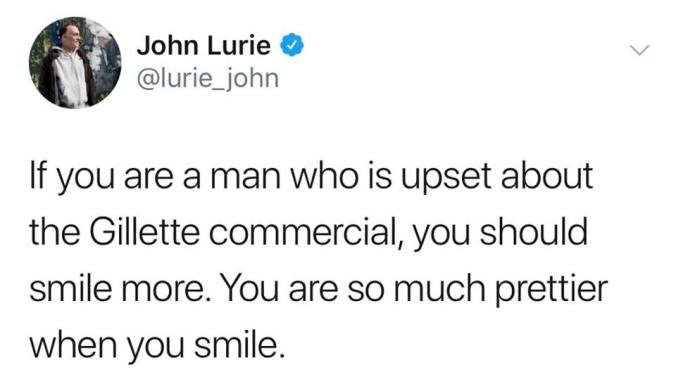
The Gillette commercial announces the company’s revised motto: Instead of “The best a man can get” they urge men to be the best they can be. The response from a narrow group of men has been nearly hysterical. They accuse the commercial of everything from unrealistic to emasculating. Most people I know, including men, including men actively hostile to feminism, find the commercial empowering.

One man tweeted in response to a furious “let men be men Let boys be boys” pundit: “It’s about balance. No one is suggesting men can’t be men. It’s about being a good person as a man. Historical behavior is no longer in tune with todays equality. You can be a tough guy, a manly man but still a man with values and appropriate behavior to help guide your kids.”

What we demand from ourselves is dependent on a lot of things, including what we are told about ourselves as men and women.

Girls have been outperforming boys in school for a long time, but this somehow magically swaps around . . . not in gradeschool or high school. Not even in college where women are still doing better. But somehow, in interviews and promotions, despite decades of women outperforming men, men abruptly do better. There are plenty of explanations for this. Nature or nurture? Natural aptitude? Inherent differences? Self-confidence?

I read a historical review that insists women have always outperformed men in school going back over a hundred years. (Anecdotal evidence from my life and my family supports that.) I think we only began to worry about this in the past 30 years because of popular books like John Gray’s Men Are from Mars and Women Are from Venus and Susan Faludi’s work. The assumption from some studies is that women were not actually smarter but simply socialized to be “nicer” in school, which is not so different from the claim in this article.

My psychiatrist friend says it’s hormones.

The New York Times report points to something simpler. “The study adds to a growing body of research suggesting that boys’ underperformance is not because of anything innate to boys. Instead, it seems, it’s largely because of something external: their school environments and peer influences.”

“Girls are encouraged to be diligent, cooperative and ambitious — all things that serve them well in school. Boys are more sensitive than girls to environmental influences, according to a variety of research, and they feel pressure to be strong, tough and athletic. They get the message that doing well in school is not masculine, social scientists say. Even in peer groups that prize good grades, it’s considered uncool to seem to try hard to earn them.”

The gender gap, with girls performing ahead of their male peers, historically reverses as the children age. After more than a decade of encouraging girls to be perfect students, we discourage girls from being smart. My brother used to talk about the gender gap in math in the US and how in Japan at the time the gap was reversed. It was assumed in the US that girls were “not good at Math” and they fulfilled that expectation. In Japan, Math was assumed to be mechanical and repetitive and exactly what girls were good at, and so the girls did well in Maths. In the 80s I would sub for the Math department and there would be no girls taking higher math classes at all at SHS. It was shocking. The head of the department in those days assured me that girls were naturally weak in abstract thinking. I assured him I had been in the 99%tile when I was tested.

Despite beginning Pre-Algebra when I was 10 and Algebra the following year, no one blinked when I stopped taking math my Sophomore year of high school. I often think how differently my life might have gone if everyone had not assumed I would eventually marry and be supported by a husband.

In my experience, I see how boys and girls receive vastly different treatment and expectations. A colleague with twins treated them differently from the instant they were born, and I was shocked he failed to even notice. The girl, despite being pounds heavier at birth than her brother was handed around like a fragile jewel. The boy, despite being underweight and subjectively fragile was passed about like a sack of flour. This is about more than pink and blue blankets.

We train them young to be what we expect and want them to be. Both boys and girls do their best to satisfy our expectations.

This may be changing.

Personal relationships are indeed personal, but our existence as people, as members of human society, should guarantee a certain level of respect and absolute justice. Not everyone benefits or suffers in identical and visible ways from sexism, but I would hope we all value the right of each individual, regardless of demographics, to life and liberty and the pursuit of happiness. At least one study of relationships between men and women over the past 50 years suggests that our expectations are changing. The assumption used to be that the man in a heterosexual marriage must have a superior education, but a “key finding is that the relative stability of marriages between educational equals has increased. These results are consistent with a shift away from rigid gender specialization toward more flexible, egalitarian partnerships and provide an important counterpoint to claims that progress toward gender equality in heterosexual relationships has stalled.”

That should mean that we are allowed to find out our personal interests, strengths, and weaknesses instead of having them arbitrarily defined for us.

KIDS TODAY

fullsizeoutput_e9f

I am ill. Sick. Not sick as in vomiting, which is what that word means in England. This is not England. I have a cold. I have not been this sick in almost five years.

The last time I had my morning walk was a week ago. I have been outside the house once since last Thursday, that was to visit the Walk-In Clinic in Seaside. My lungs and ears and sinuses are clear. I have a bad cold, a fever, major congestion, and until I took the NP’s prescribed Cherratussin (generic Robutissin) Sunday night, I had not slept more than an hour or two at a time for several days. The NP told me to go home, stay home, and get some rest. She capped it. REST.

Yes, I am become an old person talking about health.

My country is not so very healthy either, but there are hopeful signs. Gillette announced their new slogan is not about the best a man can get, but the best a man can be. See it for yourself. If you judged the content of the PSA by the outraged, even hysterical responses posted by a tiny but highly vocal minority of men, you would think it was an emasculating horror. Instead, even a former student who declares himself “a harsh critic of feminism” finds it perfectly reasonable. So do I. As another man I do not even know tweeted: “It’s about balance. No one is suggesting men can’t be men. It’s about being a good person as a man. Historical behavior is no longer in tune with today’s equality. You can be a tough guy, a manly man but still a man with values and appropriate behavior to help guide your kids.”

A friend posted: “I think some object to the idea that there is even a problem that needs to be addressed, and if that isn’t privilege, I don’t know what is.”

The first really powerful statement I read of the need for men to be the change was written by a man.

Times change. I am frequently asked how students have changed since I began teaching. I suppose I most object to the assumption that teenagers have changed. Teenagers are people, just like everyone. They come from a variety of backgrounds, have suffered a variety traumas, are blessed with a variety of natural gifts and of earned ones. They are teenagers—pinched between childhood and adulthood. It is still a terrible time where individuals enjoy little power, suffer screaming hormones, and possess no clear sense of what is coming. I was not a particularly happy teenager, and like students even today, I was assured this was the best time of my life and I should be enjoying it! Dear heavens, you mean it’s all down hill from here? I knew it for a lie, and I frequently assure my students that this is probably not the best time of their life. They look relieved when I say that. They are not so different. There are few changes. They are people. Sometimes they are dense as bricks and sometimes they are scared.

They have cell phones.

At my school, the economic advantages of some are not more marked than they were 40 years ago when I first subbed for my own former Junior High School Science teacher. Perhaps the bigotry of some is more openly condemned? Perhaps they are more aware of injustice? Perhaps they are less likely to avoid coming to school because of bullying?

Perhaps not? But perhaps.

As I say, I am ill today, my ramblings are not reliable. My personal list of grievances and gripes is long, but I will not rant. We all have our disappointments.

So here is what I think about my students. My students are not snowflakes. They are not fragile flowers. They need to be more curious. They need more skepticism and less cynicism. They need critical thinking skills. Someone should convince them that not all parents or teachers or politicians are right or even their enemies. Something should matter to them more than games and sport. They should read enough news to understand it. They should have moral goals and beautiful dreams and they should work hard to see those dreams bloom.

It’s a lot to ask, but they are strong. They need the confidence that genuine accomplishment can give. They are young to have that.


WILLINGLY FOOLED

img_3787

My son had a cat living in his house who knew that he possessed the Secret of the Red Light.

Alan had an infrared pen which he shined on the floor and that cat chased from room to room, in circles and mad dashes across the house. Once she he ran the light under the door of of one his housemates’ rooms and she waited faithfully for hours for the light to come back out.

He laughed and insisted she knew he was the one who has the light. She would come to him and meow and meow until he played with her. The ultimate suspension of disbelief.

I told him this is why some of our dogs, the smarter ones, were not good lure coursers.* They had speed and agility and endurance. Certainly they were enthusiastic. Speed, Agility, Endurance, and Enthusiasm were four of the five scoring categories. But the fifth scoring category was Follow. They watched, they responded to each twist and turn of the lure on the ground. They chased the lure enthusiastically, but eventually—often too soon—some part of them simply refused to play along.

“Wait a minute, enough already! That thing is only a shredded plastic garbage bag dragged by a line. Go over there where the line is—it’s bound to get there eventually.”

They began cutting, shaving off corners, in order to get to where the lure was going rather than following behind. They understood the game they were playing, that the lure was not moving freely, but along a predetermined path. They knew it was not alive. They did not pretend it had a choice of where to run, but they did. They couldn’t, or chose not to, suspend disbelief to play this game for us. They wanted to win, I suppose. The hunt was more vital than simply the chase. They wanted success at the end.

Where is the sweet spot between being right, being first, being a winner, and being entertained?

It seems such a human thing in some ways, or perhaps it is very animal and at least some of the hounds who were fooled and continue to be fooled know they are playing and are as willing to play as are we throughout so much, perhaps too much, of our lives.


*The American Sighthound Field Association developed from a Borzoi and Saluki fancier, Lyle Gillette’s determination to find a year-round activity that allowed sighthounds to practice their skills. Lyle was a sweet man, very active and successful in showing his dogs. He had hunted wild hares in Open Field Coursing but that is a seasonal activity, and the dogs love it. Lure coursing was mostly his invention while he was still living in California.

In the late 70s, my husband and I were active in establishing ASFA (later AKC) field trials for sighthounds in the Pacific NW. For years we traveled all over running our dogs. I was a licensed ASFA judge, but began judging because of my involvement with Heather and Jeff Loube in BC. I traveled with the Loube in 1975, I think, to Denver to the inaugural Grand National. There were over a hundred sighthounds from all over the nation competing. The Loubes came home determined to establish the sport in Canada, which they did with the support of other sighthound owners, some with Open Field experience.

IMG_2870

Gary with his dog, Volant O Solitary Man, American and Canadian Field Champion, in the 80s. “Manny” was not fooled, but he loved to run. (He’s in “pony clip” for ease of grooming.)


TO A BETTER YEAR!

IMG_3785

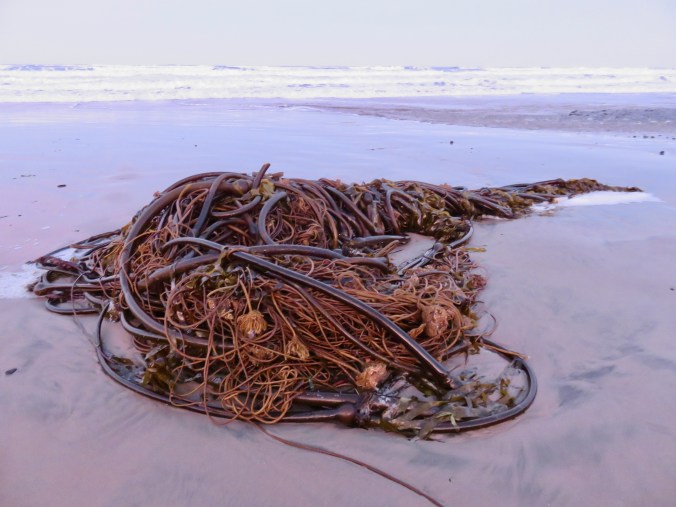
People think they can burn plastic into nothing. No, it turns into lumps I pick up later.

And all those illegal fireworks? I am still collecting the refuse from the last blast.

However, most of the refuse Gary and I pick up is from ships at sea. I know this because it’s plastic and nylon rope and containers no one brings to a beach picnic.

Just so you know.

The sky just after sunset was not the color you see in the photo below. It was purely red and midnight blue, but my camera has a better eye than we do, so it captures the golden highlights of the set sun that we did not see at all. What we saw was a band of lipstick red. That’s what the human eye could perceive. I wish you had been here to see it too. Still, my camera has a pretty view. (The little yellow dot at the bottom left of center was a brief beach fire on the sand.)

May 2019 bring you joy and contentment, a deep sigh of pleasure, a dog or cat to pet, good meals, quiet walks, many good books, a brand new view of something genuinely marvelous. I just watched a video of a solitary narwhale traveling with a pod of beluga whales. We all need friends. He’s picked up their bubble-blowing habit and swims close. Have a look at the footage.

IMG_3788