AUGUST

IMG_3206

It is the last of August, and this ending could not come too soon. It’s been a memorable month.

There are great things about August: my wedding anniversary, the birthday of my older son, and surely something else.

In the old days, August is the month I began playing solitaire compulsively—with cards, not on the computers. Wikipedia suggests that about 79% of games are winnable, but I am fortunate to win a tiny fraction of that number. I have no idea what I am doing wrong. I can play a dozen hands of the game without winning.

That’s how August feels to me.

And too many tourists, preparing for company, cleaning up after company, completed projects.

The real reason August is a depressing month is that I am eager to start my teaching year. Until I retired, August simply stood between me and a new school year. Now I only teach one class each in Winter and Spring terms. The end of August means I still have 12 weeks to go.

I need a project.

When I finally checked my class list, I discovered 36 students listed in my Writing 121 class. No college or university I know would inflict that many students on a writing instructor. It is likely a few will drop, but I am thinking about how to fit that many into a classroom. I am mentally adding hours each week to my grading time. They have moved my students into two different rooms, new to me since last year and the year before, and years before that. No one contacted me about any of this, I was unable to schedule a meeting with my department, I did not receive the schedule letter from the school, and the principal was briskly friendly when I stopped by earlier this week. This is merely to say that my high school, like all public schools, is struggling.

I just read a pair of articles about pay at public school districts, one about the highest starting pay, and the other about pay scales that dip into six figures. One reality of teaching is that schools generally hire as cheaply as possible. You might observe that this is true for any business, but you might be missing a key difference about hiring teachers. A public school seeking a new principal (or a law firm seeking a contract lawyer) can find the candidate they want to hire and then negotiate a salary commensurate with desired skills and experience. That is, they know what they want and hire the best person for that job.

Public education doesn’t work that way. The districts with the highest starting pay, offer more money to beginning teachers for two reasons: they are building a stellar school system or no one wants to move to Wyoming. School districts with exceptionally high pay can do that because their tax base is exceptionally high, cost of living is high, and because they are building exceptional schools. They are throwing their money down to hire the best teachers. If you are tempted at this moment to repeat that old saw, “You can’t solve a problem by throwing money at it,” you are both right and wrong. Throwing money around is pretty pointless. But having money to spend can allow a school to hire the best and brightest teachers.

Almost no district can afford the best and brightest teachers. They have limited funds and overfilled classrooms. They hire the best teacher that they judge they can afford. Whether 80 or only 12 apply for the job, districts hire first-year teachers because they are cheaper. They might hire a teacher with 3-5 years of experience, but they can’t afford more years, or anyway, they do not afford more years of  experience. Each year of experience means additional pay, and they do not budget for that extra pay.

Districts offering the highest starting pay assume that this is one way to find and keep teachers. If they can keep them for a few years, those straight-out-of-college teachers who chose to go somewhere for the high starting pay will find they are not desirable candidates anywhere else. The longer a teacher stays in a position, the less likely another district will spend the money to hire them away.

Compare that to most other industries where experience not only costs employers more, but is actually valued more. In schools, this only seems to work for administrators.

And yet. And yet, I am eager to begin. I will visit classrooms and volunteer my time in the school library on Wednesdays, and I am eager to begin teaching. In the mean time, I am piecing a quilt and playing solitaire.

“There are four types of hands [playing American Solitaire, or Klondike]: winnable games, theoretically winnable lost games (the player made a selection that resulted in a lost game, but could not know what the correct selection was because the relevant cards were hidden), unwinnable games (there is no selection that leads to a winning result), and unplayable games.”—Wikipedia

I am playing blind.
FOUNTAIN PEN

IMG_3205

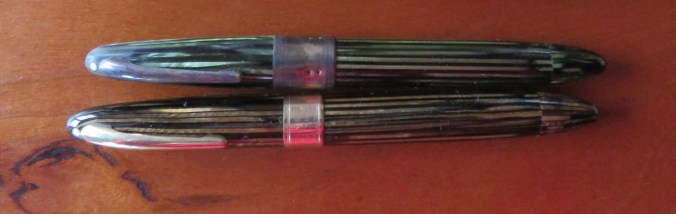
top: My dad’s fountain pen, probably from the 40s, maybe older or younger. The lower one was a surprise. I have no memory of seeing it before a couple of days ago. I have searched for exactly such a pen on Ebay.

I began using fancy pens when I was in college as an Art major. Mostly I wrote with a 0000 stylus fountain pen—a Kon-i-noor Rapidograph. The tip of such pens is a tiny tube, thinner than a crow quill, and notorious for clogging. The 4×0 tip makes a line 0.18mm wide. I used a 3×0 later, but eventually, the pens would always clog, freeze, and I would need a new one every 2-3 years. I learned to write carefully because the pen must be pretty much perpendicular to the paper to flow at all. While I have never been successful at calligraphy, my handwriting, which had been even worse than my typing is now, improved. I worked at it.

I also illustrated catalogues and magazines, designed logos and other advertising, and drew portraits of famous dogs. A German kennel came across an illustration of mine and was using it for his logo. By the time I found the image on his website, I was no longer making a living as a designer. He offered to pay me, but I told him he was welcome to it.

0105214-1.jpg

Eventually, I shifted over to Rotring Rapidographs, which were easier to find and cheaper. Around the time my children began walking, I gave up on Rapidographs entirely.

In the ’90s, my husband gave me an expensive fountain pen, a Pelikan 600, with green striations, and I have been using it daily every since. My dad’s fountain pen, the green striated one above at top is from another maker and was always loaded with blue-black ink. My pen generally has green or purple ink. Just now it is loaded with a Japanese green ink that is not quite olive enough. I am tempted to fool with the color by adding some orange to the bottle. I’ve mixed ink colors before.

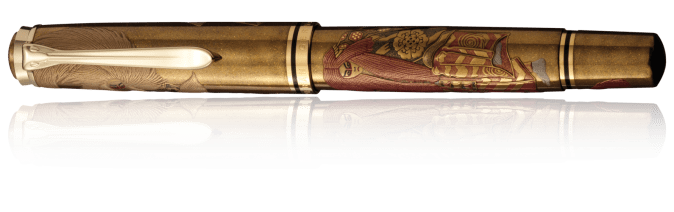
My Pelikan fountain pen has served me well for over 20 years, During that time an occasional student was inspired to try a fountain pen after admiring mine. They wanted to try it, but my dad always insisted that no one should ever, ever use an other person’s fountain pen. I have tried the Pilot Metropolitan, which is a very cheap pen (about $20) and allowed me not to cry when it was ruined at school. My Pelikan remains the one I carry everywhere. If I ever win the lottery, I would be tempted to buy one of the crazy-expensive Maki-e or Souveraen pens from Pelikan. They don’t even list prices online. So, yes, the lottery. 

maki-e-renjishi-large.png

souveraen-m800-raden-royal-gold-large.png

This is just to say that I love fountain pens both as artful in themselves and in use whether to make art or a shopping list. 

When they have been used, as my dad’s pen was used, they become almost like family.

In unpacking my grandmother’s desk, I found a stash of fountain pens in a drawer. Two tiny ones with ink reservoirs held in place by the nib, two Esterbrooks (black and gray marble from the 40s or 50s), and two Shaeffer’s pens. I put most of them in that desk drawer myself perhaps 30 years ago before my dad died. Since it came to me, my dad’s Shaeffer’s pen has floated about the house, in places where I could pick it up and hold it. The original owners of the other pens include a fancy gold-bound one with the initials of my grandmother’s second husband’s brother, and small serviceable pen my step-grandmother Genevieve used as a nurse. There is no certainty about the others. I have been able to clean two Esterbrook pens, and I am using the marbled one with purple ink.

The mechanical pencils in that drawer? . . . well, that’s for another day. I use a Y&C Grip500 0.5mm mechanical pencil. After losing several, I found they were discontinued. I bought a box of six old stock 10-15 years ago, and I have managed to hold on to four of them. (Whoops! found another one, which means only one has been lost.)

Tools are precious things.

The two pens in the photo up top are going to a repair person in Arizona tomorrow. I am not optimistic about what he can do for my dad’s pen. My dad used his pen for nearly 50 years. It took him all through the war to France and Germany, and the nib is quite bent to suit him. Late in life Daddy “customized” the pressure closure because it was no longer holding, and I doubt that can be corrected. But there is a chance both pens will return to me in a few weeks, and at least one will be serviceable.

I have felt loyalty to my Pelikan for over 20 years, but I respect the two small Esterbrooks for still working, after a lot of flushing, despite benign neglect for decades. The gray marble one has seen hard use. Both its “jewels”, the black plastic button on each end, are damaged, but the gold nib still flows nicely. I might load vermillion ink in the black one.

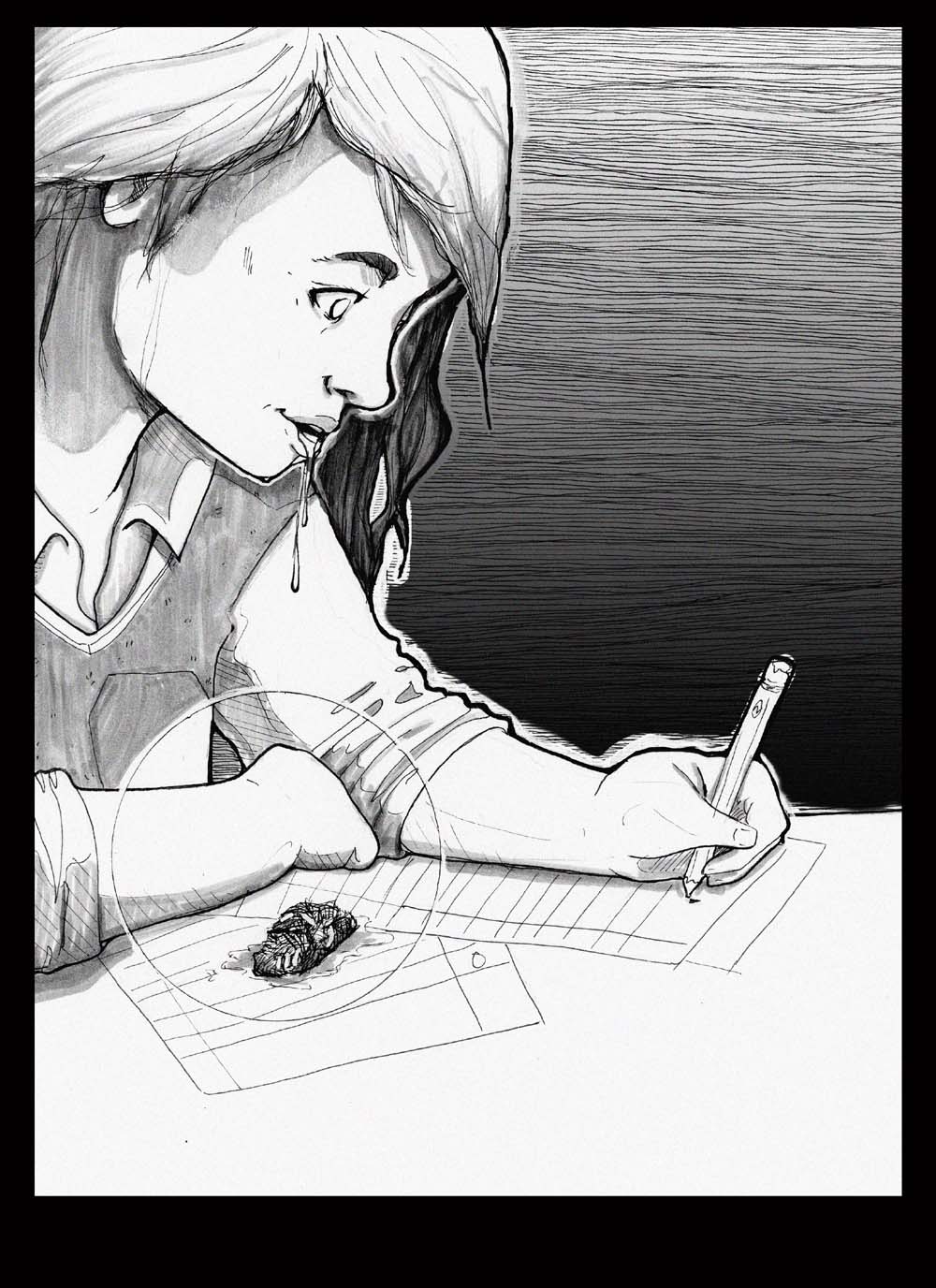
Perhaps, if I am particularly brave, I will try cleaning my old stylus pens. It would be good to use one again. Doing that would also convey an obligation in my mind to return to drawing. I have the idea of illustrating the owl story.

I do not know what happened to the original illustration. Here is the fuzzy version I found on a German website. Ch. Mecca’s Falstaff and Wita Rosie van de Oranje Manege


DÖSTÄDNING

IMG_3203

I found the escutcheon plate missing from the top drawer. They key is in another lock.

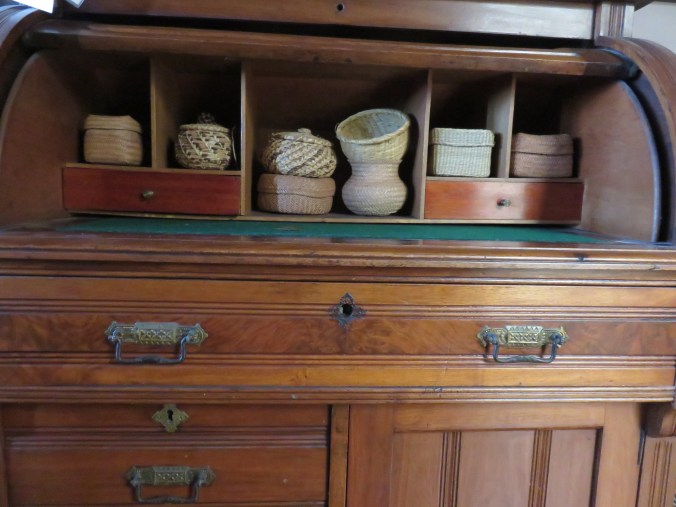
My step-grandmother’s secretary desk has pride of place in our home opposite the front door. Yesterday, I began emptying this beautiful secretary, purchased in 1962 for $125. Baubles, birthday cards, baskets, and relics of childhood. Things my mother and grandmother kept, programs from Ian’s early performances, and things I had forgotten completely even existed. A pair of ancient fountain pens I will try to get working again.

IMG_3202

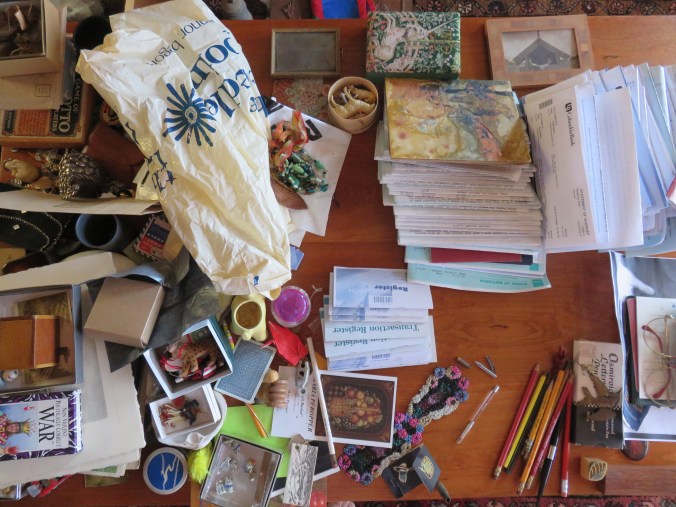
What came out of the working part of the desk. Three drawers and a cubby are empty.

I keep finding baskets and little boxes with buttons, necklaces, earrings I will never wear, campaign buttons and tiny objects without any use whatsoever. The music box will return to the desk, my grandmother’s slim leather briefcase with her maiden initials. The rest is going out the door to find a new home, leaving without regret.

Gary points out we are merely getting rid of things we do not both love and need. The “love and need” items still constitute quite a stash. It is only our half-joking effort at Swedish death cleansing, döstädning. A garage sale, giving things away, donations, etc. are an effort to make a little space in our home and in our lives.

The idea is to lighten our load, which has been burdened by being the last Priddy in my dad’s family, as well as the last in my mother’s family. Gary, with five siblings, brings less to this accumulation of stuff.

A few years ago a family member yelled at us for “not sharing” the family’s collectables. Truly, we would have been very grateful had this person taken more since they had first access to my mother’s house when it was emptied.

The family items I treasure were given to me long ago, a tiny pin, my great grandmother’s engagement gift, two lengths of wool jersey fabric that I have no more been able to cut and sew into a garment than my grandmother was. I am keeping it even so.

IMG_3204

Maybe I will tackle the upper display in the secretary . . . later.

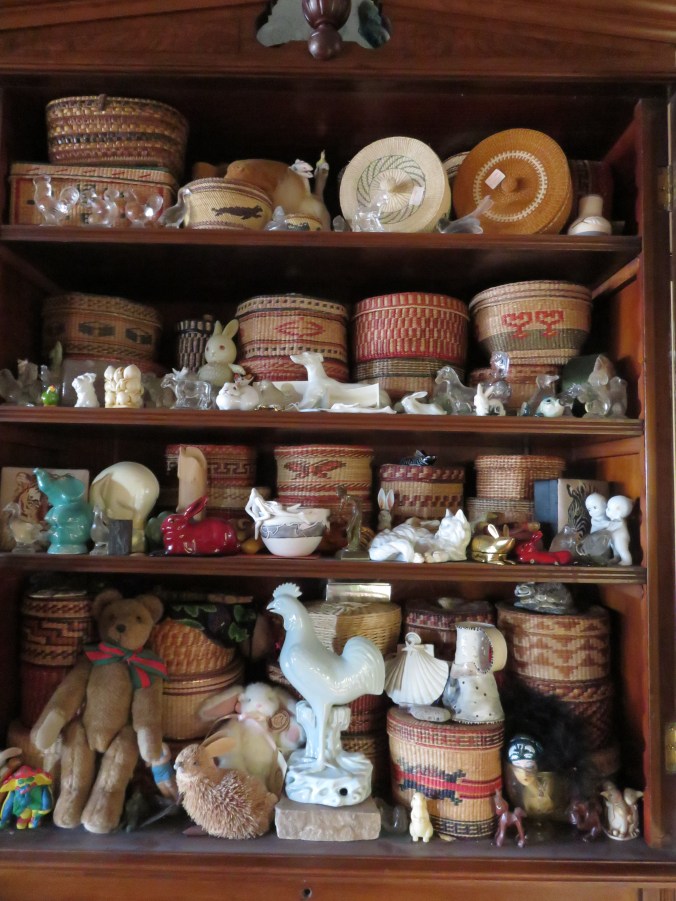
And there are the objects on display in the upper glassed section of the secretary. Most of these are not “family” but objects I made or collected.

The green elephant on the second shelf came from my grandmother’s kitchen window. She would remove her wedding rings and place them on the trunk when she did the dishes. There is a little white Persian cat on the same shelf that Mom found in an antique show held at Northgate. I was with her when she first saw the kitty, but it was only later in the day she went back to buy it. She gave it to me before she died in 2007. There is a Kay Finch ceramic goldfish and a porcelain greyhound. The celadon rooster is meant to decorate the table at holidays. Aside from small ornaments, all the little woven grass baskets I bought while I was in college and working at the University Book Store are waiting for review. Also the NW basket made and given to Gary in thanks for his work at Tulalip. We will keep all the baskets, but I am afraid many of them have things inside.

To be clear, we are not preparing for death anytime soon. We are accepting of our mortality, but having cleared the homes of too many relatives ourselves, we do not want to leave an unnecessarily burdensome task for our family.

44th ANNIVERSARY

IMG_3726
Gary feeding me the wedding cake at our wedding.

We were very young when we met and still young when we married. Lucky in that joining, as in so many things. Lucky my step-grandmother was a weaver. Lucky her second husband loved Gary. Lucky to walk off the street in Cannon Beach and get a job in a bakery. Lucky our sons were born early but healthy. Lucky to be together 49 years after our first “date.” Lucky to be alive. Lucky to live here with a man I love.

16105837_10154388706543667_103270127776112116_n

We’re lucky to agree on politics, on religion and ethics and human decency. We listen to different music and read different books but we like the same Irish and Australian television murder mysteries.

We are both losing weight these days and committed to cleaning out the house and our daily walks on the beach to pick up trash. He prefers rough agates and I prefer flat sand-smoothed stones. We both get excited about a nice piece of green sea glass. We both hope for blue.

The second photo above is from last year, the pussy-hat march in Astoria. If I take one today, I will put it at the bottom, because Gary’s hair looks better and he might smile for the camera if I tease him.

It is our anniversary, but there is nothing playing at the local theater we want to see and “so much food in the house” Gary doesn’t see the point of going out to eat. I agree. I have ice cream in the works, and luscious salmon in the fridge and two large ripe avocados. We can stuff ourselves if we want on favorite foods.

When we were still young, and only together for a few years, people asked me all the time how we’d managed to stay together. There is a line from Rilke about that, which I cannot quote accurately, but I find togetherness is a continual process of moving toward one another, of acceptance of imperfection—perfection is an inhumane notion if ever there was one—and a certain trust and determination, a willingness to give more than 50% in faith that so will my partner when I need him. He always has.

Yesterday we sorted through and cleaned closets and cabinets and today we will likely find something else to do. Being useful, doing productive things, makes us happy.

We’ve been happy together for a long time. That is love too.

BECOMING

IMG_3182

Our tenant, Greg, brings his cactus outdoors when it blooms, a rare semi-yearly event.

One day my favorite design teacher, Hazel Koenig, saw me walking to a metals class in the Art Building. She stopped me to ask if I would be willing to help out at a state art education conference. That would have been about 1974. Later, she got me my first teaching job. I thought of myself as an artist, and I still do. My work space where I write and make things is not a “craft area” as someone recently called it. It is studio space, work space. Calling myself a writer was harder somehow that calling myself an artist. I was exhibiting while I was still in high school. It took years to become a published writer of fiction. I had many articles published in dog magazines, I didn’t count them.

Calling myself a teacher also took time. I came to teaching relatively late in my arts education. I had avoided thinking too much about how I would make my living. I was in a five-year BFA program, most of the way through a BFA in Ceramic Art, when I “moved up the hill” from the Fire Arts building to the great facility in the Metal Arts wing of the Art Building on the Quad at the University of Washington.

From 1970 to 1976, I was a student at the UW. By 1974 or 1975, I was thinking about my future in a more realistic way. I toyed with transferring to a Botany major. I considered the law. I had wanted to be a an architect since I was no more than 11, but somehow failed to pursue it, though I took the non-major architecture history series from Gustav Pundt and then finagled my way into the majors-only series. Later I would make a decent supplementary income drawing plans for clients and for an architect.

Anyway, somewhere along the way, I realized that I was always teaching. Maybe I liked telling people what to do. Maybe I was good at explaining things. Maybe teaching was the creative and professional outlet that I needed. Maybe I was still under that favorite delusion that I would have “three months off every summer” and time to do my own art. That last one for sure, and even working half time as an art teacher, I never got “my own work done.” Teaching is more than full time work.

Even as a student, I knew classroom management would be my greatest challenge. Part of my educational preparation was brief field assignments in classrooms from Kindergarten through high school. When it was time to begin a longer term field placement, I asked for middle school. It was the hardest assignment and the right choice. I earned a k-12 certificate and later taught Art at a girls’ prep school for three years.

Then I moved back to Oregon and my husband and we began our family. For a few years I drew plans for clients and Jay Raskin. When I looked at teaching opportunities on the Oregon coast, I chose Social Studies as a second subject endorsement. I learned to write essays in my SS classes, how to reason and think. I began coursework, but then took an NTE exam and was awarded Social Studies certification.

I subbed for teachers all over the school district, our children were born and graduated and went off to make their lives. After substitute teaching for 11 years, I taught English for 25 years, earned an MFA in writing, and now I teach only two college classes, Writing 121 and Writing 122. I have my 10 weeks of summer and then another 12 weeks in the fall without teaching. In November, I write a novel. I am not inclined to do nothing. I will be busy Winter and Spring with my two college classes.

All this summer, Gary and I have been sorting possessions. We are each of us the end of the line. I have personally cleared the possessions to my parents, aunt, step-grandmother, and even my step-grandmother’s second husband’s brother. People gather unto themselves. Going through tiny professional pins with my son, Ian, I found I had no explanation for the pin from the carpet business in Portland, the mysterious Mason’s pendant from a hundred years ago. I know how they came to me, but there is no one to ask why they exist or what they mean.

Today, we went through the “treasure chest” and the linen closet together, and eliminated a great deal of “stuff” we didn’t need. Blankets and sheets and linens, bits of wrapping paper and ribbons from past holidays. The habit of my mother and her mother before her: keep what might be useful in the future. But I do not think I will ever want that rest of the red eyelash yarn I used to wrap packages a dozen years ago. There is also the joy of finding things I’d forgotten I possessed, the occasional gift I do not remember ever having.

Then I sorted my jewelry. The small jewelry box is completely empty, while the other is neatly sorted. The ladies in my family are going to do well this Christmas.

A necklace I used to wear every time I flew needs to be restrung. I have been putting that off. It is a luck piece, plain elephant ivory beads. I like to think the ivory did not come from a slaughtered elephant, but that is not a story I possess. I only know the beads are nearly 200 years old and when I was in a plane, I folded my hands over their smoothness and stroked them for comfort.

I finished the last of the blackberry crisp this afternoon. I sipped a half glass of wine as a reward for my industry. I feel enlightened.

When I go looking for something, I will know where it is, but I also know the greater value I possess. I know myself to be teacher, writer, artist.

SO ‘VERY DARK’

The burn ban. The pain did not begin with the cake or fire or police, but it ended with the pain in my feet. I do not believe this was all my fault, but I will worry that it was.

IMG_3197

Maybe the bad day began with the cake. I did everything right. With multiple dietary issues in my family, I was determined to create a chocolate cake that everyone could eat. That meant: no gluten, no dairy, no nuts, no refined sugar. Organic and luscious. Pretty. I found a recipe that was close and made my own modifications to eliminate sugar. I test-drove the recipe and it was perfect that first time! So, the day before my son’s birthday, I baked two layers.

Epic fail.

My Facebook friends suggested trifle, jam, licquer, whipped cream. I contacted family who okayed dairy, but trifle is new to me. Easy, but new.

So I chilled the cake to tackle tomorrow morning.

Before that, I’d woken in the night coughing. Our father’s both smoked. Camels. And they both died of lung cancer, so we are both susceptible to colds and flu. I more than Gary have bronchitis and pneumonia if I am not careful.

I woke in the night coughing from smoke drifting from illegal beach fires. This is not surprising since air quality is poor in many places, much worse elsewhere than here. The West is burning. Friends in Spokane and Seattle and Portland and all across California have posted photographs on Facebook of the terrible smokey air that makes ordinary activity outdoors unwise. Oregon firefighters are overworked fighting regional fires.

We had to close all our windows to keep smoke out of the house. On our walk this morning Roxxy’s mother pulled apart an illegal beach fire that had burned all night, carried sea water up from shore to put out the four smoldering logs. We have had to do that many times. Sandy told me the mayor of Portland had a beach fire which he promptly extinguished when alerted to the ban. There are signs at public access to the beach warning of the burn ban. Locals are supposed to know.

After our walk I baked and my chocolate cakes did not turn out, but I wrapped and chilled them. Tomorrow I will make chocolate frosting or open a jar of homemade jam and do my best to make a pretty cake for my son’s birthday.

The renters next door went out to build a fire on the beach.

Gary walked out to talk to them. He did not want me upset about their fire. He explained about the burn ban, and they said they would check and not burn if there was a ban. It was a polite conversation with Gary. They went ahead and lit their fire. I went out and talked to them and they did not believe me either. I was less polite. They claimed they talked to Cannon Beach police (which Cannon Beach Police deny) and they said they went online and found no burn ban, but people believe what they want to believe, and not what would otherwise be reasonable.

It is inconvenient. Inconvenient laws often require a lot of convincing.

I did not have the email address of my neighbor who owns the property because I have updated my computer and lost my address book. It did not occur to me to phone since my landline does not work long distance, and so I wrote a note on the home owners’ property Facebook page. Then I began calling around, trying to find someone to explain to the tourists that there is, in fact, a burn ban. There has been a burn ban for weeks.

When the tourists added more logs to their fire, I finally got through to the State Police and talked to someone who said they would send someone out.

There is a burn ban. Local police will not respond. County police will not respond. Parks and so forth will not respond. The State Police will. They sent an officer.

So, the coughing, the cakes, the fire in the wind, and finally an officer calls me and wants to know where is the fire? I tell him but he explains that it is “very dark” here and he could not leave his vehicle in the road where someone might not see it and thus cause an accident. I tried to explain, but he complained that our connection was poor. Then he complains that I am being very rude. “I don’t know what I have said to make you treat me so rudely.” I stopped talking. Women offering information are inevitably “rude.” Unless we are apologetic and soft-spoken, we are yelling. We are yelling and disrespectful and rude. I took a breath and waited.

So I listened until I was told I could speak. I had already offered to come out and show him the path to the beach. I waited until he asked if I was still willing to do that. I said I was. I was careful only to say “Yes. It will take me 5 minutes to get there.” I pulled on socks and my shoes and ran south, then east, then north, all the blocks to the officer’s car, lit up and blinking in the dark. I saw a flashlight and turned toward the ocean down Markham Lane. I called out to the officer and he identified himself and I went to him and walked ahead of him in the dark to the shore.

He had been concerned about trespassing on private property, and it was so “very dark.” I explained “I am a 65 year old grandmother and have lived here most of my life.” I asked if he would please tell the people there was a burn ban and he said he would. “They don’t believe me,” I said. And then I turned and walked home alone in the dark in my nightgown and socks and shoes.

And then the owner of the rental property called. By then it was past 10pm and well past our normal bedtime. He let me know how “disappointed” he was because he “didn’t think we had that kind of relationship.” I should have called him. I should not have called anyone else. I thought I was only reporting someone breaking the law. But I should not have done that. I am the villain of this story.

I should have called him at home, he said. It was my personal responsibility to inform him of how to properly manage his income property. How was he to know about the burn ban?

I can see his point. He says his phone number is listed on the Facebook page. Only I do not have long distance on my land line. I suppose after posting my concerns on his Facebook page and talking twice to his tenants, I am to blame for the embarrassment of police coming. I did call the police, after all.

So I do see his point of view, that out-of-state property owner. I feel like a jerk and I am pretty certain that I will feel bad about this long after he has forgotten the events of this night completely. I also know that it is my home that would have gone up in flames had that fire sent out sparks (which it did—I watched the sparks) and the wind had carried fire to my house.

So the coughing, the cake, the sparks from the fire, not being believed, being acused of being unreasonable, and my feet now hurt like needles stabbing them because I am not supposed to run. I really am not supposed to be running in the dark. It was so very dark.

OWLS DREAM

 Art by  Laurie Noel

And a check came for my story, “If It Were True Owls Dream.” It appears in issue 5 of Liminal Stories. The illustration they chose disturbs me because in my head I see Beatrice from the other side, facing left. (Plus, this character is right-handed.)

The early drafts of this story used my grandchildren’s names, but those have been altered to protect their innocence.

NGS Picture Id:1166458


WEASEL TRACKS

IMG_3172

The brown pelicans are here. We found a shed flight feather on the sand.

IMG_3123

We think we found weasel tracks in the sand. Not dog or cat or rat or raccoon. Little weasel tracks. By the time I got them with a camera, the sun was up and the tracks had begun to fall in. You will have to take my word. A weasel. There has been a weasel in the neighborhood at least since the 80s when I first saw one dart across the front yard. A weasel watched the electricians replacing a rusted out meter box. Our cat Leakey had an on-going feud. Then it was gone, but maybe it is back again, or more likely a cousin after all this time.

IMG_3129

The tide scrubbed cold water up from the bottom of the ocean and dozens or hundreds of aged dead crabs were tossed on the sand, many of them 8 inches across and nearly all males. The other day as the sun came up during our morning walk we could see odd color in the sky, a gilded haze from the fires elsewhere in the west.

Our family came for the weekend and we had 8 adults and 5 children between the ages of 2 and 6. There was a bit of chaos.

And then Gary and I picked blackberries. They are early this year. I meant to gather only a handful to combine with nectarines, but there were so many!

IMG_3176

My mother always said you could tell a pie was done when it began leaking and bubbling over.

IMG_3177

A good month so far.

SOCIAL SECURITY

IMG_3106

As a child, I thought I would one day have many horses. This is one of my horses.

When I was a teenager, my mother was buying and selling antiques. She reported the income as coming from both herself and my dad because, having worked for the feds and before that for a college, he did not have many years in the Social Security system. In other words, he qualified for a federal pension but not for Social Security benefits. Mom wanted to ensure he could have both so my dad was a partner in the resale business of antiques and collectables. Today, she would have done this via Ebay; in those years, she attended flea markets and antique shows.

This was a good lesson for me as a teenager, to see someone planning ahead.

Talking about money is uncomfortable. I get that. It is for me too.

Some in my parents’ generation were diligent about preparing for retirement. They may have been particularly motivated if they faced particular challenges related to race or religion or divorce, humble upbringing or handicap. There was also the fact of growing up in the Depression, which tended to instill a sense of monetary insecurity and need for preparation. And the G.I. Bill had sent a generation of Americans to college who would not have had that opportunity in previous decades.

The G.I. Bill was initially conceived primarily as a home-buying incentive for returning veterans. The educational portion was tacked on at the end, but it might have created the most dramatic shift in American culture.

Don A. Balfour was “the first recipient of the 1944 GI Bill.” Veterans Administration letter to George Washington University.

On June 22, 1944, the Servicemen’s Readjustment Act of 1944, commonly known as the G.I. Bill of Rights, was signed into law.

During the war, politicians wanted to avoid the postwar confusion about veterans’ benefits that became a political football in the 1920s and 1930s. Veterans’ organizations that had formed after the First World War had millions of members; they mobilized support in Congress for a bill that provided benefits only to veterans of military service, including men and women. Ortiz says their efforts “entrenched the VFW and the Legion as the twin pillars of the American veterans’ lobby for decades.”

Harry W. Colmery, Republican National Committee chairman and a former National Commander of the American Legion, is credited with writing the first draft of the G.I. Bill. He reportedly jotted down his ideas on stationery and a napkin at the Mayflower Hotel in Washington, D.C. U.S. Senator Ernest McFarland, (D) AZ, and National Commander of the American Legion Warren Atherton, (R) CA were actively involved in the bill’s passage and are known the “fathers of the G.I. Bill.” One might then term Edith Nourse Rogers, (R) MA, who helped write and who co-sponsored the legislation, as the “mother of the G.I. Bill”. As with Colmery, her contribution to writing and passing this legislation has been obscured by time.[Wikipedia]

Like slightly more than half of World War Two veterans, my aunt (Marines) and my father (Army) used the G.I. Bill to gain a college education. Both went to the University of California at Berkeley. They were first generation. My mother was too young to have served during the war, but she lived with her sister and after the war also attended UC Berkeley before her marriage.

The Bill was not perfect. It suffered from the bigotries of the day, stumbled, lapsed, but has been renewed in recent years. It still looks like opportunity for many young people seeking to serve their country and find a better life.

There used to be a popular fiction, the Horatio Alger myth, that encouraged a belief that in America anyone can rise. Indeed, many have come to our country to find a better life. Many have found that better life, but actual wealth tends to run in families. We do not live in a fluid society. Children born into affluent families may achieve actual wealth (Gates), but the rags-to-riches story is rare to nonexistent. (Riches-to-rags is an easier move. There is plenty of research documenting how a single generation brought up in privilege can squander wealth.) Most people shift slightly up or down in class, work and earn slightly more or less than the generation before them.

It has never been easy to shift social classes, and there is deep resentment among the wealthy, hence derogatory terms such “Nouveau Rich” and “social climber.” Research suggests that active resistance has grown. Social mobility is less likely today than is has been in the middle of the last century.  My mother’s mother had hoped to attend college and according to family stories was accepted to Reed College, but was unable to attend when she and her sister were forced to support the family due to a strike. Later my grandmother was an office manager in a shipping company, a single mother supporting her daughters. My own mother attended college only until she married. I have four college degrees, and my sons have four between them.

What we are given is ultimately less important than what we assume we are entitled to pursue. I assume my grandchildren will attend college, and because of such assumptions about their futures, they likely will. My parents assumed as much for me. My husband attended college only because I did, not because anyone in his family had ever attended college or because anyone in the educational system encouraged him. He graduated in 1974 with honors and Phi Beta Kappa. His work has rarely relied on that education directly, but a look at his bookshelves reveals a man still interested in his own education. I am proud of him—he is interested in knowing.

Assumptions about my own life have also flexed. I thought I would teach till I was in my 70s, but a year of lingering illnesses forced me to retire at 62 when there was “no money” to offer me a half-time teaching position. I have not been sick since, though I do still teach two college classes each year.

My husband and I have three pensions between us, none of them enough to pay rent, but adequate together with Social Security, which we each paid into since the 60s.

My mother was determined that she and my father would enjoy a secure retirement. In practice, life did not proceed in the manner she hoped for. My father was forced to retire early due to rheumatoid arthritis. He died of lung cancer before reaching my age. My mother moved alone to a coastal town in Oregon, and her contractor underestimated the cost of her retirement home by a factor of three, so she went back to work part time for a few years.

We do what we can and hope for the best.

The BLANKET

IMG_2968.jpg

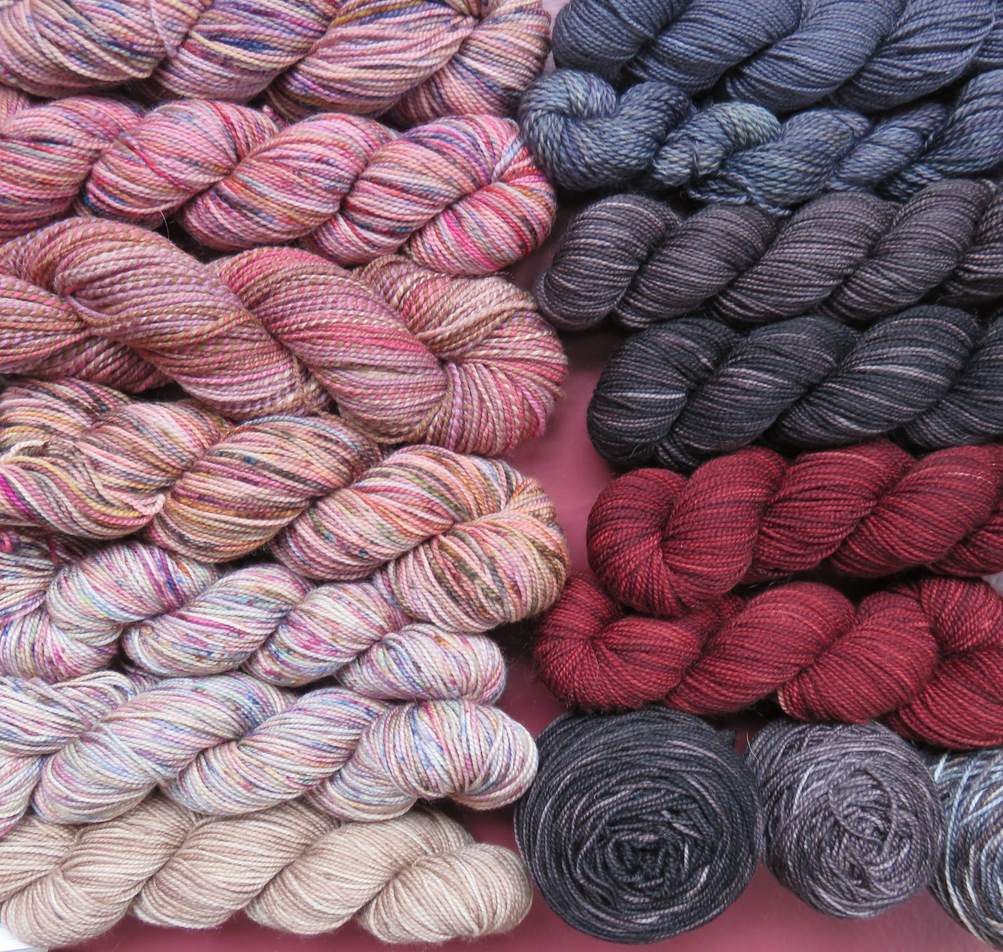
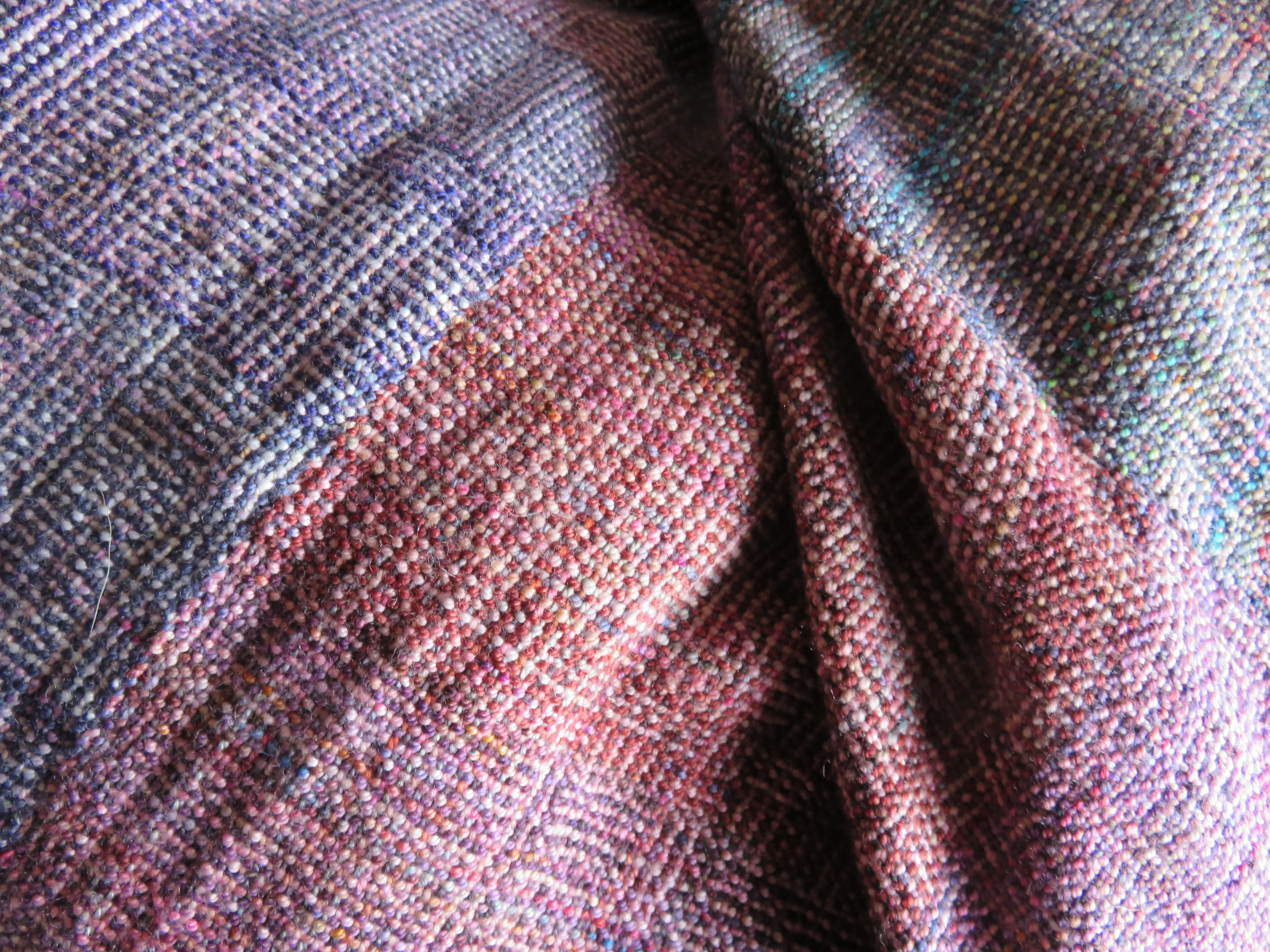
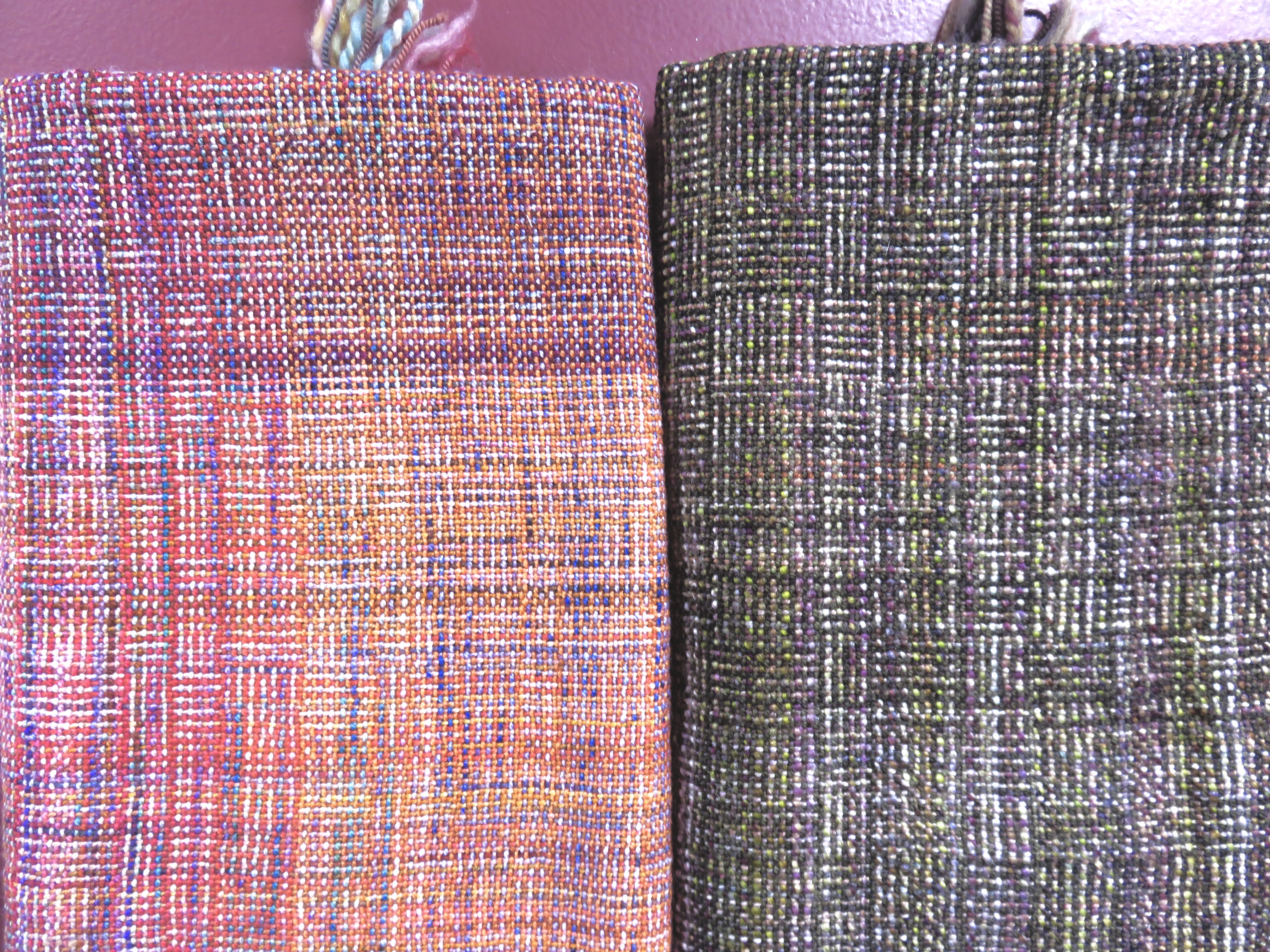
The yarn above is from the blanket I just completed. The warp was 8.5 yards, and I wove three 82.5″  lengths and then seamed them to make a blanket of 75″ x 88″  including fringe. One of the lengths used weft very like the warp and the resulting fabric is warm-toned and reddish. The other two used neutrals, dark blue and purple and green, as well as a scattering of sparky contrasting colors. The neutral weft lengths went on the outside and the reddish one in the center.

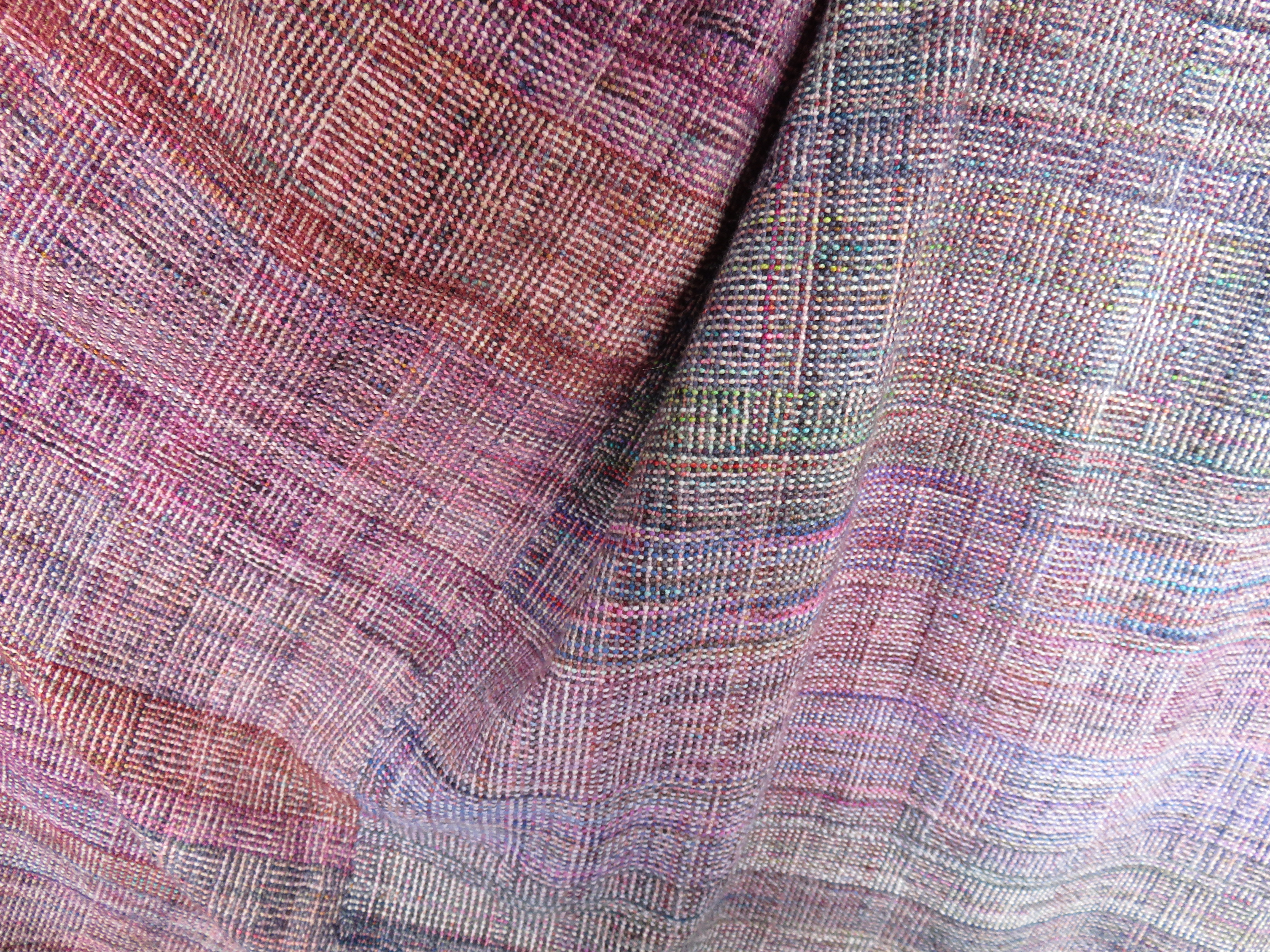
The pattern I wove is called “log cabin”  that is quite different from quilter’s log cabin. Weaver’s log cabin starts with alternating light and dark warp threads; the weft threads also alternate dark and light. You can see how I set darks against lights in the photo at top. The color contrasts reveal a pattern of horizontal and vertical bars. The three strips (each 25″  wide) on the same warp are seamed together in the two photos immediately below.

IMG_3118

IMG_3121

The pattern sounds simple, but I am fond of it. There is a bit more to it than that, of course, but that’s the gist. You can see how the pattern varies in the four woven lengths stacked in the photo below. This is a different warp and shows four different approaches to weft. The one on the left is blue/purple. The one on the right used a handspun yarn in gradually shifting dark hues. There’s a dyed-in-the-wool skein from Washington state, shown up top, third from top on the left. Everything else on this page is woven of Koigu, a Canadian hand-painted merino yarn.

IMG_0778

Years ago, weaving my first project, I played with a classic balanced coverlet pattern called “Snow Ball and Pine Tree to make a weft faced rug of Swedish cow hair. You could say that I took a pattern from one tradition and used it in another. I did that with weavers log cabin, too, stitching a quilt in alternating vertical and horizontal bars. One creative effort feeds another.

Some days feel abandoned, wasted and lost.

Other days feed the soul. A friend just became a grandmother, and I sent her a baby blanket for the little boy, the one at left below.

IMG_3117

Some days pass without incident or accomplishment. Some days there is kindness in the air.