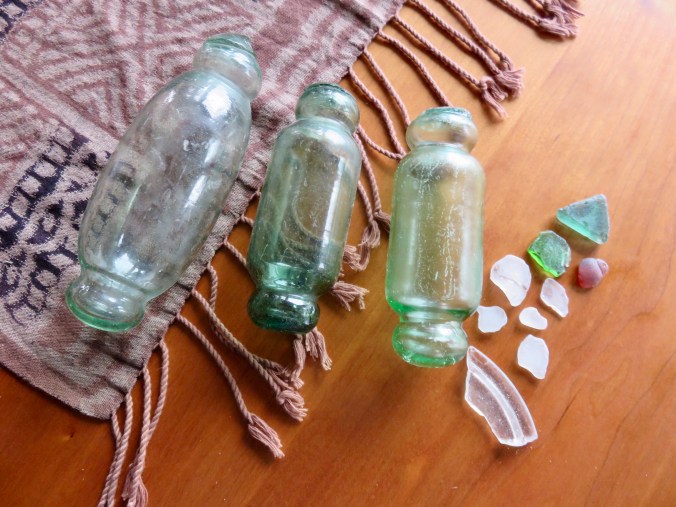
My grandfather’s pair and mine on the right after cleaning. Also today’s seaglass.
My grandfather found three of them. I still have two of the ones he found. This morning I found a Japanese glass float of the kind called a “rolling pin.”
 It was pure chance. It always is. We went out this morning intending a quick walk. We were halfway home and Gary was anxious for his breakfast but I was determined to gather plastic bottle caps and poly-styrene foam anyway. I had turned back for a blue plastic bottle cap when I saw it. I knew, just knew. It was covered with sea growth and I still knew it was glass. the narrow necks at each end would have accommodated ropes in nets that might have been strung for miles in the ocean.
We have many floats, a couple of them still in their rope nets and they used to hang outside the front door before we remodeled. Gary has found many floats, including really large round floats the size of volleyballs. I have found two small round floats the size of oranges and a large, cracked float. That last one is only two millimeters thick in the spot where it’s broken. Wikipedia says the Norwegians are the first to use glass floats in the early 1840s, but in our ocean, beginning in 1910, “recycled glass, especially old sake bottles in Japan, was typically used and air bubbles/imperfections in the glass are a result of the rapid recycling process.”
 It didn’t look like much on the beach but to us, a glass float is a huge find. It’s been years since either of us found one on the beach. These days the floats are plastic. We’re finding those too. Bell-shaped floats in white and orange. The round ones are usually black with loops on opposite sides or a pair on one side. I hauled home a huge lime green one the other day loaded down with gooseneck barnacles.
These too are from very far away and a long time ago.
.


 I am always so glad when I check my emails and your blog is there. It’s a breath of fresh air.

 IMPERFECT PATIENCE