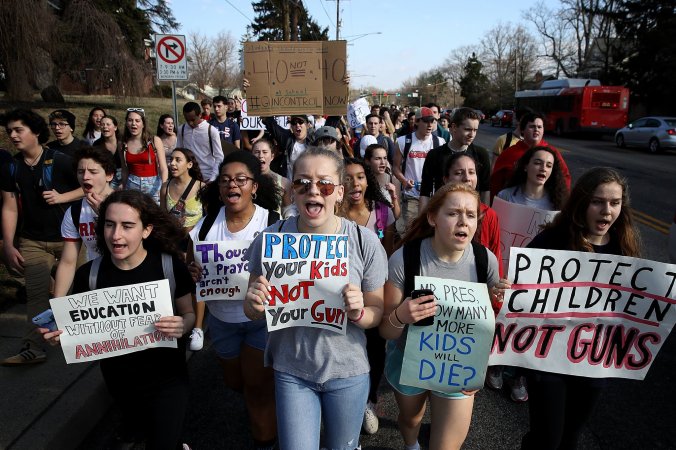

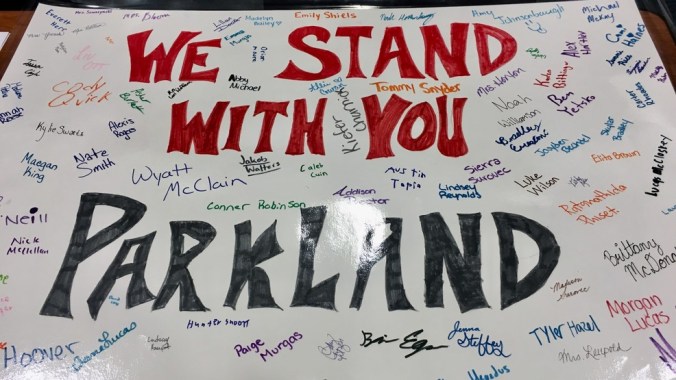
Even on “reality TV” the firing is done in person. Trump seems to want to play things both ways—hiring and firing at random and then those ousted find out when someone in the news or working in the West Wing takes the trouble to forward a tweet. Really? Is that any way to run a country?
Tillers is replaced by CIA Director Pompeo, which ought to scare many of us. Similarly Pompeo’s replacement is the person who oversaw torture. Nice that she’s a woman, the first woman Director of the CIA. Not so nice it’s . . . her.
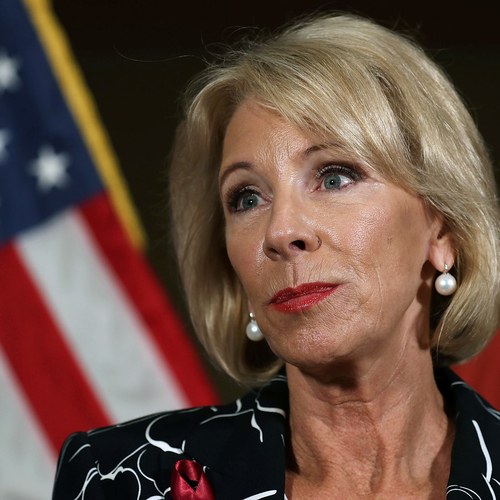
Speaking of not nice woman, DeVos is still thrashing around in the Department of Ed. like the proverbial bull in the china shop. She was on 60 Minutes the other night and seems not to have learned a thing about public education since she was given her position via a tie-breaking vote from Pence. From The New York Times:
“Speaking to DeVos, [Leslie] Stahl compared situations in which white kids are punished for classroom disruption by a trip to the principal’s office, while for black kids, ‘they call in the cops.’ DeVos refused to say such a discrepancy is wrong: ‘Arguably, all of these issues or all of this issue comes down to individual kids.’ Stahl pressed her on whether this ‘disproportion in discipline’ constitutes ‘institutional racism.’ DeVos said she was committed to ‘making sure students have opportunity to learn in safe and nurturing environments.’
“The comparison Stahl offered was a hypothetical, but it captured the heart of the issue. Black public school students are suspended at 3.8 times the rate of white students. That discrepancy alone doesn’t necessarily demonstrate discrimination, but there’s evidence that students of color are punished differently from white students for the same infractions. Lhamon told me about one elementary school where a black girl was suspended for poking a student with a pencil. When a white girl in the same grade threw a rock that hit another child in the head and broke the teacher’s sunglasses, she was made to help the teacher clean the classroom during lunch.”
It is likely that in most cases teachers are completely unaware of their own bias. Studies of disproportionate attention given to grade school boys over girls are rarely believed by the teachers studied until they watch videos of themselves.
David Brooks of The New York Times might have suggested she had a look at public school success stories such as Chicago, which has increased its graduation rate to 77.5% from 56.9% and those attending collage after graduation to 63% from 50%. The current superintendent gives credit to principals. Maybe. (Most research suggests that the only people who really make a difference are parents and teachers.) Perhaps this works when principals support those efforts toward a shared goal of high standards and consistency.
“Research suggests that it takes five to seven years for a principal to have full impact on a school, but most principals burn out and leave in four years or less. Chicago has one of the highest principal retention rates of any large urban system, 85 percent. Principals are given support, training and independence. If you manage your school well for a couple of years in a row, you are freed from daily oversight from the central office.
“But the big thing is transforming the role. Principals used to be administrators and middle managers, overseeing budgets, discipline, schedules. The goal was to be strong and decisive.
“Today’s successful principals are greeting parents and students outside the front door in the morning. That Minnesota-Toronto study found successful principals made 20 to 60 spontaneous classroom visits and observations per week.
“In other words, they are high-energy types constantly circulating through the building, offering feedback, setting standards, applying social glue. In some schools, teachers see themselves as martyrs in a hopeless cause. Principals raise expectations and alter norms. At Independence Middle School in Cleveland, principal Kevin Jakub pushes a stand-up desk on wheels around the school all day.”
Brooks also gives partial credit to the leadership of people like Arne Duncan, but since this improvement occurred since 2006, I tend to disagree. Duncan was a lousy Secretary of the Dept. of Ed. Except he looks positively brilliant compared to the current Secretary.
DeVos supports school vouchers and using public funds to pay for private schools. She never attended public schools, does not support them, has not visited a school struggling to improve, and cannot explain why schools in her home state of Michigan, a state which has instituted her policies, now performs worse than it has in the past. What does she care? Unless there is a profit for herself or a friend . . .
In the mean time officials insist Russia now has more intelligence agents in London than during the Cold War. They at least attempted to interfere in U.S. elections and according to the British Prime Minister, Russia recently poisoned two ex-pats (not for the first time). And what has Trump said condemning Russia’s dirty tricks?
Not
a
single
word.
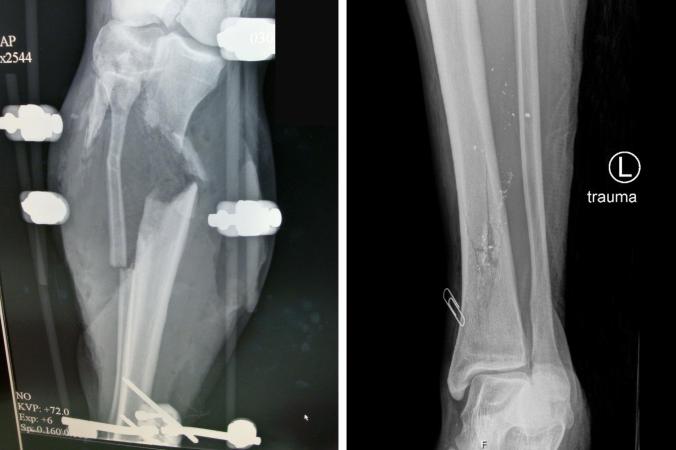
Left, an X-ray of a leg showing a bullet wound delivered by an assault rifle used in combat. Right, an X-ray of a leg that sustained a bullet wound from a low-energy bullet, inflicted by a weapon like a handgun in Philadelphia. from an article about destruction caused by military-style weapons in The New York Times
We have this in common. We are wounded.
“Many factors determine the severity of a wound, including a bullet’s mass, velocity and composition, and where it strikes. The AR-15, like the M4 and M16 rifles issued to American soldiers, shoots lightweight, high-speed bullets that can cause grievous bone and soft tissue wounds, in part by turning sideways, or “yawing,” when they hit a person. Surgeons say the weapons produce the same sort of horrific injuries seen on battlefields.
“Civilian owners of miliary-style weapons can also buy soft-nosed or hollow-point ammunition, often used for hunting, that lacks a full metal jacket and can expand and fragment on impact. Such bullets, which can cause wider wound channels, are proscribed in most military use.
“A radiologist at the hospital that treated victims of the Parkland attack wrote in The Atlantic about a surgeon there who ‘opened a young victim in the operating room and found only shreds of the organ that had been hit.’
This is one reason the hunters I know, even if they have such weapons, never carry them while hunting. So-called assault weapons have absolutely no function other than war and mass murder. No civilian needs one. Indeed, even an actual “well regulated militia” has little use for them.
“ . . . ‘Bystanders are traumatized just seeing the victims. It’s awful, terrible. It’s just a ghastly thing to see.’ ”
Law is a reflection of the will of citizens. We pass laws that demonstrate our values and our goals, that define boundaries for behavior. Australia experienced a mass shooting and promptly outlawed the weaponry used because they did not see the need to allow another such shooting. They haven’t had another since.
It is simplistic and naive to say that “guns do not kill people, people do.” Somewhere in the United States psyche there seems to be imbedded the belief that guns make us safer. It is a treasured fantasy, a macho or fearful or perhaps fearful-macho faith that having a gun will turn individuals into saviors. Abundant evidence proves otherwise.
In truth, it is widespread but not a majority view that guns make us safer. A relative of mine who has been founded guilty in court of attacking his wife has a concealed carry. He says he “feels safer carrying.” It is a line I have heard from other men and women too. They only feel safe when armed. Needless to say, I do not feel safer that they are armed. Like them, I am afraid,
Fear is wounding. Fear is symptomatic of psychic damage. It, too. is a wound.
We are all wounded. Every killing, every attack, every shouted insult and barbarous excuse for such actions, wounds. Our nation is bleeding.
We did not see the film The Darkest Hour until recently. I had concerns about the lead, about the film, and particularly about its subject, the much lionized Winston Churchill.
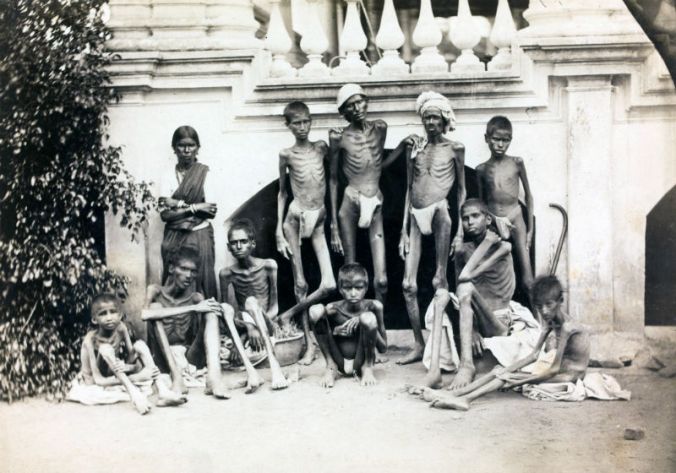
It is one of my nightmares to find myself teaching a subject I know little to nothing about, such as the Boer War. Even so, I thought I knew British history. I knew for example that Indians (of India) died of starvation while the British sat on overfull grain houses during WWII. When I feel particularly distressed about the interference of my own country in the lives of people around the world, I have only to call up the atrocities of the British. They have been at it so much longer than we have.
I thought I knew this story.
A new essay in The Washington Post by Shasti Tharoor about Winston Churchill reveals how little I knew. He reviews Churchill’s unwarranted and brutal attacks on people of color all over the world. He advocated genocide,
“ ‘History,’ Winston Churchill said, ‘will be kind to me, for I intend to write it myself.’ He needn’t have bothered. He was one of the great mass murderers of the 20th century, yet is the only one, unlike Hitler and Stalin, to have escaped historical odium in the West. He has been crowned with a Nobel Prize (for literature, no less), and now, an actor portraying him (Gary Oldman) has been awarded an Oscar.”
“Churchill’s beatification as an apostle of freedom seems all the more preposterous given his 1941 declaration that the Atlantic Charter’s principles would not apply to India and the colored colonies. He refused to see people of color as entitled to the same rights as himself. ‘Gandhi-ism and all it stands for,’ he declared, ‘will, sooner or later, have to be grappled with and finally crushed.’
“Many of us will remember Churchill as a war criminal and an enemy of decency and humanity, a blinkered imperialist untroubled by the oppression of non-white peoples. Ultimately, his great failure — his long darkest hour — was his constant effort to deny us freedom.”
Not counting soldiers, millions died as a direct result of Churchill’s policies in Kenya, Ireland, South Africa, Afghanistan, Greece, Iran, Iraq, Palestine, and other countries. Up to three million died of starvation in India alone. In response to Gandhi’s campaign of peaceful resistance, Churchill said the Mahatma “ought to be lain bound hand and foot at the gates of Delhi, and then trampled on by an enormous elephant with the new Viceroy seated on its back. . . . I hate Indians. They are a beastly people with a beastly religion.”
He bombed and starved and destroyed and exploited. His words beyond his famous rousing speeches about British persistence, reveal a man so certain of British (English) superiority, so bigoted and self-righteous, that he never was held to account for his racism, terrorism, and butchery.
He helped win a war. Didn’t he?
Would ordinary Brits have done and said such things? Would I? No one likes to think so, but then I have to wonder why it keeps happening if so many, many people “would never . . . ”

We went to a promo presentation of Michelle Horgen’s new musical Scarlet at Powell’s Book Store in Portland last month. The songs were beautiful, the brief performances impressive. We drove over the coast range especially to see it. Tickets were on sale at the event, but I’d already bought tickets to the official Opening Night. We know the playwright and we were excited to see her. I’d supported this production since it was a 2013 Kickstarter. It is based on The Scarlet Letter, and I reread the novel in preparation. We had a reservation for the night at The Kennedy School and Gary and I talked about places to go for lunch and dinner before the play. Gary was worried about sitting still for the long play, but we planned a nap earlier in the afternoon. We planned to try sleeping in on Sunday because we were not used to being up late and because of Daylight Savings Time. The hotel had confirmed our stay.
And then last night, the hotel called to ask if we were checking in. Our reservation was for Friday, the woman said. Friday the 9th, not Saturday the 10th. I had printed off the reservation and the tickets. I had written it incorrectly on my calendar, had it stuck on my head as a Saturday event. It was already after 8pm. We live two hours from the show. My first thought was that I hoped someone else had gotten our tickets since it was sold out and there was a waiting list.
My second thought was that I am an idiot.
Gary assures me, “I am not going to mention this to anyone because I love my wife. It is a sign I was not ‘hoovering’ over her enough.” I am writing this blog post as he says this and handing me a cup of coffee. Okay, I am a most fortunate idiot.
The term ended this week after Wednesday’s final, and I completed grades for my college writing class. A student, reviewing his final grade at 89% online, emailed to ask if there was anything he could do to raise his grade. I had not yet rounded up, so that will be good news for him, though he has not thanked me and probably won’t. They were a nice class and I wish I’d had more time with all of them. Learning to write well is not something that happens in a few weeks, but there is hope it will happen.
Thursday, I worked for twelve hours on a novel manuscript that grew from a short story I wrote to apply to graduate school. Friday I worked most of the day on that novel and printed it off for Gary to read over the next week. I contacted friends to ask for a reading. Two have agreed. I thought Saturday would involve the drive to Portland and not enough sleep. I finally researched the person who asked for a complete manuscript in response to my agent queries. He seems an intelligent person and properly flattering to a potential client, but I knew he had only skimmed and not actually read my manuscript. His agency is a good one, but my online search suggests he is probably not a licensed agent. He is a valued member of the agency’s team, and perhaps he is working on his agent credentials. He asked me to rewrite a section of my novel, a section I knew was weak. Agent or not, he seems to know what he is about. I am doing exactly what he’s asked for, and more. Today, the Saturday morning after Michelle’s opening last night, we will dive to Portland and do some shopping. Sunday we will try to sleep in. Daylight Savings Time will cost us an hour. It is the anniversary of the Madrid train bombing and Fukushima.
Tomorrow is also the anniversary of my mother-in-law’s death in 1990.
The working title of my novel is Everybody’s Mother Dies.

A dear friend is retiring in June. It will be an enormous change for him and a great loss for his employers—far greater than they appreciate, I suspect.
My husband and I have experienced our own great changes. Both of us are retired, though Gary teases me that I will never retire from teaching. The concern for students is too deeply rubbed into me. I still teach two college writing classes each year and hope to continue doing that.
Last summer—was it only then?—we drove the coast highway south in order to experience the complete solar eclipse. Gary had been alarmed by the reports of anticipated traffic jams and I was not willing to argue about it. We were going to stay home and see only the partial from home. We checked the ODOT highway 101 cameras that morning and the road looked clear so I suggested we drive for forty minutes or an hour, just to see how far we could get. We had each seen partials before. There was cloud cover and fog around Tillamook and south over the river valley. For a time we thought we might miss the event entirely, then further south I was able to look through my eclipse glasses at the sky when the sun was visible in a patch of blue. That little chip of darkness in the sun! We drove a few miles further into the zone before looking for a vantage point. There was a long line of cars on the shoulder and we pulled over behind a white car. One car pulled in after us. The couple waiting on the shoulder just in front of us had flown from Arizona to see it. They had stayed the night before in Cannon Beach, the closest they could get to the zone.
The Eclipse Chasers say the first time you see a total eclipse is life-changing. I am not sure how that is meant, but maybe so. Advice included taking photos and not taking shots, seeing the event with people. So many warnings about looking at the sun. I kept looking around at the maples behind us, the fields across the highway, horses in the distance. A field in the far distance being sprayed with water and shit from dairy cows.
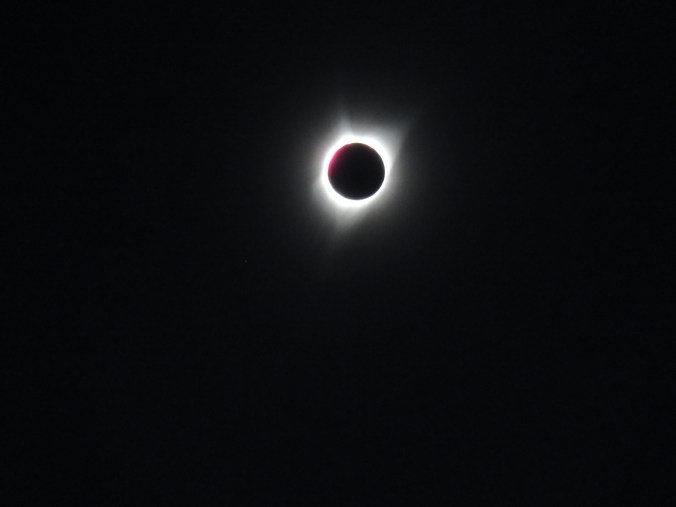
We watched through our glasses and chatted with the Arizona couple. Gary named places the Arizona couple knew, and the bright sunlight dimmed. It was unsettling and amazing. Not only the sky which we watched through glasses till Totality but because there were light waves across the ground both before and after. They shimmered across the pavement, running north to south, like ripples in beach sand before and arrows after. The air chilled and I shivered. That cold was completely unexpected. Five bats flew out in the darkness and then vanished an instant later when the first direct light returned. This photograph was taken during totality, I shot others just as the sun came back and I was not looking. A flash of pink at the upper left edge is what I saw. I have seen that in the photographs of other viewers. Several shots I took during Totality show a white disk. I imagine someone could explain why.
It was still vivid in my memory days later. It is a moment I will remember. Perhaps that is enough to qualify as life-changing. There was the sense of existence beyond what I might have curled my awareness within and believed qualified as daily life.
Another event last summer changed our lives, a far more permanent event. Our dog, Yeti, died on the living room sofa. There had been several back-and-forth visits to the vet. She was unwell and only a few months past the age of twelve. We had always had dogs, since 1993. And cats too. And then last June we had no animal in the house. We are both reluctant to endure the death of another animal. I tell every dog I meet on the beach that he or she is a good dog. They all seem good to me. I think we are both lonesome for another being in our home.
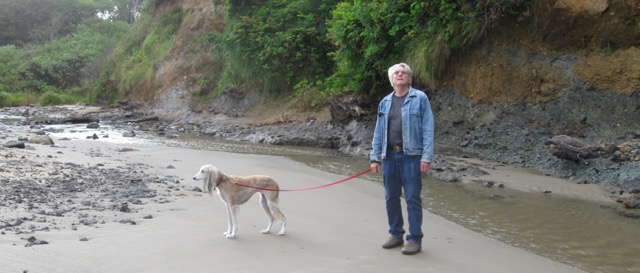
We are each the oldest members of our family. We each have severely mentally ill family members. We walk the beach and collect trash—mostly plastic—most days. The people we greet on the beach are mostly close to our age. We go to bed too early, a habit of old people. We freely admit we are old.
My peculiar owl story is short-listed with a paying magazine. That means they have told me they like it and will perhaps publish it, but they have more stories they like than space for. I have been waiting almost three months for their final decision. It is the third magazine that has short-listed the story and kept it exclusively for months. This has happened before—a story editors like, but then eventually decide against.
In the mean time, I am receiving interest in the novel I first drafted in 2016. I worked so long on it yesterday that I was ready to go to bed by 7. Gary laughed at me since he is usually the one negotiating a bed time. He insisted I stay up till 8:30.
This novel, my fifth—how can that possibly be?—seemed done, but an agent asked me to revisit fifty pages. Those fifty pages led me to more chapters that needed work. And now I am working on the entire manuscript. There were issues in the chronology of the story, serious issue I failed to address until now. Two YA writers looked at earlier drafts with limited success, and an academic I absolutely trust was helpful and encouraging. This month I hope to share the manuscript with three other readers. My timeline, since I can work fast, is not short, but I have a great deal to accomplish.
And in the mean time? In the mean time we have spoken to a realtor about the value of our home. We were honest that we had made no decision to sell, but we are looking at options. Our sons and their families are in Portland. Medical care is not good locally. Most of the homes here are short term rentals—the house to the north, the one to the eats, and the one south is a bed and breakfast.
I wake too early and read too much of the news and fret about my students and what this world is coming to.
And yet, most every day, rain or merely cloudy, when the tide is low, we walk the shore.

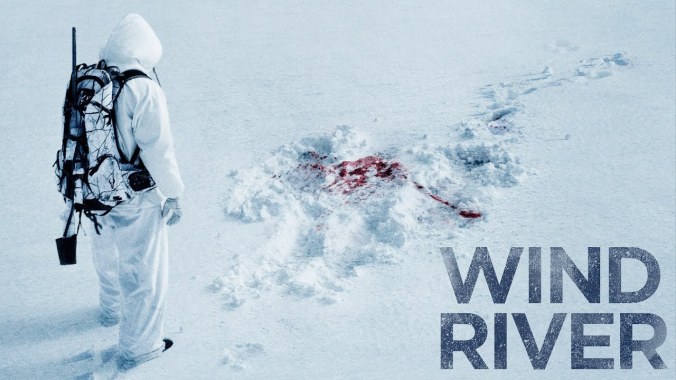
We’ve seen a lot of films this past year, most of the Academy award nominees before Oscar night and others in theaters or on DVD. We didn’t get to everything. We still have not seen the sequel to Bladerunner or the animated features or the documentaries, but these will come to us eventually through Netflix. I mostly agreed with the Oscars, but I was offended by the cartoonish depiction of good and evil in The Shape of Water. It was not by any means a bad film, but I would have chosen any of the other six nominees I had seen for Best Picture.
I might have chosen a film we saw on Netflix only recently, Wind River. The critics liked it and the audience loved it even more. The Rotten Tomatoes consensus declares: “Wind River lures viewers into a character-driven mystery with smart writing, a strong cast, and a skillfully rendered setting that delivers the bitter chill promised by its title.” It begins with a woman running in darkness and snow, then it shifts to daylight and a Fish and Wildlife contract-hunter shooting coyotes. Soon enough that man (Jeremy Renner) is hunting a man who so terrorized a Native woman she ran until her lungs burst. “Figure how far a person could possibly run in these conditions and then double it,” he tells a rookie FBI agent (Elizabeth Olsen). The woman was a warrior, he says. There is respect. There is conflict here between poverty and power, between Whites and Native peoples, between what we want for our children and what they are determined to have for themselves, between hope and mere survival.
I do not understand why that film was not present on Oscar night. But if I were to speculate, if I were to actually research and write about it, I suspect the reasons would have to do with race and class.
There is an opening in the film industry just now, driven by #MeToo and reactions to the well-documented bigotry of the current administration.
This morning, in honor of Women’s Day, The New York Times offers up obituaries for a few overlooked women. Ida B Wells was familiar to me as a historical character in Alice Walker’s short story, “Advancing Luna—And Ida B. Wells” from You Can’t Keep a Good Woman Down.
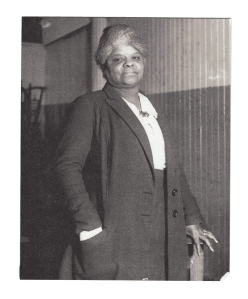
Wells is considered by historians to have been the most famous black woman in the United States during her lifetime, even as she was dogged by prejudice, a disease infecting Americans from coast to coast.
She pioneered reporting techniques that remain central tenets of modern journalism. And as a former slave who stood less than five feet tall, she took on structural racism more than half a century before her strategies were repurposed, often without crediting her, during the 1960s civil rights movement
Henrietta Lacks (1920-1951) was another, though even if the Times had been paying some small attention to people of color and women when she died, she would not have appeared on their pages. Her suffering and the suffering of her family, the ways she was used and abused, her contribution through the cells of her body, were concealed until Skloot’s book, The Immortal Life of Henrietta Lacks, revealed it. The Times article confesses the obvious, that most of their obituaries are of white males. Even in the past two years, only about 2 in 10 obituaries have been of women. They do not offer statistics for people of color, but I think I am safe guessing that representation is not . . . representative of our population.
In the years before I reached college, my teachers assigned dozens of novels and works of nonfiction. Aside from The Diary of Anne Frank, every nonfiction and fiction book was written by a white male. The canon was white and male authors from the US and England. I remain a great fan of Mark Twain, but I saw this bias continue in my college classes. Between terms, I devoted myself to reading works by women, by African Americans, by people throughout the world other than England—all the Others who had been ignored in my education. I went hunting.
As a teacher I offered stories and novels by people of color, by gay and foreign authors, and from the perspective of Indigenous peoples. I taught Things Fall Apart, The Bluest Eye, and stories by Louise Erdrich, Leslie Marmon Silko, and Michael Cunningham. I taught Mountains Beyond Mountains and The House on Mango Street. In electives, I offered The Rite of Passage by Alexie Panshin, a coming-of-age SF classic about a privileged Latina on a future spaceship struggling to understand the Other. I always wished I had been able to create a unit of novels representing poor people around the world. I would have started with Nectar in a Sieve, a 1954 novel by Kamala Markandaya. The goal would be to expose my mostly-white rural students to underrepresented voices from a variety of cultures and periods. The goal was to find humanity on our differences. I wasn’t the only one pursing this goal. The Senior English teacher assigned The Color Purple, which was my older son’s favorite read in high school. But Chris has retired and no one teaches that novel now.
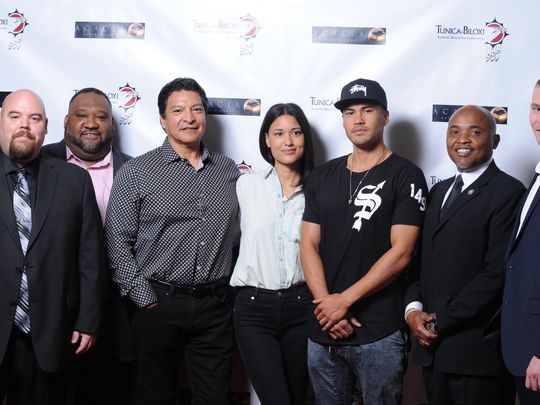
Wind River included a diverse and significant cast beyond Renner and Olsen, including Apesanahkwat, Gil Birmingham, Jon Bernthal, Tantoo Cardinal, Graham Greene, Julia Jones, Kelsey Asbille, Martin Sensmeier and Tokala Clifford. Most of the promotion was of the hunter and FBI agent who joins him, but the story of this story is bigger and more inclusive than it might otherwise seem. “The film is the latest project of Acacia Entertainment, a finance and production company that is a joint venture between the Tunica-Biloxi Tribal Economic Development Corporation, a wholly owned entity of the Tunica-Biloxi Tribe of Louisiana, and Savvy Media Holdings.”

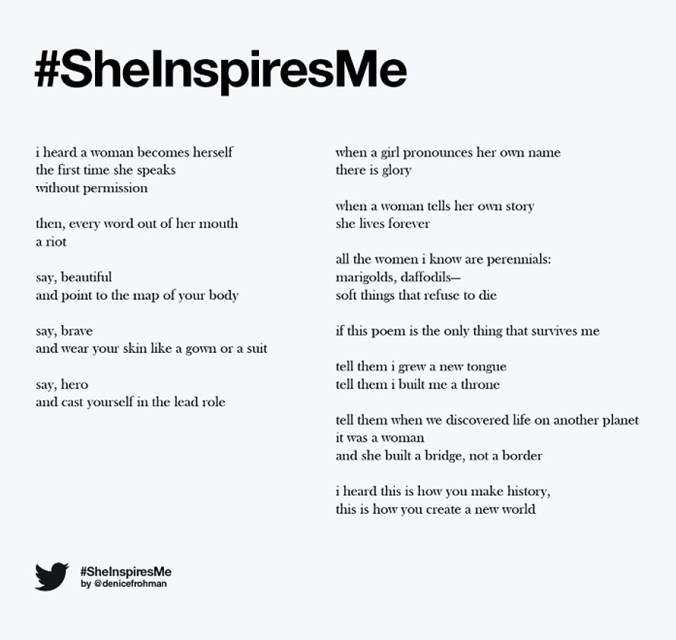
“I heard a woman becomes herself the first time she speaks without permission,” says poet Denice Frohman in the first line of Twitter’s new #HereWeAre campaign, which made its TV debut tonight during ABC’s Oscars telecast. The brilliant video was the best thing on the Oscars. I hope no one minds me linking to it and posting the words.
. . . until, Common (Lonnie Rashid Lynn, Jr.) and Andra Day, backed by a row of activists, sang “Stand Up for Something.” The activists included Alice Brown Otter (Standing Rock Youth Council); Bana Alabed (author and Syrian refugee); Bryan Stevenson (Equal Justice Initiative); Cecile Richards (Planned Parenthood Action Fund); Dolores Huerta (Dolores Huerta Foundation, United Farm Workers of America); Janet Mock (#GirlsLikeUs), José Andrés (ThinkFoodGroup); Nicole Hockley (Sandy Hook Promise); Patrisse Cullors (Black Lives Matter); and Tarana Burke (Me Too).
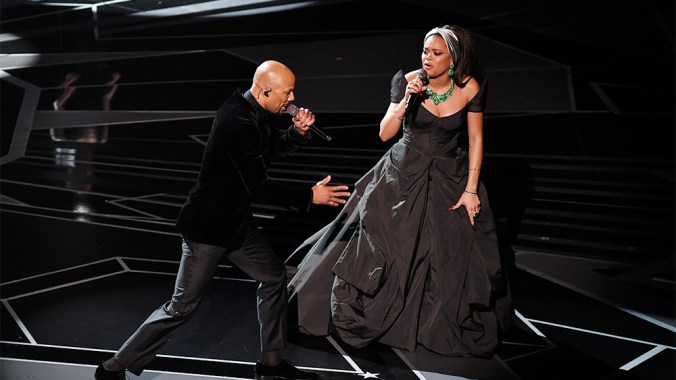
And then . . . she put her Oscar on the floor, patted its head, and she was ready to rock-n-roll.
That las . . . I have watched credits for more than 30 years, looking for women on crew.
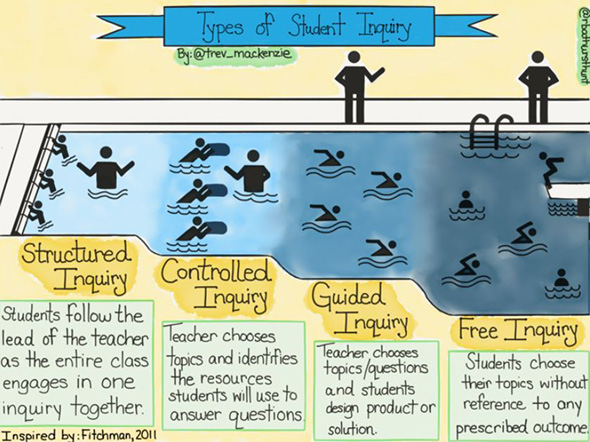
When I teach, I strive to give my students guidance and support as they become independent thinkers and writers.
I am not always successful.
Objective research, evaluating the credibility of sources, and teasing out the truth from propaganda and prejudice—this process is not automatic, but the result of trial and error and direction from family, teachers, and experience. Most people will stick to their bias—to what they believe as if it were truth—regardless of evidence to the contrary, and throughout their lives. Unfortunately, it is the rare individual who reconsiders what they think they know to be true. We look for support of what we already believe, and fail to seek out reality in the face of our own prejudices.
More than two centuries ago, the United States abandoned the notion of inherited privilege, of God choosing who gets to be queen and who gets to slave. Except we did not give it up. We love our princess narratives, our anointed few.
A friend of Trump’s sold stock in a company that was hit hard by the president’s recent announcement that he would implement a 25% tariff on imported steel and 10% on imported aluminum. That would be fine—buying and selling stock is one way to make money without laboring for it—except that the billionaire friend of the president sold a few days before the announcement. Maybe he was tipped off? And that would be breaking the law.
Like his much-promoted tax cuts, the advantage falls to a narrow slice of America:
“The mills and smelters that supply the raw material, and that would directly benefit from the tariffs, have been shrinking for years. Today, those industries employ fewer than 200,000 people. The companies that buy steel and aluminum, to make everything from trucks to chicken coops, employ more than 6.5 million workers, according to [the highly conservative] Heritage Foundation analysis of Commerce Department data.”
Apparently, many more people, more workers, will be hurt by the tariff than helped, and there is no indication that this disproportion has been taken into consideration when the tariff was announced. Workers and stock-owners sometimes have wildly different priorities. It should be easy to see why, especially for those of us who have lived through decades of corporate raiders.
It’s tempting to wonder if, after Trump changes his mind again, some friend of Trump who bought after the promised tariff drove some stock down will sell high after it comes back up. Buy low, sell high. That is the strategy of gambling on the stock market. However, that would rely on Trump actually having a long game, which few believe he has. The man does things without much planning other than benefit to himself.
Some Americans still cling to the fantasy that human problems are mostly self-created, at least when they judge other people. Captured and tortured as a prisoner of war? They prefer the soldier who was not captured. Struggling to pay bills on minimum wage? Workers willing to work hard do better. Your son died in the war? If you’d paid for a doctor to diagnose bone spurs, he would have lived.
Tell Job he must have done something really, really awful for God to visit such suffering upon his head.
Ironically, it is a distinctively American view, a Puritan, social-Darwinist, Power-of-Positive-Thinking fantasy that we are entitled to take whatever we can grab and that people get what they deserve in life. If your life is hard, this prejudice goes, it’s not only your tough luck, it’s no better than you deserve. If you are a billionaire, it’s not the result of luck or dishonest and brutal business tactics, but superior intelligence and better favor in God’s sight. . . . Really?
Many years ago, I showed A Raisin in the Sun to a class of smart 16-year olds. Lorraine Hansberry’s prize-winning play-turned-film concerns a few days in the life of a poor black family living in Chicago. Clearly struggling members of the hard-working poor, that family has ambitions: to live in a house rather than a tenement, to support his family so that his mother need not work, to have a second child, to become a doctor. Late in the film, Walter Lee Younger’s plan to open a business is destroyed when a business partner absconds with his money, money he has been entrusted with by his family. A new home, education, a better future—all their collective opportunity seems to rest in that fund. The women of his family turn on Walter Lee as he falls to his knees in despair. Four boys at the back of my classroom laughed.
I stopped the film.
The boys told me Walter Lee was stupid. He’d made a ridiculous mistake, a mistake they would never make. I took them out into the hall.
Though I did not know these boys all that well, I knew enough to recognize that three of the boys were the sons of thriving local business owners who had worked hard for their success. Their sons assumed that this meant that they, personally, had earned success as well. They assumed because their parents had accomplished so much that their lives would be free of stupid mistakes, that they were smarter and deserved more than Walter Lee. It is the definition of entitlement.
They were given an assignment to write me a brief essay defining “compassion and empathy.” And in the years following, I talked to my classes about making mistakes. If we expect to get through life without doing things we regret, without making stupid mistakes, with damage, we are delusions or doomed to disappointment.
The “best man” does not always win. The best person . . .
Have we not all experienced losing to someone who does not deserve to win? the person who did not study and does not know the material as well as we do but scores better on the test? the person who cuts us off in traffic? who snatches the bargain out from under our reaching hand? Have we always received what we deserved? Haven’t we eve, sometimes, done better that we deserved?
Success comes as the result of hard work and as a result of the luck of birth. It comes to people with enormous vision and creativity. It comes to people who are morally corrupt and willing to do anything to get ahead.
Riches come to those who deserve them, and as often they come to those who do not.
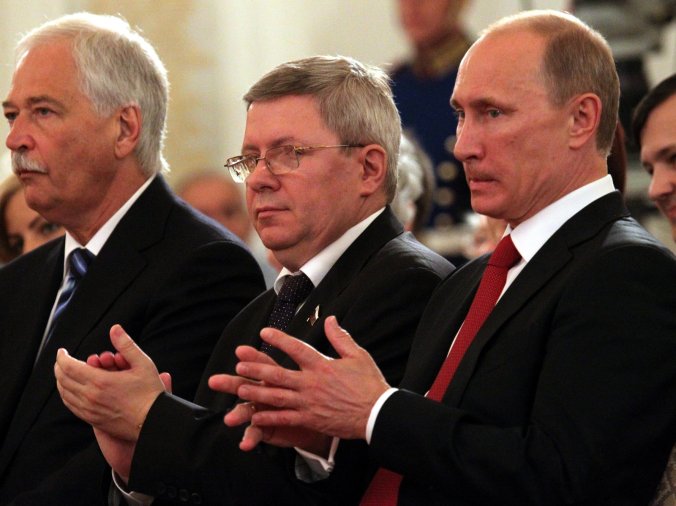
Russian politician Alexander Torshin, standing next to then-Russian prime minister Vladimir Putin, attends a ceremony at the Kremlin in 2011. Torshin is a lifetime member of the National Rifle Association, and says he met Donald Trump through the group in 2015.—NPR
I intended to post about our walk this morning. My husband likes to say it’s hard to get me out, but once I am on the beach it’s even harder to get me to come back in. Today I found two pieces of sea glass and a handful of agates and interesting crystals and pebbles. Once a year or so a wave catches me. Today was one of those days. I was focused on finding agates and glass, I failed to see the huge sneaker wave, and though my husband shouted, I didn’t move quickly enough to avoid getting my feet soaked.
That was supposed to be my topic as a reward for scoring the last of a set of essays this morning.
And then I read about Russian ties to the NRA. The student essays will have to wait. It seems Russian agents have infiltrated the National Rifle Association. “National” as in the United States of America. My nation.
Rumors of Trump’s connections to Putin came out a while ago, a potential fire that Trump fanned by repeatedly expressing admiration for the despot (more than 80 times). There was talk of Putin “having something on Trump”—porn or sex scandal—but I didn’t believe that. I didn’t even believe it when Trump was revealed on camera boasting of sexually molesting women. Trump has never seemed to me to be any sort of “sport” person. Not even the sort the rumors were about. It isn’t that I think Trump is too smart to do such a thing, but Putin is that smart. Trump continually does stupid things—and a lot of people fail to object. Nevertheless, it all sounded too conspiratorial and I am so very weary of conspiracies.
Trump tends to lash out at people, especially people threatening his superiority. Trump always wants to be bigger and better. He must be bigger and better. For example:
“North Korean Leader Kim Jong Un just stated that the ‘Nuclear Button is on his desk at all times,’” Trump tweeted two days after Un made the menacing statement about the nukes.
“Will someone from his depleted and food starved regime please inform him that I too have a Nuclear Button, but it is a much bigger & more powerful one than his, and my Button works!”
And then just the other day, Putin broadcasted his own weapons boast:
A cruise missile, powered by nuclear technology, that can reach the United States. Nuclear weapons that can evade any missile defense system. Unstoppable drone submarines that can be used to blow up foreign ports.
Those are the weapons Russian President Vladimir Putin claims he now has. If true, Putin has purposefully raised the stakes in the decades-long nuclear standoff between Washington and Moscow — threatening to worsen deteriorating ties between Russia and the West.
Putin spent much of his annual state of the nation speech on Thursday talking about Russia’s improving weapons arsenal. He even went so far as to show a video of nuclear missiles striking Florida.—Vox
And Trump promptly responded . . . with silence. Sad or scary?
Many people expected Trump to fire off a volley of Mine’s-Bigger-than-Yours tweets. Most people around the world expected Trump to express some objection to what sounds like dangerous boasting. There would be reasons to hold back, but holding back isn’t Trump’s style. So now I believe the rumors of ties between Trump himself and Putin. The Russian leader has some hold over Trump. I don’t think it’s sex, but money? Yes, money seems likely. It is the only thing Trump genuinely cares for.
Trump has said “trade wars are good and easy to win.” I wonder what he would know about winning a trade war, this born-wealthy real estate developer and self-promoter? And “good” for whom, I wonder? Probably not me or mine. Good for some investors, perhaps? Not me. Trump is so goodly he would run into a trade war unarmed.
And then this morning, that woman in a Thai jail who says she has videos . . .
So now, while the sneaker rushes up behind America’s back, isn’t anyone going to shout a warning?

