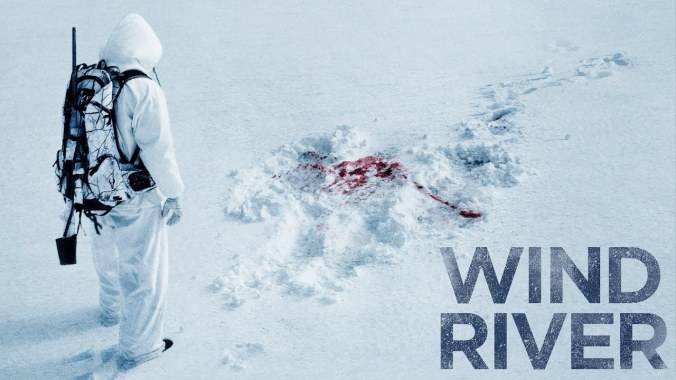
We’ve seen a lot of films this past year, most of the Academy award nominees before Oscar night and others in theaters or on DVD. We didn’t get to everything. We still have not seen the sequel to Bladerunner or the animated features or the documentaries, but these will come to us eventually through Netflix. I mostly agreed with the Oscars, but I was offended by the cartoonish depiction of good and evil in The Shape of Water. It was not by any means a bad film, but I would have chosen any of the other six nominees I had seen for Best Picture.
I might have chosen a film we saw on Netflix only recently, Wind River. The critics liked it and the audience loved it even more. The Rotten Tomatoes consensus declares: “Wind River lures viewers into a character-driven mystery with smart writing, a strong cast, and a skillfully rendered setting that delivers the bitter chill promised by its title.” It begins with a woman running in darkness and snow, then it shifts to daylight and a Fish and Wildlife contract-hunter shooting coyotes. Soon enough that man (Jeremy Renner) is hunting a man who so terrorized a Native woman she ran until her lungs burst. “Figure how far a person could possibly run in these conditions and then double it,” he tells a rookie FBI agent (Elizabeth Olsen). The woman was a warrior, he says. There is respect. There is conflict here between poverty and power, between Whites and Native peoples, between what we want for our children and what they are determined to have for themselves, between hope and mere survival.
I do not understand why that film was not present on Oscar night. But if I were to speculate, if I were to actually research and write about it, I suspect the reasons would have to do with race and class.
There is an opening in the film industry just now, driven by #MeToo and reactions to the well-documented bigotry of the current administration.
This morning, in honor of Women’s Day, The New York Times offers up obituaries for a few overlooked women. Ida B Wells was familiar to me as a historical character in Alice Walker’s short story, “Advancing Luna—And Ida B. Wells” from You Can’t Keep a Good Woman Down.
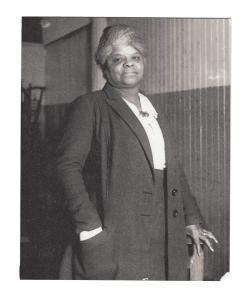
Wells is considered by historians to have been the most famous black woman in the United States during her lifetime, even as she was dogged by prejudice, a disease infecting Americans from coast to coast.
She pioneered reporting techniques that remain central tenets of modern journalism. And as a former slave who stood less than five feet tall, she took on structural racism more than half a century before her strategies were repurposed, often without crediting her, during the 1960s civil rights movement
Henrietta Lacks (1920-1951) was another, though even if the Times had been paying some small attention to people of color and women when she died, she would not have appeared on their pages. Her suffering and the suffering of her family, the ways she was used and abused, her contribution through the cells of her body, were concealed until Skloot’s book, The Immortal Life of Henrietta Lacks, revealed it. The Times article confesses the obvious, that most of their obituaries are of white males. Even in the past two years, only about 2 in 10 obituaries have been of women. They do not offer statistics for people of color, but I think I am safe guessing that representation is not . . . representative of our population.
In the years before I reached college, my teachers assigned dozens of novels and works of nonfiction. Aside from The Diary of Anne Frank, every nonfiction and fiction book was written by a white male. The canon was white and male authors from the US and England. I remain a great fan of Mark Twain, but I saw this bias continue in my college classes. Between terms, I devoted myself to reading works by women, by African Americans, by people throughout the world other than England—all the Others who had been ignored in my education. I went hunting.
As a teacher I offered stories and novels by people of color, by gay and foreign authors, and from the perspective of Indigenous peoples. I taught Things Fall Apart, The Bluest Eye, and stories by Louise Erdrich, Leslie Marmon Silko, and Michael Cunningham. I taught Mountains Beyond Mountains and The House on Mango Street. In electives, I offered The Rite of Passage by Alexie Panshin, a coming-of-age SF classic about a privileged Latina on a future spaceship struggling to understand the Other. I always wished I had been able to create a unit of novels representing poor people around the world. I would have started with Nectar in a Sieve, a 1954 novel by Kamala Markandaya. The goal would be to expose my mostly-white rural students to underrepresented voices from a variety of cultures and periods. The goal was to find humanity on our differences. I wasn’t the only one pursing this goal. The Senior English teacher assigned The Color Purple, which was my older son’s favorite read in high school. But Chris has retired and no one teaches that novel now.
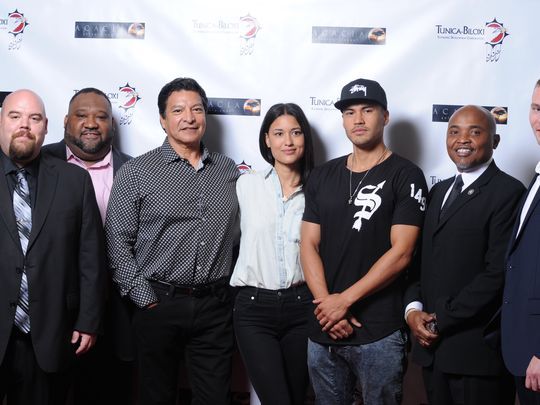
Wind River included a diverse and significant cast beyond Renner and Olsen, including Apesanahkwat, Gil Birmingham, Jon Bernthal, Tantoo Cardinal, Graham Greene, Julia Jones, Kelsey Asbille, Martin Sensmeier and Tokala Clifford. Most of the promotion was of the hunter and FBI agent who joins him, but the story of this story is bigger and more inclusive than it might otherwise seem. “The film is the latest project of Acacia Entertainment, a finance and production company that is a joint venture between the Tunica-Biloxi Tribal Economic Development Corporation, a wholly owned entity of the Tunica-Biloxi Tribe of Louisiana, and Savvy Media Holdings.”
 IMPERFECT PATIENCE