MEAN GREENIES

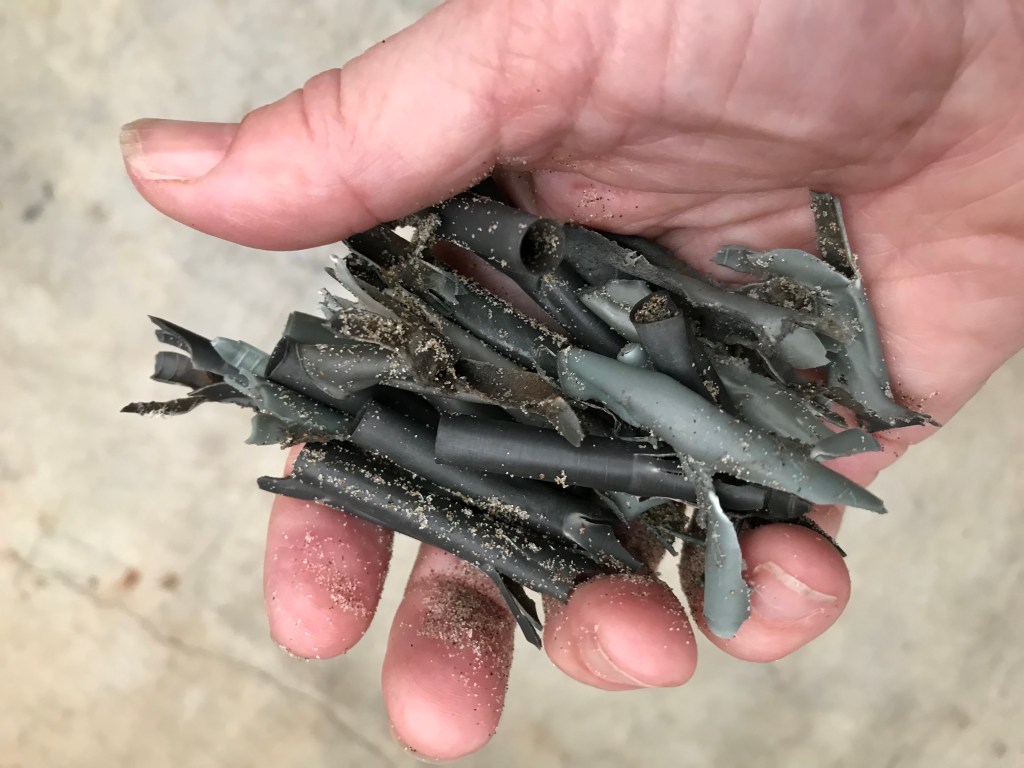
Yeti, our last dog’s favorite treat was a Greenie, a green starchy chewable bone-shaped object she could chew into bits and swallow in a minute of two. Green meanies are something else and they hurt my hand to hold, as I am in this photo. I wish people would pick them up so I didn’t have to.

I call them “green meanies” because I stepped on one once barefoot. Though I didn’t bleed, it was painful. They are the remains of fireworks of some kind and difficult to spot amongst bits of seaweed on the tideline. I search for them every day, plucked a couple dozen from the sand this morning, and I will still be finding them in January.
Continue reading

BUSY DAYS

June is ridiculously busy, which is not something I can say about most months. Most months my busy is entirely self-inflicted. I read, sew, knit, run, post online. Scrub floors. Gary and I drive to Portland and home from Portland, we walk across the city or walk five miles north on the beach. [We did this recently. Once. Ten miles round trip. Probably not again.]

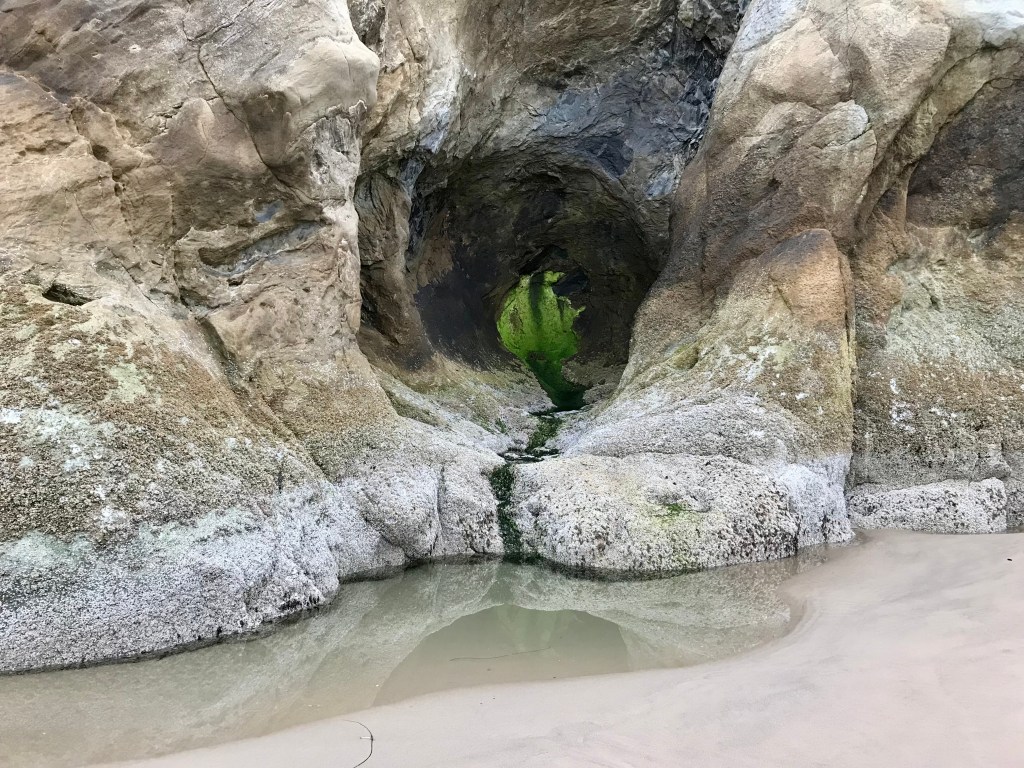
This is the hollow in sandstone facing the ocean that I call “The Little Altar.” Usually by this time of year there is a circle of green algae on the back. This year, there are three green penguins. Can you see them? Two looking south, a youngster flapping and pointed north? (And yes, there is a Big Altar a few feet north. No penguins.)
Continue reading

CAT POPULATION

I was reading an upbeat story about a species of dove native to a Pacific island that had become extinct in the wild since 1972 due to human activity and human-introduced species. Cats are often cited as the cause of the birds’ extinction, but the real damage to the birds’ survival had been domestic sheep that destroyed their habitat, explained a scientist with Mexico’s Institute of Ecology who is leading habitat restoration efforts on the island. The cats merely finished off an already decimated population. What is missing may be another cause, too often ignored: human-introduced rats.

“I hear you have an opening?” Leakey invited herself into our home a couple of weeks after Zora Neale Hurston Cougar Cat, “Zora,” died at age 19. It was January and we learned that Leakey with two other cats had been dumped the previous late summer. There had been sitings, but the cats were shy. My theory was that the cats had managed well enough, feasting on wild rodents until winter when the chipmunks were estivating. By the time she showed up at our door, Leakey was starving, weighing less than half what she should. She quickly put on weight with us, but never lost the habit of hunting. Leakey had a small meow and a loud purr and developed a love/hate relationship with our Saluki, Yeti. She was gentle and sweet-tempered but also had the longest and sharpest claws I have ever seen on a domestic cat. Rodents were her prey of choice and like Zora before her, she often ate her catch, but not the rats laid out for Gary to dispose of. [I did try to coax the other abandoned cats to join the family, but no. Only Leakey.]
Continue reading

BABY SAND DOLLARS

Coming back from my run on this morning, I saw a crow standing well out on the shore in about an inch of water. I gave the bird a bad time about that. “What are you doing out there? That’s not your place. You don’t belong there.” The crow was indifferent to my chiding, but I went on a bit more. “Get in here!” Then the crow turned her head and I saw her red beak and realized she was a black oystercatcher. I had to apologize.

I arranged my finds on the railing of what we call “The Cat Deck” though we no longer have a cat. Most of what I found this morning plus four spices of limpet, scallops of two kinds, a round button of rust (iron, rusted clear through), “Ugly clams,” and the back shells and one head shell of chitons that we call “butterflies.”

.

Continue reading

SAFETY

The white lacecap hydrangea, above, was near where we entered the south end of massive Forest Park in Portland (more than 5,100 acres). The Rose Garden is within Forest Park and the extensive Japanese Garden, the zoo, second growth and old growth forest trees, and more than 80 miles of trails. A former coastal neighbor has a bronze plaque in the Rose Garden. Sometimes I run up to the roses—a hard uphill route, run loops up and down through the garden past thousands. of roses.

It’s May Day. I hope you find an opportunity to walk near a garden, into a garden, a place a little bit untamed, wild, and a place to find a quiet place to feel safe.

When I was a teenager, I used to sneak out of the house at night. I suppose a lot of teens did that back in the day. Maybe some still do. I didn’t sneak out to be with a boyfriend or any friend. I didn’t go to parties or score drugs. I walked to be alone and think. I went walking in the dark entirely by myself because I was miserable most of my high school years and walking in the dark was a comfort. I’d walk a few miles on the gravel shoulders of suburban roads and go home to bed.

Continue reading

LET THE BUCKET GO

This is not my day to post, but today, just now, a frighting event.

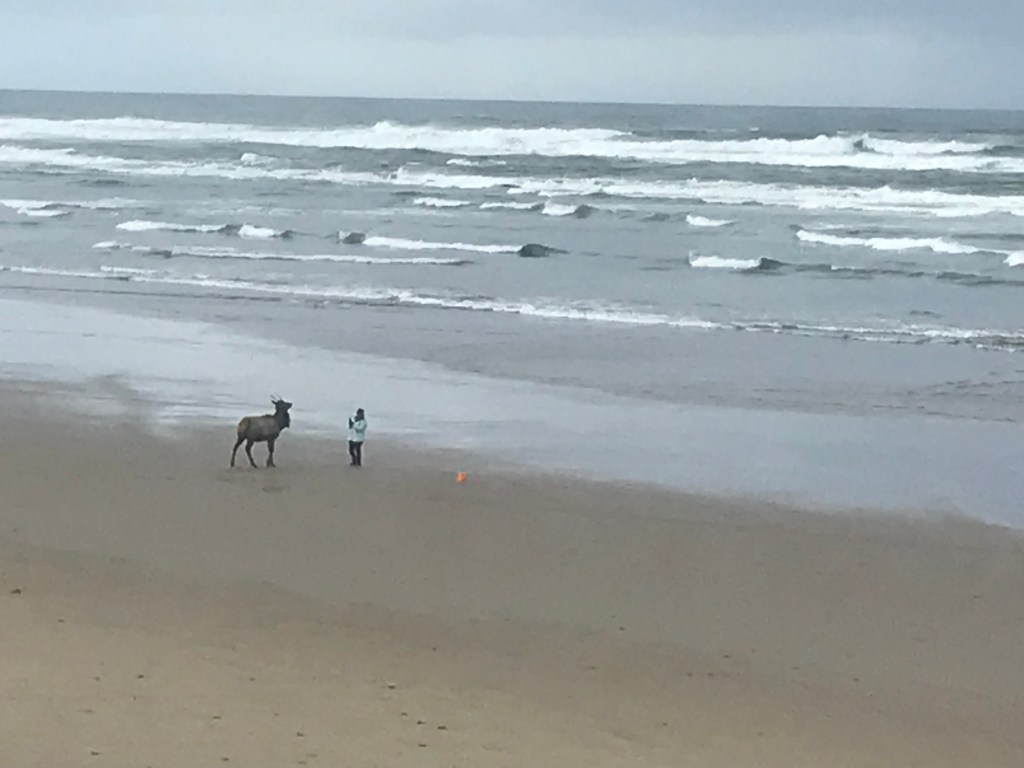
That is a young bull Roosevelt elk on the sand, what is called locally a spike because he has his first antlers. The orange object to person’s left (your right) is a bucket belonging to the woman. The elk is interested in that bucket. Whether she was aware of it or not, she challenged that elk. The person is texting and taking photos. Do I need to explain that getting this close to an elk, even one that is on the low end of 700 to 1100 pounds, is what we would call “dangerous.” Stupid comes to mind.
Continue reading

HOLIDAY

Like last week, this post is late. I mean to write early, but it’s been a week of strong wind, heavy rain, an 18-hour power outage, some baking and planning and writing, and exhausting work on our rental. A friend sent me notes on the novella version of my book and I began a new draft. Good stuff. It sounds like I’m complaining, but I have no business doing that.

This morning the shore is littered with spruce and fir needles, branches, yard debris, and at least two Adirondack chairs, one red, one green, broken into sticks. We brought home a big bag of litter. We started out thinking we’d walk north for at least a mile, but at the first seasonal creek had to wait out a wave. The tide was coming in and we decided we might find ourselves caught between beach access paths by a sneaker, so we turned south. We didn’t get rained on, but you can see the next squat coming from the southwest in the photo.
Continue reading

BIRDS and MEN

As I began writing this on Wednesday, I was reading Helen Whybrow’s memoir, The Salt Stones, which focuses on her family, her ninety-some Icelandic sheep, and how as a pastoralist she lives within the rhythm of her animals, the trees and grasses, blueberries and shrubs, the soil microbes and those in our gut, and all that lives in and on, over and above that soil and makes of her two hundred acres a thriving ecosystem. Her husband is kind, her step-daughter has gone off to live her life, and soon her daughter will follow. Her mother has Alzheimer’s and doesn’t always know her daughter, but is the same kindly person for all that. I read the final chapter yesterday. I felt grateful for the beauty she shares.

On our beach walk, we found bits of litter on the sand and tangled in the rocks, enough to half fill our trash bag. Mostly this was bits of plastic and plastic foam smaller than my thumbnail, but also a comb, a sturdy mesh bait bag, several lengths of reusable plastic twine. We admired the local bald eagles scavenging onshore. This photo taken at a distance—the bird flew as a wave washed in.
Continue reading

WHAT I KNOW

The storms come, no stopping them. They also pass.

The wind had been blowing since midnight, and the rain coming hard not down but sideways, off and on. Mostly on. I could see the ocean waves blowing back over themselves and sea and sky are both soft grays with a hint of green in the surf. Two and a half hours till high tide, but all the sand wet from the rain, and we did not get our morning walk. We got out the door for our three miles and had to turn straight back. We don’t mind a light shower, but this was a serious weather front. Storminess predicted to last without a break until Friday, which is not at all unusual for November. I used to count on a solid week of rain in this month—all day and all night without a break. But recently all bets are off. (The days in January of warm east winds and a burst of termites and carpenter ants drowned in the surf has not been predictable for years.) We average about 90” of rain a year—sometimes a mist or drizzle, in a storm sideways like a firehose, not usually coming “down,” and a hundred and fifty inches of rainfall isn’t unheard of. People new to the area are unprepared, friends naively suggest rain gear to walk the sand. Weather reporters in NW cities are alarmed by 45 mph gusts; we are accustomed to 65 mph. There is no rain gear that will keep you dry and safe in a full gale. Stay indoors!

Despite the foam, the ocean looks more tame in this photo compared to earlier in the week. The surf grew and after the rain splattered the glass, an updated photo was impossible.
Continue reading

ALL HALLOW

It’s the end of the month I turned 73, and we were busy with cleaning and walking; I’m running a mile at a time on the flat and writing and reading. There’s more. The basalt shore is stirred up along the edges and we’re finding things.

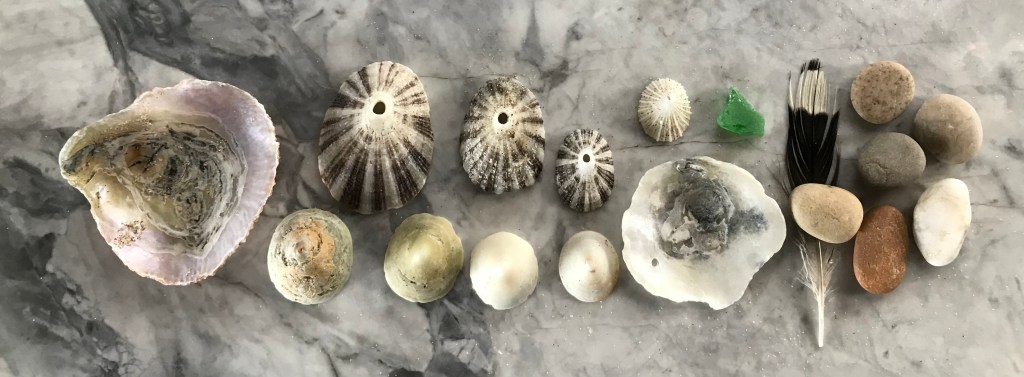
I think about and intend to show a day’s collection during every walk, day after day. Here, finally, is one day’s “catch.” At left a very large “ugly clam” that looks like nothing special on the other side, but the inside is beautiful mother-of-pearl nacre. Then three striped limpets, the most common kind, and four white ones with the one at left showing damage from worms and the one at right nearly perfect. Just left of that and above another ugly clam is my favorite and rarest type of limpets with vertical grooves and a hole shaped like a droplet, pointed at one end and rounded at the other. The green seaglass is the second glass this week, what I’d call “medium size,” and that find is recorded in my daily record as “1glass” and will join other glass in a glass jar. Recent tides have been washing up into the rocks and exposing treasures and trash buried the basalt, including several bits of pumice from the blowing of Mt St Helens in 1980 in the past week but none this day. The feather is what I call a “two-spot feather” which may have a single spot across the central vein, one spot on one side, or a distinct spot on each side, hence the name. If anyone can help identify the species of bird that molts these feathers, I would love to hear about it!
Continue reading