An imperturbable demeanor comes from perfect patience. Quiet minds cannot be perplexed or frightened, but go on in fortune and misfortune at their own private pace like a clock during a thunderstorm.—Robert Louis Stevenson
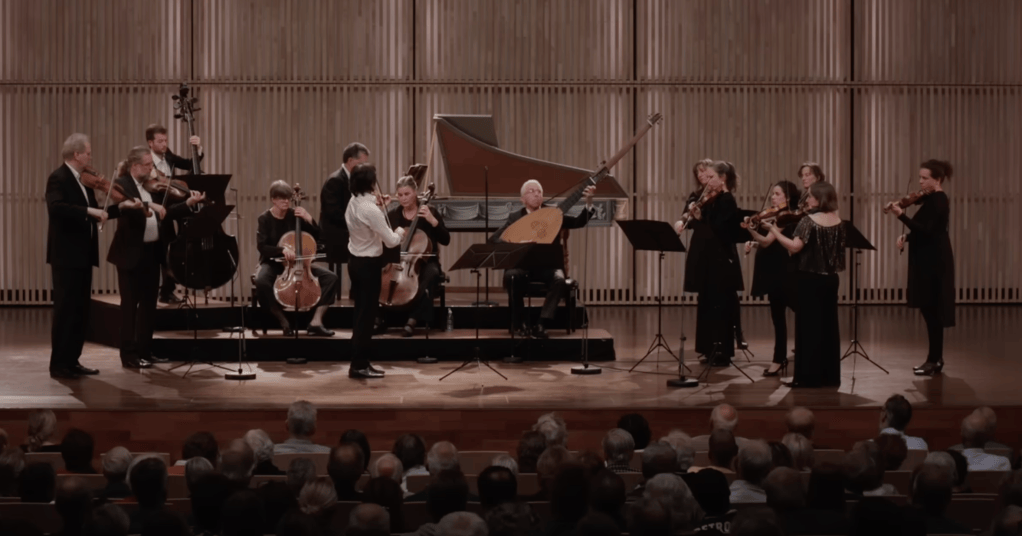
Vivaldi – Summer from The Four Seasons | Netherlands Bach Society. These are the original instruments that would have been used in Vivaldi’s time. No director; the soloist, Shunske Sato, is the director. The entire sound is far more startling—a shocking break in weather! You can hear it HERE: https://www.youtube.com/watch?v=q8TFQFQeL0o
In my teens, I attended a lot of concerts. Janis Joplin, Grace Slick, The Beatles, Country Joe and the Fish, the Kinks, the Birds, Ravi Shankar, Donovan, Simon and Garfunkel (acoustic at the HecEd), Moody Blues, then Laura Nyro and my favorite Joni Mitchell. I’d had guitar lessons from Candy Mack and played a number of folk tunes from The Joan Baez Songbook. Then college.
A couple of weeks ago, I watched a reel from “Toby-the-Neuro-Scientist” about maybe not quite failing his A-levels. He failed to achieve a score that would get him into the University program he wanted. So he worked for a year waiting table and pissed that away on clothes and drinking, but got serious about maths and got into uni, but his first year was “rubbish,” and then tried to be better the second year and was hit by a car. His third year was Covid so he graduated “alone in [his] bedroom.” He took a year off waiting table again and entered a dementia program to graduate the top of his class, researched Parkinson’s disease for two years. Ten years after those disastrous A-levels, he has his PhD from a prestigious university. Who woulda thunk it?
On beach runs, I cannot resist the amber agate, striped limpet, or rare bit of glass. I circle, bend to pluck them from the ground, and bring them home. I pile stones on the coffee table, line limpets on the kitchen counter, and upstairs too, beside the sink and on either side of my computer—the irregular translucent quartz and smooth flat ovals of jasper and agate. The baby sand dollars. Eventually, they find their place in bowls and jars. A couple of decades ago I collected more than a dozen Coach bags by bidding on Ebay. I carry a flat red bag on weekends. I pack another large bag for overnights. But there is also the brown bag I bought for my first teaching job. The rest were pointless accumulation. My mother would have understood.
Do you see the eagle at the headland a mile and some north of our home? She used to rest in a snag, but lately she’s chosen a higher perch.Continue reading →
The white lacecap hydrangea, above, was near where we entered the south end of massive Forest Park in Portland (more than 5,100 acres). The Rose Garden is within Forest Park and the extensive Japanese Garden, the zoo, second growth and old growth forest trees, and more than 80 miles of trails. A former coastal neighbor has a bronze plaque in the Rose Garden. Sometimes I run up to the roses—a hard uphill route, run loops up and down through the garden past thousands. of roses.
It’s May Day. I hope you find an opportunity to walk near a garden, into a garden, a place a little bit untamed, wild, and a place to find a quiet place to feel safe.
When I was a teenager, I used to sneak out of the house at night. I suppose a lot of teens did that back in the day. Maybe some still do. I didn’t sneak out to be with a boyfriend or any friend. I didn’t go to parties or score drugs. I walked to be alone and think. I went walking in the dark entirely by myself because I was miserable most of my high school years and walking in the dark was a comfort. I’d walk a few miles on the gravel shoulders of suburban roads and go home to bed.
I love a stormy sky, and I surely got wet on the day I took this photo. We often are rained on during our walks. I know what it feels like to have gloves and rain gear soaked through, to feel my fingers stiffen. It’s why I understand the bits of rope we find onshore, usually with a knot, often only a knot cut from a working line. The man who cut that plastic twine or rope (maybe the woman) could barely feel their fingers. There was no chance of untying the knot. It drifts in the salt water until it’s cast onshore, and my husband and I gather it and toss it along with other bits of plastic and foam—all the pounds of litter we gather from the shore.Continue reading →
If you’ve been reading my blog or my Facebook page, you might know that we have been restoring our rental, a duplex attached to our home. It’s just off the beach at the end of a dead end street, and the only long-term rental that I know of locally.
Just now we’ve been at work on the downstairs unit. Renting long term makes it possible for us to afford to care for the property and pay taxes. It’s why my grandfather first constructed the building in the mid-1930s. My family had a summer house then, dating back to 1911. We’d hoped to replace our dysfunctional garage door this year and take a few days on a vacation, but life had other plans.
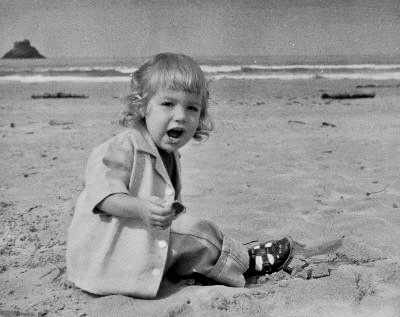
This is probably 1954 before my brother was born, and Castle Rock behind me is 0.6 nautical miles offshore. My mother spent all her summers here and my grandfather retired here in the 1940s. Some of my earliest memories are from this place and Gary and I have lived here full time since 1979.
THE MARTIAN (2015) is one of my favorite movies. Even though it’s romantic nonsense, even though, even though I barely care about a space program, even though Matt Damon. As I write, it’s playing on Netflix, and at this moment I am playing hooky from cutting and sewing my quilt border in order to focus on the ending. Every time his character Mark Watney follows the science, every time he goes to the numbers, I want to cheer and laugh. That determination to find a solution in listing what he has available to work with, to calculate how long till this or that runs out, and every time he recognizes an opportunity, my heart sings. Mark Watney, Space Pirate. “Everywhere I go, I’m the first.”
They are always bright and silvery, brighter than shows in this photo, even though “the little silver fish” are dead when we find them on the sand. Maybe this is a tiny bit of a missed pelican meal. There were still six pelicans fishing offshore that day.Continue reading →
I was already intimate with self-doubt by the time I read about the “impostor syndrome” where people (most often women) believe that they are not all that, the success and admiration—whatever that might be—they enjoy is because they have fooled others into believing in them. Men often over-estimate their appeal, their skill, their accomplishments, and their abilities. Women tend to underestimate themselves.
Yeah, I get that.
My own self-regard tends to fluctuate. It’s low at the moment.
A recent writing workshop raised the common wish to be popular. I don’t recall ever aspiring so high. I wanted to have a “best friend.” Of course I was jealous of kids who were popular—they had so many people to call friends, multiple people who would rather spend time with them. I wanted one.
Briefly, over the summer before 3rd grade I had two friends: Stefanie and Denise. Our mothers made us matching dresses for the first day of school. On that day, I discovered I was in Miss Wara’s room and my friends had been placed together in the other 3rd grade classroom. [I would discover decades later that my sense that Miss Wara disliked me was not entirely my imagination, which I believed at the time. My mother mentioned casually that parents had multiple conferences with her because they recognized the teacher disliked me.] It was a hard year for other reasons. The boy I had a crush on ridiculed me in front of the class and my friend Don punched me in the stomach, though I’d probably done something to deserve that. In 4th grade we began SRA (a timed reading program), which I loved and it was the year my dad began reteaching history to me, which was a good thing. In 5th grade, we were introduced to a brand new (to the US) system of numbers with rods of different lengths. I loved that too, but as I remember it, I wet my pants nearly every day that year. Sixth grade was wonderful. Mr. Finley taught us math and science and the other fifth grade teacher taught us history and English. I learned to do math in base 5, began pre-algebra, and devised an experiment to determine whether white cloud mountain fish could distinguish colors. [Probably not.] In 7th grade at Cordell Hull Junior High School, I had art every day, which was wonderful. The reading teacher needed a note before I was allowed to read The Once and Future King by T.H. White, because the copy I had was a paperback and she assumed all paperbacks were trashy books. I had the highest grades in class, which surprised everyone, including me when it was announced in Homeroom. We read Johnny Tremain, and I wrote the only piece of fiction before the age of 38 in that class. It was about Marie Antoinette struggling to face her coming execution. Denise and I were friends. But in 8th grade, Denise announced that she couldn’t afford to be seen talking to me anymore at school. Toni Burton moved into the district and became and remains a friend. I was part of a clique that year, the only period of my life where I had multiple good friends as a group. [In EdPsych I learned that cliquishness is typical of that age. “They should all be sent to an island until they become 9th graders,” was what the prof told us.]
In high school I mostly lost sight of Toni but was close to Rin. After high school, I drifted away from both of them, but made friends through the School of Art at the University of Washington. Sam Scott and Linda Beaumont in Fire Arts and Pamela Harlow and Kris Williams in the Metals wing. I reconnected with Madora Lawson whom I’d always admired from my Honors World History class in high school. She was doing Interior Design. Gary performed the legal wedding between Madora and Steve the night before the public one. I was a bridesmaid.
In the mean time, beginning the summer before my high school senior year, I met Gary in 1969 and found the one best friend who has lasted throughout all the years since.
I may be repeating myself here. I found this essay on my computer, and it’s mostly about my novel, which I’ve been writing about too often and will remain my obsession until I start another one. I’ve finished three book reviews and two short stories recently, found a draft of one that is a long way from being finished but I’m working on it, and two collections of short stories that I might send out. And the novel.
For the first couple of years she lived with us, our dog Yeti, a Saluki, never barked. And then one predawn, she “boofed.” She was standing on her personal oversized ottoman at the front window looking down at the garden. Outside the gate, a coyote was looking up at her. Since then we know the coyotes are around, but they are generally hidden. We recognize their footprints in the sand. [Larger and light and the toenails rarely make marks.] We saw her [the coyote in the photo] on our walk. Our friend said, “Whose dog is that?” No dog. Continue reading →
You write. You submit. You wait. You are rejected.
Only that first verb matters. Remember that. Keep going.
You write. You submit. You wait for rejection. It is tempting to believe in failure, that rejection is deserved, that it is right.
Every creative person knows this process of making and reworking and finishing, and then sharing and waiting and hoping for appreciation. We all know disappointment. Those of us in MFA programs, those sitting alone behind a desk, with a notebook on our lap, everyone with a dream of finding an audience, even those with an audience waiting and eager to read our words. We focus on we have to share, bring on every skill we have practiced, but fear our audience will not remain seated. Even our mother will lose interest.
We envy people who never doubt. We doubt.
It is tempting to believe that others never doubt themselves, that someone somewhere is writing better stories and essays and poetry, that readers respond with the same passion that writer felt while writing, that their work is snapped right up. And maybe you’ve had work that was snapped right up. Maybe you have published poetry or fiction or essays that someone somewhere told you they loved. Maybe they even told you why. Or maybe they never did. Not once.
Either way, you doubt. You write. You submit. You wait. You are rejected. Each time you start over. You want to believe others are not good enough, but you are perfect, and then hubris drops its calling card and you know you are lost. Envy scars your work, plants its ugly face between you and what you love.
It is tempting to believe that maybe this rejection is all you have, that the essay or memoir or poem or story you wrote isn’t good enough. You should revise it, set it aside for a time and revisit it, rearrange the paragraphs or stanzas, make a stronger opening, invent a new word, wrap your thoughts in metaphor or scene, reconsider what you think you are writing about. Maybe you thought this piece was about love and really it’s about hope or loss or—heaven help you—giving up.
It is tempting to give up.
You write about giving up. You write until you find the next story or scene, the new essay or poem. You find a line or a single word. And then you fall right back into writing. Hours go by, and you laugh at the memory, the paradox, the irony written before you, the odd turn of phrase, the way a character or idea does something you hadn’t expected. You might cry when you find your own blood staining the page, or laugh all over again from pure glory. You polish the line until you realize it is too shiny and you must allow the next line to shine brighter. Hotter. You might stay up too late, revise those lines a hundred times, stir that emotional pot while it boils. You might get burned, but even the rising steam belongs to you. You work with sound until the words reveal what you knew all along. You have something to say.
You glow with effort and accomplishment. You said it, you wrote it, you made it clear on the page. Hold on to this. You hold on.
You write. You submit. You wait. You are rejected.
Repeat. Repeat. Repeat.
The response you are waiting for does not arrive.
It is tempting to believe you are wasting your time and your energy and your very heart on an endeavor that you were never meant to pursue. You want to believe that someone somewhere needs your words. You fear you are wrong. It is tempting to believe you will never write better than this. Maybe, you think, I should stop. You are not good enough. Maybe it is a delusion to trust your words matter to anyone anywhere. Maybe it was never important, what you write and try so earnestly to share. You do not have it, whatever it is that is found wanting.
You want it.
It is tempting to decide that laughter —yours—and tears—yours—are small things. They’re not. It is tempting to dismiss your accomplishment. It towers over your head, this dismissal. It is a momentous thing like sliding off a mountain peak. When you found the right word, the right sound, the piece that finally fits—there is triumph in that instant before you begin to doubt.
Remember. You have struggled. You have discovered. You have created a new thing entirely your own.
Remember the process, the laughter and tears and precision. Maybe you forgot that it was the writing you loved best of all. Maybe you forgot why it matters most of all.
You wrote this. It is yours. It is important to you.
Remember that precious verb: write. Set aside submitting, waiting, rejection. Maybe those next three verbs give you nothing good, only judgment and disappointment. You are better than that.
Only that first word is good for us. We deserve to write. We need to have the last word about the value of our work.




 IMPERFECT PATIENCE