THROW A SHRIMP ON THE BARBIE

I can’t be the only one sick of hearing about Barbie. I could write about my Barbie doll—the original gifted by my mother; I do not remember asking for one—and how much I disliked her hair and makeup. Instead: weather, birds, writing, and a mountain lion.

It’s been hot in Portland, cool on the coast. The house south of us at the coast sold for 3.3 million and the new owners seem nice. They are the first to actually put a car in the garage in at least twenty years!

In Portland, the new couple on our floor are nice, too. Gary took over from a real estate agent when they were viewing the unit, pitched it hard, and is pleased he made that sale! [No commission.]

We go out for our walks before the sun rises very high because it’s cooler and we are less likely to see people. Gary has always been an early riser and I gave up fighting that a long, long time ago.
Continue reading

LAND LINE

No one calls us. No. That’s inaccurate. We have friends in Canada who call sometimes to touch base and one of our sons often calls us during his breaks working from home, especially while he is on a walk.

Our younger son got us each a cell phone and pays our new phone bill, so the land line became a useless expense. Even so it took us months to cancel and unplug our big landline phones. We finally did last week. We dickered about who and how to alert this change. In the end, family. We figured most everyone everyone has my email.

Retirement, gray hair, gardening, beauty and telephones in no particular order—

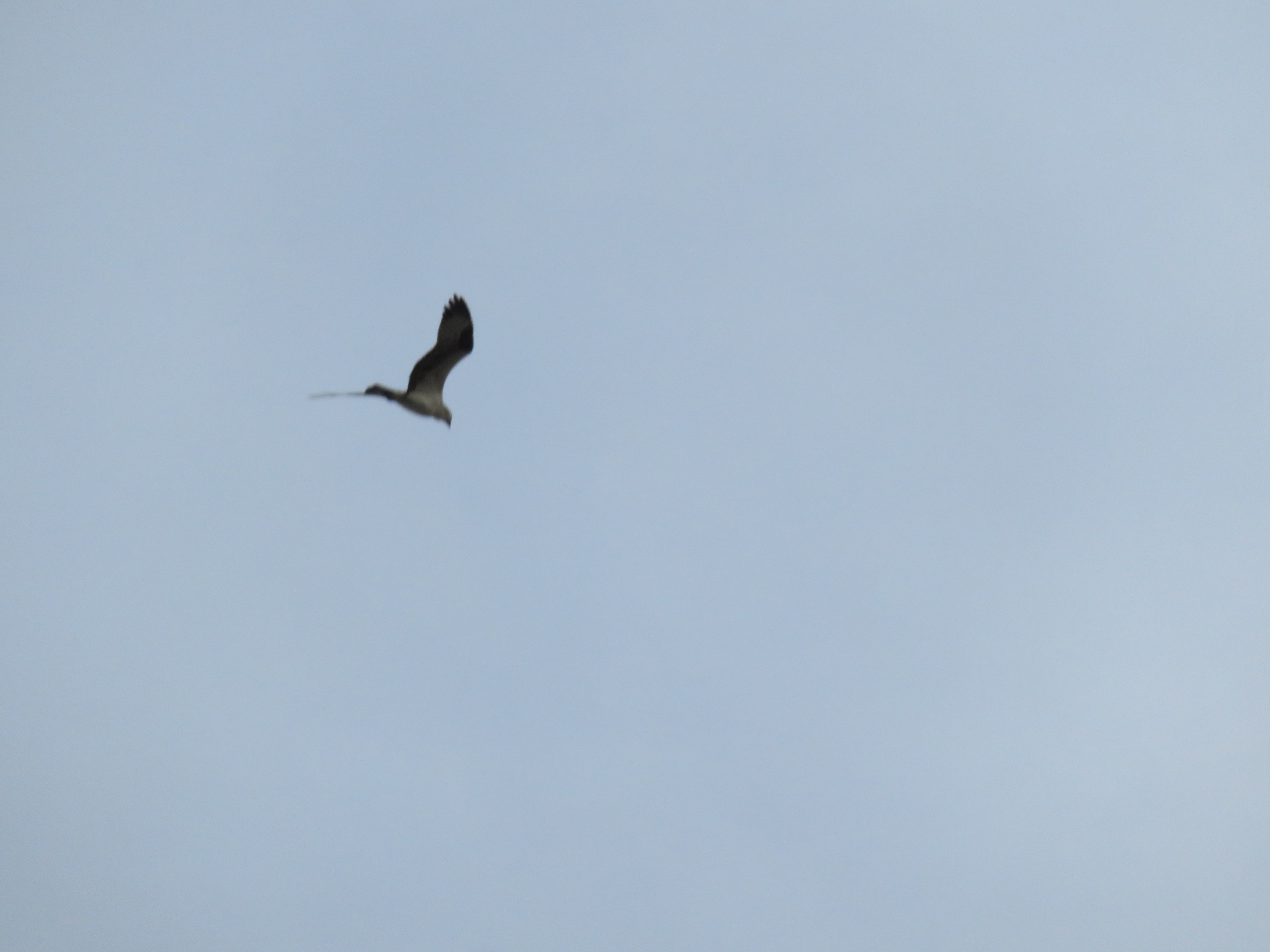
Last week we saw this osprey land on the snag at the headland north of our home. Usually there is an eagle there, or a raven or crow. We had never seen an osprey there and my zoom struggled in the wind, shot from the north in the next beach. She flew right over us in a long lazy turn.

Continue reading

EVERYTHING EVERYTHING EVERYTHING

This is the largest “sea nettle” I have ever seen, dwarfing Gary’s size 13 shoes. It was at least 28″ across—Gary said three feet.

We’ve been busy hustling back and forth, walking our 25 miles a week (and me running a few of those), working on our second home, and admiring everything we see.

Continue reading

DON’T SAY “Piece of Cake”!

It’s a line from the RomCom Forget Paris about a couple who fall in love and then suffer a series of (eventually fatal) hardships—each time after they start something that looks like a “piece of cake” aka “easy.” That’s called tempting fate.

Gary believes in fate; I do not. Both of us are probably average in terms of superstition. We step on cracks. We laugh about Friday the 13th. But when we are beach-combing we have our superstitions. If Gary announces he’s going off to check out something a hundred feet or a hundred yards away, I will find glass. [Yeah, right, Gary walking away brings me luck finding glass.] It’s happened just often enough that we smile when it does.

Continue reading

FLAMBOYANCE

gettyimages-1227919714_1.jpg

One adult shown among a flamboyance of gray flamingo youngsters who haven’t yet eaten enough pink shellfish to turn pink—wait a year and they will become more flamboyant.

Twenty-five thousand adult flamingo couples are summering in the salt marshes of southern France, the largest number since naturalists began counting them forty-five years ago. Over 60,000 flamingoes total—12,000 babies so far. They are harmless to man and beast, eating only krill, tiny saltwater organisms they filter through their beaks in a system not so different from what baleen whales use the filter small fish, krill, copepods, and zooplankton from the sea. The whale babies look just like their parents.

We appear like or unlike our parents, can be trusted or not trusted even by them to do what is expected. Most living things gather.

IMG_6688

The youngster on the left is still begging for food. The gull babies do that too.

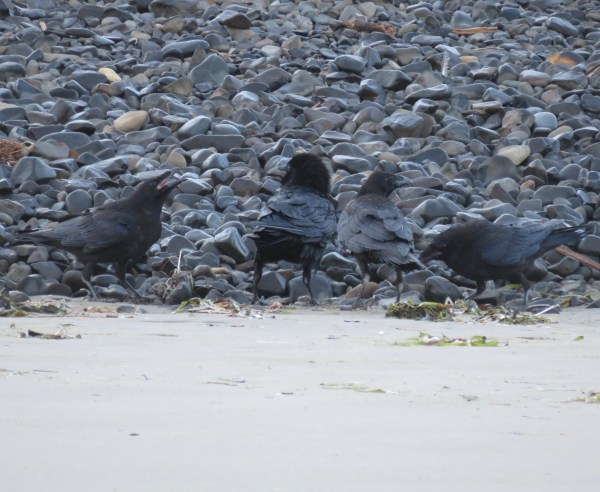
A group of ravens can be called many things. Here, the term “conspiracy” of ravens works for me. (I have never appreciated the term “unkindness of ravens”). The two raven youngsters look just like their parents—one has a fluffy head and is slightly bigger, but that might be one of the youngsters.


They are still hanging around together, though one of the adults sometimes wanders off on scouting missions.

Gary broke up a leftover waffle and some crumbs and put them out on the sand at the beginning of our walk the other day. The ravens stuck around long enough to say thank you.

fullsizeoutput_144f

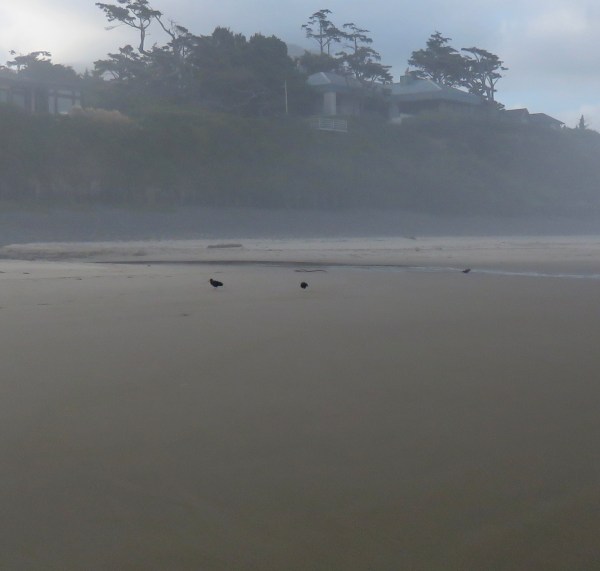
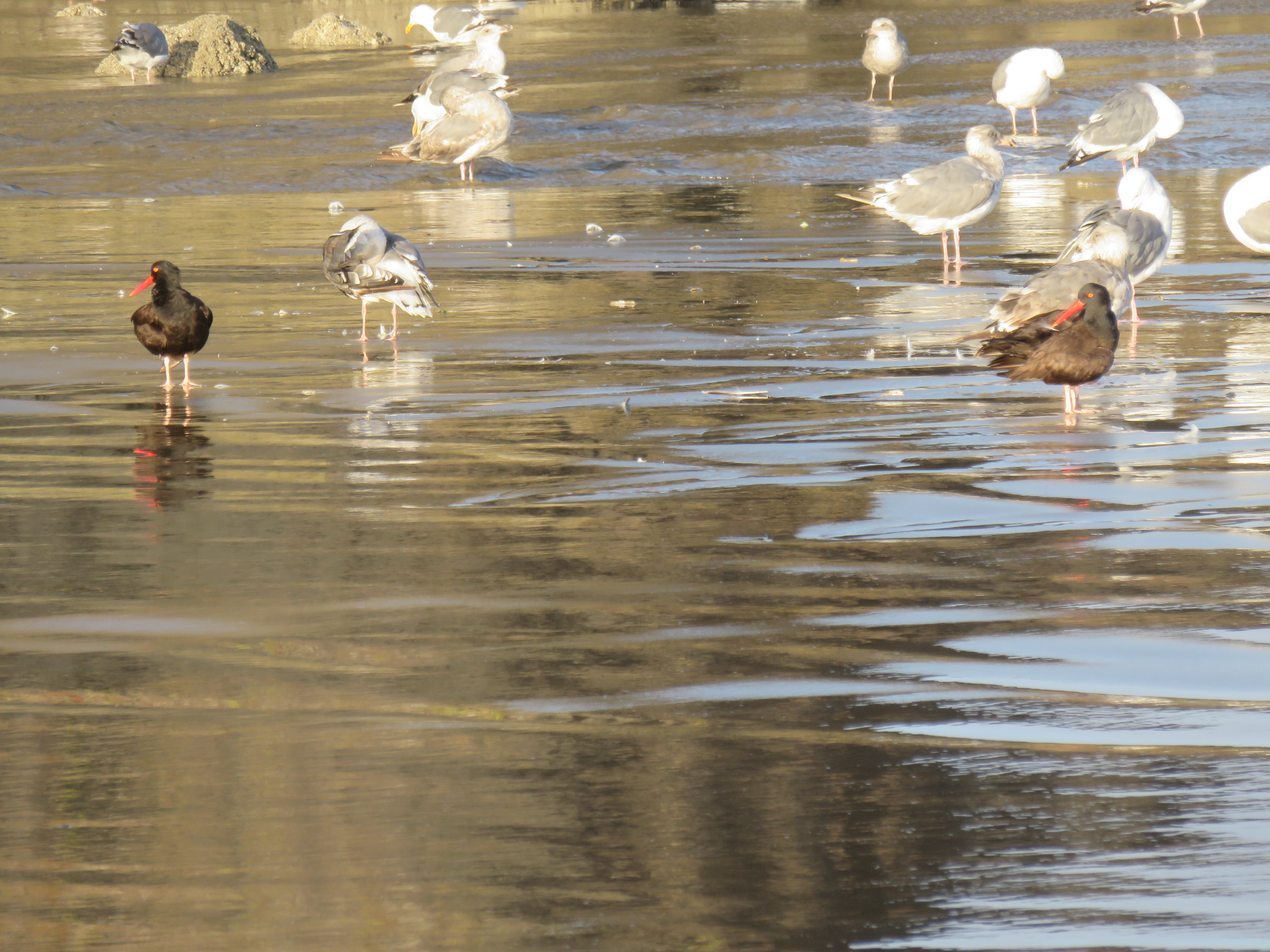
You’ll have to take my word for it that this photo shows three black oystercatchers.

We spotted the black oystercatcher youngster with its parents the other day at the north end of our beach. I did not zoom to catch which of the three was the child, but it didn’t really matter. I snapped the photo in the fog as we passed at a distance. We’re just grateful the baby is doing so well.

We are careful not to approach birds resting on the sand. If they are not flying, they likely want their rest, but it’s tricky for them with so many loose dogs. A photographer deliberately frightened dozen of birds off the sand just to get a photo of them flying.

That’s not as bad as the people trying to “rescue” baby seals (highly illegal and often fatal for the seal pup left onshore by its mother) or young eagles (disturbing any member of an “aerie of eagles” is also illegal and dangerous for the fool trying to “rescue” one). Or the man throwing a ball for his dogs into the surf in an outgoing tide. [This is why Gary does not like me to go with him when he gets the mail. He says I bark at people—I did bark at that man with the throwing stick. “They’re hunting dogs,” he said. “They trust you,” I responded. I saw a dog rolled right under waves, come out of the surf and absolutely refuse to go back in again. The dog was smarter than the owner.]

The wild things are right not to trust us, to focus a wary eye on our movements. We are not of their group, not trustworthy or predictable and kind. The wild rabbits (a nest) nibbling rose hips in our the front yard, the jays (a party) cruising through, the garter snakes (a bed), and gulls (a colony) and know to avoid us.

We try not to disturb the wildlife. When we must pass birds onshore, we walk steadily, avert our eyes, and direct ourselves away, away!

IMG_6801

These two black oystercatchers are not the same pair. There is a  
“parcel” or “stew” of oystercatchers nesting south of us.

The featured image at top is from Wikipedia: “James’s Flamingos at Laguna Colorada in Bolivia”  “Young flamingos hatch with grayish-red plumage, but adults range from light pink to bright red due to aqueous bacteria and beta-carotene obtained from their food supply.”
The adolescent flamingos with one adult is a Getty image taken off the Smithsonian page

WATCHING OUT

fullsizeoutput_13b7

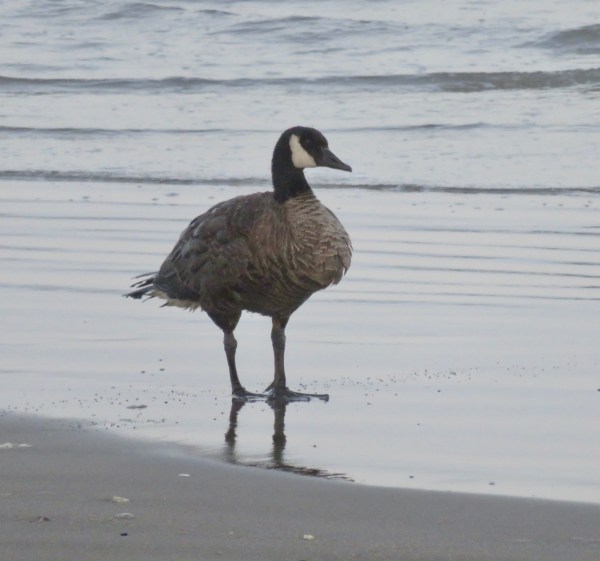
Canada goose all alone just north of the creek this morning.

We see the gulls and lately pelicans fishing low over the surf each day. This morning we saw a solitary Canada goose. It is not the first time. There was a goose that hung about Asbury Creek a few years ago. It was there for weeks in the late summer and we hope it eventually flew off. The bird we saw this morning did not seem distressed. We told him he might find companions in Ecola Creek but he was not impressed. Gary insisted it was a young bird, though full size and avoiding the gulls. Continue reading

SHORE BIRDS

fullsizeoutput_1135

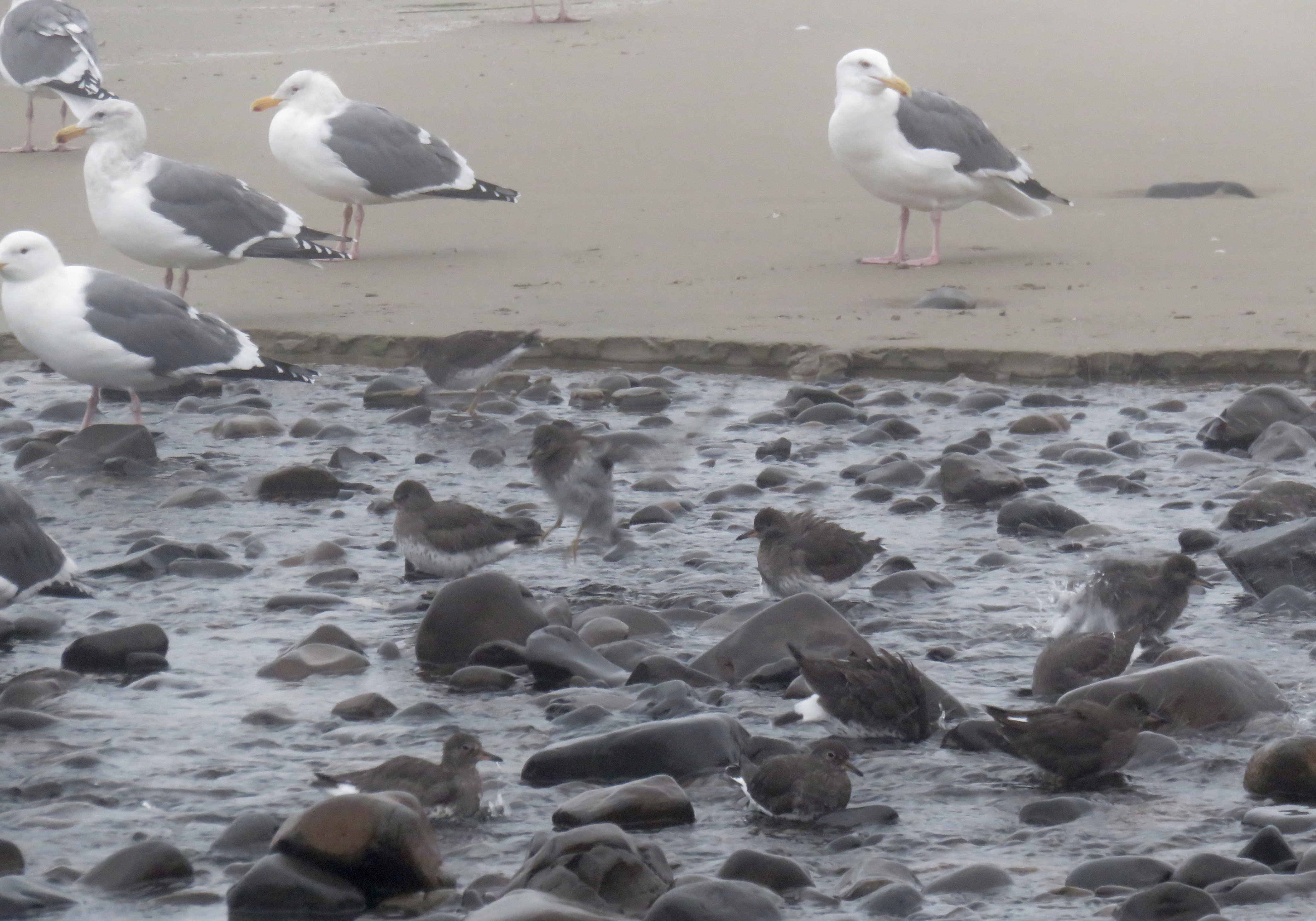
We saw dozens of  small shorebirds bathing in Asbury Creek this morning. They looked like smallish (largish robin-sized) but very fat pigeons. I stood and watched them while Gary moved quietly up to my side and gestured to his pocket where he carried the camera. A neighbor joined us. None of us knew what they were, and I took photos to be sure I could accurately recall what they looked like.  Continue reading

NEXT?

IMG_2882

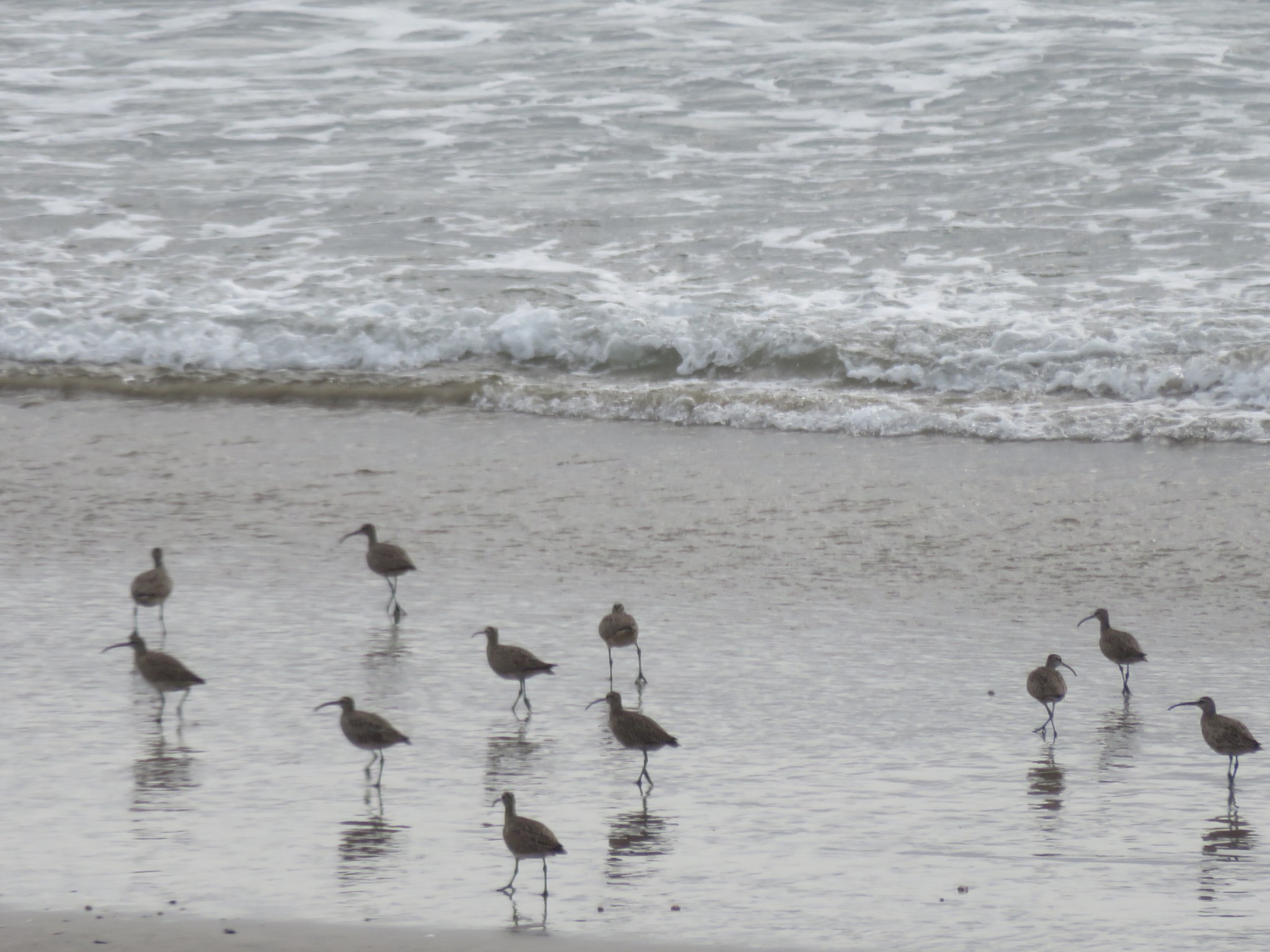
Yesterday morning ravens came to eat the stale bread we threw out. An eagle flew low over our heads, and we found the pile of abandoned “treasures” dumped from some child’s bucket. It must have looked like food. Only two gulls stood in the stream. The sky was bright blue all day.That afternoon I counted twenty-eight whimbrels.

There are even more this morning and we are walking out as this goes post goes live. I like thinking someone will read this while we are a couple of miles north on the sand.

To prepare for today’s post I checked back four years ago to the first time I (almost) retired.

I entered a classroom as a teacher-in-training in 1975, had my first job later that next year at a private girls’ prep school. After moving home to Oregon I worked as a substitute teacher for a long time in the English Department, but I quit teaching altogether this past March. I taught high school for over thirty years, and I substitute taught for another decade.

Each April morning between about four and about seven, I spent writing. I do this sitting up in bed. Some days I went right on writing for the rest of the day. It was a busy, reckless month. We went away for two nights. More recently, windows have been open sometimes this week. The ocean is always calling. Today we will get our longer morning walk.

Another retired teacher asked me recently what I would do now that I am retired? It is a good question for which I have no answer. Will I do something new, or merely divvy up my time in a slightly different way? I suspect the later.

What I miss is community. During the past month, various workshops, and my MFA program, I found that writing group I feel I needed. . . . At least for a month or couple of years or a few days at a time, but not regularly. What I have are a few people who will, if I ask not too often, read my work.

My original writing group was twenty years ago and it was only me and one student. B was the first sophomore we skipped over Sophomore English into the most rigorous junior class. This was pretty much necessary since she was, in skill and ability, far beyond her peers. She needed the challenge. She was the one junior in my senior class as well, and one day I walked out of the Faculty Room and there she was coming out of the Library. “Do you want to write together this summer?” I said. She agreed. We thought we would try writing a novella, just for the challenge because it is longer than a story and neither of us had written anything long. We weren’t even sure what a novella was, so while I was busy ending the year in yearbook, B researched.

After school ended in mid-June, we began writing and meeting weekly to share and respond to each others’ work. Neither of us wanted to look bad to the other. We worked hard. The manuscripts forged ahead, the stories growing beyond what we’d expected from ourselves, beyond our early goal of seventy pages or so of a novella. I discovered what a messy process I have, and B discovered she could do anything.

By August we each had a full length novel. Since I had a publishing connection, our books were read by HarperCollins. They liked B’s quite a lot. It was far the better of the two. (A senior editor wanted to see more, but HC was about to undergo a transformation and this went by unexplored by B.)

B has published since—poetry and academic writing, books, magazine and journal articles. She is a professor of English and much in demand. I have had publications too.

Later, I nominated a student for a writing award, which she didn’t win. But she went on to an MFA in fiction.

A third student was for a time a respected slam poet. And a fourth student completed an MFA in poetry from a program that rejected me twice.

Many of the students I had the pleasure of working with for a term or the better part of a year, have gone on to careers in education, the military, the government, and various professions and occupations in the private sector. Many of them earn more than I ever have. Many are smarter and more talented than I am. They are good in their various fields.

Someday they will retire too.

I receive emails about submission opportunities almost every day, but I rarely send out fiction anymore. I don’t know what I will do about writing. Duotrope shows many fiction submission in the past 12 months, but these were nearly all agent queries about the most recent novel, and now that is completely rewritten. I am not sure what to do about that. I have other work to submit, but that will take some organization. The poems too. I keep thinking I should print them all off and see what I have. There is a warp on the loom, waiting to be completed. Two quilts fight in my head. I have worked on a pattern for a grandchild’s cardigan.

Several times I have joined writing groups in the past twenty-odd years. More than one fizzled. Another decided fiction was too much trouble. Another turned out to be social, and I did not want to drink wine and smoke dope. (That word, “dope.”) I don’t know what  new thing will be that I pass on to.
That word “passing.” We pass tests, pass by, pass it on, pass Go, pass through, pass as something we’re not, pass out, pass under or around, pass over, pass away. Time Passes. So many ways to leave the building.

NEVER TURN YOUR BACK

IMG_3063

“Never turn your back on the ocean,” we were warned as children.

Most people think of the “front” of their home as the side facing the street. What we call the front faces the Pacific Ocean. It is a beautiful view.

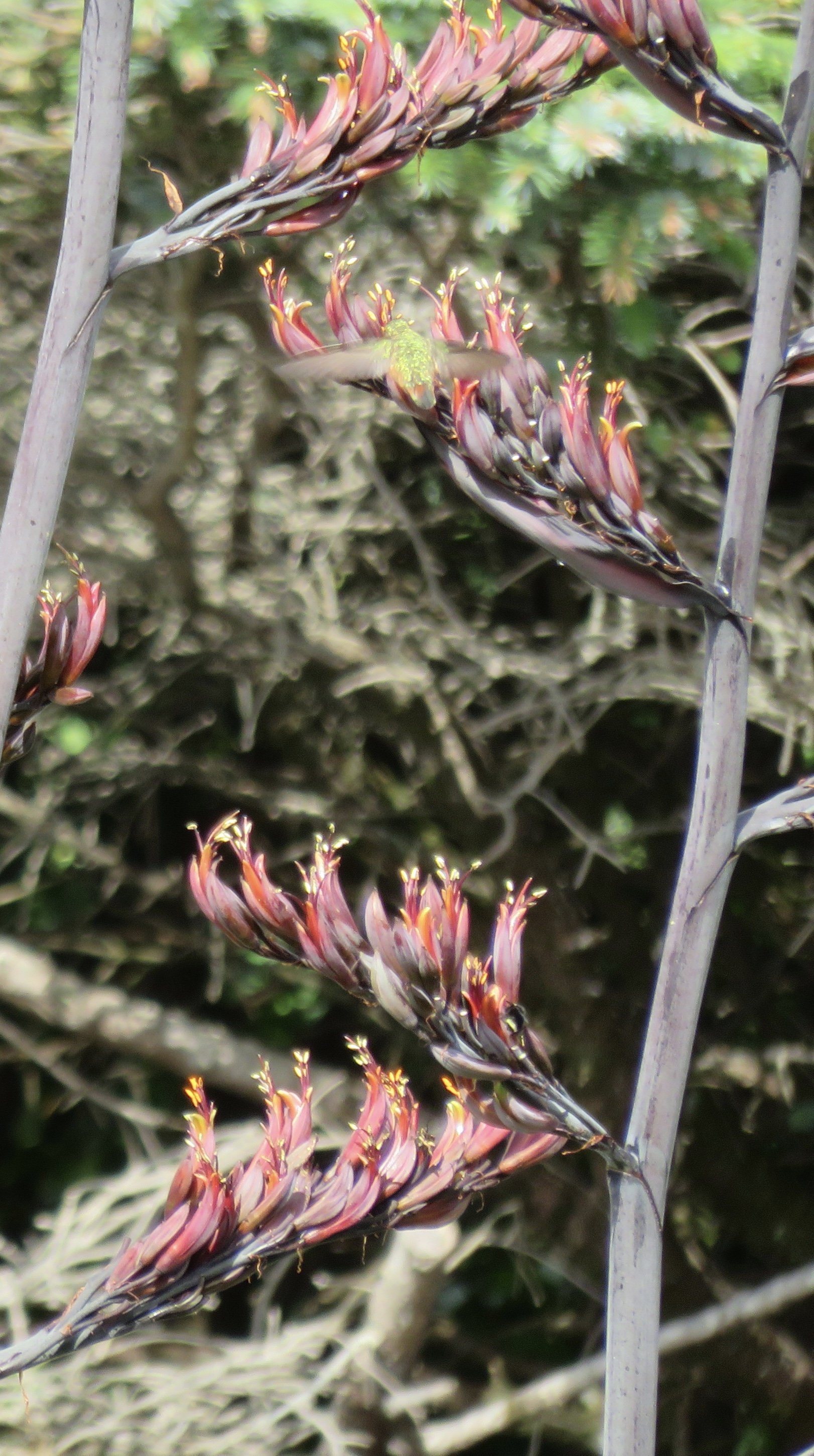
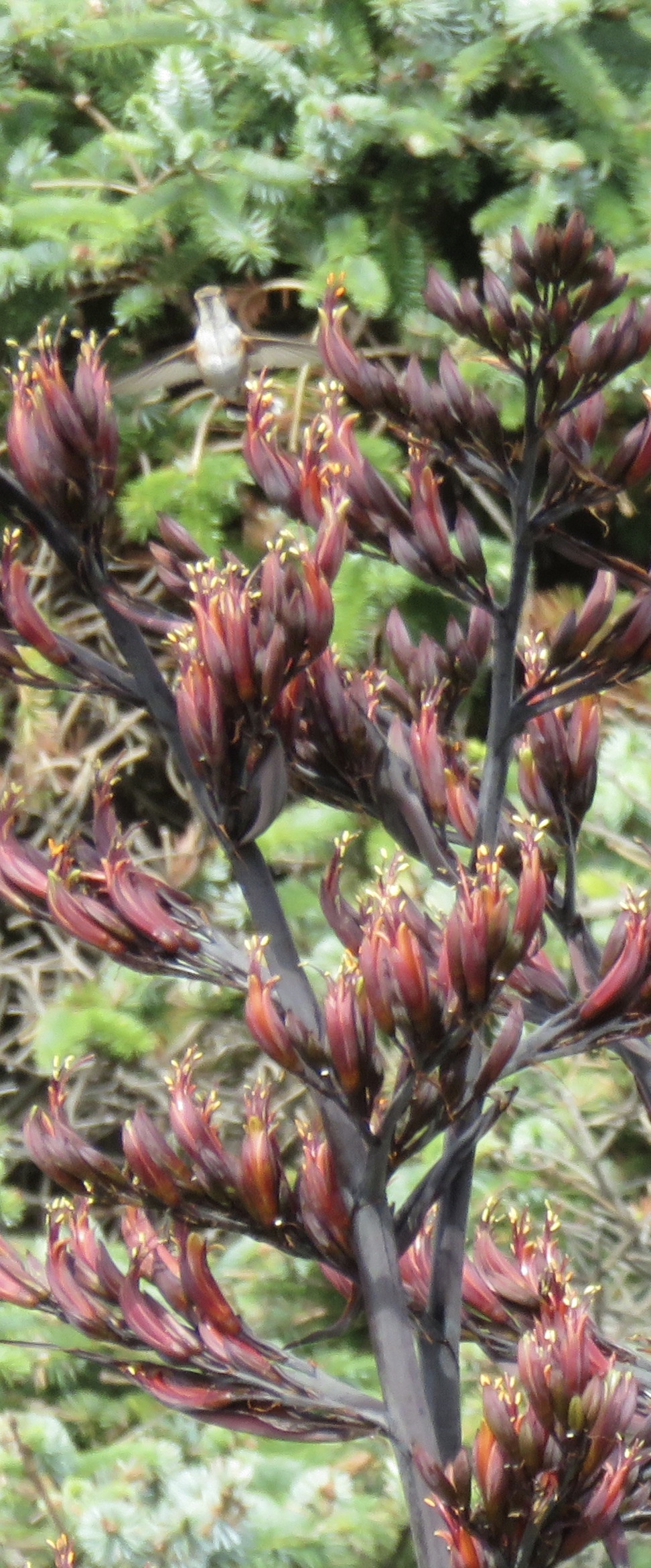
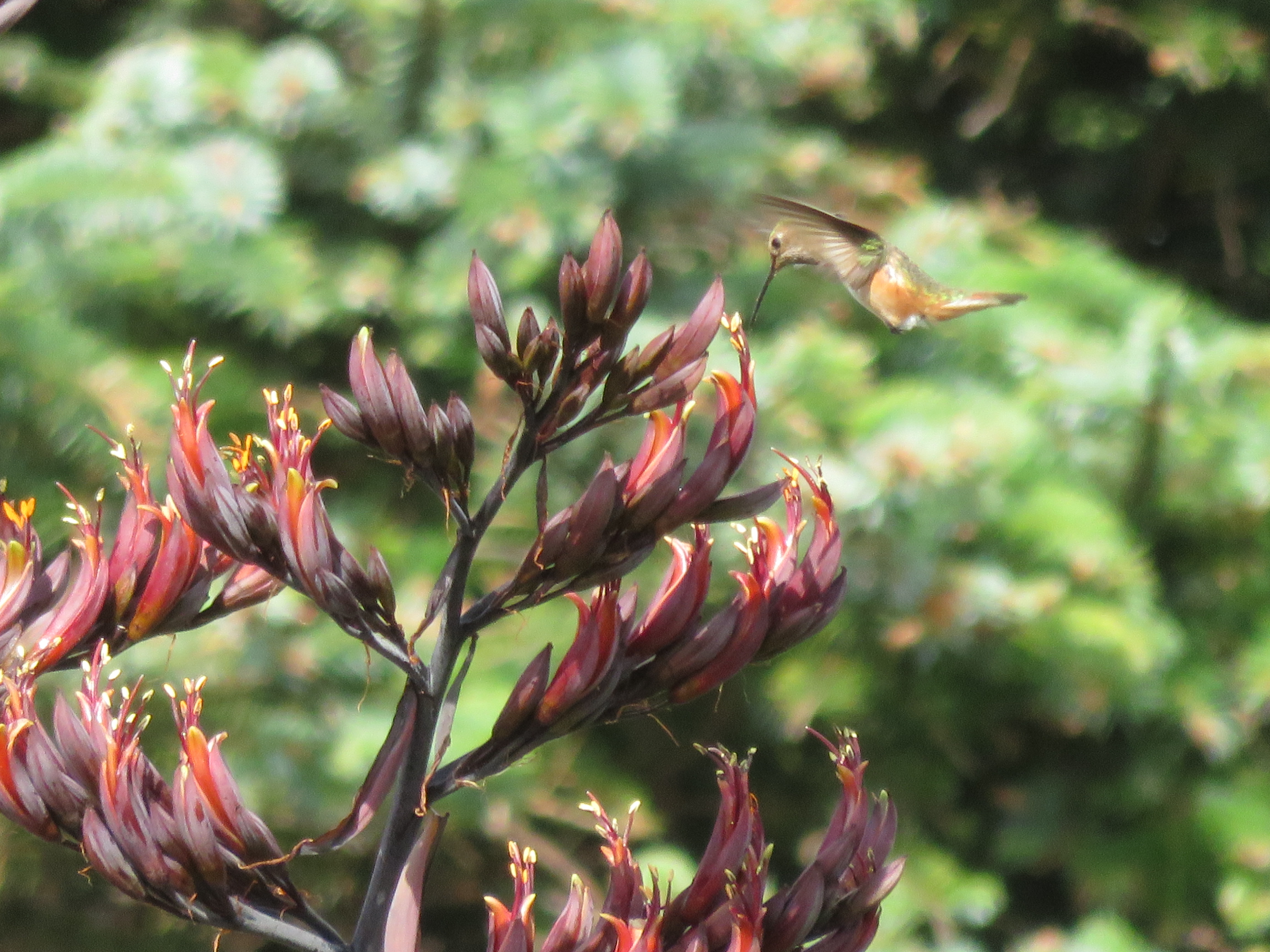
The hummingbird above—can you see her?—she has her back to me. I was fifty feet away when I shot this photo and she was at least 15 feet in the air, sipping nectar from a semi-tropical plant in the neighbor’s yard. Perhaps it is from New Zealand? The hummer was not alone. We counted at least four hummingbirds feeding a couple of days ago.

Just now, I spotted a hummer in our own garden, checking out the lavender and pale thyme, before settling to dine on the royal purple blossoms of our butterfly bush. The dark pink escalonia pulled her away for a few seconds, but then she was back hovering over the purple. We also have purple hebe, pink geraniums, glistening red-orange “Lucifer,” and white rugosa roses blooming.

In the front yard, the wild roses and ceanothus are done, the honeysuckle past its prime, but another pink rugosa hydrangeas are in full flower. The native salal, which flowers and fruits simultaneously, will feed bees with nectar and us with berries for months. Soon the montbrecia will begin opening while the salal and hydrangea go on to September.

IMG_3059

She seems to have turned and looked at me in the photo above, but I was deliberately distant. I did not want to disturb her.

There is always something blooming in the garden.

This is a deliberate choice. Most of the garden is evergreen plants, shrubs and bulbs and other flowers were chosen each season to ensure we could feed local bees and birds throughout the year. Even in winter, we have blooms.

IMG_3071

On the beach we also avoid disturbing the birds, though Gary and I both talk to the crows, and sometimes he pretends to want to pick up a seagull. Gary goes straight toward one saying, “Kitty, kitty, kitty.” The gull doesn’t mind him much, but walks away if he gets too close.

My strategy is different. I do not walk in the direction of gulls resting onshore, I do not look at them directly. They seem to understand that I have business of my own that does not involve them.

Yesterday morning an osprey was right out in front. Later one of the four eagles passed overhead. We saw a Cooper’s hawk just a few months ago when it rested on our garden gate. It’s leaving was too fast to see.

The ocean is always in front of our house. Before our house was here, there was spruce forest right down to the beach. Before that, the beach itself followed a different line. The water washes and washes the shore, sweeping up from its basalt basin onto the edge of the continent. It is not only water but the shore that moves. One day the Cascadia fault line will give way and a wave is likely to take not only our home but the land now under it. Everything I recognize as front or back of our house will vanish in an hour.

But the ocean? The ocean will remain. I expect the birds will too.

SaveSave