My best time was eight minutes and some seconds per mile (maybe more than thirty, but not much) over highway hills in the rain. I was a lot younger then, had been training for a half marathon in Seattle, and that fast run on steep hills resulted in injury.
But that’s not what we meant, is it?
We want my best time on vacation or during sex, or whatever. My best time as a writer. My best time writing or weaving or knitting or playing with my children.
My best time birthing was the second because it was quicker than the first time. The first time I was in labor for three and a half days. The second time I had three contractions, went to bed, woke before seven and gave birth less than two hours later. True, I can recall thinking that “labor could not possibly have hurt this much the first time—I would never have done it again.” But, of course it did, and I did do it again.
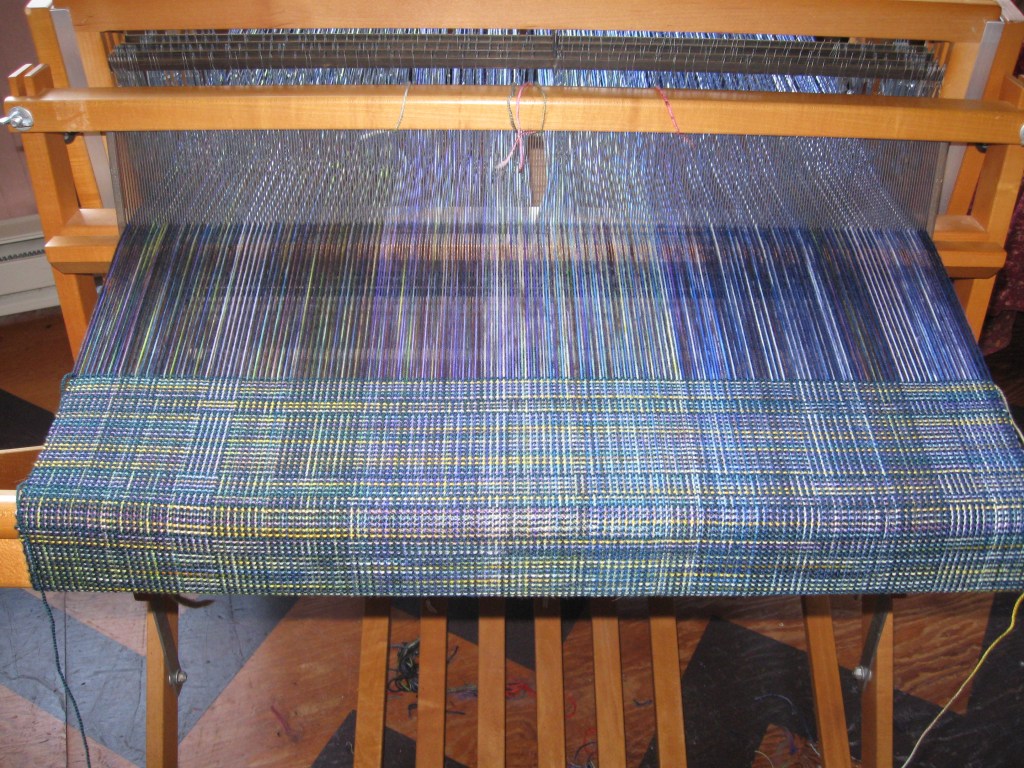
The most amazing weaving experiences were probably at The Factory of Visual Art in Seattle, and later at the University of Washington weaving with Delores Brockway (I hope that was her name; it’s been more than fifty years) in the Home Economics building west of the School of Art where I wove for Andrew Proctor. Decades later, after my friend Toni gifted me the loom she hadn’t expected to find in her mother’s basement, I first wove a silk blend using a test pattern from college, but the best was when I risked weaving knitting wool in tabby. I’d thought I would move on to twill, which I’d preferred in school. The work came off the loom stiff and dry. I wasn’t pleased, but then, sometime later, I wet-blocked it, and hung it to dry overnight. That wonderful Canadian wool from Koigu that I’d been using to knit lovely socks made an amazing shawl. I’m told the behavioral scientist Temple Grandin has that first shawl draped on the back of her couch. Grandin got it from a friend who asked me on a Monday if I might weave a shawl for her; he was leaving for an Utah even a couple days later (—weave it in three days? I laughed), I gave him what I had already finished. This is just to say that such handwork is slow work. I need a month to finish a warp, though I’ve taken much longer. I’ve woven dozens of shawls and baby blankets in the years since.
The early pieced cotton quilts were like that—deeply enriching, satisfying. They took weeks to figure out and weeks to cut and piece. After the first few, once I shifted over to batik cotton’s, I sent the pieced front and backing out to be machine-quilted because hand quilting batik fabric makes my hands bleed. I pay more for that than most people are willing to pay for the finished quilt, which is why I’ve never sold one. Then it comes back to me for the binding. It’s work, and at every stage, there are so many choices—this color against that, lighter and darker values, thread color and quilting pattern. The work itself is about craft and art, the same way a painter chooses color and brushstroke. Painters don’t usually appreciate that.
A grad student friend in the metal shop (goldsmithing) was deeply offended with a printmaker wanted to trade straight across for a sterling jewelry piece. It wasn’t that my friend didn’t appreciate the time invested in designing and making the plate and printing each copy, but the other person didn’t appreciate that then they were able to print off dozens of copies in a long afternoon, and during the same time the metalsmith had just the one piece… started.
I had a conversation once with another dog person, a man with an MFA in painting from UCLA. I told him how annoying it was the painters and sculptors assumed that theirs was the only true art. Architecture, too. The rest of us were mere craftspeople. He nodded, because he’d done some jewelry, and then he went off on it himself, a kindness I still think. He had cast pieces and I was a fabricator. The processes are about as like as knitting a shawl and making a pom-pom.
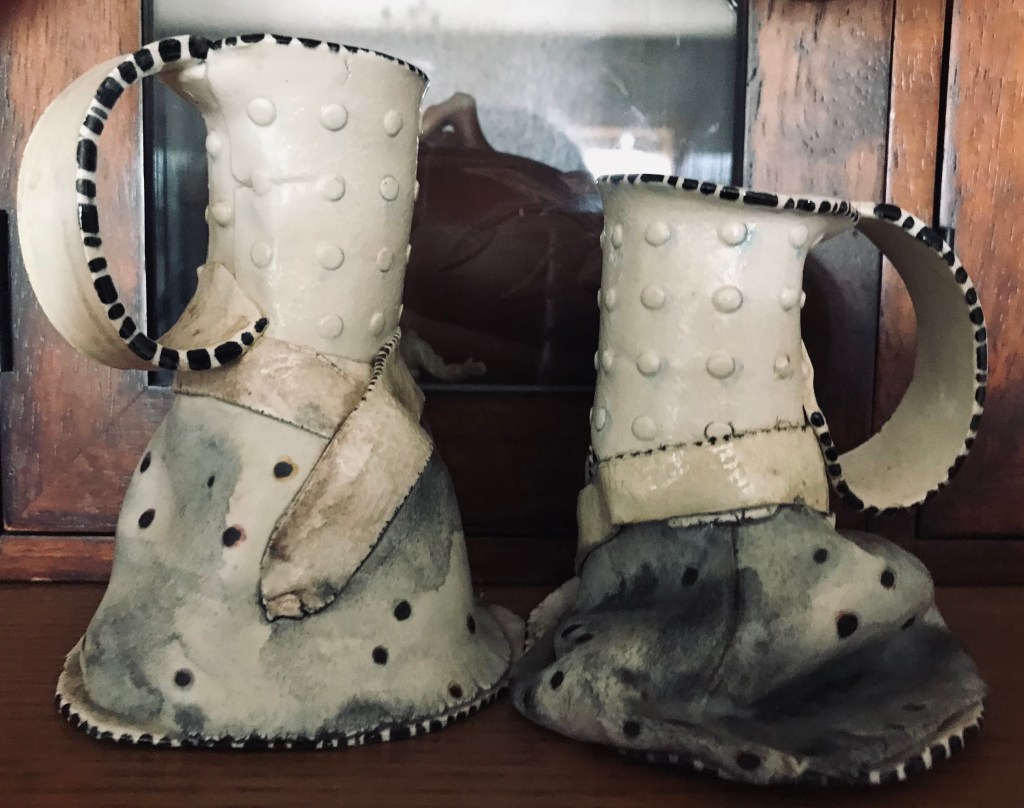
Over those years as a student, I sold mugs and teacups, traded a teaset for a gorgeous gold and sterling pin, 8 inches long—impossible to wear but it hangs on the wall. I sold an enamel-on-copper wall piece on commission. I exhibited in two art museums and several galleries. And then we moved and I birthed our boys. I had always planned to got back to school for my MFA, probably in enameling copper, maybe handbuilding ceramics, once our boys were a little older. I had a scare when I fired up my enameling kiln. Alan crawled right under as I lifted a piece from a 1700° firing. I unplugged the kiln, shut it down, and never did return. By the time the boys were in school, I was going elsewhere.
I wrote my first fiction, my very first story as an adult in the summer of 1990. I wrote it on the Friday afternoon after a week-long workshop with Sandra Dorr, one of the classes taken to prepare myself to teach English that fall. That was a best time. I was already a good writer, but of essays not stories; my college professors were generally pleased with my writing. One gave me an A+, which seemed silly at the time, and for a class for my education degree, the easy one. The two BFAs were hard work and long hours. (The BA in Education was so easy it was embarrassing. I never studied, the tests were too easy, and I wrote my required essays, including the A+ one, in a couple of hours.) The MFA in fiction I competed in 2007 was hardest of all.
While we were running and showing dogs, I wrote a humorous essay about fleas and a serious essay about inbreeding coefficients for dog magazines. For a time, I wrote a regular column. I served as an officer and on the board of various nonprofits. I was an ASFA licensed judge and traveled to field trials all over the country and two Canadian provinces. We had six or sometimes only five or up to seven Afghan Hounds, not counting rare litters of puppies. For most of those years, I kept them all in coat. It was an expensive hobby we could not really afford. I worked freelance to help pay for the dogs. I designed logos and advertising. Portraits of dogs.
That started while we were both still in college. It ended soon after we moved to the family house on the Oregon coast and a few years after both our sons were born. Our sons were more important than dogs.
In the mean time, I drew plans for complete houses and remodels and was hired to draw for an excellent architect. And then I prepared to teach English, which is how I wrote that first story about a boy who is afraid his dog has drowned in an irrigation ditch. The character is based on the stories Gary told me about his childhood. His best times, not mine, later became my MFA thesis.
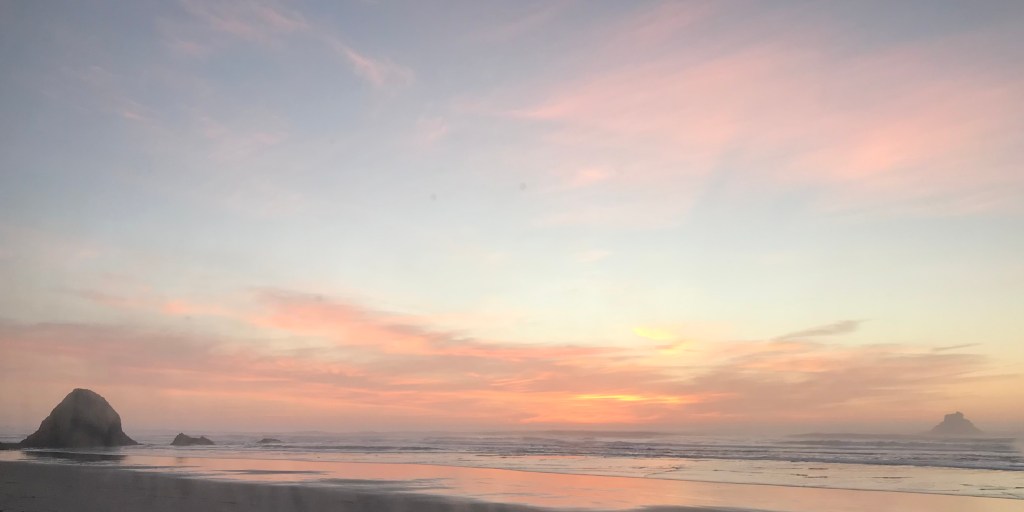
Gary and I kiss every time we walk behind what we call the Turnaround Rock, a mile and a half north of our home on the coast. That’s a best time. Every time.
He makes coffee each morning and waits for me to wake so he can bring me a cup. When is that not a best time in my day? If I find the pangram as soon as I look at the letters playing Spelling Bee, finish Wordle sometimes on my second guess—fun, but nothing best about that.
I’ve had publications that have been wonderful, but they are not my best times writing. Writing is the best time to be had writing. If I ever publish a book, that opening reading could become a best time, but I may never get there. An agent rejection has arrived as I type this. [They are generally kind, “It is an absolute honor” this one begins in the thumbnail alert. It will go on to explain why she isn’t choosing to represent me, in a form reply.] Instead . . .
Sometimes, because I am a sloppy, impatient writer I have the whole of the story for many drafts—twenty or forty or more drafts! The story doesn’t quite work, though I would like—will desperately try—to believe it’s done. I’ll spend dollars to send it out to literary journals that pay nothing. My story will be rejected many times until I give up and set it aside. And then one day I open that old file and find a good story, only . . . and just like that, I see what’s wrong. I fix it.
That is a best time, figuring out a story I’ve worked on for a long time, however many tries it takes to get there, how ever many years it takes.
 IMPERFECT PATIENCE
I remember those ceramics! I have 2 similar ones in our guest room. So wonderful that Temple Grandin has one of your weavings. My grandson Legendary often says “Best Alma’sday ever” or “best dinner ever”. Now that he is almost eleven I suppose he will stop saying it. I enjoyed reading this!
LikeLiked by 1 person
Oh, yes! I thought of you the whole time I was writing this morning!
LikeLiked by 1 person
the best time should be now even if it isn’t
so here we are again watching as the best time
even without wings — fly zzz bye
the last time or now should be the best time
unless you’re on wild mountain thyme
then perhaps like Pete best said it shoulda been me
of course with no watch time becomes ear elephant
one can only wonder what Andre Breton was doing
in that closet-in that time
but that’s another times nothing that equals zed
for you happy mothers day every day bestest and goodest
of times and thyme again
LikeLiked by 1 person
Every day with you.
LikeLike