I have been thinking a lot about housing during the past twenty-five years. My husband and I moved to the family home in Oregon in 1979 and started a family. It was what my grandfather’s third wife and her second husband hoped we would do when they left the home to us. It was a two bedroom, one and a half bath retirement home when we got here. We removed the half bath and added a bedroom and second bath. Two sons and six hundred square feet. My husband worked long hours and I stayed home with our children while they were small, which was financially challenging but also temporary. [We lived below the poverty line for some of those years, and I will never recover the lost income from remaining out of the workforce for those years. That’s another issue—instead of “affordable daycare” how about making it possible for parents to parent their own children without taking a crippling and permanent financial hit?]
Then my mother began a downward decline, a process that went on for years. Her driving was dangerous, she couldn’t see to read, never did like cooking, and my husband stopped by every day on his way to work to make her coffee. [If she’d taken better care of herself with a healthy diet and exercise… well, she lived to be 82, and most young people would see that as a ripe old age.] She was in pain and unsteady on her feet, would not take the suggestions of various helpers, and was in and out of assisted living for those last five years. It was crushing for her to live with the assistance of cooks and nurses and others, but she could not live without it.
There should be no shame in accepting what we need. There is no honor in taking more than we need. Yet we judge others by their living situation. I admit I do it myself.

I decided at the time we were caring for Mom that I wanted to avoid moving into assisted living because they are too institutional and I like cooking. On the other hand, I vowed to quit driving before I became a danger to myself and others. We would, I reasoned, need to move to a smaller place where we could walk to shopping and medical care. Our coastal home requires considerable maintenance which we mostly have done ourselves but don’t want to be doing all that forever, we’ll not be able to do all that when we’re eighty, and eighty is coming on fast. We walk most every day, but we can’t walk anywhere. In Portland we can walk to everything. It is small and entertaining is tight and awkward, but unless I want to sew or weave or Gary wants to play music, we have all the space we need. The reaction of one of our friends was: Small. Does the building allow you buy the unit next door and knock through walls?
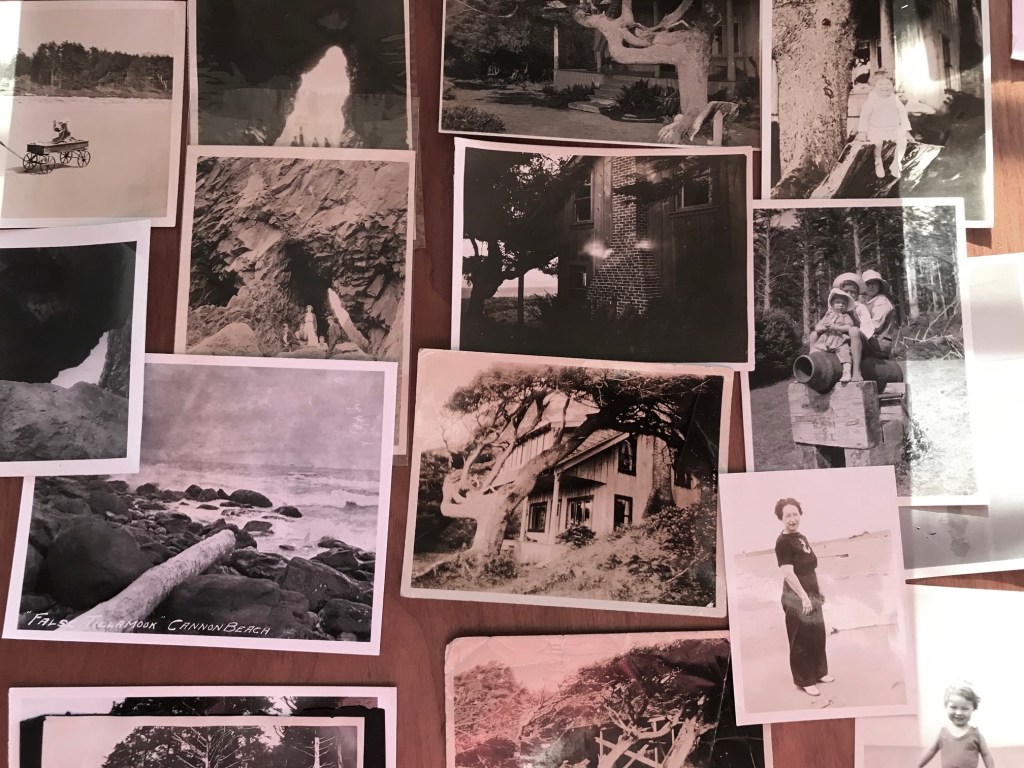
People are impressed when they realize we own a house on the beach. But while I laid flooring and built walls and set tile and designed the remodel, we have never been able to afford this home. It’s a family home, the land purchased and the original house built at a time when it wasn’t valuable.
But it’s true, we own two homes. One is paid off. That puts us in an enviable position. Many Americans are not so lucky.
It seems to me there are two issues here, not just one. Housing that suits our needs is one, but there is also pride, ordinary self-respect. Living modestly is not respected in our society. Increasingly, our culture respects only affluence, wealth, power. Modest ambitions and modest living are disrespected, and modest housing is seen as a some sort of failure rather than a practical choice.
My husband and I are downsizing from a 2200 square foot rural home to less than 600 in the city. At the coast we have half a dozen people within a mile that we know and speak to occasionally or daily. We need to replace the garage door, replace and repair doors and windows, and that’s only some of it. There’s a lot we do ourselves though cleaning house can’t be done in a single day. In the city, we have nine people we know on our floor, and the most challenging housekeeping chose might be to change a light bulb, and it takes a morning to dust and vacuum and clean the entire unit. [When one of us dies, the other will not be able to live on the coast. That’s the reality we’ve discussed. It’s not something people want to hear about.]
I think about what a person needs and how we have come to judge others by our housing.
More than a hundred years ago, living alone was impractical. Laundry required heating tubs of water, manually scrubbing the clothing, and hanging it to dry. Meals required more hot water, a stove the size of a small car, and long hours. Everything from doing the dishes to cleaning floors required intense manual labor. A garden was more work. A family of two or three or four, with one adult working, needed another full time adult to cook and clean a typical house of 800 square feet. A larger home required outside help. Even “large” homes were smaller a hundred and even fifty years ago. Inflation has had a dramatic affect on the square footage of the average American home.
A childless couple today thinks they need a lot of space. According to Bob Vila’s website, “Since 1910, home size in the United States has been expanding, by an average of 74 percent nationwide. State by state, however, the picture varies quite a bit. In some congested urban areas, homes are shrinking, while new developments in the South and West are gobbling up land and square footage. … For instance, San Diego boasts homes that average 2,417 square feet, while San Francisco’s are much smaller, at 1,150 square feet.”
Our first home in Seattle was built in 1918, had four bedrooms, one bath, and was only about 800 square feet. At the time it was built, there was no electric range or washer and housework would have been a full time occupation. [The two of us lived there with six Afghan Hounds, and we remodeled the kitchen and second story mostly ourselves. The people who bought it, raised the roof to create a third floor with a fabulous view and a glassed alcove for their orchids. No kids.] It was a family home at a time when, at least in theory, husbands worked and wives kept house.
Both my parents were raised by single parents. My maternal grandmother worked full time to support her two daughters and her aging parents; my paternal grandmother cared for the house and her son and elderly mother while her widowed sister worked to support the family. They needed to keep a house because they were part of a family.
For a single person without family responsibilities, the alternative to keeping house was renting a room in a boarding house. A single person worked all day and came home to a private room. On Saturdays, they cleaned their room or likely had someone do it for them. Meals were cooked and served in a dining room, clothing was cleaned by a laundry on site or elsewhere. The garden was someone else’s concern. This might serve for a young person until they married or an unmarried person for most of their life. Otherwise they lived with family. Unmarried people lived in the attic or a spare room in the home of parents, siblings, or cousins.
From late in the 19th through the mid-20th century, boarding houses were a significant housing option in large cities and small towns all over the country. At a time without electric stoves, fridges, vacuum cleaners, and washing machines, keeping even a small house was a full time job. An unmarried working person rented a room, might share a bathroom with others on their floor, had communal meals on the main floor, and often had someone to come in and clean. Living in a boarding house provided housing without the need to do all the other work associated with daily housework. For some people, this was practical and comfortable housing, not just temporarily, but for most of their lives. Even wealthy people lived this way in what we’d call small apartments with meals sent up in a dumb waiter.
[My great grandmother kept a boarding house in Texas a hundred-forty years ago. Her husband was in prison, and she had two small children to house and feed. My parents met after WWII while attending UC Berkeley. Their’s was not “student housing,” but he was on the GI Bill and took his meals at the boarding house where my mother was living while also attending the University. Mom’s sister also boarded in the Guest House and was on the GI Bill and there met her husband when they were in their late twenties.]
By the second half of the 20th century, the size of homes began to inflate, new builds doubled and tripled in average size. People didn’t just want a house, they “needed” a rec room, another bath, and an extra bedroom or two. Even single people wanted more space. Renting a tiny apartment or just a room became not a reasonable life choice for a single person but a sign of failure.
A local man lives very like a single person did in my great grandmother’s time since his wife was moved into a memory unit. He eats all his meals out and has someone in to clean for him. He did this even at a time when he was physically capable of cooking and cleaning his 450 square feet himself. Then he moved into a two-bedroom house and continued as before. I know another man who did very much the same thing, but moved into a larger home on an acre of land. He could afford to hire people to do what most people do for themselves. A century ago this use of space by a single person might have been viewed as wasteful. Today, living in a communal setting with or without a spouse is . . . what? Demeaning? Stifling? Cramped?
Men I know live alone in small apartments and live very much as the two now-widowers, except they have never been taught how to clean and so they don’t. They think they need apartments with a kitchen, but what they really need is a boarding house with someone to keep house for them.
Maybe it’s time to rethink all of this? Our needs, our expectations, our notions of comfort.
The New York Times has an alarming article about people unable to find housing in the city where they work. Even those earning 40-50k struggle to afford the most basic housing in the city of New York. “Employment shelters” have been converted from hotels, but the rooms are sometimes so small that there is no room for a chair!
A working mother shouldn’t have to choose between decent housing and feeding her child. Think how much easier her life would be if that single mother had a pair of rooms with a shared bath, a dining room downstairs that provided meals, a laundry, and afterschool/emergency daycare. I’m not saying people need to settle for less; I’m saying that we need to look at this from a different angle.
I’m saying people deserve better.
I’m saying workers should not feel shame for the lack of a two-bedroom apartment.
I’m saying that the comfortably housed among us often have far more than we need.
New York isn’t the only city having this problem. Housing is a struggle in almost every American city. Finding decent housing shouldn’t be so difficult for working people. We need to find a way to give people what they need. And the people who think they need a huge apartment (knocking through walls to another to have that space) might rethink what is necessary to comfort, and what is more about bragging rights.
I wish we had one more room in our Portland home, one more closet, space for my loom and sewing machine and my stashes of yarn and fabric. So far, we’re managing. Soon enough I will stop weaving, sew only small things rather than queen-sized quilts. I will accept the limitations of my age and choose what matters most. My life need not become smaller because I need less. I am not reduced because the space I inhabit is small.

 IMPERFECT PATIENCE
our house-csny
this ole house-start hamblen
gimme shelter-stones of course
something in the way -nirvana
gasoline alley bred-hollies
an undoing world-the klezmatics
somewhere-proby or Streisand–probably Streisand
just some tunes to put us in the mood until the fascist twins kill social insecurity
and throw us out of our adobe abode
cheery thoughts and prayers
mostly lions and bears
tennis anyone?
LikeLiked by 1 person
I often wish I had just one more room, a place for my weaving and knitting alone. My husband is a bit of hog when it comes to space: he has a room for his cameras and photography work, and half of our garage is dedicated to his telescopes and computers. My bedroom could be a room for weaving if I didn’t need the bed in it, but we sleep separately (so we can sleep since even in sleep, we both desire to spread out). But … we could probably downsize as long as we had access to nature, a garden, an outdoor space to meditate and contemplate. Housing is a crisis even here in the not-so-quaint-anymore Tallahassee. We see developments of large, detached houses, houses likely bigger than they need to be. I can’t even fathom having that much space. When I was growing up, we had three bedrooms for six people. My parents had one room, my sisters another, and then there was me and my brother. When I hear of young parents insisting that each of their children must have their own room, I roll my eyes. Who are they going to whisper to at night if they are alone in their bed? Oh well, I’ve lived in some pretty cramp spaces. Our current house is the largest home I’ve ever had. Roughly 1500 square feet, I think. In truth, the only things that make it feel a bit cramped are our two cats. They do take up a lot of space … including our beds! lol.
LikeLiked by 2 people