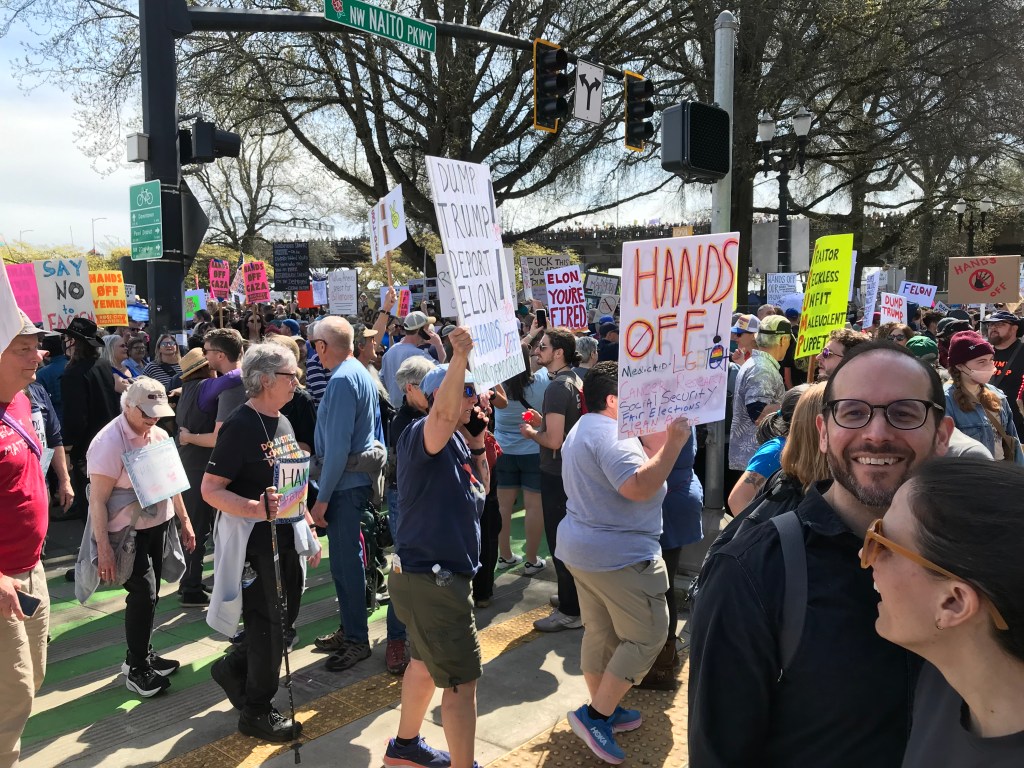
Yesterday, we marched with thousands locally, and with millions worldwide. I wish I could verify a number, but the government offices that used to do that aren’t allowed. There were babies strapped to a parent, children in strollers, others holding hands, young people and people with white hair. In the background of the photo is the Burnside Bridge. If you look closely, you can see it’s lined with more protesters waving and holding signs.
Idealism serves us now not in the achievement of it but in the striving toward it.
This afternoon, we are having neighbors over for a meal. To that end, I started cream of mushroom soup yesterday (I still need to add the cream and maybe sour cream). First thing this morning there was a false fire alarm, probably someone burning sage? Not everyone evacuated. I’d done my Wordle and got “genius” on Spelling Bee with both pangrams [Wordpress thinks I’ve misspelled both focaccia and pangram—how to tell a computer to look the word up?], read an article about Beethoven’s aging genius, and searched without much luck for confirmation of number of the millions who protested yesterday. I got to pet the building Greyhound and talk to neighbors. Fire trucks came and then declared us okay to reenter. I have black olive focaccia in the oven.
And while it rose, I scanned The Atlantic‘s email. I am fond of Xochitl Gonzales’s columns. Today, she talked about her last desperate overdraft, in 2008, and the difference when she had one recently. This time she didn’t need to go into desperation-mode, but still felt the anxiety she remembered from the 2008 recession. A jolt of fear. Her device told her the obvious: she had been experiencing “unusual stress,” and it asked her to choose the likely reason from a menu. The options included “erectile dysfunction” and diarrhea but nothing related to money. That’s because the people who designed the ring and the people who own them, don’t ever worry about money. “What the Comfort Class Doesn’t Get” is behind a pay wall, but you get the gist. Right?
For all of the racial, gender, and sexual reckonings that America has undergone over the past decade, we have yet to confront the persistent blindness and stigma around class. When people struggle to understand the backlash against elite universities, or the Democrats’ loss of working-class voters, or the fact that more and more Americans are turning away from mainstream media, this is why.
—Xochitl Gonzales
Even the recent book that defines caste in American culture, Isabelle Wilkerson’s Caste: The Origins of Our Discontents, fails to address this issue about money. It’s all about race in her book, it’s all about the impact slavery still has on our national character. She’s not wrong, but she dismisses both Native peoples and the caste of women from her argument, not to mention body type and beauty. And she pretty much fails to address the very real issues surrounding generational wealth.
People born to wealth most often fail to appreciate what worrying about money is all about. Their money concerns do not devolve into fear, heart palpitations, gut-wrenching anxiety. I am hard pressed to even call them concerning. Some of the wealthy—you know who I mean—dismiss the non-wealthy majority as lazy and undeserving. We are to blame for our situation. I’ve been told this and in so many words.
“The rich are different” is the saying. I went to school with some of them, taught a few of them, and even socialize with a few. Another one: “With the rich and mighty, always a little patience.”
“People with generational wealth control a society that they don’t understand” according to Xochitl Gonzales’s essay. The rich have no patience with the rest of us. Our money worries, we do not matter because we’ve brought this upon ourselves by failing to be richer. Our needs are not even on the list of what might worry ultra-rich. They never worry about money and we have failed to become wealthy. We failed.
I was the closing speaker at the ebullient San Francisco Hands Off rally, and when I got home later I scoured the news for reports on the more than a thousand other rallies. Of course people would show up in the big cities and the bluest places, but what really exhilarated me was to see the turnout in reddest America–Utah, Nebraska, Missouri, Indiana, Iowa, Idaho–and small communities not known for their protests. People stood up for their principles in the cold in Alaska and the rain in the Northeast and the heat in St. Augustine Florida. I’m impatiently waiting for the Crowd Counting Consortium to give us numbers, but some early estimates say well over three million people showed up.—Rebecca Solnit
The rich in power at the moment believe in a simple world. They have a lot, so we must little. They want more, so we must have less. It’s only fair . . . to them.
This is what is happening to our national government: a shift of benefit to the obscenely rich from everyone else. It is the story of medieval European governments that I studied in Honors World History when I was fifteen. Except Europe eventually grew out of that and toward something better. The United States of American was founded on the inalienable rights of all people—a great ideal of unity and respect. We have always fallen shy of the ideal, but it was still out there as a goal. The struggle to achieve that ideal is failing today. We are falling backwards.
We are falling. Failing.
But some of us are taking steps to catch ourselves before we land.

 IMPERFECT PATIENCE
Thanks for this report. I am encouraged, not only by the worldwide turnout but specifically by turnout in my son’s town of Forest Grove, a farming town, population 25,000. I didn’t know what to expect…would have been disappointed but not shocked if we had been among a dozen or so. I would have been pleased if there had been 100. The official count was 343, but I know there were more people still coming in as we were leaving. And my friend Jeannette said there were over 1000 in Grants Pass. Grants Pass! Reddest of our red towns! I am sorry but not surprised that the legacy media is downplaying this. But we know what we saw and what we were part of. And it gives me hope.
LikeLiked by 1 person
I don’t know how many we were in Portland, but I have attended enormous demonstrations in my life, and this was as large as any. Most of the time, we were inches from other people, and it took many minutes to begin moving once the actual march began because ten blocks were packed tight, and more on the bridges, more arriving as we left too. Like you, I am deeply moved by demonstrations in deeply red states—Idaho! My goodness!
LikeLiked by 1 person
Maybe because of my own origins, I’ve always felt the major difference between my opportunities and that of others was money. Not my skin color. Not my sex. Money. Since I grew up in a majority white, conservative community, it was hard NOT to see money as what made the difference between the haves and the have-nots. The property owners and the tenants. I was 16 when my mom announced that she had finally paid off the mortgage of our house. (I think she bought the house in the late 40s so by the time I was 16, she’d been paying for 30 years at least.) It totally freaked me out. I was so naive that I thought we owned it outright. My first thought was, “My god, we could have lost the house if anything bad happened.” Since then, I’ve never taken “wealth” for granted.
LikeLiked by 2 people