An imperturbable demeanor comes from perfect patience. Quiet minds cannot be perplexed or frightened, but go on in fortune and misfortune at their own private pace like a clock during a thunderstorm.—Robert Louis Stevenson
We don’t know for certain who composed The Odyssey, which is generally and perhaps inaccurately ascribed to a single bard, Homer in the 8th century BCE. Most modern experts, including Emily Wilson in her otherwise excellent introduction to her recent translation, routinely comment that one person could not possibly have memorized the entire epic poem. Most assume one person could not have written those two book-length epic poems much less remember them. They suggest that both The Iliad and The Odyssey were composed over a period of time with adjustment and additions by several or many people.
Not necessarily so. The human capacity for memorization is astounding.
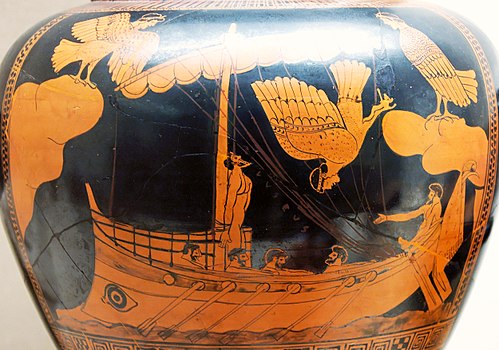
This vase from the British Museum (c. 480–470 BCE) was decorated during Athen’s classic age three centuries after the story of Odysseus was known and eight centuries after at least some of the events described may have occurred in ancient times.
Just now I’m seeing lots of reels on Facebook complaining about idiotic teacher’s in-service activities. Forms groups with people you don’t usually talk to. Markers and butcher paper. Guest speakers who haven’t taught in decades because presenting pays better and they don’t have to interact with kids. Entire sarcastic reels about wasting time. I hear them. Forming groups? Warm-up actives? Don’t I have work to do? But I learned to get it done at home on my own time. In the working time I was allowed, I made photocopies, labeled folders, and moved tables and chairs in place.
Tomorrow is the day I usually post. I probably will have something going out tomorrow. But for now…
I have grievances. Old grievances. Being told I was stupid to do all the assignments I assigned my students, and then being in-serviced a few years later about how I should be doing all the quizzes, tests, and other work I assigned my students. By the same person.
But the reels I’ve been seeing about in-services don’t question the need for continuing education. They question what and by whom. One reel focused on the poor quality of presentations teachers are required to sit through especially about something they’ve already been in-serviced on a half times, each time using a new acronym. Were they ever useful? I noted that I’d received useful information about autism (from the social-worker mother of an autistic student) and poverty (from someone who grew up in generational poverty and now had a PhD), but also a horrible in-service about poverty (from someone who wanted to sell books and advocated teaching poor kids to be more selfish).
Although I have done more than a dozen presentations for organizations such as the National Council of Teachers of English and Social Studies and numerous school districts about incorporating writing and teaching writing, no one ever asked me to present at my school. A Social Studies teacher complained that I should be teaching APA form instead of MLA because “all college writing is in APA. I started with MLA in the Junior year because I was an English teacher and because all undergrad programs in our state at that time were supposed to use MLA. [As a Math major at the University of Washington and later in Computer Science, my older son assured me he’d always been required to use MLA until grad school.] I warned students to read college syllabi and always ask about using MLA if a paper was due in week six.
When I was teaching WR121, I assumed my students knew MLA taught APA. I had overviews for both and for Chicago style (used by the UofO) and urged students to use whatever style was comfortable. I offered to send those teacher materials to the Social Studies teacher so they could teach APA to their students, but they never bothered because they only wanted me to do that work. They had no intention of scoring any writing multiple choice. Only one teacher in that department looked at paragraphs.
[It’s only fair to emphasize that all of my essay-writing skills in high school came from my Social Studies classes, from handwritten 5-page position papers to typed research papers of over a dozen pages. Only outside the English departmentt in the school where I taught assigned essays. Many teachers would not have been able to do that because they didn’t possess the necessary writing skills.]
An imported Administrator told us about her skiing vacations. A former Spanish teacher wasted more than an hour teaching us a sentence about a Spanish painting. We brought in a speaker to talk to students who emphasizes that sex in high school forever ruins their lives because God said so—caught that one in time to stifle the message somewhat. A student who had advocated for that speaker later chewed me out for judging prostitution since they had a friend who was a sex workers and they only told their kids what was “age-appropriate.”
At a conference a famous writer told English teachers to identify the “bankable students” and let the rest go. “I know you want to teach them all, but you can’t.” I followed them out the door, got in past their handlers and told them they didn’t know who was bankable, that even with 20 years experience neither did I, and we had no right to assume we could make that determination.
I am judgmental. I know this about myself. I struggle to let things go.
Every year, I was required by the State of Oregon to complete 13 training videos, a number that eventually grew to 17 or 20 (!). I was supposed to watch these online informational videos and to pass the mostly true-false tests at the end with a minimum 70% score. (I could retake that test multiple times if I failed. I did fail the legal ramifications of handling toxic substances.)
One of the questions about online harassment wanted the wrong answer. I stubbornly answered it correctly year after year, and I messaged the state several times that their source was seven years, then ten years, and then twelve years out of date. Eventually they recognized that YES online harassment was a serious problem. They added it as another test.
Well, of course they did.
All this to say that education for educators is important. We need to keep improving, to stay abreast of current research and strategies. I loved the in-service on the brain, but my peers didn’t find it useful—maybe they needed that last step spelled out about applying information to their interactions with students? Two parents prepared a powerful presentation about at-risk LGBTQS+ students. The danger the presenters emphasized was the suicide rates and failure in school among these students, that this alone suggested some compassion on teachers’ part. Without making a judgement, they urged us to consider the potential impact on academic success of these teenagers. An administrator with a religious bias advocated for compassion, but their presentation was met with vocal resentment and hostility. One teacher complained they didn’t have time to insist students not use bigoted language in their class. Another complained that students had told them I refused to allow such language in my classes.
The presenters came for free to our school. One had known for a long time of their child’s sexual orientation, and the other had learned only when their college-age child came out to them. They were very clear that they were not asking anyone to change their private moral opinions, only to consider the risk to the lives and education of non-cis students when they allowed hostility to hurt them. This was my own policy: you will not swear or use pejoratives when referring to other people. We were in the 1990s a largely white school with some very wealthy families and many more who worked for those families. Horrible things were said to kids in classrooms and during sport practice. [A person gripe was the football coach calling his players “girls” as a means of demeaning them.]
I’m not asking you to change your core beliefs; I’m insisting you be polite in my class.
I was mentor for a senior project that took the temperature of the student body about LGBTQ+ and the results were so cruel that admin sequestered and vanished the results—everyone claimed never to have seen the tallies. This was some time ago and there’s been plenty of research backing up the presentation those mothers shared [also here, here, here, here, and here]. I would like to believe attitudes have changed somewhat since that in-service. I’d like to think teachers are no longer annoyed to be in-serviced about keeping their students safe.
I’d like to believe that.
Don’t worry, this black oystercatcher has another leg. Sometimes what we choose to see is not all there is.
They used to say, Nice guys finish last. Right about now, we need more than neutrality. The world could use a dose of niceness.
My brother said our mother was the epitome of “nice,” and that is true. Mom always tried to be nice and sometimes she went above and beyond to be kind to other people just because. She once followed a car that had dangerously cut her off and ended by holding the poor driver while they sobbed out their entire life tragedies on Mom’s shoulder. My husband Gary is like that too. Saturdays in the 1970s we walked through every pawn shop on First Avenue in Seattle looking at guitars. Homeless men would tell him their life story and he would hand them change and sometimes they cried too because someone cared enough to hear them out.
That is my model for decent behavior. Treat others as you wish to be treated. Where have I heard that before?
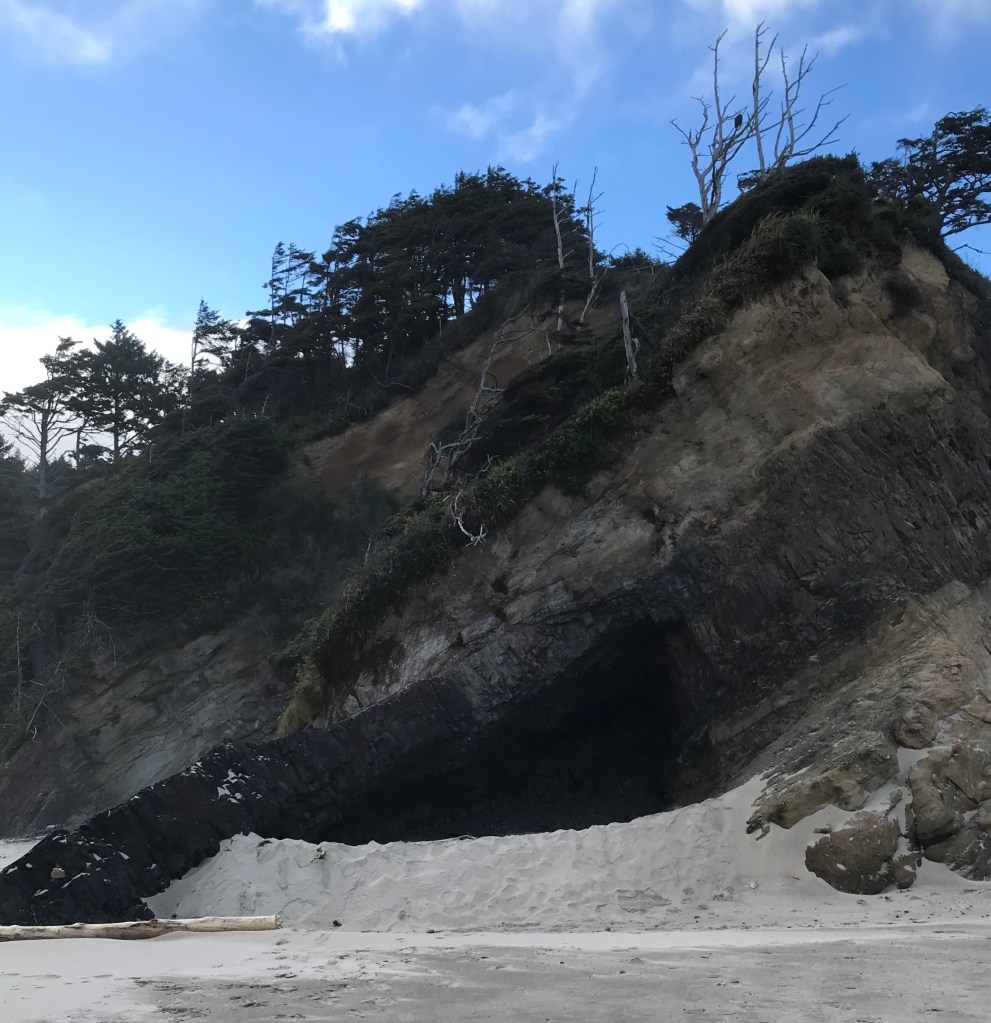
There’s a bald eagle in the snag near the top of this photo, but she’s often there in the higher branches. We suspect her favorite perch is rotting and that’s why she’s taken the lower branch. Anyway, that’s not the reason for this photo. At the bottom, this photo shows the drift of sand in front of a shallow cave we pass most every morning on our beach walks. It looks like kids piled that sand up more than three feet high, doesn’t it? But this is what the tide did a few days ago. There are four sandbars running along our shore, five if I count the one that came up this spring nearly to the green line—more sand than we have seen in 40 years or so. The dune grass that was introduced to Gearharrt a few lifetime ago, was also introduced here but has not thrived the way Siberian blackberries, montbrecia, and English ivy have.Continue reading →
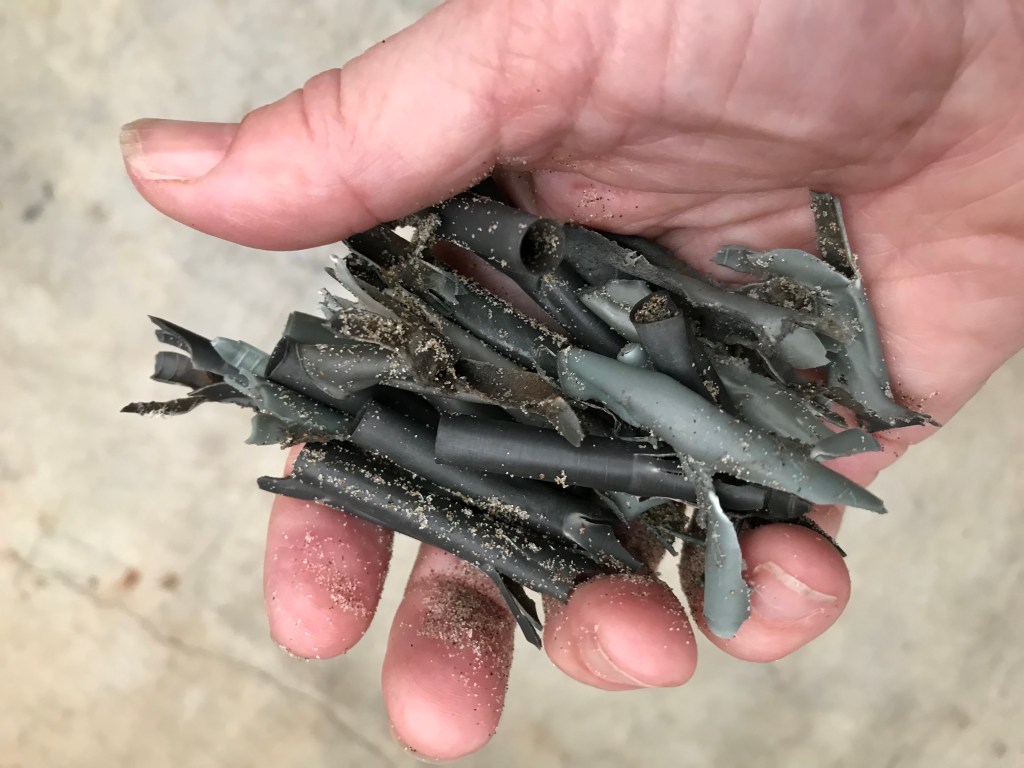
Yeti, our last dog’s favorite treat was a Greenie, a green starchy chewable bone-shaped object she could chew into bits and swallow in a minute of two. Green meanies are something else and they hurt my hand to hold, as I am in this photo. I wish people would pick them up so I didn’t have to.
I call them “green meanies” because I stepped on one once barefoot. Though I didn’t bleed, it was painful. They are the remains of fireworks of some kind and difficult to spot amongst bits of seaweed on the tideline. I search for them every day, plucked a couple dozen from the sand this morning, and I will still be finding them in January.Continue reading →
It is a newer expression, “Read the room.” It suggests that a person should have the sense of where others are emotionally and intellectually, how they view what is said and seen, and more critically, whether they agree or are inclined to wrestle with your words and actions and very presence, to be annoyed or even angered.
The sky need not be blue or cloudless, the earth need not be subdued, our hopes need not be limited nor contained. It is in us to maintain faith a kindness, generosity and compassion. We might share; we might see our duty to others.
Reading the room when I’m not in the room isn’t a skill I often possess. I misunderstand or fail to appreciate the inclination of my audience. However did I manage a classroom? Zoom didn’t exist. Determination to do right, to accept that my understanding, experience, and knowledge might be shared.
The signature CALYX image celebrates fifty years of CALYX: A Journal of Art and Literature by Women+ founded in 1976, on the 200th anniversary of our nation. It served as a reminder of the great ambition of readers and writers, makers and thinkers, a reminder that we have not yet reached our ideals.
Last weekend, Saturday the 14th, I was in my hometown, Corvallis, Oregon, for the 50th anniversary of Calyx: A Journal of Literature and Art by Women. Gary doesn’t care for events (to be honest, neither do I), so I would have attended alone. Fortunately, I was joined in the day’s events by my friend, once-writing partner, former student, and current popular college professor Rebecca Olson, author of ARRAS HANGING: The Textile that Determined Early Modern Literature and Drama (2013) and Early Modern Reading and the Imagined Self (2025), as well as numerous articles on Shakespeare, early modern textiles, and inclusive pedagogy.
In the UK, what we call private schools are called “public schools,” and they cost many thousands to attend. In the US, a private education can cost four times what a public college education costs, even more than Harvard costs, in tuition and fees. When people complain about failing public schools, it’s well to consider that you get what you pay for. It’s well to look at what wealthy people have tried to convince the rest of us about public education. The insistence over the past fifty years that public education is failing is a self-fulfilling prophecy promoted by wealthy people who feel have no stake in quality education for other people’s children. The rest of us do have a stake, because we care about our children, and maybe we should care about all children as future citizens. I won’t pretend the issues are simple.
Yes, a rainbow right down onto Castle Rock, and just the other day. We could see both ends, north and south.
I never claimed to be “blocked.” You know that word, right? It’s a term familiar even to many people, even those not devoting their days to being writers. Visiting my MFA Residency as an alum this past week, I am reminded there are several ways of being “blocked” as a writer. I’ve denied it until now, but yeah, I’ve been blocked. I have experienced at least three kinds of blockage: not writing much is rare for me and usually just means I’m resting and doing other creative work; writing badly, something that’s absolutely useless but at least it shows on the page‚oh, yes; and writing something I can’t let go of but keep fussing over and fiddling without getting anywhere. That last is where I am now. The most recent novel is done and however eager I might be to continue working on it, it’s time to set it gently aside.
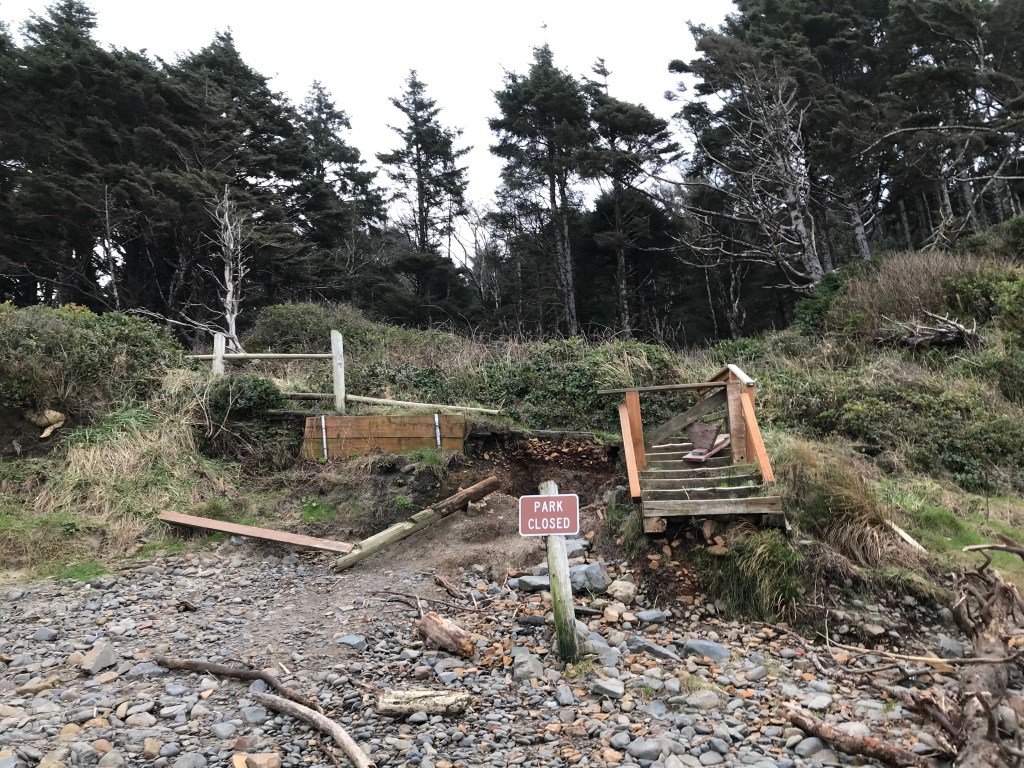
I imagine the Parks Department is trying to figure out what to do here. Last Saturday, we walked to the headland a little over a mile north of our home, then around that headland and the next headland, and all the way to Hug Point beach. If we’d waited another hour for the tide to be fully out, we could probably have reached Hug Point proper. Instead, we were curious about what exactly had closed the parking lot for this popular park. The broken railing you see in the photo was washed away last winter. It’s worse now. The Parks Department probably tried to fix it because you can see fresh wood, but a few months ago, they blocked off the entire parking lot. We are accustomed to seeing the steep lot packed to overflowing in summer and pretty much year around in good weather. But most of last year, the descent was scary. We assume someone was injured trying to get around those broken stairs. We saw people both giving up and working their way around all last summer and into the fall before the lot was barricaded and the weather and tide shortened our walk north. We wonder when this mess will be repaired but expect the Parks Department is waiting for late spring and lower high tides.Continue reading →
Hello, readers. I wrote the post below before Good was murdered. Good was murdered. I have read the articles, the defense by MAGA, the responses from newspapers around the world by reporters who watched all the videos, and comments from all sides. It is not a capital offense to slowly drive away from someone—even if those someones were police officers, which they weren’t. Not even then is it okay to shoot someone three times in the head… and people bragging about it? This isn’t my country, the country founded on the ideals of respecting every individual’s rights to life, liberty, and the pursuit of happiness.
But here, what I was worried about before:
A couple of things: I am reading Bad Bad Girl by Gish Jen, and this morning I found Allison K. Williams’s post “There Is No Closure: Stop Organizing and Start Writing” was in my feed on Tuesday. Despite a rich life deeply engaged in literature or because of that, Allison K. Williams wants closure with her writing.
They connected in my experience.
When I was a girl these large green anemones [Anthopleura xanthogrammica, or the giant green anemone] were far less common that the smaller mauve-violet ones. Today they are everywhere.Continue reading →
The truth is, I used to hit. (I’ve stopped—when? Decades ago now.) For example, I’d slap my husband’s arm in what was meant to be a playful way. Not hard. Well, a slap hard enough to leave a red mark on my son. Briefly. That was bad. This is my confession. The screaming was bad. The frightening loss of temper was bad. The irritability was bad. I regret all of it. Mea culpa. Je regret. In every language, I am sorry. I don’t know where that oral and physical violence came from. I was slapped just once as a child, but not beaten, not yelled at or berated, as best I can recall. I remember the abuse suffered by my peers. I don’t recall being spanked, just the one slap from my mother. [She did not remember doing this.]






 IMPERFECT PATIENCE