The latest research claims that “learning styles” are a myth but that reading aloud to one another is a good thing. I have to wonder sometimes if educational researchers ever consider their own biases?
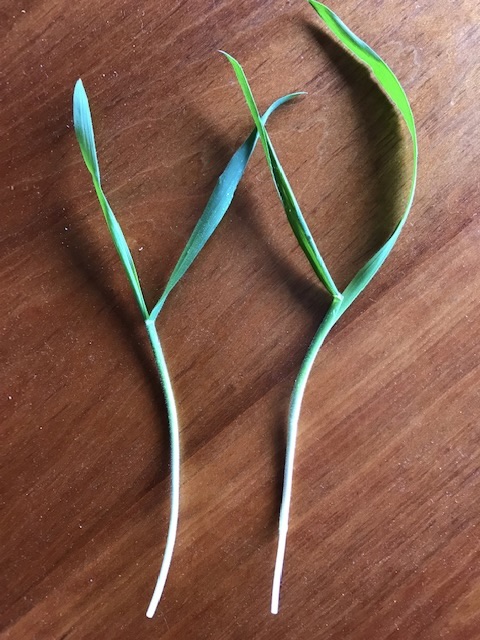
Gary worried, when he brought me these stems, that they were bamboo from our neighbors’ ugly bamboo hedge. I think: No. At least, I hope not. Anyone?
.
We were punished in grade school for reading aloud or even moving our lips as we read, but even today I prefer to hear each word I read in my head. I was an old woman when I noticed that I move my lips and say the numbers aloud while doing math—whatever the researchers might currently claim about “learning styles” and “learning preferences,” I think I was better at math because I put my entire body into the effort.
There is a huge debate about pre-Clovis sites in the so-called “new world.” Recent finds on the east coast seem to support older finds in Chile and elsewhere that people have been on this side of the world far longer than scientists insisted.
The biases in the scientific community are entrenched.
In archeology, for example, men have long assumed that culture has always been paternalistic. As a student in the 70s, I listened to a physical anthropologist describe prehistoric culture as men going out hunting and women at home in the caves taking care of the children. I raised my hand and suggested that he could not possibly know how that division of labor existed. He countered that he only had to look at “primitive cultures today.” I countered that he was assuming that cultures had remained stable over fifty thousand years? [And that word “primitive” was already known as a pejorative.]
Further, evidence from European and north African cave paintings and such ancient cave paintings elsewhere was already putting the lie to that assumption that hunting was a males-only activity. In both Architecture and Art History classes I had seen evidence that countered that familiar narrative. Today, there is a great deal more, such as studies of tartar revealing the some ancient peoples may have preferred fish to red meat and the likelihood that handprints on cave walls were mostly female. A famous Viking “warrior” was long assumed (because of course) to be male is now known to be female. Labeling it initially as a “warrior” meant it had to be male and no one bothered to confirm that. We should know better. Yet, an archeologist offers the for-instance designed to point out how genetic variability can be influenced by a single event: “Let’s suppose you have a successful population colonizing an area, and then one day, 15 males go out and get eaten by a short-faced bear.” I understand his point, but this sort of scenario is too often presented as a norm and is damaging to a science that requires a more open-minded view willing to let go of assumptions based on current human culture and preferences. It is likely that in a Gatherer-Hunter culture, everyone did everything. In fact, there is considerable evidence of that.
Instead, scientists sometimes focus on proving the obvious.
I recall learning in Psychology classes that pain is stressful—duh! They needed to prove that? Apparently they did. Okay, so what else do we think we know? It is good to prove the obvious, but too often our proofs are themselves entrenched in bias. The long history of medical experimentation only on white males unless the experiment was cruel, in which case on Black men…
Researchers finally admitted that women suffering a heart attack presented with different symptoms than men and that because those symptoms were not taught might be why women were more likely to die from undiagnosed heart attacks? A huge whoops! We need to make physicians and others aware of the symptoms specific to slightly more than half the population, right? And after this was publicized, my bi-yearly Red Cross training reflected this insight? No, when the instructor was asked during that session about the symptoms of a woman having a heart attack, he admitted they were different but he couldn’t recall what those symptoms were. He did go into lurid detail about cutting a bra off a woman in order to give CPR. The men in the training all laughed.
Over and over again, we find that our prejudices get in the way of objectivity. No where is this more apparent than among male scientists assuming they know best.
So back to learning styles (visual, verbal, etc.). The once-new notion of specific learning styles made immediate sense to me decades ago. New research insists those learning styles are mere “preferences.” Whatever. When I was teaching, I assumed that whether preference, habitual, or actual need, I would present my lessons and assignments in every manner both practical and useful. That meant I often I talked them through the purpose, drew diagrams, offered printed instructions, told a story, and reviewed models of the assignment. I moved around the classroom as I told stories, indicating changes of scene. My goal was to impart thinking, reading, and writing skills, and I did that in every way I could. Did girls and boys in my room behave differently. Yes. The girls had often been trained to be more polite; the boys were more likely to assume they were right. Learned behavior or innate? I didn’t know then and I don’t know now. I tried my best for all of them as individuals.
I recall attending a party with a colleague who had brought his newborn twins. The girl had been a couple of pounds heavier at birth and was noticeably larger than her brother. Yet the boy was bounced about by the men at the party. The girl was handled gently by the women. Indoctrination begins early. Assumptions impact our behavior, expectations, and demands. They push our lives in directions that might be different had our experience been different.
Tomorrow some educational researcher will shift the known world yet again. As one example: Perhaps noting that the reason girls seem to present less often with autism has less to do with how their brains work than with what is expected and even demanded from girls as opposed to boys. We are too often blind to what we take for granted.
Our assumptions crowd out objectivity.
 IMPERFECT PATIENCE
A big YES to this: “a more open-minded view willing to let go of assumptions based on current human culture and preferences. It is likely that in a Gatherer-Hunter culture, everyone did everything. In fact, there is considerable evidence of that.” Survival depended upon collaboration and participation by everyone and yes, different skills may have been more distributed than by assigning gender specific activities…my two cents worth.
LikeLiked by 1 person
Thank you, Gary. More often lately, I find research is too stuck on assumptions—maybe I notice this because I have been paying attention to how our understanding of humanity has changed in my long life.
LikeLiked by 1 person
If only humans could learn to be more humane and treat one another with respect, understanding and kindness, in spite of differences and disagreements. If only…. My long time observations are that we have not made a whole lot of progress in this arena and that gives me pause…
LikeLiked by 1 person
A former student, teaching undergrads Early Modern English Lit, said her students were surprised to learn that people in the past also cared about their children. They think we’ve made progress. Yet another foolish assumption. Look up Olivia Judson’s “The Selfless Gene” acknowledges the drive to self-preservation, but then details many examples of altruism in many species, from human to ameba, even where that placing of others over the self seems to have no immediate benefit the the self or the preservation of the self’s genes. I once watched a crow take on the local eagle in defense of an injured seagull (crow won). That happens in nature more often than shallow students of survival-of-the-fittest understand.
LikeLike
I don’t know what it is. I like the colors though!
LikeLike
“WHY MEN GO GAGA OVER BABIES, TOO” is the title of an article on Parenthood. Another big, duh! Human beings’ survival, as is pointed out above, depends “upon collaboration and participation by everyone.” This isn’t only true of people. Unmated male wolves in a pack take care of, play with, protect, and feed wolf cubs they are barely related to.
I went back to read the essay. I’m sorry I did. She opens with an anecdote about her dog killing a fawn and how much the cries of baby animals resemble a human baby.
Back up: She let a Ridgeback loose after a deer, caught it when it caught the fawn, and then let it go a second time? She thought it never caught anything? I used to judge field trials for sighthounds in the US and Canada. They are a highly efficient and particularly aggressive sighthound. Is she unaware or indifferent (or stupid)? Not to mention the AKC Standard suggests her dog is oversize or grossly overweight at the claimed 120 pounds (or was she making excuses for letting him go? Twice!): “Desirable weight – Dogs – 85 pounds; Bitches – 70 pounds.” The rest of the essay is pretty obvious. We are a communal animal, and everyone cares for children because we couldn’t have survived otherwise.
LikeLike
I have always assumed that different people will have differences in what works best when trying to learn something. It seems that for me if I write something down I will remember it better than just reading or listening. Even if I never reread what I wrote, having written it will help me remember it.
In the eighth grade I read an article about listening to audio when you were sleeping to learn something. I decided to give it a try with an upcoming history test. So I underlined parts of the text book and made a few pages of notes then recorded a 60 minute cassette tape with all the material I thought most important. I listened to that 60 minute tape as I fell asleep. I got an A on that history test! Conclusive proof that subliminal learning while you sleep works.
The image I found of bamboo shoots looks like the tips of asparagus not like your photo. There are probably many varieties of bamboo but I think that looks more like a common small grass.
LikeLike
Rehearsal is well known to be supportive of learning. Practice. Writing works for me, it is why I took notes in college—not to study, but the process of hearing, selecting and organizing what matters, writing it down. It works for me.
The brain is engaged in many activities, and different activities while we sleep. While we are sleeping our brain files away information held in our short- and mid-term memory. Otherwise it slips away. That’s why it’s important to have a solid night’s sleep before an exam. Staying awake all night studying is exactly counter to any hope of longterm memorization—and it why many students who do this find they recall nothing of what they studied.
Study hard and in multiple ways, look at the material before you sleep, and then allow your sleeping brain to file it away where you can find it the next day.
Your anecdotal experience supports your personal belief in subliminal learning while asleep, but it’s not proper science or proof, is it? A study requires more than one experience. You did everything else perfectly—read, wrote, spoke, and slept.
Yes, I told Gary I didn’t think it was gras but looked like some other grass. [Bamboo is a grass.]
LikeLike
Saw a baby girl with a onesie that said My First Little Black Dress. Starts early indeed.
LikeLiked by 1 person