An imperturbable demeanor comes from perfect patience. Quiet minds cannot be perplexed or frightened, but go on in fortune and misfortune at their own private pace like a clock during a thunderstorm.—Robert Louis Stevenson
June is ridiculously busy, which is not something I can say about most months. Most months my busy is entirely self-inflicted. I read, sew, knit, run, post online. Scrub floors. Gary and I drive to Portland and home from Portland, we walk across the city or walk five miles north on the beach. [We did this recently. Once. Ten miles round trip. Probably not again.]
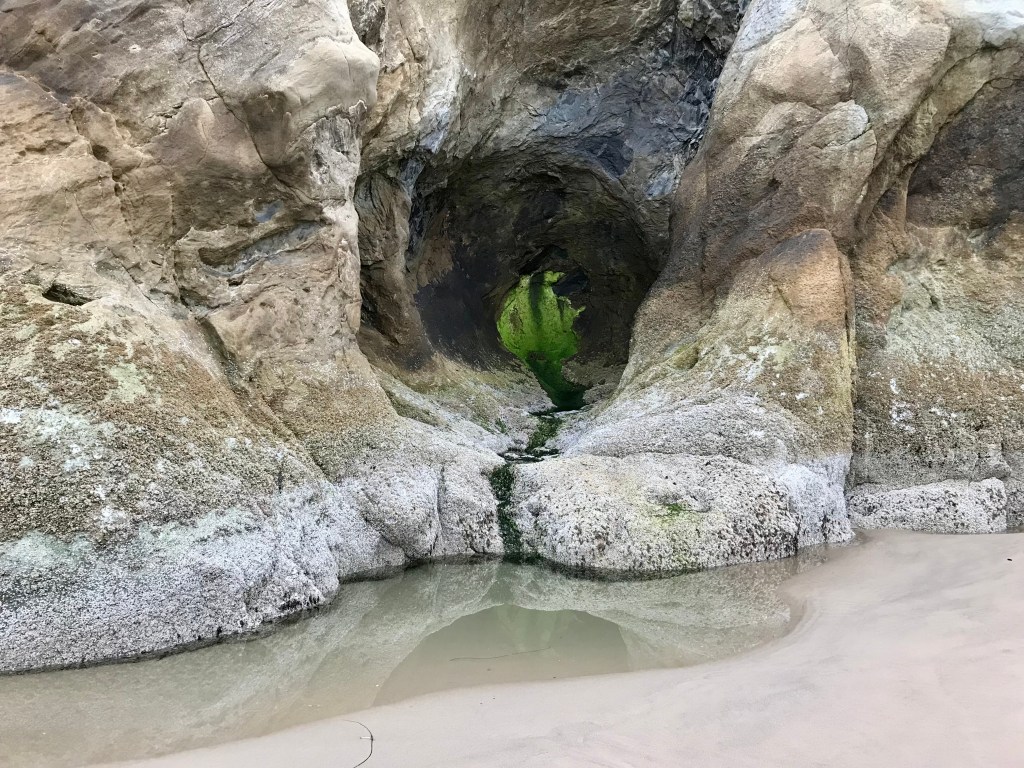
This is the hollow in sandstone facing the ocean that I call “The Little Altar.” Usually by this time of year there is a circle of green algae on the back. This year, there are three green penguins. Can you see them? Two looking south, a youngster flapping and pointed north? (And yes, there is a Big Altar a few feet north. No penguins.)Continue reading →
It’s New Years Day, the day we make promises to ourselves about how to have a good or better year. But I’m not making promises, only suggestions for myself. Here’s the short version:
dress crazier
watch what I eat
vacation even if it’s just for the day
walk long and run short distances, no hurry
write and create objects to please myself
try
This sunset was photographed by most everyone we know. It changed and got brighter, more magenta than orange.
In 2025: I went through dramatic changes with my novel, the most notable of which was sending back the advance, cutting it to 60k words, and recognizing that if it’s going to be published I will do that myself. We stopped drinking altogether in October as a result of observation of a friend’s disastrous decline. I injured my foot in May and recovered enough by November to run.
Gary and I quit drinking in October. He was having a beer or three each day, and I averaged a glass of wine. Then our tenant totaled his car and left his home in filth to go into assisted living—that was September and we’re still repairing the damage caused by incontinence, smoking and drinking, and neglect. We were surprised by how easy we found our choice to quit drinking, we don’t miss the alcohol or the hangovers, and we’ve noticed we’re saving more than a hundred dollars each month, which is particularly welcome.
The national news was mostly awful, but we are well.
One more personal suggestion for this coming year… I was once an eight-hours-sleep-a-night person. When I was still a child in the early 1960s, an article about sleep made me determined to get my eight hours of sleep each night, and I maintained that excellent habit all through college and parenting and teaching Art and English and writing. But in the 2000s, I found teaching while caring for my mother did not leave me much “free” time to write, so I deliberately cut an hour from my sleep schedule. Seven hours allowed me to write novels and complete an MFA, but I’m now down to an unhealthy six hours of sleep and I’m missing those other two hours.
I really want that sleep back, and I will be taking steps.
I’ll probably read at least 50 books in 2026 and worry too much. We’ll pick up litter on the beach, hopefully find someone to rent our rental, and visit family and friends. I’ll bake and cook and make stuff. Gary will do kindnesses, remember, listen to music, and garden. No promises, but we’ll try not to do anything stupid while staring into the face of fascism and maintaining some level of optimism because we are hopeful people.
I was asked for advice about teaching fiction in a 12-week term. Over the years, I’ve been asked to design curriculum many times, usually by administrators who have never actually done that and don’t appreciate (or care?) the amount of work involved. I have never been paid and rarely even receive a thank-you for doing this. The work is consuming and exhausting, and I should have learned by now to say no, but I always do it. It’s interesting to me.
Though I was discouraged from teaching fiction, I assigned fiction every term I taught. Telling stories is what makes us human.
You might teach people how to write fiction this way:
Consider at the outset, how much homework, how much work you are willing to read as a teacher. Draft at least some of the writing in a writing fiction class by hand on paper. There is a difference once you type into a computer. Refuse to accept work that has been drafted using AI*. Watch students begin. Require all drafts be turned in. Do many very short low-stakes fragments and scenes. Explore craft, particularly considering sentence structure and tone, dialogue and scene, the magic that happens. Use the shorter assignments and reading to get to this. Advise students to watch for the assignment that gets away from them.
I have taught a workshop for teachers called “How to Teach Writing Without Making Your Eyes Bleed.” The title comes from an excellent AP teacher whose eyes literally bled every spring before her students took the AP test. Since I was teaching as many as 200 students at a time as a high school teacher (never that many teaching college classes), I have strategies. Among those: Grade writing only after it has been through revision. Grade only after work has been typed.
Outline everything they will have done by the end of term and share this with your students. Reassure them that your goal is not to turn them all into published writers (you won’t). Your goal is to help them to become better at story-telling and to understand what makes a story work for readers. Publication is another thing altogether. Most MFA graduates have learned nothing about publication.
Begin with an assigned short fiction. A 300-500-word fable works well because it fits single-spaced on a page and has very specific conventions, which relieves students from having to invent the wheel, so to speak. State the moral at the end. [It’s important to note that I read hundreds of their fables and they were always good.] I required MLA form for this assignment. I usually threw my students a twist or two for the second draft: add dialogue or change the point of view to first person. Usually both. I marked the stories for errors and required them to revise until the story was free of error—with no penalty if they needed another seven drafts to get there. If you keep it single-spaced on one page, it is entirely manageable to staple previous drafts behind. Assume three drafts or ten. This assignment will ensure everyone understands how to set up their pages and gives you a good overview of their skills (or lack thereof). Having them write the first draft in class may make sussing the AI-users easier.*
Throughout the term, have them read many good writers: Assign what you know will demonstrate the techniques you value in fiction. This is a discussion topic for one class period each week: read the assigned text and discuss it in class (a short story in the public domain works—check what they can find online, and if necessary make them read it in class and respond the same day).
Another series of weekly assignments might be the ones from Ursula K. Le Guin’s craft book, Steering the Craft—you can read each assignment aloud or require students purchase the text, which has a ton of great information! [I have created my own ten assignments geared to nonfiction writing.] I can recommended Stephen King’s craft book, which might be better than his novels. There are others.
Microfictions of 250 words ±25, can be tailored to emphasize specific skills such as POV or lists or conversation or scene. One due each week with a particular craft or scenario for each and including a specific word. For example: Tell a story with two people in a car driving to an event and one of them has a secret they want to tell, include the work “mask.” I had the class choose the “magic words” they must include because it gives them some ownership. They might write one each week for most of the term (10 in a 12-week class) or just eight. Stamp them as “completed on schedule” and then they turn them in all at once for credit, with a lengthened story stapled at the front—the only one graded.
All the above might be 50% of their grade for the term. Include discussions and peer editing of the first writing and of the longer one.
As a last assignment, a longer story of 4000-5000 or 2500-3500, ±2000, or even a flash fiction of ≤1000 words. This final story is the necessary goal, but find a way to be flexible if someone finds they cannot write to your required length. Maybe the story must be longer, or very short? For this assignment, I urge requiring Modern Manuscript Format (Shunn), which is standard for fiction and nonfiction submissions. There are many options concerning how you assign a short story and what you require. Be as flexible as possible. Good stories, in my experience, are born of pure magic. You can’t demand magic and we sometimes throw up out hands concerning how to start. You might suggest:
Begin with a true story you make more dramatic or set elsewhere;
choose familiar traditional story such as a fairytale, rewritten to take place here and now;
rewrite a news piece that makes you wonder and then create backstory and afterward;
examine a problem and solve it in the story;
expand a micro by complicating it or exploring more of that story;
develop an in-class writing based on Chris Van Allsburg’s illustration in The Mysteries of Harris Burdick. [find a used copy or individual illustrations online—or have students find any one of them and write a story for which the drawing is an illustration;
or just allow the short piece that’s getting away from you to grow, the voice that will not stop telling you their story, the question you find demands answering by showing you what happens but insists you get down every darned detail.
Chris Van Allsburg’s The Mysteries of Harris Burdick offers wonderful illustrations from an imaginary book. There is a collection of stories by famous authors based on these illustrations.
Evaluating a short story in-class might serve as a midterm or final, if you need one. You might offer students the choice of how to prove their skill by giving them a bad story to improve and/or explain why it’s not good and how it could be better. There are plenty of general “rules” about writing short fiction. Alice Munro deliberately and magnificently breaks most of them in her early collection, Friends of My Youth.
Some of the suggested assignment include what we now mostly call speculative or genre fiction. If that’s not your comfort zone, don’t go there. Stick to realist stories. Do what makes sense to you.
About drafts: Teach them drafting/revising to the point where the author is stuck, and to seek peer editing (or workshop), and revision right from the beginning. Most new writers will not have workshopped a story. Teach them to be gentle with one another. Point out that one gift of reading others’ work is recognizing what works and doesn’t and then applying those insights to our own writing. Remind them that creation involves risk, but that what is obvious to one person is invisible to another. Help them see more.
Workshopping: The goal for the reader is to express admiration of what works, ask questions to clarify confusion, and perhaps suggest where they want more or less on the page. It is not the reader’s job to “fix” anything; that is up to the writer. [Even editors who are very good at finding where work is needed are not helpful in telling the writer how to accomplish that work—though they will try—that work must remain in the writer’s hands.] You will have the occasional student who believes their first draft is perfect, every single time. They need to accept that they are wrong about that.
You may quote me: No one writes a perfect first draft. No one gets it right the first time, not even after hours of work on that first draft. We need to put that wonderful “perfect” draft away for a while, and then look at it with our own fresh eyes. There isn’t time in a course to do that properly, but even a day or two of not looking helps. After hard work and many drafts and setting it aside and workshopping (peer editing for adults) and staring at it till our eyes bleed (famous quote), we might get there.
Go online and search “How to workshop fiction?” you’ll find plenty of advice. The standard is everyone reads the text or the author does aloud, and then the author is silent while the group responds. The response is not thumbs up but a careful appreciation and evaluation: what works and what isn’t done. Yet. [That “yet” can hurt. Keep it in mind when offering feedback.]
Teach alternative chronology:
Teach the traditional plot triangle and why no one writes stories structured like that anymore;
warn about expository lumps;
teach the work of a scene, which has a person or people in a particular time doing something, even standing still and tapping their foot’s a reason for a scene—by establishing and revealing character, motivation, information, conflict—establishing, escalating, turning—and in this way moves the story forward;
likewise, every description contributes to our understanding of the story because how the flowers bloom or fade suggests the overall arc and mood of the fiction;
start the story with a scene pulled from the middle of action;
cut the first page (or four) of a story (this is sometimes “throat-clearing”);
and remind them that hack-and-slash butchery of their own work often makes it stronger because the author always knows more about their story that they put on the page.
One final point: This is a personal bug of mine. Bring bad work to workshop if it’s the best you have, because we all get stuck, can’t see our forest for the trees, need help. But first read the story aloud (if you stumble over a word or phrase try to figure out how to fix that). Then read it to someone or to the dog or the bathroom mirror. Bringing bad work to workshop is forgivable. Most of us write bad stuff before we get to the good. Bringing work that you haven’t already done what you can, at that time, is annoying. If we haven’t already read it aloud, checked for and repaired typos, ensured the story fits the assignment (save it for another time if it doesn’t), we are abusing our readers. Do not abuse your readers. Give them the best you can, even if you know it’s not good. Yet. Listen to what the readers say, find your own solutions. Have patience. Write another fifty drafts.
I was asked to design a 12-week class, and thought it was odd because in college, classes are usually in semesters (15 weeks) or quarters (10 weeks). And then I wrote most of this and set it off. No word from the person who asked. Not the first time I’ve been asked for help and heard nothing back.
*A former student who is a tenured professor tells their students that if it sounds to them as if the work was written by AI, regardless of whether it is or not, they will receive a D for the assignment. We don’t want our fiction manufactured by technology or sounding as if it were.
When I was teaching persuasive writing, I always began with frames—a general structure on which to hang ideas. The 5-paragraph essay I was taught when I was an adolescent seems pretty basic, but it’s not a bad place to start. An introductory paragraph explains the issue and ends with a thesis, the main idea. Three body paragraphs offer three supporting reasons. The conclusion restates everything. I generally added another paragraph just before the conclusion reviewing opposing views and explaining why they’re wrong.
It’s a beautiful dress and the embroidery tells many stories. As a visual and verbal artist, I care how everything looks on the page. Every word. Every line-break. This work was conceived by the visionary artist Kirstie Macleod. “The garment has been worked on by ‘367 women/girls, 11 men/boys and 2 non-binary artists from 51 countries‘, according to RedDressEmbroidery.com.“Follow a link here to learn more about the Red Dress Project.Continue reading →
This is one of my favorite photos. It’s my desktop image just now.
Gary caught me working on this and when I told him it was a new blog post, he said, “Finally!” I had “resolutions” for 2024. Some of those plans fell apart and some went better than I dared hope and shifted my goals. Toward the end of the year I began making plans for 2025. Those have shifted too.
The latest research claims that “learning styles” are a myth but that reading aloud to one another is a good thing. I have to wonder sometimes if educational researchers ever consider their own biases?
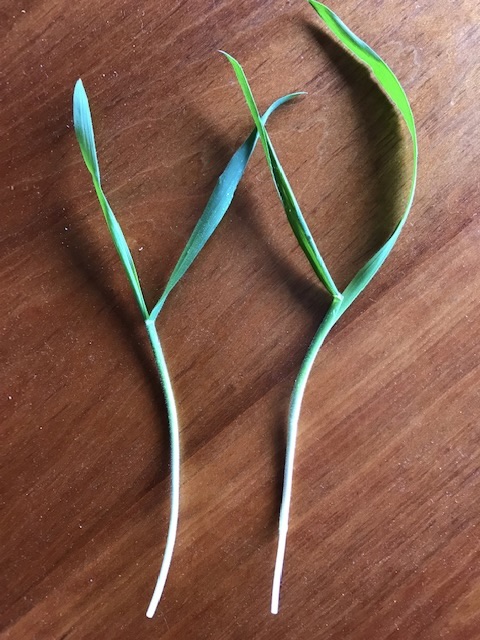
Gary worried, when he brought me these stems, that they were bamboo from our neighbors’ ugly bamboo hedge. I think: No. At least, I hope not. Anyone?
I can stand on one leg long enough to put each sock on the other foot. I cannot stand on one leg for long with my eyes closed so I stopped trying to do that. I keep reading that my ability to balance on one foot is an indication of longevity.
This morning I read about the 30-second test, balanced on one foot, and with one eye closed. I can sort-of do that with my right foot and right eye closed. (I am left-eye dominant—cross dominance is more common among women than men—right handed and left eye dominant. It’s why I had to aim off-center when I had archery in high school, though I did not understand this at the time.)
The goals I set and the accomplishments I am proud of… a little planning and some realism.
As I type this post on the morning of the last day of November, I have over 61k written for National Novel Writing Month. The official goal is 50k of a novel. In case you wonder, a typical novel is around 75-80k, but sixty thousand words is regarded by many as the absolute minimum length for a novel. By this evening, I might have over 70k once I add these new words to the one already written. Fingers crossed for me.
I won all the NaNo badges, every one. I wrote daily for a month and completed over 50k of a novel, and while I did not get the sixty thousand words to add to my existing 21k (pared down to 19k), I am optimistic in this moment. I would have liked eighty thousand words, but I think seventy-five thousand is realistic over the next months. Revision will both shave and add words. There is some hope I will get it done, that it will astonish me and make me proud.Continue reading →
I assumed that a year was precisely 52 weeks, but had never done the math. That is odd for a lot of reasons, mostly because I was always good at arithmetic and algebra and geometry etc. I worked figures in my head back when I was running regularly in my 40s and 50s. Anyway, I created a calendar and realized that a year is more than 52 weeks. Add two days and a third during leap year.
The weather is changing. We have been grateful for rain, for cooling temperatures, and colorful leaves on our longer drives. Because nearly all my life has involved beginning school in the fall, this is the season for something new.
A year ago today, I decided to take charge of my daily habits, eat a better diet, lose weight, stop wasting food, and live a more physically active daily life. I was retired and so had time to devote to taking better care of myself, covid had forced me to shop less often and pay more attention to food in my fridge and on my pantry shelves, my Body Mass Index put me in the “overweight” category which was a risk factor for covid I could do something about (unlike my age), and I had begun winding down an intense creative production. I needed a new focus.
Three other events impressed me, one from personal experience and two from “authority” figures. When sitting and watching television, my fat pressed so hard into my belly that I sometimes experienced cramps and that seemed scary. An article suggested that humans need to fast for at least ten hours overnight to rest our digestion and that made a lot of sense to me. And Samantha Bee announced on her show (which I love) that “diets don’t work!” Well, of course they do, I thought. Nothing motivates me like a good argument. I had lost weight without trying during cross country season when I was often too tired to eat when I got home from a long day and when grief stopped me eating after my mother died.
And then I thought more about what both Bee was saying and my own experience of deliberately and successfully dieting after childbirth. The trouble with dieting is that what most people regard as “a diet” is something to do to lose (or gain) weight and then they return to the poor habits they had before. Surprise! They end up back where they started.
I needed a permanent change.
Usually Gary spots eagles after hearing them first. This one hadn’t made a sound. She was watching crows consume a dead bird. Maybe she’d already feasted, maybe it would be her turn next.
I would weigh myself every day, I would expect my weight to fluctuate, but I would track the same day of the week as the one that “counted.” I would meticulously count and cut calories, but allow for higher calorie days since that is actually helpful to maintaining a normal metabolism. Since I began on a Friday, the date that mattered would be the last day of seven, Thursdays. Over the past year my weight was stable 3 weeks, I gained weight by the end of 11 weeks, and for the other 38 weeks, I lost. Sometimes I lost a couple ounces, sometimes a pound.
I set up a chart on my computer to track what I ate each day. This was not merely a diet, but my intention to radically reform my eating habits: more vegetables and fruits, regular mealtimes, only occasional no- or low-calorie snacks. I set up a sample weekly menu (that I referred to less and less, whenever I was stuck about what to make for meals) and typical lo-cal meals, goal weight, and overall aspirations, appointments, and accomplishments—first to be “Normal Weight” according to my Body Mass Index, then to achieve my prior ideal weight during cross country season. I was in it for the long haul, and assumed it would take me at least a year to get where I wanted to be.
The chart grew more complicated as I went along. I added tracking for minutes and then miles I walked and where I went. Later I added miles run. I tracked my vitamin D and calcium. I tracked the days I went to the post office for my mail (once or twice a week) and grocery shopping (every three weeks). I measured myself so that I would know when I had a waist under 31″ because that’s supposed to be healthier for me. I regained a sense of limited control over my body and health.
My BMI is under 21,
I lost 40 pounds,
my waist measures 29″ and my hips are under 37″,
old favorite clothing stashed in a bin now fits (items I never expected to wear again but kept for their fabrics),
new LL Bean petite 6 jeans fit (in my youth, before size inflation, my measurements would have made me a size 9/10, and size 2 did not even exist),
I walk about 25 miles each week, and
I can run every other day.
A week ago I ran (most of) a 5k. I had not actually ever expected to run again, but when I hit my old cross country weight I began running short distances in June, hoping to achieve a mile, and gradually built to a couple of miles. The nearest Park Run 5k had rolling hills, but I only walked about a half mile of the 3.1 miles. My time was five or six minutes slower than what I could manage twenty years ago. That’s probably good news, but I have begun training on hills—short distances. So far, so good. My long range goal is to run an entire 5k after my 70th birthday in October of next year. Slow is okay.
Right at the end of my 5k in Hillsboro last weekend. Yeah, I was tired!
I might lose another 4 pounds or settle on the weight I am now. I know how to eat better while including treats, including ice cream (rarely and a half-cup at a time instead of an entire pint) and pie and cake and popcorn with butter (again, not so often and not as much as I used to eat). I eat what I know is enough instead of until I feel full—since it takes a long time for the brain to catch up and signal “full” and eating lunch at school for nearly all my life taught me to eat too fast. I do not feel discouraged if my weight abruptly pops up a pound or two—salted popcorn will do that, but it’s temporary. Feeling hungry might actually mean I am only thirsty or bored—I can live with that for a few hours before bedtime. I get to eat sourdough waffles (or toast with peanut butter or homemade granola) for breakfast. And I am breaking my fast each morning, because while I might eat 11 almonds as a snack before my morning walk, I do not breakfast until after I get home, lunch (my biggest meal) is around noon, and dinner (usually salad or roasted veg) is around five. If I snack beyond that, it’s tea or iced coffee with milk, 1% fat.
During our last-day-of-summer walk, I found limpets and agates, two pieces of seaglass, and a large hunk of Mt. St. Helens pumice!
The upshot? The trauma in our country and the world is completely beyond my comprehension or control, but I can behave mindfully in my own actions and choices. I feel physically better and I have regained healthy habits at a time in my life and because of covid where I felt the need to exercise such control. I am not in denial about my age, but am delighted at how much I can manage. (I nap.)
This morning I ran two miles on highway hills, more up than down since I ran up to the highway, to the top of the headland north, and then rolling hills past my marker, and back to walk down through the steep Hug Point parking lot. I found a machete in the ditch alongside the highway and carried it carefully all the way home. It needs cleaning and sharpening, but I am the person to do that.
Without meaning to brag (yet I know I’m bragging), the past year has proven a lot to me. I am proud of myself; I am both hopeful and grateful. I want to prove Samantha Bee wrong by maintaining this progress, by finding a healthy maintenance and maintaining as long as I can.
I drive a small car, my husband’s little red Honda Civic hatchback, and one thing I that makes me crazy is when drivers of giant SUVs come right up behind me and tailgate.A couple of days ago I was driving home from work and an SUV merged from highway 26 onto highway 101 right behind me.I could tell the driver was mad at me that I didn’t brake to let him in in front of me because he waited till his merging lane ended before he slowed and cut in about five feet behind me.The speed limit changes to 55 mph right about there and I was speeding up but I kept speeding up to a little above the speed limit and even so he tailgated me all the way to the passing lane.He whipped on by me in the left lane and then moved back into my lane about a hundred feet ahead of me and slowed back to the same speed he was going before he passed me.So what was the big deal about passing me if he didn’t actually want to go any faster?He just had to be in front of me. It just shows America is a dangerous place to drive. I am more likely to die on American roads than in most nations of the world. There are 15.2 deaths/100,000 in the U.S. compared to 6.0 deaths/100,000 in the United Kingdom. In fact, a German data base survey of twenty-eight participating countries showed most reporting death rates in the single digits with only Portugal, Poland, Greece, Korea, and Luxembourg showing higher death rates than the U.S. (“Selected Risk Values”). We’re all a little crazy on U.S. roads. Something must be done to make the road safe from crazy drivers.
There should be some way to safely respond immediately to the stupidity of drivers who tailgate, cut people off in traffic, or drive way too slow or too fast.My solution is to issue an “idiot pistol” to all drivers in good standing.This gun would be turret mounted on the top of my car and respond to verbal direction.I would simply say the license number or describe the location of an offending driver’s car and say “fire.”The idiot pistol would shoot a dart directly into the back of the car where it would harmless attach itself and release a large two-foot orange and purple flag saying “IDIOT!”I would feel revenged right away and for a month the driver would have to drive around with a sign proclaiming him an idiot.There would be no permanent damage to the car, but if a single driver accumulated four flags in a four week period while offending four drivers in four separate incidents of stupidity, the car would be impounded.Of course, everyone makes mistakes once in a while and this would act as an immediate reminder and lesson to all drivers, while seriously punishing drivers who consistently drive like idiots.
I like the idea of punishing offenders on the spot and firing darts into the back a cars could certainly make me feel better when I’m cut off in traffic, but even I can see there are problems with my plan.I’m as susceptible as anyone to irritation, bad temper, and error.My goal is to make the roads safe from foolish drivers, but shooting at them could be counterproductive.I could end up acting like an idiot myself and chase down another driver, succumb to road rage, or pay more attention to getting even than driving safely.I might overreact to an honest mistake or choose to pick on someone I have a grudge against.Four friends could gang up on a common enemy in order to cost him his car.Most people can’t afford to rush right out and replace an impounded car.I know I would be in a bad spot if that happened to me.Finally, aside from issues of safety and fairness, this system would definitely be expensive to set up and monitor and there isn’t any existing technology to safely shoot the harmless but non-removeable darts in the way I recommend.
Nevertheless, idiot drivers are a real and ongoing problem and all sorts of strategies should be considered in order to address the problem.There are laws dealing with these things.We all need to respect the need to abide by laws designed to guard us against our own deep, sincere need to drive like fools at time.I think it should be against the law to use cell phones on the road as it is in many other countries.All drivers need to more considerate of existing laws regarding speed limit and other traffic signs, as well as use common sense about recommended speeds, spacing on the highway, and demonstrate courtesy when merging and passing.We could brand or tattoo notice of traffic violations on people’s foreheads.That would certainly get their attention.Maybe it’s not legal or nice, but driving like a creep isn’t very nice either.Too many people behave as if laws apply only to criminals and not to them.Maybe more police on the road would help, better education when learning to drive, remedial classes for people with bad driving records.Maybe some rock star, Sting perhaps, would take up the slogan, “Don’t be an idiot, drive sensibly” and make it cool to be a cool driver.
In desperate moments I’ve considered desperate measures to get even with drivers who scare the pants off me.I would like them scared too, and at least publicly embarrassed by their poor driving habits if not thrashed and arrested.But I drive a little car and I’m not interested in declaring war on the highway.The truth is that I can’t make others drive better, I can only practice what my husband suggests:“Drive like they’re all crazy, because some of them really are, you know.”His attitude is international.The Chief Superintendent of Police Traffic Headquarters in Hong Kong said just the other day: “smart drivers always assumed that other drivers were inexperienced and careless.” After a widespread courtesy campaign, death rates in Hong Kong dropped to the record low of only 3/100,000, a fraction of what they are in the U.S.So I think I’ll be safer if I listen to the experts and my loved ones and take care of myself without seeking revenge. I will be polite. If someone wants to merge in front of me I’ll try to let them.If they want to drive faster, I’ll look for a place to pull over.If some motorhome is creeping along at 35 mph in a 55 zone with no passing lane for a mile, I’ll take a deep breath and ask myself why I’m in such a hurry.I don’t want to get so bent out of shape about other people’s idiocy that I become another idiot myself.Though I can’t change the rest of the world, I can try not to let the rest of the world ruin my day.





 IMPERFECT PATIENCE