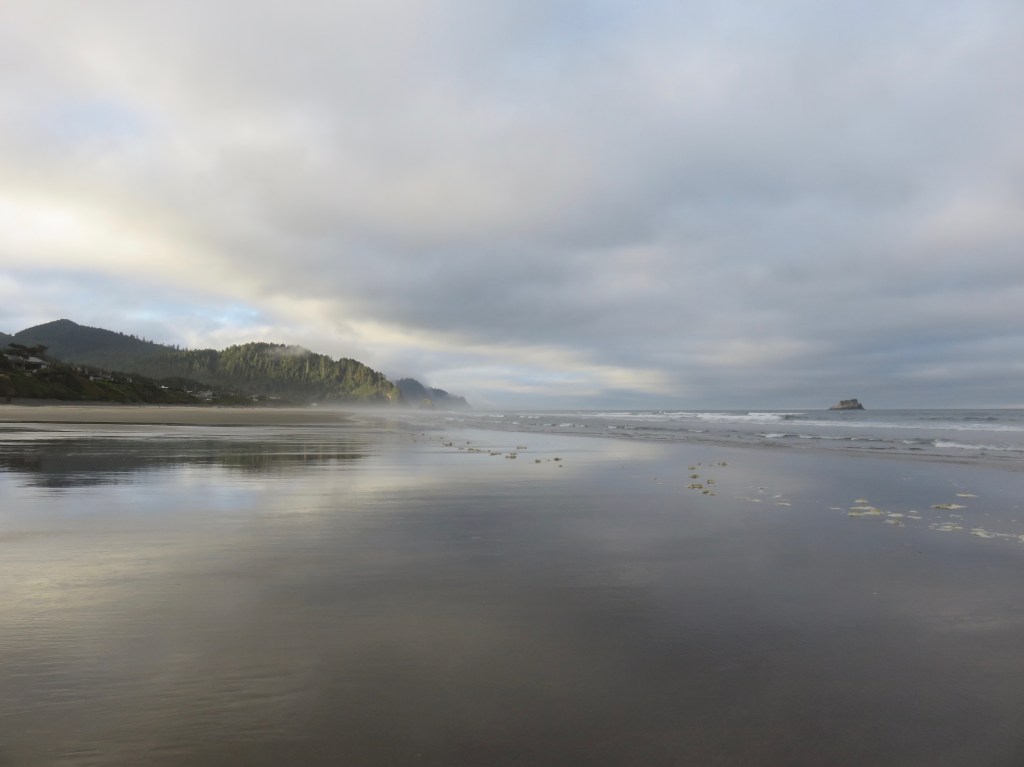
Our walk is what begins our day, what gets me out of bed and moving so that we can walk tide-washed sand and get home before the crowds. What we see on our walks—crabs, isopods, a moth caught on the wet sand, seabirds and eagles, the sand crabs and hoppers of various sorts—decorate our path. There were no chitons, none at all this morning, on the headlands or seastacks, but juvenile gulls still cried for their mothers to feed them.
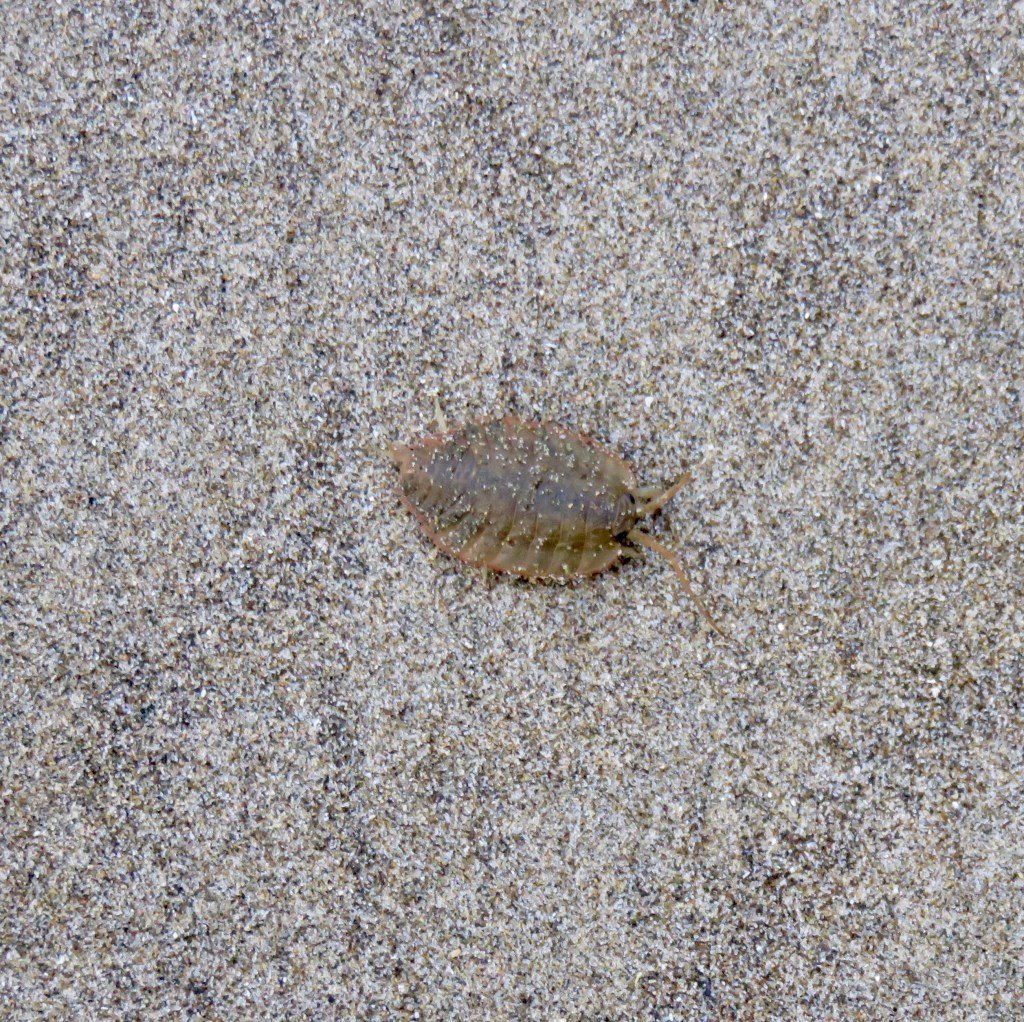
The odd little fellow rushing past us was an isopod, a sort of catch-all term covering the ten thousand other species of Isopoda, an order of crustaceans that include woodlice, what we called “pill bugs” when I was little. The Isopoda include 4500 species that live in or near the ocean, 500 on dry land, and the other 5000 in fresh water. They are found worldwide and the land-based species are entirely herbivorous and harmless to humans. Some marine species bore into wood (such as boats) or are parasitic to fish, shrimp, or crabs. The one I saw this morning was likely a rock lice or sea slater, considered a terrestrial isopod, though its habitat includes tide pools—the entire splash zone. Taken together, this order lives everywhere in the world, from the tropics to the edges of the Arctic and the continent of Antarctica.
We walked long this morning and after touching stone at Hug Point, hundreds (Gary says thousands!) of pelicans flew past us heading north. The first group of seventeen was followed by a small group of five, which appeased us since we suspect they are almost always in even numbers. (They are monogamous for the breeding season.) Then a group flew just outside the surf line, too many to get an accurate count, and another group and another and another all the way while we walked the two miles home.
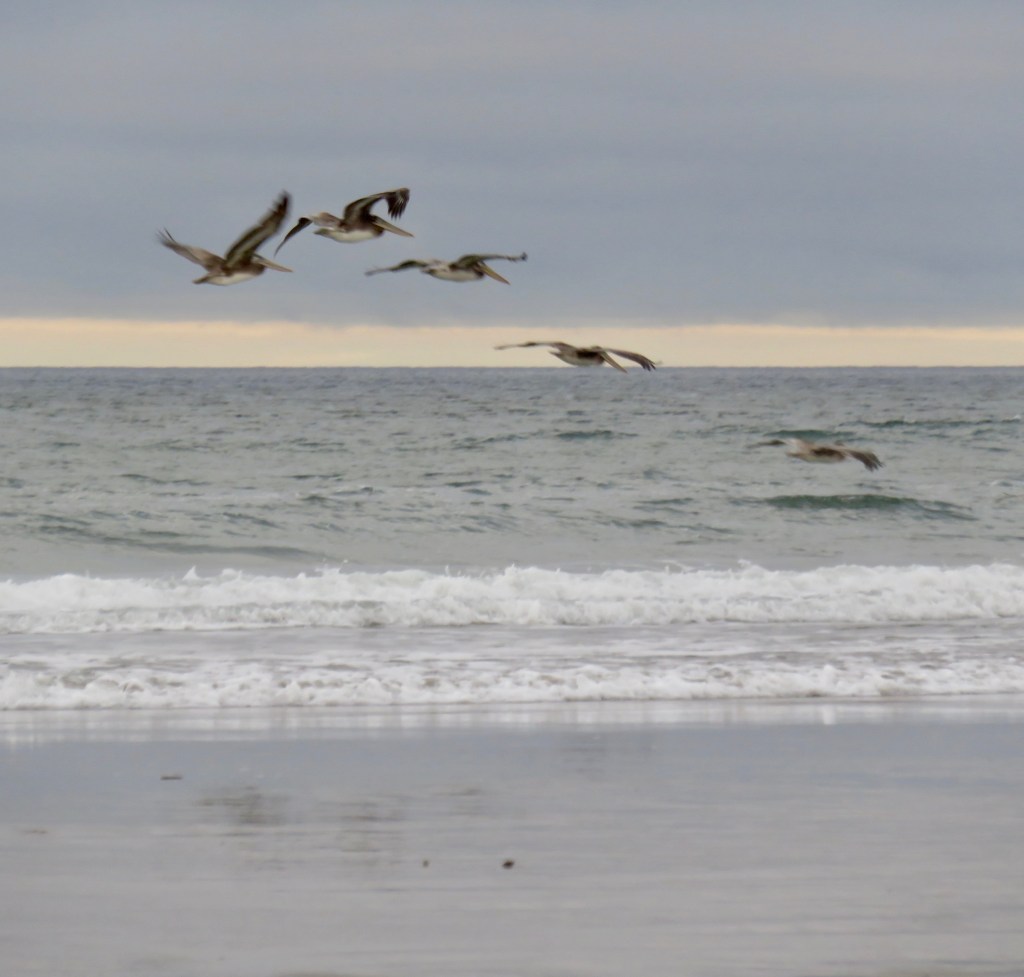
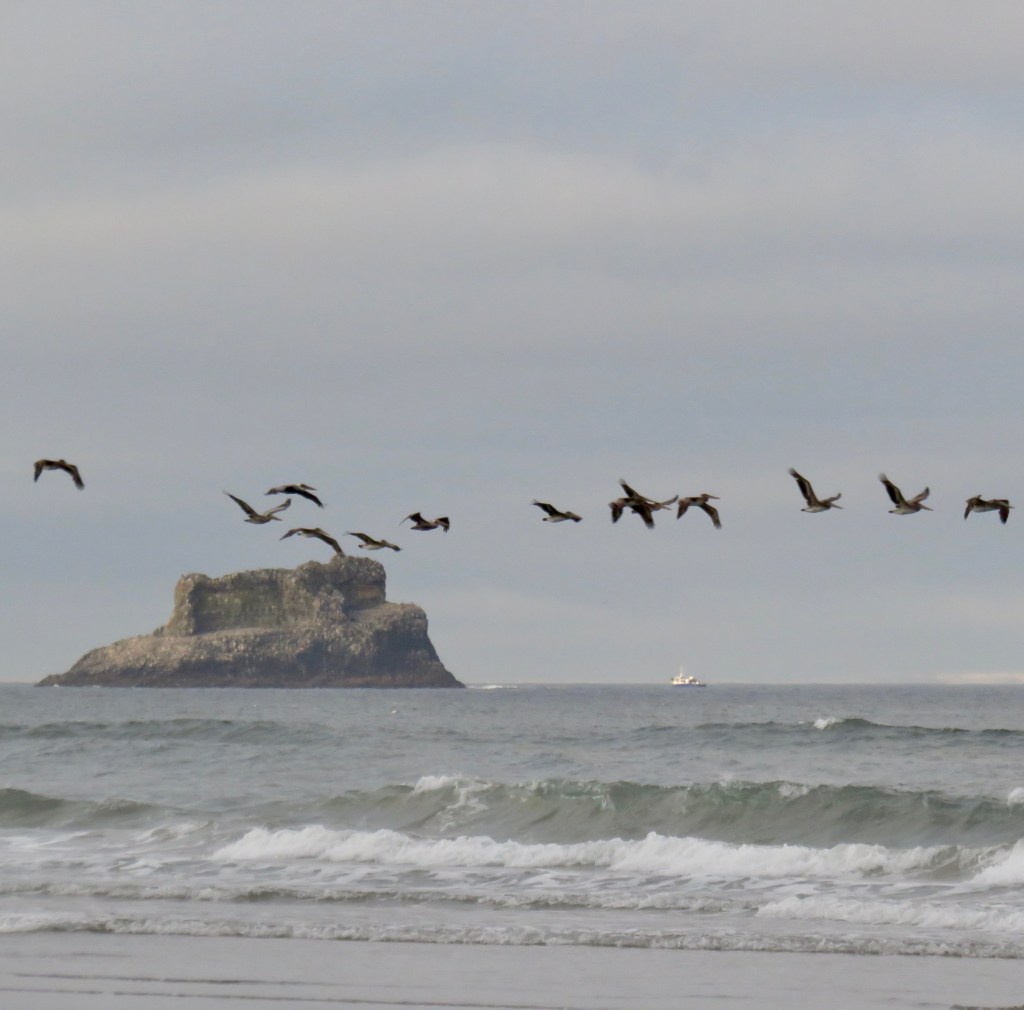
The brown pelican (Pelecanus occidentalis) was identified and named by Linneaus in 1766. It is found from the mouth of the Amazon River and Galapagos Islands north into Canada on both the Atlantic and Pacific shores. It was listed among the endangered species by the U.S. from 1970 until 2009, but thanks to the ban on DDT in 1972 the species has recovered and today is listed of “least concern.” The local subspecies is californicus, which breeds on the California coast. A large seabird, our brown pelicans are the smallest of their kind. Their flight feathers are dark brown when I find them onshore, and sometimes a foot and a half long. They have a wingspan of about seven feet (6’8″ to 7’6″) but weigh seven to eight pounds. They spend their lives almost entirely at sea. They glide steadily near the surface and we enjoy watching them dive into water for fish. Pressed to catch up with their pod, a pelican can move very fast indeed. They can perhaps fly at speeds past 50mph, and live for decades.
When we moved here forty-one years ago, neither of us recall seeing these birds at all. Then one summer, there were a few who passed, then fourteen arrived one early summer and stayed into the fall. That might have been fifteen years ago, perhaps more recently, perhaps in 2007. We see them each year now and long lines of hundreds sometimes pass, but usually a dozen or more hang about, fourteen or eighteen, throughout the warmer weather. They have flown right in front of our windows—their strange pterodactyl faces, always seeming to be pointed north. Most often they glide a few feet above the ocean, between breakers or just outside the surf. But other days we see them far out on the horizon, moving in smooth, graceful arcs.
We are always heartened to see the pelicans. Thank you, Rachel Carson. Thank you thank you thank you!
•
•
•
 IMPERFECT PATIENCE
Included in the absolute wonder of Birds is their resolute ability to survive [if only in memory] in the presence of human folly—I say this as I sadly observe each September and remember Martha—truly one of the Thunder Birds!
LikeLiked by 1 person
[fyi Martha was the last of the passenger pigeons who died in the Cincinnati Zoo on 1 September 1914. Gary was born on that day 35 years later.]
LikeLike