An imperturbable demeanor comes from perfect patience. Quiet minds cannot be perplexed or frightened, but go on in fortune and misfortune at their own private pace like a clock during a thunderstorm.—Robert Louis Stevenson
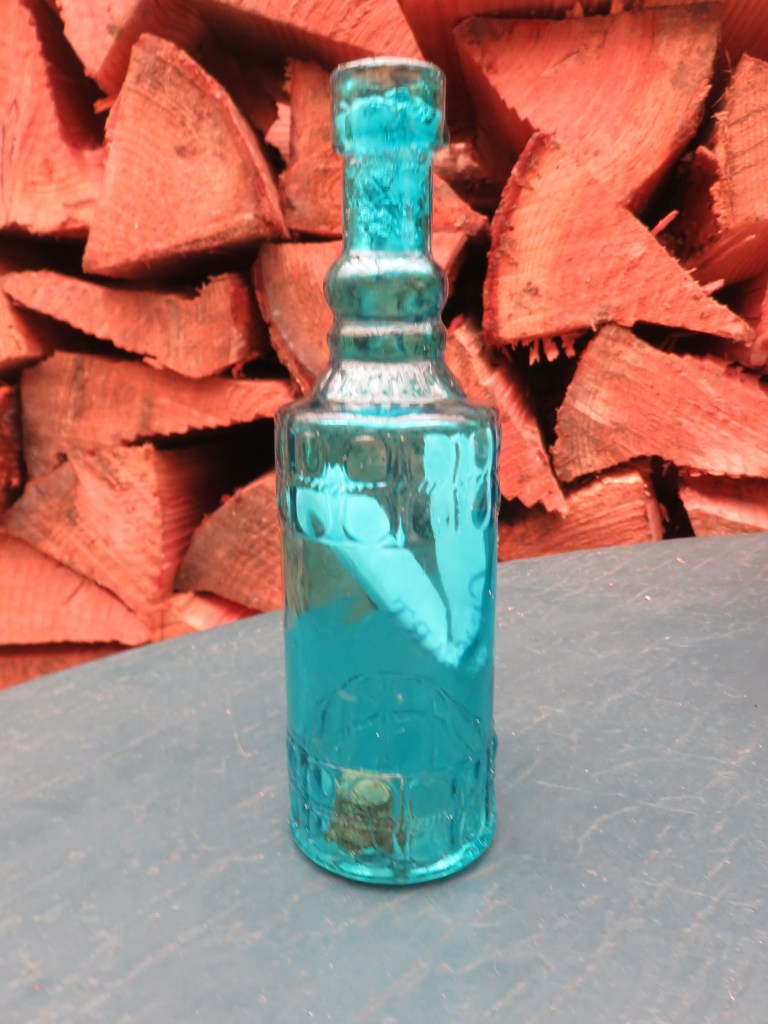
The bottled message was dropped the day before about 15 miles north by a couple celebrating their anniversary. The cork had been pushed through, and the neck was plugged with a foiled candy wrapper. We’re sure they would have loved to hear about the finding after a month and from another state, but it made our day!
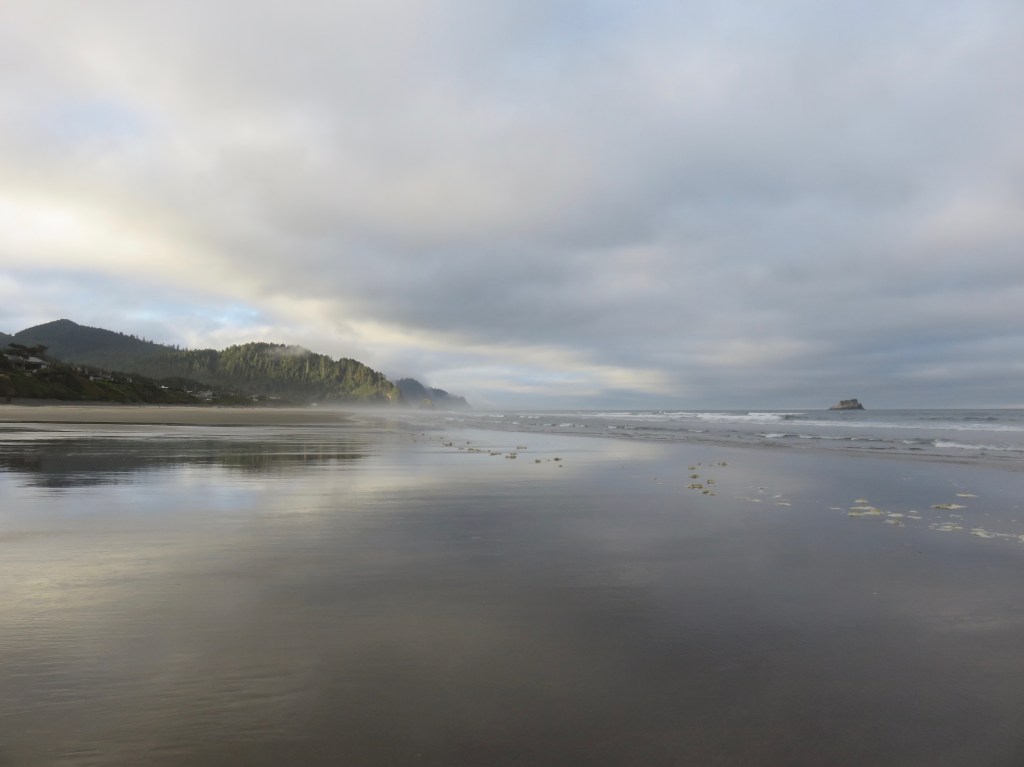
There was fog this morning, lovely fog and a bit of wind during my run. Yes, I ran. I am running a bit faster than ten minutes miles. My old easy “light run” pace was nine-minute miles, and that might be what muscle memory is giving me now. I thought my knee might be giving me trouble again, but it didn’t. Sore, but not impeded.
It’s been a crazy week, crazy for a number of reasons I will not try to explain. Gorgeous skies. Pelicans fishing right in front of us. Sand sweeping in. And struggling to find out information. Is it because I am old or because I am a fanatical researcher that I sometimes know more about other people’s jobs than they do? It’s been happening for years. Does that happen to anyone else?
The first years we lived here, we did not see them at all. Perhaps we failed to pay attention when our sons were small, or perhaps they either flew right past or never came close enough to visit for long. Then in the ’90s, fourteen pelicans arrived one August and stayed in the area until the weather changed. Since then we have seen pelicans every summer. Often there have been fourteen.
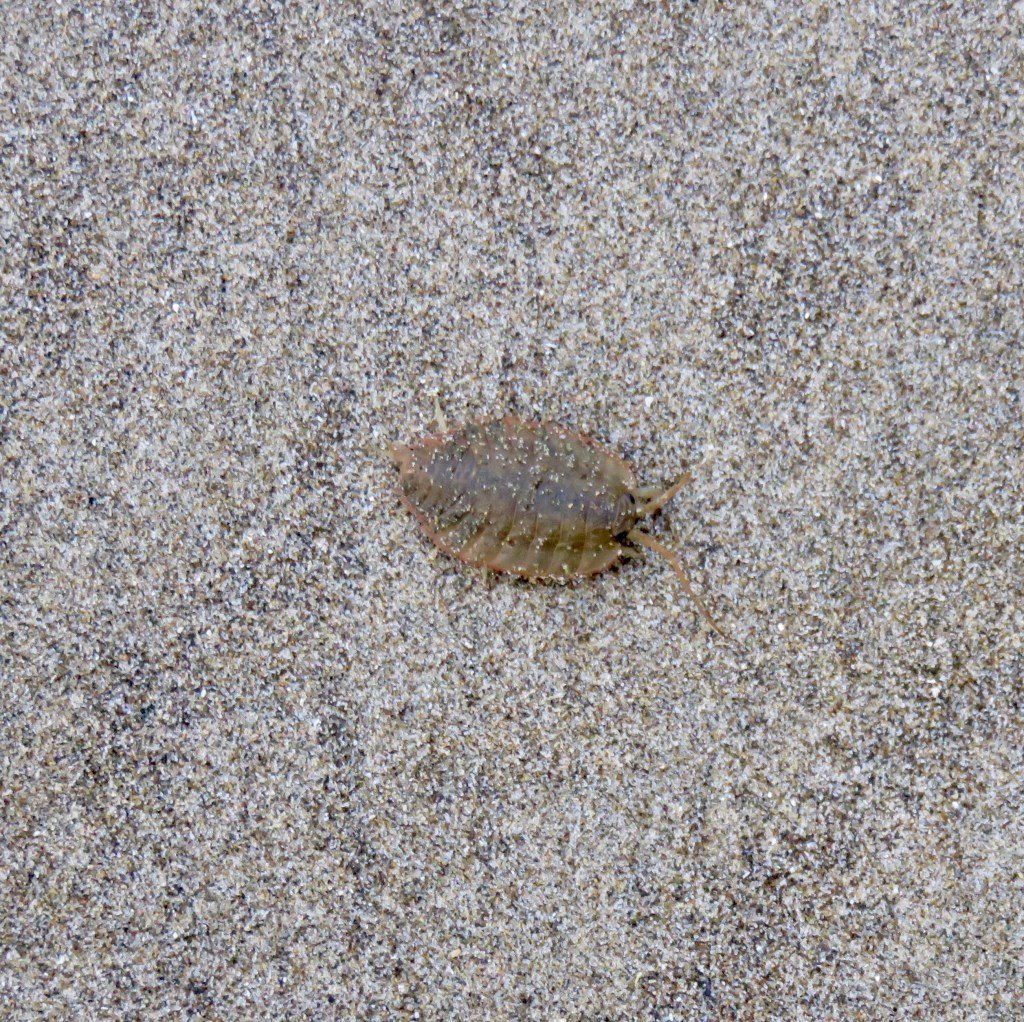
Our walk is what begins our day, what gets me out of bed and moving so that we can walk tide-washed sand and get home before the crowds. What we see on our walks—crabs, isopods, a moth caught on the wet sand, seabirds and eagles, the sand crabs and hoppers of various sorts—decorate our path. There were no chitons, none at all this morning, on the headlands or seastacks, but juvenile gulls still cried for their mothers to feed them.
When my nearby footsteps alarmed this isopod, it flipped onto its back, rolled up just like a pill bug, and then flipped back onto it myriad legs and scurried on. It was more than an inch long
The odd little fellow rushing past us was an isopod, a sort of catch-all term covering the ten thousand other species of Isopoda, an order of crustaceans that include woodlice, what we called “pill bugs” when I was little. The Isopoda include 4500 species that live in or near the ocean, 500 on dry land, and the other 5000 in fresh water. They are found worldwide and the land-based species are entirely herbivorous and harmless to humans. Some marine species bore into wood (such as boats) or are parasitic to fish, shrimp, or crabs. The one I saw this morning was likely a rock lice or sea slater, considered a terrestrial isopod, though its habitat includes tide pools—the entire splash zone. Taken together, this order lives everywhere in the world, from the tropics to the edges of the Arctic and the continent of Antarctica.
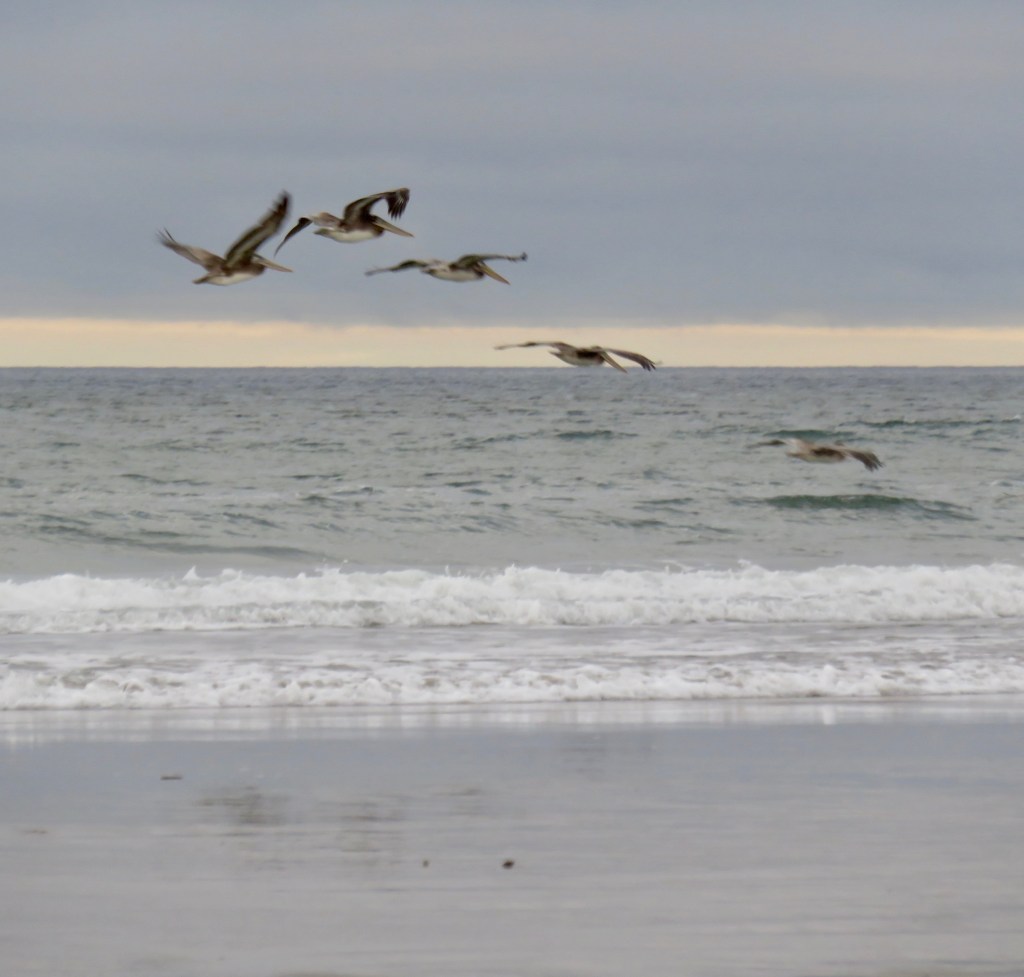
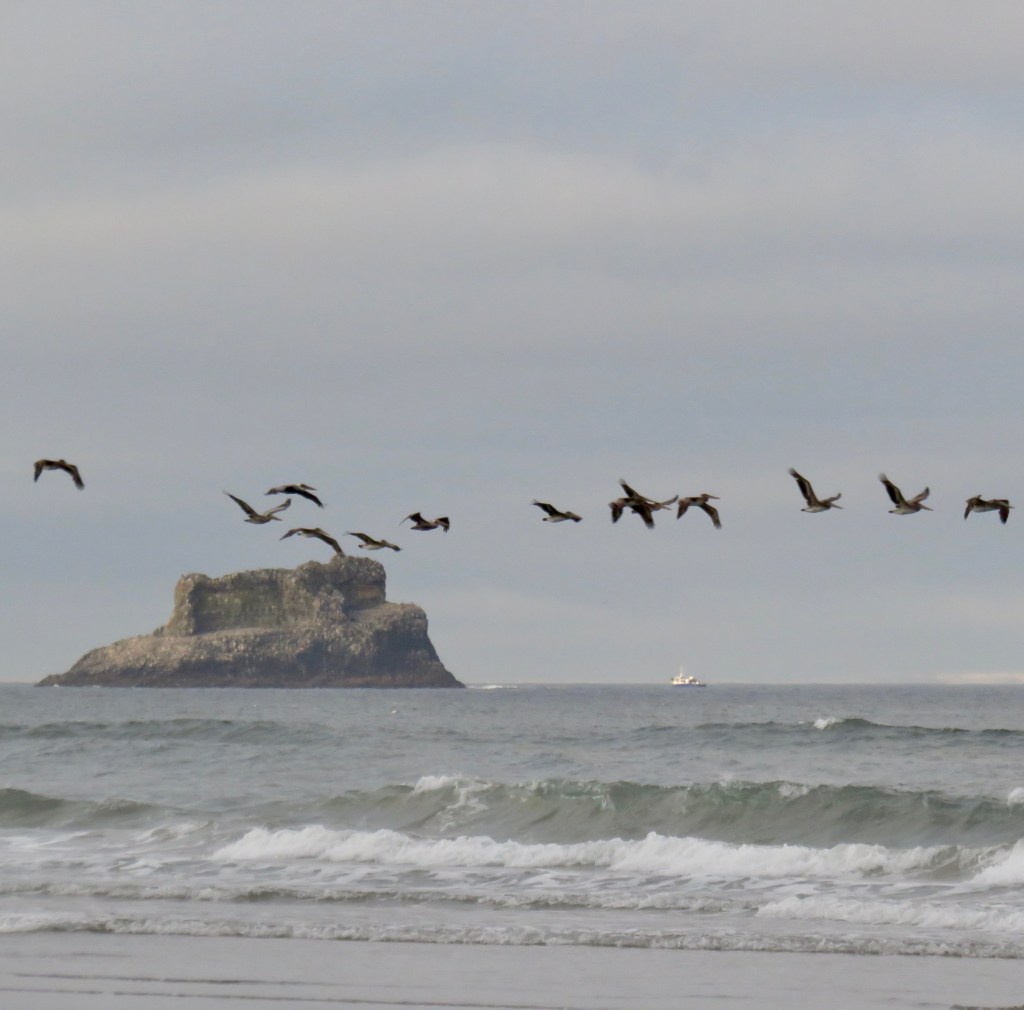
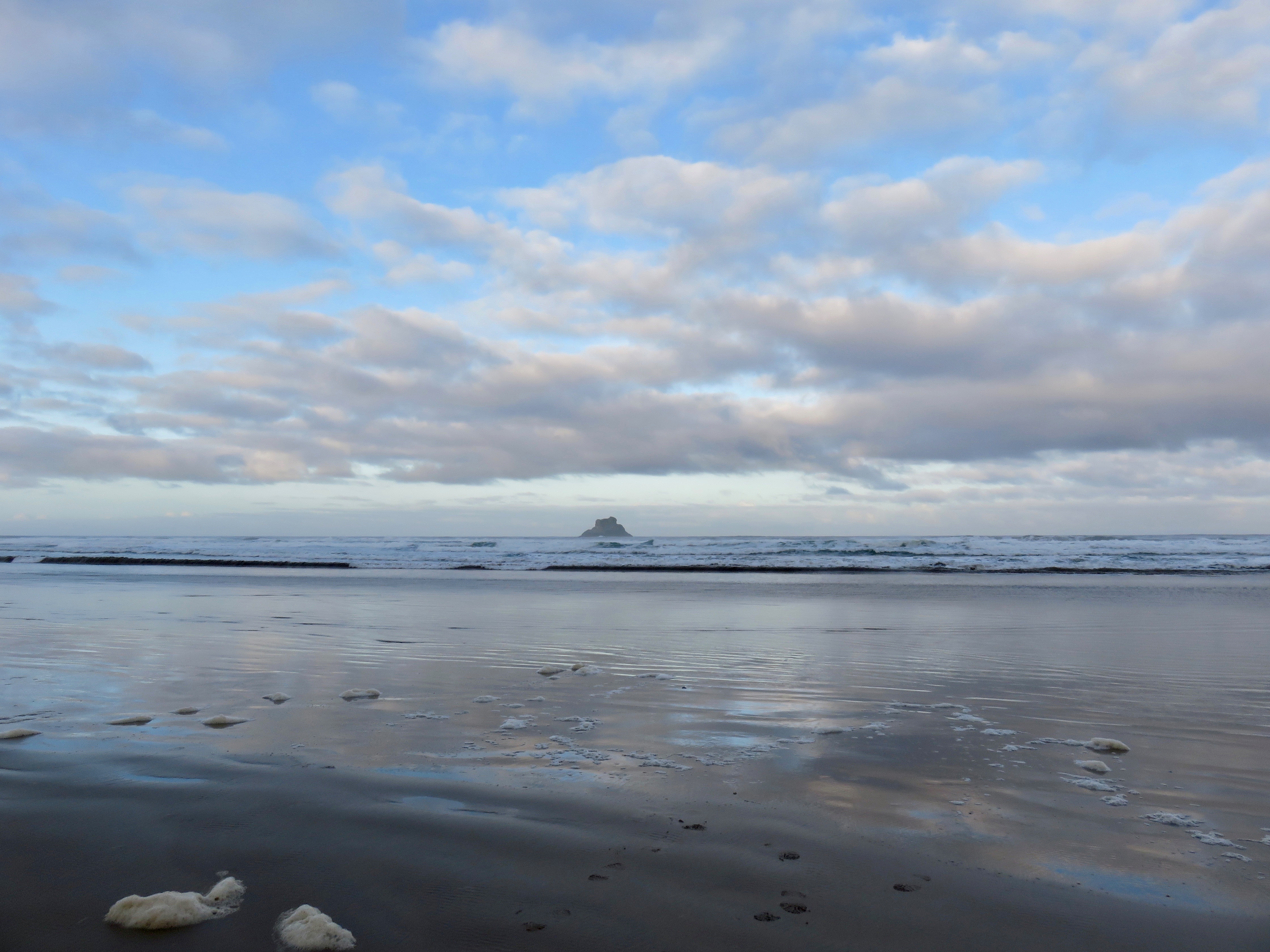
We walked long this morning and after touching stone at Hug Point, hundreds (Gary says thousands!) of pelicans flew past us heading north. The first group of seventeen was followed by a small group of five, which appeased us since we suspect they are almost always in even numbers. (They are monogamous for the breeding season.) Then a group flew just outside the surf line, too many to get an accurate count, and another group and another and another all the way while we walked the two miles home.
This is part of a group that flew between us and the surf. Some groups flew out near the horizon, usually in a looping line.
The brown pelican (Pelecanus occidentalis) was identified and named by Linneaus in 1766. It is found from the mouth of the Amazon River and Galapagos Islands north into Canada on both the Atlantic and Pacific shores. It was listed among the endangered species by the U.S. from 1970 until 2009, but thanks to the ban on DDT in 1972 the species has recovered and today is listed of “least concern.” The local subspecies is californicus, which breeds on the California coast. A large seabird, our brown pelicans are the smallest of their kind. Their flight feathers are dark brown when I find them onshore, and sometimes a foot and a half long. They have a wingspan of about seven feet (6’8″ to 7’6″) but weigh seven to eight pounds. They spend their lives almost entirely at sea. They glide steadily near the surface and we enjoy watching them dive into water for fish. Pressed to catch up with their pod, a pelican can move very fast indeed. They can perhaps fly at speeds past 50mph, and live for decades.
When we moved here forty-one years ago, neither of us recall seeing these birds at all. Then one summer, there were a few who passed, then fourteen arrived one early summer and stayed into the fall. That might have been fifteen years ago, perhaps more recently, perhaps in 2007. We see them each year now and long lines of hundreds sometimes pass, but usually a dozen or more hang about, fourteen or eighteen, throughout the warmer weather. They have flown right in front of our windows—their strange pterodactyl faces, always seeming to be pointed north. Most often they glide a few feet above the ocean, between breakers or just outside the surf. But other days we see them far out on the horizon, moving in smooth, graceful arcs.
We are always heartened to see the pelicans. Thank you, Rachel Carson. Thank you thank you thank you!
The rabbit has been at my roses again. Gary put wire around the denuded stripy rambler and it leafed out again and bloomed, though it did not have the energy to send out much new growth. The other new, pink, rose in the front came back without help, but apparently the rabbit has been only waiting on salad. The stems are naked. Again.
We like the rabbits even so.
Gary and I have been out in the garden each day, attacking the escalonia, potting up flowers. There are little plants coming up all over the front yard where the deck used to be. The montbrecia came up first and the rabbit bites off a blade in the middle and then chews it right up to the end. Since then, snow-in-summer and violets and lamb’s ears are coming along.
We have been watching the Monty Don gardening shows, including Gardeners’ World. The BBC presenter talks about gardening in ways I have never heard in an American show or from any American nurseryman. Don puts up netting and wire against invading rabbits and cabbage worm, but he spends a lot more time talking about flowers and other plants and environments that attract and feed bees and moths, birds and other wildlife. Wildlife is a priority. He also realistically and explicitly addresses the challenges of gardeners’ more urban environments and the growing impact of climate change. Heat and drier summers. The challenge of new pests and the loss of native plants unable to survive the new normal. The world is changing.
On our two-hour walk yesterday we saw a little display, a faerie-fort created by some visiting children. There are painted messages and careful arrangements of vegetation they found on the shore.
Where we live.
World bird populations are in trouble. A recent study by Cornell shows a 30% drop of breeding birds, and loss of many species. In the mean time, an organization did a brown pelican count recently and decided they are doing fine. Most days I have counted a dozen or more each day. On a good day, there are too many to count—a great squadron or scoop or pod (or maybe a group of pelicans is called a “colony”?) flies on and offshore. We used to hardly see them, and then ten or fifteen years ago fourteen stayed all summer. It’s been a growing population.
We got our flu shots today and put the quilt back on the bed. The weather is changing from summer to autumn. It is a pleasure not to have to consider the heat.
I have been staring at the inner border of the orange and purple quilt for a few days, moving strips here and there, cutting new stripes, and I think it is ready to be sewn. I even took the step of applying for a show. I don’t expect to win one, but I have enough work to share. Either that or shift the quilts on four beds for newer ones.

 On our two-hour walk yesterday we saw a little display, a faerie-fort created by some visiting children. There are painted messages and careful arrangements of vegetation they found on the shore.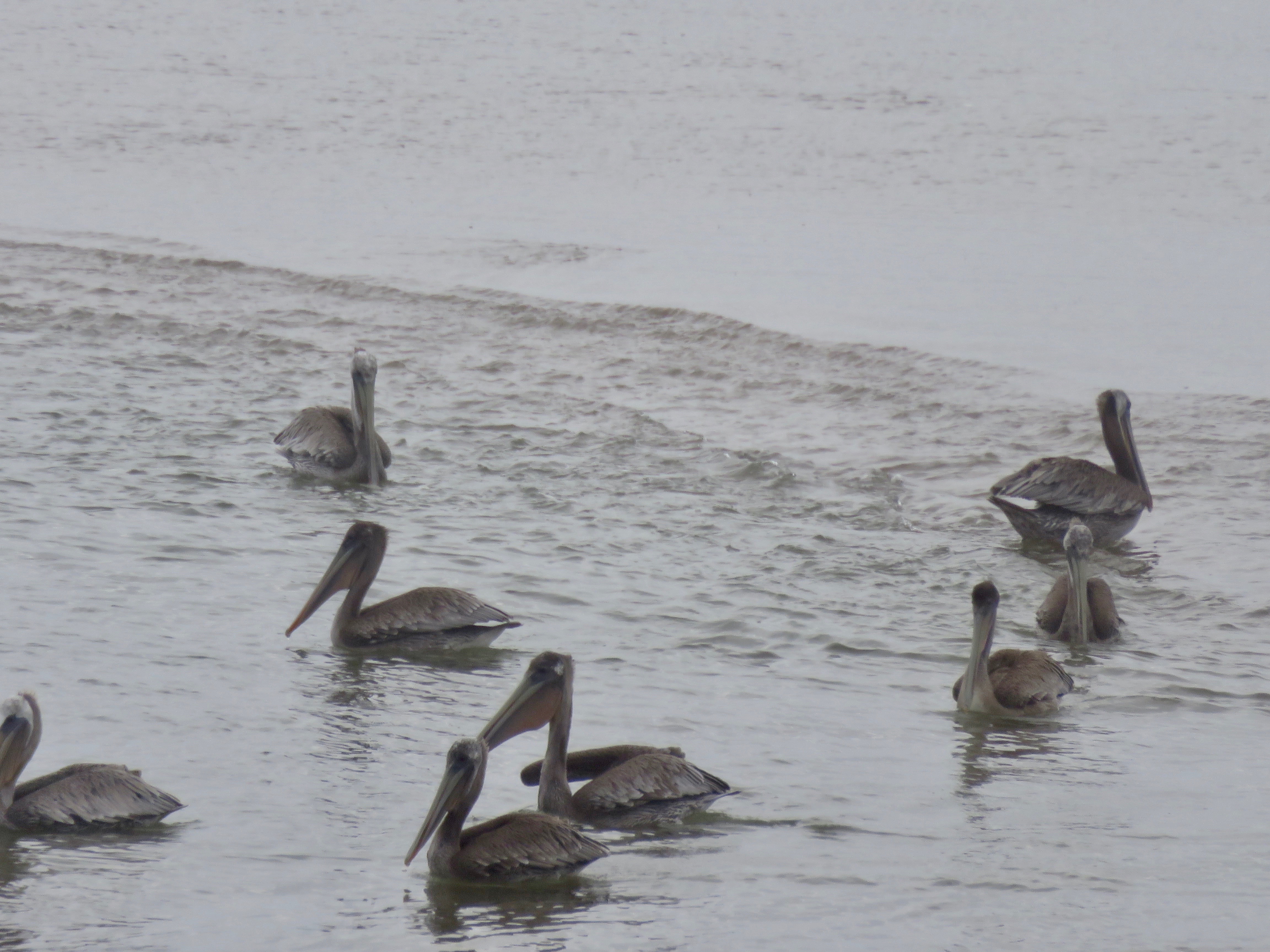
 IMPERFECT PATIENCE