ANTHROPOMORPHICATION

Years ago, a visitor in our home was sitting in the purple chair, petting our cat. Zora. The cat lashed her tail. I had to caution our friend that a cat lashed her tail when she was irritated, not like a dog would because she was happy.

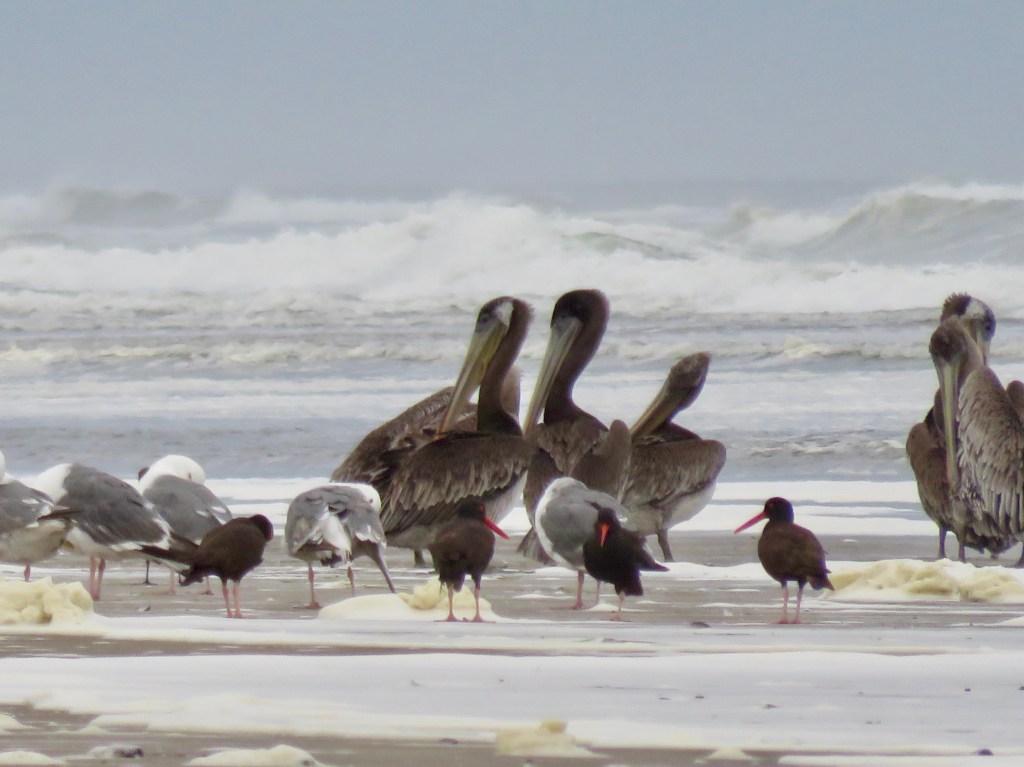
The brown pelicans are still offshore, the nearest black oystercatcher pair had one baby this year, and there seem to be fewer juvenile seagulls this year. I admire them on the shore.

Every time I see someone on Facebook coo over a baby animal, “Oh I want one of those!” I cringe. We are a peculiar species, it’s true, fawning over the babies of other species and then eating them.

Continue reading

MORNING WALK

This is why we walk early.

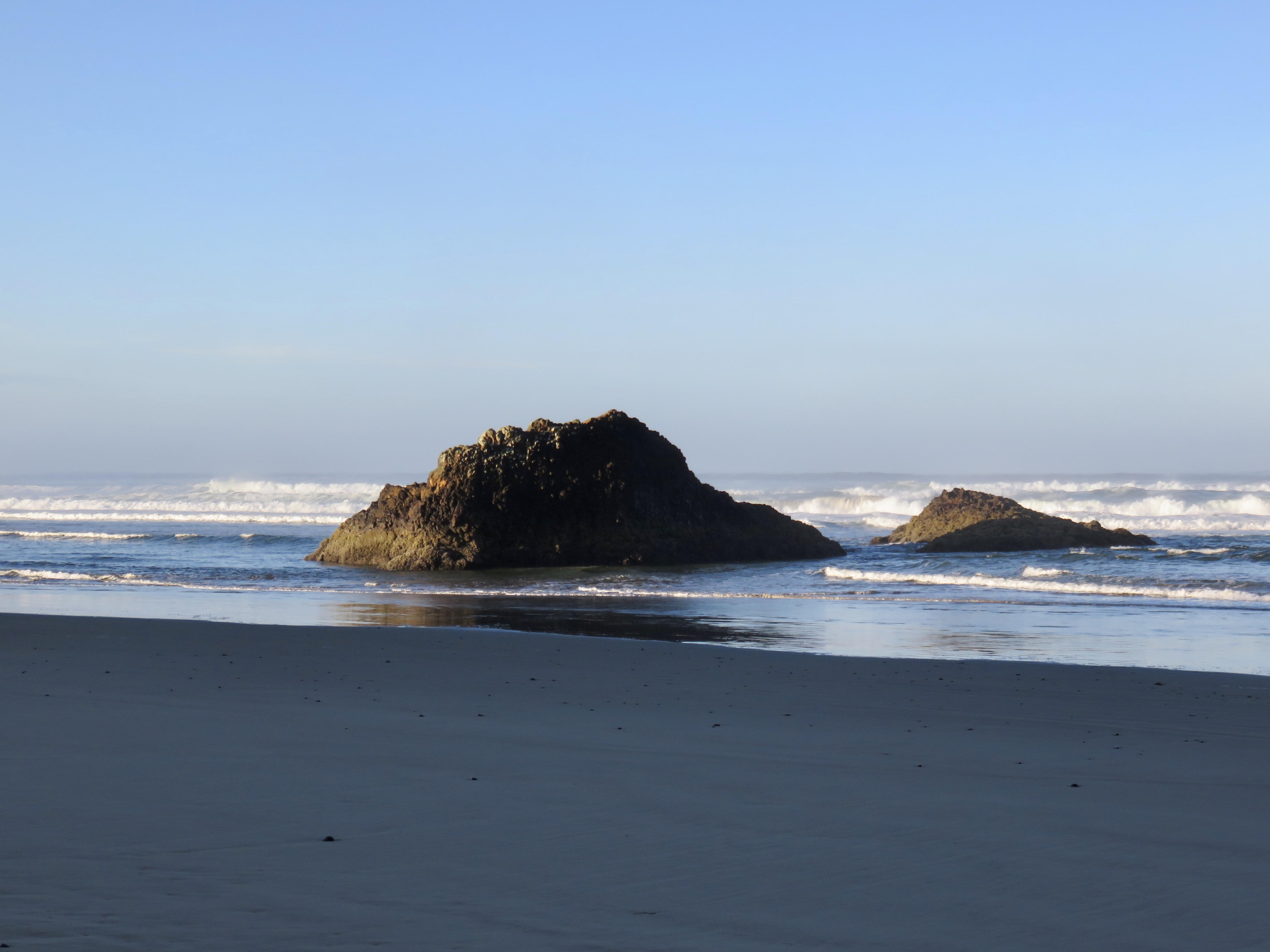
Our walk is what begins our day, what gets me out of bed and moving so that we can walk tide-washed sand and get home before the crowds. What we see on our walks—crabs, isopods, a moth caught on the wet sand, seabirds and eagles, the sand crabs and hoppers of various sorts—decorate our path. There were no chitons, none at all this morning, on the headlands or seastacks, but juvenile gulls still cried for their mothers to feed them.

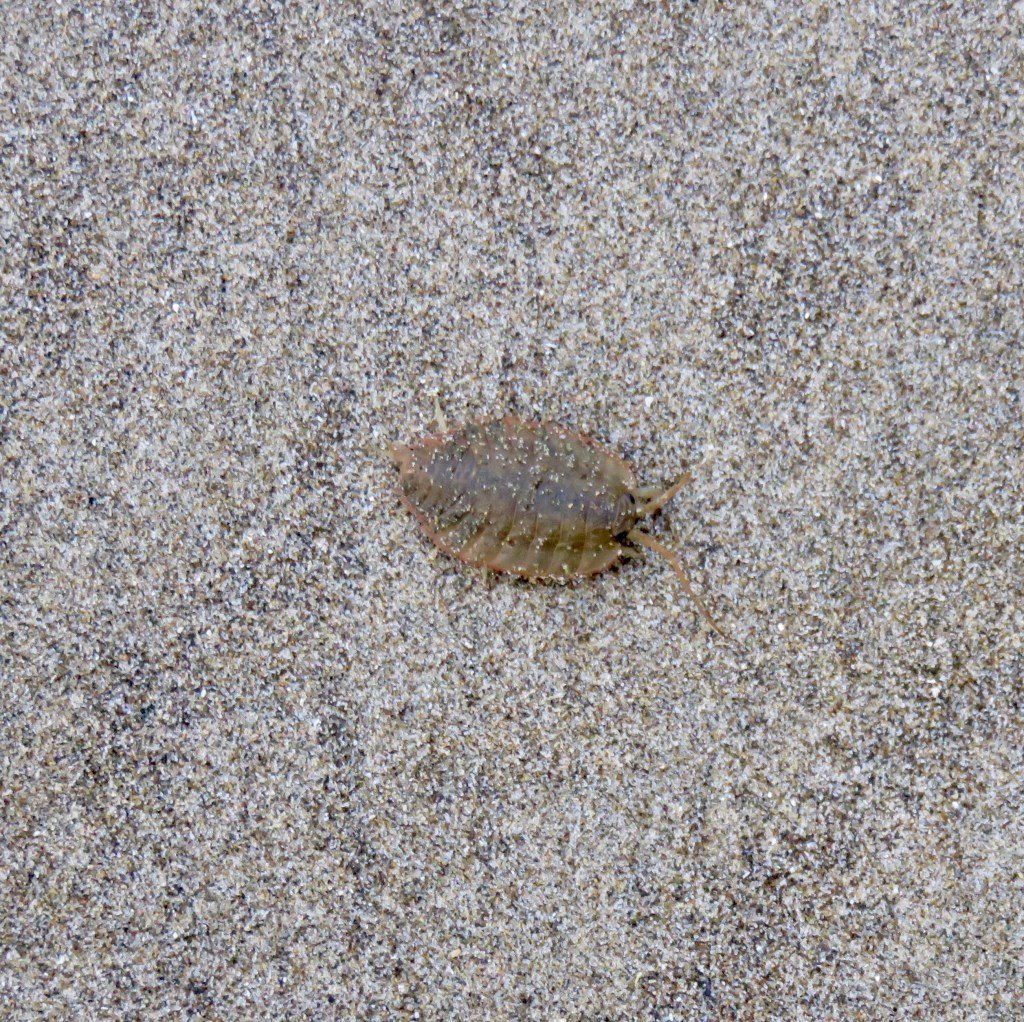
When my nearby footsteps alarmed this isopod, it flipped onto its back, rolled up just like a pill bug, and then flipped back onto it myriad legs and scurried on. It was more than an inch long

The odd little fellow rushing past us was an isopod, a sort of catch-all term covering the ten thousand other species of Isopoda, an order of crustaceans that include woodlice, what we called “pill bugs” when I was little. The Isopoda include 4500 species that live in or near the ocean, 500 on dry land, and the other 5000 in fresh water. They are found worldwide and the land-based species are entirely herbivorous and harmless to humans. Some marine species bore into wood (such as boats) or are parasitic to fish, shrimp, or crabs. The one I saw this morning was likely a rock lice or sea slater, considered a terrestrial isopod, though its habitat includes tide pools—the entire splash zone. Taken together, this order lives everywhere in the world, from the tropics to the edges of the Arctic and the continent of Antarctica.

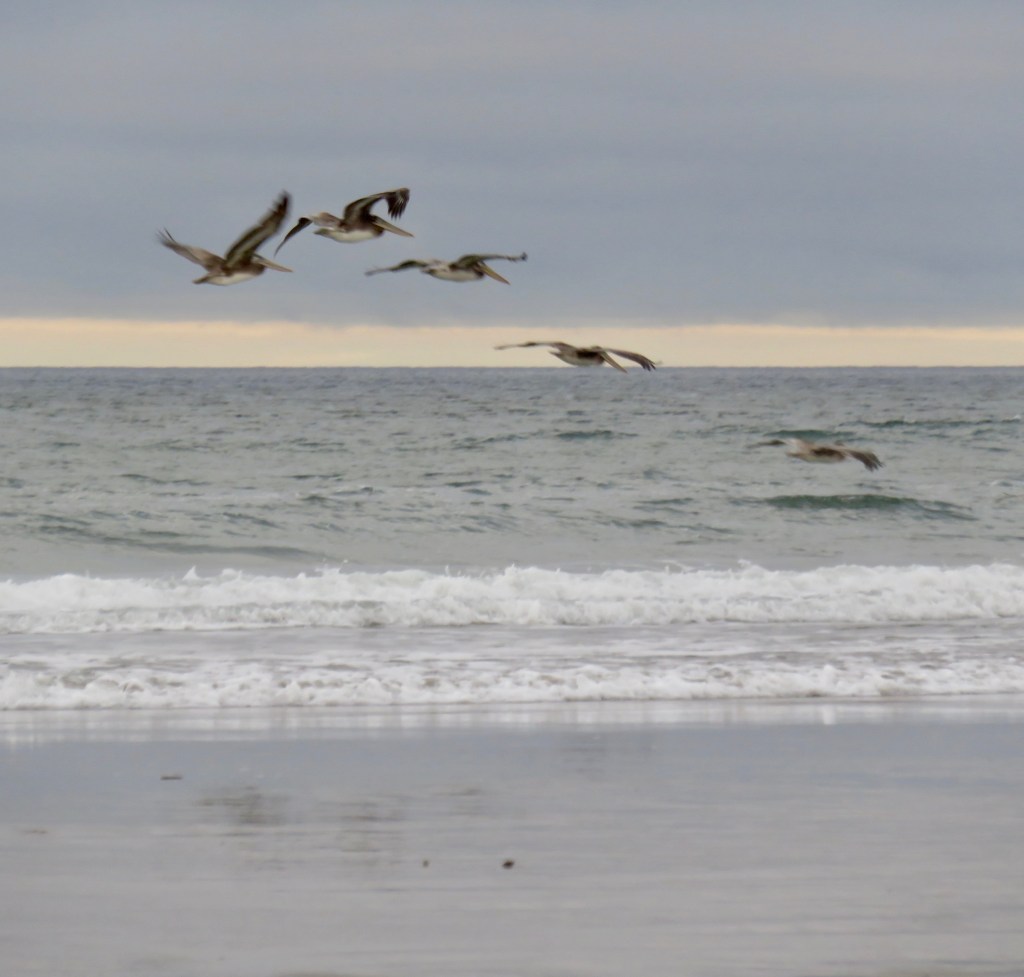
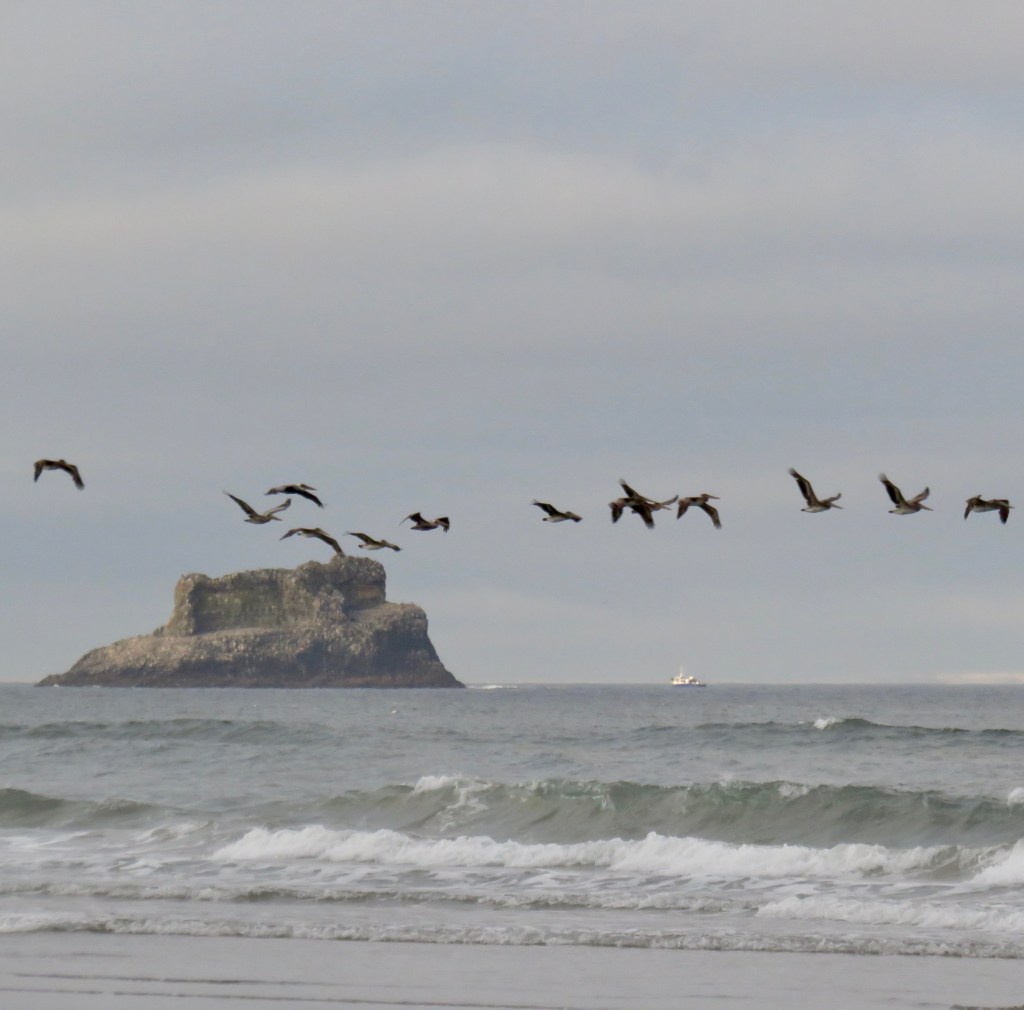
We walked long this morning and after touching stone at Hug Point, hundreds (Gary says thousands!) of pelicans flew past us heading north. The first group of seventeen was followed by a small group of five, which appeased us since we suspect they are almost always in even numbers. (They are monogamous for the breeding season.) Then a group flew just outside the surf line, too many to get an accurate count, and another group and another and another all the way while we walked the two miles home. 

This is part of a group that flew between us and the surf. Some groups flew out near the horizon, usually in a looping line.

The brown pelican (Pelecanus occidentalis) was identified and named by Linneaus in 1766. It is found from the mouth of the Amazon River and Galapagos Islands north into Canada on both the Atlantic and Pacific shores. It was listed among the endangered species by the U.S. from 1970 until 2009, but thanks to the ban on DDT in 1972 the species has recovered and today is listed of “least concern.” The local subspecies is californicus, which breeds on the California coast. A large seabird, our brown pelicans are the smallest of their kind. Their flight feathers are dark brown when I find them onshore, and sometimes a foot and a half long. They have a wingspan of about seven feet (6’8″ to 7’6″) but weigh seven to eight pounds. They spend their lives almost entirely at sea. They glide steadily near the surface and we enjoy watching them dive into water for fish. Pressed to catch up with their pod, a pelican can move very fast indeed. They can perhaps fly at speeds past 50mph, and live for decades.

When we moved here forty-one years ago, neither of us recall seeing these birds at all. Then one summer, there were a few who passed, then fourteen arrived one early summer and stayed into the fall. That might have been fifteen years ago, perhaps more recently, perhaps in 2007. We see them each year now and long lines of hundreds sometimes pass, but usually a dozen or more hang about, fourteen or eighteen, throughout the warmer weather. They have flown right in front of our windows—their strange pterodactyl faces, always seeming to be pointed north. Most often they glide a few feet above the ocean, between breakers or just outside the surf. But other days we see them far out on the horizon, moving in smooth, graceful arcs.

We are always heartened to see the pelicans. Thank you, Rachel Carson. Thank you thank you thank you!

PROGRESS

fullsizeoutput_1126

On Tuesday, I “won” the National Novel Writing Month (NaNo) challenge by completing fifty thousand words. It needs at least twenty or thirty thousand more words, but I have identified the arc of the story, my two main characters in their parallel experiences, a structure that imposes both tension and order, and some sort of closure. Words, words, words. I am not done but have the beginning of a novel, and I have cheated, which is totally allowed.

Once a week I play Scrabble with a friend and we cheat. We do not keep score, we use  the dictionary and a page with two-letter-words to check spelling and aid our choices, and our goal is interesting words and enjoyable play. We have never actually traded tiles, but we frequently lament picking a third and fourth A from the bag of letters. The letter I seems to gather too often as well. We offer to move our new word to another part of the board in order to make play easier for the other. We both celebrate a new word neither of us has used before. We laugh when each of us manages to put down the same word: OATH or QUIET. We play until we have used all the tiles, and then we play a second game. We have been doing this most weeks for a couple of years.

My husband and I began playing Scrabble in 2015 when I retired from full time teaching. But I usually won because I like winning competitive activities and I am a strategist. It was not so much fun for Gary. Running had to be abandoned because of my arthritic feet. Instead, we began taking our daily walks together. Yesterday, we walked for over two hours. We do not go so far from the house, even in two hours. We walk up and down the beach, and gather a lot of plastic, until my back aches from bending over fifty or a hundred times to fish a bit of blue plastic or cup lid from between stones. On certain parts of the beach we follow a very close zig-zagging course, searching every inch for sea glass. Yesterday I found a nub of thick brown glass. Gary found an impressive lump of clear and pale green larger than a quarter.

He tells me I am grieving because I have left teaching. He was delighted that I retired. (Gary takes exception to the “delighted” because “from the situation you were in—yes. From the work that you loved—no,” he says.) It was the right decision, the situation was too stressful, and it was good that I retired. But he still says I am grieving.

I have gained ten pounds, and my days are a muddle. I hope, once an entire school year has passed that I will be in a better state. We miss our children and grandchildren though they are not so far away. We miss the dog. We miss the cat. We are clearing out the house. Only one bedroom is piled with gifts waiting to be wrapped, and my work space is pure chaos. I have three quilts wanting binding. Three knitted items being blocked. Boxes of materials and piles of scraps that want sorting.

My life wants sorting. I recently read Gail Collins’ new nonfiction, No Stopping Us Now, which chronicles the accomplishments (and struggles) of older women in the United States. Despite medical opinion over the decades that women are unfit, insane, or simply dangerous in age, older women have managed to change the world. My personal favorite example is the author of Silent Spring, Rachel Carson. Carson did what many women I have known and worked with have done. She sacrificed her ambitions, abandoned her educational goals after completing a Masters and went to work as a marine biologist for U.S. Fish and Wildlife Service in order to support her family. When a friend begged her to find out why all the songbirds were dying after a community DDT spray, she looked for someone in that field to write about the danger of pesticides. She was in her 50s when she accepted that no one in the field would risk the backlash from industry, she devoted the remainder of her life to documenting the dangers of the poisons spread on crops and neighborhoods.

“Although Silent Spring was met with fierce opposition by chemical companies, it 1024px-Rachel-Carsonspurred a reversal in national pesticide policy, which led to a nationwide ban on DDT and other pesticides. It also inspired a grassroots environmental movement that led to the creation of the U.S. Environmental Protection Agency. Carson was posthumously awarded the Presidential Medal of Freedom by President Jimmy Carter.”—Wikipedia
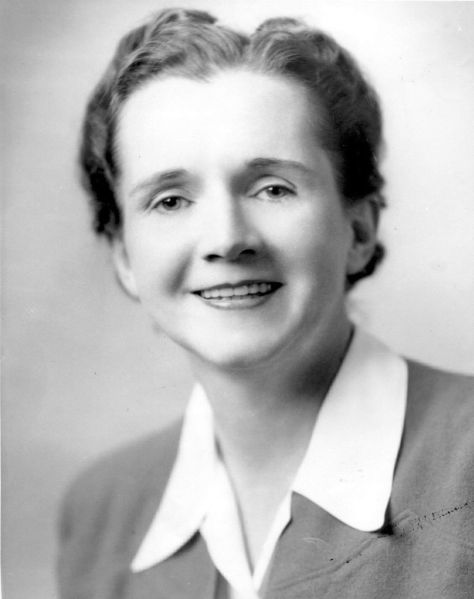
Rachel Carson was 56 when she died of cancer.

November is the beginning of the dark days of the winter season. It is a false glittering and interior time. I tend to look inward, to make plans, set goals in this season. I have no illusion of contributing to the world as Carson did, but I am not done contributing. I will complete the projects currently cluttering my work space, clear it out and begin cluttering it again. I am teaching a workshop for Willamette Writers in April, and perhaps I will complete a novel over the coming months.
5 EAGLES

IMG_4226

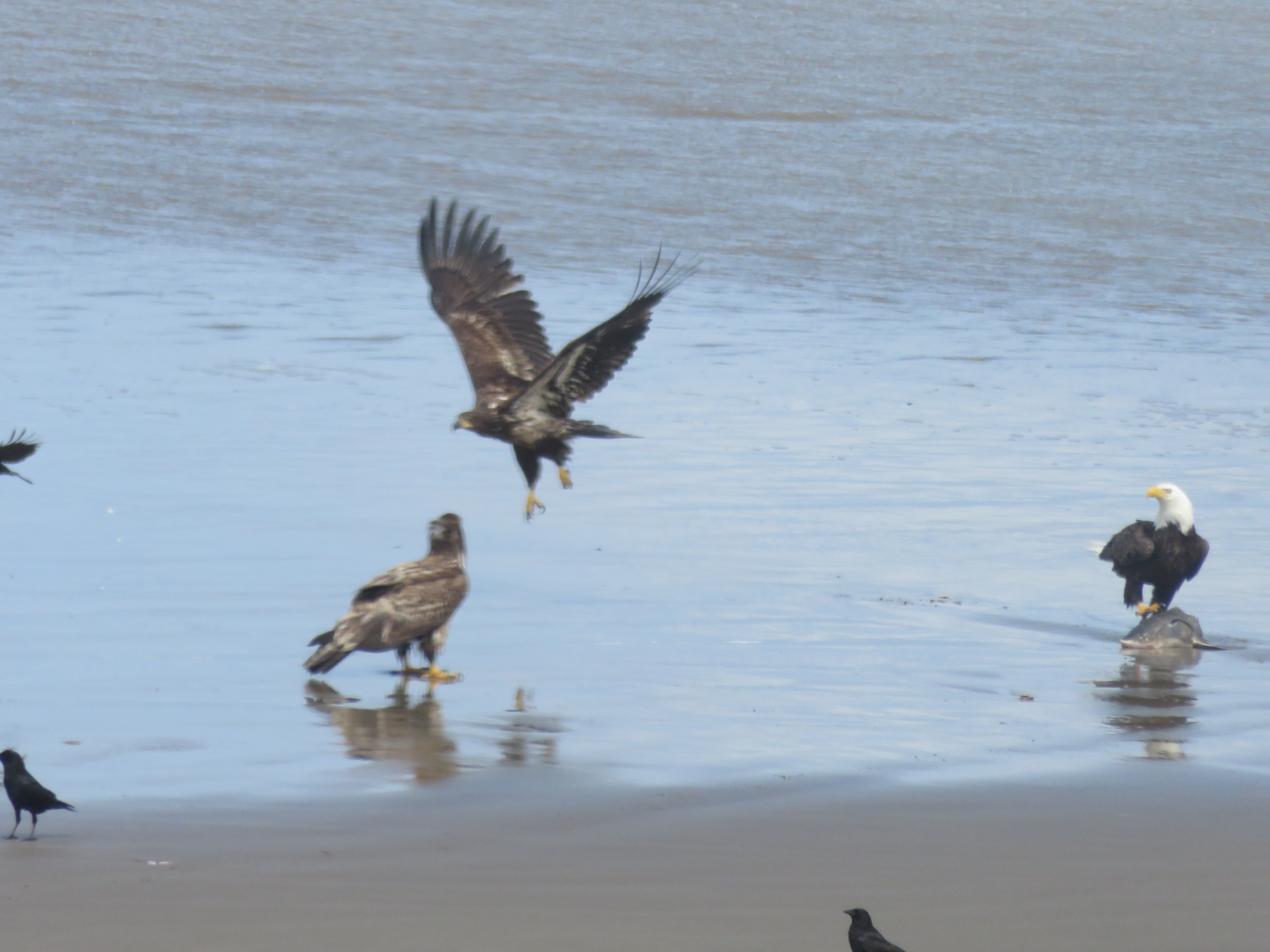
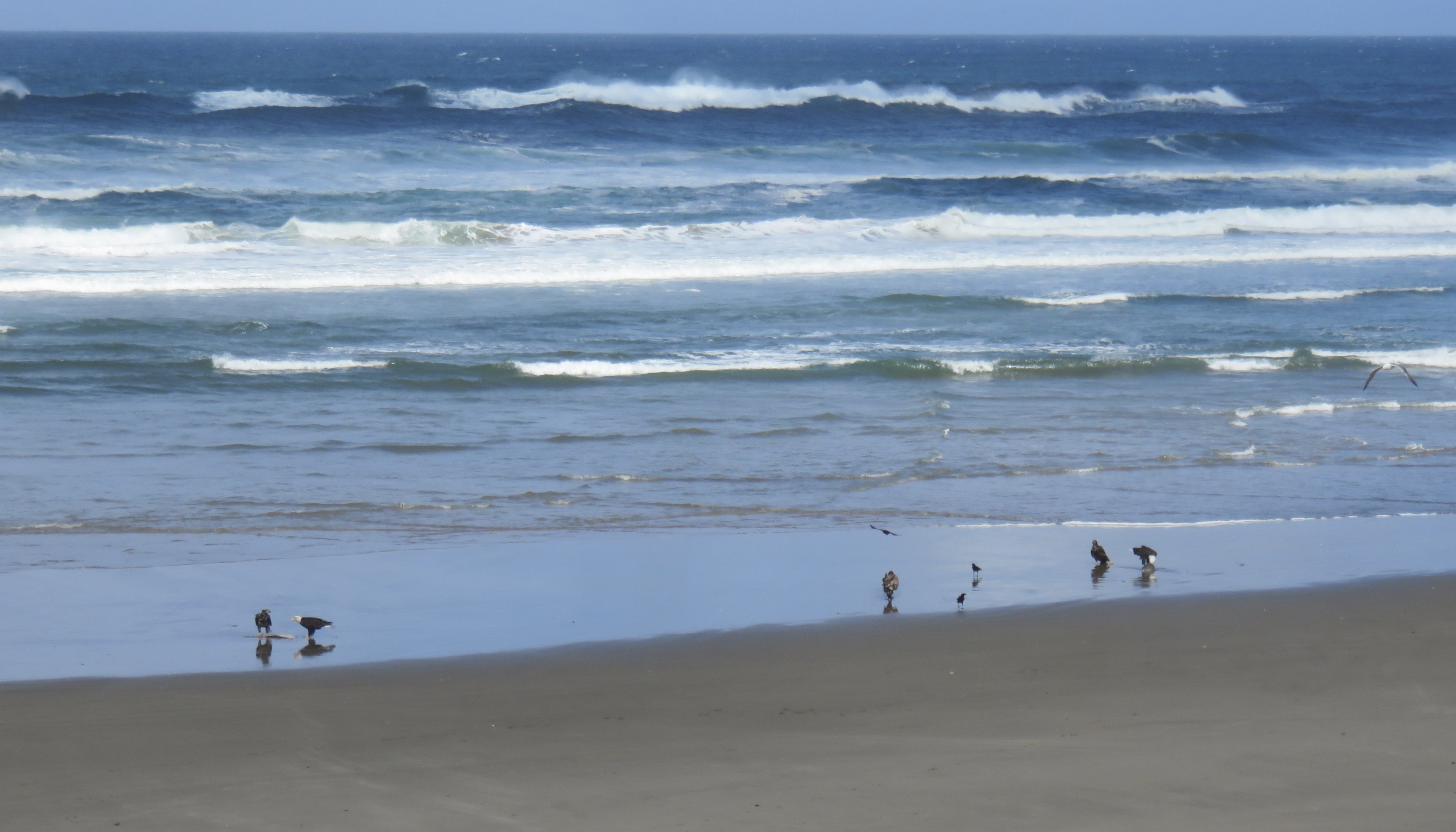
A tourist approached the feeding eagles and drove all but the least confident flier off. She told me she was afraid the non-flier was hurt. What did she think she could do to help? It remained on the sand for twenty minutes or more and then flew away south.

We had never before seen five bald eagles at once on our beach. Clutch size of eagles has been rising ever since Rachel Carson’s Silent Spring alerted the general public about the dangers of DDT. (Before we began poisoning crops, bald eagles in Chesapeake Bay had clutches of four or, rarely, five eggs. The average size clutch was 2-3. In the 60s this dropped mostly to 1 egg. Average clutch size has been slowly rising ever since the banning of that poison.*) Gary assumed bald eagle laid 2 at most “Like normal birds” (he means pigeons). I had not known eagles ever hatched 3 eggs. But here they are.

These parents, the successful breeding pair, have brought out their youngsters each late spring. Inevitably the youngster lands on the beach, finds her or his feet on flat and wet sand and stands in the shore, often for many minutes. Eagles always look a little bit pissed off. It is their expression formed by keen eyes and a downturn in their sharp beaks. I like to imagine they are unhappy with the wet and flat ground, an unfamiliar surface.

Whenever an eagle shows up, crows arrive to harass it. (Crows routinely harass the red-tails too.) We once watched an eagle harrying an injured gull, that itself was then bullied by a half dozen crows. Eventually, even gulls arrived to drive the eagle away. The adolescent eagle moved off north, stood for a time on the sand, but that injured gull would be eagle food before the day was out.

We never interfere. These are wild things and their lives should now be messed about by human being. (It is a different situation when the animal is endangered as a result of human action to begin with.)

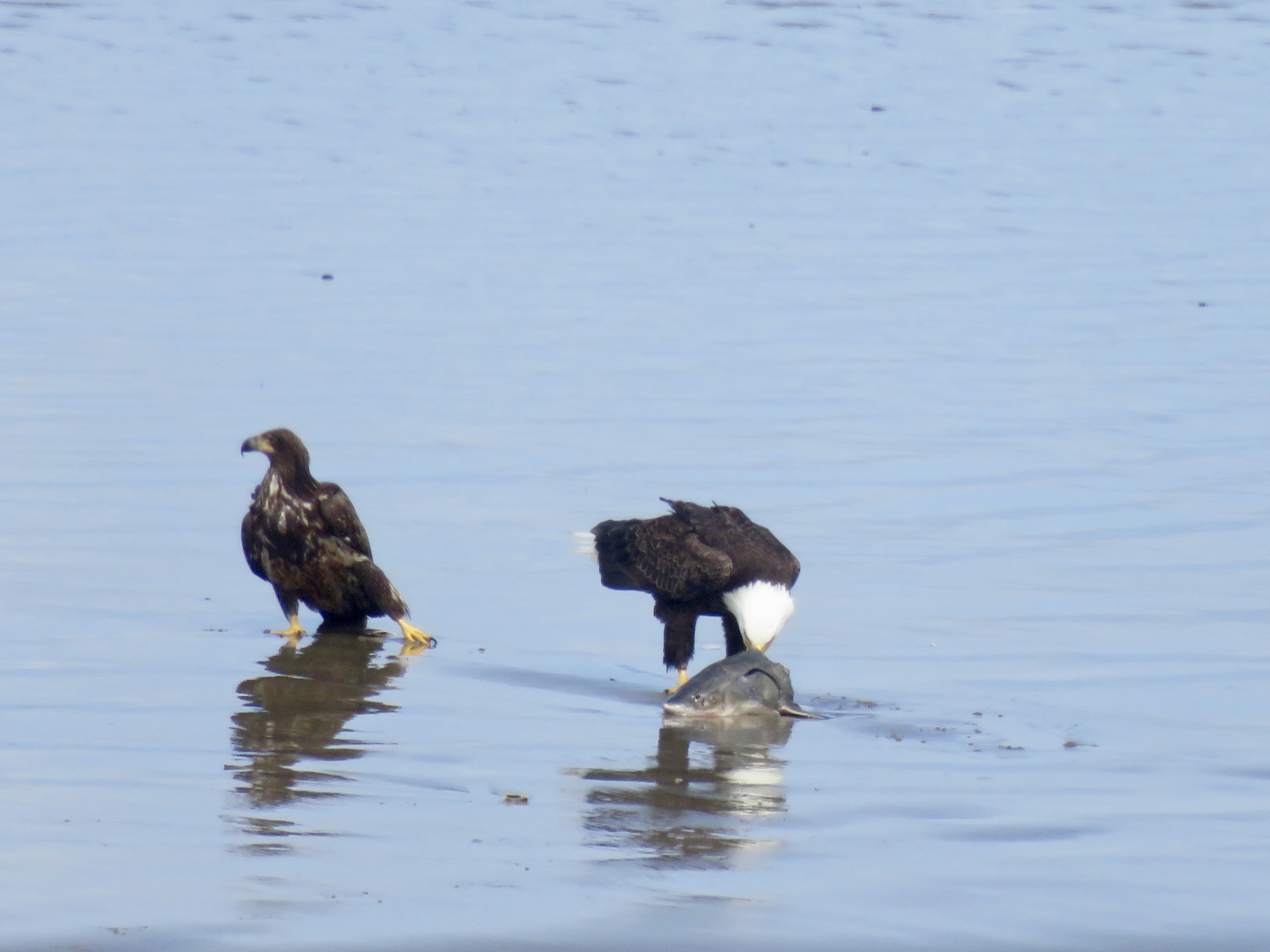
The five eagles from the other morning were eating a large fish, the remains of a huge sturgeon—head and spine were thrown up on the rocks by that night’s high tide.

fullsizeoutput_f3d

That is the head of a sturgeon, the prize that attracted ten raptors to our shore.

The breeding pair always appear smaller than their youngsters. They are relatively new to our area. When we moved to my grandfather’s house forty years ago, there were no eagles (no ravens then either). This pair, the ones we like to think of as “our eagles,” appeared more than a decade ago and began bringing out their adolescent children soon after. This is the first year they have successfully raised three.

fullsizeoutput_f3f

This photo shows the two white-headed parents and their three plain brown children, plus a couple of crows. This is only part of the show.

It was a spectacular day for raptors. In the sky and on the beach we counted the five eagles, three turkey vultures (also a first) and two other raptors that Gary thought might be the osprey, which we have identified recently fishing just offshore. (A neighbor claimed they were red-tail hawks and there are red-tails a dozen miles north on the other side of Tillamook Head, but we did not see the telling red tail and we know to look. We have recently identified Cooper’s hawks in our own yard, but they are smaller than the birds we saw. The pair were probably ospreys, but I do not have a photo to prove it.) The entire local murder of crows arrived, the raven pair too.

In any event, ten raptors at once. Ten.

They are one sign of a healthy ecosystem.

*I do not know any high school science teacher who routinely assigns the work of Rachel Carson, the Great Parent of the modern environmental movement. Rachel Carson was a marine biologist and already a published author when a friend wrote to her about how spraying had caused songbirds to drop dead from the trees in her yard. Because it was not her field, Carson tried for some time to find someone within that discipline to write about the dangers of pesticides, but there were no takers. The chemical industry was and remains a powerful lobby. Finally, Carson did the research and wrote the book herself, knowing full well the chemical industry would do whatever it took to destroy her. They did.