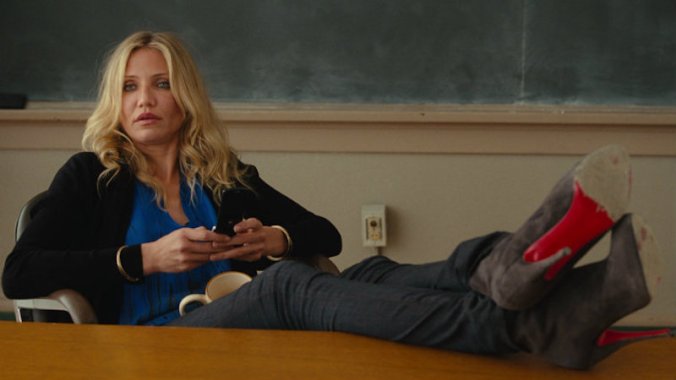
I have not seen and never will see this film. Up the Down Staircase, a novel, was written by a lifelong teacher. Most people who write books about their incredible experience and wisdom as teachers last 1-3 years in the profession before moving on to something that pays better.
A message arrived this morning via email with the image above and the headline below:
Why Teachers Make the Worst Students
As a snarky high school teacher, here’s what I came up with: Teachers don’t make great students.
The author offers a list of reasons teachers are bad students and she is pretty much spot on that they are uninterested in educational or brain theory, have too much to do already and resent being pulled from their classroom, and generally behave like the difficult and only marginally teachable students sitting in the back of their own classrooms. She doesn’t know quite why this is true and asks for help in explaining why teachers are often so unteachable.
It’s a funny post and she uses the complaints of her own students to illustrate common teacher complaints. She’s spot on.
Me? I am generally a sit-at-the-front sort of person with an exceptional academic record. Honest. I read newspapers each day. I have a lot of books in my house, fiction and nonfiction, and I have read those books. “Metacognition” is not an annoying word I dismissed once I knew it was no longer going to appear on a test I had to pass but a concept critical to my profession. I am fascinated by brain theory and willing to stir up curriculum even though it makes more work. I like the work. It’s why I teach.
My own explanations for why some high school teachers are such terrible students:
- Teachers are already waaay too busy trying to keep up with classwork to take time out of their day to attend a poor presentation. Liz Oppelt was right on target with this one. This is always true and is the biggest reason for their inattention. They already have a job waiting for them and truly do have more important things to do and most would prefer to be doing those things. Unless the in-service helps make that job easier, they would prefer to be doing their job. or perhaps . . .
- That one teacher would rather not be there at all. There was a teacher in my building who was smart and effective in front of students but also only pretended to grade work and was easily swayed by fellow-travelers who charmed their way through their education. Being clever was enough. Another teacher in my building lay down each day during his prep period and napped or read the newspaper or anything rather than scoring papers or preparing for a class or counseling students. Some rare teachers kept a 40-hour work week schedule. This sort of behavior is not typical among teachers, probably less common than in some other professions. I have known shopkeepers who fail to ring out the registers, health care professionals who never bother to review records, bookkeepers who ignore illogical figures. It is incredibly rare to find a lazy teacher, but this 1-in-100 teacher is texting during in-service presentations. The rare Administrator too.
- The presentation is a genuine waste of time. We know bad when we see it because it’s our job. Yes, some presentations are bad. Sometimes really bad. Once in a long while a mandatory presentation is entertaining and held during an in-service week when teachers are in a great mood, even though the lesson doesn’t teach much other than how to play for an hour without actually learning more than four words in Spanish. But more often it is delivered by a hired person who was never a very good teacher to begun with (and maybe that’s why they went to work for the ESD or a private company or administration, jobs that all pay much better and involve shmoozing), or they are presenting material under contract and they do not themselves understand or care about it, or they have forgotten everything they once might have known about teaching and now want to tell about how much they love skiing or about their recent divorce. Or all of the above. (Seriously, this happens.)
- Some teachers do not want to be taught. Some teachers are bad students because, frankly, they were never very good students to begin with. (see #2) They are still not any more curious or proactive or ambitious about their subject or teaching as a profession than they were in high school. (Again, I see this in every profession—bankers, contractors, health care providers, small business owners who merely drift through their job.) Some teachers only want to get through their day. (see #1) They are not interested in how to do their job better. If they are teachers, they don’t care about educational theory or brain science now and never were interested because they do not care how people learn and never did. They want activities to keep students busy, or they want to be entertained, which is why they liked the terrible art/Spanish lesson delivered in Spanish that required an hour to teach four words and no art. (See #3)
Some people enter teaching because they thought teaching would be easy. It isn’t. But some small minority of teachers keep no books in their homes, waste time at school, never their profession whenever they walk out the door, and are incurious. They never do the best job they could because that would require too much work.
I love teaching and I love teachers. Most often we are overworked and tired. (see #1 again). We are inattentive because we have more important concerns on our minds as we do our best to educate. Give us something to help us do a better job for our students and you will have our full attention. We are always trying to do a better job.
But seriously, we know a bad presentation when we see one.


I think some teachers (or doctors or psychologists and so on) over time feel they are superior to those being taught in a whole range of ways that have nothing to do with simply knowing more about the material they are teaching. Us and them, the teachers and the taught. So then being a student puts them back in an inferior position. I think we all, (or maybe I should just speak for myself!) do this inadvertantly to a small extent and have to combat against in when back in a student role. At almost 60, having taught and psycholog-ized for umpteen years, I started taking violin lessons again after a 40 year break. It is indeed humbling and I have to work to get over feeling 12, feeling inferior, but this is so worth it, because then i can experience the privilege, the luxury, of being taught by a talented voilinist, of going home and using what I’ve been taught, learning 5th position, even 6th, playing the gorgeus, challenging Meditation by Thais, feeling myself improve, and going back to learn more.
LikeLike
I just reread this comment and I have to applaud Karen for pointing out the pecking order. I recognized early on that I was smarter than most of my students and knew more than all of them, but also that I had teenagers in my class who were smarter and more talent than I could hope for. Further, since I have continued to take classes, I have also continued to experience the opposite role of less talented, less smart, less knowledgable. It was good for me.
LikeLike
I always hear teachers are underpaid. They get raises. I still wonder when my son will be educated. They dont teach handwriting. Computers are the excuse.Too bad computers dont access the part of the brain that decifers symbols into words;only pictures. They started him on algebra in the 3rd grade!He was on his own then. We learned math &business math. They pushed innane tests on him all year rather than kindle curiosity. I am angry as hell. He loved school before benchmark era. Now he just skims thru. Not everykid will go to fancy pants college! Some;like me,get a job after graduation. Some-like my dad go the military route. But we dont count . Only jocks and college bound. I love to read. That helped a lot. Teachers want a raise?EARN IT!
(Nothing makes me vent like the piss poor state of education. Not hollering at you. Sorry)
LikeLike
Everyone wants to blame education on teachers. It looks like I just did too.
If we want better schools we will have to do a better job of educating and hiring our teachers, and that does mean paying them better, giving them better working hours, and respect.* You want better teachers, treat them better. Teachers do not set out to miseducate children, but we are limited by what we are compelled to teach, by ridiculous exams that focus on a very narrow range of skills.
You want your child taught more about handwriting or oceanography? Teach them yourselves or advocate for those educational opportunities in the classroom. Don’t blame teachers for the curriculum they are often required to teach.
Some people still enter education as a profession because it is their choice, because they feel compelled. And still we find ourselves misjudged and mistreated by the public and even by administrators.
When I was substituting k12 this became horribly obvious—grade school teachers who are totally responsible for the care, well-being, and education of 25-40 children at a time. I saw them treated like they were children themselves, and incapable of doing more than they were driven to do.
Private education costs a great deal more than public, that is, more money is spent to educate the privileged children in private schools. (I taught in an excellent prep school for several years.) In private schools, there is 100% parent involvement and the sense that parents and teachers are on the same side. And it was true. It is also true in public schools.
How did Finland create the poster child for excellence in public education (from having one of the worst in the world)? First, they closed private schools in order that all parents, including wealthy parents, have a stake in public education. They they gave teachers a lot more say.
Stop blaming teachers for a social failing to value public education. I have been treated on some rare occasions like an enemy of my students because I am a “hard” and demanding teacher.
You want a better public education system? So does every teacher I know.
*I have 8 years of public university education that I paid for myself, and an MFA in my field from a private university. I have as much education as most health professionals. I worked 10 months a year, 60 or more hours a week and throughout that fabled “summer vacation.” I am not complaining about my pay, though I earned considerably less than other with my skill, education, and working hours.
LikeLike
And, yeah. I was spot on here. I quit teaching a month after this posting. I just reached the end of my rope, being treated disrespectfully.
Years ago, the office manager of a law firm with a high school education was incensed when she discovered that teachers with a Masters and as many years teaching as she had directing typing and filing in Seattle were “paid almost as much” as she was.
Most jobs, at the end of the day you go home and think about other things. According to my husband I was “never off the clock.” Even now, two years fully retired, I cannot read a good article with considering how I could use it in a class.
LikeLike