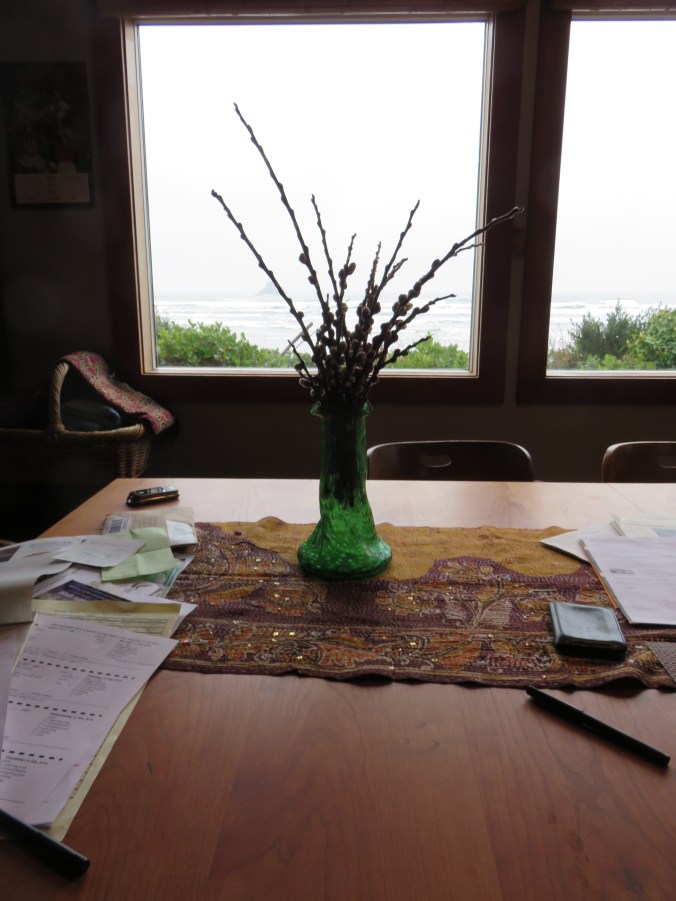
The spring after my mother’s death, I remained deep in grief and P.C. asked me if I had anything I did with or for my mother that I might do to continue that sense of connection. Her suggestion was wise. I began picking pussywillows for my mother when I was no more than 6. I still do.
I am a feminist deep down into my gut. I inherited my respect for women from both of my parents and from self-respect, and from my own experience that men and woman are more alike than different and equally deserving of respect as human beings.
When I began seriously reading fantasy and science fiction as a teenager and in college, I specifically looked for novels where gender was no longer the most critical fact about characters. This was the late 60s and early 70s, Ms magazine was new of the shelves and I read The Feminine Mystique. My father, a research librarian, complained about women who changed their professional name, scattering their scientific work all over the shelves.
Science fiction and fantasy offered the possibility of riveting stories involving characters interacting in a post-sexist universe. I was there for space travel or fairy princesses. I wanted a future I could live with. I found novels with powerful men and women, with weak men and women. I found novels with characters.
When I read the line above in Ursula K. Le Guin’s A Wizard of Earthsea, I put the book down on my lap and thought for a long time about whether I wanted to keep reading. I did. Le Guin got so many things right, I figured she was allowed to have a character speaking from his culture. And she more than repaid my patience in her later work. Further, I admired her ability to change her mind—such a rare thing—and to discuss a change of her view publicly rather than trying to cover it up.
I cannot say the same for other books. I have read or reread a great many children’s and young adult classics as well as the new hits. I worked with teenagers for a long time and wanted to know what my students were reading. I had never read A Tree Grows in Brooklyn as a girl, and I was shocked at what I found there.
From A Tree Grows in Brooklyn:
“Remember Joanna. Remember Joanna. Francie could never forget her. From that time on, remembering the stoning women, she hated women. She feared them for their devious ways, she mistrusted their instincts. She began to hate them for this disloyalty and their cruelty to each other. Of all the stone-throwers, not one had dared to speak a word for the girl for fear that she would be tarred with Joanna’s brush. The passing man had been the only one who spoke with kindness in his voice.”
“Most women had the one thing in common: they had great pain when they gave birth to their children. This should make a bond that held them all together; it should make them love and protect each other against the man-world. But it was not so. It seemed like their great birth pains shrank their hearts and their souls. They stuck together for only one thing: to trample on some other woman … whether it was by throwing stones or by mean gossip. It was the only kind of loyalty they seemed to have.”
“Men were different. They might hate each other but they stuck together against the world and against any woman who would ensnare one of them.”
At one point Francie and her mother discover that they can bond only over their mutual distrust of women. I found a drunken father beloved by her daughter, and a mother who scrubbed floors on her knees and was blamed. I never felt that was fully redeemed, though she later says she will make an exception for her mother. I still find the lines quoted above misogynistic. There is the child molester, there is undeniable antisemitism. I could not understand how an Irish woman could write a book so hostile toward Catholics (she prefers the protestant Bible?) and the Irish until I researched the author. A Tree Grows in Brooklyn was written by a German-American Protestant about Irish American Catholics and is heavily invested in the prejudices and bigotry of the period.
Yes, other authors are racist. The Jungle Book comes immediately to mind, but most stories in that book are not about race or even people. I had to ignore the racism in Normal McLean’s A River Runs Through It. I grieved for McLean’s remorse. I often find I must overlook bigotry of various kinds, even in books I love. Even when I was young, I noticed that while most of the human heroes in the Oz books were girls, nearly all the non-human ones were male. (The glass cat and Patchwork girl were notable exceptions.)
Lately many children’s books and YA books of the past have come under scrutiny. The Little House series, and Anne of Green Gables. I didn’t read them as a child, but sexism and racism and other forms of bigotry were common in the novels I read as a child. Today, handing books to my grandchildren, I must be more cautious. I have made mistakes and regret them deeply.
I wonder now how I would have handled the bigotry that is so clear to me had I read A Tree Grows in Brooklyn as a child? Would I have noticed and objected or would I have accepted her judgement? I like to think I would have objected. Even though, I was as susceptible as any child to such effectively written messages about the evils and necessary inferiority of myself as a girl. I like to think I would have judged Francie was a fool to side continually with her drunken father against her mother. I like to think I would have objected t that word “ensnare”, that I would been offended at the depiction of racial and religious minorities had I read the book when I was nine yers old.
I would like to think that.
 IMPERFECT PATIENCE