HOW TO REVISE

IMG_4911

The process of sending written work—stories, essays, poems—to editors and agents who represent authors’ work is called “submission.”

Just now, I am submitting a complete novel.

The novel concerns a women who marries unwisely, suffers mightily, and must find a way to remake her life. It might sound like a metaphor for my writing life.

It is not.

It is the fullest expression I have managed of my faith in the ability of the human soul to overcome adversity. This is because I do not believe anyone gets through life without suffering.

Gary taught our granddaughter an exchange: He says, “We’re all gonna die!” and she responds, “No, we’re just going to suffer.” And then they both laugh like idiots.

Writing and submitting is like that, too.

The first draft of this novel (my fifth) was about 77k words, the second draft was longer. I cut and rewrote and it got much longer—more than 81k—and then for the 4th draft I deleted nearly all the backstory about how my main character got herself into the initial mess of estrangement from her family and a bad marriage. I am not actually very interested in how people get into messes. I think most of us don’t see them coming. I think most of the terrible events we must overcome could not have been avoided. Avoiding trouble isn’t the issue—there is always unavoidable trouble. The trick is surviving.

I wrote a book about overcoming trouble, not about getting into trouble. \

So I wrote, rewrote, read the manuscript aloud to my husband, sent it to a friend who writes YA (young adult) books, sent it to a smarter friend who is an academic and a good reader. I read it again. I changed the title seven or eight times. At draft nine I began submitting. Gary just read it again, and his reading was smart and helpful. After his input, I restructured the chapters because I wanted 24 chapters instead of 33. This is now draft 10. No one has actually read the novel as it stands. Except me and mostly Gary.

I have written a synopsis of four double-spaced pages, a version of that synopsis on two double-spaced pages, a version that is 500 words, and a version that is 300 words. I have written a query letter that accompanies my submission. In fact the query letter is all that most agents read.

In the past, my work has been criticized for being “too quiet” or lacking in plot. My query letter suggests, in an even more brief summary, that a great deal happens in this novel. There is death and loss and overwhelming grief. All this is true, but I may have gone overboard. One agent wrote back the yesterday, someone I know through another writer, and

“I read this query letter, it’s thoughtful and well-written. I don’t, however, have the mental energy to read a novel of this description, the world has become such a violent and angry place, I find myself unwilling to read fiction which deepens that impression.

“I’m sure there are others who will disagree with me and toward that end, best of luck . . .

So I went back to my query letter to undo some of the negativity. In the mean time, I had sent that unfortunate letter, submitted it, to a dozen agents. It is too late to take them all back. I want to rewrite the query as well as the novel. (Though, to be fair to myself, that letter was rewritten more than a dozen times.) I changed the title again.

I lie awake at night and think through this novel I am submitting; how the story began with an experience in my freshman year of college; how I first tried to write it and that story gained my admittance to a Masters of Fine Arts program in writing; how I recognized that the flaw of the short story was that it was meant to be a novel; how more and more this work of fiction details the truest events in my life; how I originally wrote about my character’s unhappy marriage; and how I cut dozens of pages because that unhappiness didn’t matter. Marriages are sometimes unhappy. I wanted to write more about what comes after.

Several days ago, a woman stopped me on the beach to ask what I was doing. “Mostly picking up trash.” I had a handful of plastic. She was a retired teacher and we commiserated for some time on the poor quality of writing instruction. We talked for a long time and I told her I wrote.

“Are you published?”

I said, “Oh, yes.”

But non-writers do not know how little that means. I have published essays and poems and even stories. I am in books. None of this matters very much except to me. It is not significant. I told her I was waiting to hear about a story, that the magazine liked it but accepted no more that 0.2% of the hundreds of story sent to them.

“Why not send it to somebody else?”

And right there is the catch. Yes, some journals publish more of what is submitted than others. But I want to be accepted by better journals. I want to fly up there overhead. And that requires that I write and revise, and then take my chances submitting. It means a lot of rejection.

Submit to the market. Submit to the inevitable. Submit. It sounds like a sort of violation.

Submitting work to a stranger is not a violation; it is an act of faith that someone I do not know will read and value a story that I needed very much to write.

That is simply the truth.

I found a piece of blue-green sea glass the other morning and a smooth flat pebble spotted green. I held them tight in my hand while I talked to the retired 2nd grade teacher whose grandson attends a private school in Seattle and does not know how to revise.

I held color in my hand and then after I came home I spread my novel all over the floor in order to complete this revision.


TWO WEEKS

IMG_4419 - Version 2

My mother died in 2007. In 2002 when I was on the other side of the country at a writing workshop, Mom drove the two blocks to the Post Office and realized she was unable to get out of her car. Over the next five years, Mom had surgeries, falls, and was in and out of hospitals, assisted living, and nursing care. She would get home for a few days or a few weeks and then would be back in care.

During most of those years, Gary and I were here primary caregivers. We took her to the ER a dozen times, maybe twenty times. We made her coffee, we cleaned her house, we took her to appointments. We sat and talked. Particularly when she was trying to manage at home, we each stopped by several times a day. One notable weeks I had parents conferences and Mom went to the ER three times. She refused to move in with us.

One earnest colleague suggested at lunch that if Gary and I stopped doing everything for her, perhaps my mother would do more for herself. I had been moaning about Mom’s stubbornness and our exhaustion. We were not enabling her, but to someone who has not had that experience of caregiving, my complaints must have sounded petty. We did more and more as Mom had more and more trouble negotiating the ten feet between bed and bathroom, bathroom and her favorite living room chair, that chair and bed. It was emotionally distressing, physically exhausting for al of us.

I am a writer and reader, so by the end of 2002 I was looking for help in books. I found several memoirs about caring for a dying parent. The experience was uplifting, a reconciliation, sometimes even declared “beautiful.” These observations came from people who cared for their parent in the final hours or days or weeks of life. None of them involved months of care or a patient who refused to follow the advice of doctors, nurses, and physical and occupational therapists. What they had to say did not seem relevant to me.

I recall sitting in my house, upstairs near a window facing west, when I finally found a book addressing the needs of caregivers—family and friends helping someone to manage basic activities. It might have been a nurse who wrote that book. One chapter was given over to recognizing when a caregivers were in over their heads. There was a checklist.

We were drinking every night when it felt possible to do so, we did not sleep well, we had trouble talking to others about our experience. We were afraid to travel outside the county. The book suggested that if a caregiver checked more than one or two boxes, additional held was needed. The checklist filled more than a page and I could check every box. Gary and I found humor in that. We laughed at many things that were not objectively funny, such as the time we were on our way home from the ER and nearly hit by a bull elk crossing the highway on a second such trip in two days.

Gary spent as much time with Mom as I did. He loved Mom and she loved him by then. I suspect neither of my parents believed he was good enough for me. More often I have recognized it was the other way around. It is the greatest luck in my life that Gary has shared it with me. We could care for Mom because we did it together.

Two Weeks is playing on television as I type, a film starring Sally Field as a mother dying while her four children struggle to come to terms during her final 14 days and immediately after.  I had never heard of the movie before today, but entire television series premiered and ended without our notice during those years Mom was dying. We certainly would not have been able to watch it in 2006 when it first came out. It is a touching film, but it misses the hardest part of losing a parent.

It is not the death or the two weeks before death or distributing the ashes. The dying is hard, the decisions about care are painful: the last words exchanged, her body in the hospital bed, hoping to reconcile with estranged family members (that never happened)—all so very painful.

Most novels and films and television programs collapse the process of grief—the shock and guilt, denial, anger and bargaining, and depression, all the way to acceptance and renewed hope so very fast, in a timeline of a few hours or days or pair of weeks. I wish that had been our experience.

We worked through years caring for my mother, and we needed years after, to adjust to the emptiness where a dear person used to reside.

That is hardest.

A GREAT POEM

I wanted to post this to Facebook, but I am not on Facebook.

FOR THE WHITE PERSON WHO WANTS
TO KNOW HOW TO BE MY FRIEND

Pat Parker


    The first thing you do is to forget that I’m black.
Second, you must never forget that I’m black.

You should be able to dig Aretha,
but don’t play her every time I come over.
And if you decide to play Beethoven—don’t tell me
his life story.  They make us take music appreciation, too.

Eat soul food if you like it, but don’t expect me
to locate your restaurants
or cook it for you.

And if some Black person insults you,
mugs you, rapes your sister, rapes you,
rips your house or is just being an ass—
please, do not apologize to me
for wanting to do them bodily harm.
It makes me wonder if you’re foolish.

And even if you really believe Blacks are better lovers than
whites—don’t tell me. I start thinking of charging stud fees.

In other words—if you really want to be my friend—don’t
make a labor of it.  I’m lazy.  Remember.
   From Movement in Black by Pat Parker.  Copyright(c) 1978 by Pat Parker.

IRRITATING DAY

mbp15touch-gray-select-201610_GEO_AE.jpeg

I won’t call it a “bad day” because no one I love died or is in the hospital or lost their job or anything momentous. It was not a cruel day or a day the weather was so ferocious that we didn’t get our walk. I walked a couple of miles. I showered this morning. My class did fairly well.

Subaru insists on sending me emails, though I have asked them seven times—as of last count—to please stop. I am still saying “please.”

Trump . . . well, I should be used to it by now. I refuse to let that freakish crank ruin my day.

It was not a “bad” day because the whole day was not bad. It was irritating because I had to talk to several automated voices and three people about my computer and none of them helped me.

The irritation is about my laptop, which I use on battery for about 12 hours every day. My “early 2013” MacBook Pro alerted me that I will “need a new battery soon” and we thought we’d take care of that tomorrow by driving into Portland to the Apple store.

My husband Gary insisted I call ahead to be certain they have the battery I need. Simple, right?

At this point I should probably mention that my last Apple laptop lasted for close to a decade and I burned through three or four batteries. Replacing them was simple: flip the closed laptop over, click open the battery cover, pop the old battery out, slide the new one in, replace the cover, and done. I did it myself each time in half a minute.

My new laptop has ten tiny screws in the back. I realized when I got it that I would need to take it in to have the battery replaced. I was not happy about that but I still was under the delusion that this would be simple because simplicity is the reason I have been loyal to Macs for going on 30 years. Someone would unscrew the back, pop the old battery out and slide the new one in, replace the cover and done.

Oh, no. It seems I need an appointment. They need to be certain they will have the battery I need. After passing through two sets of menus at the Apple national number and another set of automated voices locally, no one can reveal a thing about that battery. They “cannot release stocking information.” Do I live near a Best Buy—no. Can I go to my local Simply Mac—no such thing locally, but I tried calling them too. Bring it in so they can diagnose the problem and then order the battery? They each want my phone number, my email and name, the model and serial number of my Mac, but they either can’t order it until they have my laptop or can’t tell me whether they have the battery I need for my Mac.

They suggested I mail it in.

Well, no, my life is on this computer. I am not mailing it in.

Then I must make an appointment. In northern Oregon only two stores have available appointments, one at 6:30 pm Saturday and the other at 1:30 on Wednesday at another location. I do not object to the $126 price, but we are old people here. I can’t ask Gary to drive home in the dark on a Saturday night. I won’t do that myself. We are asleep by 8:30 on a Saturday night. And Wednesday I have to be at school. How about next week? I asked. No, Apple can’t make appointments more than 7 days out.

Seriously?

That little blue and green explosion on the screen above? That’s my patience right about now.

I never thought I would say it, but it might be time to jump brands.

. . . and the new Subaru. We admitted to one another today that the only way to open the hatch is with one electric key,—the other key does not have a hatch release button at all. There is no keyhole and no interior release for the hatch. So we’re fine unless the key battery dies.


SUNDAY SOUP

IMG_2100

This will post on a weekday, but it is Sunday as I begin writing. Vegetable parings from the past week are in my cast iron pot on the stove. I am filtering water to pour over onion skins and parsley stems—the trimmings of a week of cooking. It became a habit when I was working full time and both our sons were gone to make “Sunday soup” that would feed us for several days. I was too busy till Thursday to cook much of anything, and I needed lunches since like every teacher I know, I have a half hour for lunch.

We know that eating quickly is unhealthy, but the way. We’ve known this for a long time, and if you google “eating too fast impacts health” you will find well over two million hits. “Benefits of eating fast” will yield even more, except most of those articles tell you why you shouldn’t do it. “The benefits of slow eating include better digestion, better hydration, easier weight loss or maintenance, and greater satisfaction with our meals. Meanwhile, eating quickly leads to poor digestion, increased weight gain, and lower satisfaction.” I won’t go into fast food. We do not do fast food in my home.

So. On Sundays I make stock and then I make soup. Today I have some Parmesan rinds that will flavor my stock as if simmers for an hour. The stock will then be added to beans and maybe rice or pasta, fresh vegetables, and parsley at the end. Dinner. Half of the leftovers will likely be frozen and we will finish the rest in a day or so. In the mean time, I have curry frozen from last week, or pesto or chili makings. Food is important.

A seal is dying a few hundred yards north of our home. He was not there when we walked north yesterday, then he was working his way out of the water as we walked south. We called him in and the Seaside Aquarium sent someone to stake him out. Tourists sometimes want to “help.” There is no help.

I attended a writer’s retreat, my first time at The Flight of the Mind in 1996. During an open read, a woman told her story about visiting the Olympic Peninsula and finding a baby seal “abandoned” on the shore. She rescued the took it back to Seattle and eventually placed it with a business. She was lightly proud of herself for her selfless action.

The Marine Mammals Act of 1972 criminalized such act. It is against federal law to feed, interfere ,or cause to be interfered with any marine mammal, such as by allowing a dog to harass or chase or come too close to marine mammals. “The U.S. Marine Mammal Protection Act (MMPA) protects all marine mammals, including cetaceans (whales, dolphins, and porpoises), pinnipeds (seals and sea lions), sirenians (manatees and dugongs), sea otters, and polar bears within the waters of the United States.”

My father worked for the Bureau of Commercial Fisheries (then in the Department of the Interior), and he warned his children that mother seals often leave their infants onshore. The baby seal was not abandoned. It was resting. The woman stole an infant from its mother, and even in hindsight failed to appreciate that aside from violating the law, had deprived a mother of her child.

We cut our walk short this morning when we recognized the seal is still alive. Another local who is often out this time of day, snapped a leash on his day and took her off the beach. None of us are not hopeful it will live much longer, but we won’t add to its suffering.

The woman’s essay that had been published in The Seattle Times revealed she meant well. She was proud of her actions all those years ago. What she did was not kind, it was illegal. What she did was subject to civil penalties of up to $11,000 and up to a year in prison plus criminal fines. What she did destroyed a family and, worse, no one else recognized the heartlessness of her actions in time to stop her, regardless of her intentions. Too late for the seals. Too late.

ABOVE: A family of sea lions float on swells just off shore, basking in the sun, flippers up in the air. 

IMG_0001

The remains of a Sunday Soup. Carrots, sweet peppers, onion, celery, and rice.

WORSER & WORSER

Even on “reality TV” the firing is done in person. Trump seems to want to play things both ways—hiring and firing at random and then those ousted find out when someone in the news or working in the West Wing takes the trouble to forward a tweet. Really? Is that any way to run a country?

Tillers is replaced by CIA Director Pompeo, which ought to scare many of us. Similarly Pompeo’s replacement is the person who oversaw torture. Nice that she’s a woman, the first woman Director of the CIA. Not so nice it’s . . . her.

Speaking of not nice woman, DeVos is still thrashing around in the Department of Ed. like the proverbial bull in the china shop. She was on 60 Minutes the other night and seems not to have learned a thing about public education since she was given her position via a tie-breaking vote from Pence. From The New York Times:

“Speaking to DeVos, [Leslie] Stahl compared situations in which white kids are punished for classroom disruption by a trip to the principal’s office, while for black kids, ‘they call in the cops.’ DeVos refused to say such a discrepancy is wrong: ‘Arguably, all of these issues or all of this issue comes down to individual kids.’ Stahl pressed her on whether this ‘disproportion in discipline’ constitutes ‘institutional racism.’ DeVos said she was committed to ‘making sure students have opportunity to learn in safe and nurturing environments.’

“The comparison Stahl offered was a hypothetical, but it captured the heart of the issue. Black public school students are suspended at 3.8 times the rate of white students. That discrepancy alone doesn’t necessarily demonstrate discrimination, but there’s evidence that students of color are punished differently from white students for the same infractions. Lhamon told me about one elementary school where a black girl was suspended for poking a student with a pencil. When a white girl in the same grade threw a rock that hit another child in the head and broke the teacher’s sunglasses, she was made to help the teacher clean the classroom during lunch.”

It is likely that in most cases teachers are completely unaware of their own bias. Studies of disproportionate attention given to grade school boys over girls are rarely believed by the teachers studied until they watch videos of themselves.

David Brooks of The New York Times might have suggested she had a look at public school success stories such as Chicago, which has increased its graduation rate to 77.5% from 56.9% and those attending collage after graduation to 63% from 50%. The current superintendent gives credit to principals. Maybe. (Most research suggests that the only people who really make a difference are parents and teachers.) Perhaps this works when principals support those efforts toward a shared goal of high standards and consistency.

“Research suggests that it takes five to seven years for a principal to have full impact on a school, but most principals burn out and leave in four years or less. Chicago has one of the highest principal retention rates of any large urban system, 85 percent. Principals are given support, training and independence. If you manage your school well for a couple of years in a row, you are freed from daily oversight from the central office.

“But the big thing is transforming the role. Principals used to be administrators and middle managers, overseeing budgets, discipline, schedules. The goal was to be strong and decisive.

“Today’s successful principals are greeting parents and students outside the front door in the morning. That Minnesota-Toronto study found successful principals made 20 to 60 spontaneous classroom visits and observations per week.

“In other words, they are high-energy types constantly circulating through the building, offering feedback, setting standards, applying social glue. In some schools, teachers see themselves as martyrs in a hopeless cause. Principals raise expectations and alter norms. At Independence Middle School in Cleveland, principal Kevin Jakub pushes a stand-up desk on wheels around the school all day.”

Brooks also gives partial credit to the leadership of people like Arne Duncan, but since this improvement occurred since 2006, I tend to disagree. Duncan was a lousy Secretary of the Dept. of Ed. Except he looks positively brilliant compared to the current Secretary.

DeVos supports school vouchers and using public funds to pay for private schools. She never attended public schools, does not support them, has not visited a school struggling to improve, and cannot explain why schools in her home state of Michigan, a state which has instituted her policies, now performs worse than it has in the past. What does she care? Unless there is a profit for herself or a friend . . .

Borowitz-Betsy-DeVos-60-Minutes-Waste-Half-Hour.jpg

In the mean time officials insist Russia now has more intelligence agents in London than during the Cold War. They at least attempted to interfere in U.S. elections and according to the British Prime Minister, Russia recently poisoned two ex-pats (not for the first time). And what has Trump said condemning Russia’s dirty tricks?

Not

a

single

word.

SaveSave

WOUNDED


merlin_134771283_034ff30e-18df-4a10-9371-c3da43bb3cf6-superJumbo.jpg

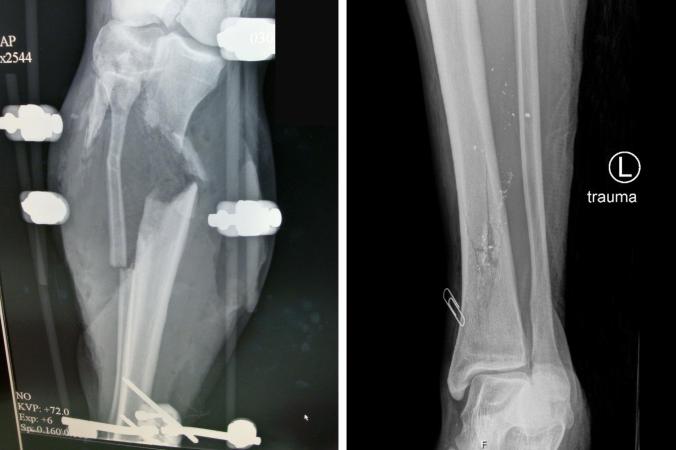
Left, an X-ray of a leg showing a bullet wound delivered by an assault rifle used in combat. Right, an X-ray of a leg that sustained a bullet wound from a low-energy bullet, inflicted by a weapon like a handgun in Philadelphia. from an article about destruction caused by military-style weapons in The New York Times


We have this in common. We are wounded.

“Many factors determine the severity of a wound, including a bullet’s mass, velocity and composition, and where it strikes. The AR-15, like the M4 and M16 rifles issued to American soldiers, shoots lightweight, high-speed bullets that can cause grievous bone and soft tissue wounds, in part by turning sideways, or “yawing,” when they hit a person. Surgeons say the weapons produce the same sort of horrific injuries seen on battlefields.

“Civilian owners of miliary-style weapons can also buy soft-nosed or hollow-point ammunition, often used for hunting, that lacks a full metal jacket and can expand and fragment on impact. Such bullets, which can cause wider wound channels, are proscribed in most military use.

“A radiologist at the hospital that treated victims of the Parkland attack wrote in The Atlantic about a surgeon there who ‘opened a young victim in the operating room and found only shreds of the organ that had been hit.’

This is one reason the hunters I know, even if they have such weapons, never carry them while hunting.  So-called assault weapons have absolutely no function other than war and mass murder. No civilian needs one. Indeed, even an actual “well regulated militia” has little use for them.

“ . . . ‘Bystanders are traumatized just seeing the victims. It’s awful, terrible. It’s just a ghastly thing to see.’ ”

Law is a reflection of the will of citizens. We pass laws that demonstrate our values and our goals, that define boundaries for behavior. Australia experienced a mass shooting and promptly outlawed the weaponry used because they did not see the need to allow another such shooting. They haven’t had another since.

It is simplistic and naive to say that “guns do not kill people, people do.” Somewhere in the United States psyche there seems to be imbedded the belief that guns make us safer. It is a treasured fantasy, a macho or fearful or perhaps fearful-macho faith that having a gun will turn individuals into saviors. Abundant evidence proves otherwise.

In truth, it is widespread but not a majority view that guns make us safer. A relative of mine who has been founded guilty in court of attacking his wife has a concealed carry. He says he “feels safer carrying.” It is a line I have heard from other men and women too. They only feel safe when armed. Needless to say, I do not feel safer that they are armed. Like them, I am afraid,

Fear is wounding. Fear is symptomatic of psychic damage. It, too. is a wound.

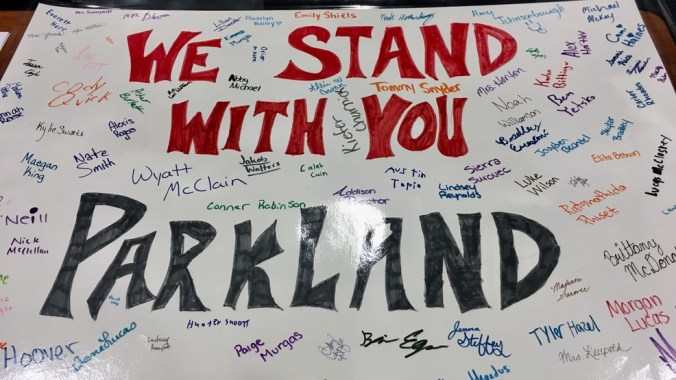
We are all wounded. Every killing, every attack, every shouted insult and barbarous excuse for such actions, wounds. Our nation is bleeding.

A MEMORY OF CONVENIENCE

2-wb1iccm

We did not see the film The Darkest Hour until recently. I had concerns about the lead, about the film, and particularly about its subject, the much lionized Winston Churchill.

It is one of my nightmares to find myself teaching a subject I know little to nothing about, such as the Boer War. Even so, I thought I knew British history. I knew for example that Indians (of India) died of starvation while the British sat on overfull grain houses during WWII. When I feel particularly distressed about the interference of my own country in the lives of people around the world, I have only to call up the atrocities of the British. They have been at it so much longer than we have.

I thought I knew this story.

A new essay in The Washington Post by Shasti Tharoor about Winston Churchill reveals how little I knew. He reviews Churchill’s unwarranted and brutal attacks on people of color all over the world. He advocated genocide,

“ ‘History,’ Winston Churchill said, ‘will be kind to me, for I intend to write it myself.’ He needn’t have bothered. He was one of the great mass murderers of the 20th century, yet is the only one, unlike Hitler and Stalin, to have escaped historical odium in the West. He has been crowned with a Nobel Prize (for literature, no less), and now, an actor portraying him (Gary Oldman) has been awarded an Oscar.”

“Churchill’s beatification as an apostle of freedom seems all the more preposterous given his 1941 declaration that the Atlantic Charter’s principles would not apply to India and the colored colonies. He refused to see people of color as entitled to the same rights as himself. ‘Gandhi-ism and all it stands for,’ he declared, ‘will, sooner or later, have to be grappled with and finally crushed.’

“Many of us will remember Churchill as a war criminal and an enemy of decency and humanity, a blinkered imperialist untroubled by the oppression of non-white peoples. Ultimately, his great failure — his long darkest hour — was his constant effort to deny us freedom.”

Not counting soldiers, millions died as a direct result of Churchill’s policies in Kenya, Ireland, South Africa, Afghanistan, Greece, Iran, Iraq, Palestine, and other countries. Up to three million died of starvation in India alone. In response to Gandhi’s campaign of peaceful resistance, Churchill said the Mahatma “ought to be lain bound hand and foot at the gates of Delhi, and then trampled on by an enormous elephant with the new Viceroy seated on its back. . . . I hate Indians. They are a beastly people with a beastly religion.”

He bombed and starved and destroyed and exploited. His words beyond his famous rousing speeches about British persistence, reveal a man so certain of British (English) superiority, so bigoted and self-righteous, that he never was held to account for his racism, terrorism, and butchery.

He helped win a war. Didn’t he?

Would ordinary Brits have done and said such things? Would I? No one likes to think so, but then I have to wonder why it keeps happening if so many, many people “would never . . . ”


STRANGE DAY

IMG_0378

We went to a promo presentation of Michelle Horgen’s new musical Scarlet at Powell’s Book Store in Portland last month. The songs were beautiful, the brief performances impressive. We drove over the coast range especially to see it. Tickets were on sale at the event, but I’d already bought tickets to the official Opening Night. We know the playwright and we were excited to see her. I’d supported this production since it was a 2013 Kickstarter. It is based on The Scarlet Letter, and I reread the novel in preparation. We had a reservation for the night at The Kennedy School and Gary and I talked about places to go for lunch and dinner before the play. Gary was worried about sitting still for the long play, but we planned a nap earlier in the afternoon. We planned to try sleeping in on Sunday because we were not used to being up late and because of Daylight Savings Time. The hotel had confirmed our stay.

And then last night, the hotel called to ask if we were checking in. Our reservation was for Friday, the woman said. Friday the 9th, not Saturday the 10th. I had printed off the reservation and the tickets. I had written it incorrectly on my calendar, had it stuck on my head as a Saturday event. It was already after 8pm. We live two hours from the show. My first thought was that I hoped someone else had gotten our tickets since it was sold out and there was a waiting list.

My second thought was that I am an idiot.

Gary assures me, “I am not going to mention this to anyone because I love my wife. It is a sign I was not ‘hoovering’ over her enough.” I am writing this blog post as he says this and handing me a cup of coffee. Okay, I am a most fortunate idiot.

The term ended this week after Wednesday’s final, and I completed grades for my college writing class. A student, reviewing his final grade at 89% online, emailed to ask if there was anything he could do to raise his grade. I had not yet rounded up, so that will be good news for him, though he has not thanked me and probably won’t. They were a nice class and I wish I’d had more time with all of them. Learning to write well is not something that happens in a few weeks, but there is hope it will happen.

Thursday, I worked for twelve hours on a novel manuscript that grew from a short story I wrote to apply to graduate school. Friday I worked most of the day on that novel and printed it off for Gary to read over the next week. I contacted friends to ask for a reading. Two have agreed. I thought Saturday would involve the drive to Portland and not enough sleep. I finally researched the person who asked for a complete manuscript in response to my agent queries. He seems an intelligent person and properly flattering to a potential client, but I knew he had only skimmed and not actually read my manuscript. His agency is a good one, but my online search suggests he is probably not a licensed agent. He is a valued member of the agency’s team, and perhaps he is working on his agent credentials. He asked me to rewrite a section of my novel, a section I knew was weak. Agent or not, he seems to know what he is about. I am doing exactly what he’s asked for, and more. Today, the Saturday morning after Michelle’s opening last night, we will dive to Portland and do some shopping. Sunday we will try to sleep in. Daylight Savings Time will cost us an hour. It is the anniversary of the Madrid train bombing and Fukushima.

Tomorrow is also the anniversary of my mother-in-law’s death in 1990.

The working title of my novel is Everybody’s Mother Dies.