IT’S COMPLICATED

Battle_of_Churubusco2.jpg

I have been reading and writing since I was at least five years old. A science teacher complained some years ago that English was offered to students every year in school. “You would think kids would know how to read and write by now.” I could see his point. Two years of high school science is clearly not enough, given everything from technology to understanding the difference in treating a bacterial infection versus a virus. You would think we could find a way to teach writing and reading throughout the curriculum so that all subject areas received adequate attention. I could get behind that.

Sadly, only a few teachers of science or social studies or mathematics bother to reinforce, let alone teach reading and writing skills. The careful scanning for bias in a text, interpreting multiple perspectives, and writing well-documented analysis. The complaining science teacher was not among those. That would be my complaint.

Some teachers do teach reading and writing skills relevant to their disciplines. A local Social Studies teacher insists student read primary source material such as “Letter from a Birmingham Jail,” and a Biology teacher assigns The Sixth Extinction. Yesterday, I handed my coffee-stained copy of Saving Tarboo Creek to an English teacher, suggesting that while the biology of habitat and spawning salmon was a primary draw, the memoir was worth reading for the analogies alone.

There is no single discipline we studied in high school that explains how to buy the right car or plan a vacation or choose a future career. No high school class teaches us how to be responsible citizens and happily married. Our lives are not neatly divided into school subject areas. The skills and information specific to a discipline should best be taught within that discipline, but our education must expand beyond school.

When I ask students in an English class to use basic arithmetic to compute a letter grade or their reading speed, they sometimes look at me as if I have lost my mind. Why are we doing math in English? They demand an explanation, perhaps an apology. I am asking them to mix stuff up. As if our lives were not a confusing mixture already.

Our lives are a messy tangle of obligations as members of families, communities, nations, religious affiliations and social groups; work in our homes, our neighborhoods, as citizens, and on the job; choices about procreation and leisure, career and family planning, government and law; and steps taken to ensure the mental and physical health of ourselves, our loved ones, and the more general population.

What we know how to do and our perspectives on justice and fairness and the future are determined by our family backgrounds and experiences and also by the tools and information provided by our formal education. If we lived in a hunter-gatherer community, those food-collecting skills would have been taught by people we had known and trusted since birth, people who had themselves been taught and practiced those skills all their lives. We are long past the time when every adult in a community knew everything there was to know.

Geometry and Botany and multiple translations of The Odyssey (and the original Greek) are disciplines that might each consume a lifetime. Most of us need a little of each. Our lives are far more complicated today. We travel. Our lives are touched by people, experiences, events, and demands beyond the capacity of any one person to grasp entirely. We know a little about a lot of things. We might know a lot and a few things. We require complicated skills of computation and reasons, reading and writing to manage even that much.

Rudyard Kipling wrote “If history were taught as stories, they would never be forgotten.” He had something there, and not only about history.

My students often want a simple narrative, a right and a wrong. The world does not work that way, or anyway, it rarely does. The truth is not possessed by one side alone. That would be science, and even science evolves.

We need stories to go with all our studies. We need stories about ecology and mathematicians and social movement. If we are truly to understand the Mexican-American War, we need the stories from Polk and Taylor and Perry; of the San Patricios, enlisted men and others who moved to the other side; of Americans, Mexicans, and native peoples who fought and died and the ones left behind; and the stories of those who came after. There is more than one true narrative.

We need all the stories if we are to make sense of our lives, too. Our lives are not high school classes, neatly divided into discrete disciplines. Our lives are complicated. Our lives change all the time. Our lives matter as story.


TRUTH TO POWER

15walkout-01-superJumbo

When I set up my essay on the little black dress (LBD) to run on Tuesday, it was because I have a series of essays about color that I planned to post on successive Tuesdays. I am releasing them in order, and it was that essay’s turn. It was posted automatically this morning with me doing a thing.

Not only will we have to repent for the sins of bad people; but we also will have to repent for the appalling silence of good people.
—Martin Luther King Jr.

Wednesday is the 50th anniversary of the death of the Reverend Doctor Martin Luther King, Jr. so I have been thinking about him all day. I am old enough to remember.

I used to do an activity or talk each year about three men. I held a globe in my hands and spun it as I talked about different places. I began with a New Englander, an American who refused to pay taxes that contributed to an unjust system and was jailed. He argued that by doing this, he harmed no one but himself and thus was not forced to act outside his morality. He called his actions Civil Disobedience.

On the other side of the world and decades later, a young lawyer fresh out of university in England tried boarding a train in South Africa and was told he was not allowed in First Class. Then that man went home to India and found that there, too, he was a second class citizen. Like the New Englander, his personal values would not allow a violent response. He chose another way. Sometimes he stood on train tracks and refused to move. In prison, he refused to eat. He called his actions Satyagraha, nonviolent protest.

Return again to the American South a few decades later, and here a young minister looked for a way to force change without sacrificing his soul in the process. He sat at lunch counters and ordered coffee. He marched in the street and sang. He called his actions nonviolent resistance.

Thoreau and Ghandi and King were inspired, each one, by the actions of others before them. Each one made change happen. Each one followed and then led in turn. It was not only men. Sojourner Truth, Josephine Hull, Fannie Lou Hamer, and many others created a path, stepping before those behind them, and lighting the way ahead.

Be inspired.

LITTLE BLACK DRESS

Little-Black-Dresses-Assort_1349795787_670x0.jpg

Black skin and black eyes, black noses and black fur, black hair, and the darkness inside tunnels. Darkness playing against light, the strength of contrast, of deepest intensity.

The little black dress is all about reliability, the safe but shapely and dependable dress that will always looks right for an occasion. When I was young and weighed considerably less than I do now and wore what today would be a size 0, but was then labeled a size 8, Sizes have changed. It is all about numbers, When I was a girl, I thought I was too fat and too white for black. I wore short tent dresses in sherbet shades of pink and orange and worried about my hairy arms and whether I had shaved under them recently enough. I could, in those days, fit into vintage dresses from the 1920s and 30s, beautiful narrow gowns in pleated silk with a pattern of black on rust and ruby velvet with black jet beads. I had a pair of black kid leather boots from the previous century, but when I wore a slender black wool crêpe, my mother declared it “too old” for me and I worried it made my skin look like the underside of a fish. My white skin carries an olive undertone that was unfashionable without a tan. My friends lay for hours in the sun. I hid in shadows.

A few decades pass and today most of my wardrobe is black. Looking down the line of my closet there are rare slices of deep coral and olive green, brown and purple and gray. Mostly, though, there is black hanging in my closet. Black jeans are my favorites. Black t-shirts and tank tops hang beside black cardigans in wool and linen. I have patterned leggings purchased one fall in the spirit of fun with turquoise zigzags and red hearts, but more often I wore the four black pairs. Black socks fill one drawer and black underwear another, two pair of black boots and black shoes line the floor. I had a red pair, but wore them out and failed to replace them. Hanging on the taller side of the closet that mostly belongs to my husband, there are four long black dresses. I save the smokey purple velvet one for winter weddings, but my best dress, the long lean, black jersey dress is good for occasions in any season. It is a petite large, mid-calf sleeveless, rayon jersey Eileen Fisher basic. When I have lost weight I belt it, and when I have gained I wear it loose with a light cardigan to conceal my waist. I do not worry that the dark color makes me look too pale, I hope it makes me look thinner. Like many women in America, I worry about my weight but do nothing about it other than casting illusions with my wardrobe. None of my black dresses is little. Though I wore little dresses that rode my thighs in many shades other than black when I was young, in my sixties the dresses in my closet hang well past my knees. A dark disguise.

Black is hard to see. Black is the lack of seeing, the absence of light reflected from a surface—when we see black, in fact, we are seeing nothing, the absence of light. Black clarifies the outline of objects in silhouette, but obscures what comes between its edges. The object is perceived as smaller than it is—hence the mystique of the little black dress.

I first became aware of this shrinking invisibility in real life rather than theory at a dog show. I had driven north and slightly east of Seattle in order to look at Afghan Hounds at the Puyallup Kennel Club show held indoors in a fairground stadium. The lighting was poor, and the black dogs being shown appeared nearly invisible, obscure blobs moving around the ring. When I later went looking for a dog, I knew I wanted one that looked like Barberryhill Dolly, a red Afghan in a photo from the 1930s. In a reversal of Henry Ford, I did not care what color so long as the color was not black. I flew to Arizona and came home with Oranje Anisette, a year old black bitch named for the anise-flavored liquor. She had white chest locket the size of a quarter that rarely showed, a good outline, and I finished her championship in Canada, but I would return to that fairground three years later to win a major with her distant cousin, who was red.

Anisette was one of our sweetest dogs. Licorice can be sweet or salty, red or black. I took mine black and sweet, but black as a color has other associations in the west: funerals, witchy hats, cats crossing our path. Black is the color of funerals and ill fortune, evil hearts and cruel magic events. The type on our page is black, but the page itself is innocently white. In the West black is the color of mourning, but some eastern cultures have a wiser approach to sorrow. They mourn loss by wearing white, the absence of color, not the absence of its reflection.

Applied to objects in dyes and inks, black is a supersaturation of pigment, so much pigment that the fabric or signature appears black until time, sunlight, or bleach fade it to purple or rust. This can be used to advantage. During my practicum, at the time I was student teaching in a middle school, Lynn Gray found black corduroy pieces from several bolts to make a group project. Students did reverse tie dye—discharge—tying cut squares with string and rubber bands and twine, dipping briefing in a bleach solution and then in baths to neutralize the bleach and rinse it clear. We expected a pattern of white on the original black, but none of the squares bleached to gray, instead some showed smokey blue, others rust or green. We came to greet this variation with enthusiasm.

Black itself varies, fades, shows bleaching from the sun. water on black ink may float in waves of colors. We may choose to write in black or blue or any dark color at all, but legal documents generally require dark ink, blue-black or black. The blue-black ink in my father’s fountain pen was a throw-back to early European times when the gall-ink black was transparent when first applied and a blue dye was added to ensure the writing was visible. Over time the gall ink turned dark and black.

The earliest India inks were from China and colored with carbon from sources such as burnt bone and oil. The Romans also wrote in black ink made from soot, but a recipe for black tattoo ink includes iron sulfate, bronze ground with vinegar, pine bark, and gall from insect egg deposits. Europeans made black ink colored with black iron gall—iron salts and tannic acids, often from oak—beginning in the twelfth century, but this acidic pigment is destructive of cellulose paper. The ink of Bach’s original eighteenth century scores have faded to brown and threaten to destroy the paper on which they were written so that conservators wrestle with how to preserve them. The signatures on my undergraduate diplomas, from not forty years ago, have mostly faded to illegibility.

Newspapers today are printed with carbon pigment suspended in oils, which results in ink coming off on the hands of readers. In Wodehouse’s stories, the impeccable butler Jeeves irons the Times so that the ink will not rub off on Bertie Wooster’s hands. My regional newspaper, The Oregonian, began using “rub-free” ink in the 1980s, but no one reads print newspaper much anymore.

The word black itself is derived from Old English dark and earlier words meaning to burn, gleam, shine, or flash. That might refer to the night sky, which in the days before streetlights would indeed and gleamed and shone, bright with stars no city-dweller can see today. The earliest know art, such as the caves at Lascaux, were painted in the dark with ground charcoal and manganese—mostly black on the stone. The marks are guessed to be wishful thinking of hunts and plenty.

The Egyptians regarded black as fortunate in their rich black soil but also through Anubis, god of the underworld and protector of innocence. The Greeks created a more complicated relationship with black, using black in ornament and cosmetics, decorating red pottery with black and later red drawn on a black ground. Black was darkness and death in the afterworld, darkest for those deserving punishment. But the Romans reserved colors for those of rank and black became the clothing of commoners. Death itself was named the Black House. In the north, there was the goddess of the night, but soon enough the prejudice of black as evil robed the devil in black. This would change in the West as black became fashionable and associated with the rich and powerful. Colors such as scarlet and blue and purple were still reserved for the wealthy and those with standing in the church, but black became the color of government officials and later the emblematic color of the Reformation, a somber and serious morally upright color, a hue of humility before God.

Thus use of black often carries a moral message, from black cats and witches’ hats to religious austerity in cleric’s cassock and nun’s habit, from the ostentatious display of sable furs and silk magistrates’ robe to the wretched industrial revolution’s soiled cities, black tie to tail coats, butlers and the governess’s modest dress to the Grim Reaper.

Queen Victoria made a life-long ceremony of wearing black in mourning for her husband from 1861 until her own death forty years later. Convention mourning of her day required plain black to be worn for a year and a day after the death of a family member. Gradually black was relieved by touches of white and then a shift to muted colors such as gray and mauve over the next years. Not everyone could afford to wear their grief but others played it to their advantage. Lily Langtry, the Jersey Lily who became one of the Prince of Wales’ mistresses and internationally famous beauty—Langry, Texas is named for her—entered society wearing a plain black silk mourning dress, which she secretly restyled each day for daytime and then evening wear. Without the money for jewelry or fashionable changes of clothing, her unadorned appearance ran against the highly decorative style of the day, and captured the public’s imagination.

In the midst of all this Victorian mourning, John Singer Sargent’s portrait of a notorious financier’s wife in a tight, low cut black dress, reveals Virginie Amélie Avegno Gautreau’s precious skin glowing like opal against the darkness. The painting that became known as “Portrait of Madame X” suggested a new and delightfully wicked association for the color in clothing.

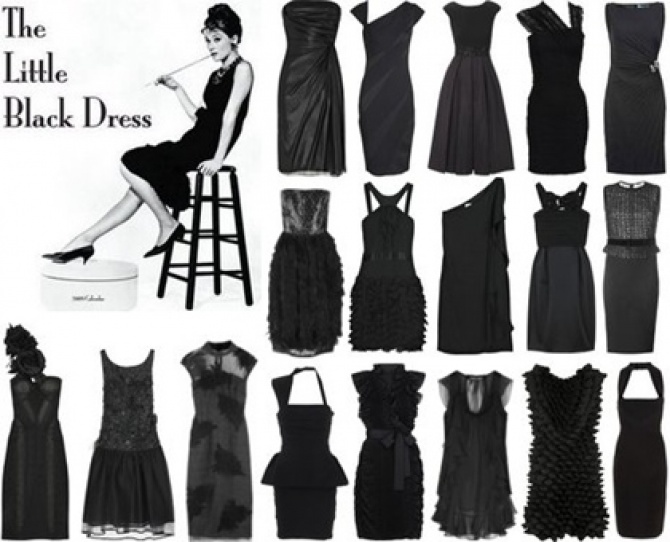
The Little Black Dress dates back to designers Coco Chanel and Jean Patou in the 1920s who were looking for understated chic. This sexy thing is available from every department store today—Nordstrom offers over seven hundred versions. Think of Audrey Hepburn with her long cigarette holder, her long black dress in Breakfast at Tiffany’s. Black shows the cat’s hair, but is a workhorse in the wardrobe, going everywhere and with everything. The use of black today conveys a message of elegant choice rather than judgement, punishment, or come-hither titillation. I only wear black in order to seem more slender than I am. A tiny visual lie. Surely not so dangerous a failing.

How I spent Spring Break

IMG_0729

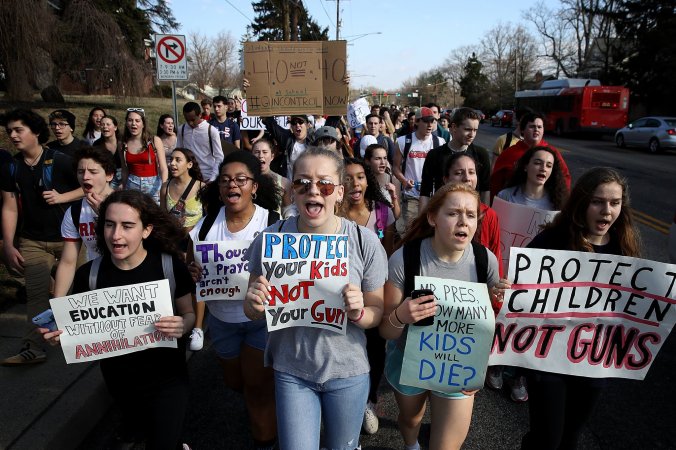
I napped, walked, read, cooked, revised older words, wrote new words, traveled, drank coffee, took a ferry twice, queried, submitted, and received good news. We went to the march in Astoria last Sunday. We both support sane “well regulated” gun safety. I set up blog posts to go live in the middle of the night. Life has been trundling along peacefully, but our passports were about to expire in April without our having ever used them, so we decided we had to leave town.

Usually Spring Break is an especially busy time for my students who work in the tourist industry—many of my students do. In fact, local teenagers and immigrants are the only way most of my local restaurants and hotels can stay open.

Though I offer a syllabus with information on where we are headed in class, I never give homework over vacations. Nothing is due the day we get back. They can come to class as unprepared as they like and we will pick up from there.

A friend who is retiring is struggling to figure out what he wants to do with his time. How do I manage? I suppose the best answer is that most often I hardly know the difference between work and non-work. Sometimes I am eager to bake bread and other days it is just something that must happen because the sourdough start on the counter needs to be put to use. Teaching my college class is like that. Most often I am eager to get to class, but some days I have to put in time preparing merely because the task has to be done. The walk on the beach in the rain? Not so different this morning than yesterday when the weather was lovely. Mostly, I do not dread any part of my life.

Most often, I devote Spring Break to working on curriculum and grading papers. I did not do that this year. Instead, I did the bare minimum and my husband and I went away for three nights—the longest we have been gone in 15 years. We stayed in B&Bs in Port Townsend and then took the Black Ball ferry across the Strait of Juan de Fuca from Port Angeles to Victoria in Canada. During this passage north, we talked to a couple visiting Victoria for the first time. We had visited many, many times, but not for thirty years.

Gary and I used to travel to Vancouver Island to stay with friends and show our Afghan Hounds. We attended the first Canadian lure course on Vancouver Island and our Onika was Best of Breed. I was nearly always there around Easter because the the Vic City shows. The old Dutch Bakery sold fancy molded rabbits in three kinds of chocolate. I intended to buy three, one for each grandchild.

I finished reading two books, one already started, but the novel was from a Port Townsend author and I interrupted The Odyssey to read it. I bought a bit of yarn and batik fabric—3 quarter-yard pieces—and three chocolate rabbits-in-roadsters from the Dutch Bakery in Victoria. Gary bought The Nation and 3 pounds of wildflower honey. We did not have access to the internet during the entire trip. We relaxed.

It wasn’t until we were nearly home again that I commented to Gary that I wanted editors and an agent who genuinely loved my work, not just liking it but enthusiastic about it. I found over 200 emails waiting. I responded first to Dinty Moore, editor at Brevity, who had emailed two days before to ask if my essay “Murder of Crows” was still available. Yes! I found a request for the full manuscript of my novel (the second such request). And after I had responded to everyone and written a blog post, Liminal Stories emailed acceptance of my peculiar owl story. I emailed the readers who had helped me with that story to share my good news and to thank them. I returned phone calls from people who had left me messages. I went back to work on the eleventh draft of my novel and worked through three more chapters. I began a work of nonfiction about restoration of a stream and wetland on the Olympic Peninsula, land we passed on our travels. A few days ago, I committed to the Camp NaNoWriMo challenge to complete a project this month. After our walk yesterday, I began work on an SF story, and I will work on it today too. But I always do the National Poetry Month Challenge to write a poem a day. The afternoon was crowded with words.

Saturday, we delivered a chocolate rabbit-in-roadster to each of our grandchildren. I played with each one, and I walked two of them home from their Easter Egg Hunt, loaded with tiny treats. The rabbits were not long for this world.

What I did not do: scored 4 of the essays in APA form that wait on the dining room table; order Malabgrio yarn; complete more squares for the quilt I began, last month now; knit anything beyond a swatch that is unsuccessful; finish painting walls and the rest of the ceiling upstairs violet-gray, or the four matching dining room chairs black or green.

Yesterday I poached sockeye salmon in lemon, garlic, and wine, roasted potatoes, and churned ice cream. I watched some television and recognized that during this vacation I both accomplished and relaxed. I opened the draft of the activity I plan for my writing students today, completed, and printed it off. I went to bed and rose early, heading back to work. Change is good, relaxation is healthy, but so are the ordinary tasks that give meaning to each day.

TRIP

cropped-img_2460.jpg

Do you wonder some times what the purpose is of a vacation? Are there rules of engagement?

Is it to “get away” or “see the rights” or become a tourist like the people who visit locally, the ones who want to know of the rocks on the beach are trucked in? When, exactly, do the deer turn into elk? How do you get to the beach? What does that cost?

These are favorite “stupid” questions cited by my students over the years. The easy answer is look around and head west, all paths lead to the beach and all beaches are open to the public in Oregon, an access unique in the United States.

Read the signs for prices, but not everything is for sale.

The Roosevelt elk are not overgrown deer, but the largest variety of elk in the nation. Bulls can weigh over a thousand pounds. If you see them, grazing on the side of the road, drive past. Do not pull over onto the shoulder to watch. Do not walk into a field to get a close-up photo. If the elk are standing at the side of the road, heads up, let them pass. Drive slowly and with care. Do not challenge a bull elk in the fall—the ones with antlers—because they are big and mating-crazed, and they can destroy your car or you. Leave the elk alone.

Bring your own firewood to the beach. Stay with the fire until it burns out—this will take longer than you are willing to sit on a windy beach. Put the fire out with water, not sand. A fire buried under sand will smolder.

A beach fire near the greenline, where the land meets beach, is illegal because it is a fire danger. Yes, a hundred inches of rain in the last year, but none of it fell in August when you want to roast marshmallows. Don’t try to burn the beach logs—also illegal—because they are for sitting and will smolder for days. See above.

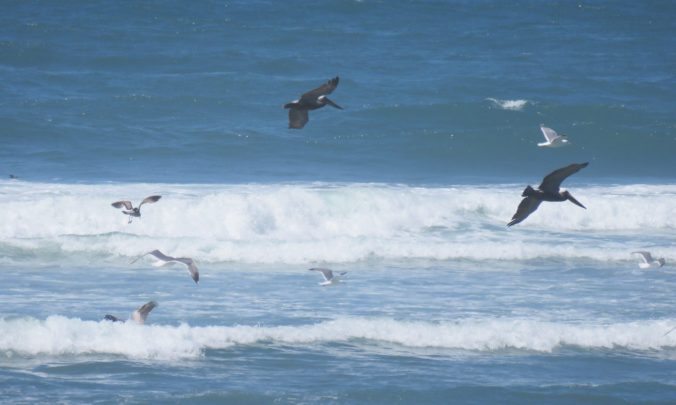
And flight. Don’t we all wish to fly? It is, I think, the real reason we go away, fly away, take flight on vacation.

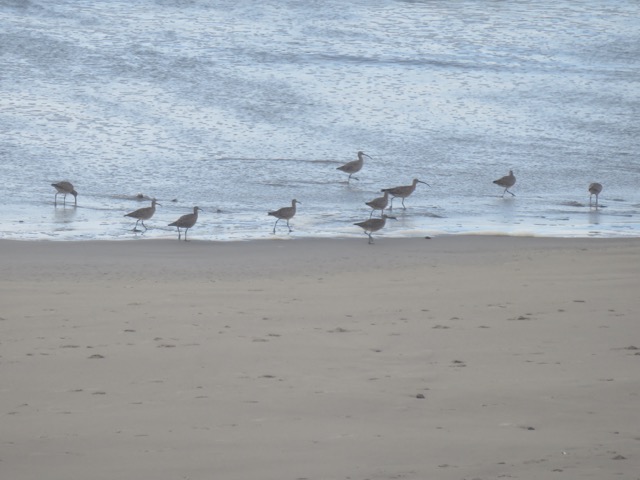
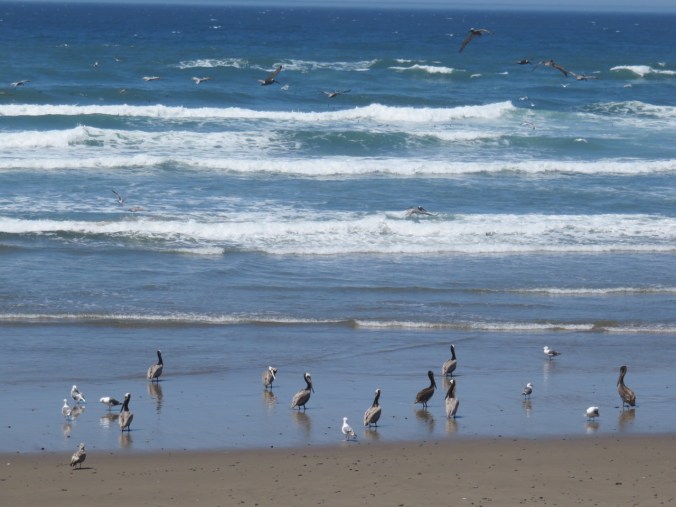
Those are brown pelicans and glaucous-wing gulls in the photo above. Black oystercatchers live here. The pelicans, other gull species, and cormorants, greebs, auks, plovers, sandpiper, whimbrels, and herons appear seasonally. You will see the eagles if you watch long enough. They live on the other side of the cape, but cruise our skies. A Cooper’s hawk and an osprey, owls, perhaps other raptors show up. There is a large family of crows and the raven pair have a baby in the spring. Hummers winter over sometimes. We see Steller’s jays and robins, wrens and sparrows, and black-headed towhees. The pigeons locally are native band-tailed and the invasive Eurasian doves. We love them both.  In the spring through mid-summer, the dawn chorus is worth waking early. A bat lives in our eaves. Flight.

Yes, a vacation looses us from the daily grind, lifts us from habit, reminds us to sleep, to see, to take in sights. To dream.

IMG_2440

IT’S TRUE

It’s true that I keep track. I have kept track since I was a girl, and I am officially an old woman now . . . so it’s been a long time. I have noticed for at least fifty years. I stay for the credits in films and search for women among the crew. I count who is asked to comment and what percentage of teams on news programs and Boards of Directors are male and female, white and people of color. I look at the genders of the people thanked in author’s acknowledgements. I count whose books are reviewed and by whom. When I went to the Faculty room at my local high school where I taught for 30 years, one table was crowded around by men, and women were not welcome at that table—seriously. I tried. I complained about this for years, literally years. Recently I said out loud in that lunch room, to the only other person at my table (a woman), that I planned to take a photo. I called the situation a “toxic work environment.” One of the men immediately suggested to administrators that maybe it was not right the way men crowded around one table and ignored the women in the room. Now there is a brand new, long narrow table, forcing everyone to sit at one table. This has, sadly, come far too late to address the “good old boy” atmosphere at this school.

Years ago, when the football, cross country, and volleyball coaches refused to allow formation of a soccer team, I was the one who suggested to a class of seniors: One of you must have a parent who is buddies with a school board member . . . and there was a soccer team.

It didn’t seem fair to expect the girls’ softball team to perform all maintenance on their frequently-flooded field while the boys’ baseball team had a brand new, non-flooding facility. And there was a lawsuit, but not until after several people tried to reason this out with those in power and were blown off. My sympathies were less with my employers than with the girls, who had for years dealt with the situation.

So, yes, I am one of those people on the side of the underdog, one of those people who keeps track. I notice when all the people in a room are white. I notice when only men populate a Congressional panel on women’s health. I notice when the only female person on a film crew is the “script girl.” And I notice when only men get book reviews. As Editor of the New York Times Review of Books and a woman, I might have hoped for better from that editor, but all the books recommended today are by men. One of the men is Mexican American (reviewed by a Vietnamese-American man). The illustration and one of the reviewers are women. Not enough. Not nearly enough!

Do better, please. I cannot believe that only men’s stories were published recently. I cannot believe that any special effort is required to ensure that there is some representation of the broad diversity of experience and perspective within our literature. The illustration below suggests that we all sit at the same table. I would like that to be true.

What came in an email:

Dear Reader… 
<nil>
Marta Monteiro
Our editors are enthusiastic about Luis Alberto Urrea’s new novel, “The House of Broken Angels” — as is our reviewer, Viet Thanh Nguyen, who writes: “The quips and jokes come fast through a poignant novel that is very much about time itself, especially the passing of time and the inevitability of death.”
Both Easter and Passover fall on this weekend. So Jon Meacham looks at changing perceptions of the resurrection story throughout history. Michael Massing’s new book, “Fatal Discord,” studies the relationship between Martin Luther and Desiderius Erasmus. And Simon Schama reviews Jonathan Weisman’s new book about being Jewish in the age of Trump.
Also inside, C.E. Morgan, author of the acclaimed 2016 novel “The Sport of Kings,” reviews Ulrich Raulff’s new cultural history, “Farewell to the Horse.” And those eagerly anticipating Steven Spielberg’s latest movie, “Ready Player One,” can enjoy the By the Book interview with Ernest Cline, author of the novel on which it’s based.
Lastly, do you love Grant Snider’s book comics as much as we do? His latest, “Whenever, Wherever,” is close to my heart. You can check out his other work here.
As always, let me know what you think – about this newsletter, our reviews, our podcast or what you’re reading. You can email me at books@nytimes.com and even if it takes me weeks to write back (I confess it probably will) I’m reading and thinking about your feedback.
Pamela Paul
Editor of The New York Times Book Review
@PamelaPaulNYT

SHORTLISTED update: ACCEPTED!

wood2

A story I am particularly proud of is “shortlisted”—that is, the editors told me they liked it and wanted to hold it longer—with a paying online journal. This particular story had been shortlisted three times before, each time by a journal that pays professional rates and does not allow simultaneous submissions. As a result it has been held for months, and then rejected three times already. It is sad for me to recognize how long ago I first drafted this story.

I desperately want a journal to publish this story. Three well-published literary friends have read it and helped me revise. The editors of this current journal said they would get back to me with a decision by the end of February. It is now the end of March.

To say I am anxious would be understating my feelings about publication of this story. Fourth time’s the charm? I don’t want editors to lower their standards for my story. I want them to love it as much as I do. They see a lot of great work. I want mine to belong to that rare group. I could save myself a lot of pain if I could lower my own standards. I could send it to smaller, nonpaying markets. I could send it to minor journals that have asked for my work. But it feels to me like an important story, a great story with an impact I will never replicate. Or is it merely a good story that is simply never going to be good enough? I really cannot say.

I read a lot, and I am pretty sure I know what my favorite journals are really, really looking for. It is not my story. I recognize the quirkiness of my story’s genre, which is mildly disturbing but not disturbing enough to be classified as horror. It is fantastic, but not in the conventional way that immediate labels a story fantasy. It’s not realist fiction or SF. It has humor but is not a comedy.

“If It Were True Owls Dream” is an odd, amusing, and somewhat unsettling short story in need of a home. It felt like magic when the first draft arrived. I need a little publication magic right about now.

I worked on a recent story and committed to work during April on another.

30 March 2018 update: Liminal Stories has accepted “If It Were True Owls Dream” for their summer issue! And it arrived in the same emailing—or in my same reading—as acceptance of a true story by Brevity and a request for a full manuscript by an agent I have been interested in for a long time. We had gone to Canada for a few days without internet and came home to all this wonderful news.

“Thank you for sending ‘If It Were True Owls Dream’ to Liminal.  We love it and would be pleased to accept it for publication. We were drawn in by the strong voice of the piece and found it wonderfully engaging and unusual.”

SHOCKING PINK

IMG_2120

I had been reading The Feminine Mystique by Betty Friedan in the bright pink paperback cover before my drawing class started at 7:30 in the morning. My instructor began screaming at me that the book had ruined his best friend’s marriage.

Somehow I knew, without knowing, that there had been some other reasons for the breakup. But I was young and small and female. I knew enough not to argue that day.

It was only my second term at the University of Washington, winter of 1971, when I arrived early for Art 111, the second in a studio drawing series required of all art majors. I had already been chewed out for humming and for missing a class due to snow (the busses did not run within two miles of my house and my ride went in late that day). I waited on a drawing bench, my large portfolio propped at the end and ready to go once class started. When my professor charged into the room, I stuck a bookmark in my book I had been reading and set it aside.

I was not quick enough.

He spotted the paperback book beside my hand and asked me, “Do you believe all that?” The pink cover was unmistakable.

“Yes, I do,” I said, well aware this was not the right answer.

“That book cost my best friend his marriage,” he said. He then reviewed details of his friend’s private life that I immediately forgot, his voice rising as he went along. It would not be the last time I would be yelled at by a man standing over me, insisting that men were being treated unfairly.

“One and a half million copies in print” my bright pink 1970 Dell paperback says on the cover. The dedication is to Friedan’s husband and children.

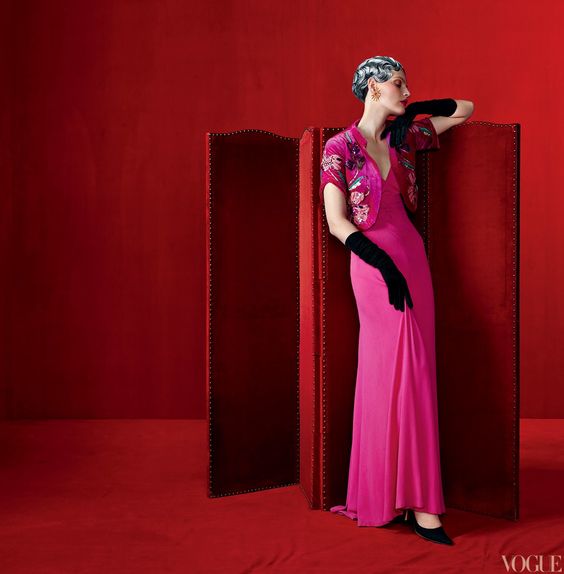
That book has been on my shelves ever since, and though the spine has sun-faded, the front cover is still shocking pink and that color was a statement in its day. Pink for girls—that pink inspired by an outsized diamond introduced on a perfume bottle in 1937 as “shocking pink” by fashion designer Elsa Schiaparelli. We called that shocking color “hot pink” sometimes, bright, the vibrant pink of bougainvillea and drag racer Shirley Muldowney’s car, the color striped on my purple Cher-designed bell bottoms when I was fourteen, a color that could hurt your eyes if you stared too long. In some European languages such as German, the word pink is not pale red, the color called “rosa”, but this particular intense pink, this intense leaning-toward magenta shocking pink is the only “pink”.
6dccee3524f3a67b84920ade2b114e37.jpg

Model Guinevere Van Seenus wears Schiaparelli’s shocking-pink dress (fall 1937) in the May issue of Vogue.

Shocking? Betty Friedan’s book, originally published in 1963, revealed what was happening to women in middle America after the Second World War, after Rosie the Riveter was sent home from factories to make room for returning veterans. As Americans moved into the suburbs, women went back to suburban and now isolated kitchens, married younger, had more babies, enjoyed the modern conveniences of automatic appliances, and yet they were not happy. The grocer, the baker, and even the candlestick maker were a car ride away and chances are, that wife didn’t have a car—only about 15% did by 1960 when my mother was responsible for two elementary-age children. Opportunities for women outside the home had actually deteriorated during the twentieth century. Schools for women still focused on the domestic arts, and women were warned that ambitions beyond their immediate family were a threat to peaceful society.

The cover of Friedan’s book was not just pink for girls, it was shocking pink, a color that warned it was starting something, a new look at women and their place in society, their need to find a place of meaning and purpose beyond marriage and parenting.

Friedan was among the first to utilize Maslow’s hierarchy of needs when she described how society was deliberately limiting women’s role to their sexuality. Gender alone as destiny.

Until the post-war period, pink was not even considered the color of little girls. In fact, earlier in the twentieth century, no one considered the gender of young children to be an issue at all. In England, if pink was deliberately chosen for a baby or young child, it was generally for a boy since red was the color of military uniforms and boys are pale versions of what they will become. Pink was not then a baby girl color; pale blue was not the color of little boys. Children were not thought to be sexual entities. Regardless of sexuality, the enforced split into girly pink and baby-boy blue does not seem to have been good for girls. (It hasn’t done the boys much good either.) Today entire toy departments are sometimes divided into the blue section with boy toys and the pink section confined to girls’ toys.

Nevertheless, the nearly two hundred year old American clothing manufacturer Brooks Brothers still offers thirty-three dress shirts in pink but only twenty-four in white and four in green, in addition to the most popular blue. Pink shirts are reputed to soften the impact of dark suits and sport coats in charcoal, navy, and black. The pale pink is tinted warm toward yellow or cool toward blue in order to complement skin tones.

Pink as a color name is nearly unique in that for many people it is a distinct color, not a tint or lighter version of red, but a color all on its own. Orange, green, purple, blue, and even yellow are described as light or dark, but add white to red, and it becomes another something not called light red, but pink.

The color illicits intense emotional responses. It is the color of the triangles labeling gay men during the Nazi era and today worn as a symbol of gay pride. It is currently one granddaughter’s favorite color. The older granddaughter likes blue, but before blue, she favored pink too. Before pink she loved yellow, and purple might be the approaching favorite. But for now, the younger granddaughter wears shocking pink whenever possible: pink pants, pinks dresses and nighties. She is not yet two.

In English, most people would have no hesitation calling anything from a dark navy to a light baby blue, blue. Even in the gem trade, all blue sapphires of any intensity, light or dark, are called blue. The same is not true for red sapphires.

My older granddaughter’s name is Ruby, the name of a gemstone that is always red. Rubies are corundum, the same gem as a blue sapphire, and both colors can sometimes be found in the same crystal, blue at one end, red at the other. Sapphires can be many colors other than blue, any color really—orange, yellow, green, violet. Only when sapphires are red are they called rubies, and when they are a pale red they are no longer rubies, they are pink sapphires in the United States. This is a relatively recent distinction. Where the gems are mined in Asia, all the reddish stones are rubies. The “riper” red ones most desirable, but the rich pink stones are favored in some nations. In some languages there are names for paler tints of blue, to distinguish them from saturations. There is even a more specific name for some sapphires. I would call the padparadscha sapphire a tropical fruit color, a rich orangey-red, but the name comes from the lotus flower. It is an especially desirable color.

Red and pink diamonds remain the rarest and command the highest prices for any gemstones. The highest price ever paid for a diamond was the vivid pink 5-carat stone sold for nearly eleven million dollars a few years ago, the inspiration for Schiaparelli’s shocking pink.

Pink today represents our tenderest emotions in English. The use of pink in clothing and decaration to denote specifically a girl child is a result of this recent prejudice. Wikipedia insists that the color name, pink, comes from a flower. The clove pinks (Dianthus caryophyllus) of my childhood were a low-growing plant with pale pink flowers standing above the foliage and having a distinctive and intense clove scent. It is worth noting that the name of the species, Dianthus, is derived from the words for “divine” and “love”. The stage name Pink refers to singer Alecia Beth Hart. Her professional name might be from her favorite color or a character in a movie (Mr. Pink in Reservoir Dogs), because she’s pink in private places—as we all are—or because she blushed a lot as a child. Does it matter? Pink can refer to sexuality and heat, but more often innocence.

There is safety in pink. Press a thumb on the gums of a person to observe how quickly the gum tissue returns to dark pink. A healthy vascular system replenishes color almost immediately. Pink is the color of health—though pink cheeks are never the pink found highlighting the cheeks of a porcelain doll, regardless of basic skin tone. Pink flushes the cheeks of every person, of any skin. It is also the color found in inflected eyes and the insides of shells, but blood stains wash out brown, not pink, and pink comes in many shades. What a confusion of color.

The cult classic, Pretty in Pink, concerns a girl trying hard to be something that others will admire. It is the color of newborns of many species regardless of adult fur, hair, feathers or skin color. Infancy to innocence in a single generation. By the 1950s, pale pink was the color most associated with fluffy sweaters and full skirts, with little girls and demur ladies with hands neatly folded in their laps.

By the second half of the last century, women grew tired of being always ladylike and supportive and silent. The watered-down tint that suited Maimie Eisenhauer no longer satisfied. According to a Life magazine blurb on the back cover of Friedan’s book: “Angry and thoroughly documented . . . it is going to provoke the daylights out of almost everyone.” Yes, pretty in pink, but also politically awake if we are told that passivity is the extent of our future.

It is never too late to become shocking with pink.


SaveSave
MY NOVEL

cropped-img_2225.jpg

My query-letter pitch:

Imperfect Patience*, a literary novel of about 76k words, follows a woman’s odyssey beyond grief. It is a novel of love overwhelming adversity.

Thena Justice was building a new life near Seattle after the death of her mother and breakup of a terrible marriage when her former husband murders the neighbor-babysitter and their daughter before committing suicide. Lost in grief and guilt, Thena first hides in a friend’s converted garage, then in a tiny cottage on the Pacific coast, thrashing her way through anguish, apathy, anger, and routine. Instead of returning to Puget Sound, she moves to Portland, Oregon, the city where she was born, takes the bus to a retail job each day, and keeps her head down until a child crying in the night wakens her sense of agency and hope.

My work has earned an Oregon Literary Arts Fellowship, Arts & Letters fellowship, Soapstone residency, Pushcart nomination, and publication in journals such as the Brevity blog, The MacGuffinCALYXThe HumanistNorth American Review, and anthologies on running and race. I have BFAs in studio arts, and an MFA in fiction from Pacific University. I live and teach in the NW corner of my home state of Oregon. My house has been home to six generations of my family, which like most has seen its share of tragedy.

I have written the novel I searched for when I faced my own life troubles, a story proving the pathway back from unimaginable loss. Women, especially, do this all the time. I have little faith in fairytale romance, but I do believe in grit, I believe in recovery, and I believe in love. I believe stories can sometimes save us.


Currently, I am writing nonfiction and science fiction, but later this year I will begin revising another realist novel—a completed draft that will go through several more drafts. You can also read more about revision.

*I have gone through several titles (at least five). If someone decides to represent this novel, perhaps they will help me name it too.

#FACEBOOK

Pendiri-WhatsApp-Dukung-Gerakan-DeleteFacebook.jpg

My husband and I don’t do Twitter. I have a Pinterest account, but no one in our family does the other social media. But for nine or ten years, maybe longer, I was on Facebook. I had over 1600 “friends.” They are actual friends, family, former students, former classmates, artists and writers.

I began phasing out use of my Facebook account early last summer. I nearly deleted my account this winter, but changed my mind at the last moment. I figure most people do that—change their minds. It’s hard to let go. I deactivated my account months ago and I did not exist on FB just now, at least as far as I knew. I had been afraid to check. FB will turn your account back on if you access it, even accidentally. That happened several times a few months ago.

So this is it, folks, I am back to thinking about deleting my account permanently. Or not.

I was fully aware of what I was getting into when I joined. The ads at the side made clear to me that Facebook was selling information. I found promoted stories in my feed every day. During the 2016 election campaign, I found horrible stuff in my feed and told it to go away. It did go away. I am not a good customer for conspiracy theories and wackjob political stories. I verify facts.

So now that everyone is a little hysterical, I can’t help feeling terribly disappointed in those 50 million accounts that were hacked. But my disappointment is not with Facebook—which is only trying to make a buck (or a few billions)—but with users who read the ridiculous trash on Facebook and apparently shared it. Facebook isn’t a site created in order to allow us to communicate with people we like. It was created to make a profit. Those ads on the sides were not a clue? The crazy “promoted” stories didn’t tip people off?

Yes, my schizophrenic relative believes Michelle Obama is a transvestite. Another believes in Obama’s death camps. The “Lock her up!” line was the favorite of many people who seem not to have noticed that their darling Trump has now, genuinely, done all the things we were supposed to lock her up for.

(Remember those crimes that were supposed to make us angry at Hillary?—Wall Street connections, private email servers, questionable charity?—those are Trump stories, my friends. The White House cabinet is stacked with Wall Street people; Trump’s family—I had to define “nepotism” for my seniors last month—members use private email servers in the White House; and only a lout like Trump would use his charity to purchase an enormous portrait for his golf course club house, a portrait of himself.)

I read the news every morning. I know more about what is going on than the latest shooting. I read science stories, political stories, art stories. I double check stories.

I trust (and so can you) any story that is covered by The New York Times, The Washington Post, The Guardian, and NPR. If I want a more conservative slant, I check The Wall Street Journal, The Hill, and The Christian Science Monitor. If I want a more liberal slant, I check Mother Jones or even The Nation. If I don’t want to read opinions, I don’t have to. I can stick to straight news. I can even check the news wire services who supply facts to everyone: the AP and Reuters.

Many of the stories I found on Facebook over the years, including on the pages of people I like, were nonsense—total trash and nonsense, some outright propaganda and a lot of irrational scare tactics. I mostly ignored those stories. Sometimes they made me angry. Sometimes the juxtaposition of someone I liked spouting nonsense disturbed me so much I could barely stand to be on Facebook.

It’s why I left.

However, even if I don’t miss Facebook, I do miss my people.

So there is my problem, or problems: I miss my peeps, I miss the family posts and news of former students, the art and writing news of friends. I miss sharing what I am doing each day. I miss posting news of my posts here on my Facebook page. I’d like to think I might have a book to promote on Facebook some day, and I would like to be able to do it.

Like everyone, I would like to boast about what makes me proud—recent publications, beach finds, grandchildren . . . on Facebook.

It would be ironic, wouldn’t it, if I returned to Facebook just as everyone else leaves?