I have been reading and writing since I was at least five years old. A science teacher complained some years ago that English was offered to students every year in school. “You would think kids would know how to read and write by now.” I could see his point. Two years of high school science is clearly not enough, given everything from technology to understanding the difference in treating a bacterial infection versus a virus. You would think we could find a way to teach writing and reading throughout the curriculum so that all subject areas received adequate attention. I could get behind that.
Sadly, only a few teachers of science or social studies or mathematics bother to reinforce, let alone teach reading and writing skills. The careful scanning for bias in a text, interpreting multiple perspectives, and writing well-documented analysis. The complaining science teacher was not among those. That would be my complaint.
Some teachers do teach reading and writing skills relevant to their disciplines. A local Social Studies teacher insists student read primary source material such as “Letter from a Birmingham Jail,” and a Biology teacher assigns The Sixth Extinction. Yesterday, I handed my coffee-stained copy of Saving Tarboo Creek to an English teacher, suggesting that while the biology of habitat and spawning salmon was a primary draw, the memoir was worth reading for the analogies alone.
There is no single discipline we studied in high school that explains how to buy the right car or plan a vacation or choose a future career. No high school class teaches us how to be responsible citizens and happily married. Our lives are not neatly divided into school subject areas. The skills and information specific to a discipline should best be taught within that discipline, but our education must expand beyond school.
When I ask students in an English class to use basic arithmetic to compute a letter grade or their reading speed, they sometimes look at me as if I have lost my mind. Why are we doing math in English? They demand an explanation, perhaps an apology. I am asking them to mix stuff up. As if our lives were not a confusing mixture already.
Our lives are a messy tangle of obligations as members of families, communities, nations, religious affiliations and social groups; work in our homes, our neighborhoods, as citizens, and on the job; choices about procreation and leisure, career and family planning, government and law; and steps taken to ensure the mental and physical health of ourselves, our loved ones, and the more general population.
What we know how to do and our perspectives on justice and fairness and the future are determined by our family backgrounds and experiences and also by the tools and information provided by our formal education. If we lived in a hunter-gatherer community, those food-collecting skills would have been taught by people we had known and trusted since birth, people who had themselves been taught and practiced those skills all their lives. We are long past the time when every adult in a community knew everything there was to know.
Geometry and Botany and multiple translations of The Odyssey (and the original Greek) are disciplines that might each consume a lifetime. Most of us need a little of each. Our lives are far more complicated today. We travel. Our lives are touched by people, experiences, events, and demands beyond the capacity of any one person to grasp entirely. We know a little about a lot of things. We might know a lot and a few things. We require complicated skills of computation and reasons, reading and writing to manage even that much.
Rudyard Kipling wrote “If history were taught as stories, they would never be forgotten.” He had something there, and not only about history.
My students often want a simple narrative, a right and a wrong. The world does not work that way, or anyway, it rarely does. The truth is not possessed by one side alone. That would be science, and even science evolves.
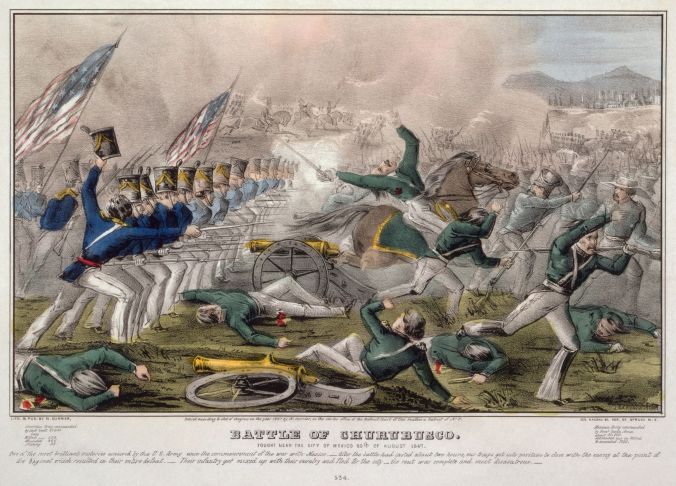
We need stories to go with all our studies. We need stories about ecology and mathematicians and social movement. If we are truly to understand the Mexican-American War, we need the stories from Polk and Taylor and Perry; of the San Patricios, enlisted men and others who moved to the other side; of Americans, Mexicans, and native peoples who fought and died and the ones left behind; and the stories of those who came after. There is more than one true narrative.
We need all the stories if we are to make sense of our lives, too. Our lives are not high school classes, neatly divided into discrete disciplines. Our lives are complicated. Our lives change all the time. Our lives matter as story.
 IMPERFECT PATIENCE