Do you wonder some times what the purpose is of a vacation? Are there rules of engagement?
Is it to “get away” or “see the rights” or become a tourist like the people who visit locally, the ones who want to know of the rocks on the beach are trucked in? When, exactly, do the deer turn into elk? How do you get to the beach? What does that cost?
These are favorite “stupid” questions cited by my students over the years. The easy answer is look around and head west, all paths lead to the beach and all beaches are open to the public in Oregon, an access unique in the United States.
Read the signs for prices, but not everything is for sale.
The Roosevelt elk are not overgrown deer, but the largest variety of elk in the nation. Bulls can weigh over a thousand pounds. If you see them, grazing on the side of the road, drive past. Do not pull over onto the shoulder to watch. Do not walk into a field to get a close-up photo. If the elk are standing at the side of the road, heads up, let them pass. Drive slowly and with care. Do not challenge a bull elk in the fall—the ones with antlers—because they are big and mating-crazed, and they can destroy your car or you. Leave the elk alone.
Bring your own firewood to the beach. Stay with the fire until it burns out—this will take longer than you are willing to sit on a windy beach. Put the fire out with water, not sand. A fire buried under sand will smolder.
A beach fire near the greenline, where the land meets beach, is illegal because it is a fire danger. Yes, a hundred inches of rain in the last year, but none of it fell in August when you want to roast marshmallows. Don’t try to burn the beach logs—also illegal—because they are for sitting and will smolder for days. See above.
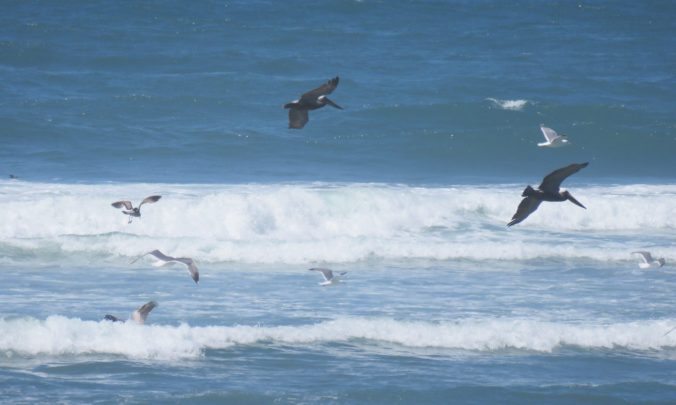
And flight. Don’t we all wish to fly? It is, I think, the real reason we go away, fly away, take flight on vacation.
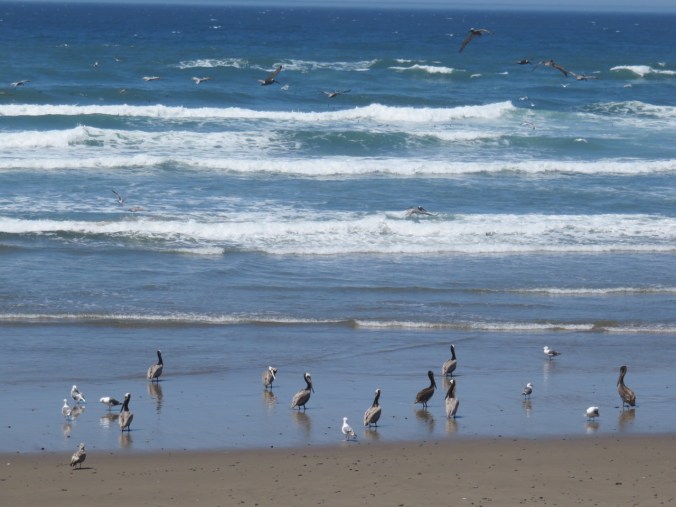
Those are brown pelicans and glaucous-wing gulls in the photo above. Black oystercatchers live here. The pelicans, other gull species, and cormorants, greebs, auks, plovers, sandpiper, whimbrels, and herons appear seasonally. You will see the eagles if you watch long enough. They live on the other side of the cape, but cruise our skies. A Cooper’s hawk and an osprey, owls, perhaps other raptors show up. There is a large family of crows and the raven pair have a baby in the spring. Hummers winter over sometimes. We see Steller’s jays and robins, wrens and sparrows, and black-headed towhees. The pigeons locally are native band-tailed and the invasive Eurasian doves. We love them both. In the spring through mid-summer, the dawn chorus is worth waking early. A bat lives in our eaves. Flight.
Yes, a vacation looses us from the daily grind, lifts us from habit, reminds us to sleep, to see, to take in sights. To dream.
 IMPERFECT PATIENCE