FAIR TRADE

IMG_2996

My husband and I pick up trash along the shore, and in some magical-superstitious way, I believe removing plastic pays for my pleasure on our daily walks.

Yesterday morning there was a seal resting onshore. She was alive but unwell, sick or injured. She would either live or die and nothing I could do would aid her survival. We gave her a wide berth during our walk so as not to unduly hasten her death. She was our second beached seal already this season. The body of another seal rots higher up the beach.

More often we see sea lions swimming in surf or basking just beyond the surf line. But we have found them dead onshore with a bullet wound in their face. You will have to take my word for that. I do not take photographs of everything.

Years ago at a writing retreat, a woman described how she became a writer. It began with a solo vacation on the western edge of the Olympic Peninsula. “I found an abandoned baby seal,” she began. And I sat upright in the audience, waiting for her understanding. But no, she “rescued” that baby marine mammal. She took it from the beach, put it in the back of her car, and drove it to Seattle. I waited for her to admit her terrible error. She never did.

At best, she stole a baby from its mother. Signs at many beach access locations warn against interfering with marine mammal, particularly baby seals, which have been left by their mothers while the parents fish.

At best, that baby and mother were separated for all time, a shelter was able to get the baby to feed, and perhaps release it later. I do not know that this ever happens. The more likely outcome would be that the baby sickens and dies or lives and spends the remainder of its life in a compound or cage.

Sea mammals are beautiful and smart, and most of us would not be willing to eat one. They have appealing faces and large eyes that seem too human. We cry at the thought of clubbing baby seals. Charities garner funding with photos and videos of bloody beaches.

The Marine Mammal Act levies heavy fines for interfering with sea mammals or allowing them to be interfered with—think people wanting to touch the animal or “help” the weak animal back into the ocean, consider loose dogs on the beach.

Three women hovered near the seal this morning. One of them had, thankfully, leashed her dog, a dog which has in the past harassed a baby seal, driving it into the surf. I approached one woman, who stood too close.

“We don’t know who to call,” she said.

“It will live or or it will die, and there is nothing you can do to help.”

“Won’t they come and put it back in the water?”

I shook my head. “They might stake out the seal with signs warning people to keep their distance. You need to stay back and give it space. The seal needs to rest, and she will live or die.” We have been through this before.

“Thank you,” she said. “Thank you.”

What for? I wondered. The seal was dying. I did not tell her the truth, what I did not want to know. The seal was dead by afternoon.

In our hubris, our self-importance, our presumed human power to damage and destroy and build and create, we want to believe we can control everything. We want to believe that we or some expert can fix everything.

It is wise to accept that much of the world spins on without our help and often without even our notice. It is wise to place our humanity a little off from the center of the universe.

SaveSave

SaveSave

EAGLE & ALBATROSS

IMG_2994The other day we saw five eagles all at once. Three were on the beach near the dead seal just up the beach, which has since then begun stinking. The seal. The other two eagles were in a snag about fifty yards back from the beach. I didn’t have my camera with me, so Gary and I just stood and stared for a long time from a respectful distance.

Not all surprises are so delightful.

A story I’ve sent out too many times has just been rejected again. Some of the best literary journals in the country have rejected it. Sometimes they send me a note about how they almost took it or they liked it and were sorry. Today a journal that I submitted to last year (344 days ago) rejected it with only a form rejection. It is a great journal I have subscribed to and they receive thousands of submissions. But after keeping a story for a few days shy of a year, I really think they could have coughed up something better than “Thank you for your patience.”

I am not patient. Another story was rejected recently with the note: “Our staff especially admired the sisters’ personalities. We suggest slowing the pace of the story and really taking time to develop the many themes in the story.” I had recently spent a lot of time carving that story back in order to speed the pace up.

Maybe a form rejection is better?

Nope.

There were no bald eagles in Arch Cape when we moved into my great grand aunts’ home. At least there were none that we noticed.

IMG_2982This morning, an eagle stood near a dead albatross. It’s the second dead albatross we have seen on our shore since 1979. Our biologist neighbor didn’t believe we’d found that first bird until Gary took him out and showed him the body on the sand. “That’s a black-footed albatross,” he said then. If John was right, we found a rare bird. Dead, though.

Alive, a black-footed albatross has a wingspan of 6-7 feet. The eagle we saw this morning was full grown, but the other day when we saw five, at least one was a “baby”—full size, but still in juvenile plumage.

A friend suggested that I consider writing nonfiction.

I thought I was already doing that.

I don’t know why that drift log has red paint.

SaveSave

SaveSave

BETTER

IMG_2587

We were up on the balcony at the Schnitz in Portland the other evening. A woman sitting behind us dropped her cane and it hit my husband right on the top of his head.

“Oh! I am sorry!”

“It’s okay.”

“No, really, I am so sorry.”

“It’s fine.”

“But are you sure you’re okay? I can’t believe I did that!” She could not stop apologizing.

My husband turned full around. “Hello, I’m Gary.” He grinned.

Soon they knew one another’s history and we all chatted away.

There is some empirical evidence that talking to others, particularly the habit of reaching out to people we meet casually—the person waiting in line in front of us, the man watering his lawn, the woman having coffee at the next table—is a reliable predictor of longevity. It’s certainly no cure for what ails us, but it focuses us away from our pain in the same way the I was taught to focus away from labor pains.

Talking to other people is a challenge during depression, but if we already have the habit and refuse to let go, such casual conversation can be a distraction from our sadness.

Depression IS sadness, but on a level and for a length of time that there is no end in sight. This belief that depression is not often caused by circumstances flies in the face of all evidence. It is not a literal “epidemic” but a failure of our culture to provide meaning and purpose. We fail to eat, sleep, communicate, work, and live meaningful lives and then we wonder . . .

Undoubtedly, suicide is sometimes the result of illness. It is always the result of unbearable circumstances, it is always the result of overwhelming sadness. Like the current “epidemic” of opioid abuse, suicide is about loss.

Sometimes the loss is entirely personal and unknowable. Increasingly, the loss is widespread and a failure of our culture to sustain the human soul.

For most of human history, human interaction was primarily cooperative.

For most of human history, communication was between people, not machines.

For most of human history, people ate what they could find or grow themselves.

For most of human history, we slept more than we do today.

For most of human history, we sat quietly for regularly periods of time. We attended to the seasons, to the darkness and light, to shifts of other living things because this attention was necessary to survival.

Despite growing awareness of the dangers of depression, acknowledgement of suicide, and drug and talk therapy, suicide rates continue to grow.

I have heard depression compared to diabetes, in that we would not expect a person ill with diabetes to thrive only on good intentions. A symptom of diabetes is increased thirst. A glass of water addresses their immediate need but not the problem. The “epidemic” of depression and suicide will not be cured with anti-depressants or even with talk therapy. It will only be repaired by addressing the cause, which is the result of a failed culture, not broken brains.

Wiser people than me have insisted that suicide is not a cry for help. But maybe it is a cry for help in the way we live. Maybe it is a symptom of illness not of the person but of an increasingly unsatisfying, unsustainable, and unbearable way of life.

Maybe I can’t do a thing about any of that. But I can greet others. I can trade stories. As long as I can participate, I will.

Hello! My name is Jan, and you are . . .


SaveSave

SaveSave

SaveSave

BIRTH

To my second-born son:

Thirty-six years ago, just now, I was in labor. My first pains were last night and Gary said, “Don’t think about it.” So I didn’t. I went to bed. I got up about now because I couldn’t ignore labor any longer.

At the hospital, a nurse examined me. “Well,” she said, “whatever happened last time you are doing it again.” You were 4 weeks early and I was already close to delivery. I was glad of that because I did not want them to send me to Portland again, or do anything to stop the labor.

I overheard a frantic conversation in the hall outside my room. My doctor would not come for the delivery because it was his day off. This didn’t surprise me. That doc was new and his father was an OB/GYN in Beverly Hills. He didn’t intend to stay in Oregon.

There was literally no doctor in the entire hospital. They called Dr. Larry Zagata, who had been my original doctor in my first pregnancy. He had just come off a weekend on ER duty, but he drove back from Neahkahnie. The baby was coming fast—you—and I recall quite clearly thinking, “It could not possibly have hurt this much the first time, or I would never have done it again!”

They barely got me into the delivery room before you came out, spilled amniotic fluid all over Larry, and then you pissed on him. He laughed. He’d only just showered before returning to the hospital.

So Larry Zagata, your dad and I, and three nurses were there in that moment. We saw you first.

I always figured Larry owed me a birth since your brother arrived in Portland.

I was in a room, showered and elated by 8:30 that morning. My temperature and other vitals were down and nurses kept coming in to check me. They did not tell me they were concerned, but I knew, and I wasn’t worried because a dropped temp is a sign of imminent labor in dogs. I took the birthing classes both times I was pregnant, and they were helpful. I did not scream, I sang during labor (Joni Mitchell’s “Song for a Seagull”), and though I cried on the third day of labor with your brother, I did not cry for you. What most helped was breathing exercises I learned in high school PE (the only useful thing I ever learned in PE) and relearned in classes plus what I learned watching our dogs whelp puppies. It’s called labor because it is hard work being born.

Welcome to the world, my dear boy. I always wanted brown eyes as a child and you were that gift.

love,

mom

MEMORY

my-brain-is-full-1.jpgOne of the assignments I used to give my juniors was to memorize the Preamble to the Constitution of the United States.

We the People of the United States, in Order to form a more perfect Union, establish Justice, insure domestic Tranquility, provide for the common defence, promote the general Welfare, and secure the Blessings of Liberty to ourselves and our Posterity, do ordain and establish this Constitution for the United States of America.

We listened to the School House Rock song (which leaves out four words) and sang it together several times. Then we wrote the fifty-two words on a slip of paper. Students had to write it perfectly, with all the peculiar caps, punctuation and spellings, before they were done. Almost no one got it the first time they tried to write it out. Some needed a dozen tries. For many, this was the first time they noticed the word “posterity” and I had to define the term. Many initially complained it was “impossible.” Yet most of these same students could likely sing the lyrics of favorite songs. Eventually they all got it.

Students routinely underestimated their own capacities in many ways. Memory was one.

In the past, I have used the example of my younger son’s experience as an undergraduate Theater major. Ian will say he is fortunate, and that is likely true, but he is also smart and a skilled performer. He was a gamer from the age of 4 and now makes his living in theater, mostly as a master electrician.

In earlier days, Ian starred in high school musicals, performed in community theater, and while a college student at Portland State he played on every university stage as well as in commercial theater, and starred in an indie film. When the male lead in a local community theater walked off four days before the opening of a play, the director called Ian. He was on stage for the opening, off script and brilliant.

I recently read a new translation of The Odyssey by Emily Wilson. It functions as a comfortable introduction to that ancient story, offering an excellent overview of its background and an attempt at form—the original Greek is in a poetic form that does translate so Wilson chose to use iambic pentameter with shorter lines, which do not allow for all the detail of other translations. But the story is lively and interesting with monsters and divine storms and bloody battles. The claim that most disturbed me was her insistence that no one poet or performer could have memorized the entire epic of over 12,000 lines. I could only conclude she didn’t know theater people.

One of the plays my son performed in college was the restoration comedy She Stoops to Conquer. The play includes many characters and he memorized all the lines—he had little choice since he performed all six of the major male roles in rotation as well as all the unnamed male roles such as “servant.” It is a long play.

So is Hamlet, which contains just over 4,000 lines and anyone playing the lead would likely, by necessity, learn the entire play. It is not enough to know cues, the lines immediately previous to those the actor knows. The actor needs to know more than that. And that is not the only role a lead actor in Shakespeare’s day would have known. In repertoire, where a limited groups of actors perform several plays in rotation, he might be performing a dozen roles. It would not be unusual for a single actor to have 12,000 lines mostly memorized. And then a month later he would have a new play and another and another.

Assuming a minstrel sang only long piece or perhaps a handful learned over a lifetime? To perform 12,000 lines is not “impossible.” It would require 12 hours, be sung over a series of nights. Again and again.

It is, frankly, incredible what the human brain can do.

Many of us struggle to commit a phone number to memory. How about 67,980 digits? That’s how many digits of pi that Chao Lu of China, a 24-year-old graduate student at the time, recited in 2005. Chao uttered the string of numbers during a 24-hour stretch without so much as a bathroom break, breaking the world record.

It is only in modern literate times that we have so underestimated the capacity of the human mind to memorize. Modern research suggests that most people know as few as 10,000 or as many as 35,000 words. A working vocabulary, words we use routinely in conversation, is much smaller, a few thousand words. The Kottke blog (one of the oldest) offers an interesting overview:

In his collected writings, Shakespeare used 31,534 different words. 14,376 words appeared only once and 846 were used more than 100 times. Using statistical techniques, it’s possible to estimate how many words he knew but didn’t use.

This means that in addition the 31,534 words that Shakespeare knew and used, there were approximately 35,000 words that he knew but didn’t use. Thus, we can estimate that Shakespeare knew approximately 66,534 words.

According to one estimate, the average speaker of English knows between 10,000-20,000 words.

True, Shakespeare cannot be considered typical, but words were his business. His command of language was not so unusual, even in Europe. Wordplay was entertainment as well as occupation. Courtiers invented puns on the fly. People got the joke. When my typical Honors students were assigned to read Huck Finn, they often complained about the difficulty of reading Jim’s dialogue and rarely found the book funny. When I read it aloud to my regular English classes, they laughed continuously. They heard all the jokes. My “smarter” readers were not often hearing the language, but skimming.

(A reading specialist once told me that reading under 350 wpm was failure. This represents a misunderstanding of how the brain processes language. True, a very slow reader, sounding out one word on the page after another, struggles to make sense of a sentence. But a very fast reader fails to grasp anything but an overview of content. The fast reader cannot help but resent poetry for the demands it places on the reader, and thus loses the art on the page completely—a complaint for another time.)

The impact of cell phones, audiobooks, and other technology on language has been estimated to be anywhere from debateable to improved. It might result in little change to overall usage or actively cause vocabulary and grammar to deteriorate or even improve usage.

In any event, the memory capacity of the human brain is enormous. There is no danger of filling it up. Whatever we might believe limits our abilities to learn and use new information, we are likely wrong.

People are capable of learning and growing throughout their lives. It is wise for us to do that, a healthy habit. However long we live and any way we look at learning—through formal education, memorization, life experience, or invention—it is what we are meant to do throughout our lives.

Our brains are never full.

SaveSave

SaveSave

DID IT

IMG_2969.jpg

It was raining in Portland. Kids were dancing. The music was fine.

Today is a big day. Sand Castle Day happened in Cannon Beach and Rose Festival in Portland. It was also World Wide Knit in Public Day, so I took my knitting along with me to the Scandinavian Midsummer Festival in Oaks Park. We’d gone to the Scandinavian Festival closer to home, but this was our first time to the one in Oaks Park. The skies poured rain down on us and the traffic was terrible on the way over, but we found the venue without getting lost. I wore my pussy hat to keep my head warm and a huge sport top I borrowed from my son Alan almost 20 years ago and never returned.

It was a wet day, but I finished my swatch for . . . something. I have 7 skeins of a lovely tweedy-painted violet and blue Koigu merino 2-ply and a matching extra fine, silk-and-mohair lace-weight, which is also from Canada. I think I bought them to knit a sweater.

When I got home, the sun was shining, I blocked the gauge swatch, and now I suppose I will have to write up a pattern and actually knit a garment.

BELIEVE ME

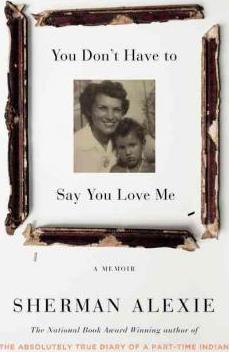
9781478912811.jpgI first wrote a review of Sherman Alexie’s memoir, You Don’t Have to Say You Love Me, in August of 2017 on Goodreads. I continue to be mystified by the glowing reviews of this memoir. It seemed to me that Alexie was busy blaming women for what men had done or for what he, himself has failed to do. I have read many books that attack a woman (a character, a mother) in inexplicable way, as if the suffering of women listed purely to advance the needs and character of men in their live. Zoe Boisierre wrote on the Brevity blog about the recent outing of Junot Díaz as a serial abuser. Given recent revelations about Díaz, Alexie, and other authors, I feel vindicated in my distrust.

Recent news of Alexie’s abuse of women (early 2018), confirmation by no less than Joy Harjo that complaints have been ongoing for years, and especially his semi-apology should not surprise anyone. It is clear in his memoir that his perception of suffering is entirely selfish. He reveal no depth of appreciation for the suffering or pain of anyone but himself. Despite his skill as a writer, I never understood the apparent widespread “love” of this book.

“Believe me, believe me, believe me.” Ever since I read a review of Sherman Alexie’s memoir, You Don’t Have to Say You Love Me, the song has been running through my head. You could find it on YouTube, but if Dusty Springfield’s voice doesn’t come right up out of your memory, best to leave it alone. You may find yourself walking in time to the tune for the next few days. Maybe that isn’t so bad. It’s a great old song, but I would be happy to get it out of my head.

There are short vignettes, longer scenes, words cut into lines and stanzas that sometimes are poems and sometimes have other business. Ultimately this book does not reveal wisdom of hindsight or generosity of objectivity or even modest compassion for the woman who sacrificed so much to keep him alive. This is thrashing. This is struggle. This is self defense.

Alexis calls himself an “urban Indian” who left home to attend an elite private high school and never really came home again. As I read, I searched for commonalities. He was raised poor and on a reservation and, while I was raised on a dirt road with open ditches and poverty all around me, my parents chose that house because the schools were good. My father was also an alcoholic. Maybe. But he worked and brought home his paycheck. We always had milk in the house, even if it was powdered. He died. I loved him very much. We have that much in common.

My friend Kathie lent me her ARC and we invited him to talk to my high school students and to read in Cannon Beach based on that book. (We are a largely rural and poor community, those of us who actually live on the north coast of Oregon. He would not have been available a few months later. His speaking fees were astronomical.) Alexie and his bride stopped off for these events on the Oregon coast before completing their journey home after their honeymoon in Hawaii.

Before telling more I should mention that I have read most of his books. I loved Sherman’s first collection of short stories and the ones that followed. I did not love his novels. My friend taught The Absolutely True Diary of a Part-Time Indian, which has considerable connection to Alexie’s real life, when I was teaching literature I taught his short stories, and this author made my husband cry on that long-ago visit. I bear a grudge concerning that last. I have not forgiven Sherman Alexie any more than he has forgiven his mother. I was not raised in poverty but my husband was. I am not always a kind person, but my husband nearly always is. So I am a skeptic when it comes to Sherman Alexie. I am a fan, but I know enough not to trust him.

The strength in this memoir is the writing itself, which is sometimes brilliant and occasionally even humble when he admits flaws. Too often he is defensive. Mostly he is churning with guilt and anger and not managing any forward movement. He is eager to label himself bipolar. He expresses tremendous guilt and resentment for his estrangement from his mother, for not speaking to her for days and weeks and even years at a time. But he blames her for it. Like many children of bad fathers, he blames his mother. As a woman and a mother myself, I find that bizarre. I take it too personally, you might think. I am a feminist and a class warrior. I am also weary of people who hold their mothers responsible for all the sorrow in their childhood.

Big message here: No ones’s mother is perfect.

She did the best she could.

Alexie’s mother stopped drinking when he was a little child and struggled to support her children and her husband. She also moved onto the living room couch, a move she explains as a step up from memories of being crowded in bed with siblings. At least sleeping on the couch, on a succession of couches, she did not have to share. Alexie accepts and even defends this explanation. I wonder that he never considers the likelihood that she no longer wanted to sleep with her drunken husband, that she did not want to take a chance on another pregnancy? That while she may have still cared for Sherman Senior, she was not willing to sleep with him stinking of “alcohol and vomit and piss and shit”.

Sherman Alexie is an aggressive and angry man. He has suffered in his life, he has suffered terribly, and perhaps that is why he is quick to anger and quick to exact revenge for any real or imagined slight. My impulse is to call his attacks in this book “counting coup” but counting coup is honorable, a show of courage and skill. These attacks are self-justifying, snarky, and often unfair. Sometimes they are not even skillfully written.

I was still young when I first met him, and Alexie was much younger with several books of poetry and only that first collection of fiction when he told my students he wrote prose for the money. If he didn’t need to sell his work he would stick to poetry. That might be the major difference between us.

Like his mother, I am a quilter. My father died in 1986 and my mother died in 2007, a week after graduation from my MFA program. After my mother died I grieved. Everything went dull and even my writing withered for a time. My husband and I had cared for her in her last five years. When she apologized to me: “I was mean to you” I responded with absolute sincerity that she never was. But she was. She did hurt me. She bullied me and criticized and was an imperfect mother. She was also kind and helpful and supportive in most ways. It took some time after her death for me to appreciate that this is the best anyone might hope for.

According to this memoir, Lilian Alexie could be kind and supportive but also verbally combative and abusive. When Alexie’s good friend died his father played hoops with him for hours. When, days later, he was still crying in his room, his mother opened his door and told him to snap out of it. He took his father’s action as proof of love and his mother’s as proof of cruelty. But which one got him out of bed?

Once or twice a year, Lilian would take it into her head to vacuum in the middle of the night. According to Alexie, this was completely inconsiderate, unbearable, and woke everyone in the house. One night, because he was the strong kid willing to stand up to his mother, Alexie got out of bed, grabbed the vacuum and threw it out the door. When I read this vignette, I sided with his mother. Who else ever bothered to vacuum? She is the one who stayed. Alexis ran away and has never really returned. He might at least credit her for her willingness to remain with her family, even if chooses to question her motives.

Immediately after her husband died, Joan Didion wrote her memoir: The Year of Magical Thinking. After a lifetime of journalism and research, Didion did what she had always done. She reported with objectivity and poetry about her experience. The result is truthful and beautiful and a powerful exploration of loss and death.

Alexie has not done so well. He is too angry and guilty, eager to assign blame and to score points on every person who ever hurt his feelings. He is angry at the man who abused him as a child (me too). He wants everyone in the audience to admire and cheer him, not just most. He is also angry at the Indian woman who called him on his claim for being the voice of all Indians. It was a claim he made in my classroom when he was still in his twenties and later speaking on a panel of people about shared issues of people of color. If Sherman Alexie is to be believed, his suffering is the worst, his people have suffered the most, no one else knows the sorrow he has seem. No one but he has the courage to say it. Only he can tell truth. These feelings are not entirely unjustified, but they get in the way. He has been angry for all this time. One of my students was angry that he misquoted Kurt Cobain while claiming Cobain as his. I was put off when he quoted liberally from another Indian author without once naming his source, or even revealing that his rant was not in his own words but the borrowed words of another.

He claims his mother was the last Spokane fluent in the language, but that he never learned a single word of that language. I mentioned that to my husband, who found both claims unlikely. My husband’s parents are both dead too. We are each the oldest in our families. Alexie has cousins, I have none. We have troubled relationships with our siblings. For a while in the 1970s, my husband was one of a handful of fluent speakers of Puget Coast Salish. During a reading he said a name to Sherman Alexie, the name of a Spokane Indian, and my husband pronounced it perfectly. Sherman walked close and demanded, “What did you say?” but my husband would not repeat it. “I have some naked pictures of your mother,” Alexie said. “I would like to see them,” my husband said. His mother had recently died. Two men wounding each other.

I have been paying attention since. Sherman Alexie and I have several mutual friends and acquaintances. Perhaps he is a wonderful father and husband, but he was a neglectful son and he is not a man to tangle with unless you are prepared to bleed. None of us is perfect and most of us have a list of actions we are not proud of, but Alexie might do better to comes to terms with his own failures and his particular cruelty while criticizing his mother for similar behavior.

Like most memoirists, Alexie concedes that his version of events may not parallel versions told by others. Mary Karr warns at the beginning of Liar’s Club that her memories are not the same as her sister’s and mother’s. Mary McCarthy offers a similar disclaimer in Memories of a Catholic Girlhood. In his case, Alexie seems to allow for considerable stretchers. His is a memoir of personal convenience, occasionally confessional, but more often on the attack.

Alexie wrote this book and saw it published in the two years following his mother’s death at 78. He also had brain surgery. All of this is too quick. Unlike Didion, he does not have a lifetime habit allowing him to stand apart from his experience in order to tell his story objectively. He does not even try. These are powerful words and considerable rambling, some poetry and some prose broken into lines and stanzas in a pretense of poetry. There is self-justification and enough fury and blame to waste what little insight this brilliant author might otherwise have shared.

Alexie declares himself an “urban Indian” in a way that is defensive and tough. He had a hard life and survived to move away. He has kept himself strong by keeping apart. There is a lot more guilt here. He needs to forgive his mother. More than that, he needs to forgive himself before he can recognize that he owes her more than forgiveness. She let him out.

He claims he is deliberately repetitive. He claims a lot of things here.

If readers take Alexie at his word, they might find a touching if erratic story of a heartbroken son struggling to come to terms with the death of his “complicated” mother. This book was promoted as a memoir about Alexie’s mother, about grief and family and loss and forgiveness. I found it mostly about getting even.

On the last page: “I don’t know how or when / My grieving will end, but I’m always / Relearning how to be human again.” I speak from experience: The grieving does not end, and the year or so after that loss there is almost no sense to it at all.

My advice to readers: Do not read this or his awful novels. Read The Absolutely True Diary of a Part-Time Indian which is a circuit of stories. Read the short stories and the poetry. Let Alexie come back in twenty years and write about his mother. At the least he may find some kindness. Maybe the truth isn’t funny, and Alexie wants that sharp wit like a stick to poke us. Maybe tenderness makes us vulnerable. It requires a difference sort of courage than a streetlight.

[Just saw an on-air interview with Smiley. Who is this person? Salish is not a single language but many. The scene at Haight Ashbury was over by the 70s. Who is this man abruptly stating the obvious, which is clear but pretty much unstated in the book, that Sherman and Lilian had/have a great deal in common? His manner is so tender and humble. When has he ever been tender and humble? I do not even recognize his voice.]

COMMIT TO ENDINGS

IMG_1704 (1)

I struggle with endings, with hitting the balance between hope and regret. Despite wanting my students to listen carefully, review assignments, and take extra time to perfect their work, I am impatient myself. I always wish I’d done something different, pushed harder, and accomplished more.

Monday, I had my students over for a party at the end of the year. I haven’t done that in years. I think they had a good time and we ate and laughed some. I sent them out on the beach while Gary and I cleaned up, and they came back after a long time, grinning and sandy.

They asked me if I wasn’t glad the school year was over.

I almost never am.

These are graduating seniors, with summer plans of work and travel and college classes in the fall.

I always wish I had more time, that I could have their full attention for another month in order to, as my mother would say, “whip them into shape.”

The truth is, I am slow to get to know my students, and then I value them as people. I wanted them to work harder and mostly they did. They made no more mistakes than I did in high school, but expectations have not been set nearly high enough. They have coasted too much.

An administrator complained to me the other day that these current high school students are afraid of things being too hard, that their parents do not want their children to struggle, and that even some teachers find it impossible to set high standards because doing so makes more work for them too. Everyone wants to make education easier, as if that were possible or even a good idea.

Throughout my teaching career, I have been asked to articulate my teaching philosophy. After 40+ years, I would say it comes down to this: Set a high standard, support incremental growth, and demand excellence. When we show them they can accomplish beyond their expectations, they are capable of pushing on. When we make the work easy, we are telling students that “easy” is all they are capable of accomplishing. We reinforce their belief that struggle is equal to failure.

Many years ago, I heard Kylene Beers speak at an NCTE Conference. I’d been heading into the conference room next door, but the presenter in that room stood outside her door: “Go see Kylene. You’ll be glad, and I am presenting again in the next session.” I took her advice. One of Kylene Beers’ key points was to reveal struggle as a good and natural process. “I struggle when I read the tax forms. I struggle when I read Toni Morrison.”

The choir teachers from my son’s high school days were exceptionally demanding. Do it better, be stronger, try something even harder! Sometimes those teenaged singers would listen to their songs and be simply amazed at how excellent they sounded. They produced professional performances. They gained confidence and ambition as a result of that demand to do the harder thing, that insistence that they do it and do it and do it again, until they have mastered themselves.

Learning is struggle, struggle makes us strong, strength makes us better.

My teaching is done for the time being and I must return to my own work. I still have a warp to wind, a quilt to complete, and a story that wants editing.

This week: Slow down, do better, amaze myself.