CLEANING OUT


IMG_3003

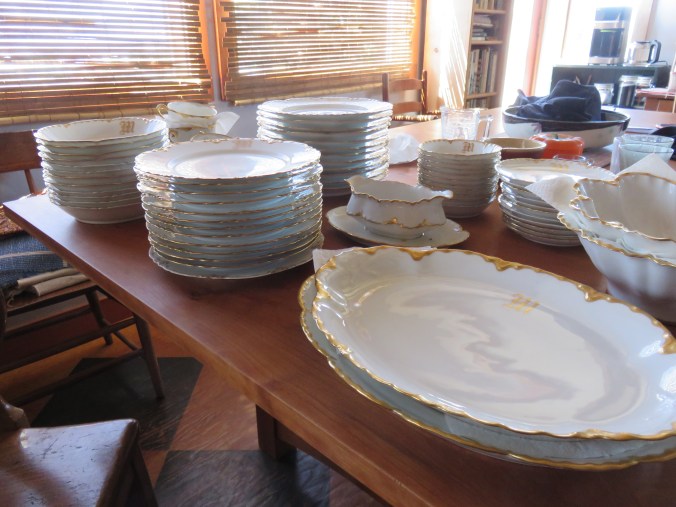
Seeking a loving home: nearly 100 pieces of Havilland porcelain, a pattern called “Ranson” made in France about a hundred years ago and emblazoned with a W or M in 24k gold. I have never used these pieces. Even my grandmother never used them, to my knowledge.

We paid off our mortgage on Tuesday. We asked for a payout balance and had the bank wire the funds. The trick is that we will still be putting the money into the bank to cover insurance and taxes. It feels good even so.

As I type, my husband is realizing a long-term goal. He is emptying the attic. It is part of a broader effort to streamline the house and rid ourselves of accumulated stuff. We have filled the garage and atrium with things that will not return to the house.

For many years I have presented my husband with a pair of champagne flutes on our anniversary. We generally broke them, or at least one of them, but I still have twenty or more cluttering up a cabinet.

No one wants this sort of thing anymore, I find. And neither do I.

In my childhood, coming to the beach was an enormous effort. The highway through Arch Cape was so evenly lined with aged spruce that finding the turn to the narrow gravel track leading to my grandfather’s house was tricky. My mother had spent all her childhood summers here, but even so we always overshot the turn. Today, and especially during the 4th, the change is unmistakable. Nearly all the houses are short-term rentals. A new business of several thousand square feet will be added to the property that was a tiny deli and post office in my childhood. The three-unit rental cabins south of us are converted to year-round rental use and a new 7-unit motel is only the latest.

This is not the quiet, isolated beach where my great grand-aunts purchased property for $10 in 1911. They packed up toilet paper for the summer and drove on the beach at low tide to get here on Memorial Day and stayed till Labor Day. My grandfather inherited the place in the 30s and continued the tradition. My mother raked crabs for supper as a child. She and her sister had to clean the lanterns of soot once a week. There was no electricity or running water. The outhouse hung over the swamp next door. The house on that sand-filled lot rents for $695/night in September these days. It’s fully booked for the rest of the summer at over a thousand/night.

The house was always “too rich for our blood” with taxes costing more than the mortgage on our Seattle house. When we moved to my grandfather’s house, it was a two-bedroom, 1 1/2 bath, one story house. We added back the second story my grandfather removed in the 40s. Our children were born here and raised and went to public school here. Beyond home improvements, we have added too much stuff.

I have bins of yarn and fabric and some day I must have whittled down our possessions so that our sons will not be faced with the monumental task of doing it for us. We did that for my mother, my grandmother, my aunt, and even my grandmother’s second husband’s brother. We still have unexamined boxes of family documents and photos that my mother never sorted and which I will never sort. All the lifetime accumulation of stuff no one wants. If I could sell it, we might afford a vacation. In 44 years of marriage we had no honeymoon and have never traveled for longer than the week spent with friends in Alberta nearly 30 years ago. It is memories of that sort I still desire. But then I live in a vacation paradise, too beautiful to leave. Instead I have beautiful things.

I confess even I no longer want them.

When I explained to my mother that inheriting my grandfather’s house was the reason we had children, that having a safe and largely undeveloped place for children to play was essential to our vision of child-rearing, she called that “a ridiculous reason to have children.”

Maybe she never made the connection between her own childhood spent playing in the woods in Gresham and on the sand here, and my own childhood play in woods and swamp north of Seattle. I cannot imagine growing up in a city. I cannot picture what sort of childhood that would have been. My husband and I both “ran wild” as children. We were determined that our children would have that opportunity.

Those times and those ideals of childhood freedom seem to have gone the way of typewriters. Manual typewriters.

Taxes were the largest portion of our mortgage payment, and living here is really more than we can afford. It always was. There has been no time since 1978 when we could have afforded this house. It has been an enormous gift to live here. Every morning we go for our walk. And Gary is about done emptying the attic.

The china is beautiful. Want it?
SaveSave

WHY WE DO NOT LOVE THE 4th

IMG_3019

It is not a “victimless crime.”

One of our neighbors takes her dog to British Columbia right after Canada Day until after the 4th. Other people drug their pets in order to spare their nerves. My husband and I do that too. We would happily have left the country, but we are afraid to leave our home unattended over the 4th of July. Instead, Gary hooks up the power-washing nozzle on the hose, and we watch the drone filming the action with trepidation. Yesterday morning, an osprey was fishing right in front of the house, and then the pyros arrived on the sand.

Years ago, a person actually trained in fireworks put on a display on our beach. Eventually the crowd of onlookers grew so large that he no longer felt it was safe. Now all the illegal explosives and fireworks are lit by ordinary people bent on having a good time.

It’s not good.

“Each July 4th, thousands of people, most often children and teens, are injured while using consumer fireworks. Despite the dangers of fireworks, few people understand the associated risks – devastating burns, other injuries, fires, and even death.”

The safest 4th of July on my beach was like last night. We’d had some damp weather so the hedges were not quite tinder. The temperature was mild, the air light and breezy, tending to flow from the east or south rather that onshore. There was a sprinkle of rain. The tide was going out all evening so there was plenty of sand and no need to set off fireworks too close to the hedge. True, some people build fires too close to the hedge anyway, but we found the remains of only one rocket in our yard. That was how it was yesterday night until after 11.

There was the year it rained and people blew up their illegal fireworks every single night for the rest of the summer. There was the still year when the smoke from nearby blasts was so thick we were forced indoors to breathe. There was the year bottle rockets landed, still blazing, on our cedar roof. We replaced that roof, but last year we watched floating lanterns drift over shore. One landed, still glowing, in an old spruce tree.

“Smoke from fireworks is harmful to health, study suggests. Summary: The metallic particles in the smoke emitted by fireworks pose a health risk, particularly to people who suffer from asthma, new research shows. … The different colours and effects produced in these displays are achieved by adding metals to the gunpowder.”

Mostly, the fireworks were gold and green and red this year. Last night it was a particularly loud and lengthy display. Rockets with a diameter of up to 6 inches managed not to light any homes on fire. So you could say it’s been worse, more dangerous, more frightening, the smoke more choking.

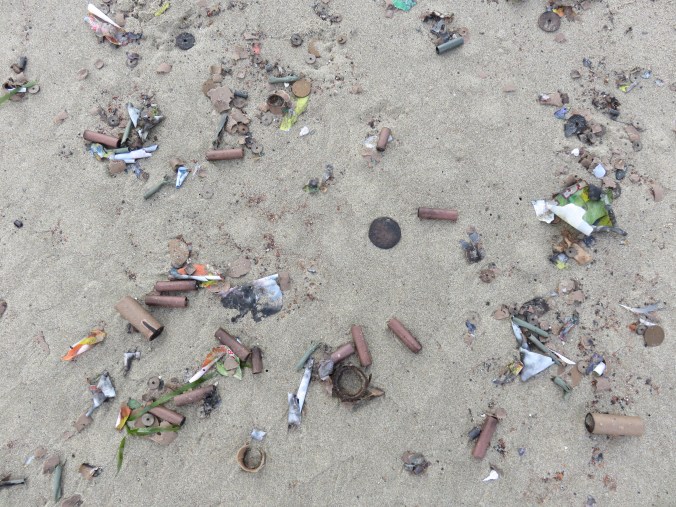
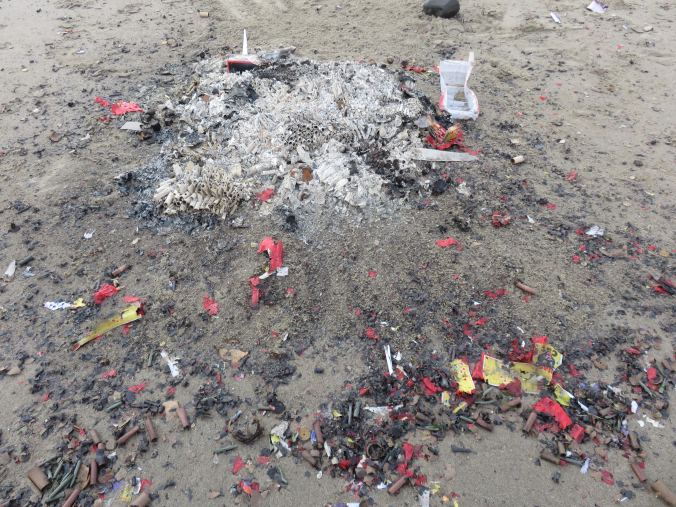
And then this morning, one person came out with a wheelbarrow to police the area directly in front of their beach camp. Along the rest of the shore is filth my husband and I will be picking up for the next year.

IMG_3037

It is not harmless. Chemicals enter the air and percolate into soil and sand. Seabirds are disoriented, and the impact of the chemical refuse remains. The paper wrappers are impregnated with toxins but will unroll and dissolve. The plastic cones will wash into the rocks where we will gather them in January. And that only counts the stuff we see.

“Although much of the perchlorate present in pyrotechnic devices is transformed into harmless compounds during combustion, any remnants of the chemical that fall back to earth can enter into the soil and water. When ingested, perchlorate is absorbed by the thyroid gland in place of iodine, which can interfere with the production of thyroid hormone, an essential part of metabolism and mental development. As a result, perchlorate exposure may be particularly harmful to fetuses.

“A recent study of lake water in Ada, Okla., before and after annual fireworks displays found that the perchlorate concentration in the water increased by up to a factor of 1,000 in the hours after the show, exceeding several states’ maximum allowable levels for drinking water. The levels took between 20 and 80 days to return to normal.

“The heavy metals that colorize fireworks can also be dangerous, and unlike perchlorate, they’re not used up during the combustion reaction. ‘What you start with is also what you end up with,’ Chavez explains. ‘They can get aerosolized and breathed in, or they go into the soil and water.’  Particularly harmful is barium, used to produce green; studies suggest it may cause respiratory problems, among other maladies. One study found that barium levels in the air increased 1,000 times after a fireworks-heavy Diwali festival in India.”Newsweek


Green.

To be clear, aside from the danger of injury and fire, research proves that fireworks are hazardous to our health. They are made of dangerous, poisonous chemicals. They not only frighten birds, they poison people. They do not “just go away” because they are blown up. They land on sand and water, they infect the air. The party on our beach is over and people are checking out of rentals and heading back home. They leave behind a mess.

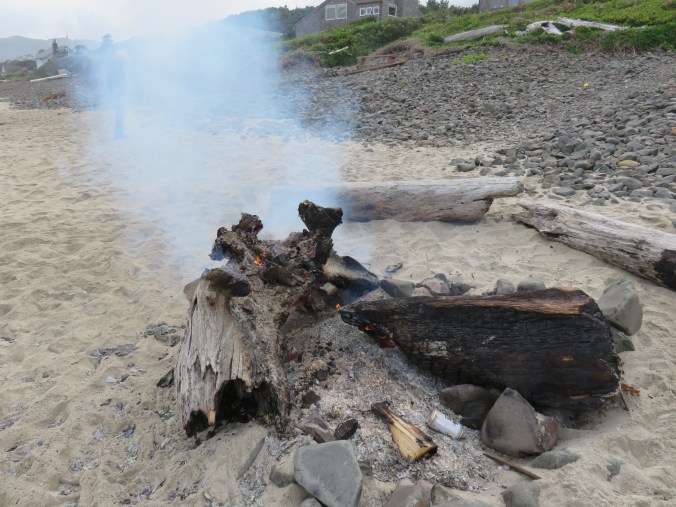
Some beach fires still smolder 18 hours later. That was once a beautiful drift log in the photo below. Beer cans, pop bottles, plastic trash, and the remains of a great many completely illegal explosions. The began yesterday afternoon with a dense black cloud. The refuse at top is from this party. There are people out trying to clean up, but the making of this mess are not among them.

IMG_3057

The people who made this mess do not live here, they are not people who walk the beach at sunrise or enjoy the quiet or nature. They come here to drink and blow things up—illegal explosions that they indulge in here because there is no one to stop them.

“ ‘When people think of air pollution, they think of other kinds of things—smoke stacks, automobile exhaust pipes, construction sites,’ says study author Dian J. Seidel, senior scientist for climate measurements at the National Oceanic and Atmospheric Administration (NOAA). ‘I don’t think most people think of fireworks.’

“The level of particulate matter, or small pollutants like dust, dirt and soot present in the air, increased by 42% on average across the U.S. on the Fourth of July, according to the study. Air conditions are at their worst between 9 and to 10 p.m. on the day of the holiday. The researchers, who looked at data from 315 sites across the country, found that ten of the sites met a threshold deemed unsafe by the Environmental Protection Agency (EPA) when sustained for a prolonged period of time.”Time

I sometime indulge in a fantasy where I drive to Lake Oswego and light explosives in a driveway, set a fire in a Laurelhurst lawn, or drive all the way to Seattle and set off firecrackers in the middle of the night.


SaveSave

“The Supreme Court traded one injustice for another 74 years later.”

FIGHTING HATE // TEACHING TOLERANCE // SEEKING JUSTICE

JUNE 30, 2018

Weekend Read // Issue 86

Fred Korematsu was 23 when he defied the order sending him to an internment camp.

He was one of 120,000 Japanese immigrants and Americans detained by the federal government under Executive Order 9066. He fought his case all the way to the Supreme Court.

He lost.

Korematsu v. United States — in which the Supreme Court ruled that the internment was justified — was never overturned.

Not even after President Gerald Ford formally terminated Executive Order 9066; not after President Ronald Reagan provided each detainee with financial redress; not even after President Bill Clinton awarded Korematsu with the Presidential Medal of Freedom did the Supreme Court overturn its ruling upholding the internment of Japanese Americans.

That all changed Tuesday, when the Supreme Court finally repudiated Korematsu v. United States, writing that it “was gravely wrong” — at the same time that it upheld Trump’s discriminatory Muslim ban.

It was painful irony, especially for Korematsu’s daughter.

“Racial profiling was wrong in 1942 and racial profiling and religious profiling is wrong in 2018,” Karen Korematsu told The Washington Post. “The Supreme Court traded one injustice for another 74 years later.”

Using the “same dangerous logic underlying Korematsu,” wrote Justice Sonia Sotomayor in a powerful dissent, the Supreme Court “blindly accept[ed] the government’s misguided invitation to sanction a discriminatory policy motivated by animosity toward a disfavored group, all in the name of a superficial claim of national security.”

Or, as Karen neatly summarized it, the court allowed the government to “racially profil[e] a group because they looked like the enemy.”

It’s not the only parallel between the Trump administration’s actions and the incarceration of people President Franklin D. Roosevelt deemed “alien enemies.”

Once targeted, Japanese Americans were interned for over four years. They were held in converted racetracks, fairgrounds and horse stables in camps west of the Rocky Mountains. Korematsu himself was held in a horse stall with a single light bulb.

“Jail was better than this,” he told one biographer.

Today, migrant children are being detained — soon, ostensibly, to be held with their parents — in “tent cities” and converted Walmarts.

Their trauma, according to psychotherapist Satsuki Ina, herself born in an internment camp, is all too familiar. As she detailed for Splinter:

They have no idea how long they’re going to be held. They have no idea if they’ll ever see their parents again. That level of anxiety causes tremendous emotional stress, and we know from the research in neuroscience that constant release of these stress hormones can affect a child’s ability to learn, a child’s ability to self-manage, to regulate themselves. The long-term impact that I’ve seen in my own Japanese American community is this hyper-vigilance … a reaction to having been incarcerated unjustly. This kind of treatment has consequences for a lifetime for a child. The trauma effect is pretty severe when there’s been captivity trauma. We were unjustly incarcerated when we weren’t guilty of anything.

Today, people across the country will rally to protest Trump’s “zero tolerance” policy toward migrants who cross the border. We’re partnering with the ACLU and the Alabama Coalition for Immigrant Justice to host the Families Belong Together rally here in Montgomery, Alabama, as well as in Atlanta and Washington, D.C.

Now, more than ever, apathy is not an option. As Ina recalled for Splinter:

When thousands of Japanese Americans were being removed from their classrooms, from their jobs, and their neighborhoods, there was no outcry. No one instituted any kind of protest. … My hope is that people will know how important it is to stand up for the injustice that’s happening right now.

We couldn’t agree more.

The Editors

THE FLAG


IMG_0718

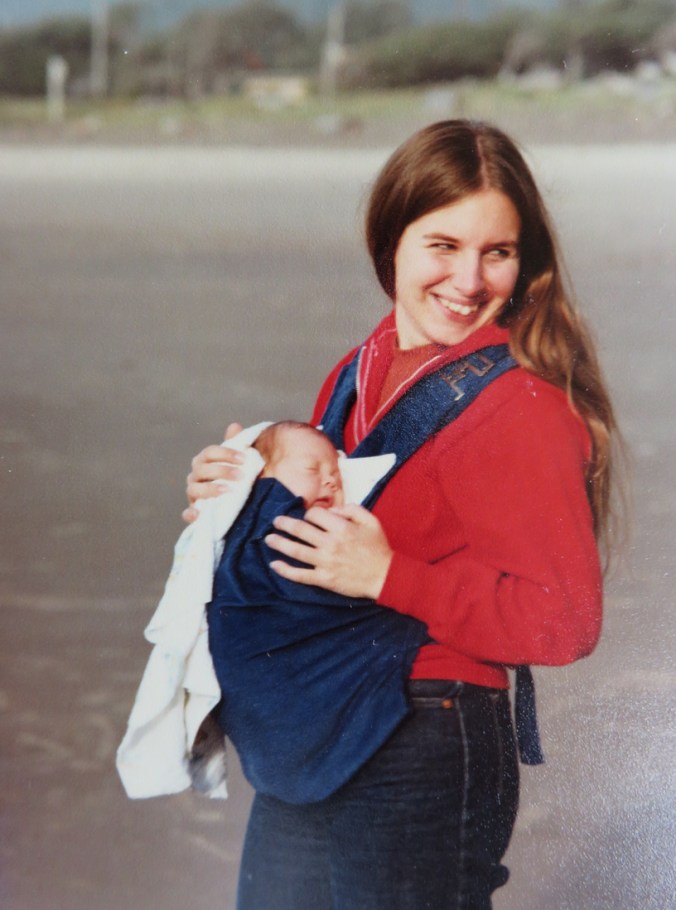
With baby Ian in 1982. Maybe not the 4th, but there are the colors.

When I was a little girl, I looked at a book with colored illustrations of flags. Compared to the emblems and gilded centers of others, I did not like the U.S. flag much. It was out of balance to my eyes, and the color scheme did not appeal to me. It was not so boring as all those European flags with only two or three horizontal color bands, but far less interesting that the ones with colorful emblems, or Japan’s elegant simplicity. I understood as I aged that the flag is symbolic, however, and that it represented notions of fairness and opportunity and liberty admired throughout the world.

Nevertheless, the reason I have never cut or damaged or worn the flag might signify less respect for our flag than artistic preference.

Still, a flag is a symbol and symbols matter.

A symbol is less important than what it symbolizes. It is less important than its people. It is less important than its ideals.

So I wonder sometimes, what people mean when they use the flag.

Men driving around with a flag hanging off the back of a vehicle seems less patriotic than disrespectful. The stars and stripes made into headgear likewise causes me to cringe.

I am loyal to my country, despite recent developments, despite the man in the Whitehouse, despite my discomfort with fellow citizens who get the news from shock radio and memes, do not read books, and perversely assume politics are beneath their notice. The 42%, give or take, who still support what this administration is doing to our global reputation.

Our reputation has already taken hits.

Who has the right to use the flag for their personal agenda? This is the Land of the Free, so anyone may. If some are offended by flag burning, let me say here that I am offended to see a United States flag wrapped around someone’s head or dragged behind their pick-up truck.

Some of my ancestors have been here a long time, the more recent arrived in the 20th century. My immediate family was born here, but distant and not-so distant relatives came from other nations including England and Mexico, Finland and Scotland. Those traveling north from south, west from east. The eldest moved east to west. Such is the passage of human migration, the claim of humanity on any land. The only claim I have on this soil is personal.

Just now the flag flying day and night in the yard of a house due south of me is hanging still. I do not display a flag, but I know that proper treatment of our national symbol includes taking it down unless it is lit in the dark. I know it is not proper to use this symbol of respect and righteousness as a bludgeon. I am sorry that my country is no longer a beacon light of hope in the world but become the bully on the block.

I will go out on my walk, and along the way I will greet other walkers, the roar of water constantly in motion, just as I must remain moving to be alive.

SaveSave

SaveSave

4BITS OF FOUND WISDOM

IMG_3000

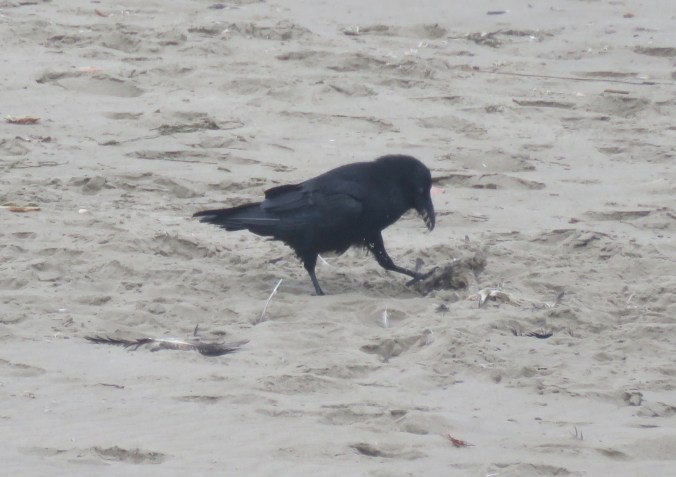
We had no local ravens when we moved to the coast in 1979. In 1992 I saw a raven at the crest of highway 26 through the coast range. He stood on the shoulder and four crows walked around him. I would never confuse crows and ravens again. The first raven I saw at sea level would have been while running in the late 1990s. Then a pair moved into the neighborhood. Today we have an extended family of four ravens. This is one of the youngsters.

What to do and how to live.

1. SMILING. As a very young girl I read in one of my mother’s magazines—Redbook?—that smiling was the secret to forming friendships. I was a lonely child, but I learned that lesson that most girls are taught from a magazine.

Too many girl and women have been told to smile. Maybe not so much. Maybe smile only when there is something to smile about. Lesson unlearned.

2. SLEEPING. Somewhere, at least ten years later, I read another article that more permanently altered the way I live my life. A neuroscientist explained that sleeping in on the weekends guaranteed that on Mondays, I would feel “jet-lagged” since my body would have to make a two-three hour adjustment to sleep schedule. I realized then that the secret to getting my eight hours of sleep was not so much bedtime as getting-up time. Yes, I needed to be asleep by ten or eleven at night, but that meant I also needed to have gotten up by six or seven in the morning in order to feel ready to sleep that night. It is the reason I took Art 101 Drawing at 7:30am my first term at the University of Washington. The class was smaller and I knew I would be awake.

Sleeping in these days means 6am, and that is because it is June and the day is bright by 5am.

I have absolutely no memory of where I found this bit of wisdom.

If we struggle to get up Monday morning at 6:30, but we have to because we have to get to work or school, we resist and resent the effort to be wide-awake-an-bushy-tailed at the crack of dawn. We struggle Tuesday and Wednesday, and by Thursday we’re thinking one more day till the weekend. So Friday is only bearable because tomorrow is Saturday. The Saturday and and Sunday we sleep in a couple or three hours, so on Monday morning, we feel cheated of sleep and much start all over again with the struggle to wake.

Get up at the same time every day. No matter what. Pick a time and get up. Go to bed in time to get the sleep you need. And then get up at the same time as yesterday.

3 MY WAY. Another great truth that I might never have come by on my own concerned the Way People Do Things. If you want something done in a particular way—the dishes washed just so, the laundry sorted in a particular way (beyond not putting the red t-shirt in with your white underwear), colored pencils sorted by rainbow—if you are very picky about a job and your partner is not, do it yourself. Yes, I know, “If you want something done right, do it yourself.” But this is a reminder that when we are fussy about some things, it is unreasonable to expect anyone else to absorb our fuss, because half the time it’s just our preference.

If it’s rationally better and the other person is willing, teach them to do the job right. But if the precise manner something is done is just a personal preference, for heaven’s sake don’t expect others to see the need.

Do it yourself the way you want. 

4. COMPLAINING. One bit of wisdom dropped on me all by myself partially as a daughter and reinforced as a result of teaching for over 40 years has to do with dealing with parents. You cannot go wrong telling parents something good about their child. I’m a daughter and mother, and as a teacher: Say something nice and keep most criticism to yourself.

My husband and I were not perfect people when I met him and we are certain I still am not a perfect person today. Both of us have our flaws, our fussiness, our weaknesses and fits of temper. My husband dyed the laundry pink at least three times before he learned to sort colors. I have given in to being a morning person. But in the early years of our relationship, while were were famously in love with the giddy passion associated with youth and romance, sometimes we got on one another’s case. We squabbled and quarreled and yelled.

In all those years, I never once complained to his parents about Gary. I did not even complain to my parents about him. Our struggles, however angry and irritating, were between us and they were worth working through because, you know, love. Complaining to his parents would only have been seeking allies. And what kind of future daughter-in-law allies herself with her husband’s parents against him? Not this one.

Do not complain to parents or in-laws about their children. You will only hurt their feelings. They likely did the best they could, and most do as well as anyone. Give them a break.

Did I have complaints about my in-laws’ offspring? Of course. Did Gary? Undoubtedly. We worked it out.

Perhaps that is a reason we have 49 years.

TALKING OUT OF TURN


IMG_2855

I lost my temper the other day. I used a couple of bad words in public. I have apologized, but the incident has troubled me since.

In the past, I have managed to keep my cool under extremely trying circumstances, and to make reasoned responses to completely unreasonable, even deeply offensive people. Once in a while I lose it and say something I should not. It is not that my opinion is wrong—at least not always—but that my approach, my words are wrong.

There really is not excuse for that.

This morning on the beach, I shared my distress with a neighbor and she was quick to offer me excuses, mostly having to do with stress. “We are all so stressed,” she said.

Yes, I would agree with that.

One of the essays I used to share with my students concerned civility. The author contrasts the offenses upon civility as noted by the right, and then a slightly different list of offenses identified by the left. All concerned offenses on common courtesy and decency. In the middle of the essay, the author asks of himself: “What do I think?” He thinks they are both absolutely correct, but then he goes on to identify his own take on civility.

Civility is more than words and one-on-one actions. Civility is how we regard others as individual members of the greater community. Is crude language offensive? Is bragging about casual sex offensive? Both likely are to most. What about lies and exploitation, taking over a business only to dismantle it and putting people out of work in the process? How about ridiculing a person with a health problem? What about the family of a soldier? The soldier? People struggling to make ends meet? Saying whatever will draw cheers at a rally, even to the point of advocating violence?

There was a time when a decent member of either party would have found all those behaviors deplorable.

What happened?

Why am I losing sleep over an f-bomb spoken in the heat of the moment, when our leader with speech-writers at his disposal chooses to speak as if he were leading a Klan rally instead of my country?

Does anyone believe that man ever loses sleep over anything but his personal bank account?

Well, maybe that is unfair.

This morning I saw a tiny shrew, dead on the sand a hundred yards out from the shore. Poor little thing. It knows to eat insects. It knows to hide from predators. It was completely unmarked.

Four raven fed on the most recently dead seal. The other day the body—now more gone than remaining to be eaten—had been dragged a few feet across the sand. No human or dog footprints. I suggested maybe an eagle had tried to lift it.

“It’s too heavy for an eagle to lift.”

“Exactly.”

MY WRITING LIFE

IMG_2766

I began writing fiction in 1990 when I was hired to teach English at Seaside High School. I believed myself wholly unqualified to teach English (and others have agreed), but I had taught art in an elite prep school for three years, picked up a Social Studies endorsement through exam, and substituted in the Seaside District for eleven years. I had 20 undergraduate English credits. I had never considered teaching English. Nevertheless, the Chair of the English Department at that time knew me well as a substitute teacher and argued that I was better read than she was and urged me to apply.

My hiring was contingent upon gaining a certification in English. I took another test and began taking graduate classes that summer. In the fall, I was teaching English. Among my advantages were an excellent public school education and substantial experience as an essayist.

My first novel was written over the summer of 1995, working with a student who also wrote a (better) novel. Both were read my the editor of a major publishing house. My student’s manuscript received the better response.

My second novel, Clean Away, was written from multiple points of view, nine women representing several generations of a family over many decades. Certain experiences seem to repeat themselves through the generations. I began that in 1999 and it was funny.

My third novel, A Single Fact written in 2002, was the very rough draft I later rewrote in 2017. The main character of this novel is a teenager who is having a rotten senior year and afraid the only thing worse than high school might be that nothing better will come next. The title story was published by CALYX in 2006 as “A Single Fact Can Spoil a Good Argument.”

All this time I was working 60-80 hours a week teaching English and advising the yearbook. When I crawled out from under the yearbook in 2002, I found I could not slow down. I wrote more.

In 2007, while completing my MFA, I compiled Blonde Indian, later retitled Living in Snake Land. These linked stories about a poor white boy are set in 1961 in Phoenix, Arizona. That novel-in-stories is number four.

In 2007 I completed an MFA in fiction from Pacific University. Three of my dearest friends came to my graduation—two of them from Seattle. It was a great day, and Gary preserved that for me by not telling my that my mom had been back in the hospital until all my obligations in defending my thesis, a public reading and craft talk, were complete. She died a week later.

I dropped 40 pounds in the next few months. I stopped writing. I struggled to regain optimism, to regain my stride, whatever that might be.

Revision happens in people’s lives, too. I retired from teaching full time in 2015 after nearly 40 years of teaching art and English in private and public high schools. I think I am, I was good at my job. My greatest joy is hearing from former students who discover I taught them something useful. I think most of us hope to be useful.

In November of 2016, I  took the 4k short story, “The Promised Hour,” that I wrote to apply for my MFA and wrote from there. I had rewritten that story dozens of times (literally) and submitted it dozens of times but it couldn’t find a home. I hoped that maybe what it needed was to become a novel. National Novel Writing Month (NaNoWriMo) offered me an opportunity to race through a much longer version of that story.

Since then, I revised the novel going-on eight times. I originally hoped for 60k but did better than that, ending the month with over 75,000 words. By it’s 8th draft, it was retitled Escape My Heart of Sorrows. By the eleventh draft it had seen several new names, the best of which was suggested by a former student who got it from her husband, Painting Over. I am working on draft 14 now and still dithering about the title. Maybe Everybody’s Mother Dies. This is novel number five and it is not finished.

My work has earned many awards including an Oregon Literary Arts Fellowship, Arts & Letters fellowship, Soapstone residency, Pushcart nomination, and publication in the Brevity blog (several times), The MacGuffin, CALYX, Work Magazine, Raven Chronicles, Ink Filled Page, The Humanist, North American Review, and anthologies about running and race. There is a list of all my publications, or most of them, under “Publications” on this site. There are links to all the works available online.

I thought my second NaNo year in 2017 was time for something completely different, stories or fantasy, but I changed my mind at the last minute. Instead of a new piece, I returned to an earlier effort, the novel from 2002. I altered verb tense, added and changed characters, and introduced the crime I originally intended to provide more tension. So those were the differences. A familiar first person voice but an entirely new book. I hoped to complete 80k and I got 75k. I was okay with that, but since then I have completely lost track of that novel and begun working in a new direction.

Last year I surprised myself by writing a fantasy story, “If It Were True Owls Dream,” which will be published in August in Liminal Stories. (When that goes live, I will provide a link.)

In April 2018, I wrote 15k of a science fiction novelette. Writing science fiction is new for me though I have been a fan for many years. In the fall I intend to add 50k to an existing short manuscript. But I might be still busy rewriting novel number five, the one that began as “The Promised Hour”:

The way back from loss may seem unimaginable, but people do it all the time. Thena Justice was building a new life near Seattle after the death of her mother and breakup of a terrible marriage when her former husband murders the babysitter and their daughter before committing suicide. Lost in grief and guilt, Thena first hides in a friend’s converted garage, then in a tiny cottage on the Pacific coast, thrashing her way through anguish, apathy, anger, and routine. Instead of returning to Puget Sound, she moves to Portland, Oregon, the city where she was born, takes the bus to a retail job each day, and keeps her head down until a child crying in the night wakens her sense of agency and hope.

It sounds a sad book, I know, but it is all about survival, about hope. My interest is in how we regain an active role after a calamity and that is the focus of this story. Would you read it?

For several years I blogged at Quiet Minds, which is now renamed and active here on WordPress as Imperfect Patience. I send work out. I am still teaching college writing in Winter and Spring Term, at least I hope I am.

I walk the beach. I weave. I write. I am mostly retired, but I am not done.


SaveSave

“Hillbilly”

Last fall, I read the memoir Hillbilly Elegy and I struggled with its view of poverty. The man suffered, but suffering does not necessarily make us wise. I both recognized that he was reporting his personal experience, and felt concerned that his view of his own life was limited by his selfish political point of view. This morning, an essay by Chris Offut, “I Will Always Write About Appalachia” helped me understand why.

“The most recent addition to these false accounts of Appalachian life is the widely read book Hillbilly Elegy, the author of which grew up in the decaying Rust Belt town of Middletown, Ohio. Nevertheless, he blames his personal difficulties on the culture of Appalachia.”

The writing in Vance’s memoir isn’t anything special, but the story is emotionally compelling. Vance grew up in a violent, loud, drug-afflicted, under-educated, and sometimes poor household, but he had people who genuinely loved him and cared for him, even if those people had their flaws and were not necessarily his parents. I love the quote from a teacher at his former high school: “They want us to be shepherds to these kids. But no one wants to talk about the fact that many of them are raised by wolves.” And then . . .

I began to consider stories I knew best from my own family and from teaching in public schools. I don’t know much about Appalachia, but I do know something about poverty and disadvantage. “Hillbilly” and “white trash” are filthy words in my home.

For one, I know it’s no shame to be poor is immediately followed in my head by “It’s no great honor either” from Fiddler on the Roof. Tevye was not a sinful man, but a good, honest, hardworking father and husband. “Economically disadvantaged” is a euphemism I find personally offensive because it suggest there is something shameful about poverty. Being rich is not supposed to give anyone special rights or privileges, and I have been thinking a lot about that lately. I know being poor is not a sin or a failure.

My husband was raised poor in a family that did not take charity. His family bought “day old” bread from an outlet when he was little, and he picked the mold off his lunch, trying not to be seen doing it. He sat on the porch waiting for his dad to get home on payday because there was no food in the house beyond scraped jars of condiments. His experience of poverty was not unique, and it didn’t happen in Kentucky, but in Arizona, but it was hard. One side of his family was Ballard Swedes from Seattle, Washington and the other was Dust Bowl Scots-Irish share croppers from Oklahoma, orphaned when their mother died and Pappie gave them away.

No one in his family intervened or encouraged him to make something of himself. Vietnam was raging and his hair was long. In the years between high school and college, he had three pieces of luck. He was granted a draft deferment based on his eyesight that eventually became permanent, he began working at the University Book Store where he was exposed to new people and ideas, and he met me. When I graduated from high school the next year, he went to college because I was going to college. My husband graduated from high school with a C average but he was Phi Beta Kappa when he graduated from the University of Washington four years later. Like Vance, he saw no point in pajamas and is still in a perpetual state of what others term catastrophizing. Christmas was fraught when I met him but has become a good holiday through decades of determined effort on my part. He loves his cotton jersey pajamas.

Vance would like to give himself all the credit. He would blame achievement or lack of it on people rather than circumstance, but like my husband, he had some luck.

From the LA Times: “As Vance puts it at the beginning of this American dream memoir, he has done nothing ‘extraordinary.’ So what’s wrong with all those other hillbillies? In suggesting that his own success in Silicon Valley was a matter of refusing cinnamon rolls, Vance is giving us a basis in feeling for the devastating policy Ben Carson wants to enact. People are poor because they deserve to be. And there it is: Trump-era elitism defined.”

Some people abuse the system, and some people are too proud to accept help, even for their children. When my husband was given a sweater by his pastor because his second-hand store clothing was too poor for church and too sad for the pastor to ignore, it was only because his mother won the argument with his father that he was allowed to keep it. It was the nicest item of clothing he ever owned as a child. “White trash” is a filthy expression in my home. “Red neck” was the term I was taught as a child. I would not use it today. Change is not easy.

In my forty-year experience working with students, I witnessed most parents doing the absolute best they knew how. Neglectful poor parents do not necessarily love their children any less than neglectful affluent parents do, but the results tend to be more public among the poor. They are less skillful at concealing problems because they do not have the money to hide behind. Some parents work too many jobs just to get by. I think of a single parent who could not ensure his child did his homework because he got off work in the middle of the night find his teenager drinking soda and playing video games instead of sleeping.

Affluent families have their own troubles involving drugs and mental health, abuse and time. Even in my poor, rural community, some entitled parents send their children to elite private schools. They can afford private lessons and vacations their peers cannot even imagine. Their students drive cars worth more than the average local yearly income. Affluent parents may not need to work two or three jobs to pay rent, but sometimes they work long hours or ignore their children because they choose to do so. The results are similar.

Things go horribly wrong for children, dreadful things happen to them, but in my experience, not always, but often when things go wrong with children—pregnancy, drinking, drugs, crime, dropping out—the causes are not simple genetics, politics, poverty, public education, or an unwillingness to work hard. Something is wrong in the home. Too many children from “nice homes” have revealed the truth of their lives to me. Wealthy or impoverished, when kids’ lives go very wrong, there is nearly always something very wrong in their lives. It is not a character flaw, but reaction to something they cannot control. And there is bad luck again.

Unintended teenage pregnancy caused moves and marriages and monstrous errors beginning with his Mamaw when she was too young to drive. It seems to me to be the particular curse of Vance’s family is early pregnancy. Yet he reflects on this only in passing, perhaps because as a boy it did not hit him personally.

Vance works hard not to blame the people he loved, even the people who damaged his life, but he is also specific and detailed in itemizing the chaos, abuses, insults, and injuries inflicted upon himself and he repeats the lists every few chapters to ensure readers do not miss the hardships he suffered. Still, this book is lived truth, and if Vance fails to recognize the irony of complaining that a single call to child services fails to net any interference in a neighbor’s neglect of her children and then complaining a handful of pages later about child services “prying” into his own messy family . . . well, I guess he’s what one of my young students once called “a guy”.

There is no easy answer to the problems we face in America, but I think it is fair to suggest that we could do better as a nation for our children, regardless of who is at fault for their troubles. An equitable public education, a reliable health care, a decent diet, and a nation caring enough to inconvenience itself would go a long way toward making the lives of all American children better. It would give us all a better future.

Vance was lucky in more ways that he credits.

His Mamaw was tough-talking and violent, but she used her threats to keep him off drugs and she assured him that golf was a rich boy’s game and education was his best hope for a decent future. In other words, he was pushed—hard!—to do what every person ambitious for monetary success does. Vance had support.

In addition to choosing to reject the dysfunctional walk he witnessed all around him and gaining the stability and peace of his Mamaw’s house, Vance claims he “found a couple of teachers who inspired [him] to love learning”, but it’s likely he didn’t find them; those teachers found him. No member of his family killed him though several seem to have tried, and he found a family and practical education in the Marines, without seeing action in Iraq. That’s another piece of luck. The Marines taught him to give more than he thought he had, and they took less than they have required from many others.

Vance would like to blame people on assistance for their trouble, but he had plenty of assistance himself.

Vance was lucky. He had strong people who loved him unconditionally. He found friends and mentors along the way. It was luck and generous people who saved him. He knows that. Or at least he should.

APOLOGY

IMG_2173

Koi. Just because they are big fish and pretty.

My husband and I were talking about apologies last evening. We had been discussing boorish behavior revealed by the MeToo movement as contrasted by the genuinely criminal behavior of Bill Cosby and Harvey Weinstein.

I can forgive the guy who makes a stupid joke or a failed pass. But what about the cases of men who double down on a stupid move by harassing and threatening the careers of women? How bad before borderline become brutality? How bad does it have to be before action pass into unforgivable?

At what point does a mistake become abuse? Is the line so very hard to see? I don’t think it’s all that difficult to define where a mistake becomes a failure to offer basic respect. You make a modest error, and instead of threatening to damage a woman’s career, you apologize. You don’t wait years, you don’t pretend it didn’t happen, you don’t blame her for anything, and you don’t apologize to one woman while ignoring the other two or six or sixteen you abused. You recognize you have been a jerk and say, Sorry! right off. Then you do not do it again.

If, let’s say, you accuse someone of having a bad temper while standing over them and yelling, and while the person you are yelling at is worried because her husband has gone to the doctor and been taken to the ER; or you have yelled at a teacher and called her “vindictive” because she asked your son to rewrite an essay that failed to follow directions, after several papers where the same student didn’t follow directions. It is not enough to stop. “Sorry” is the missing word.

Sucking up to someone later to avoid admitting you have been a jerk is not the same as apologizing. “Being nice” or claiming: “I didn’t intend for your feelings to be hurt” is not the same as apologizing.

An apology begins with “I’m sorry” and moves on from there.

Some people seem to have trouble with those words. Some women have trouble saying they are sorry, too, but mostly it seems to be men. Last night, I said I was glad both our sons and my husband were able to do that.

“Well,” my husband offered mildly, “it’s different for a man to apologize.”

I thought: male ego? Cultural demands for masculine behavior? “Is it?” I said.

“No,” Gary said.

I laughed.

Gary said, “If you’re an asshole you’re an asshole and you should apologize.”

Well, you see why I married him 44 years ago, right? Our sons take after their dad. I am proud that they consider the consequences of their actions. They care about justice. They care about what is right. They aren’t perfect people. Who is?

Gary ordered six CDs today. “I got carried away.” I don’t mind. He loves music the way I love yarn. He’s entitled. (And he’s not sorry.)

On the other hand, we all make mistakes sometimes. We lose our temper or say something we wish we hadn’t. We do or say things we are sorry for.

When that happens, we should just say it: I’m sorry.

We should mean it.


SaveSave

HABIT

IMG_1622

Taken on a winter day, the tide was out far enough this morning that I could walk well out on the sand beyond that triangular seasick I think of as a seal sticking his head up out of the sand.

Clouds like cobblestones drift over the eastern horizon. Light seams their edges. Birds join the morning music.

We might miss a half dozen days out of the year, but my husband and I try to walk each morning. We go out as soon as there is light or whenever I can get my behind in gear. Two cups of coffee, checking my email, and this time of year, it is light at 4 but even so we are usually not before 6am.

We are rarely first.

This morning was perfect, sun already over the coast range, reaching across the sand. Low clouds sliding down along the cape to the south and mist rising up off the ocean. A roll of fog out on the horizon, blue sky overhead. We walked south, Gary with the trash bag, mw filling my pockets with little stone, as is our habit. Sometimes we walked together, more often we wove away and back across sand and the rock edging the beach, looking for trash, agates, and glass. The tide was sweeping in, but there was a broad expanse of sand and last night’s high tide had left a stretch of dry sand along most of our shore.

We headed north, waving at locals as we went. I thought about going past the northern point, the first long distance of the year. Drift logs pile up in that little cove north, the way they once did all along Arch Cape beach. My mother used to play a game with her sister where they pretended the sand was poison and they walked drift logs all the way south to the big creek. I might have played that same game in my own childhood, but now locals cut up the logs and tourists place them whole across beach fires and walk off.

A group of campers were just waking up on the sand just south of the falls at Hug Point State Park. It can be a risky place to camp. When the tide comes in high in the dark, it strikes the cliff face and the only escape is pretty much straight up.

By the time I got to Hug Point, a hundred-year-old roadway carved into the rock, waves were already lapping around at the base of the rock. I went up anyway. This was part of my favorite run. No wind. No chance of drizzle. A bright blue, misty day cool enough that I would not be overheated. I ran this path for twenty years. This morning, I would have run all the way to Arcadia, if I had been running and not walking.

It was a good and healthy habit, my running days. Giving it up was one of the hardest things I have ever done. Ask anyone. Ask anyone who used to smoke. Kicking a habit is hard.

I never smoked, and experimented with drugs only briefly. When I was caring for my mother I drank too much, too much for me. Three glasses of wine and I am wasted, and I did that once or twice a week during those five terrible years. I gained weight, but kept running, which certainly shortened my running days. One bad habit destroying a good one.

I am trying to find better habits of eating and drinking, walking and work. I track everything and already, after almost four weeks of keeping track, I am doing better—drowning the bad habits with the good one.

It seems to me that there is too much talk these days about addiction and lifestyle. I was not addicted to running and I was not addicted to eating too much or drinking or writing. These were habits. That is not meant to minimize their power; I mean to acknowledge the power of habit.

When I stopped running I thrashed around, seeking some way to move. I swam when my boys were little, but chlorine and I are not friends and the pool is my only option. I tried bellydance for a while, but now I am a walker, which seems to suit me best.

We were out for two hours this morning, four mile as the crows flies, longer as a real crow might fly and as I walked up and down, up and down, my eyes examining thousands of square feet of rocky shore and sand.

We brought home a sheet of polystyrene foam the size of a lounge chair, a bag of trash, a pocketful of agates, two limpets, and ten sand-washed bits of glass.

Then I went out into the yard and picked the first salal berries from our hedge to make muffins. That is a habit too. At the peak of season, I could make muffins most very day from the berries in our yard. I will save the pickings from three or four days and make jam next month.

I have only worked on my loom for a short time this morning. A bit over four inches are done so far today, and I want twenty.

Some will call this a lifestyle. It’s just life.