GARAGE SALE

IMG_3108

We gathered. I gathered some of it, not counting what my mother, aunt, grandmother, and other relatives failed to deal with. There were unsorted boxes in the attic that NO ONE wanted to deal with. We tried to give away a lot of things that were immediately useful—to someone else—but much of that stuff has been weighting us down for decades now. Some family was resentful about selling, but I feel they should have, and would have been welcomed to, deal with it themselves.

Some people deal with objects immediately. When I gave a gift to a friend recently, she immediately disposed of all the packaging in the restaurant where we eating. I suspect she does that with everything. She will say she lives in a small house, but it’s more focused than that. She has set some sort of internal line and chooses in every moment not to cross.

Our garage sale has many, many beautiful, useful, and valuable items. It’s not that we do not appreciate them, but we have other valuable and useful items already in use. These lived in boxes for too long. It is time they found a more appreciative home. Time for them to be used.

READING SCIENCE FICTION, pt. 1

IMG_3093

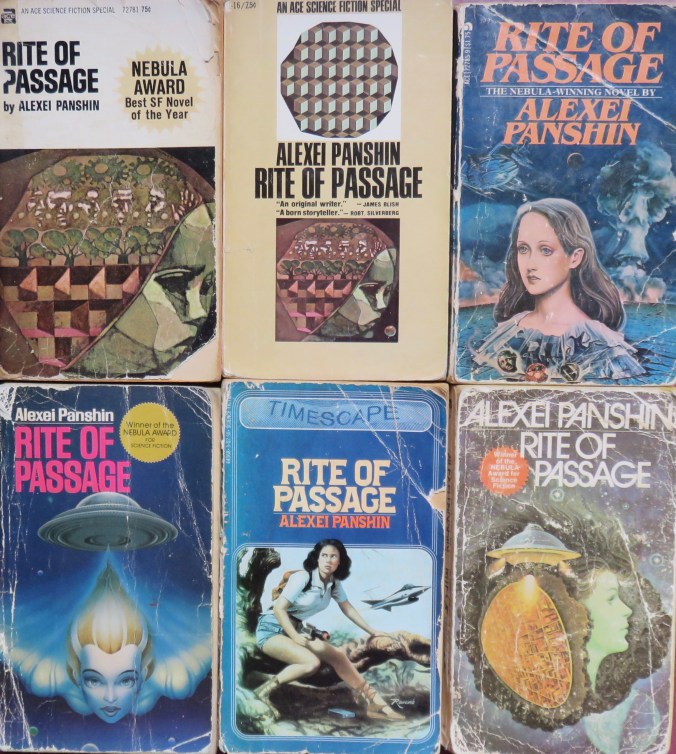
I could pretend to love The Left Hand of Darkness, but I never did. I could acknowledge that I do love many other novels such as Ursula K. Le Guin’s The Dispossessed, Vonda McIntyre’s Dream Snake, and Molly Gloss’s The Dazzle of Day. But my favorite science fiction novel is Rite of Passage by Alexei Panshin. Above are a few of the covers of this science fiction novel title.

The first time I read it, I was in college and about the age of the main character as she tells her story.

Rite of Passage is a science fiction novel by American writer Alexei Panshin. Published in 1968 as an Ace Science Fiction Special, this novel about a shipboard teenager’s coming of age won that year’s Nebula Award, and was nominated for the Hugo Award for Best Novel in 1969.—Wikipedia

This is the dystopian coming-of-age novel people should be reading, what is known as “hard” science fiction because there is no magic, no fantasy, only scientific possibility. There are also no clear villains, just people doing the best they know how to take care of the themselves and their own. The “heroes” are flawed, the ethical choices are not clear cut and tidy, and no one is shot with an arrow.

Mia Havero is a “little black-haired, black-eyed girl” of about 12 at the start of the story she tells of her rite of passage. Few of the covers I have seen indicate that the designers had actually opened the book, much less read it. Upper left and middle are solid. Sometimes what you see is not what you get.

I was reminded of this a day or two ago when I found a meme in my feed with a misquote of the Constitution of the United States. The meme contended that if the President were impeached, he and all his people (VP on down) would be forced from office. A lot of people liked the meme. People who have college degrees and should know better. And I will admit that I would be happy to see the back of Pence and the rest of Trump’s minions, but that is not what would happen.

That so many people accepted this meme as true was disappointing. I was left wondering if no one else remembers anything from our Constitution?

Does no one verify their sources anymore?

The left has been eager to throw up their hands at the ignorance of those supporting Trump. I have witnessed this again and again. Sadly, there is plenty of evidence that those on the right believe exactly what they want to believe. It is so much easier than actually finding out what is true. Those on the left do that too sometimes.

There is this simple black-and-white view of the world that is not the least helpful to accomplishing anything. It’s comfortable to discard another’s viewpoint just because it differs from our own, to ignore the demands of people we do not identify with. Working to hammer out solutions is messy compared to simply “laying down the law.” The Russian interference in our national conversation has done further damage to thinking that already viewed “compromise” as a dirty word.

We seem unwilling to understand that the world is not a YA dystopia with an evil force (them) fighting to take down those fighting purely for good (us). Reality is a whole lot of people with different ideas about how to achieve justice and liberty. When we acknowledge that complexity, we will get farther as a nation. There are times when the only solution is an imperfect one, when you get a little of what you want and I get a little of what I want, but no one gets buried in the process.

I read science fiction to find a laboratory for possibility. I already know how things can go wrong. I am interested in how things go right without the intervention of comic book heroes. Plenty of science fiction and fantasy is just another world struggling for power, but some science fiction and fantasy looks hard at difficult ideas. Not the dark lord or evil empire, but really people struggling to do their best.

Mia Havero is a Latina name. The author is American, and his book is back in print.

“The Nebula Award-winning novel, back in print at long last!

“In 2198, one hundred and fifty years after the desperate wars that destroyed an overpopulated Earth, Man lives precariously on a hundred hastily-established colony worlds and in the seven giant Ships that once ferried men to the stars.

“Mia Havero’s Ship is a small closed society. It tests its children by casting them out to live or die in a month of Trial in the hostile wilds of a colony world. Mia Havero’s Trial is fast approaching and in the meantime she must learn not only the skills that will keep her alive but the deeper courage to face herself and her world.

“Published originally in 1968, Alexei Panshin’s Nebula Award-winning classic has lost none of its relevance, with its keen exploration of societal stagnation and the resilience of youth.”—Fairwood Press

HEDGEBROOK

Today I applied for a Hedgebrook residency. I have applied ten times before for this residency, which is limited to women. My first experience at a women’s writing residency was The Flight of the Mind in the 1990s. The first time I attended, I completely failed to anticipate the impact of spending a week with eighty women who were concerned only about the written word. That initial week was life altering, and I was fortunate to attend several times. Each time I was terrified at the start and came away brimming with hope.

It frightens me to ask. The last year I attended The Flight of the Mind, I carried the acceptance letter home from the post office and stood sobbing in my garage. I had not admitted to myself how much it meant to me. That was also the last year Flight was held.

Hedgebrook is on my bucket list, and occasionally I threaten not to apply again. But then I do. This year because I have a challenging concept for an SF novel that requires slow work and contemplation, I want the residency very much. But many others need this opportunity. At the least, my application fee will serve a good cause.

CAN YOU HAVE TOO MANY BOOKS?

tlmcgb68mogpbd6ewbnh.jpg

I saw a meme on Facebook the other day. The wording was something like: “I decided I needed to lose 10 pounds last year, and after six months I am doing great—12 pounds to go!”

That is the irony when our best intentions go backwards. I have some personal experience with that. I have been watching my eating, drinking, and walking for the past 7 weeks and have lost the 8 pounds I gained since last December after deciding I needed to lose 14 pounds. I sleep better and my feet feel better when I weigh less.

During that same time, I taught two college writing classes, read 38 books, completed weaving three 82″ lengths and seamed them into a 75″ x 82″ blanket + fringe, planned a quilt, submitted stories and poems and essays, several published pieces and a story due out next month plus an essay out in September. (I will inflict links to these publications upon you once they are live.)

We walk the beach most days for at least two hours. I have picked up a few hundred pounds of trash since January, and 98 bits of sea glass so far just in July. People ask Gary and I all the time what we are finding. “Do you find agates?” they invariably want to know. We always find agates. We don’t even gather most of the agates we find, not even a quarter of the agates we find. What we carry away is mostly plastic trash. You knew that.

I watched the second season of the Netflix series, Anne with an E, which I loved from the first episode and this second season more than ever with challenging issues of sexual orientation and race. The novels are pretty “safe”, but the series takes chances and flashes back to the early years not only in Anne’s life but in Marilla’s and Matthew’s lives. The characters are thus more well rounded and meaningful, more real and less white-washed cardboard characters. The Irish actor playing Anne really is not “pretty” by the standards of those days, but bursting with energy and imagination as she should be. Green Gables is depicted here in the same way that Wicked seems to portray a genuine Oz. All the magic, but a grown-up and serious version—charm without flinching.

My own flinching is mostly about too much stuff.

My goals for the year, my husband’s and my goals for the year, include gutting the house. Going leaner, you might say. We are emptying out closets and shelves, the dozens of pretty pictures that have no walls to hang upon. Gary took everything out of the attic which still had things from my mother’s house, unexamined items from her sister’s home, boxes of ceramics I made in college decades ago now.  Nothing goes back in the attic. I am about to empty four bookcases of nonfiction and poetry. A lot of the books and at least one bookcase will go out the door. We are preparing for a garage sale and major gifts to Good Will in the near future. I keep going through books and moving stacks out of the house.

Despite all that, I ordered a book the other day. I ordered three towels on sale and I ordered two skeins of yarn, even though I have SO MUCH YARN! Too much. Too many books. Too many Christmas ornaments. Too many family pictures in frames. Too much stuff. The greatest appeal about moving into a smaller house—something we fantasize about from time to time—is the need to divest.

More important than divesting is the imperative to stop accumulating. It is possible to stop. I believe it is possible, but I have to skill in that direction.

The Green Gables house in the new series is sparse and clear. The table is set for dinner in a dining room that has no other purpose but dining. The meal is eaten, the table cleared, the ceiling is the primary decoration. Beautiful unpainted boards.

No cell phones, no music but what people made for themselves. I am not so foolish and as wish myself back in that era. Dentistry. Vaccinations. Voting rights. I know what I would lose.

But Anne’s daily walk through the woods. Writing with pen and paper. A fox in the forest. People who make immediate use of nearly everything, or they do not keep it at all. Anne has little, but holds so very much. She is creative and imaginative and loving and kind. Her ambition is generous and heartfelt. She asks for little, but the best of everything. Her best is not about gilded rooms or extravagant praise. She might enjoy those things, but there is something precious and few about her longings. More does not mean better, as I was warned in childhood.

May I at least have more of Anne? And maybe a few pounds less of me.

BOOKS I TAUGHT

phony.jpg

A student wrote to me the other day to thank me for assigning Mountains Beyond Mountains when she was  junior in my class. The young woman is in her third year of medical school and credits Tracy Kidder’s true story of Dr. Paul Farmer for inspiring her ambition. It was not the only nonfiction I taught, but it was the only nonfiction book I taught.

I showed films to introduce my students to other lives and other times. I am proud that I taught the novels Their Eyes Were Watching God, The House on Mango Street, Things Fall Apart, and A Yellow Raft in Blue Water.

A self-proclaimed “non-reader” in my regular English class agreed to keep reading Yellow Raft after I’d read the first chapter of part one “Rayona” but could not read “Christine” because she was “too much like my own mom.” So we struck a weekend bargain. He would read seven pages and if he still couldn’t stand to read that part of the book, I would given him a summary and he wouldn’t have to read the rest. He came back to class on Monday and declared he “loved Christine.” She helped him understand his own family and the fictional character remained her favorite in the novel.

Sometimes we find ourselves or people we need to understand in a novel.

I taught both The Catcher in the Rye and The Adventures of Huckleberry Finn for over 20 years. 

I generally shared William Raspberry’s column about Huck Finn, and worked hard to introduce my students to satire. The novel was a consistent failure in my Honors classes. These “good readers” were unwilling to slow down and hear Huck and Jim speak, they were too good at skimming. As a result they found the novel unfunny and boring. However, when my voice could manage it, for several years I read nearly the entire novel aloud to my “regular” students. They got every joke.

Huck is a poor boy with a rotten father, a racist boy who eventually learns to respect and honor his friendship with the young man, the slave Jim. He is on a hero’s journey but he fails because he does not figure out that slavery is wrong. He cannot overcome society’s instruction about what is decent and proper. Even at the end, he believes it is a sin to help a runaway slave. Nevertheless, he is willing to go to hell rather than betray a friend: Jim, who is far craftier and kinder than Huck recognizes. Jim reveals himself as one of the view decent adults in the novel when he risks his life staying with the critically wounded Tom. Some students responded to the moral lesson in the novel and the humor throughout. Many missed it completely.

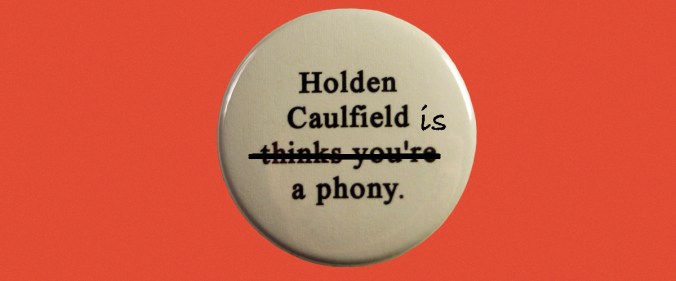
By contrast, for more than twenty years, students loved Holden Caulfield in The Catcher in the Rye.

Holden is a rich white boy attending elite private schools but with neglectful parents. He is grieving and riddled with guilt. He does not overcome these challenges. Parents of my students sometimes balked at the language, but the real problem with this novel, from this parent’s perspective, is that Holden is suicidal throughout and in a mental hospital as he relates his story and he’s been there for months and still lying about where he is and why.

Teaching this novel allowed students to develop understanding of “voice” in literature, and to realistically extrapolate Holden’s future (they were never optimistic). One girl waited after class to speak to me and sobbed that Holden would not like her if they met. Sadly, she was right. Holden’s tolerance for most people is slim.

I used Jane Smiley’s ridiculous take-down of Huck Finn and Calvin Trillion’s questionable 50th anniversary review of Catcher in order to introduce my students to opposing views, to critical thinking, and evidence-based argument. The more they liked the novel, the more passionate was their response to the reviews. To be fair, however, even people who had not initially liked Huck Finn sometimes became fans after recognizing the false equivalency of Smiley’s comparison of Huck Finn to Uncle Tom’s Cabin. As if Jane Austen failed because she did not write novels more like Charles Dickens.

Eventually the tide turned for Holden, and one year a majority of readers found Holden “annoying.” I gratefully replaced him with Jason Taylor in Black Swan Green by David Mitchell. That book also contains language, but deals with bullying and class. Jason is also a relatively affluent white boy, but younger and in many ways nicer than Holden. He is not oblivious to social injustice. He is not so obsessed with his own suffering that he is largely incapable of noticing others’. 

We read all of The House on Mango Street aloud in class, each student choosing a story to read and I read the rest. It is brilliant and a superior trigger for personal stories. We talked about fiction and creative nonfiction and prose poetry. It’s all there.

I taught Toni Morrison’s first novel The Bluest Eye for 25 years. I warned students about content. I advised them to skip pages or call me if they had trouble. I had an alternative and more euphemistic novel in the wings. But Toni Morrison is our only living Nobel novelist, and she is among the best writers to ever exist. There are no substitutes. She writes about love, including the love of little black girls, the most neglected of all. She teaches paradox of pain and beauty, of survival when someone loves us and tragedy when we are unloved.

Isn’t that what all novels are about?

UP?

IMG_3079

I have spent two days trying to get online with WordPress. Yesterday the site told me that I did not exist—not my password or email.

Yet here I am.

I have no idea what happened.

Am I back? Fingers crossed.

Yesterday I finished seaming three woven panels together. The yarn up above is on its way to being something later this summer. I cleared off my work table and folded the leaves back in. Gary is preparing for the garage sale we plan for next Friday. Lots of Christmas ornaments and other lovely vintage and antique items.

I have ordered a desk, which Gary has been nudging me to buy for months. I had saved more than half the cost and perhaps the garage sale will allow me to pay it off.

There were 200 yards of sand at the end of our walk. We found 26 bits of sea glass. On our way home from the long walk, a woman asked Gary if his trash bag had oysters in it. Oysters? No. Beach trash and a strange rock—oysters do not grow on our shore. They like a sheltered environment, a bay or cove. We have mussels and razor clams. Just now the Dungeness crabs have been molting and the little sand crabs (seagull eat them) are laying eggs.

The horizon is still misty after 10am.

LOST and FOUND

IMG_2010

There was fog and some low clouds in the coast when we went out just after 6 this morning. We walked north, as we usually do, picking up trash and hoping for beach glass. I found three pieces in three colors, but my husband had no such luck and thought he would be skunked again.

On our way home, Gary saw what he assumed was a clear jelly fish cast onshore. As is his habit, he gave it a nudge with his foot. Instead of wobbling, the clear object spun around on the sand. Gary had his sea glass. A huge piece found.

In the mean time, fog closed in and as we walked further south toward home, both the waves to our west and the houses fronting the shore to our east became mere suggestions. This reminded both of us of a time my old dog show partner, Bonita, was here with her husband and children. We went for a walk and fog closed in so thick that visibility was reduced to perhaps ten feet. It was extraordinary!

One of Bonnie’s children became lost and searching for the child was impossible, like search for a penny on the floor in absolute darkness. Moments later, as best I recall though it seemed like hours in frantic effort, the child was found. The father began to yell, a reaction I remember from a day long before that when Alan went missing in Lower Woodland Park in Seattle. Gary and I were both nearly hysterical. My mother was with us and commented mildly that Alan had probably gone to the bathroom. But his parents were panicked and running everywhere to search. It was my mother who strolled over to the public restroom and returned our toddler (perhaps he was 4?). Our immediate impulse was to yell at him, but my mother calmed us both.

When we lose those we love, even for an hour or a moment, the adrenaline and sorrow can overwhelm good sense.

That is what we spoke of on our way home. We recognized the faint rooflines silhouetted against the brighter eastern sun.

A friend and his wife have lost a baby at 20 weeks gestation. They are handling this with grace, from what I can see. Hundreds of miles away, I am not there to offer physical comfort. Is there any comfort to be had? I cannot imagine. What they have lost will not be found again. Perhaps they believe in another life and reunion then, but for now, that child is gone as if never was. Lost in fog.

When we have fog like today in summer, this is generally a sign that Portland will have a 100° day. It is what is forecasted. It is a best guess, but only an educated one, not a certainty. There few things certain in life other than morning and loss. We all lose people we love during our lifetime. It is rare to survive to adulthood without gathering ghostly memories of people we will never see again on earth.

Just now, I want to remember the little girl walking out of the fog, my son grasping the hand of his grandmother. Those children are grown now. They, like my friend who lost his baby, will experience the entire range of human losses. They will also find courage and companionship. They will find meaning where they can. They will create and consume. They will share good intentions and make mistakes. And sometimes what they most love will seem lost.

Like all those before them, they will take their losses in hand and search for meaning. And they will, sometimes, find what they need to walk on in the fog.

“Father, Son, and the Holy Spigot”

Jonas-Salk-Quotes-41.jpg

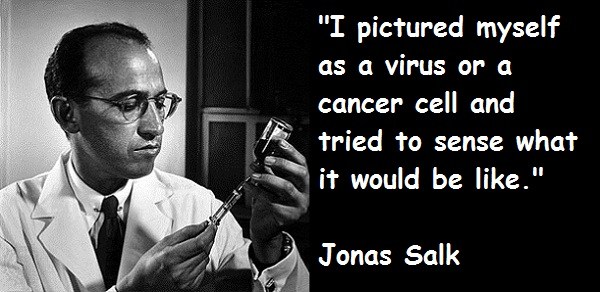
Dr. Salk developed the polio vaccine. My title is a line from Four Weddings and a Funeral, otherwise notable for the use of an elegy by W. H. Auden, listed as “Funeral Blues” but also known as “Stop All the Clocks.” It is a poem of friendship and devotion and love.

But I mean to write about not partisan or political tolerance, but about the actual support for Donald Trump. On most levels this supportive base completely mystifies me. The man disrespects nearly everyone, including what might be considered the conservative base. He is a friend to our national enemies and an enemy to our friends. He has been married three times, and committed adultery while his most recent wife was in childbed. He has used language on tape that the men I admire would never use. He has insulted a Gold Star family, a POW, and the men and officers of his own military. He admires dictators and autocrats and seems indifferent to nations struggling to achieve what we have in the way of freedom. He is a hypocrite by both claiming religious faith and failing to evidence any knowledge of Christian teachings.

So here’s my understanding of why some still flock to his message:

  1. Money. Despite the fact that he was born wealthy, was handed wealth, and apparently had squandered more than he actually possessed at election, Trump is filthy rich. We admire money, don’t we? Money is power. Money is success. Never mind the seven deadly sins of pride, greed, lust, envy, gluttony, wrath, and sloth, the man is selfish and mean. But he’s rich and America loves a rich man. “Wealthy”, by the 19th century, was used as a girl’s name. In that case, of course, the meaning was not about wealth in terms of money, which the Bible and Jesus absolutely condemned, but “wealthy in the sight of the Lord.” It was that much-denied group the Puritans who preached that monetary success was a sign of God’s favor, despite an entire book in the Bible designed to refute that notion. Americans gave up Puritanical notions about sex, but decided we liked money. So some like the man because he’s rich.
  2. Vulgarity. He says exactly what he thinks and what many Americans apparently also think. He’s rich enough not to care if some object to his racism and sexism and bias against compassion and humility. They like that Trump attacks the poor for being poor, that he supports religious freedom so long as that religion is the one he pretends to follow. It is a cynical view of many Americans that everyone, or a majority of people, would speak exactly as Trump does, that they would ridicule a disabled person if they could get away with it. They like him for spouting hatred they dare not spout themselves, and for providing an opportunity for that venom to achieve acceptance.
  3. He is Everyman. Trump proves that anyone can be President. We don’t have to know the Constitution or pay attention to the news, study the complexities of international and national events, or even vote in elections. Certainly, if we are smart, we avoid paying taxes. We can brag that we “know more than the generals” and belittle those who have devoted their lives to the public good. Seriously. Some like the idea that a President can be as ill-informed, perhaps even as stupid, selfish, and self-serving as they are themselves. They genuinely believe no one is nicer than they are themselves. And they are not nice.
  4. Government. There are individuals in the world more powerful than small governments. There are companies more powerful that most nations. Yet, paranoia about government control is rampant. Children raised in strict, top-down households, particularly households with a strong authoritarian father, are often fearful of government. The psychological theory explaining this well-documented tendency postulates that when a child’s initial introduction to control and power is cruel and arbitrary, the child often retains distrust of governance throughout life. Trump removes government controls, and many do not seem to mind that those left in power are now the ones more concerned about profit than people. It’s the money again. Some will forgive most anything if a profit is to be made, even at the cost of health, safety, opportunity, and futures of others.

In contrast, it is an essential part of the American character to respect the needs of each individual, so long as this does not trespass on the needs of others. Life, Liberty, and the Pursuit of Happiness is at our core. To this end, we live together as human beings have always lived in community. There is evidence of this truth.

I offer Dr. Salk.

“On March 26, 1953, American medical researcher Dr. Jonas Salk announces on a national radio show that he has successfully tested a vaccine against poliomyelitis, the virus that causes the crippling disease of polio. In 1952—an epidemic year for polio—there were 58,000 new cases reported in the United States, and more than 3,000 died from the disease. For promising eventually to eradicate the disease, which is known as ‘infant paralysis’ because it mainly affects children, Dr. Salk was celebrated as the great doctor-benefactor of his time.”

Both my husband and I were spared this disease when we were children because Dr. Jonas Salk invented a vaccine that protected us and he gave it away for the public good. Both of us knew people who had polio, were confined in iron lungs for weeks or months, and spent the rest of their lives struggling to walk. Dr. Salk made an adequate living as a doctor, he claimed. “His sole focus had been to develop a safe and effective vaccine as rapidly as possible, with no interest in personal profit. When asked who owned the patent to it, Salk said, ‘Well, to the people I would say. There is no patent. Could you patent the sun?’ ”

There is irony throughout my explanations. It is ironic to trust Trump because he is “successful” and “says what he thinks” and is as petty as the worst of us, because our life experiences should tell us that success is rarely gained only by those who are deserving. Surely, some people are kinder than others, not out of any selfish motive, but because they sincerely care about being good.

I am genuinely grateful that there are people willing to sacrifice for the common good, that some people are smarter and more generous than I am myself, and that consideration of the needs and feelings of others is not a conservative or liberal notion, but a humane one. And I am grateful that the majority of Americans feel as I do.

My hope and the hope of a majority of Americans is that we will soon inoculate our government against the current virus infecting our nation.

Yet, there is good. There is good in each of us. We fear and are comforted. We hunger and are fed. We are homeless and are housed. We join together to maintain the common good, because as human beings that is what we must do to survive. It is what we have always done. A strong nation protects weak from strong, the vulnerable from powerful, and small from the great. That is, ultimately, our greatness.

NEVER TURN YOUR BACK

IMG_3063

“Never turn your back on the ocean,” we were warned as children.

Most people think of the “front” of their home as the side facing the street. What we call the front faces the Pacific Ocean. It is a beautiful view.

The hummingbird above—can you see her?—she has her back to me. I was fifty feet away when I shot this photo and she was at least 15 feet in the air, sipping nectar from a semi-tropical plant in the neighbor’s yard. Perhaps it is from New Zealand? The hummer was not alone. We counted at least four hummingbirds feeding a couple of days ago.

Just now, I spotted a hummer in our own garden, checking out the lavender and pale thyme, before settling to dine on the royal purple blossoms of our butterfly bush. The dark pink escalonia pulled her away for a few seconds, but then she was back hovering over the purple. We also have purple hebe, pink geraniums, glistening red-orange “Lucifer,” and white rugosa roses blooming.

In the front yard, the wild roses and ceanothus are done, the honeysuckle past its prime, but another pink rugosa hydrangeas are in full flower. The native salal, which flowers and fruits simultaneously, will feed bees with nectar and us with berries for months. Soon the montbrecia will begin opening while the salal and hydrangea go on to September.

IMG_3059

She seems to have turned and looked at me in the photo above, but I was deliberately distant. I did not want to disturb her.

There is always something blooming in the garden.

This is a deliberate choice. Most of the garden is evergreen plants, shrubs and bulbs and other flowers were chosen each season to ensure we could feed local bees and birds throughout the year. Even in winter, we have blooms.

IMG_3071

On the beach we also avoid disturbing the birds, though Gary and I both talk to the crows, and sometimes he pretends to want to pick up a seagull. Gary goes straight toward one saying, “Kitty, kitty, kitty.” The gull doesn’t mind him much, but walks away if he gets too close.

My strategy is different. I do not walk in the direction of gulls resting onshore, I do not look at them directly. They seem to understand that I have business of my own that does not involve them.

Yesterday morning an osprey was right out in front. Later one of the four eagles passed overhead. We saw a Cooper’s hawk just a few months ago when it rested on our garden gate. It’s leaving was too fast to see.

The ocean is always in front of our house. Before our house was here, there was spruce forest right down to the beach. Before that, the beach itself followed a different line. The water washes and washes the shore, sweeping up from its basalt basin onto the edge of the continent. It is not only water but the shore that moves. One day the Cascadia fault line will give way and a wave is likely to take not only our home but the land now under it. Everything I recognize as front or back of our house will vanish in an hour.

But the ocean? The ocean will remain. I expect the birds will too.

SaveSave

WRITING EDUCATION

_MG_0011

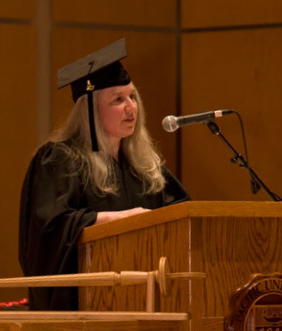
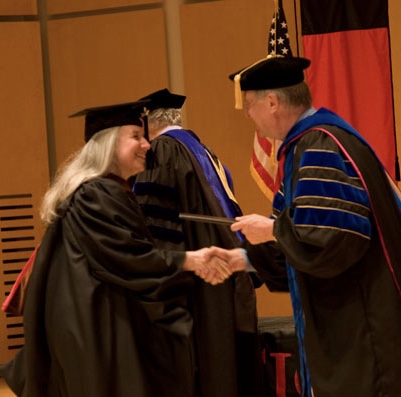
I was Class Speaker in 2007 at Pacific University’s MFA in Writing graduation.

A writer friend of mine who has taught in an MFA program for several years reported that not one of her students had become a “successful” writer by publishing a book. I shared that among students from the two years of my MFA program, only a handful had published books. Of those, most were poets and most came to the program with a chapbook already published.

Tom Jenks writes in the newest edition of his online publication:

“By 1975 the number of graduate programs had grown to fifty-two, a number that in the subsequent nine years tripled to 150, and by 2017 the number grew to more than four hundred. If undergraduate programs are included, today’s number exceeds two thousand. Across approximately eighty years, writing programs have proliferated as the accepted foundation for the would-be writer’s route of entry to a life of writing, publishing, and/or teaching. …

“The 2016 AWP conference in Los Angeles hosted twelve thousand attendees, a number that represents perhaps 7 percent of an estimated 170,000 MFA degree holders and students in the US. Currently, graduate writing programs and undergraduate programs with an emphasis in creative writing turn out some fourteen thousand new degree holders each year.”—Narrative

Need I point out that we do not publish 14,000 books from “new” writers each year? The industry published a bit over 316k titles in 2010, but actual sales were down by 14 million that same year. More books, fewer buyers. A book has less than a 1% chance of showing up in a bookstore. That is a bit better odds than being published by most noted literary magazines, which rarely pay anything to their authors.

Academic life? Other than the (very) rare person who lands a tenure track position, the demand for college professors without substantial publications and research means most work as adjunct. Trust me, a high school English teacher is paid much better. A good cocktail waitress is paid much better. Retail sales at least do not result in hours spent scoring papers.

Years ago, I read that the average full-time writer earns less than $10k/year. True, Neil Gaiman, but there is only one of him. The nation does not need many new writers. They will not earn a living through creative writing of any kind. A writer I knew from years ago had this piece of advice: “Marry money.” Unlike the graduate of an engineering program or even one with an English degree, very few creative writing majors will find work relevant to their education. Their odds are about on par with the high school character actor becoming the next Cate Blanchett.

So of the majority of people who graduated with me in 2005, what are we up to? Several are not writing at all. They have stopped pursuing “writing, publishing, and/or teaching” altogether. Some have moved on in their academic careers. At least half published work in literary journals or books, but several of those are not actively writing now. Only two that I know of have new books out in the past few years. They are not making even $10k/year from those books.

I am mostly retired from teaching but still writing. I am publishing in journals. According to Duotrope, an online resource I use to locate markets and track my submissions, my publication rate has consistently been “higher than the average for members who have submitted to the same markets.” My acceptance ratio has varied over the years from a low of around 5% at the start to a brief high of 14%. Just now I am at 8.5%. I submit to journals than accept less than 1% of submissions recorded by Duotrope. At no time have I made a profit on my writing. I have been published in fine journals (without pay) and have presented to regional and national conferences (for zero pay). I have been paid for technical writing, but I was better paid freelancing graphic design, which was not my major, or drawing plans for an architect, for which I had no educational preparation at all. Even when I was judging field trials across the West, a hobby, I was paid travel expenses and was housed and fed. Writing and presentations on writing? Not a chance. I have never actually been paid for any literary work, though I do expect a small check to arrive in the next month from a paying market. Maybe.

So why the degree?

I had promised myself an MFA. I assumed it would be in the visual arts since my undergraduate degrees were in the visual arts. I have BFA degrees in ceramics and metal and a BA in Arts Education. I came to writing relatively late in life because I wanted to return to teaching and there were no arts jobs available. I thought I would teach Social Studies, those classes where I learned to write essays, but instead I began teaching English, where all writing is taught these days. I did not need an MFA for that job.

My MFA cost me $20,000 and I will never see a return on that investment in any job. I had already written three novels and published essays, stories, and poetry before I began the program.

So why?

There were people in my program who only wanted to write a book, people who needed a terminal degree to advance in academia, and people who left the program and became musicians. I have kept writing and reading and writing and reading. Why the MFA? I was already productive and growing.

It was that promise to myself. Self-indulgence really. Just as most the other actual writing is self-indulgence. My sons had graduated from college and I found that the frugal habits I had developed when we were a one-income family and throughout our sons’ education were not as easy to break as I once thought they would be. I was at the top of the pay scale as a teacher, my husband was also working, and we went no where on vacation, drank only cheap wine and good homemade coffee, used no drugs, and ate out rarely at restaurants labeled with one fork, for “cheap eats.” I could afford $20,000 spent over the course of two years.

The degree was for me. I hoped to become a better writer and to find a writing community since my efforts at finding a writing group had failed again and again. (There was the group where the poet-leader declared fiction “annoying.” The group that wanted mostly to gossip. The one that wanted to get high. The one that self-published horrible trendy fiction.)

Jenks assures me that I didn’t need that MFA degree, that I will likely join the tens of thousands who will never “use” their degree to be a “successful author,” a term even he finds it difficult the define. Did I enjoy the program? Yes, very much. Would I do it again? Absolutely. Did I find the writing community that I desired? Not really. Did it make me a better writer? Perhaps it did. Did it help me to become a published writer? No, it did not. That is something else again. I got something from the program, made a few friends, and often consider how to return. That is enough.

Were I today in my early 20s, a white girl, even a white girl from a modest upbringing _MG_0049and married to a man raised in poverty, what value would I bring to fiction? What story do I offer? It is a question I ask myself even now.
“Some things can be taught, some learned—so much depends on the character of the writer.”—Tom Jenks

SaveSave