OWLS DREAM

 Art by  Laurie Noel

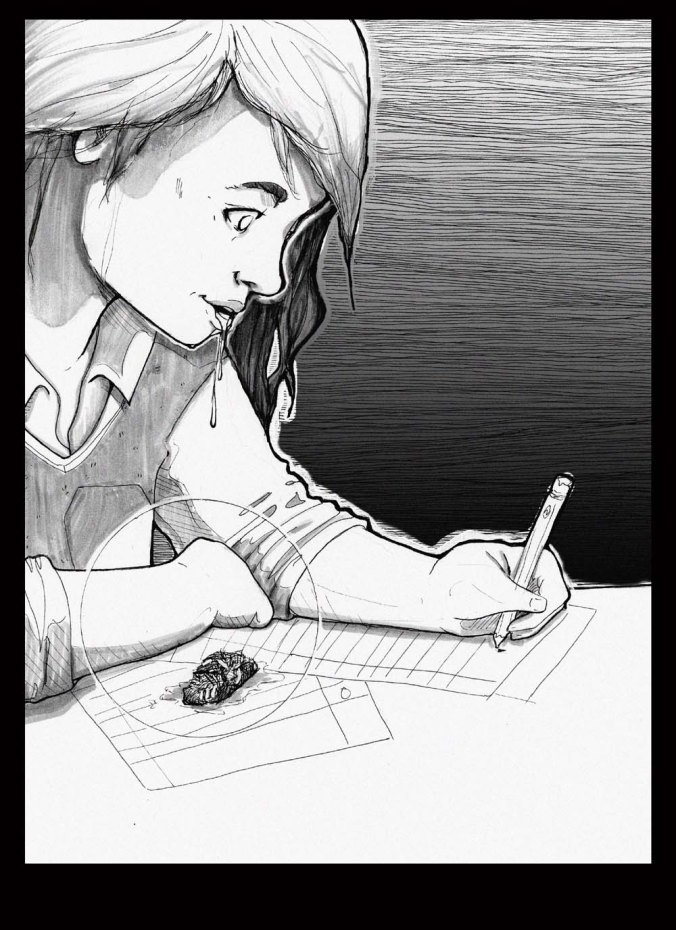
And a check came for my story, “If It Were True Owls Dream.” It appears in issue 5 of Liminal Stories. The illustration they chose disturbs me because in my head I see Beatrice from the other side, facing left. (Plus, this character is right-handed.)

The early drafts of this story used my grandchildren’s names, but those have been altered to protect their innocence.

NGS Picture Id:1166458


WEASEL TRACKS

IMG_3172

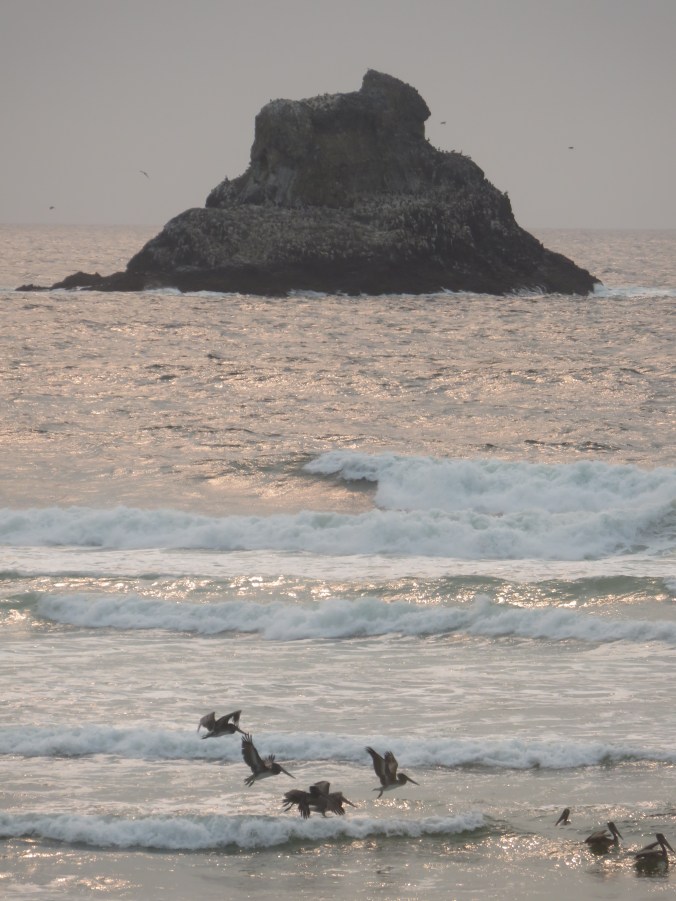
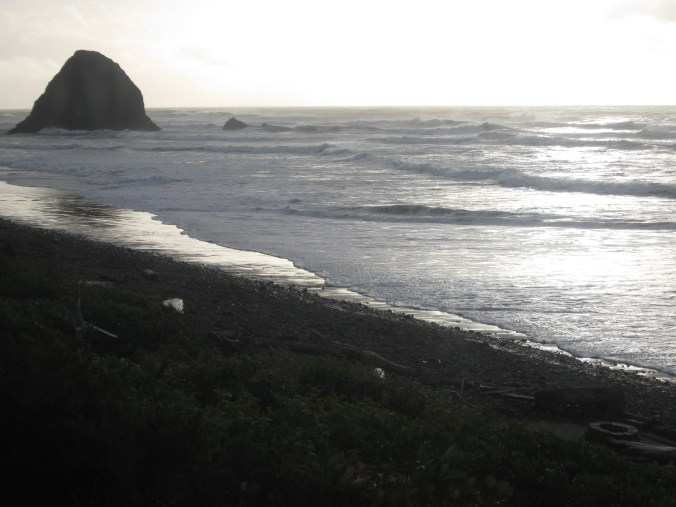
The brown pelicans are here. We found a shed flight feather on the sand.

IMG_3123

We think we found weasel tracks in the sand. Not dog or cat or rat or raccoon. Little weasel tracks. By the time I got them with a camera, the sun was up and the tracks had begun to fall in. You will have to take my word. A weasel. There has been a weasel in the neighborhood at least since the 80s when I first saw one dart across the front yard. A weasel watched the electricians replacing a rusted out meter box. Our cat Leakey had an on-going feud. Then it was gone, but maybe it is back again, or more likely a cousin after all this time.

IMG_3129

The tide scrubbed cold water up from the bottom of the ocean and dozens or hundreds of aged dead crabs were tossed on the sand, many of them 8 inches across and nearly all males. The other day as the sun came up during our morning walk we could see odd color in the sky, a gilded haze from the fires elsewhere in the west.

Our family came for the weekend and we had 8 adults and 5 children between the ages of 2 and 6. There was a bit of chaos.

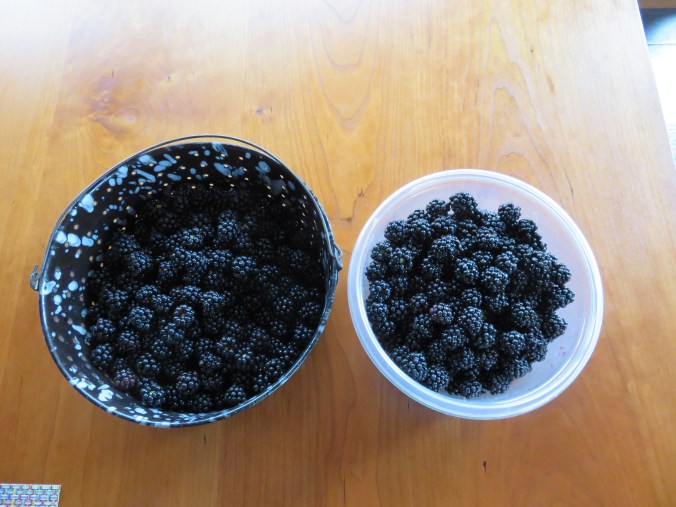
And then Gary and I picked blackberries. They are early this year. I meant to gather only a handful to combine with nectarines, but there were so many!

IMG_3176

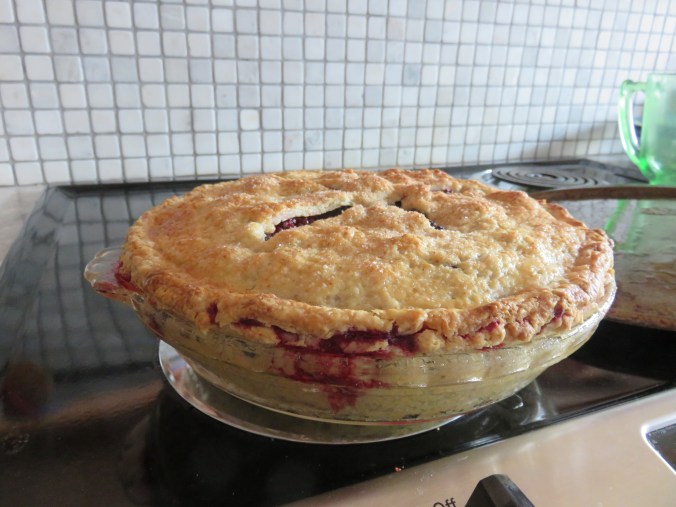
My mother always said you could tell a pie was done when it began leaking and bubbling over.

IMG_3177

A good month so far.

SOCIAL SECURITY

IMG_3106

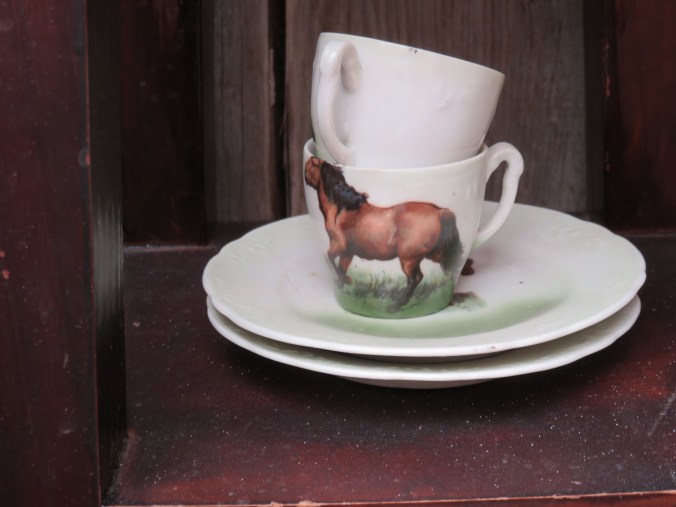
As a child, I thought I would one day have many horses. This is one of my horses.

When I was a teenager, my mother was buying and selling antiques. She reported the income as coming from both herself and my dad because, having worked for the feds and before that for a college, he did not have many years in the Social Security system. In other words, he qualified for a federal pension but not for Social Security benefits. Mom wanted to ensure he could have both so my dad was a partner in the resale business of antiques and collectables. Today, she would have done this via Ebay; in those years, she attended flea markets and antique shows.

This was a good lesson for me as a teenager, to see someone planning ahead.

Talking about money is uncomfortable. I get that. It is for me too.

Some in my parents’ generation were diligent about preparing for retirement. They may have been particularly motivated if they faced particular challenges related to race or religion or divorce, humble upbringing or handicap. There was also the fact of growing up in the Depression, which tended to instill a sense of monetary insecurity and need for preparation. And the G.I. Bill had sent a generation of Americans to college who would not have had that opportunity in previous decades.

The G.I. Bill was initially conceived primarily as a home-buying incentive for returning veterans. The educational portion was tacked on at the end, but it might have created the most dramatic shift in American culture.
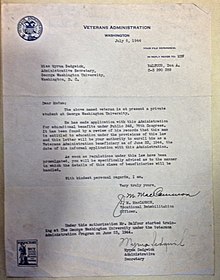
Don A. Balfour was “the first recipient of the 1944 GI Bill.” Veterans Administration letter to George Washington University.

On June 22, 1944, the Servicemen’s Readjustment Act of 1944, commonly known as the G.I. Bill of Rights, was signed into law.

During the war, politicians wanted to avoid the postwar confusion about veterans’ benefits that became a political football in the 1920s and 1930s. Veterans’ organizations that had formed after the First World War had millions of members; they mobilized support in Congress for a bill that provided benefits only to veterans of military service, including men and women. Ortiz says their efforts “entrenched the VFW and the Legion as the twin pillars of the American veterans’ lobby for decades.”

Harry W. Colmery, Republican National Committee chairman and a former National Commander of the American Legion, is credited with writing the first draft of the G.I. Bill. He reportedly jotted down his ideas on stationery and a napkin at the Mayflower Hotel in Washington, D.C. U.S. Senator Ernest McFarland, (D) AZ, and National Commander of the American Legion Warren Atherton, (R) CA were actively involved in the bill’s passage and are known the “fathers of the G.I. Bill.” One might then term Edith Nourse Rogers, (R) MA, who helped write and who co-sponsored the legislation, as the “mother of the G.I. Bill”. As with Colmery, her contribution to writing and passing this legislation has been obscured by time.[Wikipedia]

Like slightly more than half of World War Two veterans, my aunt (Marines) and my father (Army) used the G.I. Bill to gain a college education. Both went to the University of California at Berkeley. They were first generation. My mother was too young to have served during the war, but she lived with her sister and after the war also attended UC Berkeley before her marriage.

The Bill was not perfect. It suffered from the bigotries of the day, stumbled, lapsed, but has been renewed in recent years. It still looks like opportunity for many young people seeking to serve their country and find a better life.

There used to be a popular fiction, the Horatio Alger myth, that encouraged a belief that in America anyone can rise. Indeed, many have come to our country to find a better life. Many have found that better life, but actual wealth tends to run in families. We do not live in a fluid society. Children born into affluent families may achieve actual wealth (Gates), but the rags-to-riches story is rare to nonexistent. (Riches-to-rags is an easier move. There is plenty of research documenting how a single generation brought up in privilege can squander wealth.) Most people shift slightly up or down in class, work and earn slightly more or less than the generation before them.

It has never been easy to shift social classes, and there is deep resentment among the wealthy, hence derogatory terms such “Nouveau Rich” and “social climber.” Research suggests that active resistance has grown. Social mobility is less likely today than is has been in the middle of the last century.  My mother’s mother had hoped to attend college and according to family stories was accepted to Reed College, but was unable to attend when she and her sister were forced to support the family due to a strike. Later my grandmother was an office manager in a shipping company, a single mother supporting her daughters. My own mother attended college only until she married. I have four college degrees, and my sons have four between them.

What we are given is ultimately less important than what we assume we are entitled to pursue. I assume my grandchildren will attend college, and because of such assumptions about their futures, they likely will. My parents assumed as much for me. My husband attended college only because I did, not because anyone in his family had ever attended college or because anyone in the educational system encouraged him. He graduated in 1974 with honors and Phi Beta Kappa. His work has rarely relied on that education directly, but a look at his bookshelves reveals a man still interested in his own education. I am proud of him—he is interested in knowing.

Assumptions about my own life have also flexed. I thought I would teach till I was in my 70s, but a year of lingering illnesses forced me to retire at 62 when there was “no money” to offer me a half-time teaching position. I have not been sick since, though I do still teach two college classes each year.

My husband and I have three pensions between us, none of them enough to pay rent, but adequate together with Social Security, which we each paid into since the 60s.

My mother was determined that she and my father would enjoy a secure retirement. In practice, life did not proceed in the manner she hoped for. My father was forced to retire early due to rheumatoid arthritis. He died of lung cancer before reaching my age. My mother moved alone to a coastal town in Oregon, and her contractor underestimated the cost of her retirement home by a factor of three, so she went back to work part time for a few years.

We do what we can and hope for the best.
The BLANKET

IMG_2968.jpg

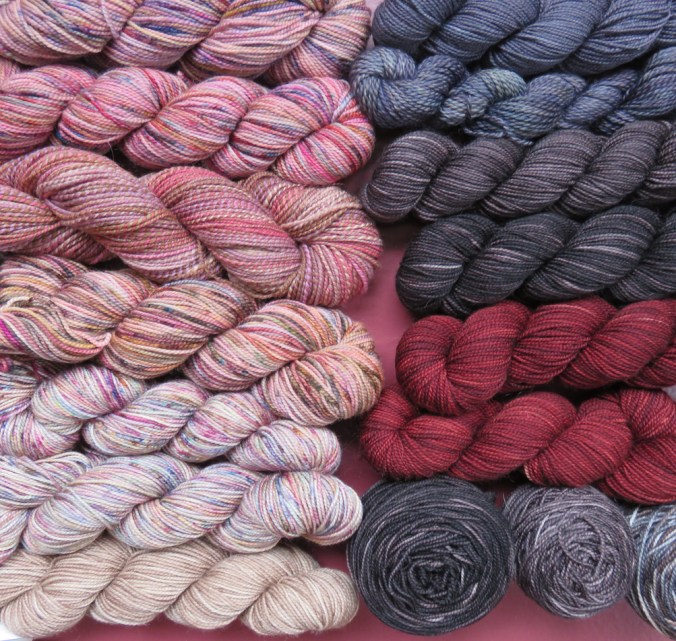
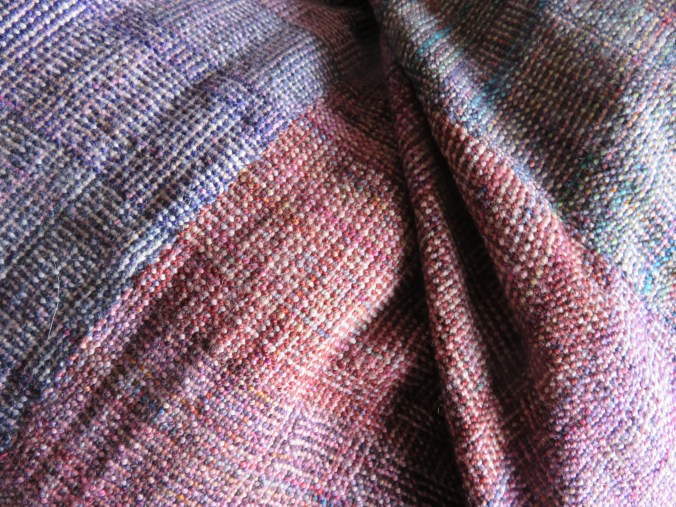
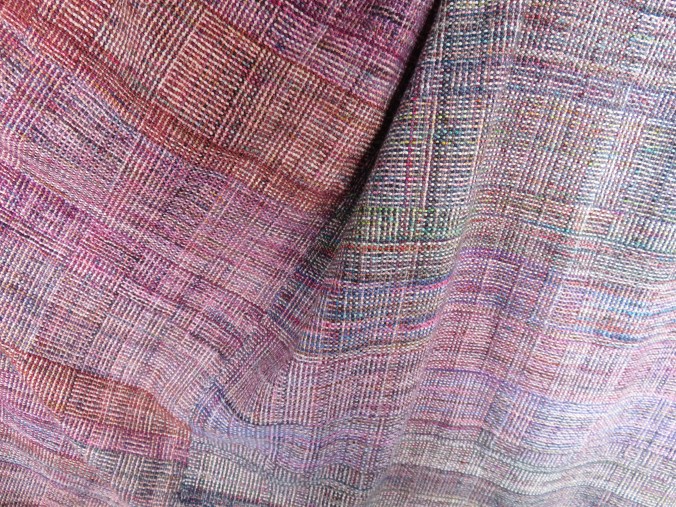
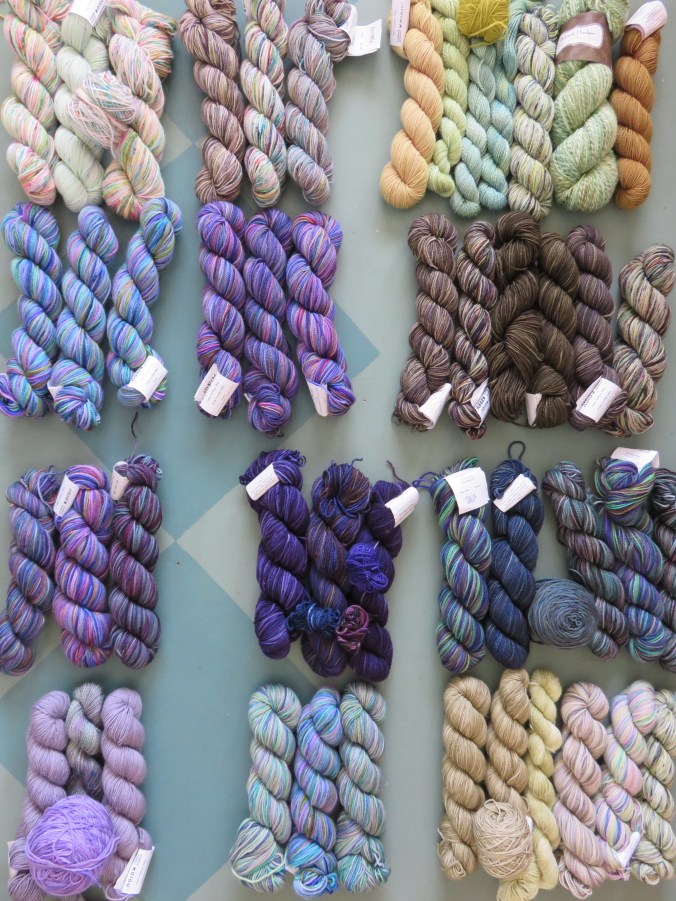
The yarn above is from the blanket I just completed. The warp was 8.5 yards, and I wove three 82.5″  lengths and then seamed them to make a blanket of 75″ x 88″  including fringe. One of the lengths used weft very like the warp and the resulting fabric is warm-toned and reddish. The other two used neutrals, dark blue and purple and green, as well as a scattering of sparky contrasting colors. The neutral weft lengths went on the outside and the reddish one in the center.

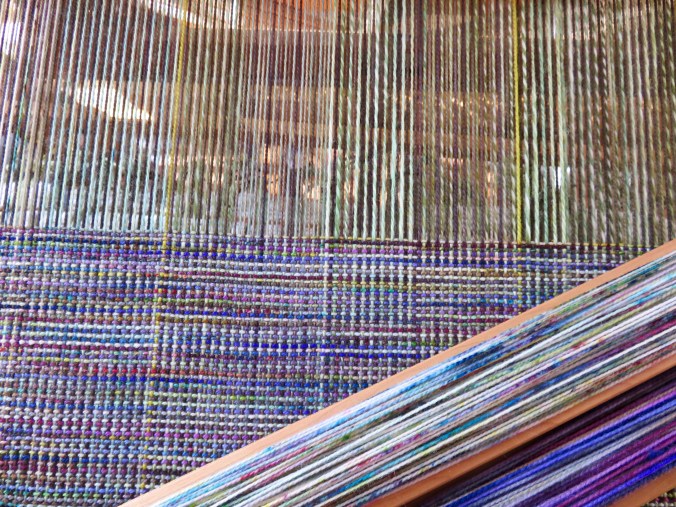
The pattern I wove is called “log cabin”  that is quite different from quilter’s log cabin. Weaver’s log cabin starts with alternating light and dark warp threads; the weft threads also alternate dark and light. You can see how I set darks against lights in the photo at top. The color contrasts reveal a pattern of horizontal and vertical bars. The three strips (each 25″  wide) on the same warp are seamed together in the two photos immediately below.

IMG_3118

IMG_3121

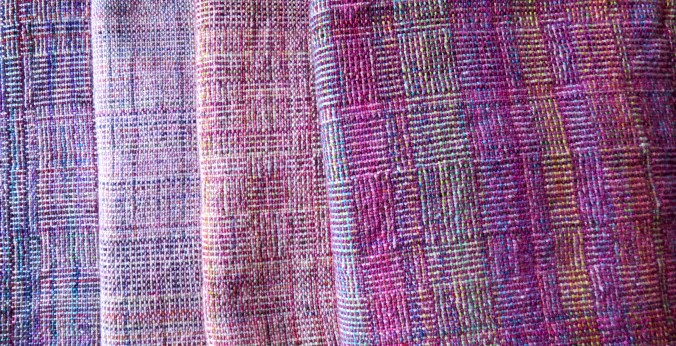
The pattern sounds simple, but I am fond of it. There is a bit more to it than that, of course, but that’s the gist. You can see how the pattern varies in the four woven lengths stacked in the photo below. This is a different warp and shows four different approaches to weft. The one on the left is blue/purple. The one on the right used a handspun yarn in gradually shifting dark hues. There’s a dyed-in-the-wool skein from Washington state, shown up top, third from top on the left. Everything else on this page is woven of Koigu, a Canadian hand-painted merino yarn.

IMG_0778

Years ago, weaving my first project, I played with a classic balanced coverlet pattern called “Snow Ball and Pine Tree to make a weft faced rug of Swedish cow hair. You could say that I took a pattern from one tradition and used it in another. I did that with weavers log cabin, too, stitching a quilt in alternating vertical and horizontal bars. One creative effort feeds another.

Some days feel abandoned, wasted and lost.

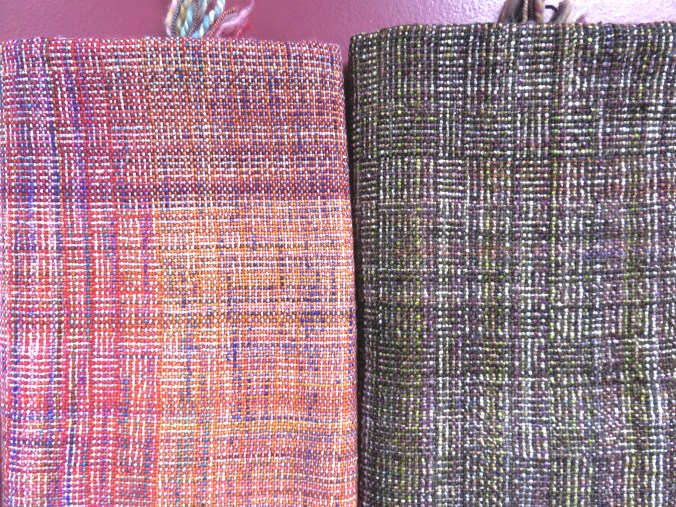
Other days feed the soul. A friend just became a grandmother, and I sent her a baby blanket for the little boy, the one at left below.

IMG_3117

Some days pass without incident or accomplishment. Some days there is kindness in the air.

WE MISS THE CAT

IMG_3959

One of our sons just adopted two kittens. They are adorable and I got to hold and pet them the other day.

We are in the midst of “Swedish death cleansing” known as döstädning. “It’s what people are doing before somebody passes away so that the relatives don’t get left with the big chore of sorting out their personal things.” Except we do not plan on dying soon. 

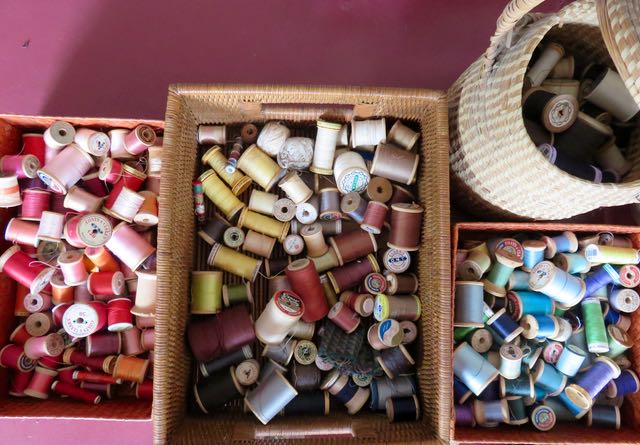
Perhaps this is “Oregon reverse gathering”. I am 65 and I do intend to live another twenty or thirty years. It is not an unreasonable expectation. What I do not expect to do during that time is use all of the hundreds of spools of thread I inherited from my mother and grandmothers (also my aunt and my step-grandmother’s second husband’s brother who is responsible for an oversize spool of heavy black cotton thread). The four baskets are shown midway in my sorting and contain only about a half dozen spools of handquilting thread that I actually purchased. The rest found their way to me through no effort on my part. The effort is in using or disposing of them. The sewing notions are taking me longer than anything else. Elastic, zippers (when was the last time I put in a zipper?), thousands of needles and pins. I found two darning needles I had been looking for. I found all the missing pincushions. Too many pairs of scissors. Sewing machine parts I do not recognize and that may not fit the 1940s sewing machine I use. Just separating all these into sorted containers has taken me a week. And I am not done.

IMG_3116

No worries. I have a plan.

The sewing notions will be used or donated. The car is presently stuffed with other items for Goodwill. There will be more drives north to the donation site. There will be projects organized and stashed. I will compile sewing kits for each grandchild, and I will restock the drawers of my sewing machine and the little sewing chest downstairs. Both were emptied while I sort. I will find places to donate the rest. Perhaps each of my writing students would appreciate a sewing kit to take away to college?

Clothing, because I keep everything, has been a challenge. I finally researched Eileen Fisher’s program offering $5 in credit for each used EF garment. To think of all the Ebay purchases I wore for a time and then donated to Goodwill! I went through my stashed/binned clothing and garment that have hung in my closet for years without being worn. I held back the burgundy velvet skirt and two silk tank tops for the fabric. The rest goes. I plan a trip to an EF store. I hope to half pay for a pair of shoes. In the mean time, what had been three large bins is now just one, and I have space to hang something new. (I will resist that last temptation.)

The furniture is more of a problem. There is still plenty that needs an exit strategy. Chairs, a low cabinet with sliding glass doors, an Ikea desk, a farmer’s dining table with a drawer, a 4-drawer file cabinet. These are all free for the taking unless we can find a way to load and take them to a charity. None will come to collect them, not even for a price.

We still have a plan.

All this work will not all be done in time for our family reunion this weekend, but enough will be sorted that the five children can safely play and that two cars can park in our garage. It will be done soon enough, the attic is completely empty, bins await delivery to family, and then I will sort other gatherings of clutter: the desk, the linen closet, the Kitchen Queen. There is a still a great deal to go. I have a list, and I assume that once I have ticked off all that I know to sort, I will begin again.

Nest week we are rewarding ourselves with a night at the Sylvia Beach Hotel. We are staying in the Shakespeare room. There is no WiFi, no phone or television. We have our reading planned. We will eat dinner out and Gary will have Guinness at the Irish pub down the street. Maybe, just maybe, I will take along some knitting. There will be no hurry about getting home as there was when we had pets.

Our cat suffered when we were gone for more than a few hours, and as a result, we are only now becoming accustomed to the freedom and leaving for overnight stays. Clearing the house lightens our lives, provide a freedom of some sort, a mental decluttering along with the physical decluttering. Letting go is not only a human problem.

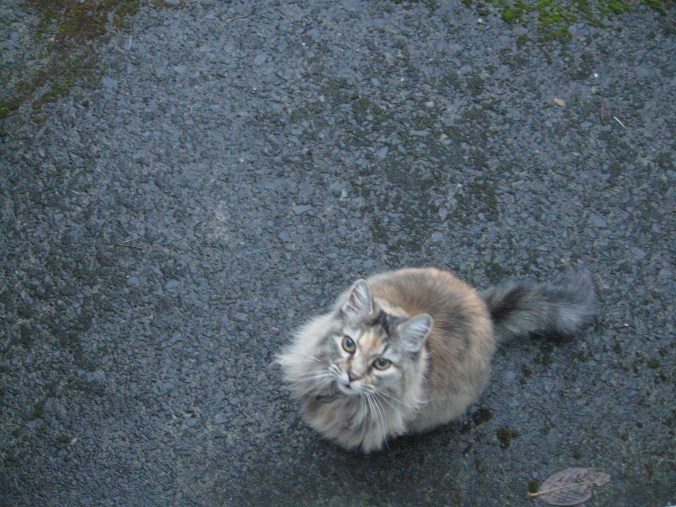
But still, we both miss the cat.

CRUEL & UNUSUAL

Love is love. [This was written but not posted many weeks ago.]

From The Hill, a primarily political newspaper in Washington DC. This is not how I want my home state to appear in the national news:

An Oregon school district reportedly forced an LGBTQ student to read passages from the Bible as a form of punishment

The World in Coos Bay, Ore., reports that the student’s allegations were detailed by the Oregon Department of Education (ODE) in a March 6 letter to North Bend School District Superintendent Bill Yester. 

The ODE is investigating claims that an LGBTQ high school student was forced by a school administrator to read the Bible while they were being “disciplined,” according to The World.

It reported that ODE officials are investigating whether the forced Bible reading violated the student’s First Amendment rights, including the Establishment Clause which recognizes the separation of church and state.

The district, about 200 miles south of Portland, initially denied the allegation, but the administrator ultimately admitted it in an interview with the ODE, The World reported.

On a separate occasion, a different teacher reportedly equated same-sex marriage to marrying a dog during a lesson.

Do I believe this happened? Of course I do.

A teacher at my high school once told me over the lunch table that she could se no difference between homosexuality and bestiality.

Was the person serious? Yes.

Did the person teach Health? Yes.

Did I respond? Yes, I did.

As if speaking to a child, I explained that bestiality was sex between species, which is not found among wild species. Homosexual behavior, by contrast is found in most species. It is perfectly natural.

WEAVING


IMG_2695

I won the July Make-It-Koigu! (Mine was the only entry.) Above are the skeins I laid out as I was figuring out the warp below. All but one handspun skein is Koigu.

IMG_2698

The final blanket was woven in four strips on two warps.

IMG_3075

NAKED

IMG_3557

I made salal muffins yesterday morning. The berries grow wild in our hedge and ripen over a period of weeks or months. The muffins were made with organic flour and eggs, butter and some maple syrup for sweetening. I had two with butter for my breakfast. That’s about 400 calories, which is allowed and also delicious.

A couple of months ago, I glanced at myself in the mirror. Then I looked at myself. Naked. I was taken aback. I see myself in the mirror every day, and I got over my cellulite decades ago. But I had intended, in February, to lose 11 pounds, and instead, I went the other way and gained 11 pounds. I had simply refused to see it.

My feet hurt and my lower back and many of my clothes no longer fit. It was one of those seeing-without-seeing periods. I would like to blame this inattention on someone else, but, you know, I just ate too much. Then I refused to see.

Last summer we went to the Oregon Country Fair for the first time. We went early on the first day, and much of what we saw was colorful and wonderful, but mostly we noticed it was hot, dusty, and insanely crowded. I caught only the end of the belly dance demo, which I would have wished to see. I found a doll-maker who turned out to be a good friend of one of our oldest friends. I bought two leather masks. An owl mark is probably destroyed by now by our grandson. I wore the plain red mask for several hours, forgetting completely that I even had it on. I just didn’t notice.

What Gary failed to notice was the nakedness at the Oregon Country Fair, which is well-known for people walking about with only body paint and glitter, at least on the upper half of their bodies and sometimes just the glitter and no clothing at all. It was warm enough. Gary insists he did not see any naked people because he was overwhelmed by the general chaos.

Life is naked chaos.

Since the first of June I have been paying attention to what I eat, and I have been drinking more water. We usually walk for over an hour each morning, and we emptied the attic and I have put a couple of gallons of paint on walls and ceilings. I have read 40 books so far this year, had 6 essays and a story accepted for publication, been rejected by 62 literary agents and a couple dozen literary magazines. I attended the memorial for Ursula K. Le Guin and in a couple of weeks we will have 13 people in our house for the annual summer reunion.

By the reunion I might be back where I started in February. I am nearly back to that weight. Not quite, but it’s been pretty painless. I can stand to look at myself naked again. My back still hurts, but now it’s because I am not sitting properly in my desk chair.

And I have begun rereading Rite of Passage by Alexei Panshin (1968), a book I have read ten times already. Panshin describes an insecure girl looking for a way forward and challenged by her study of ethics—and many more dramatic events I will not attempt to describe here. It is my favorite book, probably of all time. I enjoy each reading.

It seems I never quite let go of some goals and habits, like reading books, while others, like noting how many glasses of water I drink in a day, are acquired through time, and some, like looking in antique shops, fall away.

Just now I am close to done sorting spools of thread by color and fiber. The polyester thread will be given away. I have at least four shoeboxes filled with thread, sorted into war colors, cool, neutral, and black and white. Some are nearly empty, some full. Many are on wooden spools. It is notable that aside from half a dozen spools of hand quilting thread, I did not purchase any of this thread. My step-grandmother’s color pallet is clear as I stand over the boxes. I will probably find a way to keep the cotton and silk.

I have become less sentimental about most other accumulations. We gave away and sold the gatherings of generations. Our garage sale netted a few hundred dollars, mostly items sold for a quarter or a dollar. My one sale was two scraps of cloth for a dollar-fifty. In the next week, we will have a charity come and pick up the furniture and other reusable items. What has been moved out and now fills our atrium will not be welcome back into the house.

After purging my home of so much stuff, I am not eager to fill the vacancies. I like the slices of nakedness on my walls, the space between objects, gaps on bookcases, the way I can sweep all my clothing to one side of the closet, because there is somewhat less of it.

There are riches elsewhere.

Two little pound cakes came out of the oven. I made stock yesterday or the day before and made a lentil soup with coconut milk, vegetables, and spices. We had friends coming for dinner and a couple of nights. There is homemade ice cream in the freezer and local salad greens in the crisper. Gary vacuumed and mopped most of the floors downstairs.

There is space in our lives now that we are retired, and because both of us spent most of our adult lives working and caring for children and pets and indulging in hobbies and muddling along as best we could. There was hardly time to look around.

Home now feels a little like we just stepped out of the shower, all clean and new. Naked.


FLOOD WATERS

IMG_2658

We live right onshore, just a few bare feet above sea level. Every day we watch the Pacific Ocean wash in and out just beyond our front yard. Since 1979, the ocean has slid through the path in the hedge and onto the grass just twice. The Cascadia Fault is a concern, but like most coastal residents, we are in deep, deep denial. (Not that the rest of you are not.)

When it inevitably comes, the quake will be strong enough to knock me down, unless I am already lying or sitting. It will be vigorous enough and last long enough to topple trees and drop buildings. Some areas with sand instead of soil will liquify and what was supported a moment ago will sink—quicksand. Our garage and other doors will go out of plum and refuse to open ever again.

My running shoes are beside the fireplace, where there has been a masonry pile for over a hundred years. It is the only part of our house that has not moved, not even a millimeter. I put on my runners.

I will head out what we call the front door, assuming it opens. Or perhaps the other door just twenty feet further east. Either one takes me into the atrium, a long roofed area with fiberglass far overhead. Normally I would go out the garage door, but the electricity is out and the shaking has caused enough damage that I assume the garage door will not open manually. I pull Gary’s maul from the workbench, close my eyes against flying glass, and bash the sliding glass door. The gate on the side of the yard will be hard to open, but I will manage. The shortest route would be north and then south, but that would take me through fifty feet of dense underbrush and wetland. I will run two hundred feet south, turn left, and then head for the highway, north to St. Peter the Fisherman, and then straight east and up hill.

Somewhere along the way, and aftershock will strike.

CLASS WARRIOR

“When even the unpopular girls are rich, if not always pretty, how will they attempt rebellion and nonconformity?”

I haven’t read this new satirical novel about an elite private school in Australia. I probably never will. When I got to the line above in The New York Times review, I thought, “Why would I care?” and decided I should stop reading.

I know, I know, rich white kids have problems too. Their lives are not perfect just because their parents have money. Sure. Sure. I get that. I still don’t want to read about them struggling to find a way to rebel when . . . what? They aren’t overcoming racism, finding their next meal, moving every six months? So sad for them.

I say I don’t care, but the truth is I am merely annoyed.

“Ziggy makes friends with the social outcasts Lex, who was adopted from Bangladesh by aging white Australians, and Tessa, who lost an arm to cancer and wears a prosthetic.”

So I get it, her friends have a tidy assortment of struggles.

There was no getting around it, I had to read the entire review. Being a teenager is miserable for most. Even those who are popular often have something terrible going on behind the scenes. Not to mention the shallow work involved in maintaining their popularity. It doesn’t help that people are still lying to high school students about “the best years of your life.” Trust me, it gets better.

““Inappropriation” is certainly intelligent and has its finger on the zeitgeist of the Instagram and Tumblr generation, but it also paints the worst possible picture of teenagers trying to understand themselves. Who is the book’s intended audience, really? Those of us who understand our own complexities and nuances, and can laugh at the book’s exaggerations of them? Or those who think that all identity politics is nonsense? Surely both groups will enjoy it, but for very different, and in the latter case perhaps troubling, reasons. In satire as in life, there’s a difference between laughing with people and laughing at them.”

The teenagers I taught came from a wide variety of backgrounds. All of them had struggles. Even the most together, confident, and consistently cheerful person in the world genuinely suffers in his or her life. None of us get by in perfection, at least no one I ever taught. I never found their pain and confusion entertaining, much less funny. There have been any number of novels making best-seller lists while focusing on a narrow demographic. This seems to be another one.

I just finished reading the post-war utopian novel Walden Two by behavioral psychologist B.F. Skinner. Skinner honestly believed he was creating a (fictional) cultural paradise, a utopia where everyone could achieve a pleasant life regardless of gender or race. Big, big fail, not to mention many of the details about child rearing and eliminating envy, competition, and jealousy are naive at best, downright abusive at worst.

Childhood is tough. Shows like Jimmy Kimmel find entertainment in causing kids to cry. It’s okay, because it’s only a joke? Because the kids’ parents lied? Because no one should cry over candy? Why not tell them their dog died?

Kimmel is just crass exploitation. The novel review suggests Frieman’s novel has very little more to offer. Skinner’s novel is a trainreck in many ways, but at least he had an objective. If you believed you could make everybody happy (not cry), wouldn’t you try to do it?

I still don’t think I will read the book, but I am glad to have read the review.