CROWS STORY

IMG_3239

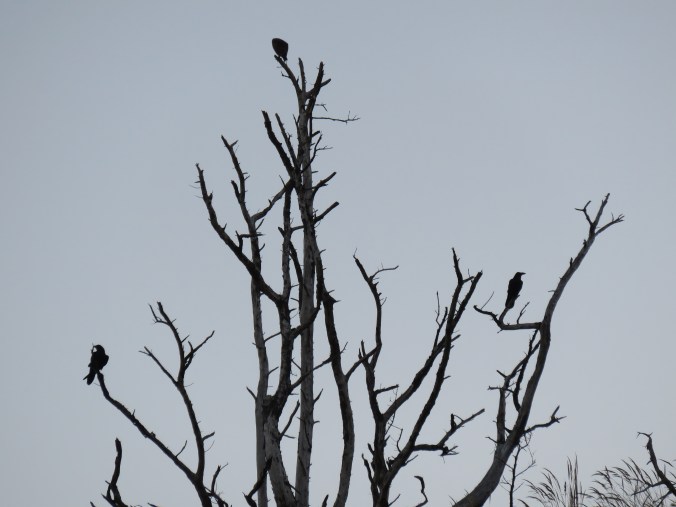
Two ravens and one of the local ospreys, top.

I have a brief creative nonfiction essay in issue 59 of Dinty Moore’s Brevity. All the work there is nonfiction and very short (under 750 words). My true story, “A Murder of Crows,” recounts an event from some years ago at a local summer camp.

This journal’s website has been a valuable resource for my college students over the past ten years. Students read essays and write précis on craft essays found at the same site. Then they go on to write their own creative nonfiction.

My work has been featured several (8? 9?) times on the Brevity blog.*

IMG_3243

The osprey from another angle. (I know this should be a photo of crows.)

  • I went to the Brevity blog and did a count. Thirteen times. Who knew?

HELP, I’VE FALLEN BUT I GOT BACK UP

IMG_3294

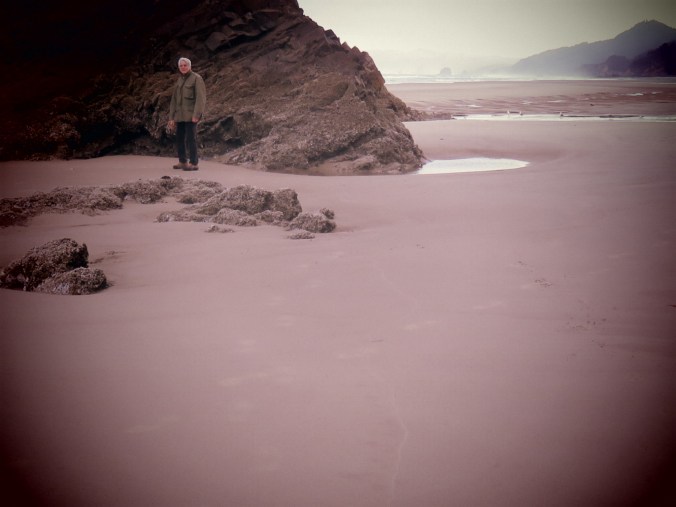
I fell hard yesterday. I was doing something stupid, trotting backwards as I tried to photograph my husband and a seastack and he kept walking right out of my frame. (If he knows he’s being photographed, he mugs or frowns. Photos of Gary smiling are pretty rare.)

So I was backing up to keep Gary in my photograph, and I tripped over a rock poking out of the sand that I had failed to notice and landed hard on my back. The smooth wet sand was hard as concrete. I did not land on the rock.

Still on the sand, I held still to discover how badly hurt I was. Would I be able to stand up? Had I broken my pelvis? I hurt. Gary had been watching me and wondered what I was doing. He says he thought, “Why is she trotting backwards? She’s going to hit that rock.” Then I did and he trotted over to me.

When he arrived, he said: “What are you you trying to do?” I snapped back at him, and he considered that a good sign. I hurt.

When I was pregnant with our first child I tripped and landed in a seated position. I damaged my tailbone. The doctor said it might have been cracked, but they couldn’t Xray because of the baby, and “there’s nothing we could do for you anyway.” Time would heal me, not any treatment they could offer beyond over-the-counter pain meds such as Tylenal. That was almost forty years ago, but I remembered that pain and considered that I might have cracked something in my pelvic area, but there wasn’t much to be done about it.

Aside from, maybe, my little toe and the little finger on my right hand, I have never actually broken a bone. Usually, I am a good faller. I could probably recall every time in my life I have ever fallen. Never from a tree, but once on my bike as a child. I jumped from a second story window, but that was a stupid choice, not a fall. I’ve been thrown from horses without a mark. One fall while pregnant, once I tripped over the oversize shoes my podiatrist insisted I wear, before I was used to them. About fifteen years ago, I fell while running hills when I missed my footing at the edge of pavement on the highway. I got right back up and kept running. This time was not like that.

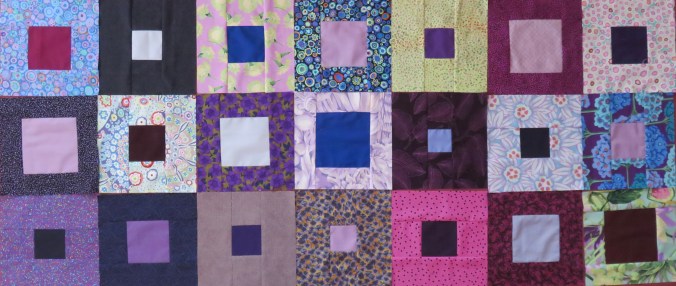
After a half minute assessing my condition, flat on the sand, I rolled carefully to the side and got up. Yes, hurt. Not broken, not flashing or searing pain, nothing stabbing or worse on standing. We continued our walk, stopped when we got to a stream we could not cross without getting wet, and turned for home. I took two aspirin, sat carefully, discovered what movement hurt more or less, and went back to work on a quilt. A few hours later I took another dose of aspirin, and that’s all I have done. A former student, now nearly a nurse, warned me not to use aspirin, so I stopped.

Gary told our older son on the phone about my fall, which I had not planned to reveal to anyone. Like their dad, sons worry.

When I got out of bed this morning, I felt odd in my head—not pain, but fluffy, disconnection. I lay back down for a time, considering the possibility of concussion. When I got up again, I felt the same wooly-headedness, and I was careful.

So maybe a cracked bone, certainly some bruising though nothing shows, and maybe a concussion—I hit the back of my head hard. I will take it easy for a few days. I will not think too hard since research suggests that an active mind after a concussion slows recovery. I think about my students who were in car crashes, suffered concussions and came back too soon. I think about the coach who put his own son back into a game after he suffered a concussion. I think about my age and that I am too old to risk the loss of brain function. I think worrying probably isn’t good for me.

My husband brings me coffee in bed each morning. My favorite grandparent, my step-grandfather Lavin Hansen, whom I called “Papa,” brought coffee to my grandmother in bed each morning.

The mind travels even when the body is in pain.

PURSUIT OF FLYING

IMG_3225

Linking to an article about “lawnmower parents” triggered an interesting discussion on my Facebook page. Some were defensive about “rescuing” or failing to “rescue” children. Others pointed out that some children genuinely need more guidance than others due to disabilities and disadvantages that may not even be visible.

As a private and public school teacher, I saw how it worked both ways. Most parents are doing the best they can, and doing fine, I think, but I saw this over-correction now and again all the years I was teaching. I saw it among privileged kids in the prep school where I first taught, and I saw it among local elite teaching in a public school, especially athletes, whose parents and school officials placed the ability to play above every other consideration. Perfectly capable students would not contact me, but sent their parents in to ask for favors. Parents would defend a students who had deliberately abused the system. Parents did their students’ work for them. Other students had no advocacy at all.

The article defends support for students with genuine needs, which may be entirely invisible. For example, friends thought it was ridiculous that a young woman was afraid to take the bus downtown alone. When I found out she’d been in the foster system all her life, it made sense to me. She may have aged out of the system, but she likely had little support at any point of her life. My brother-in-law is schizophrenic and could not complete his paperwork even though he was halfway through high school at the time. Such young people need guidance and support more than most, and often longer than might seem necessary to the casual observer.

On another note, one reader described arriving at college and finding herself incapable. “I did not have parents [who over-protected me] but I still had the reaction described after my first difficult college class at 18: ‘Begin planning for the inevitable destruction of their college career/future; Assume they failed because they’re stupid; Collapse in on themselves and give up completely and stop trying.’ ” She could not handle the experience and left college after her freshman year.

Many very bright and capable students arrive at college without the skills they need to thrive, and this may have little to do with parenting. My brother began college without the academic skills necessary to manage the major he was pursuing. As a teacher, he was determined to challenge his students in ways that allowed them to do well later on. My own experience was almost the reverse. I was extremely well prepared for my major and when I began teaching I was determined that my students would feel the same confidence I enjoyed in college. Resilience in both my brother’s and my own case was based less on our self-confidence than on genuine, earned capability.

I had the added disadvantage of being female. And women are given confusing signals about behavior. To be successful in any endeavor demands skill and a modicum of self-confidence. Some situations demand diplomacy and tact, while others demands assertiveness. Women receive a mash of conflicting messages pretty much from the moment they were born. No one ever lifted Sojourner Truth over any mud puddle, but she was expected to project the same retiring and gentle femininity as a white woman expected to spend all her days tatting lace without distressing the menfolk.

The recent flap over Serena Williams behavior during a tennis tournament and the response of a referee is a case in point. In the opinion of many observers, Williams was clearly being targeted, and the penalties were out of line compared to responses to male players exhibiting the same behavior.

Of course, what do I know?

I know that when we protect too much in the classroom, when our response to children facing difficult challenge is always to make the work “easier” we teach them that they are incapable. Telling a class day after day that work is easy (whether this is true or not) leads them to assume that the scarier reality of struggle means they are “stupid” instead of simply learning.

My goal in the classroom is to make difficult concepts as managable as possible. I do not pretnd that what I am asking from students in “easy.” It is not easy, it is very hard. My job is to make the work managable, to break it down, support growth, and promote self-confidence through acheivment of earned skill. Students must have the skills they need to be confident in school. They should be encouraged to do more than is entirely comfortable. They should be inspired to sustain their purpose and goals even in the face of fear. They need to be taught that they can overcome obstacles and that struggle is someone everyone deals with every day.

Many activities human beings actively pursue are very hard and very scary—many sports, bungee jumping, mountain climbing—yet somehow that high does not transfer well to education. There is a rush of adrenalin from pursuing a complex idea that we cannot quite wrap our mind around, just as there is when pursuing a sport. Maybe that mental rush is something we would all do well to pursue.

Do better because you can.

USE YOUR WORDS

Last year a student argued that black people were not being unfairly targeted by police because unarmed white people had been killed by police too. Entirely absent from the student’s research was some simple math which would have revealed, that yes, it’s true Whites as well as Blacks are killed, but black people are disproportionately likely to die, even while unarmed, at the hands of police. According to research by a Nebraska criminologist, in 2016, “police killed 38 unarmed blacks and 32 unarmed whites. Whites accounted for 49 percent of all 2015 fatal police shootings, while blacks constituted 26 percent.” According to the U.S. Census Bureau, 12.3% of the U.S. population is black, over 76% are white. Being Black in America is dangerous.

Black Lives Matter was formed to address this terrible reality.

I think most people know this, unless they just don’t want to know it.

Beyond that, I am a person committed to language, to the use of “every day” when I mean something that happens each day, and “everyday” when I mean it is ordinary.

How we use our words matters. I have thought a lot about the “All Lives Matter” slogan, which entirely misses the point, and other wording that is offensive. My husband has called a Portland television station when he heard the term “gypped” used. He explained patiently that it is a racist and bigoted term.

On the other hand, sometimes a little knowledge is a tricky thing. A video on Facebook declared “Gypsy” so offensive that it was written “G—y” and bleeped. Well, maybe, but some Romani people actually embrace that term, and the video utterly failed to address the many other self-proclaimed terms used by Romani around the world.

And then there is “white trash” which is definitely a bigoted slur against poor white people during a period when many Americans have been told that their poverty is their own fault. “White trash” is also something else, perhaps something worse than a slam against poor whites. Think about how it sounds when someone says it: “white trash.” The emphasis (the accent) is on “white” as if distinguishing between this poor “trashy” person from all other trashy people? from others who are not white? “Don’t be trashy like . . . ?” You might think I am being picky here, but I don’t think so. The use of the term and the way it is said implies a depth of insensitivity and racism that even the user might not recognize.

I know, I know, I am going to have to hear about “political correctness” which is itself a misunderstood and misused word. The left brought it to America as satire fifty years ago, adopting a communist term and using it ironically. It was a joke. Today, almost no one uses it except as a slam against people choosing language and ideas intended to be courteous. Notice, next time you hear it used. “You are being politically correct.” Hear that sneer? Someone is trying to shut up another person, most often a person who is merely attempting to be polite.

Language matters. We misspeak, we are rude out of ignorance . . . and we apologize. We try to avoid offense because it matters that we not hurt others’ feeling. That is at the basis of a civil society.

It is an everyday struggle. If you are at all astute about political realities, you do not say what Ron DeSantis said the other day. An ordinary person in some all-white rural backwater might hear such a thing without immediately recognizing the loaded language DeSantis used. It is impossible to believe a smart politician was unaware.

“At a dinner with Mattis and Gen. Joseph F. Dunford Jr., the chairman of the Joint Chiefs of Staff, among others, Trump lashed out at a vocal critic, Sen. John McCain (R-Ariz.). He painted the former Navy pilot as cowardly, falsely suggesting he took an early release from a prisoner-of-war camp in Vietnam because of his father’s military rank and left others behind.

“Mattis swiftly corrected his boss: ‘No, Mr. President, I think you’ve got it reversed.’ The defense secretary explained that McCain, who died Aug. 25, had in fact turned down early release and was brutally tortured during his five years at the ‘Hanoi Hilton.’ ”

For an ordinary person to have gotten this story wrong is one thing, for the leader of our country, it is pathetic. The rest of the world is paying attention.

That is, ordinary people in their own homes are allowed to misspeak—we all make mistakes and inevitably will. Our leaders are supposed to be better than this. Public speakers are supposed to think first. Every day.

AUGUST

IMG_3206

It is the last of August, and this ending could not come too soon. It’s been a memorable month.

There are great things about August: my wedding anniversary, the birthday of my older son, and surely something else.

In the old days, August is the month I began playing solitaire compulsively—with cards, not on the computers. Wikipedia suggests that about 79% of games are winnable, but I am fortunate to win a tiny fraction of that number. I have no idea what I am doing wrong. I can play a dozen hands of the game without winning.

That’s how August feels to me.

And too many tourists, preparing for company, cleaning up after company, completed projects.

The real reason August is a depressing month is that I am eager to start my teaching year. Until I retired, August simply stood between me and a new school year. Now I only teach one class each in Winter and Spring terms. The end of August means I still have 12 weeks to go.

I need a project.

When I finally checked my class list, I discovered 36 students listed in my Writing 121 class. No college or university I know would inflict that many students on a writing instructor. It is likely a few will drop, but I am thinking about how to fit that many into a classroom. I am mentally adding hours each week to my grading time. They have moved my students into two different rooms, new to me since last year and the year before, and years before that. No one contacted me about any of this, I was unable to schedule a meeting with my department, I did not receive the schedule letter from the school, and the principal was briskly friendly when I stopped by earlier this week. This is merely to say that my high school, like all public schools, is struggling.

I just read a pair of articles about pay at public school districts, one about the highest starting pay, and the other about pay scales that dip into six figures. One reality of teaching is that schools generally hire as cheaply as possible. You might observe that this is true for any business, but you might be missing a key difference about hiring teachers. A public school seeking a new principal (or a law firm seeking a contract lawyer) can find the candidate they want to hire and then negotiate a salary commensurate with desired skills and experience. That is, they know what they want and hire the best person for that job.

Public education doesn’t work that way. The districts with the highest starting pay, offer more money to beginning teachers for two reasons: they are building a stellar school system or no one wants to move to Wyoming. School districts with exceptionally high pay can do that because their tax base is exceptionally high, cost of living is high, and because they are building exceptional schools. They are throwing their money down to hire the best teachers. If you are tempted at this moment to repeat that old saw, “You can’t solve a problem by throwing money at it,” you are both right and wrong. Throwing money around is pretty pointless. But having money to spend can allow a school to hire the best and brightest teachers.

Almost no district can afford the best and brightest teachers. They have limited funds and overfilled classrooms. They hire the best teacher that they judge they can afford. Whether 80 or only 12 apply for the job, districts hire first-year teachers because they are cheaper. They might hire a teacher with 3-5 years of experience, but they can’t afford more years, or anyway, they do not afford more years of  experience. Each year of experience means additional pay, and they do not budget for that extra pay.

Districts offering the highest starting pay assume that this is one way to find and keep teachers. If they can keep them for a few years, those straight-out-of-college teachers who chose to go somewhere for the high starting pay will find they are not desirable candidates anywhere else. The longer a teacher stays in a position, the less likely another district will spend the money to hire them away.

Compare that to most other industries where experience not only costs employers more, but is actually valued more. In schools, this only seems to work for administrators.

And yet. And yet, I am eager to begin. I will visit classrooms and volunteer my time in the school library on Wednesdays, and I am eager to begin teaching. In the mean time, I am piecing a quilt and playing solitaire.

“There are four types of hands [playing American Solitaire, or Klondike]: winnable games, theoretically winnable lost games (the player made a selection that resulted in a lost game, but could not know what the correct selection was because the relevant cards were hidden), unwinnable games (there is no selection that leads to a winning result), and unplayable games.”—Wikipedia

I am playing blind.

FOUNTAIN PEN

IMG_3205

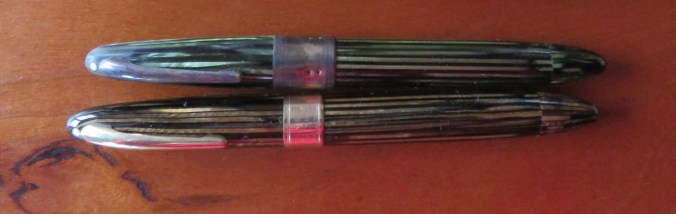
top: My dad’s fountain pen, probably from the 40s, maybe older or younger. The lower one was a surprise. I have no memory of seeing it before a couple of days ago. I have searched for exactly such a pen on Ebay.

I began using fancy pens when I was in college as an Art major. Mostly I wrote with a 0000 stylus fountain pen—a Kon-i-noor Rapidograph. The tip of such pens is a tiny tube, thinner than a crow quill, and notorious for clogging. The 4×0 tip makes a line 0.18mm wide. I used a 3×0 later, but eventually, the pens would always clog, freeze, and I would need a new one every 2-3 years. I learned to write carefully because the pen must be pretty much perpendicular to the paper to flow at all. While I have never been successful at calligraphy, my handwriting, which had been even worse than my typing is now, improved. I worked at it.

I also illustrated catalogues and magazines, designed logos and other advertising, and drew portraits of famous dogs. A German kennel came across an illustration of mine and was using it for his logo. By the time I found the image on his website, I was no longer making a living as a designer. He offered to pay me, but I told him he was welcome to it.

0105214-1.jpg

Eventually, I shifted over to Rotring Rapidographs, which were easier to find and cheaper. Around the time my children began walking, I gave up on Rapidographs entirely.

In the ’90s, my husband gave me an expensive fountain pen, a Pelikan 600, with green striations, and I have been using it daily every since. My dad’s fountain pen, the green striated one above at top is from another maker and was always loaded with blue-black ink. My pen generally has green or purple ink. Just now it is loaded with a Japanese green ink that is not quite olive enough. I am tempted to fool with the color by adding some orange to the bottle. I’ve mixed ink colors before.

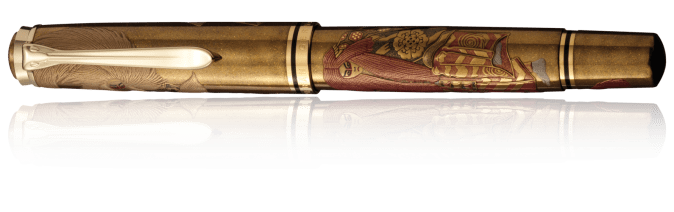
My Pelikan fountain pen has served me well for over 20 years, During that time an occasional student was inspired to try a fountain pen after admiring mine. They wanted to try it, but my dad always insisted that no one should ever, ever use an other person’s fountain pen. I have tried the Pilot Metropolitan, which is a very cheap pen (about $20) and allowed me not to cry when it was ruined at school. My Pelikan remains the one I carry everywhere. If I ever win the lottery, I would be tempted to buy one of the crazy-expensive Maki-e or Souveraen pens from Pelikan. They don’t even list prices online. So, yes, the lottery. 

maki-e-renjishi-large.png

souveraen-m800-raden-royal-gold-large.png

This is just to say that I love fountain pens both as artful in themselves and in use whether to make art or a shopping list. 

When they have been used, as my dad’s pen was used, they become almost like family.

In unpacking my grandmother’s desk, I found a stash of fountain pens in a drawer. Two tiny ones with ink reservoirs held in place by the nib, two Esterbrooks (black and gray marble from the 40s or 50s), and two Shaeffer’s pens. I put most of them in that desk drawer myself perhaps 30 years ago before my dad died. Since it came to me, my dad’s Shaeffer’s pen has floated about the house, in places where I could pick it up and hold it. The original owners of the other pens include a fancy gold-bound one with the initials of my grandmother’s second husband’s brother, and small serviceable pen my step-grandmother Genevieve used as a nurse. There is no certainty about the others. I have been able to clean two Esterbrook pens, and I am using the marbled one with purple ink.

The mechanical pencils in that drawer? . . . well, that’s for another day. I use a Y&C Grip500 0.5mm mechanical pencil. After losing several, I found they were discontinued. I bought a box of six old stock 10-15 years ago, and I have managed to hold on to four of them. (Whoops! found another one, which means only one has been lost.)

Tools are precious things.

The two pens in the photo up top are going to a repair person in Arizona tomorrow. I am not optimistic about what he can do for my dad’s pen. My dad used his pen for nearly 50 years. It took him all through the war to France and Germany, and the nib is quite bent to suit him. Late in life Daddy “customized” the pressure closure because it was no longer holding, and I doubt that can be corrected. But there is a chance both pens will return to me in a few weeks, and at least one will be serviceable.

I have felt loyalty to my Pelikan for over 20 years, but I respect the two small Esterbrooks for still working, after a lot of flushing, despite benign neglect for decades. The gray marble one has seen hard use. Both its “jewels”, the black plastic button on each end, are damaged, but the gold nib still flows nicely. I might load vermillion ink in the black one.

Perhaps, if I am particularly brave, I will try cleaning my old stylus pens. It would be good to use one again. Doing that would also convey an obligation in my mind to return to drawing. I have the idea of illustrating the owl story.

I do not know what happened to the original illustration. Here is the fuzzy version I found on a German website. Ch. Mecca’s Falstaff and Wita Rosie van de Oranje Manege


DÖSTÄDNING

IMG_3203

I found the escutcheon plate missing from the top drawer. They key is in another lock.

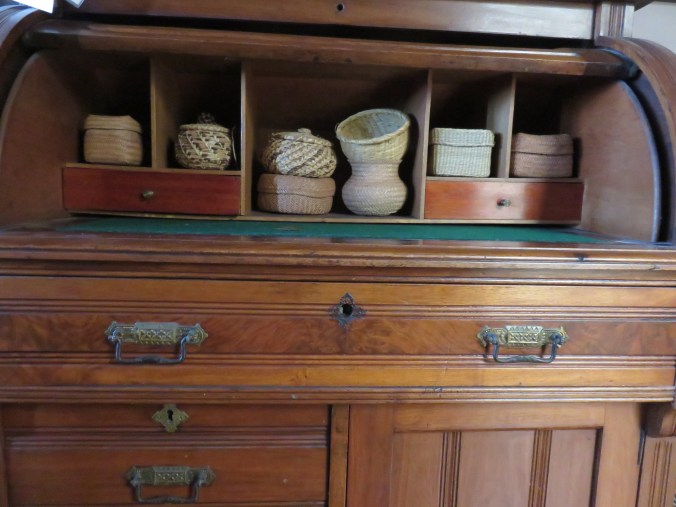
My step-grandmother’s secretary desk has pride of place in our home opposite the front door. Yesterday, I began emptying this beautiful secretary, purchased in 1962 for $125. Baubles, birthday cards, baskets, and relics of childhood. Things my mother and grandmother kept, programs from Ian’s early performances, and things I had forgotten completely even existed. A pair of ancient fountain pens I will try to get working again.

IMG_3202

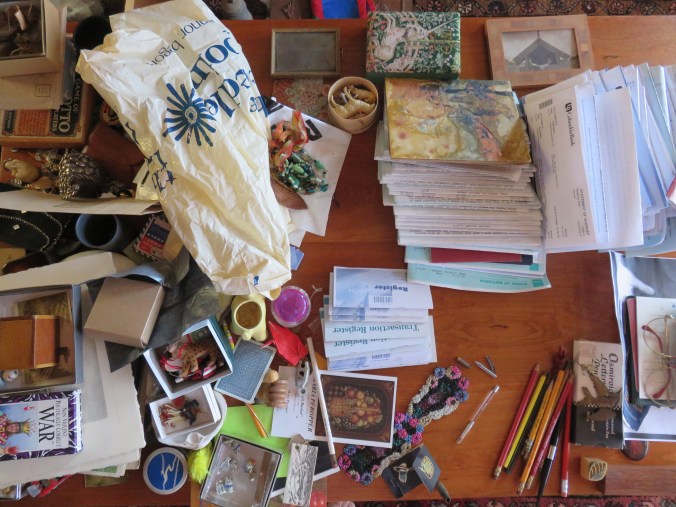
What came out of the working part of the desk. Three drawers and a cubby are empty.

I keep finding baskets and little boxes with buttons, necklaces, earrings I will never wear, campaign buttons and tiny objects without any use whatsoever. The music box will return to the desk, my grandmother’s slim leather briefcase with her maiden initials. The rest is going out the door to find a new home, leaving without regret.

Gary points out we are merely getting rid of things we do not both love and need. The “love and need” items still constitute quite a stash. It is only our half-joking effort at Swedish death cleansing, döstädning. A garage sale, giving things away, donations, etc. are an effort to make a little space in our home and in our lives.

The idea is to lighten our load, which has been burdened by being the last Priddy in my dad’s family, as well as the last in my mother’s family. Gary, with five siblings, brings less to this accumulation of stuff.

A few years ago a family member yelled at us for “not sharing” the family’s collectables. Truly, we would have been very grateful had this person taken more since they had first access to my mother’s house when it was emptied.

The family items I treasure were given to me long ago, a tiny pin, my great grandmother’s engagement gift, two lengths of wool jersey fabric that I have no more been able to cut and sew into a garment than my grandmother was. I am keeping it even so.

IMG_3204

Maybe I will tackle the upper display in the secretary . . . later.

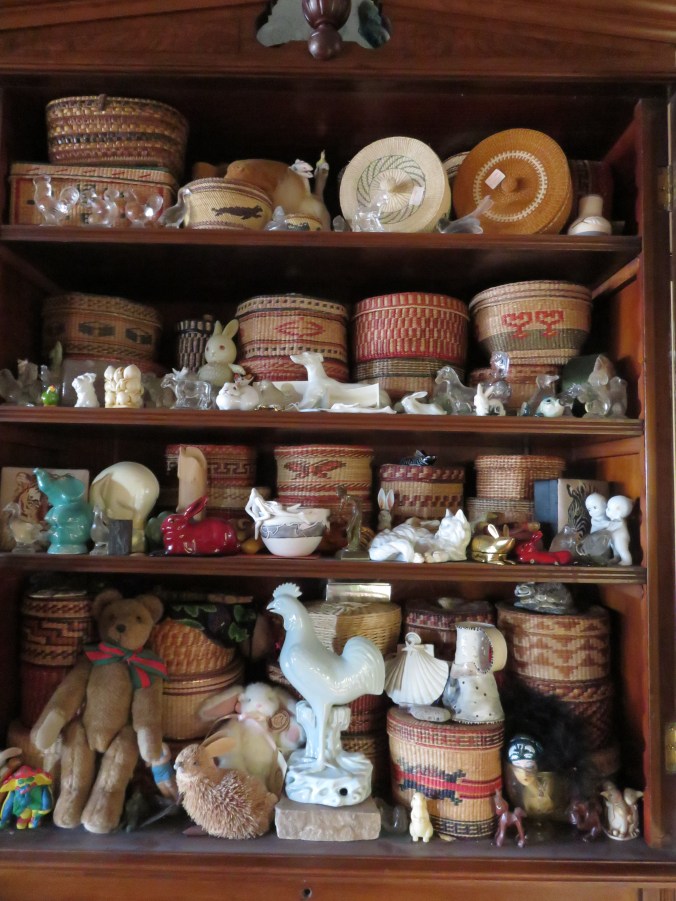
And there are the objects on display in the upper glassed section of the secretary. Most of these are not “family” but objects I made or collected.

The green elephant on the second shelf came from my grandmother’s kitchen window. She would remove her wedding rings and place them on the trunk when she did the dishes. There is a little white Persian cat on the same shelf that Mom found in an antique show held at Northgate. I was with her when she first saw the kitty, but it was only later in the day she went back to buy it. She gave it to me before she died in 2007. There is a Kay Finch ceramic goldfish and a porcelain greyhound. The celadon rooster is meant to decorate the table at holidays. Aside from small ornaments, all the little woven grass baskets I bought while I was in college and working at the University Book Store are waiting for review. Also the NW basket made and given to Gary in thanks for his work at Tulalip. We will keep all the baskets, but I am afraid many of them have things inside.

To be clear, we are not preparing for death anytime soon. We are accepting of our mortality, but having cleared the homes of too many relatives ourselves, we do not want to leave an unnecessarily burdensome task for our family.

44th ANNIVERSARY

IMG_3726
Gary feeding me the wedding cake at our wedding.

We were very young when we met and still young when we married. Lucky in that joining, as in so many things. Lucky my step-grandmother was a weaver. Lucky her second husband loved Gary. Lucky to walk off the street in Cannon Beach and get a job in a bakery. Lucky our sons were born early but healthy. Lucky to be together 49 years after our first “date.” Lucky to be alive. Lucky to live here with a man I love.

16105837_10154388706543667_103270127776112116_n

We’re lucky to agree on politics, on religion and ethics and human decency. We listen to different music and read different books but we like the same Irish and Australian television murder mysteries.

We are both losing weight these days and committed to cleaning out the house and our daily walks on the beach to pick up trash. He prefers rough agates and I prefer flat sand-smoothed stones. We both get excited about a nice piece of green sea glass. We both hope for blue.

The second photo above is from last year, the pussy-hat march in Astoria. If I take one today, I will put it at the bottom, because Gary’s hair looks better and he might smile for the camera if I tease him.

It is our anniversary, but there is nothing playing at the local theater we want to see and “so much food in the house” Gary doesn’t see the point of going out to eat. I agree. I have ice cream in the works, and luscious salmon in the fridge and two large ripe avocados. We can stuff ourselves if we want on favorite foods.

When we were still young, and only together for a few years, people asked me all the time how we’d managed to stay together. There is a line from Rilke about that, which I cannot quote accurately, but I find togetherness is a continual process of moving toward one another, of acceptance of imperfection—perfection is an inhumane notion if ever there was one—and a certain trust and determination, a willingness to give more than 50% in faith that so will my partner when I need him. He always has.

Yesterday we sorted through and cleaned closets and cabinets and today we will likely find something else to do. Being useful, doing productive things, makes us happy.

We’ve been happy together for a long time. That is love too.

BECOMING

IMG_3182

Our tenant, Greg, brings his cactus outdoors when it blooms, a rare semi-yearly event.

One day my favorite design teacher, Hazel Koenig, saw me walking to a metals class in the Art Building. She stopped me to ask if I would be willing to help out at a state art education conference. That would have been about 1974. Later, she got me my first teaching job. I thought of myself as an artist, and I still do. My work space where I write and make things is not a “craft area” as someone recently called it. It is studio space, work space. Calling myself a writer was harder somehow that calling myself an artist. I was exhibiting while I was still in high school. It took years to become a published writer of fiction. I had many articles published in dog magazines, I didn’t count them.

Calling myself a teacher also took time. I came to teaching relatively late in my arts education. I had avoided thinking too much about how I would make my living. I was in a five-year BFA program, most of the way through a BFA in Ceramic Art, when I “moved up the hill” from the Fire Arts building to the great facility in the Metal Arts wing of the Art Building on the Quad at the University of Washington.

From 1970 to 1976, I was a student at the UW. By 1974 or 1975, I was thinking about my future in a more realistic way. I toyed with transferring to a Botany major. I considered the law. I had wanted to be a an architect since I was no more than 11, but somehow failed to pursue it, though I took the non-major architecture history series from Gustav Pundt and then finagled my way into the majors-only series. Later I would make a decent supplementary income drawing plans for clients and for an architect.

Anyway, somewhere along the way, I realized that I was always teaching. Maybe I liked telling people what to do. Maybe I was good at explaining things. Maybe teaching was the creative and professional outlet that I needed. Maybe I was still under that favorite delusion that I would have “three months off every summer” and time to do my own art. That last one for sure, and even working half time as an art teacher, I never got “my own work done.” Teaching is more than full time work.

Even as a student, I knew classroom management would be my greatest challenge. Part of my educational preparation was brief field assignments in classrooms from Kindergarten through high school. When it was time to begin a longer term field placement, I asked for middle school. It was the hardest assignment and the right choice. I earned a k-12 certificate and later taught Art at a girls’ prep school for three years.

Then I moved back to Oregon and my husband and we began our family. For a few years I drew plans for clients and Jay Raskin. When I looked at teaching opportunities on the Oregon coast, I chose Social Studies as a second subject endorsement. I learned to write essays in my SS classes, how to reason and think. I began coursework, but then took an NTE exam and was awarded Social Studies certification.

I subbed for teachers all over the school district, our children were born and graduated and went off to make their lives. After substitute teaching for 11 years, I taught English for 25 years, earned an MFA in writing, and now I teach only two college classes, Writing 121 and Writing 122. I have my 10 weeks of summer and then another 12 weeks in the fall without teaching. In November, I write a novel. I am not inclined to do nothing. I will be busy Winter and Spring with my two college classes.

All this summer, Gary and I have been sorting possessions. We are each of us the end of the line. I have personally cleared the possessions to my parents, aunt, step-grandmother, and even my step-grandmother’s second husband’s brother. People gather unto themselves. Going through tiny professional pins with my son, Ian, I found I had no explanation for the pin from the carpet business in Portland, the mysterious Mason’s pendant from a hundred years ago. I know how they came to me, but there is no one to ask why they exist or what they mean.

Today, we went through the “treasure chest” and the linen closet together, and eliminated a great deal of “stuff” we didn’t need. Blankets and sheets and linens, bits of wrapping paper and ribbons from past holidays. The habit of my mother and her mother before her: keep what might be useful in the future. But I do not think I will ever want that rest of the red eyelash yarn I used to wrap packages a dozen years ago. There is also the joy of finding things I’d forgotten I possessed, the occasional gift I do not remember ever having.

Then I sorted my jewelry. The small jewelry box is completely empty, while the other is neatly sorted. The ladies in my family are going to do well this Christmas.

A necklace I used to wear every time I flew needs to be restrung. I have been putting that off. It is a luck piece, plain elephant ivory beads. I like to think the ivory did not come from a slaughtered elephant, but that is not a story I possess. I only know the beads are nearly 200 years old and when I was in a plane, I folded my hands over their smoothness and stroked them for comfort.

I finished the last of the blackberry crisp this afternoon. I sipped a half glass of wine as a reward for my industry. I feel enlightened.

When I go looking for something, I will know where it is, but I also know the greater value I possess. I know myself to be teacher, writer, artist.

SO ‘VERY DARK’

The burn ban. The pain did not begin with the cake or fire or police, but it ended with the pain in my feet. I do not believe this was all my fault, but I will worry that it was.
IMG_3197

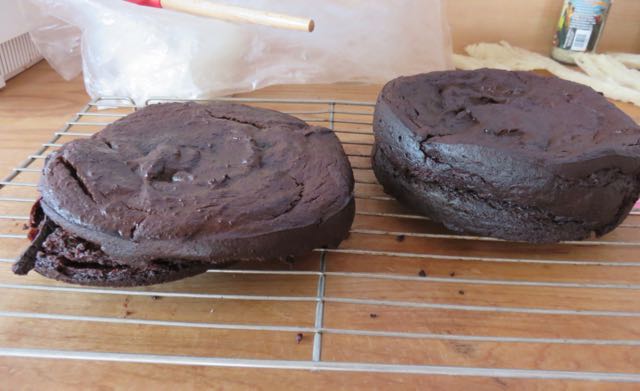
Maybe the bad day began with the cake. I did everything right. With multiple dietary issues in my family, I was determined to create a chocolate cake that everyone could eat. That meant: no gluten, no dairy, no nuts, no refined sugar. Organic and luscious. Pretty. I found a recipe that was close and made my own modifications to eliminate sugar. I test-drove the recipe and it was perfect that first time! So, the day before my son’s birthday, I baked two layers.

Epic fail.

My Facebook friends suggested trifle, jam, licquer, whipped cream. I contacted family who okayed dairy, but trifle is new to me. Easy, but new.

So I chilled the cake to tackle tomorrow morning.

Before that, I’d woken in the night coughing. Our father’s both smoked. Camels. And they both died of lung cancer, so we are both susceptible to colds and flu. I more than Gary have bronchitis and pneumonia if I am not careful.

I woke in the night coughing from smoke drifting from illegal beach fires. This is not surprising since air quality is poor in many places, much worse elsewhere than here. The West is burning. Friends in Spokane and Seattle and Portland and all across California have posted photographs on Facebook of the terrible smokey air that makes ordinary activity outdoors unwise. Oregon firefighters are overworked fighting regional fires.

We had to close all our windows to keep smoke out of the house. On our walk this morning Roxxy’s mother pulled apart an illegal beach fire that had burned all night, carried sea water up from shore to put out the four smoldering logs. We have had to do that many times. Sandy told me the mayor of Portland had a beach fire which he promptly extinguished when alerted to the ban. There are signs at public access to the beach warning of the burn ban. Locals are supposed to know.

After our walk I baked and my chocolate cakes did not turn out, but I wrapped and chilled them. Tomorrow I will make chocolate frosting or open a jar of homemade jam and do my best to make a pretty cake for my son’s birthday.

The renters next door went out to build a fire on the beach.

Gary walked out to talk to them. He did not want me upset about their fire. He explained about the burn ban, and they said they would check and not burn if there was a ban. It was a polite conversation with Gary. They went ahead and lit their fire. I went out and talked to them and they did not believe me either. I was less polite. They claimed they talked to Cannon Beach police (which Cannon Beach Police deny) and they said they went online and found no burn ban, but people believe what they want to believe, and not what would otherwise be reasonable.

It is inconvenient. Inconvenient laws often require a lot of convincing.

I did not have the email address of my neighbor who owns the property because I have updated my computer and lost my address book. It did not occur to me to phone since my landline does not work long distance, and so I wrote a note on the home owners’ property Facebook page. Then I began calling around, trying to find someone to explain to the tourists that there is, in fact, a burn ban. There has been a burn ban for weeks.

When the tourists added more logs to their fire, I finally got through to the State Police and talked to someone who said they would send someone out.

There is a burn ban. Local police will not respond. County police will not respond. Parks and so forth will not respond. The State Police will. They sent an officer.

So, the coughing, the cakes, the fire in the wind, and finally an officer calls me and wants to know where is the fire? I tell him but he explains that it is “very dark” here and he could not leave his vehicle in the road where someone might not see it and thus cause an accident. I tried to explain, but he complained that our connection was poor. Then he complains that I am being very rude. “I don’t know what I have said to make you treat me so rudely.” I stopped talking. Women offering information are inevitably “rude.” Unless we are apologetic and soft-spoken, we are yelling. We are yelling and disrespectful and rude. I took a breath and waited.

So I listened until I was told I could speak. I had already offered to come out and show him the path to the beach. I waited until he asked if I was still willing to do that. I said I was. I was careful only to say “Yes. It will take me 5 minutes to get there.” I pulled on socks and my shoes and ran south, then east, then north, all the blocks to the officer’s car, lit up and blinking in the dark. I saw a flashlight and turned toward the ocean down Markham Lane. I called out to the officer and he identified himself and I went to him and walked ahead of him in the dark to the shore.

He had been concerned about trespassing on private property, and it was so “very dark.” I explained “I am a 65 year old grandmother and have lived here most of my life.” I asked if he would please tell the people there was a burn ban and he said he would. “They don’t believe me,” I said. And then I turned and walked home alone in the dark in my nightgown and socks and shoes.

And then the owner of the rental property called. By then it was past 10pm and well past our normal bedtime. He let me know how “disappointed” he was because he “didn’t think we had that kind of relationship.” I should have called him. I should not have called anyone else. I thought I was only reporting someone breaking the law. But I should not have done that. I am the villain of this story.

I should have called him at home, he said. It was my personal responsibility to inform him of how to properly manage his income property. How was he to know about the burn ban?

I can see his point. He says his phone number is listed on the Facebook page. Only I do not have long distance on my land line. I suppose after posting my concerns on his Facebook page and talking twice to his tenants, I am to blame for the embarrassment of police coming. I did call the police, after all.

So I do see his point of view, that out-of-state property owner. I feel like a jerk and I am pretty certain that I will feel bad about this long after he has forgotten the events of this night completely. I also know that it is my home that would have gone up in flames had that fire sent out sparks (which it did—I watched the sparks) and the wind had carried fire to my house.

So the coughing, the cake, the sparks from the fire, not being believed, being acused of being unreasonable, and my feet now hurt like needles stabbing them because I am not supposed to run. I really am not supposed to be running in the dark. It was so very dark.