LIKE A RUNNER

IMG_1206.jpg

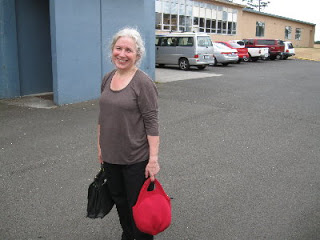
After my 15-16 miles—happy, but hurt.

In August 2011, I ran from my house to school.

It would be the last good run of my life. And it was not good.

I had been training all summer for my second official half marathon that October. I ran long one day a week, working up to 12.5 miles, and 3-6 miles other days, including hills. I was conditioned, but I underestimated the distance to school. I believed I was running about 13.5 miles that day and figured I could take my time and manage that stretch. I’d covered that distance before. The run turned out to be more than 2 miles further than I’d expected. Even so, I might have been okay except that my new runners were sitting in a box at home—saved for the Portland Half Marathon, still six weeks away. I ran the first 5 miles on sand but as soon as I turned off the beach, I realized my shoes were dead flat. By mile eleven on pavement, I was hurting. By mile fourteen I was struggling.

LESSON ONE: Know what you are doing.

I began running after my eldest son ran with the cross country team because the boys and girls teams were so cheerful and supportive of one another. I’ve read plenty of books about running, written by runners, and I was a runner for nearly twenty years, covering a modest 3-6 miles at least every other day.

At the age of 41 in 1994, I began training over a distance less than a third of a mile. I started April 1st. It was a joke on myself that accepted the likelihood I would not be running for long. My plan was never to hurt myself. I am not a believer in no-pain/no-gain. That’s a crock. Pain is an indication of damage. I didn’t want to hurt myself. I wanted to get in shape. I ran every other day and added a couple of hundred feet each day. This schedule of running every other day allowed my muscles time to heal. By August I was able to run strong for six miles. When the cross country team began practicing, I ran with them and could keep up with all but a handful Varsity boys. I was not fast, but steady and capable of distance.

When I set goals for myself, I intend to promise only what I am certain I can complete. When I make a list of task, I pace myself, allowing for flexibility but also for serious deadlines.

LESSON TWO: Make reasonable, doable, consistent plans.

Despite my good planning, I made other mistakes at the beginning. I did not buy any sort of running gear for myself and chaffed my legs between my thighs on cuffed shorts. I didn’t have a running bra. My running shoes were hand-me-down sport shoes that were a full size too small. No muscle pains from my early training, but blisters and sore feet.

LESSON THREE: Buy or borrow the right equipment. 

Once I began working with the cross country team, I picked up race strategies. When I was covering distance, I maintained a steady pace. There was a sweet spot between one and four miles where running felt almost effortless.  Right at the beginning and after the first four or five miles, my effort increased. Another had to do with “running strong” right through the finish line. In other words, resist the temptation to slow when approaching the end, even if I am doing well enough that I believe I could.

When I near the end of a process—the end of the school year, for example—I push myself to sustain my pace. In other work, this is one of my greatest challenges. Sustain attention, quality, and detail right through the end.

LESSON FOUR: Run through the finish line. 

I was not yet 59 years old when I had my last “good” run. I’d become fond of a vision of myself hobbling along at age 72. I gave myself time, went back to running slowly and over short distances. I was careful, but my feet were ruined. I got orthotics and wore larger shoes all day until I could walk without pain. By 2013, at age 61, I accepted that I would not be running again. It about broke my heart.

I considered biking and swimming, belly dance and yoga and gave up. Walking stuck.

There is a memoir about running by the novelist Haruki Murakami, where he describes trying to run at a pace in his middle years that he never trained for in his youth. The entire time I read that section I shook my head. As we age, some goals become unrealistic. I’m not happy about it, no one is. I have a neighbor who is in his mid-70s and still runs the beach. It’s true I can walk faster than he can run, but I admire his spirit and his willingness to continue doing what he loves, even if he has to slow down.

Most of the activities I have enjoyed in my life are still fully available to me. I quilt and weave and go to films. On my morning walk I can see to beachcomb. I read a book every few days, though I need better light to see the page. I lost the habit of 8 hours of sleep at night when I was an overworked high school English teacher. I nap instead. I am careful about what shoes I wear and how hard I pinch because my hands and feet are inclined to ache. I no longer run.

Could I do more? Hubris needles me to answer yes, but common sense wins. I will do what does not hurt me, and that is more than I would have expected for a woman my age.

LESSON FIVE: Accept your limitations.
SaveSave

WHAT’S IN A NAME?

IMG_2963

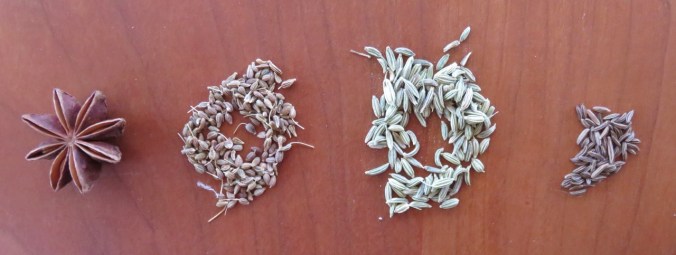
STAR ANISE     ANISE     FENNEL     CARROWAY   

So. If apples are a fruit, and pineapples are also a fruit, then pineapples are a kind of apple. And pineapples are surely similar to pinecones? Then pinecones must also be apples!

Don’t worry, it’s not logical. It’s just the way my day has gone.

I had a peculiar experience today while searching in Whole Foods for aniseed (anise) to bake a seed cake for my students. I reviewed all of what they had. No anise. I found a hapless produce worker and, after apologizing for talking to him when I knew it was not his area, complained that “I can’t find what I want.”

Another employee appeared at my shoulder. “What are you looking for?” He sounded more annoyed than concerned.

“Aniseed.”

“Anise? You want anise? That’s the same as fennel.”

“Is it?”

He pointed to packets of star anise and other packets of fennel. I thanked him, though he still seemed somewhat cross. I got all the way to check-out with fennel seed before I remembered I’d made this mistake before. It’s easy to assume that they are related, but fennel seed and anise, not to mention star anise are not the same spice. Not quite.

Star anise (Illicit serum), found inside a fruit, originally grew on small evergreen trees in China. I have eaten it in tea, but never baked with it. According to Wikipedia it is “a highly fragrant oil used in cooking, perfumery, soaps, toothpastes, mouthwashes, and skin creams. About 90% of the world’s star anise crop is used for extraction of shikimic acid, a chemical intermediate used in the synthesis of oseltamivir (Tamil).” It is sometimes used in the west as a cheap substitute for aniseed.

Aniseed (Pimpinella animus) is from a flowering annual plant native to the Eastern Mediterranean and SE Asia. Wikipedia says it “is widely cultivated and used to flavor food and alcoholic drinks, especially around the Mediterranean. It served as a carminative in herbal medicine.” I love it in pastry. 

Fennel seed (Foeniculum vulgar) comes from a member of the carrot and parsley family found originally in the Mediterranean. The bulb at the bottom is a delicious vegetable I frequently add to dishes. But no, fennel is not the same as anise. They are not even in the same genus, though Wikipedia points out: “In North American supermarkets, it is often mislabeled as ‘anise’.” (I swear I did not post that.) See above. Do they look the same to you? Trust me, they do not smell alike. 

Caraway seed (Carum carve) from another member of the carrot family native to western Asia, Europe, and North Africa. I’ve used this in seed cake, it taste nothing like the others, and is most often found stuck between my teeth after eating caraway rye bread. I put it here because, up close, the shape of the seeds resembles fennel more than aniseed does and because seed cakes are more often made with caraway. The plants of caraway, anise, and fennel all look similar when in flower, to be entirely honest. But they are not the same.

Wikipedia and my nose tell me that fennel, both seed and vegetable, anise, and even star anise all smell somewhat like licorice. (Caraway does not.) While both fennel seed and star anise are sometimes substituted for anise, the scent and flavor are distinctive in each. They are not identical, and none of them are true licorice, which comes from the root of an entirely unrelated perennial legume plant found in southern Europe and some parts of Asia (Glycyrrhiza glare). 

Who knew?

Tomorrow I will bake the seed cake. Photos to follow, if I am successful in emulating the delicious flavors of the Pearl Bakery’s gibassier pastry. I have candied citrus peel on purpose.


SaveSave

IN BETWEEN

IMG_0278

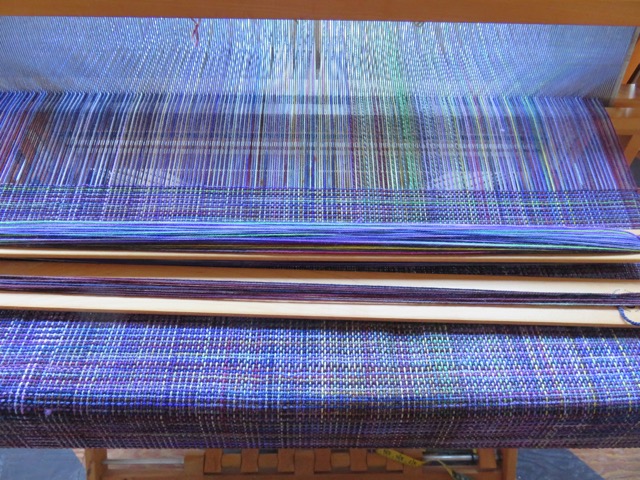
When I am not teaching and when I want a break from writing, or I am feeling wounded and drained (it happens), I weave. Sometimes I quilt.

I have a friend who sells a lot of work urging me to join a group, open an Easy account, or in some way make some money from my work.

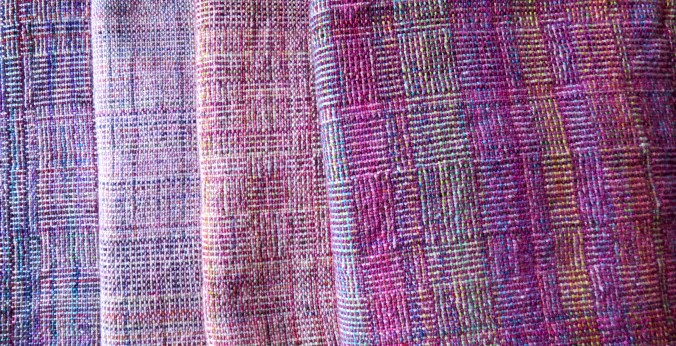
It’s not going to happen. I give weaving to friends and charities. I make baby blankets for expectant parents. I give them to friends. New Mexico children’s illustrator and YA author Betsy James, Russian sculptor Marina Globova, and Oregon novelist Molly Gloss have my shawls/scarves. (See below.) I don’t have a photo, but professor of animal scientist Temple Grandin has one draped on the back of her couch in Colorado. My shawls live on shoulders in Alberta and Washington and California. Each one gifted.

I put on warps and choose weft colors specifically to suit what I understand about their preferences.

I make a quilt and knit a blanket for each grandchild at birth. I make another when they turn two. When they go to college, I will make them each another. I try to use their favorite colors, though children change their minds. A sweater begun in July may no longer appear by the time it’s finished in October.

In the mean time, I weave.

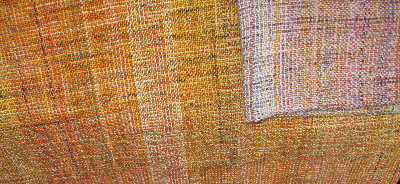
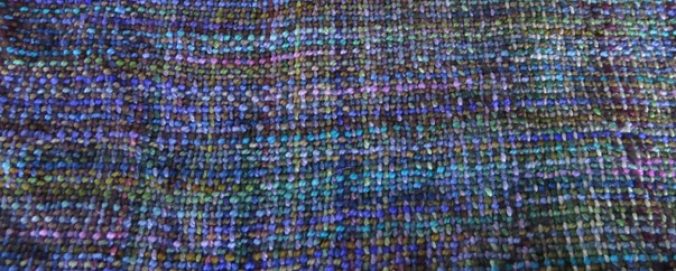
Tomorrow, I will begin my first warp of the year. I am thinking red and browns this time. There was a saffron warp a few years ago and I still haven’t found a home for two very special pieces. There was the “Peacock” warp and one for Ruby and seasonal warps where the weft varied to take me through Spring, Summer, Autumn, and Winter. Each warp yield two or three or even four pieces. I like color, but sometimes the more subtle combinations appeal. Each piece is meant to be distinct.

saffron_warp IMG_0778

cropped-img_0404.jpg

I will begin pulling skeins and winding tomorrow.

WALKING IN THE DARK

Pacifica Project Presentations

There was no color essay on Tuesday. I have been busy the past few days because my high school has a graduation requirement that ends with presentations at the convention center. Students have identified a community and a need—a charitable concern such as feeding children, tagging salmon, collecting litter, or coaching kids—then designed a project to address the need, put in dozens of hours, researched a related issue and written a lengthy persuasive essay, and finally, yesterday, presented their projects to the community at the Seaside Civic & Convention Center. Their 12-15 minute talks required visuals and rehearsals beginning last week at school and then all day on Tuesday in their assigned rooms downtown.

I meant to skip the Pacifica Project Presentations this year, its 26th. I was a member of the original team that designed the program, and one year when the mastermind behind it all, Mike Hawes, was unable to be there, I hosted. I always create the program and attend rehearsals. This year, I was tired (more about that some other time). In the end, I managed to see two full presentations and parts of four others. It was, as always, an inspiring evening.

Mr. Hawes made me cry (not the first time) in his opening address about the inspiration of these earnest young people and the need for hope.

Students worked hard, many of them at work on their projects a year or even several years before. More than a few were deeply impacted by their service. One young man who volunteered at a weekly community event found that this forced him out of his dependence on media and into relationships with people face to face. He said it reminded him of the need to see and talk to people, to hear them. A young woman who tagged on to an existing anti-bullying program in another state discovered that she wanted to more and organized a parade in favor of kindness and hope.

I started two blog posts, but was unable to finish either of them because I was so focused on these Pacifica Projects.

This afternoon while my husband was collecting our mail, I heard a father explaining the Golden Rule to his little girls:

“If you want people to be kind to you . . . “

In the mean time, Rosanne Barr tweeted a series of deeply offensive messages (more than just the racist one) and her show was cancelled by a network unwilling to defend or overlook her remarks. Samantha Bee used a horrible word to describe Ivanka Trump and people are scrambling about that one. Trump, who has said equally terrible things without apology, made the recent events about himself, which is to be expected. He has no principles beyond his personal popularity and fortune.

This morning (Thursday), republican John Kasich called for the Senate to get their act in gear and do something about DACA. He wants something to be done. In a CNN interview this morning, he said that Congress should not wait for permission from Trump. It was not their responsibility to pass only what the executive branch wanted. They should, in the end, be doing something, the right thing, he said, and I hope he pulls his people together.

In the interview, Kasich could not resist a partisan remark that he didn’t know what the democrats stand for—which is unfortunate especially since DACA is a program most compassionate people of both parties defend. Still, it is a republican talking point to say democrats do not take a stand. The unfortunate corollary is to wonder if Barr and Trump’s locker-room talk is what too many of these congresspeople stand for?

I believe most republicans are horrified by these ugly comments. I think the vast majority of Americans are decent people who respect Gold Star families, POW, women and children and men of any color and station, and most honor ordinary courtesy.

This brings me uncomfortably to my son’s recent distress about Samantha Bee. Yes, she is a left-leaning comedian, and yes, my husband especially loves her (he has lost respect now). She is married and a mother and she is not polite about politicians she disagrees with. Is it okay for her to be vulgar, but not the president? Is it fair for her to call names she would certainly condemn coming from a politician? It’s worth thinking about.

There is false equivalency coming from every direction. Anti-Nazi protesters are not equivalent to Pro-Nazi protesters, at least not given our world history. And sexualized workplace comments are not equivalent to rape. Any abusive behavior is to be condemned, but on the scale of abuses, there is error and lapse in judgement and there is clear, egregious abuse of power.

Hitting Up

I have always contended that humor at the expense of some individual or group only works when the blow is delivered up. That is, it is fair to challenge and ridicule the richer and more powerful, to laugh at the expense of those with a superior position in society. It’s a cheap shot to ridicule the weak and powerless. It is in Christian scripture to serve the powerless, it is part of our national character to support the underdog, and it is the over-size bully on the playground we are all inclined to dislike.

“With the rich and powerful, always a little patience.”

I am deeply concerned with principle, with doing the right thing regardless of the impact on myself. Nevertheless, I often site my own experiences to explain my positions.

In high school, I used to sneak out of the house to walk all alone. I was depressed and lonely and struggling. Walking in darkness was my way of coping, a way of avoiding death. I felt close to death at times.

The significance of this is not just that when I write about depression, I am speaking from experience. It is also true that in hundreds of solitary walks, I was never attacked, and I avoided people and spoke to no one, even on weekend nights when drunken people in cars were common. I hid in shadows and if I felt something was off somehow, I did not question my own judgement, but took steps to keep myself safe.

A gun would not have served to protect me. I was brought up with guns, taught how to take apart and assemble, load and unload. I do not hate guns, but I do fear the impact they have on frightened people. If I had a gun, the most likely result, statistically, would be that it would be taken from me and used against me. Toddlers kill their parents or a sibling accidentally every year. Police officers, trained to perform, miss their target 72% of the time when they fire in a real life situation. I would not expect to do better than those who have made law enforcement their profession.

Back in my teens, I ducked behind hedges to avoid being spotted by drivers in cars or drunken walkers, and I avoided populated areas. I walked across campus alone in the dark every term I attended the University of Washington. (There were advantages to scheduling an early morning or evening class in those days.) One night I was walking down the hill from Denny Hall, a paved but dimly lit path I followed regularly. That evening, I looked ahead at the mountainous overgrown cherry laurels just ahead and stopped. Something felt wrong. I didn’t hear anyone or see anyone in that dense twenty-foot mound of shrubbery, but I turned aside anyway. Following a more open path cost me seconds and might have kept me safe. Ted Bundy was killing women in those years around Seattle and I fit his preferred victim profile. No one admitted there were campus rape statistics to track in those days, but terrible things happened. I knew of terrible things happening. Maybe it was only luck that I was never  attacked, but I was aware, I wore a rape whistle, I splayed my keys between the fingers of my fisted right hand. I walked like I knew where I was going, and it was true.

Today, America is a dangerous place, and some of the danger comes from people slinging guns around. The responsible gun-owners I know keep their guns locked up, and I honor their family tradition of filling their freezers. I honestly do not want to take away everyone’s guns, but I also do not believe than guns are the only way to be safe. Our national obsession with guns is not a Constitutional right, but something more cynical. The harboring of guns and ammo with no purpose but to kill our fellow citizens amounts to dangerous paranoia. Our nation was founded on many things, a promise of semi-automatic weapons was never part of the original plan.

A small minority of people are terribly afraid of gun regulation. It is ironic, isn’t it? Especially given that the second amendment specifically calls for a “well regulated militia” and this wording refers back to an ancient tradition in Britain of requiring all adult males to train in military skills because the kingdom did not maintain a standing army large enough to defend the country. In case we have not noticed, we have the largest military the world has ever know. It consumes 43% of our discretionary funds—an enormous weight upon our budget and one reason we have little left for education and health care. Yet, we are so frightened we must allow ordinary citizens to have military weapons in their homes?

I’ve been accused of being too optimistic about human behavior. But I see things differently. I recognize that people do terrible things every day. I recognize that accidents happen. People make mistakes. But if we were at heart such terrible monsters as some seem to think, I wonder how I survived my parents’ temper with I was an obnoxious child. (You know I had to have been obnoxious now and again.) We survive because we are social animals, committed to working together for the common good. At least, that is how I was raised to understand my country.

NATURAL VARIATION


33688037_10217044950302347_6133954008747868160_n (1)

Despite discussion the other day about his resemblance to other family members, my grandson looks like no one more than himself. This is true for all life—zebras too.

A friend posted on Facebook that if she could have any question answered, she would ask God why humans were so made to be so different, varying in height and weight and color and language—we are so variable, unlike zebras or elephants or monkeys, which are about the same, she wrote.

A mutual friend suggested that the answers were in the Bible. [Maybe, if you accept that the story of the Tower of Babel is about God separating people to make us unable to talk to one another, and completely miss that it is primarily an allegorical story about the danger of hubris—our self-importance and arrogance.]

They are both missing the obvious.

Animals, too, are each unique, variable in height and weight and color and language. Ask anyone who has spent time observing another species.

When we study animals closely, we find that they exhibit all the variation found among humans. Humans may not notice the variation because we are not attuned to it, not because all zebras or elephants or monkeys are identical. They vary in size and color and voice and personality. Zebra stripes vary and are as distinct as fingerprints, but on a grand scale. They also vary in size, build, and character—some are faster or slower, with higher or lower voices, inclined to complain or bear up, kick their neighbor or not.

Elephants are individually recognizable from a distance by the zoologists who study them, and find size, shape, ears, mannerisms, and movements distinctive.

And monkeys? or apes? Check out Jane Goodall’s research. She named and studied the animals over many years. Each was as individual to her as my own children are to me. They all look alike to us because we fail to observe. We are not interested in the many distinctive physical characteristics and behaviors that make each one an individual. As a result, we simply do not see them.

All penguins of a species look identical to me, but not to another penguin. Twenty thousand baby penguins wait on land in a rookery, waiting for Mom to come back with food. Their mother is able to distinguish her own baby’s cry and find it among that surging cacophony. Diane Ackerman could not understand how they could hear anything in the racket of screaming infant penguins, much less identify a distinct voice. Then she spent time feeding baby penguins, and realized, with a sort of shock, that she could hear “her” baby’s voice distinctively amidst the calling of dozens of other babies.

We learn to notice individuality only when it matters.

As a tiny local example, the song of song sparrows in Arch Cape barely resembles the song of the same species in Seaside or Portland. Song sparrows mostly all look alike to me, but even I can hear their variation. To another song sparrow, they must look as distinctive and unique as my husband and I do to me.

We make friends with twins and learn to distinguish between them. We notice what we care to notice, what we attend to, and to what matters to us. We see that all trees are not Christmas trees or apple trees. We notice one day, as I did in Kindergarten, that “red hair” is not red, but orangish.

All species change through time, adapting through tiny and notable genetic variation to different climate and food sources. There is ample evidence of this in recent history—moths in Britain evolving to camouflage against coal soot-stained trees and brand new species, not to mention deliberately created breeds of cattle and horses and dogs that are human-selected for desirable traits.

On a more human scale, consider Golden retrievers. Do they all look alike? Would a dog-owner fail to recognize his own well-loved dog in a crowd of retrievers?

We notice what matters.

When I was young and had no interest in motherhood, I once insisted that all babies looked alike. Maybe one was a little darker or had more hair. Some have brown eyes already? Whatever. I saw no individuality when I was fifteen. They all looked alike to me.

I am a mother and grandmother of babies.

Ask me now.

BIRTHDAY CAKE

IMG_2957

I like to bake. I like baking cakes even more than eating them. I like eating pie better, but baking a pie is never as satisfying as cake. I don’t know why that is.

Let month, I was asked to make a cake for my youngest grandchild, an honor. Today we are celebrating our only grandson’s birthday, and orange is his favorite color. So far.

Orange was my dad’s favorite color too. There are Campbells in my family coming down from my dad. When I was little, I tried to pinch my dad for not wearing green on St. Patrick’s Day, and he pointed to a smudge of orange from painting boats for the Bureau of Commercial Fisheries, and he said that counted for him as a Scot.

Whatever. My grandson is a busy little person, so his preferences are bound to be original. He likes the color orange just now even it is statistically more often a least favorite color as well as the color most likely to be hated.

But I ask you: Would you mind getting a four-layer gingercake with orange buttercream for your birthday, even if it was orange? Even if you’d moved on from orange to red?

The cake is dark as chocolate, but instead is flavored with gingerbread spices and a full cup of organic blackstrap molasses. I cooked down the juice of four oranges to color and flavor the buttercream. The orange candy slices came from Bruce’s in Cannon Beach just this morning. You can’t see it, but the sides of the cake have a sprinkling of naturally colored orange sugar sprinkles. I’ve saved the tall, striped candles for almost a year.

Happy birthday, Logan!

‘I Told Him, I Said’

IMG_3962

It’s been a while since men at my school considered it appropriate to make a retirement speech suggesting that a male teacher was putting moves on a teenage girl. Ten years? Maybe longer. Maybe not so long ago. Not long enough.

I heard them make such remarks and others. The promise of a better grade if a girl would lose ten pounds. “She’ll thank me.” The detailed speculation about what a girl might have done at a weekend party, spoken in the Library where other students could hear. Those are mild examples, much worse was suggested at that banquet. A school guidance counselor got up and left the room that evening. Unlike him, I went to the Ladies until the speech was over. I couldn’t leave because I was making a speech about someone else later in the program, a decent man who did not find his peers’ bawdy humor the least bit funny.

Did I say anything to anyone about the off-color remarks? I believe I did. Was there a reaction? Not so’s you would notice. My distress was not important. My professional opinion did not count. I was being fussy or a “feminazi” or needed to get a sense of humor.

Worse happened.

This was the world I lived in. Mostly, it still is.

I am expected to ignore inappropriate remarks, pretend they do not embarrass or offend me, that there is such a thing as harmless “locker room talk.”

The experiences of women have not changed enough since that evening. Teachers, coaches, and school safety officers have had inappropriate romantic relationships with students. Local cops. Prominent members of the community. That is, they have had a romantic relationship with a minor student, which is never appropriate. The girl is inevitably blamed when this becomes known. Her own peers, even the girls, blame her. They may even ostracize, harass, and threaten her. I remember this from my own days as a young girl. The girl is blamed. Did she do something stupid? Probably. It’s why we have rules about minors. Young people do stupid things all the time. It’s our job as adults to stop them, not to tempt them. But adults do tempt them, and then they step away. The man denies improprieties publicly, and perhaps privately feels he has done no wrong. Clearly the girl tempted him.

Stupid girl.

A Senator is called a disgrace and forced from office for making decidedly inappropriate gestures. The person calling for that man to abandon his career, makes specific and crude remarks. Each man claimed afterward that he was only joking. Only one of them removed himself from office.

Neither one was Bill Cosby or Harvey Weinstein or Humbert Humbert. Only one was a buddy of a convicted pedophile, also accused of sexual harassment, also accused of physical harassment . . . and President.

Unless the offender is a democrat, the President blames women. Naturally.

A “Lolita” is a colloquialism for a “sexually precocious girl.” “No one knows . . .” It’s easy to forget that Lolita is not the main character of the novel by that name. The main character is a middle-aged man who marries a mother in order to gain access to her 12 year old daughter. TWELVE YEARS OLD. He grooms and abuses that child. Lolita, the title character, will end up ruined, pregnant, and dead. But no one throws the term “Humbert” around like a dirty joke. It’s the adolescent girl (who died, remember?) whose pain becomes a dirty joke tossed at girls.

It’s easy to see how men excuse their indiscretion and abuses. For one, they have been encouraged to be assertive and certain. Aggression is rewarded, but hesitation is a weakness. Doubt is a weakness. Apologizing is weakness. Among men, that it. The rules are different for women. And, of course, for men in our society, being weak is absolutely not an option.

Being weak as a woman is allowed, even encouraged and considered attractive. Willingness to doubt, to question our own actions, to rethink, change our minds, apologize . . . all allowed, but then this humility is also often used against us. But demonstrating assertiveness and certainty? “Unladylike.” “Offensive.” “Aggressive” and ugly in “the weaker sex.” A woman projecting that sort of confidence unleashes a landslide of ugly words. Do I need to list them all here? “Unlikeable.”

Both men and women are caught in this terrible stereotype of gender-enforced behavior. The narrow, brutal definitions of what it means to be a woman or man allow us scant wiggle-room for individuality, male, female, or anyone else.

But when strength is considered a character flaw and weakness is considered attractive . . .

And when we talk about it. Out loud. Oh, dear. When we try to defend ourselves . . . that’s just not something we should be talking about. Right?

This year, a dear colleague is retiring. I am not attending the banquet. The banquet on the year I retired was not offensive, but absurdly wounding, and as a retiree I do not feel compelled to attend ever again. My friend will be given a good speech (I know who is in charge) and I wish him well. There is not a wisp of scandal associated with him, and times have changed enough that no one would find it amusing to invent or exaggerate a sorry and humiliating (for someone else) story for the occasion.

Times have changed, but not enough. Too many in power believe they have a lock on decency. And they are wrong.


SaveSave

SaveSave

METAPHOR FOR GIRLS

IMG_1409

Pododesmus macrochisma: METAPHOR FOR GIRLS 


Each morning I walk the sand, searching

for what my grandmother misnamed

the “ugly clams” caught in foam left behind

by a retreating wave or stranded high on shore

from last night’s tide. Smaller than my thumb

or filling my palm, they might come to rest

among seaweeds torn from their beds,

half buried by wind-driven grains. Often

when I find a shell, there is another nearby.

Is it too fanciful to think they gather to die?

Perhaps because the first makes me alert

to the next. Every one I have seen lies

face down, resembling nothing much of note.

Some thinner than drawing paper, sometimes

thick, calloused like my toes. They lived wild

in depths to three hundred feet, here adrift

and dead, their softer life dissolved in the sea.

Only rarely are the unequal halves complete,

shaped back shell still attached to the round.

Sometimes only shards remain, wholeness

crushed by the careless heel of an earlier walker

passing by, oblivious to the gift underfoot.

One reason to search at dawn. Turn one

over, see what hides—that nacre, sometimes

scarred, dark glimmering, pearly sheen—alive

amber and green, holding captive light.

IMG_1704

originally published last year in Portland Review

BIRD STORIES

CSC_0322

In the last week: band-tailed pigeons and Eurasian doves, Steller’s jays and a single scrub jay, robins and goldfinches, red-wing blackbirds, song sparrows, hummingbirds, crows and ravens, bald eagles, red-tailed hawk, black oystercatchers, gulls, whimbrels, Canada geese and brown pelicans, and a mixed flock of semi-palmated plovers and dunlins (this latter with distinct dark bellies—I wish I’d had my camera). Gary calls the black birds with bright eyes “cowbirds”, but I wonder if they are the same as a bird called a Brewer’s blackbird? They are new in our neighborhood.

The other day I watched three pairs of Canada geese herding 15 goslings across tidal flats fifteen miles south of my home. One pair had 8 babies, one pair had 4, and one pair had 3, and the tender care of both parents was genuinely touching. I was at the dentist having my teeth cleaned, but everyone stopped what they were doing to admire the three families.

There is a story there.

At least twenty years ago, my writing partner Rebecca Olson noted that my stories always had birds in them. I had not noticed. It is my husband who loves birds. As a result, I think about birds more than I would otherwise.

That impulse to focus on birds has resulted in stories. I imagined children falling asleep and becoming owls; then the owls fall asleep and slip back into being children. My story “If It Were True Owls Dream” was accepted for publication by Liminal Stories and will be available online in July. The first day I sent it out was to Shimmer and the editor E. Catherine Tobler rejected it but urged me to send it to Liminal. I owe her for that excellent advice.

Most recently, I began a science fiction story wherein I imagined all the birds in the world dying. I originally meant it to be a short story, but the early draft grew longer and longer and more and more complex. I have drafts that are nearly 20,000 words long. This fell into three parts, one in the near future, one hundreds of years later, and a third part even further into the future. Then I worked just on the first section, which was also the longest at nearly 10k. A friend urged me to cut most of it, which I did.

I had the idea of the vanished birds, but also other ideas about veganism and overpopulation. Then it became a story of about 6,000 words that began working as a story. It was not done, of course. Not in four drafts or ten, since I have only been working on it for a few months, but still. It is science fiction and it is about birds . . . and mostly about life on Earth.

I carved back that shorter story and carved back some more. It is less than five thousand words now and maybe it works. Probably it lags in the middle because my stories often lag in the middle, and there is not enough action—there is never enough plot in my stories.

There are usually birds.

I want another story, and I have one, but it is not quite figured out. “On Cherry Street” is about a young woman returning to the house where her mother died. She is very much aware that crows are watching. Birds again. I still don’t know what it is trying to be. Is it a horror story? I’ve not explored horror. Is it magic realism? This story is about four thousand words and I am not even sure what it is about.

Back to thinking. Back to visualizing.

When I create a story, as when I create anything, I need a solid visual. This is true when I am piecing a quilt or, just recently, designing a program cover for an event. Most often what I am creating must be complete in my mind before I actually make it. Even the weaving where I deliberately provoke randomness and choose yarns that vary in color, I have a vision. When I was painting, I would spend far more time imagining what I wanted to create than actually painting it. The stories are harder as I build them up and tear them back down on the page.

Creative work is like that. How and what we create must be first born in the imagination. Only when that vision has grown can the work be realized for others to see. Sometimes the ideas come home to roost.

There is always the danger they will simply fly away.