YELLOW

IMG_2874

So yes, I know: buttercups and warm lights, the shadows on a polar bear and pollen. Lemon curd sauce and angel pie, the afternoon light glowing in the living room. Gold on my fingers, the tint of big leaf maples in September. Bananas, egg yolks, buttered corn. Caution signs, dandelions, honey bees.

Even so. The color is a problem for me. I delayed considering it here. My mother loved yellow because as a child with yellow hair she was told she should never wear the color. She wanted to wear yellow to spite that notion. But I have no memory of my mother in yellow.

Mom washed a white Orlon sweater and laid it out on a rack in the sunshine to dry and it turned yellow. “Ruined,” she said. Old bruises turned yellow. After a filling, I had a bruise sliding down the side of my face for weeks. Once the blood in that bruise was turning yellow, people kept asking if I had been hit or run into something.

My second baby was yellow with jaundice and I cried on drives back and forth to the hospital to feed him, blinders on his eyes, lying uncurled under billy-lights. Would;t he have been better off lying bare against my chest?

The pages in my books can be said to have yellowed, but the color is perhaps more orange than pure spectrum yellow. Yellow has some baggage in my life. Nothing dreadful, but a minor prejudice.

My grudge against yellow dates to Hazel Koenig’s design class my freshman year at the University of Washington. We were working with poster paints, creating color wheels of tints and shades. My yellow looked pure enough. When white paint was added, I created a gradient of pale and paler yellow tints. But when I added black, the shades of yellow were green. That’s because a super concentration of blue or green or even purple is used to produce paint that appears black. The flaw was not in the yellow pigment, but in the black. I wanted darker yellow and I found shades of olive and laden instead.

My grandmother painted her beach house yellow inside. The bedroom walls were two or three shades of intense blue with white carpet on the floor. Everything else was yellow—walls, carpet, appliances, even the Mixmaster in the kitchen. I think she was after a cheerful color, a sunny yellow on the cloudy coast. I have tried palest gray-pink and taupe and green and rose, in pursuit of the same effect. Now the walls are pale lavender and I avoid yellow.

Except, I do not avoid yellow. I use it, the complement of purple, in weaving and quilts. I am cautious and yet there is is again and again, those yellows and golden hues.

IMG_2645

Left is an early version of the last quilt I pieced, “Rain,” the colors laid out and unstitched. I wanted mostly tints and shades of gray, but here I tried pinks, reds, and maroons played off against purple, a range of colors on a ground of mottled-gray. It did not work for me. I lifted them all, cut new strips. The whole project was laid out on our bedroom carpet for weeks while I was changing my mind about color.

IMG_2650

Above is the layout I settled on after Gary and I had been stepping around the edges of carpet for over a week. After several shifts, I made my choice about color. Yellow sunshine raying from the upper right where you will find it in many children’s drawings of the sky. The sun in upper right smiling down on the green grass and hopeless perspective of a six year old artist learning to use poster paints and crayons.

We always draw the sun as a yellow disk, the moon as white. The gold of day and the silver of night, though even in the midnight blue sky, the moon too is gilded.

SaveSave

BRAIN POWER

IMG_2389

The brain is a greedy organ*. I heard once that Einstein used the same energy when he was thinking hard that a marathon runner would be using about mile 25.

I am thinking a lot these days. I am revising curriculum on the fly because my tiny writing class needs to become a more muscular group, and I am grading their essays and trying to give them specific writing advice—actually all sorts of advice.

At the same time I am writing a story. It is not ready to be submitted, but it has undergone enormous revision. When I butcher four or five thousand words out of this long story, write a thousand new words, and then butcher out another thousand to make room for them; when I rethink how the story should end and what, perhaps it means; and when I allow myself to become distracted enough that I risk killing that darling at the beginning of my novel (a very different project), which I am trying to find representation for . . . I need to take a nap.

My exhaustion is not physical, but it is real. I have been thinking. And all my thoughts are about what to put on the page.

This year I set an unusual writing goal for myself. I would like to plan on publications, but acceptance for publication is primarily the choice of editors. I have no control about what is published, other that to submit work for consideration. All I can do is send work out. So a more reasonable goal is to set a number of submissions. A friend of mine, in her effort to gain tenure as a college writing professor, set a goal of having 100 submissions out at all times for a year. That sounds admirable but insane to me. One hundred? I have been paying attention for a long time and have read many, many—in fact, an astounding number of—journals, and I have found 104 to put on my list. There are close to 4,000 I might consider, but even of those on my list, there are perhaps a couple dozen that really interest me. In the past, I have tried to keep at least 8 submissions out at a time. Sometimes I go for double digits.

The entire process of submitting work is work, and mass submissions also require that I have a lot of work “ready for publication” (see above). And there is that word “submit.”

At some point toward the end of 2017, I read about a writer whose goal was to have 100 rejections. That is pretty smart, I thought. Sneaky too, since in order to have 100 rejections, I would need at least 100 submissions over the course of the year. In 2017, I had 78 submissions—close—so I thought about this and decided it was totally doable.

Counting rejections also has the advantage of giving my some tiny advance in my record-keeping each time an editor sends me a note that says, “I liked the quality of the prose, but overall the narrative didn’t quite win me over and I’m going to pass on this story for [our magazine]. I wish you best of luck finding the right market for it and hope that you’ll continue to keep us in mind in the future.”

Well, that story really does needs more work. I sent it out too early, and I should have asked a friend reread it. I should have read it aloud to my husband. But . . .

But good news, halfway through May, I already have 45 rejections! Whoopee me! I am going to meet my rejection goal!

The bad news? My brain is completely worn out. Wiped out. Soggy noodle. Maybe I should go take a nap? Or two. Or a good night’s sleep?

Tomorrow I will read that story aloud and do the needful.

*Although the human brain makes up only 2 percent of body weight, it consumes more than 25 percent of our baseline energy budget.

SaveSave

GOOD WORK

Teaching is not like working at Taco Bell. Teaching is different. Teaching is the profession I love. But before I entered teaching, I had other jobs.

When I was a college student, back when it was much easier to do so, I worked to support myself and pay my public university tuition and expenses. My parents did not contribute, I took out no loans, and I lived dirt cheap while working poorly paid and inconvenient retail jobs. I did not hate my job at the University Book Store in Seattle, though it was not in the art supplies department as I’d hoped. No, though there was an opening in the art department, they put me to work in the music department. I had worked a few months for DJ’s Sound City at the Northgate Mall and was thus assumed to have “experience.” I tried to tell them I knew nothing about music, but Fran in HR did not listen. I would sell records and sheet music for the next five years.

I learned a good deal about music while I worked there. For example, I heard mbira music and Vaughn Williams’ “Lark Ascending” and Pachelbel’s “Canon in D” and Paul Horn Inside the Taj Mahal playing “Syrinx” by Debussy. One day a man came to my counter with a case and I begged him to open it and play his gold flute for me. He chose “Syrinx” and I nearly swooned.

The record store was not particularly well-run, and the book store was never generous with employees, but I liked working there. I spent my breaks mostly trolling the science fiction and fantasy book sections, or next door at Andy Shiga’s import store.

My first job had been at Taco Bell, a terrible job, but I learned to mop and wipe down and clean and make fake tacos and burritos. It had its uses.

At other times I delivered junk mail to houses, worked in a bakery, and sold quilting fabric. I designed logos and house plans freelance and I drew for an architect, who paid me less than I was worth. I taught in a community art center, a museum, and in private and public schools. I learned how to make florentines in the bakery, and I spent more on materials than I earned working most days in the fabric shop. My jobs have taught me that I do not usually enjoy working on commission or selling my own work. I would rather give that away. My jobs also made me curious about what I was doing and that led to lifelong learning.

Aside from Taco Bell, I never disliked work. (And the only thing I disliked about Taco Bell was my boss.) I did the best I could with every new experience, and perhaps because I never stayed in any job for long, I enjoyed myself.

Some people seem never to have researched or learned from their jobs. They “dread” going to work and “hate” their jobs. They are not curious, but just put in their time. I run into people in the service industry who do not seem to like the people they are serving, and people working in professions where they seem to have no understanding of that work. It makes me sad.

Aren’t they curious? Don’t they want to do a good job on the job?

No job or profession is consistently rewarding, of course. There were periods when I was teaching and felt underappreciated, overworked, and exhausted. My peers were not friendly. I felt unsupported and disrespected. Over the years a few parents, nearly always people who also worked hard, attacked me for not giving their child an A in class. (Now that I think about it, it’s always about the A.) I cried on my way home from work sometimes in the early 2000s, though much of that was dealing with my mother’s illness on top of everything else.

However. It was not actually my job that made me miserable. I was nearly always excited about my actual job, teaching teenagers. I never wavered in my love of teaching. It was the rest of it. Mean people. Like Taco Bell, making and wrapping a taco in 17 seconds was fine, capping little individual containers of hot sauce was fine, and even mopping was fine. My boss watched us with binoculars from his car across the street and shorting our paychecks? Kind of a brutish.

The anniversary of Kent State passed recently. I marched with many thousands in Seattle after Kent State in 1970. Some of the victims were not even near the anti-war demonstration on the Kent State campus that day. They were just walking to class. Sometimes I tell the story of my boss at Taco Bell telling me that those four students who died and others who were injured that day deserved it. I walked out to my mother’s car and drove away from the job.

I enjoy working. I have enjoyed every job I have ever had. Even now, I catch myself seeing employment ads and imagining the work. Even when someone comes along who makes me want to go hide under a rock, is yet another lesson. A bump in the road that does not ultimately interfere with the scenery.

The skills I got to keep for free.


TAKING ART OUT OF THE BOX

IMG_3840

When I became licensed as a K-12 Art teacher in 1976, I knew it was unlikely that I would find a job teaching students younger than high school age. Those little kids I worked with in my field experiences would never be mine for more than a few hours during my one-week assignment. Most districts considered arts a “frill” and that cutting out construction paper hats would do as an introduction to the visual arts.

Even then, elementary programs rarely included arts specialists, though junior high and middle schools did. However, while completing my program at the University of Washington to become an Art teacher, I worked in the art programs of several school districts, including the Northshore School District which then employed arts specialists at all grade levels. It was also ranked as the finest public school system in the state. It was, and is, a wealthy school district, but a recent book by Sir Ken Robinson, PhD, and Lou Aronica reinforces my experience in 40+ years teaching in private and public schools, 25 of them as an English teacher. Increased focus on “the basics” and teaching to tests has done our children no favors.

It may seem counter-intuitive to insist that spending all day on math and reading (often out-of-a-box instruction) may actually make our children weaker in those subjects, but that has been my observation. The much-lauded Finnish school system seems to bear this out. Only a creative and richly diverse education will produce the citizens we want in our future.

Allow me to indulge in a when-I-was-young digression:

Most of my elementary education was in a public system north of Seattle. We had choral music and instrumental music specialists, physical education specialists, and individual teachers with particular skill in math and science as well as history and literature. I was introduced to musical instrument with an assigned recorder when I was eight years old. My parents would not allow me to study the oboe (I failed to practice my recorder and they were unconvinced I would last long enough on the clarinet to get to the oboe). Nevertheless, I continued taking Music Appreciation classes required of all students through Sixth Grade. That year I also took pre-Algebra, observed the life cycle and behaviors of meal worms, designed an experiment to determine if white cloud mountain fish could perceive color (maybe), and wrote reports citing a variety of sources from books and periodicals. I attended the second best school district in the State of Washington. While there was no art specialist at Echo Lake Elementary School, we’d begun learning to play musical instruments in 4th grade and later had Band, Music Appreciation, and so forth throughout.

Cordell Junior High (7th-9th grade) had, according to my yearbook, about 980 students. There were 43 teachers, 3 councilors, a vice-principal, and a principal. It had two full time art teachers. My seventh grade Algebra teacher was also the Jazz Band director. There were also full time choir and band teachers in this public school. Many of us went on to college.

By contrast, the small school system where I still teach college classes employs two music specialists (Choir and Band) who teach elective classes in grades five through twelve (over 800 students), and a single teacher who teaches art electives 4/5s time to grades nine through twelve (over 400 students). There is no art specialist teaching at the middle school. At the elementary level, there has not been an art specialist, so far as I know, ever. But there are still a music specialist and and P.E. teacher (one of each for 800 students) in our athletics-obsessed community.

The art and music and physical education specialists have been protected by an administration determined to hold onto “frills” that are necessary for so many of our students.

Money is the motivator we pray to. We focus on “basics” because we believe they will profit us more. Lost, in this dynamic, are thought, analysis, critical thinking, and creativity. There is almost nothing creative about read-the-passage-and-identify-the-following. There is almost nothing creative about addition or memorized times tables. Reading and arithmetic can be taught in creative ways, but rarely are. Creativity itself is a maligned and neglected step-child of our current educational system.

How will this profit us in the future? we ask. And “profit” is spelled only with dollar signs. Despite the idealism associated with youth, new high school students are told too often that doing well in school will earn them a higher income. Too often we fail to explain how education might make them wiser voters, better spouses, or more creative individuals.

According to economist Dan Pink, “When profit becomes unhitched from purpose . . . bad things happen.” Watch his video it’s brilliant! Once basic needs are met, humans want autonomy, mastery, and purpose. Self respect goes a long way. Creativity is about all those three motivators. The opportunity to make, invent, envision, create—that is the essence of humanity.

In the late 20th century as the U.S. lost ground in manufacturing, we still led the world in ideas. This is changing now too. As we focus on mechanical skills, how can anyone be surprised that we have lost ground in invention and innovation? Creativity not only feeds our souls, it allows us to advance in other ways such as technology.

What happens when we prioritize art? Experience and studies suggest: GOOD THINGS.

IMG_3835

‘Can We Talk About Race?’

002_1477347.jpg

I remember when I first understood that “Negro” had gone the way of “colored.” In the late 60s, I walked home from school and explained this to my mother: “Don’t say that word, ‘Negro’. Say ‘black’,” and because we were that kind of family, Mom and I discussed respect for a long time. Years later the language changed again, and I screwed up my courage to ask one of my best friends if she preferred to be called “black” or “African American”? We discussed respect too. Even then, I understood that she was making a personal choice, not a definitive one.

My mother disliked the word “drapes.” So I called the fabric hanging across her windows “curtains.” It’s no skin off my nose.

When talking about ourselves, this is more critical. People have the right to label themselves, to choose their own identity. I am not a “broad” or a “chick” or a girl. I am not “65 years young” or a “young lady” or “as old as I feel.” I have lived sixty-five years, and I have been paying attention. Some language offends one person and is shrugged off by another, even when that other seems to share many similar qualities, even when the words themselves seem too similar to make any difference.  I detest certain words used to demean or define me. Not everyone minds. I am also old, and I feel it would be silly to deny that. I didn’t like a doctor calling me “elderly” at 63, but “old” or “older” don’t bother me a whit. I was a young woman in the 70s, and I was white. I am a white woman.

I can claim a great grandmother Rosa who crossed the Mexican border to marry in Texas, and I suspect my great grandmother on the other side was unrelated to the six tall red-headed brothers in her family—she was under five feet, dark-skinned, and black-eyed—but it makes no difference what investigating my genes proves. It means nothing. I was raised white and that is who I am.

Writing workshops frequently get around to the question of who is entitled to tell what story. One short answer is “anything you want.” There are longer, tougher answers.

As a woman, can I speculate about my grandfather immigrating to this country over a hundred years ago? Am I allowed to write across boundaries of time and space, gender and race? A better answer would be that writers may tell any story they have the skill and courage to tell, but that is pretty shallow. The reality is different. We need to talk about what belongs on the page. We need to talk about tact but also truth.

Language draws us in, but it also drives us apart. We do not have equal access to words we are born with, choose, and claim through observation and suffering. I was given “white” by birth, and I did nothing to earn or to claim it. It is a word I cannot put aside. I am also the oldest living member of my family, and I have no word for that. I am retired, but not retiring. I am warned against quiet writing, but also shouted at for raising my voice.

In a bio prepared for a recent public reading, I called myself a “native Oregonian” because I was born, spent my early childhood, and have lived nearly all my life in Oregon. A concerned reader invited “the organizers to interrogate the use of ‘native’ in one of the bios provided, and reflect on how it may contribute to the ongoing erasure of Indigenous people that underlies mainstream US American society.” My Alaska Native friend and I interrogated that usage. It would be useful to have a broader discussion about language and the words I use and should use, and to consider who is in the best position to help me make those choices.

I can choose words for myself, and I must respect that right for others. How about “Oregon-born”?

Indian Country asked prominent people their preferences for self-identification, and they chose a variety of terms to self-identify: indigenous, Native, Indian, American Indian, original people, First American, Native American. First Nations is a term of preference in Canada, but all those interviewed were clear that their first preference is to be known by their tribes and their personal names. When in doubt, when it is necessary to know, ask people how they prefer to be identified.

Getting the words right is only the beginning of the challenges when discussing race in America. Science assures us that race and ethnicity are social constructions invented by a dominating whiteness. We are so closely related that if we were plants, we might merely be different colors of snapdragons. Pink flowers off this stem, yellow off another. Nevertheless, “race” is not going away because we recognize that it is a false division or even because it makes white people uncomfortable. Race is muddled up in our Constitution and laws. It shows up on identification records just as caste does in India. It does damage. America has an insidious history of racial injustice and systemic persecution. We need to talk about race, and perhaps more important we need to listen more carefully and report faithfully what we hear. We need to judge less and observe more.

Forget our past? When people are still reenacting the Civil War? When 23&Me is dragging up genetic structures and telling people they’ve been celebrating the wrong holidays? When Faulkner claimed: “The past is never dead. It’s not even past.” It’s right here with us. Pretending it’s over denies the lingering impact of our personal, family, and communal histories.

Maybe what we can hope for is to overcome the past. We can talk about it. We can plan for a better future.

Guilt, embarrassment, and resentment cloud our talk. It might seem easier, safer even, not to refer to race at all. Some argue there are enough human struggles and conflicts without entering a potential mine field, and not all people of color welcome white authors telling stories based on guesswork rather than firsthand experience. White authors may respectfully shy from writing characters of color or about situations involving racial, ethnic, religious, and other differences. That creates another layer of fabrication, because an all-white fictional world defies reality, and impoverishes our writing.

We cannot write about ethnicity or race without risk of getting something wrong. This is a legitimate concern, but the same challenge exists when I write about my grandfather, dead these fifty years or about the experiences of my mother who is also not here to tel her own story. Pretending different realities do not exist is one way we hide our trespasses and become complicit in disrespect of others’ feelings and lives. When we limit our writing to “our own” we limit our story in a way that can be fatal to truth. Can we speak from personal preference and experience without demanding absolute authority? Can we tell our truth without infringing upon the truth of others? And can we enrich our stories by including other’s stories?

Would I prefer my story be told incorrectly or would I prefer it not told at all?

Am I only allowed two choices?

An Oregon author writing a novel that included tribal members went to a tribal member and asked for help in getting things right. Bette Lynch Husted found a third choice for All Coyote’s Children: Write as carefully as you can, do the research, and then ask for help.

The people I see every day are dark and pale, red-haired and dreadlocked; they visit relatives in China and Germany, Mexico and Florida; they are older and younger than I am; and some speak languages I do not know at all. When I describe the people in my life, I must include all their colors, because all colors are part of my reality. These people are my people. I want to know their stories. I want to share them.

Talking about race might lead to writing reasonably and accurately and to language that expresses those same values. I can listen to those who possess different identities and different lives. Writers, just like readers, want to know other stories alongside our own.

If we trust one another, if we approach with respect and genuine interest, then maybe, yes, maybe we can talk, even about race.

NOTE: An earlier version of this essay appeared in RAIN.

COLD COFFEE

IMG_3313

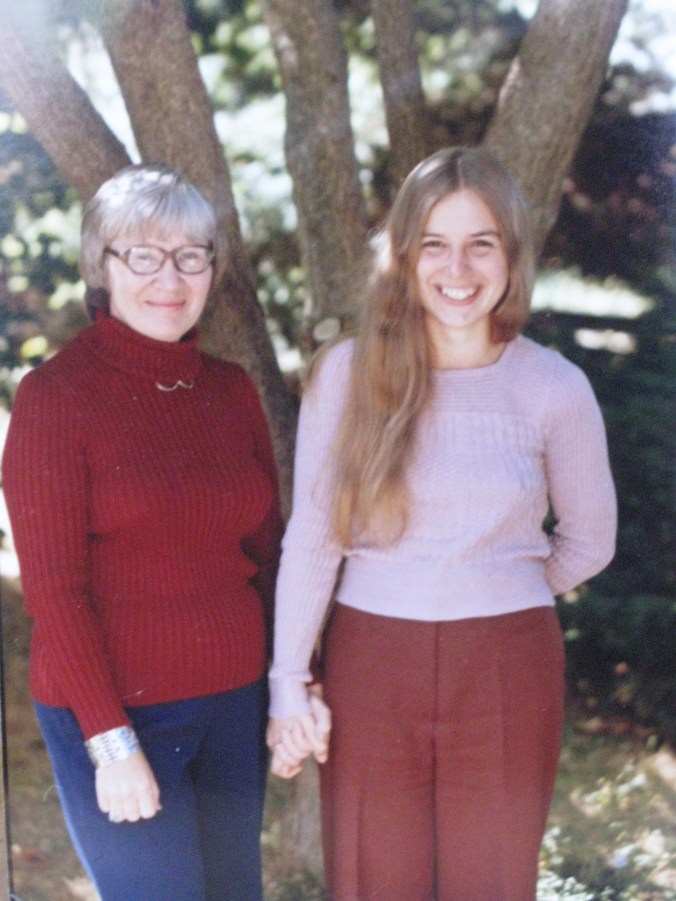
Probably in 1970. I was 17 and Mom would be about 43. I’d forgotten my hair was that long.

My mother would wander about the house looking for her coffee cup. Maybe she left it on the counter or the coffee table, beside the telephone or on the mantel in the living room. It might be on the picnic table in the back yard from when she went out to check on something.  It was usually cold. The cup was always half-full. Sometimes it was in her hand while she searched.

It keeps me awake, but helps my husband to sleep. He is what might today be diagnosed as ADHD. If he wakes in the middle of the night, drinking a little caffeinated coffee allows him to go right back to sleep. That is actually not uncommon. The caffeine allows some people to focus enough that they stop thinking about a thousand things and instead think about one thing: sleep . . . and they do.

Coffee has the more usual effect on me, so I drink two cups of coffee when I first wake and then I stop, unless I want to be staring at the moonlight half the night.

I began drinking coffee in my thirties as a way of drugging myself into alertness when I driving home from night classes. My children were still preschoolers but I had decided I would return to teaching as a Social Studies teacher. When my husband arrived home from work, I would head out for a 45-minute drive to an evening class. The struggle was remaining alert on the drive home. Coffee did it for me.

A few years later, I was hired as an English teacher, but I didn’t give up night classes. I began driving to Portland State for graduate work in their English Department. I also continued drinking coffee.

I like my coffee strong, black, and unsugared. I like iced coffee with whole milk, and the only way I take sugar in my coffee is in ice cream.

You might think that after nearly fifty years, my husband and I would know all there is to know about one another, but we had a discussion about coffee before six this morning and Gary was surprised to discover I do not sugar my iced coffee.

We had been talking about beer.

I’m not sure what my mother loved about coffee. She was not particular about flavor—she thought that instant and fresh-brewed tasted the same. She always had a cup, but didn’t actually drink it much. Maybe she liked the heat of it in her hand. I recall her reheating coffee in a saucepan on the stove. The microwave was a great timesaver. On the other hand, she never drank everything in her cup.

Happy Mother’s Day, Mom.

A BLESSING FROM BOOKS

IMG_2772

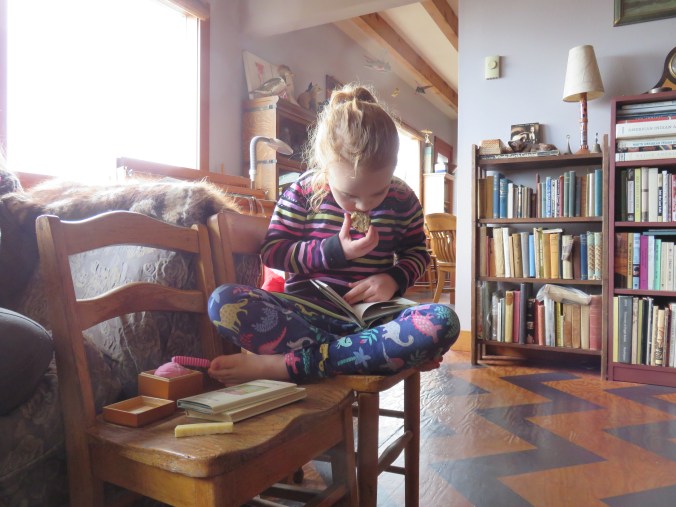
My granddaughter Ruby with her chosen books, cross-legged on a little chair, and making that one cookie last as long as possible.

I buy books. My husband buys books. We have, on occasion, vowed to stop, but we do not stop. We buy more books. Purchasing books is no cheaper than smoking or drug use, but this habit will not kill either of us.

We buy books.

We buy books from second-hand vendors and the local stores and Powell’s Book Store in Portland. We buy from independent small presses. We read about them online.

We buy books that make us suck our breath. Books for the past and future. We buy books that tell us our own story. We buy books that tell us a story we have never heard before. We buy books because we are not in district for the local lending library and the school library has a tiny collection. We buy books because we like to own books, and because the books we want will never be in our local libraries. We buy books because that is how authors make a living. We buy books to reread. We buy books because I write them. We buy books to covet and collect and loan to friends. We buy books for photographs and poetry. We buy books we cannot read because they are in Icelandic or Greek.

We look to books for laugher and tears. We look for education. Inspiration. Peace and hope and joy. Possibility. Truth.

A bird in the house is supposed to foretell death. Books are different. We buy books because research shows that just having books in a house with children will cause them to do better in school. A blessing.

We buy books to find lives we will never live.

We buy books to find ideas we do not have time to explore without help.

We buy books to find the other side.

We buy old books and out of print books and books that contain references we cannot find in the edition we already own. We order books we hear about and books we read about and books we wish we’d written ourselves.

We have books written originally in English and books in translation. We have books we still have not read. We have books bought in duplicate because we forgot we already had a copy. We have multiple translations of the same text, in order to place them side by side and judge for ourselves.

We have books we struggle to read because they are complex. We struggle reading books we do not have the training to understand. We read books that are over our heads and require additional sources to follow.

We never highlight with yellow markers or underline or dog ear—an abuse of pages. We use bookmarks and post-it note, tabs to help us back to the lines we want. We treasure and treat these books with the respect they deserve. All our dreams and goals and desires fit along their lines.

It is not true that you cannot have too many books. We have too many books. I feel a little guilty for having four pairs of black boots, but I do not feel guilty for owning the entire Patrick O’Brian series, even though I have already read them each twice.

We have filled many bookcases, sorted through and organized them by genre, subject, and author. (We do not sort books by the color of their bindings—an abominable habit we would never inflict on friends.) We give books away—we buy new copies to give. We loan them to friends who are gentle with them. When the bookcases become too tight to allow another purchase, we sort and we make the hard choice to allow some to reenter the world outside our door. Then we buy more.

We buy them so that they are ours and belong in our home.

For as long as I have had days, there have been books in my house.

We buy books.

NOTE: It was 85 years ago today that the Nazis burned books. Buy a book and let it burnish your brain instead.


SaveSave

SaveSave

PURPLE

IMG_2032

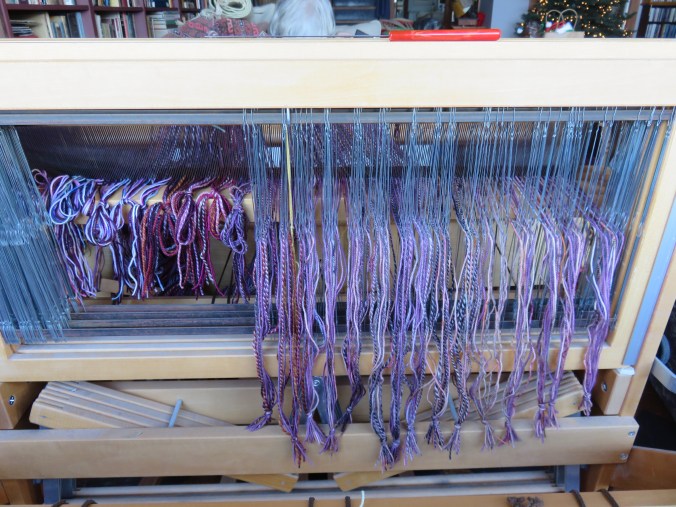
Canadian hand painted and hand spun merino yarn going on the loom.

My favorite pair of gloves are purple. They are not quite dark enough because I want the shade to conceal stains. I want it to work, but I also prefer the shadows. My walls are painted pale tints of plummy gray, but what draws me to purple is the darkness. Purple has a royal association for many people. It is beautiful. It is sometimes called a sophisticated color, but I think of berry stains on my fingers from picking salal. It also reminds me of pain. As one example, I have been thrown from horses, kicked and bitten by them. People do die falling from a horse, but for pure suffering during recovery, I cannot recall anything more painful than that perfect purple-dark bruise risen on my shoulder that took a month to begin fading. That is what I think of first when I think of purple.

Many things that are called purple are not purple at all. Male purple finches have a reddish head. Purple prose is the overblown decorative fluff that gives English teachers an upset stomach. On the other hand, blueberries are more purple than blue. The indigenous blue huckleberries make purple pies. Carrots were originally a purple root—the orange we know today is a sport that became so popular in Europe the original color is an oddity in modern times. Few would consider purple carrots anything but fantasy.

The tall flower spikes of Digitalis purpurea, as its name suggests, is usually light purple. When we were young, my girlfriends and I plucked the hollow flowers from foxglove spires as tall as ourselves. They bloomed on the edge of the woods and we slipped a glove onto each finger. We knew the flowers (and the stems, leaves, and roots) are toxic. Digitalis is the medicine my grandfather took for his heart, and too much can kill, but we ran with our purple-gloved fingers fanned before us in games. I always assumed that the foxglove of childhood games and that I see along my drive to work each June is native. But it is an invasive species, just another European like most of my ancestors. Maybe this is the source of my complicated love affair with purple.

The Purple Heart is a military award for physical injury in the field of battle—implying nothing about the actions of the wounded, other than to honor the wound.

Pretty purple things, amethyst and iolite and tanzanite and the opaque sugilite. The thick petals of orchids can be many colors, but the color “orchid” is violet. I have dyed wool lavender with iris flowers. That iris tint fades in sunlight. It is fragrance as much as hue: violets and lavender, the tuberose, iris, lilac scents. Somehow I associate purple as much with folly as with bloom—the pain bruises.

Yet, as a textile artist, it is the color I reach for, covet, value and strand in weaving. I choose purple to spice yellows or orange in a composition, to spark pinks or green. It is a hue that wants to shove gray around. And that is probably appropriate since purple has a long association with power. The ancient Tyrian purple dye worn by popes and sovereigns for thousands of years was harvested from the mucous of three species of predatory sea snails, known collectively as Murex. The fluid protects the unhatched eggs of the shellfish and drives off predators. It can be harvested by killing the snail, but also through “milking” the mucous gland of the creature. Rare but stubborn, the color, a clear reddish-violet to my modern eye, withstands fading through wear, light, and washing. The dye was already ancient when Aristotle, who was so right about some principles and so very wrong about so many particulars, detailed its production.

In the mid-nineteenth century, a British chemist invented the first aniline dye, originally called Tyrian purple and then marketed as mauve, a delicate, slightly grayed, reddish-purple. It is on the edge of being a cool color, found on the color wheel opposite yellow-greens.

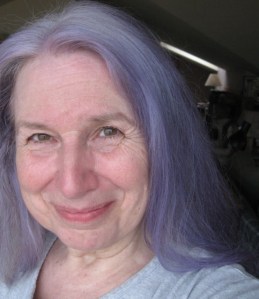
In youth I leaned to warmer colors—orange, vermillion, russet reds, dusty pinks, burgundy, and wine red. My preferences changed over the years and purple moved from a supporting role in accessories to center stage. This shift is reflected not only in what I wear, but in what I want to touch. I wore bellbottoms striped in black, lime, pink, and purple when I was fourteen. I dyed my hair purple when I was sixty, a joke on the old ladies of my childhood who used rinses to counter yellowing that turned their gray hair distinctly violet.

me14c

Purple is the foil that makes paler, more timid tints dance. Purple is the look-at-me color, associated with power, with royalty, nobility, Lent, Easter, and Mardi Gras, but very rarely named as favorite. Studies suggest that it is a color preferred by artistic folk, more often women than men, older adults rather than younger ones, and that was the character of the room.

Sandra Cisneros had to fight conservative design review to paint her San Antonio, Texas Victorian home periwinkle blue, a pale blue-violet tint by my estimation, and proved to be historically accurate. There are painted ladies in San Francisco—not women, but the grand tall Victorian mansions of that city—painted in shades of violet. A favorite house in Seattle is a smokey violet shade I found on a paint chip called “Steson” with a bright red door. Hyacinth macaws are purple, and the queen of England is known to wear tints of that particular blue-violet. It is stitched into the border of a a sari or the facing of an Afghan dress.

It makes a pattern in concrete sidewalks. Clear glass pavers were made with manganese to clarify the glass, but eventually the iron that once clouded the glass swaps ions with manganese and over years of exposure to sunlight, the clear glass turns purple. City sidewalks built with glass “prisms” faceted to direct light to anyone working in the spaces beneath. There are such sidewalks across the country in Texas and British Columbia, Seattle and New York City. Many have been damaged over the years, but the surviving glass in sidewalks is generally quite purple.

Violet is on the edge of wavelength in light that humans can see. Shorter X-rays and gamma rays and ultraviolet exist beyond the visible violet, just as microwaves and radio waves lie on the other side of the light spectrum beyond red. The rainbow shows purple inside the sweep to fairy gold. Some gifts seem the work of the supernatural. In The Color Purple, while discussing their view of God, Shug tells Celie she thinks God wants to be loved, “I think it pisses God off when you walk by the color purple in a field and don’t notice it.” We are supposed to appreciate the gift.

We are supposed to appreciate the gift of that richness and precarious pleasure, the flower that blooms for a day, the shellfish that guards its eggs with purple mucous, the semi-precious gemstone, the pebble in the water, and even the fresh bump on an elbow, the toxic flower cups that fit on fingertips, the fine line between the violet we can see and the next shade over that is invisible to our eyes. There is beauty, but concealment too, a warning both ways. My purple gloves are meant only to protect my hands from the cold. In sunny weather I require some other protection. It is ultraviolet that burns our skin.

IMG_0778

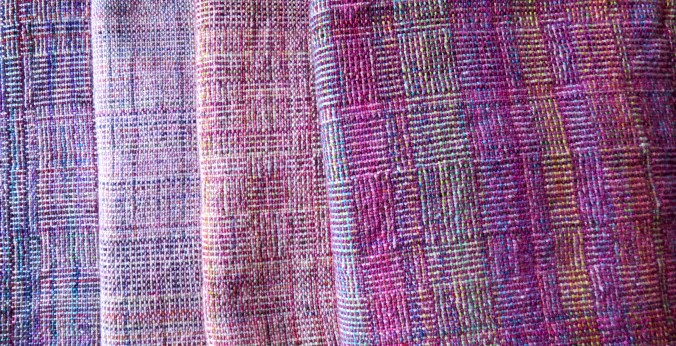
Four scarves woven on the warp shown at the top. The weft is completely different in each.

READING MEN

d5wxnck0quim9bosyfdo.jpg

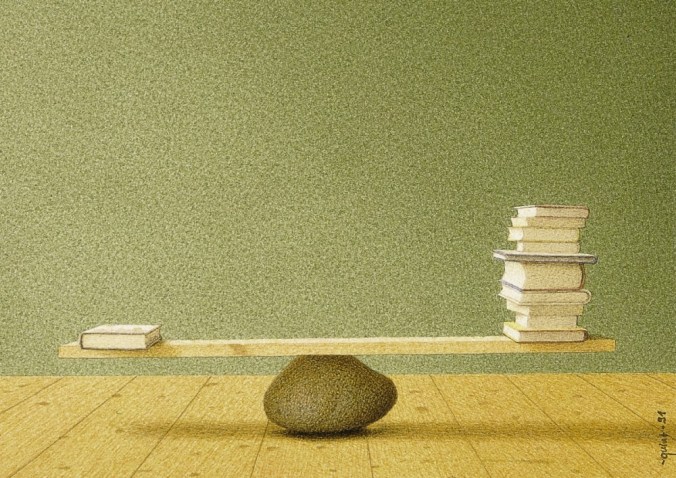
Book Scales by Quint Buchholz (1991)

So now it’s Junot Díaz accused of abusive behaviors toward women.* I wish I could say I was surprised.

Karina Maria Cabrera wrestled with how to respond to the news, with how to reconcile her own ugly experience with Diaz and her indoctrinated impulse to make excuses for him, and to resent the accuser who called him out. In “The Reckoning: What Junot Díaz Teaches Us About Internalized Misogyny” she writes:

“I had to reevaluate my anger towards Clemmons and examine why I wanted—for even a brief second—to justify Díaz’s actions. I told my mom about wanting to write about my reaction; she metaphorically clutched her pearls and said ‘No. Don’t do that! If you do, you better say he was very respectful towards you. Don’t add flames to the fire.’

“That’s when it clicked: The root of the issue is in the way women are wired to think. It is a systematic modus operandi that has been passed down to us from generation to generation. . . .

“As a child, I did not always feel protected, because we were taught to ‘save face.’ But I want my daughter to feel protected, and I want her daughter to feel empowered, and I want her daughter to feel invincible. If that means going against the grain and saving ourselves instead of saving face, then that’s exactly what we should do.”

Today, we can tell our stories and the stories can be believed. We are willing to hear voices and read beyond the chosen perspectives I was offered as a child.

As a student, the only novels ever assigned to me were written by men. Anne Frank was still part of the public school canon, but all the fiction was by white men such as Hemingway, Goldman, Twain. This barely changed in graduate school. A college class on African Arts (literature, music, visual art) gave me Things Fall Apart, but my MFA program gave me the excellent short stories of Ron Carlson and Stuart Dybek. I had to find women such as Jane Austen, the Brontës, Dorothy Sayers, Alice Munro, Maxine Hong Kingston, and Toni Morrison on my own. A student gave me Middlemarch. There is an enormous list of authors, men and women of many races, ethnicities, nationalities, and sexual orientations I can recommend. My shelves (and I have thousands of books) represent a huge range of perspectives, but I hope there is nothing bigoted or deliberately cruel pressing up against my favorites.

At the top of this post there should be an image of great authors representing a range of voices instead of merely the ones I was taught. I tried to find such a collage of authors. I searched a thousand images and mostly found composites of author images are white and male. (For composers too.) I nearly chose Virginia Wolf in the midst of 29 white men. Where is George Elliot? Where is Jane Austen? Linda Hogan? Le Guin? Erdrich? Shields? Silko? Or in alphabetical order—Atwood, Byatt, Chopin, Cisneros, Drabble . . .

We need more. More voices. Unheard voices.

Some much-praised authors wear thin. As a woman I find that my existence barely registers in the brilliant novels of Cormac McCarthy. I read the Border Trilogy and that was enough. Some authors are so hostile toward women, I have avoided their work altogether. Juno Díaz was one of those. I did try. My impression was not so unreasonable. I felt my existence demeaned. I set it down. Don’t I already get that every day of my life, everywhere I look?

Sometimes it is possible to see it coming.

Recent news of Alexie’s abuse of women, confirmation by no less than Joy Harjo that complaints have been ongoing for years, and especially his semi-apology should not surprise anyone either sheers. It is clear in his memoir that his perception of suffering is entirely selfish. At no point in this memoir does he reveal any depth of appreciation for the suffering or pain of anyone but himself. Despite his skill as a writer, I do not understood the apparent widespread “love” of this memoir. His short stories are often brilliant and that is why I have slogged through his earlier unfortunate novels.

“Believe me, believe me, believe me.” Ever since I read Sherman Alexie’s memoir, You Don’t Have to Say You Love Me, the song has been running through my head. You could find it on YouTube, but if Dusty Springfield’s voice doesn’t come right up out of your memory, best to leave it alone. You may find yourself walking in time to the tune for the next few days. Maybe that isn’t so bad. It’s a great old song.

Alexie’s memoir is likely to stick around in my head for a while too. I don’t have much in common with Alexie since he is an “urban Indian” and a man and fifteen years younger than I am. He was raised poor and on a reservation and, while I was raised on a dirt road with open ditches and poverty all around me. My parents chose that house because the schools were good. My father was also an alcoholic. Maybe. But he worked and brought home his paycheck. We always had milk in the house, even if it was powdered. He died. I loved him very much. We have that in common. But I am a woman and a mother and faithful to my marriage. I often blame myself for my parenting mistakes. We might have that in common. Sherman blames his mother.

The memoir offers short vignettes, longer scenes, words cut into lines and stanzas that sometimes are poems and sometimes have other business. It began strong, but ultimately this book does not reveal the wisdom of hindsight or the generosity of objectivity or compassion. This is thrashing. This is struggle. This is aggressive self defense.

I loved Sherman’s first collection of short stories. My friend Kathie Werner lent me her ARC and we invited him to talk to my high school students and to read in Cannon Beach based on that book. We are a largely rural and poor community. Alexie and his bride stopped off for these events on the Oregon coast before completing their journey home after their honeymoon in Hawaii.

Disclosure: I should mention that I have read his books, that my friend teaches The Absolutely True Diary of a Part-Time Indian, which has considerable connection to Alexie’s real life, that when I was teaching literature I taught his short stories, and this author made my husband cry. I bear a grudge concerning that last. It is unfair, probably, but I have not forgiven Sherman Alexie any more than he has forgiven his mother. But then, Alexie is not in my family. I was not raised in poverty, but my husband was. I am not always a kind person, but my husband nearly always is. So I am a skeptic when it comes to Sherman Alexie. I am a fan, but I do not trust him.

The strength in this memoir is the writing itself, which is sometimes brilliant and occasionally even humble and honest. Too often he is defensive. Mostly he is churning with guilt and anger and not managing any forward movement. He is eager to label himself bipolar. He expresses tremendous guilt and resentment for his estrangement from his mother, for not speaking to her for days and weeks and even years at a time. But he blames her for it. Like many children of bad fathers, he blames his mother for his sad childhood. As a woman and a mother myself and not his, I find that bizarre. I take it too personally, you might think. I am a feminist and a class warrior. I am also weary of people who hold their mothers responsible for all the sorrow in their childhood.

Big message here: Everybody’s mother dies. None of us is perfect.

Alexie’s mother stopped drinking when he was a little child and struggled to support her children and her husband. She also moved onto the living room couch, a move she explains as a step up from memories of being crowded in bed with siblings. At least sleeping on the couch, on a succession of couches, she did not have to share. Alexie accepts and even defends this explanation. I wonder that he never considers the likelihood that she no longer wanted to sleep with her drunken husband, that she did not want to take a chance on another pregnancy? That while she may have still cared for Sherman Senior, she was not willing to sleep with him stinking of “alcohol and vomit and piss and shit”?

Sherman Alexie is an aggressive and angry man. He cannot stand outside himself in order to see his experiences fairly. He has suffered in his life, he has suffered terribly, and perhaps that is why he is quick to anger and quick to exact revenge for any real or imagined slight. My impulse is to call his attacks in this book “counting coup” but counting coup is honorable, a show of courage and skill. These attacks are self-justifying, snarky, and often unfair. Sometimes they are not even skillfully written.

I was still young when I first met him, and Alexie was much younger with several books of poetry and only that first collection of fiction when he told my students he wrote prose for the money. If he didn’t need to sell his work he would stick to poetry. That might be the major difference between us.

Like his mother, I am a quilter. My father died in 1986 and my mother died in 2007, a week after graduation from my MFA program. After my mother died I grieved. Everything went dull and even my writing withered for a time. My husband and I had cared for her in her last five years. When she apologized to me: “I was mean to you” I responded with absolute sincerity that she never was. But she was. She did hurt me. She bullied me and criticized and was an imperfect mother. She was also kind and helpful and supportive in most ways. It took some time after her death for me to appreciate that this is the best anyone might hope for.

According to this memoir, Lilian Alexie could be kind and supportive but also verbally combative and abusive. When Alexie’s good friend died his father played hoops with him for hours. When, days later, he was still crying in his room, his mother opened his door and told him to snap out of it. He took his father’s action as proof of love and his mother’s as proof of cruelty. But which one got him out of bed?

Once or twice a year, Lilian would take it into her head to vacuum in the middle of the night. According to Alexie, this was completely inconsiderate and unbearable since woke everyone in the house. One night, because he was the strong kid willing to stand up to his mother, Alexie got out of bed, grabbed the vacuum and threw it out the door. Alexis here, as in nearly every scene, is the hero of his story. When I read this vignette, I sided with his mother. Who else ever bothered to vacuum? Who else was working, supporting the family, cooking and cleaning? She is the one who stayed. Alexis ran away and has never really returned. He might at least credit her for her willingness to remain with her family, even if chooses to question her motives.

Immediately after her husband died, Joan Didion wrote her memoir: The Year of Magical Thinking. After a lifetime of journalism and research, Didion did what she had always done. She reported with objectivity and poetry about her experience. The result is truthful and beautiful and a powerful exploration of loss and death.

Alexie has not done so well. He is too angry and guilty, eager to assign blame and to score points on every person who ever hurt his feelings. He is angry at the man who abused him as a child (me too). He wants everyone in the audience to admire and cheer him, not just most. He is also angry at the SW Native American woman who called him out for his claim to be the voice of all Indians. It was a claim he made in my classroom when he was still in his twenties and later speaking on a panel of people about shared issues of people of color. If Sherman Alexie is to be believed, his suffering is the worst, his people have suffered the most, no one else knows the sorrow he has seem. No one but he has the courage to say it. Only he can tell truth. These feelings are not entirely unjustified, but they get in the way. He has been angry for all this time.

I was put off that he quoted liberally from another Native American author without once naming his source, or even revealing that his rant was not in his own words but the borrowed words of another. The man has an amazing memory, but even I recognized long passages from Vine Deloria.

He claims his mother was the last Spokane fluent in the language, but that he never learned a single word of that language. I mentioned that to my husband, who found both claims unlikely. For a while in the 1970s, my husband was one of a handful of fluent speakers of Puget Coast Salish. During a reading he said a name to Sherman Alexie, the name of a Spokane Indian, and my husband pronounced it perfectly. Sherman walked close and demanded, “What did you say?” but my husband would not repeat it. “I have some naked pictures of your mother,” Alexie said. “I would like to see them,” my husband said. His mother had recently died. Two men wounding each other.

I have been paying attention since. Sherman Alexie and I have several mutual friends and acquaintances. Perhaps he is a wonderful father and devoted (if unfaithful) husband, but he was a neglectful son and he is not a man to tangle with unless you are prepared to bleed. None of us is perfect and most of us have a list of actions we are not proud of, but Alexie might do better to comes to terms with his own failures and his particular cruelty while criticizing his mother for similar behavior.

Like most memoirists, Alexie concedes that his version of events may not parallel versions told by others. Mary Karr warns at the beginning of Liar’s Club that her memories are not the same as her sister’s and mother’s. Mary McCarthy offers a similar disclaimer in Memories of a Catholic Girlhood. In his case, Alexie seems to allow for considerable stretchers. His is a memoir of personal convenience, occasionally confessional, but more often on the attack.

Alexie wrote this book and saw it published in the two years following his mother’s death at 78. He also had brain surgery. All of this is too quick. Unlike Didion, he does not have a lifetime habit allowing him to stand apart from his experience in order to tell his story objectively. He does not even try. These are powerful words, considerable rambling, some poetry, and some prose broken into lines and stanzas in a pretense of poetry. There is self-justification and enough fury and blame to waste what little insight this brilliant author might otherwise have shared.

Alexie declares himself an “urban Indian” in a way that is defensive and tough. He had a hard life and survived to move away. He has kept himself strong by keeping apart. There is a lot more guilt here. He needs to forgive his mother. More than that, he needs to forgive himself before he can recognize that he owes her more than forgiveness. She let him out.

He claims he is deliberately repetitive. He claims a lot of things here.

If readers take Alexie at his word, they might find a touching if erratic story of a heartbroken son struggling to come to terms with the death of his “complicated” mother. This book was promoted as a memoir about Alexie’s mother, about grief and family and loss and forgiveness. I found it mostly about getting even.

On the last page: “I don’t know how or when / My grieving will end, but I’m always / Relearning how to be human again.” I speak from experience: The grieving does not end, and the year or so after that loss there is almost no sense to it at all.

My advice to readers: Do not read this or his awful novels. Read The Absolutely True Diary of a Part-Time Indian which is a circuit of stories. Read the short stories and the poetry. Let Alexie come back in twenty years and write about his mother. At the least he may find some kindness. Maybe the truth isn’t funny, and Alexie wants that sharp wit like a stick to poke us. Maybe tenderness makes us vulnerable. It requires a difference sort of courage than a streetlight.

Believe him?

Like too many powerful men, he used his position and power to abuse women. This is how it goes. Men are abused, most often by other men, and then they take out their pain on women, and too often, we women accept it. It’s what we have been socialized to do.

I saw an on-air interview of Alexie with with Tavis Smiley where they talked about his memoir. They were soft-spoken and charming, but I found it impossible to believe either of them. Then Smiley himself was yanked from the air in response to accusations of abuse.

Who do I believe? Sometimes I trust my impressions. I trust my gut. I refuse to blame myself. And I prefer, when I get right down to it, reading authors who seem not to hate me.

*Junot Diaz Accused of Misconduct, and Responds, “I Take Responsibility for My Past”. “On Saturday, the Sydney Writers’ Festival said that Diaz had withdrawn from his remaining scheduled appearances at the event. The organizers emphasized their committment to providing a ‘supportive and safe environment for our authors and audiences alike.’ They noted the line in Diaz’s recent New Yorker essay—’Eventually the past finds you’—and stated, ‘As for so many in positions of power, the moment to reckon with the consequences of past behavior has arrived.’ “—Publishers Lunch

SaveSave

SaveSave

SaveSave

SaveSave

‘The Things I’ve Lost’ from Brevity

lost.jpgBrevity 22 

The Things I’ve Lost

by Brian Arundel

Fleece hat and gloves: in the backseat of a Boston cab in 2002, before driving back to Maine. Round, purple sunglasses: in an Atlanta pool hall over drinks with Ashby, whose wife was determined to save their marriage by having a baby. A measurable dose of self-skepticism: at about 14, when I realized I was very good at both playing violin and baseball, while not necessarily everyone else was. A school-wide presidential election in sixth grade, after I was drafted to run by Mrs. Sticoiu, the most frightening teacher in the school, while I was out of town. A copy of The Little Prince, in Mrs. Sticoiu’s class the previous year. A floppy disk that contained my paper on ideological subversion in Wendell Berry, the first essay I’d written after returning to graduate school following a four-year respite. A black scarf from Pigalle: somewhere in Maine before moving west.

The chance to kiss Leslie Wertmann, and, later, that redhead in seventh grade with a smile that could buckle steel—Kim, Christine, or Kathleen maybe—and the blonde at the freshman dance because I couldn’t recognize flirtations, even when told that I looked like Bruce Springsteen. My virginity: in 1980, a couple weeks short of 16, in a ritual so brief, awkward and forgettable that I have, in fact, forgotten it. My heart, or so I thought, in 1985, when Susie dumped me; my naivete, three months later, when I learned that she’d slept with at least three other guys I knew while we’d been dating.

Belief that my mother was somehow more than human: in 1972, the first time I saw her fall down after getting drunk. Belief that my father was more than human: a few months beforehand, after learning that he’d had an affair and was being thrown out of the house. The belief that my sister was stable: 1976, when she began pointing at random objects and saying their names, a few months before getting arrested, the first of many times, for disturbing the peace by refusing to leave a Western Union office until they gave her a job. A ten-dollar bill on a DC subway in 1985, on my way home to my friend Tommy’s, where I was staying after leaving my father’s house—after he’d moved back in, once my mother remarried and moved south.

The chance, in 1986, to meet Raymond Carver: the only person invited to sit in on an interview, I instead drank all night with friends and overslept. A quarter-inch off the tip of my left thumb, in 1987, while slicing Muenster cheese on an electric Hobart slicer. My shit, figuratively, that same summer when Bob Weir sang “Looks Like Rain” just as my acid trip was peaking at a two-night Dead stand in Roanoke, Va. The Buick a friend had given me as a tax write-off in 1996, which I let someone take for a test drive without holding collateral.

The thought that officials were somehow more evolved than those who elect them: in 1972, listening to my father explain the Watergate burglary. Faith in politics—particularly a two-party system relegated to fundraising contests perpetuated by shallow sound bites, mudslinging and outright lies for the Mindless American Voter so that each party can pursue a majority with which to repress the other, with complete disregard for actually trying to improve the lives of citizens: gradually over time, culminating in 2000. Fundamental hope that Americans really would overcome their vacuity, fear and greed to evolve beyond sheep determined to re-elect George W. Bush: 2004.

The ability to drink until late at night and go to work the next day without feeling like I need to be zipped inside a body bag: sometime in my early thirties. General insecurity and inadequacy: during the past seven years, as I’ve tried to allow myself to be loved without guilt or judgment. Self-pity and -importance, at least most days, while striving to look beyond the borders of my own desires in a steady ascent that some might refer to as maturation. The desire to remain in this country: since 2004. A black beret: in a Minneapolis bar, just a few days before relocating to Georgia in 1993. A taste for soy sausage patties: inexplicably, sometime in the past six months, leading up to a Saturday brunch three weeks ago.


Brian Arundel received an MFA in creative writing from Louisiana State University, and his fiction and nonfiction have appeared in numerous journals, including Mid-American Review, Under the Sun, The Strange Fruit and Bryant Literary Review. He works as an editor in Seattle, where he lives with his wife, Manuela.

from Brevity


The obvious thing is to make a list of things you have yourself lost. It was my first impulse, but at risk of being sentimental, I want to feel better, not sadder.

Do something else: consider what have you found.

Brainstorm a list of things you found: Your way out of the woods when you were seven years old; a rock with pinkish crystals; a lost kitten who eventually went home; a missing sock; single earrings, a gold chain, how to forgive yourself for losing your temper . . . make your own list of what may not even have been noticed as lost before it was found.


And perhaps most important—go read Brevity!