An imperturbable demeanor comes from perfect patience. Quiet minds cannot be perplexed or frightened, but go on in fortune and misfortune at their own private pace like a clock during a thunderstorm.—Robert Louis Stevenson
I was reading an article from The Guardian on how to deal with Christmas get-together challenges. The author led with “the turkey doesn’t fit in the oven.” [I love that turkey is the English Christmas dinner centerpiece, even though what they serve is a “New World” food, not actually indigenous to Europe. So are tomatoes, potatoes, what we call corn, and many squash and chilis. Often an “ancient” European, middle eastern, or Asian recipe includes an ingredient that simply was not available more than a hundred or a couple of hundred years ago—hardly ancient. When Shakespeare mentions “corn,” he does not mean the New World maize but another grain, probably barley.]
The article about the holiday dinner was funny and also spot on.
Pre-pandemic, we followed a simple route from coast to the city at least twice a month. We left home early and returned before dark. We shopped at the Farmers Market, saw family, went to the music store, visited the nursery, and walked through Powell’s Book Store. We were always in a hurry because of weather and darkness and animals waiting at home. Our last dog and our last cat are gone now, but the other big difference is that now we have a place to stay.
This is one of my favorite skies—when a roll of cloud sits out on the horizon, but the sky overhead is clear. You can see the sky reflected in wave-washed sand.Continue reading →
Responsibility or do I mean guilt? How I suffer for my mistakes. Regret. The I-shoulds or merely owning-up? I second guess myself a lot. I question my own motives and spend more time doubting myself than feeling confident I have done the right thing. I mean to be fair. I hope to be kind. Always. I move the tide-stranded crab back to water.
This little crab was only a couple of inches across and we had never seen one this color before. It did not like us hovering near, but raised its tiny claws in self defense. Life wants to continue. Continue reading →
One of our tenants believes in the “good old days.” He is young. He thinks the fifties and sixties and seventies were times of idyllic freedom. I look at his long hair and think: You’d have been beaten half to death living around here in the 60s; you’d have been jailed for what you smoke. Times were only good in some ways and for some people. I had to wear a skirt to school every single day and had the bloody knees to show for it. School counselors, aptitude tests, and my own mother assumed my primary role in life was to get married and stay home with children. Gary was nearly expelled from school because his hair touched his collar and was not encouraged to pursue . . . anything beyond 9-5 employment or perhaps death in the war. (Gary graduated with honors from the UW and Phi Beta Kappa. He dropped out of grad school to care for his family while his father was dying of cancer.) Our opportunities were limited by gender and class and the draft. And we are reasonably smart and able white people. (So is our tenant, which might be another reason he’s nostalgic for a time that only looks good if you don’t look too closely.)
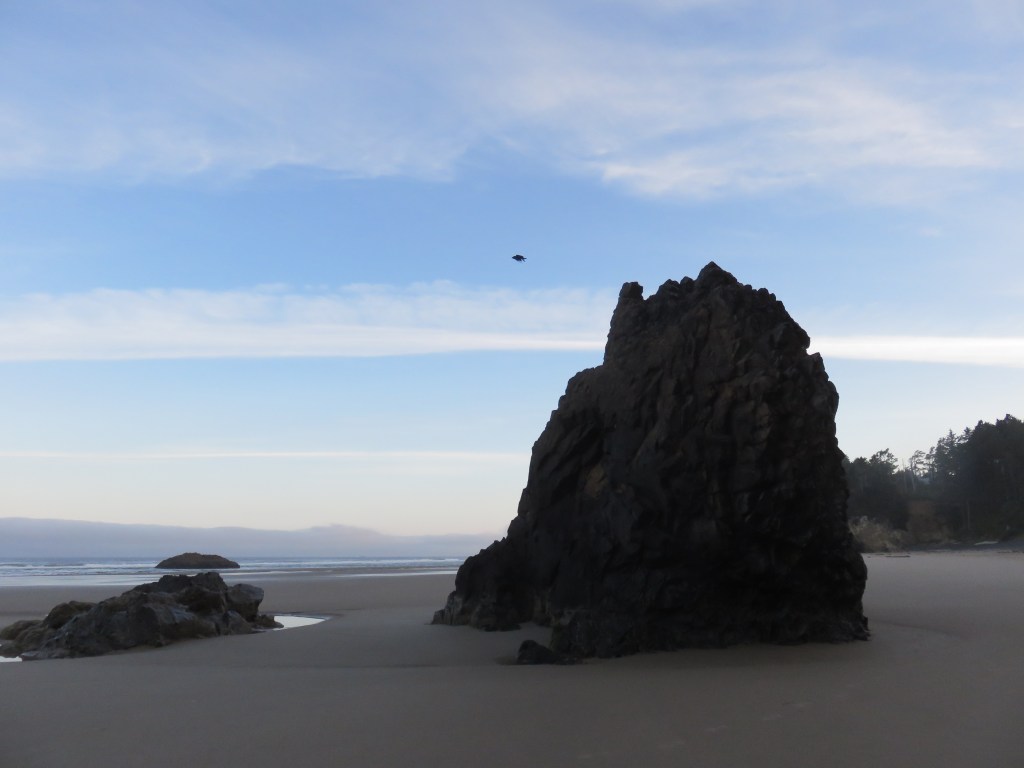
A crow was perched on top of what we term the “turnaround rock” because walking to and around it marks a three-mile journey from our home. That crow flew the instant I took my camera out of my pocket—the little black blot in the middle of the photo. I’ve been running a nine-minute mile three or four times a week, usually right past this rock. On the back side, the ocean goes quiet.
My 50-year high school reunion was this past weekend, about 200 miles north of where I’ve lived since soon after my undergraduate years. I did not attend. The group photo shows a fraction of my 600 fellow graduates standing shoulder to shoulder. Only a handful wear masks. A friend said she could not recall the events reported to her about shared high school experiences. But I wonder who of us can remember all events important to other people? In the group photograph she and her husband are the only people I immediately recognize.
“Write about a time when you chose to push against despair and bleakness. How did love, humor, and hope persist despite dire circumstances?”
—writing prompt from Arundhati Roy
We’ve only been seeing one black oystercatcher, here taking a bath, in the creek on our walk north. There were three last month. We hope that means a pair raised their baby and then two of the three left home.
During the years my mother was dying and we were generally exhausted, stressed, and gaining weight, but some things seemed funny.
The third night in a row driving home from the ER in the dark and a bull elk jumped in front of the car. We didn’t hit it.
Spending every anniversary, five years in a row in the ER and Mom was only dehydrated. A lot of visits to the ER.
The ER doc telling a friend that he had to drive two hours to work in Seaside because no other ER in the state would hire him.
My favorite was a (visiting/resident?) doc with rings and tattoos all over her face who asked me, “Have you ever seen an Xray of your mother’s spine?” I hadn’t. She put it up, showed how insanely out-of-line and titled her vertebra were. “It’s amazing she can sit up.” Not funny, but revelatory.
The final joke was after Mom died and we were clearing her rooms. No one wanted her electric wheelchair, an expensive machine which Medicare paid for. We tried giving it to hospitals, clinics, charities. We tried returning it to the company that provided it. No one wanted the “liability” of a used wheelchair. Finally, Gary drove over the assisted living facility and left it in the entrance. There were often chairs parked in the entrance.
Every time we drove past, Gary would say: Wheelchair! This made it possible for me to pass the place where she died every workday for the next twelve years without crying. I thought, Wheelchair!
My mother was a dear, sweet, controlling, and marginally mentally ill person. She was the daughter of a single mother, on whatever prescription antidepressant was going when I was an adolescent in the 60s, was in group therapy, had a hysterectomy, and daddy issues. She had mad organizational skills and was highly valued everywhere she worked. She was a feminist who seriously expected her daughter to marry a man who would take care of her, but whose daughter would also “have a skill to fall back on.” It was only after she died that it dawned on me how insulting it was the the skill she thought I would need to fall back on was typing. Typing. No offense to secretaries everywhere, but office work was never going to suit me, and I was smart enough in school and a strong math student. Accounting might have been a better choice should my imaginary marriage to my mother’s imaginary attorney end in divorce. She told me what to do almost always—what colors to wear, “put on some lipstick,” how to arrange my hair, furniture and appliances I should or should not buy. (If I didn’t purchase items she thought I should have, she’d buy it for me and then send a check of an equal amount to my brother.) I did not always do as I was told, but I was not paranoid about her “advice.” I was at least forty before I understood that not all mothers were still dictating behavior to their adult children. I have struggled not to repeat her mistakes.
Her grandchildren adored her, but even they were scared to be in the car with her. I tried talking to the DMV about revoking her driver’s license. The woman at the window said: “I would never do that to my mother.” But since someone’s 80-year-old mother had driven straight into the side of my car while my little boys were in the backseat, I was more concerned about what my mother might do to someone else. Our solution? Gary kept borrowing her car. Eventually, she became annoyed and insisted on having her car back. But by then I realized a sad but wonderful thing: my mother was no longer strong enough to depress the clutch. She might manage to get down the three steps and to her car unaided and into the car and start the engine, but she would stall it before she could leave the driveway. Gary and I laughed in relief when I told him. Good news for the safety of children everywhere!
Mom had her faults beyond what I have written here. All people have their faults and most do the best they are capable of doing. She was, on balance, a good mother and a great grandmother. She loved her family. Mom and I were close, as they say. We talked most every day, except when long distance calls were expensive on land lines and we lived in different states. Even during those years we talked for an hour at least once a week. We traveled together and saw movies, shared books. We were close.
I love my mother and miss her still. I think of her when something funny happens that would have made her laugh. Gary and I suspect she probably would have laughed about that wheelchair. She didn’t pay for it.
The first years we lived here, we did not see them at all. Perhaps we failed to pay attention when our sons were small, or perhaps they either flew right past or never came close enough to visit for long. Then in the ’90s, fourteen pelicans arrived one August and stayed in the area until the weather changed. Since then we have seen pelicans every summer. Often there have been fourteen.
A couple of people have commented that I have not been posting. My husband comments about that every couple of days. [It’s been almost a month, I think.] Gary is worried about me, and maybe I have even been a little worried about myself.
Yesterday, there was a young seal playing in the tide pool at the base of the sea stack we call “the seal.”
Not a fish trapped by the tide, or one of the sea lions or sea elephants we see more often. A true seal, and young though not a “baby.”Continue reading →
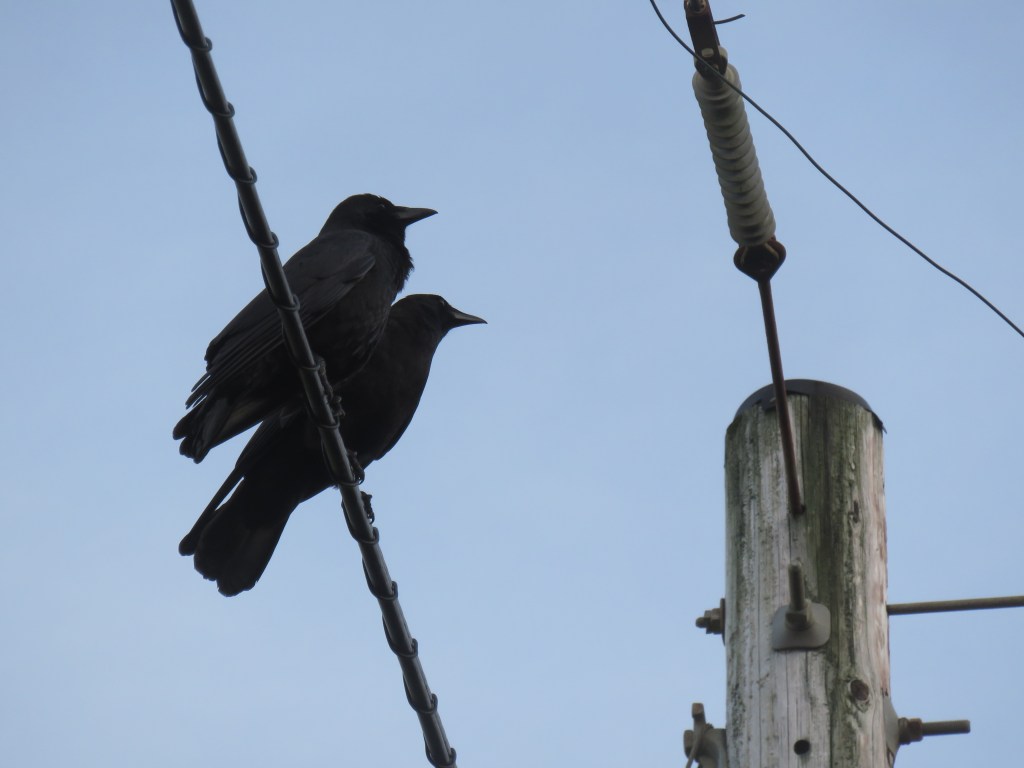
These two are nest-mates, we think, not pair-bonded. We see them every day in about this place on the power lines, near the Fentons’ home.
“I think deep down inside children are all the same,” she said. “They want two loving parents and they would prefer a house with a neighborhood they can play in. They want teachers that they can like. I don’t think children have changed that much. It’s the world that has changed.”




 &PRIDE Press