An imperturbable demeanor comes from perfect patience. Quiet minds cannot be perplexed or frightened, but go on in fortune and misfortune at their own private pace like a clock during a thunderstorm.—Robert Louis Stevenson
A friend asked me the other day about our beach walks. How far, how long, how fast? We basically walk north on the shore and then home, sometimes south too. If we can get over or around enough creeks and headlands, we might manage to get two miles north, four miles round trip. But it’s not that simple; we also walk into the rocky edges of the shoreline, east-west, up and down, over and over. I told her that when tides force us to walk on the highway we manage better than 20-minute miles. That’s not fast, but good enough. When I log distance, I mostly count North-South distance because it’s impossible for me to accurately record what our zigzag path covers.
Life is like that, isn’t it?
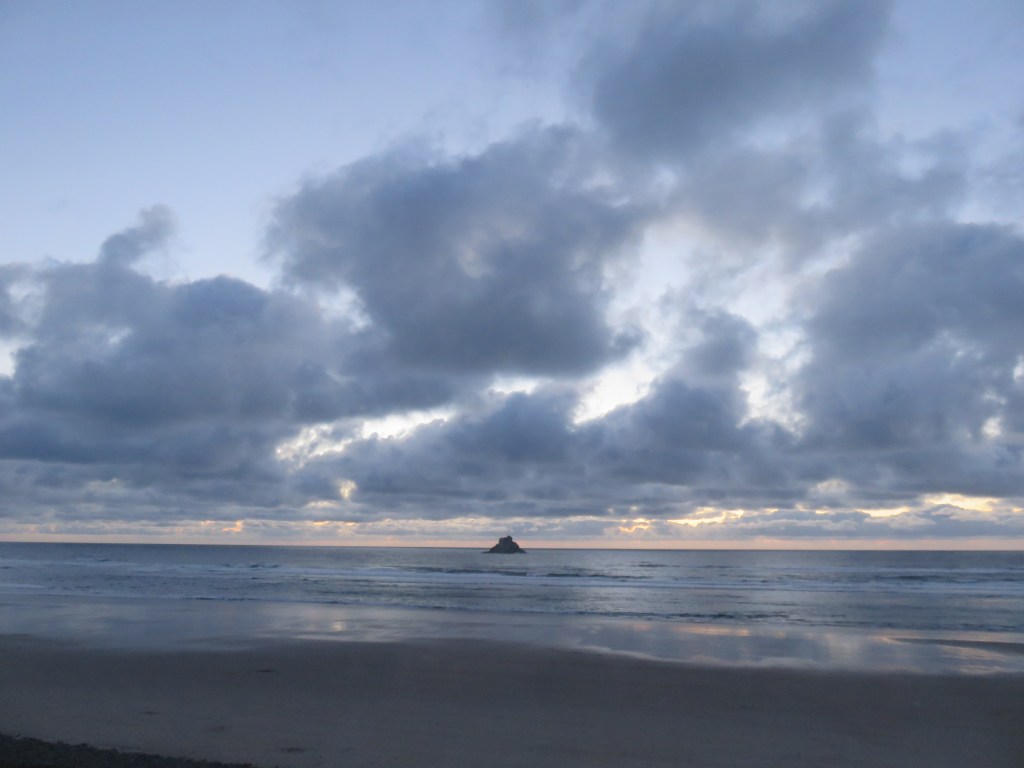
It is the sky I love. These cool colors ended a bright sunny day on 11 March. It marked more than a year in mostly-isolation. Most of our friends have been vaccinated, many have been ill.Continue reading →
Eagles are doing well. We see the mated pair that live on the cape nearly every morning.
Gary complained I had not posted. It is barely raining a little drizzle, there is sand, and we will have our walk. Lately, we find we cannot get more than a mile north because Shark Creek’s runoff is too high for us to cross, but we will go out as soon as there is light. Gary is dressing in the dark, and I will have a last sip of coffee. Neither of us have yet been vaccinated and we miss our family.
In the mean time, like so many others, we listen to music and hope for comfort, conversation, and more communal days.
Until last March, Gary and I picked up trash during our daily walks. In 2018 and 2019 we gathered about a ton of garbage, mostly tiny pieces or broken plastic and bottle caps, but also entire bottles, fishing tackle, toothbrushes, take-out containers, candy wrappers, toys, commercial and sport fishing gear, lengths of plastic rope a few inches or many yards long, and as you might guess from the photo below, polystyrene foam. We both seem to collect.
Yes, that’s just the way the beach foam was. Gary told me I should take a photo.
From romance to plastic trash to how we can all be in this together. I’ll try to explain.
When I was a graduate student studying literature, I first heard the theory that romantic love was an invention of European novelists. People felt lust and loyalty, but actual love between two people—sexual and romantic love—was a figment of playwrights’ imagination. (It’s a silly theory.) Canadian psychologist Nathaniel Brandon claims that “in primitive cultures the idea of romantic love did not exist at all.” Even Margaret Mead declared: “Romantic love as it occurs in our civilization, inextricably bound up with ideas of monogamy, exclusiveness, jealousy and undeviating fidelity does not occur in Samoa.” Freemason Lewis H. Morgan proposed the concept that marriage was the earliest human domestic institution but also judged “the passion of love was unknown among the barbarians. They are below the sentiment, which is the offspring of civilization and super added refinement of love was unknown among the barbarians.”
[Gary argues that most of what we have assumed about physical and cultural anthropology and archeology has been turned on its head in this century.]
However, a few decades ago this idea that romance was an invention of Western culture was taken seriously enough by an anthropologist that he decided to construct a research project. He used the archetypal story of star-crossed lovers—two people who abandon convention and family in order to be together. We might argue that such passion does not necessarily lead to a golden anniversary. Even Shakespeare, after all, was poking holes in the relationship between R & J. Nevertheless, the star-crossed lover story is not merely the story of lust or friendship, but of a passionate devotion that creates more than inconvenience, where two people defy their community, faith, and family to be together. He considered such stories might provide a warning, but their existence also demonstrated emotions that most of us would not hesitate to describe as romantic love. He searched for traditional stories and folktales from all over the world. Surprise! The star-crossed lovers story exists everywhere. In ancient Greece and the forests of Brazil and Madagascar and India, China, Europe, the Middle East, and the South Seas, such traditional stories exist everywhere. Individuals do fall in love and occasionally make enormous sacrifices, even of their lives, in order to be together. They fall in love and sacrifice for their devotion. The story exists in non-literate and literate cultures in every inhabited continent and within island cultures all around the world, even in cultures that otherwise seem to have no “romantic” tradition.
It’s possible that people lied. Maybe anthropologists, like everyone, found what they wanted and expected to find. More likely, love exists.
We are human beings and part of our shared humanity is that some stories persist in all cultures, in every corner of the world, and throughout time. Like the hero’s journey, the star-crossed lovers is likely a universal narrative. Lovers who defy convention and are willing to sacrifice safety and comfort in order to be together might be one of them.
Did I need an anthropologist to prove that to me? No, I actually did not. It is what I want and expect to find is true. It is Eurocentric hubris that inspired some foolish English-speaking academic to claim that romance was invented in Northern Europe. It is shallow to assume that the only way couples stay together is reproduction, envy, jealousy, rivalry, habit, boredom, or convention. Romance lives!
So. Take-out food.
“Few of us are equipped or inclined to cook three meals a day for ourselves.”
—Tom Sietsema, food critic for The Washington Post
Tom Sietsema wrote about his discovery that the take-out food he was eating during the pandemic creates a lot of trash. He was shocked, shocked to discover how much plastic his food required.
The article was titled “All my takeout has delivered a mountain of trash. So I asked experts how to minimize it.” Apparently he had not noticed how much trash his occupation as a food critic created until he was personally responsible for disposing of it. “For three weeks this summer, I saved every scrap of takeout packaging… The cups from cold-brew breaks and the cartons from sushi and burrito runs that used to be tossed out at the office and forgotten about are now our responsibility, up close and personal — in our faces. The problem is literally knocking at our door. We have to answer it.” (I want to know where he found grass to spread out his trash in Manhattan?)
How he had not known this already?
Soda and milk products came in glass when I was a girl. But the oil industry looked for a larger market and chose plastics, spending millions to convince us of a lie—that plastic was safe, cheap, and recyclable. Ultimately it is none of those things. The lesson here? Distrust the profit motive?
People were particularly irritated by this line: “Few of us are equipped or inclined to cook three meals a day for ourselves.” Commenters pointed out that preparing three meals was exactly what they did every day. We do not need to actually cook three meals because what about cold cereal and leftovers? A survey conducted in 2019 found that only 6% of Americans eat out daily. Gallup found that dining habits have been stable between 2003 and 2016 and close to 40% of those surveyed had not eaten out for even one meal in the previous week. Apparently even Sietsema’s readers don’t all eat the way he does. We should use containers made of materials that break down completely and quickly, he says. We should use our own flatware and reusable shopping bags.
Romantic love and plastic take-out containers—we assume that others’ habits and passions are just like ours. Maybe a literary critic had a bad break-up that lead to his cynicism about romantic love. A food critic assumed most everyone ate the way he does. We assume that what we do and value and desire is the same for everyone.
When I was in college, all shopping bags were still paper and the world did not come to a screaming halt because there were no plastic bags. The produce at Safeway was not continually misted with water and I put my veggies in paper bags. Milk only came in glass or waxed paper cartons. And in 1973, I carried my groceries home in a cotton canvas shopping bag imprinted with “Save a Tree.” I used that bag for years.
Today is Valentine’s Day and my husband is downstairs making coffee as I type. How we care for and feel about one another is not like anyone else. But love and passion, friendship and simple affection, loyalty and kindness, compassion and decency are all human emotions. We are all capable of changing our minds. We are all capable of fairness and altruism. We can figure things out. Maybe we fail sometimes. Perhaps all those good things are not functioning fully all the time or for everyone. But our best can be very fine indeed. We do not need to become a culture of outrage. Anger can drive needed change, but as a steady diet, love is healthier.
Take it easy on yourself today. Everyone needs a break sometimes. The human heart is vast; it contains multitudes.
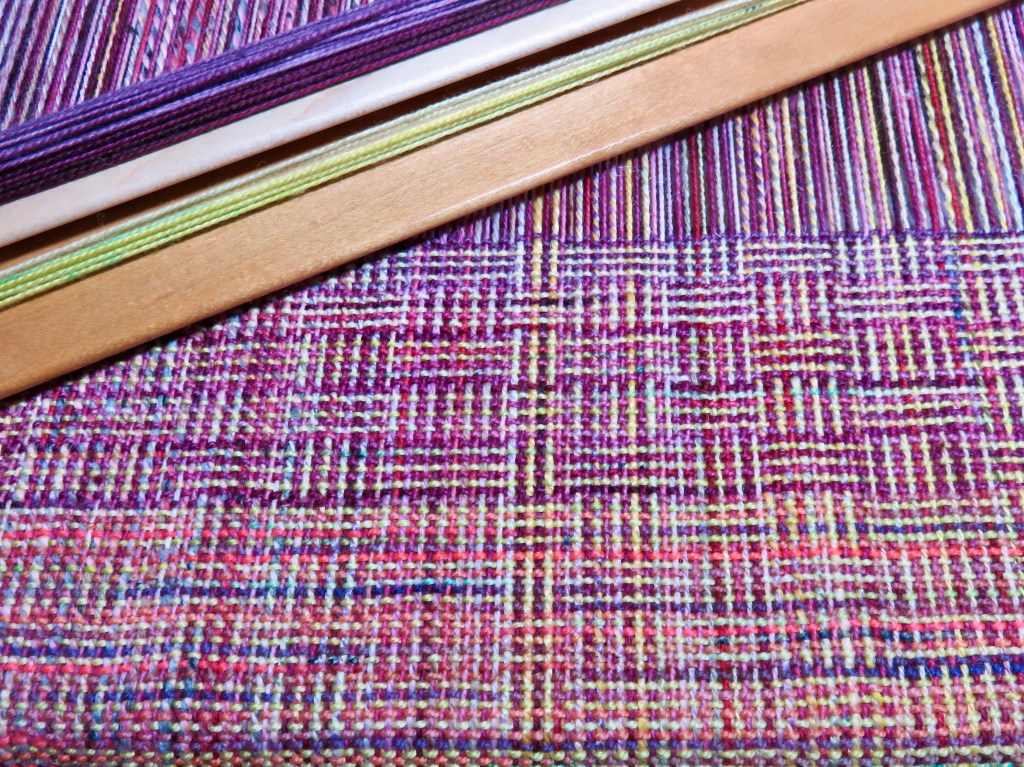
The blanket will only be 45″ by 85″ unless I put on a second warp and weave another (third) length. I could do that. I still have some handspun. As I work on the second length of this warp, I think more and more that I want that third length. It is a goal, and I need goals just now.
There are the needs of my husband, children, grandchildren, friends, students—the people who matter most—and then the things I do—reading, writing, playing with color and making meals. I read the newspaper every morning online—several newspapers. I look at real estate I cannot afford, I draw houses, something I have done since I was a little girl. I have worked for contractors and architects and directly for clients, and I have seen my plans built, but it won’t happen again. Next door someone is shoving mud around in the rain. It is a messy job. And my brain feels a little like that sometimes.
It is raining this morning, not hard but hard enough to provide an excuse for staying in. We walked long yesterday morning and the world was cold. There is snow at the summit of the coast range, but we aren’t driving anywhere today. We’ve had a fire in the wood stove every day for weeks. Rain means cloud cover and cloud cover means the temperature is up but there will be no gorgeous dawn or appaloosa sky.
The sky, the sky, the sky!
Everyone I talk to seems to be apologizing for forgetfulness and mistakes. The entire country might be on high blood pressure meds from the tension, or something to address depression, moodiness, forgetfulness, errors, confusion, and general stress. Zoom, FaceTime, phone calls, and email are temporary fixes. Our drugs of choice are only coffee and alcohol. Last night Gary and I shared sparkling wine that sent us off to bed in good spirits. Literal and figurative, emotional and physical good spirits. It was a celebration of nothing in particular, only that we are still here, still muddling along.
Our first dog was Oranje Anisette, Ann Ann, who was a year and a half old when she came to us in 1973. She had been owned by a Saluki breeder who found her character too gentle to be a fit for him. I had flown to Arizona to look at a bloodline I first met through magazine photos. I wanted to show Afghan Hounds. I was flexible aboust age and color, though I had been to enough dog shows by then to know that black dogs disappear in the ring. Ann Ann was black.
Ann Ann had hunted jack rabbits in the desert. She chased a squirrel twenty feet straight up a tree on the University of Washington campus. “Squirrels can climb trees?” Another time she actually caught one but spit it right out unharmed when I shrieked. Rain completely mystified her. “What is that stuff?” I walked her all over a wealthy Seattle district during breaks from my long studio hours, and she napped on my workbench in the Fire Arts Building on campus. The first time she saw a lure she was thrilled. It took her a couple of minutes to figure out she was chasing a shredded white plastic garbage bag. She stopped mid-course and trotted back to me. “That was kind of silly.” She finished her Canadian Championship. A sweet girl.
Our second Afghan Hound was Onika and I had driven with Canadian friends from Seattle to Colorado to see her as a puppy. There were five puppies in the pen when we arrived outside Fort Collins and the breeder was not yet home from work. The one girl who caught my eye over and over turned out to be Onika. Her mother was BOB at the first Colorado Grand National Field Trial—seeing that trial was the reason my Canadian friends made the trip. Onika later won both her majors owner-handled, but she died when she was chased onto the highway by a well-meaning neighbor in 1980. I sat in the garden and cried and cried.
Under the waterlily dome are two little cheeses, under the glass are the mince pies. I took the last loaf of cranberry bread out of the freezer, washed raspberries (an out-of-season treat). and made heart-shaped cookies out of the leftover hand pie dough. A candle burns.
We woke at the usual time, before 5am, only today I walked downstairs before Gary had finished making the coffee, and we sat together before the fire. This is not a “normal” morning because it is Christmas. It is not like last year when we soaked in the pool at the Kennedy School and watched our grandchildren unwrap gifts.
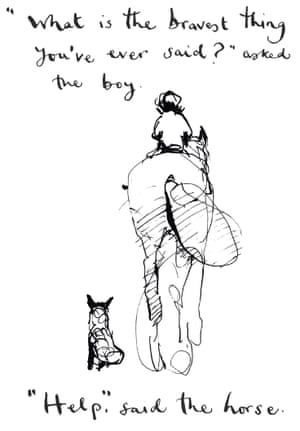
Some dismissed the book as empty calories, as saccharine and forgettable. I didn’t agree when I first read it a year ago. I disagree even more today. As a former student wrote yesterday: It’s been a year.
It’s been a year of illness and isolation, of struggle for many people working in dangerous conditions and without loved ones nearby, of honest words struggling to be heard.
This is one of those books like Winnie the Pooh and The Arrival and The Wolves in the Walls that I wish everyone read.
“Sometimes,” said the horse. “Sometimes what?” asked the boy. “Sometimes just getting up and carrying on is brave and magnificent.”
We could all use help about now—or those of us willing to ask.
There is no story here, but many gentle words of wisdom. And a mole who eats all the cake and then it happens again. And a fox. And a horse.
When I was young there were inspirational books all over the place with seagulls and kindergarten. This is like that or better. And the illustrations!
Yesterday, a neighbor’s dog went astray during their walk. We could hear Tim calling and calling. Gary said, “I hear his tags—he’s that way.” Oscar had turned up a side street toward the highway. We could not see him, and I could not hear a thing, but Gary has better ears. He found Oscar in a yard fifty feet from the highway, walked around and shooed him past me. A minute and Oscar heard Tim’s call and went running. It was a good day.
Our sons were both musical in school. Choirs have become particularly touching to us. Another sort of faith from mine, but it speaks me:
We Met a Deer

 We met a deer beside the wooded trail
 over the cape and east of the highway.
 I used to walk that way with my boys
 when they were young and eager.
 It is a long walk for a five year old.
 Miles away.

 Was it even possible to walk home
 the way we’d come? We never did.
 We returned north on the highway
 and through the tunnel, a scary path
 for any age. By then we were exhilarated,
 high on adventure and adrenaline, and eager
 to get home.

 The deer was afraid in her forest. She stood
 silent, still, breathing the same air we held
 in our chests. She willed us not to see.
 We stood still, silent, on the narrow trail
 above her. We watched, holding breath.
 We had been climbing for only a short time,
 up the north slope among alder trees,
 a lighter green than the spruce and hemlock
 we would find higher still.

 There is no leveling off
 on that early path,
 it is all up, then steeply down,
 always up on the right
 as we climb. Moss, ferns, mud,
 the dripping moisture.
 Then the Dark Fortress.
 Here at the crest, the land
 slopes steeply downhill
 on our right. Dry. The path
 nearly level. Evergreens
 grow darkly close together,
 like a crowd of giants’ legs,
 like a maze of massive pillars
 grown black and silent.
 We are near the ocean,
 a hundred meters above
 the highway, but while we stand
 and listen, we hear nothing.
 The ground is thirsty here
 and deep in duff, the dead
 needles of the spruce
 and hemlock trees, dropped
 a thousand million times,
 over a thousand seasons.
 Silent.

 The deer stood silent as if
 her stillness might make her safe.

 And then she turned her head,
 was gone.

 We moved on ourselves. We climbed
 and counted mushrooms. We walked up
 and up and up past creeks and perching birds
 and then through darkness, quiet,
 and finally down and down and down
 and through young alders to pavement
 again. We had listened for the highway,
 for the ocean, for the sound
 of our own footsteps, my little boys
 and me. Everything so still
 and far away. Quiet,

 until we are safe at home, and all
 our chatter and heat returns.
 Milk and brownies as reward
 for our long walk. “And we saw
 a deer,” they say.

 It was years ago. Perhaps my boys
 would not recall that day.
 They are grown men and too far away
 for me to ask.





 &PRIDE Press