An imperturbable demeanor comes from perfect patience. Quiet minds cannot be perplexed or frightened, but go on in fortune and misfortune at their own private pace like a clock during a thunderstorm.—Robert Louis Stevenson
We’ve been having an exciting spring so far, which reminds me of that Chinese curse: May you live in interesting times. It’s an English translation of a genuine Chinese curse, but I heard it when I was still quite young, perhaps in my 20s. Wikipedia reminds us of the obvious that the “expression is ironic: ‘interesting’ times are usually times of trouble.” I would add complication and challenge. Today’s interesting times mostly seem concerned with graft and bullying and self-aggrandizement. Alas, I am not the one profiting, gaining power, or advancing my image.
My best time was eight minutes and some seconds per mile (maybe more than thirty, but not much) over highway hills in the rain. I was a lot younger then, had been training for a half marathon in Seattle, and that fast run on steep hills resulted in injury.
But that’s not what we meant, is it?
We want my best time on vacation or during sex, or whatever. My best time as a writer. My best time writing or weaving or knitting or playing with my children.
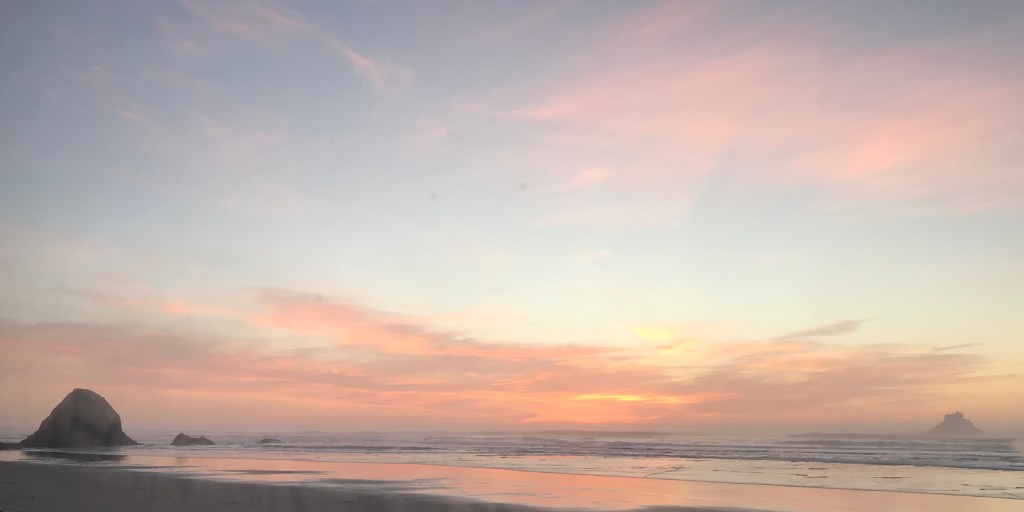
Sunsets are always pretty. We like the magenta and orange ones but also the palest gilt edges under horizon clouds.Continue reading →
I have been thinking a lot about housing during the past twenty-five years. My husband and I moved to the family home in Oregon in 1979 and started a family. It was what my grandfather’s third wife and her second husband hoped we would do when they left the home to us. It was a two bedroom, one and a half bath retirement home when we got here. We removed the half bath and added a bedroom and second bath. Two sons and six hundred square feet. My husband worked long hours and I stayed home with our children while they were small, which was financially challenging but also temporary. [We lived below the poverty line for some of those years, and I will never recover the lost income from remaining out of the workforce for those years. That’s another issue—instead of “affordable daycare” how about making it possible for parents to parent their own children without taking a crippling and permanent financial hit?]
Then my mother began a downward decline, a process that went on for years. Her driving was dangerous, she couldn’t see to read, never did like cooking, and my husband stopped by every day on his way to work to make her coffee. [If she’d taken better care of herself with a healthy diet and exercise… well, she lived to be 82, and most young people would see that as a ripe old age.] She was in pain and unsteady on her feet, would not take the suggestions of various helpers, and was in and out of assisted living for those last five years. It was crushing for her to live with the assistance of cooks and nurses and others, but she could not live without it.
There should be no shame in accepting what we need. There is no honor in taking more than we need. Yet we judge others by their living situation. I admit I do it myself.
Gary misses caring for our garden when we’re in the city, but this is where we walk. We have the whole of Forest Park, the Portland Japanese Garden and the Rose Garden within a mile, and we walk miles most days. When we are no longer able to do that, there is a small courtyard garden and the local front yards to enjoy.Continue reading →
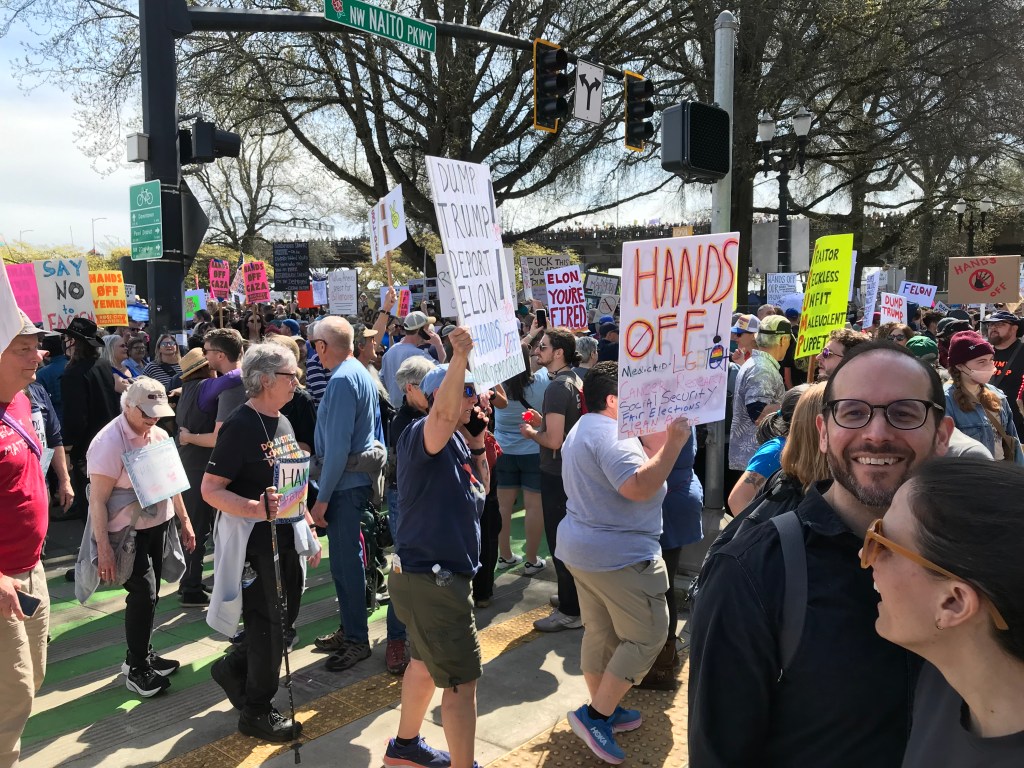
Yesterday, we marched with thousands locally, and with millions worldwide. I wish I could verify a number, but the government offices that used to do that aren’t allowed. There were babies strapped to a parent, children in strollers, others holding hands, young people and people with white hair. In the background of the photo is the Burnside Bridge. If you look closely, you can see it’s lined with more protesters waving and holding signs.
Idealism serves us now not in the achievement of it but in the striving toward it.
Most of the time, the crowd was too dense for me to take any photos at all. Some people turned their heads when I photographed their signs. I have protested every war since and including Viet Nam. I do believe I was photographed during those protests. Men in the iconic dark suits took my photo during the Seattle marches. But after Kent State, men in 3-piece suits and women in business attire and wearing heels walked out of downtown office buildings to join us.
This afternoon, we are having neighbors over for a meal. To that end, I started cream of mushroom soup yesterday (I still need to add the cream and maybe sour cream). First thing this morning there was a false fire alarm, probably someone burning sage? Not everyone evacuated. I’d done my Wordle and got “genius” on Spelling Bee with both pangrams [Wordpress thinks I’ve misspelled both focaccia and pangram—how to tell a computer to look the word up?], read an article about Beethoven’s aging genius, and searched without much luck for confirmation of number of the millions who protested yesterday. I got to pet the building Greyhound and talk to neighbors. Fire trucks came and then declared us okay to reenter. I have black olive focaccia in the oven.
I suspect the answer to that question is that too many of us want someone to blame. Someone who is lessor than ourselves. Someone to look down upon.
I found a meme on my Facebook feed claiming that LGBTQ+ people were asking that everyone else abandon their core values so that they can feel not alone. Nonsense! The purpose is not to force everyone to agree with a small group of people but to prevent a small group of people from forcing others to remain invisible. Some people seem to find the notion of allowing others to go their own way deeply offensive. Some seem to find shouting their bigotry as their god-given right.
Here’s what a former student had on his page. Some days I just feel like pissing some people off, but I hope you find this meme more ridiculous than offensive:
Decades ago now, a friend visiting with us became impatient with talk of high tide and low tide. “What does that even mean?” She was genuinely irritated, as if I’d made it up talk of tides to annoy her.
So I took her to a window and pointed at the Cape: “See where the waves are hitting the headland? Remember that.” And then I literally waited six hours before taking her back to the same window and pointing again at the Cape. “See how the surf is barely breaking on the seastack second out from the headland? What you saw before was high tide; this is low.”
The Cape and the first two seastacks during low tide, but not very low. There are at least two more revealed during a minus tide. Continue reading →
Most of the people I know are hanging on by the skin of their teeth, as my mother would say. We watch protective positions and entire systems being dismantled, people losing their jobs in a sluggish employment market, lies and more lies. And it’s probably just as well my mom is gone; this current situation would surely have killed her.
We have a few family members who supported the maniac destroying our country. One of them is a longtime supporter of Palestine, and he has gone quiet about his political views recently. Well. He would, wouldn’t he?
There is trouble brewing all over the world; I regret that my country is become a cause rather than a late-comer solution, as we were in two World Wars. Since then, we have gone to war in tiny countries where others had already withdrawn in defeat. I’m thinking of Vietnam and Afghanistan. Others have been trying to take over Afghanistan for a thousand years. Most recently Russia and the United States. We might ask what we thought we were doing and why.
We might ask what happens when we encourage people to fight a totalitarian regime, as we did with the Kurdish people in northern Iraq, and then failed to provide backup.
The more recent betrayal is Ukraine.
Why would anyone trust us?
Three creative works illustrate what is happening in the middle east.
2008 Israeli-Palestinian drama film describes the legal efforts of a Palestinian widow to stop the Israeli Defense Minister, her next door neighbor, from destroying the lemon trees in her family farm. At the same time, she develops a human bond with the minister’s wife.
.
In his new memoir, Omar El Akkad weaves his life experiences with the failure of Western liberalism to keep its promise.
“On October 25, 2023, after just three weeks of the bombardment of Gaza, Omar El Akkad put out a tweet: “One day, when it’s safe, when there’s no personal downside to calling a thing what it is, when it’s too late to hold anyone accountable, everyone will have always been against this.” This tweet has been viewed more than 10 million times. [Despite his publisher’s promotion, that tweet was not the impetus for this book.]
“As an immigrant who came to the West, El Akkad believed that it promised freedom. A place of justice for all. But in the past twenty years, reporting on the War on Terror, Ferguson, climate change, Black Lives Matter protests, and more, and watching the unmitigated slaughter in Gaza, El Akkad has come to the conclusion that much of what the West promises is a lie. That there will always be entire groups of human beings it has never intended to treat as fully human—not just Arabs or Muslims or immigrants, but whoever falls outside the boundaries of privilege. One Day, Everyone Will Have Always Been Against This is a chronicle of that painful realization, a moral grappling with what it means, as a citizen of the U.S., as a father, to carve out some sense of possibility in a time of carnage.”
“Basel Adra, a young Palestinian activist from Masafer Yatta, has been fighting his community’s mass expulsion by the Israeli occupation since childhood. Basel documents the gradual erasure of Masafer Yatta, as soldiers destroy the homes of families – the largest single act of forced transfer ever carried out in the occupied West Bank. He crosses paths with Yuval, an Israeli journalist who joins his struggle, and for over half a decade they fight against the expulsion while growing closer. Their complex bond is haunted by the extreme inequality between them: Basel, living under a brutal military occupation, and Yuval, unrestricted and free. This film, by a Palestinian-Israeli collective of four young activists, was co-created during the darkest, most terrifying times in the region, as an act of creative resistance to Apartheid and a search for a path towards equality and justice.”
Lemon Tree touched my heart long ago and Omar’s books—the best-selling novels American War and What Strange Paradise and this new work of nonfiction—are beautiful revelations. An Oscar-winner “Best Documentary” No Other Land is playing right around the corner, which is where my husband and I went to see it.
I was asked for advice about teaching fiction in a 12-week term. Over the years, I’ve been asked to design curriculum many times, usually by administrators who have never actually done that and don’t appreciate (or care?) the amount of work involved. I have never been paid and rarely even receive a thank-you for doing this. The work is consuming and exhausting, and I should have learned by now to say no, but I always do it. It’s interesting to me.
Though I was discouraged from teaching fiction, I assigned fiction every term I taught. Telling stories is what makes us human.
You might teach people how to write fiction this way:
Consider at the outset, how much homework, how much work you are willing to read as a teacher. Draft at least some of the writing in a writing fiction class by hand on paper. There is a difference once you type into a computer. Refuse to accept work that has been drafted using AI*. Watch students begin. Require all drafts be turned in. Do many very short low-stakes fragments and scenes. Explore craft, particularly considering sentence structure and tone, dialogue and scene, the magic that happens. Use the shorter assignments and reading to get to this. Advise students to watch for the assignment that gets away from them.
I have taught a workshop for teachers called “How to Teach Writing Without Making Your Eyes Bleed.” The title comes from an excellent AP teacher whose eyes literally bled every spring before her students took the AP test. Since I was teaching as many as 200 students at a time as a high school teacher (never that many teaching college classes), I have strategies. Among those: Grade writing only after it has been through revision. Grade only after work has been typed.
Outline everything they will have done by the end of term and share this with your students. Reassure them that your goal is not to turn them all into published writers (you won’t). Your goal is to help them to become better at story-telling and to understand what makes a story work for readers. Publication is another thing altogether. Most MFA graduates have learned nothing about publication.
Begin with an assigned short fiction. A 300-500-word fable works well because it fits single-spaced on a page and has very specific conventions, which relieves students from having to invent the wheel, so to speak. State the moral at the end. [It’s important to note that I read hundreds of their fables and they were always good.] I required MLA form for this assignment. I usually threw my students a twist or two for the second draft: add dialogue or change the point of view to first person. Usually both. I marked the stories for errors and required them to revise until the story was free of error—with no penalty if they needed another seven drafts to get there. If you keep it single-spaced on one page, it is entirely manageable to staple previous drafts behind. Assume three drafts or ten. This assignment will ensure everyone understands how to set up their pages and gives you a good overview of their skills (or lack thereof). Having them write the first draft in class may make sussing the AI-users easier.*
Throughout the term, have them read many good writers: Assign what you know will demonstrate the techniques you value in fiction. This is a discussion topic for one class period each week: read the assigned text and discuss it in class (a short story in the public domain works—check what they can find online, and if necessary make them read it in class and respond the same day).
Another series of weekly assignments might be the ones from Ursula K. Le Guin’s craft book, Steering the Craft—you can read each assignment aloud or require students purchase the text, which has a ton of great information! [I have created my own ten assignments geared to nonfiction writing.] I can recommended Stephen King’s craft book, which might be better than his novels. There are others.
Microfictions of 250 words ±25, can be tailored to emphasize specific skills such as POV or lists or conversation or scene. One due each week with a particular craft or scenario for each and including a specific word. For example: Tell a story with two people in a car driving to an event and one of them has a secret they want to tell, include the work “mask.” I had the class choose the “magic words” they must include because it gives them some ownership. They might write one each week for most of the term (10 in a 12-week class) or just eight. Stamp them as “completed on schedule” and then they turn them in all at once for credit, with a lengthened story stapled at the front—the only one graded.
All the above might be 50% of their grade for the term. Include discussions and peer editing of the first writing and of the longer one.
As a last assignment, a longer story of 4000-5000 or 2500-3500, ±2000, or even a flash fiction of ≤1000 words. This final story is the necessary goal, but find a way to be flexible if someone finds they cannot write to your required length. Maybe the story must be longer, or very short? For this assignment, I urge requiring Modern Manuscript Format (Shunn), which is standard for fiction and nonfiction submissions. There are many options concerning how you assign a short story and what you require. Be as flexible as possible. Good stories, in my experience, are born of pure magic. You can’t demand magic and we sometimes throw up out hands concerning how to start. You might suggest:
Begin with a true story you make more dramatic or set elsewhere;
choose familiar traditional story such as a fairytale, rewritten to take place here and now;
rewrite a news piece that makes you wonder and then create backstory and afterward;
examine a problem and solve it in the story;
expand a micro by complicating it or exploring more of that story;
develop an in-class writing based on Chris Van Allsburg’s illustration in The Mysteries of Harris Burdick. [find a used copy or individual illustrations online—or have students find any one of them and write a story for which the drawing is an illustration;
or just allow the short piece that’s getting away from you to grow, the voice that will not stop telling you their story, the question you find demands answering by showing you what happens but insists you get down every darned detail.
Chris Van Allsburg’s The Mysteries of Harris Burdick offers wonderful illustrations from an imaginary book. There is a collection of stories by famous authors based on these illustrations.
Evaluating a short story in-class might serve as a midterm or final, if you need one. You might offer students the choice of how to prove their skill by giving them a bad story to improve and/or explain why it’s not good and how it could be better. There are plenty of general “rules” about writing short fiction. Alice Munro deliberately and magnificently breaks most of them in her early collection, Friends of My Youth.
Some of the suggested assignment include what we now mostly call speculative or genre fiction. If that’s not your comfort zone, don’t go there. Stick to realist stories. Do what makes sense to you.
About drafts: Teach them drafting/revising to the point where the author is stuck, and to seek peer editing (or workshop), and revision right from the beginning. Most new writers will not have workshopped a story. Teach them to be gentle with one another. Point out that one gift of reading others’ work is recognizing what works and doesn’t and then applying those insights to our own writing. Remind them that creation involves risk, but that what is obvious to one person is invisible to another. Help them see more.
Workshopping: The goal for the reader is to express admiration of what works, ask questions to clarify confusion, and perhaps suggest where they want more or less on the page. It is not the reader’s job to “fix” anything; that is up to the writer. [Even editors who are very good at finding where work is needed are not helpful in telling the writer how to accomplish that work—though they will try—that work must remain in the writer’s hands.] You will have the occasional student who believes their first draft is perfect, every single time. They need to accept that they are wrong about that.
You may quote me: No one writes a perfect first draft. No one gets it right the first time, not even after hours of work on that first draft. We need to put that wonderful “perfect” draft away for a while, and then look at it with our own fresh eyes. There isn’t time in a course to do that properly, but even a day or two of not looking helps. After hard work and many drafts and setting it aside and workshopping (peer editing for adults) and staring at it till our eyes bleed (famous quote), we might get there.
Go online and search “How to workshop fiction?” you’ll find plenty of advice. The standard is everyone reads the text or the author does aloud, and then the author is silent while the group responds. The response is not thumbs up but a careful appreciation and evaluation: what works and what isn’t done. Yet. [That “yet” can hurt. Keep it in mind when offering feedback.]
Teach alternative chronology:
Teach the traditional plot triangle and why no one writes stories structured like that anymore;
warn about expository lumps;
teach the work of a scene, which has a person or people in a particular time doing something, even standing still and tapping their foot’s a reason for a scene—by establishing and revealing character, motivation, information, conflict—establishing, escalating, turning—and in this way moves the story forward;
likewise, every description contributes to our understanding of the story because how the flowers bloom or fade suggests the overall arc and mood of the fiction;
start the story with a scene pulled from the middle of action;
cut the first page (or four) of a story (this is sometimes “throat-clearing”);
and remind them that hack-and-slash butchery of their own work often makes it stronger because the author always knows more about their story that they put on the page.
One final point: This is a personal bug of mine. Bring bad work to workshop if it’s the best you have, because we all get stuck, can’t see our forest for the trees, need help. But first read the story aloud (if you stumble over a word or phrase try to figure out how to fix that). Then read it to someone or to the dog or the bathroom mirror. Bringing bad work to workshop is forgivable. Most of us write bad stuff before we get to the good. Bringing work that you haven’t already done what you can, at that time, is annoying. If we haven’t already read it aloud, checked for and repaired typos, ensured the story fits the assignment (save it for another time if it doesn’t), we are abusing our readers. Do not abuse your readers. Give them the best you can, even if you know it’s not good. Yet. Listen to what the readers say, find your own solutions. Have patience. Write another fifty drafts.
I was asked to design a 12-week class, and thought it was odd because in college, classes are usually in semesters (15 weeks) or quarters (10 weeks). And then I wrote most of this and set it off. No word from the person who asked. Not the first time I’ve been asked for help and heard nothing back.
*A former student who is a tenured professor tells their students that if it sounds to them as if the work was written by AI, regardless of whether it is or not, they will receive a D for the assignment. We don’t want our fiction manufactured by technology or sounding as if it were.
When I was teaching persuasive writing, I always began with frames—a general structure on which to hang ideas. The 5-paragraph essay I was taught when I was an adolescent seems pretty basic, but it’s not a bad place to start. An introductory paragraph explains the issue and ends with a thesis, the main idea. Three body paragraphs offer three supporting reasons. The conclusion restates everything. I generally added another paragraph just before the conclusion reviewing opposing views and explaining why they’re wrong.
It’s a beautiful dress and the embroidery tells many stories. As a visual and verbal artist, I care how everything looks on the page. Every word. Every line-break. This work was conceived by the visionary artist Kirstie Macleod. “The garment has been worked on by ‘367 women/girls, 11 men/boys and 2 non-binary artists from 51 countries‘, according to RedDressEmbroidery.com.“Follow a link here to learn more about the Red Dress Project.Continue reading →