An imperturbable demeanor comes from perfect patience. Quiet minds cannot be perplexed or frightened, but go on in fortune and misfortune at their own private pace like a clock during a thunderstorm.—Robert Louis Stevenson
“Sit still,” the trainee told him several times with increasing frustration. “Sit still!” When he finally did sit in his chair, the little boy completed the test. He scored so very badly. The trainer took her student aside. “Try again but let him move around this time.” Do I need to tell how much better he did the second time—on a different version of the same test? He was doing Algebra at age seven. He should have been accelerated in math in middle school. So should his older brother. As a teacher and his mother, I should have insisted.
Light on the rock. This photo was taken thirteen years ago this month and that bright-lit color is bird guano, not stone. After the first storm of the fall season, it washes off and the revealed basalt shows darker gray. Continue reading →
Examples of “evidence” I discount: • Your boyfriend’s uncle’s friend survived a house invasion only because he kept a loaded gun under his pillow. * You saw a YouTube video/Snapchat/Tweet/X post/Facebook story that proves there is a cabal of dems holding torturous events at the local pizza palace. • You found the photo that proves how people in favor of abortion celebrated a legal victory by eating a cake shaped like an unborn child.*
I loved this sign from a Portland, Oregon, demonstration. It wasn’t my sign and it wasn’t my grandfather. I am old. It was my dad who fought. My father served in Europe, fighting the Nazis. The stories about concentration camps that reached the average American before our entry into the war failed to describe the horrors that awaited my dad when he was present at the liberation of a camp.
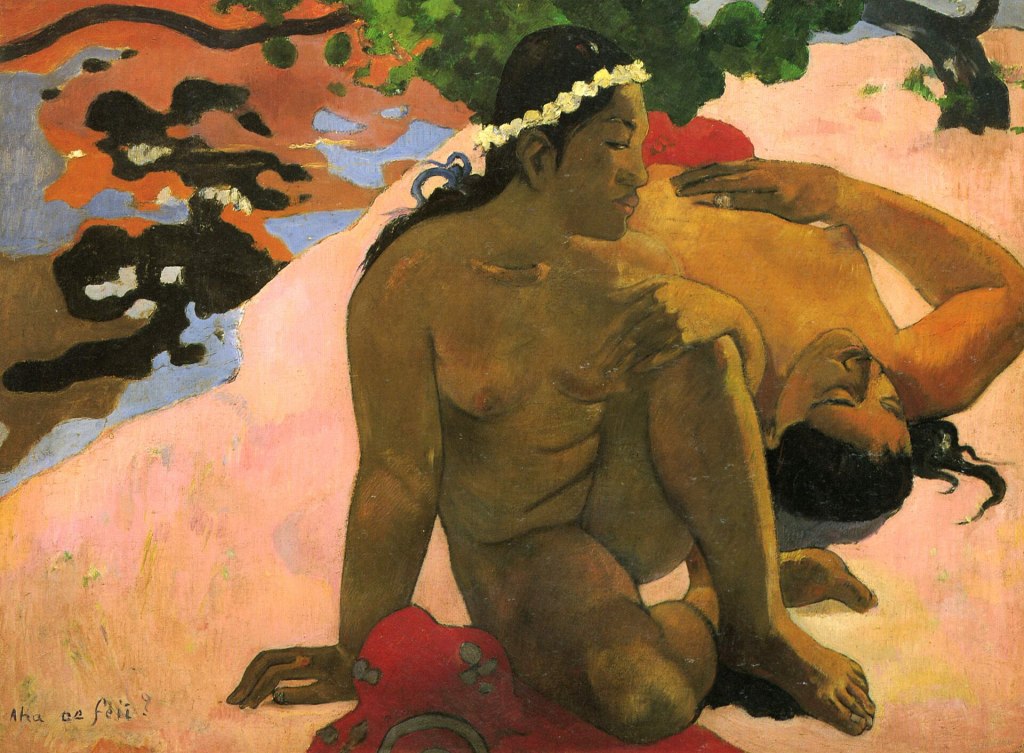
I understand from reviews that at least some readers and professional reviewers are relieved that Sue Prideaux in her new biography, Wild Thing, exonerates Gauguin’s egregious sexual relationships with girls and women because the times were different. How nice. [The French, among others, have long struggled to recognize sexual exploitation of female children, not to mention adults, but there has never been a time when misogyny and outright cruelty were not objectionable to those who suffered. It’s one thing to acknowledge that bigotry such as antisemitism and racism and sexism were tolerated and even encouraged by those in power; it’s quite another to insist that these attitudes and transgressions went unnoticed, that such bigotry was somehow rendered benign because a few declared it was.]
Paul Gauguin, Aha Oe Feii? (What! Are You Jealous?) from 1892*Continue reading →
You write. You submit. You wait. You are rejected.
Only that first verb matters. Remember that. Keep going.
You write. You submit. You wait for rejection. It is tempting to believe in failure, that rejection is deserved, that it is right.
Every creative person knows this process of making and reworking and finishing, and then sharing and waiting and hoping for appreciation. We all know disappointment. Those of us in MFA programs, those sitting alone behind a desk, with a notebook on our lap, everyone with a dream of finding an audience, even those with an audience waiting and eager to read our words. We focus on we have to share, bring on every skill we have practiced, but fear our audience will not remain seated. Even our mother will lose interest.
We envy people who never doubt. We doubt.
It is tempting to believe that others never doubt themselves, that someone somewhere is writing better stories and essays and poetry, that readers respond with the same passion that writer felt while writing, that their work is snapped right up. And maybe you’ve had work that was snapped right up. Maybe you have published poetry or fiction or essays that someone somewhere told you they loved. Maybe they even told you why. Or maybe they never did. Not once.
Either way, you doubt. You write. You submit. You wait. You are rejected. Each time you start over. You want to believe others are not good enough, but you are perfect, and then hubris drops its calling card and you know you are lost. Envy scars your work, plants its ugly face between you and what you love.
It is tempting to believe that maybe this rejection is all you have, that the essay or memoir or poem or story you wrote isn’t good enough. You should revise it, set it aside for a time and revisit it, rearrange the paragraphs or stanzas, make a stronger opening, invent a new word, wrap your thoughts in metaphor or scene, reconsider what you think you are writing about. Maybe you thought this piece was about love and really it’s about hope or loss or—heaven help you—giving up.
It is tempting to give up.
You write about giving up. You write until you find the next story or scene, the new essay or poem. You find a line or a single word. And then you fall right back into writing. Hours go by, and you laugh at the memory, the paradox, the irony written before you, the odd turn of phrase, the way a character or idea does something you hadn’t expected. You might cry when you find your own blood staining the page, or laugh all over again from pure glory. You polish the line until you realize it is too shiny and you must allow the next line to shine brighter. Hotter. You might stay up too late, revise those lines a hundred times, stir that emotional pot while it boils. You might get burned, but even the rising steam belongs to you. You work with sound until the words reveal what you knew all along. You have something to say.
You glow with effort and accomplishment. You said it, you wrote it, you made it clear on the page. Hold on to this. You hold on.
You write. You submit. You wait. You are rejected.
Repeat. Repeat. Repeat.
The response you are waiting for does not arrive.
It is tempting to believe you are wasting your time and your energy and your very heart on an endeavor that you were never meant to pursue. You want to believe that someone somewhere needs your words. You fear you are wrong. It is tempting to believe you will never write better than this. Maybe, you think, I should stop. You are not good enough. Maybe it is a delusion to trust your words matter to anyone anywhere. Maybe it was never important, what you write and try so earnestly to share. You do not have it, whatever it is that is found wanting.
You want it.
It is tempting to decide that laughter —yours—and tears—yours—are small things. They’re not. It is tempting to dismiss your accomplishment. It towers over your head, this dismissal. It is a momentous thing like sliding off a mountain peak. When you found the right word, the right sound, the piece that finally fits—there is triumph in that instant before you begin to doubt.
Remember. You have struggled. You have discovered. You have created a new thing entirely your own.
Remember the process, the laughter and tears and precision. Maybe you forgot that it was the writing you loved best of all. Maybe you forgot why it matters most of all.
You wrote this. It is yours. It is important to you.
Remember that precious verb: write. Set aside submitting, waiting, rejection. Maybe those next three verbs give you nothing good, only judgment and disappointment. You are better than that.
Only that first word is good for us. We deserve to write. We need to have the last word about the value of our work.
Everything is blooming here, other than things that are already nearly done blooming. In the front yard the wild roses and rhododendron and irises are done, but Pink Grootendorst is still setting new buds and so is my favorite double white rugosa. The honeysuckle and salal are still in flower, and the ceanothus is covered in bees, and the other flowers are getting close to opening. Lucifer looks like it will pop a week or two early this year. [I try not to notice the red lines under three botanical names my computer thinks I’ve misspelled.]
The northern half of the front garden. There is a massive lacecap hydrangea at the south that you can’t see. It’s covered in green buds that, in a few weeks, will open up to blue. The richly scented Blanc Double du Coubert and another highly scented pink single are out of the frame too. Three clay pots, two with herbs, and one with a volunteer viola that’s come back for years. We continually fight the ivy and the neighbors’ invasive single red rugosa rubra.Continue reading →
In 1972, I drove across the country with my grandfather’s third wife Genevieve to a sheep farm in Kansas. I had never been over the Rockies before that. Vietnam was at war, I learned to spin wool that summer, and when I got back Gary and I moved in together on the 4th of July. We would both be Juniors at the University of Washington that fall.
But in June, Gen and I crossed the plains. It felt foreign-strange to me to see no mountains on the horizon in any direction—no mountains at all in the last days headed to Kansas. All around, open sky. At one point, we pulled over to the side of the highway while a storm passed overhead.
I spend a lot of time looking at sky, have done for most of my life. When I was young, I didn’t want what my dad teased my mother about: Five secluded acres in the middle of town. I wanted to be far away in forest. But then we moved to the edge of the continent, and I began watching the sky.Continue reading →
Heroes aren’t my thing—I resist heroics, but I do have a few people I hold in my heart. Sojourner Truth is always the first. Many authors. Many people I’ve never met. And Kylene, who I met and then followed online for thirty years. She was an inspiration to me and many other teachers—the only academic I’ve ever met who gave precedence to actual teaching.
Over the years, I took too many education classes and workshops from people who failed to practice what they were teaching. Kylene Beers continued to teach kids while teaching teachers and serving as editor of an NCTE publication. It can’t have been easy.
Kylene Beers was the real deal. She practised what she preached. All honor to her life. She died yesterday. September 16, 1957 – June 20, 2025
Juneteenth, also known as Emancipation Day or Freedom Day, celebrates the end of slavery in the United States.*
Years ago, our son’s orthodontist commented to me that our sons were similarly handicapped when applying to college because they were white boys. He smiled, a virtual nudge-nudge, we’re in this together, right? His son’s application to dental school had been denied, he said, to make room for Black students. So he said. I generally had walked away from such comments, and I didn’t want to annoy the man fixing Alan’s teeth, but I didn’t walk away that day. I turned back and told him off with calm reasoning. [Should his son be advantaged in admission to dental school because his father had gone? Because his father was white? Was my son unqualified as Salutatorian for undergraduate study? Had this man looked at the numbers? Who did he think he was? I was angry and it was a long time ago. I don’t remember exactly what we said to one another. I am angry thinking about it now.]
It’s true I am inclined to worry. My mother was a worrier and actively taught me all the tricks and habits of an active worrier. I worry about my husband dying, about the welfare of our sons and their eventual retirement, the grandchildren and other family members. I worry about friends living in red states and my friend who just sold her last floor loom because I have never known her not to have one. It worries me.
I didn’t bother this seal. We noticed one another almost simultaneously, and I was fully zoomed with an actual camera and fifty yards away to get this photo and then I backed right off out of this pup’s sight. Continue reading →
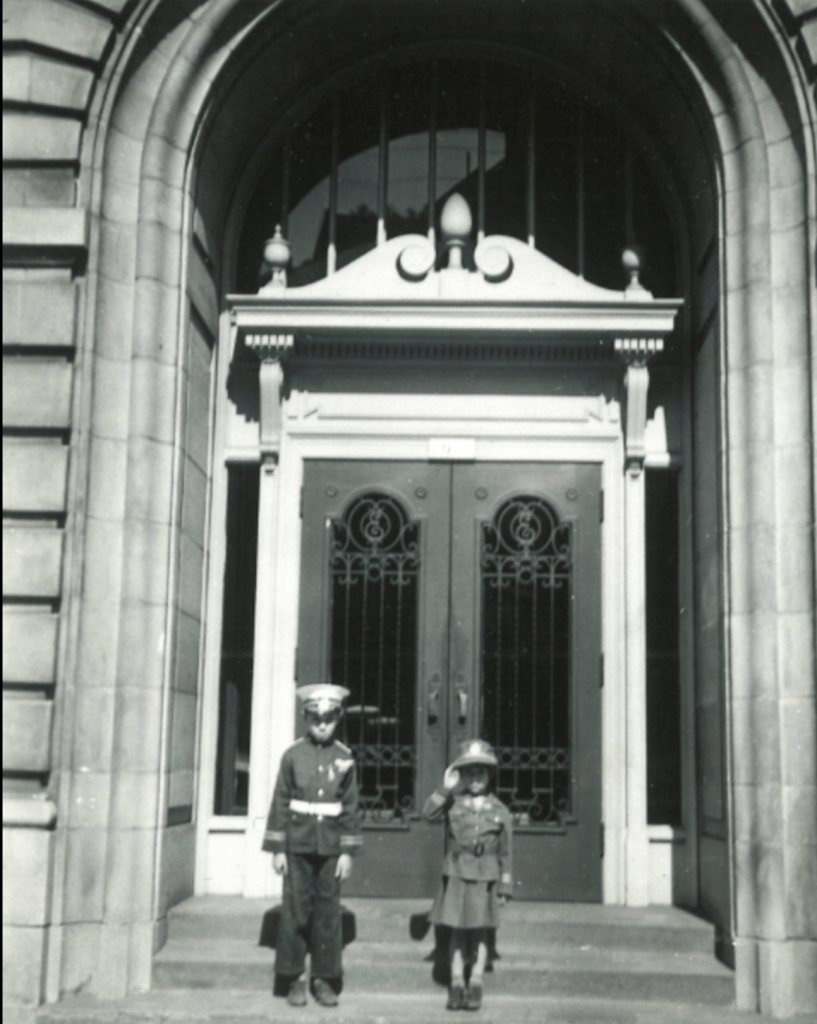
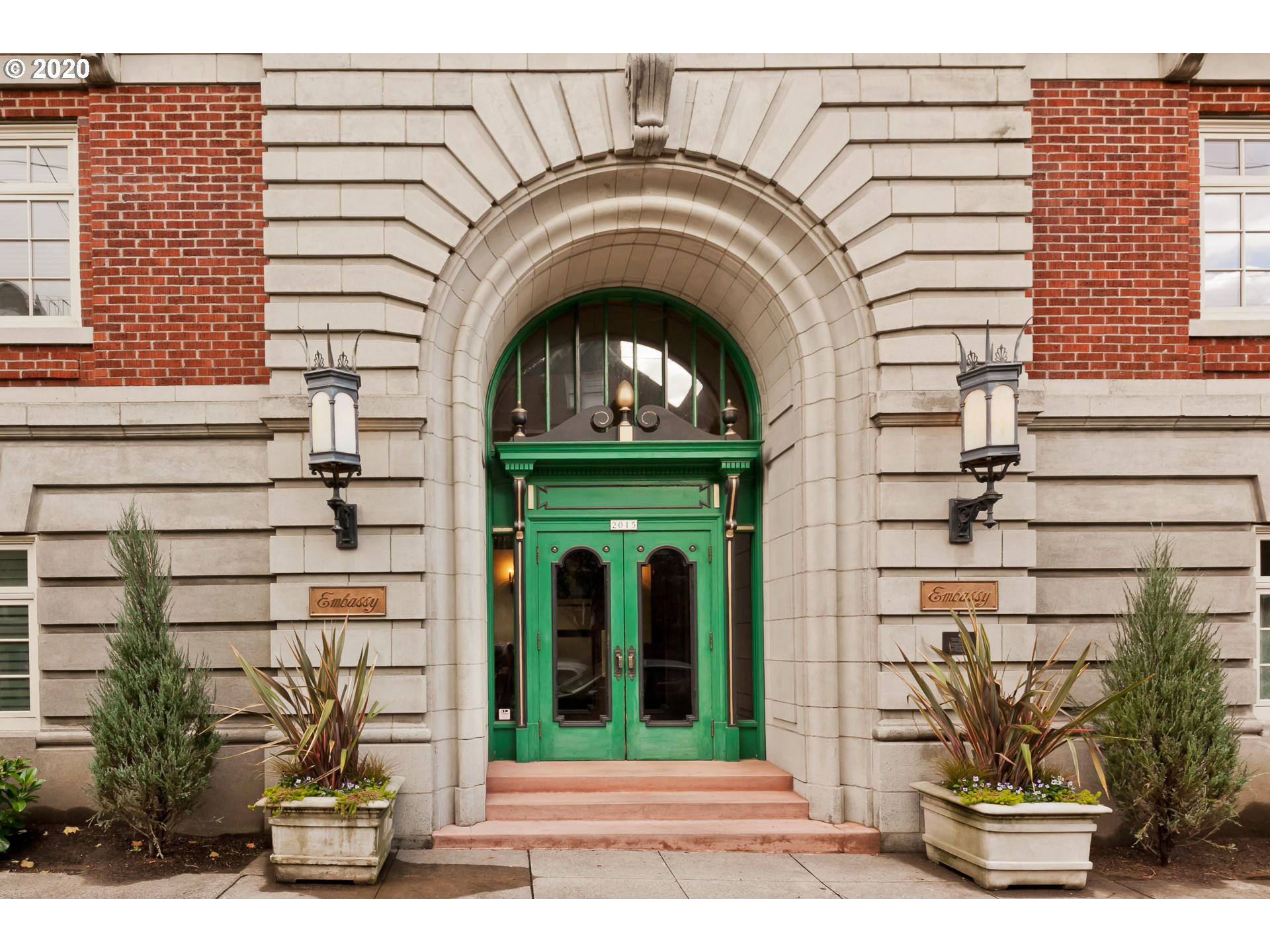
The 1923 elevation drawing by architect Carl L. Linde, a copy of which is hung opposite the elevator on the first floor, does not indicate the colors for the entry facade. The drawing does seem to show the surround as somewhat lighter than the tinted concrete and the doors as quite dark. Dark, varnished “Philippine Mahogany” was used throughout the building and survives on the back of the outer doors and the inner entrance doors, and the hall side of each apartment door. Though somewhat damaged, this woodwork remains beautiful and original. The outer doors have, aside from scratches and gouges, rot at the bottoms. Ideally, the doors should be taken down and repaired or completely rebuilt to the original design, which would be very expensive.
This B&W photo from WW2 shows the contrast between the very pale-painted surrounding woodwork and dark mahogany doors. The iron grillwork on the doors was removed years ago, but the Association has one as a model that could be used to replicate them.
The more recent colors fail to match the values of the doors and surrounding woodwork.
LEFT: This is how the entrance looked four years ago. Many residents loved this. The painted black and gold surround and green doors were cheerful and distinctive. Nevertheless, the color choices are totally out of line for the period (1924) and had detractors who viewed them as inauthentic. RIGHT: This is the way the entrance looked yesterday. The value of the surround is closer to the original facade, but in a pale cream and a putty that’s darker than the original. The brown chosen for the doors themselves was also wrong—too light and the hue is not close to the originals of this building on the National Historic Register.
The aim was to approach with paint the hue (color) and value (darkness or lightness) of the original doors. At a local paint store someone color-matched dark-stained Philippine Mahogany, a mahogany-like color. It’s a couple of steps darker than a paint color original to the building and still found on the inside of the storage room doors, so there was some historical consistency.
That same someone prepped and put one coat on the doors. The first resident passed while walking his dog right at the start of the repaint. “What are you doing?” “Painting the doors.” He said, “Not good.” By the time it was half done, several passing people complimented the new color. A resident loved it. Another resident was expected to yell, did at first, but then said thank you.
The cost of repainting the doors and surround in green, black, and gold has been bid at least $6k. Here is a stylish upgrade for no cost to the Association at all.
The goal was to take the front doors back close to their original appearance. The very dark red-brown shows up with elegance against the putty and cream of the surrounding woodwork and plays to the color of the hundred-year-old brick.
The shadow doesn’t do justice to the beautiful millwork and neither does that putty color, but it works better overall with the newly darker-colored doors. Someone would like a second coat, but maybe best to see who yells.
28 September 2025: My intention in this post was to explain what I did and why. Because I have recently been called out for failing to apologize for breaking “the rules we all agree to” I will confirm that I immediately apologized to the Board months ago, in writing, and now add to everyone in the Embassy: I am sorry for offending community standards and breaking rules.