“Sit still,” the trainee told him several times with increasing frustration. “Sit still!” When he finally did sit in his chair, the little boy completed the test. He scored so very badly. The trainer took her student aside. “Try again but let him move around this time.” Do I need to tell how much better he did the second time—on a different version of the same test? He was doing Algebra at age seven. He should have been accelerated in math in middle school. So should his older brother. As a teacher and his mother, I should have insisted.

I made a lot of mistakes as a parent and as a teacher. Years before, I should have insisted he be tested comprehensively. The school knew in grade school that our younger son “does not process information” in the same way most children do. He was smart enough to fake it, smart enough to misread the text and still figure it out correctly. And now his son is the third generation in my family with dyslexia, finally (finally!) diagnosed. I did better for some of my students than I did for my own children. It is easy to look back and see how I failed, and that is a source of both guilt and sorrow.
Students sometimes benefited from my earlier mistakes. I referred a student for testing, and was told he was fine. The next time he was in my class, I referred him again, explaining again what I’d observed. And then after a third time, testing revealed what he’d been up against. I can’t tell you his diagnosis, but he’d been told all his life by family and teachers that he was “difficult” or simply “stupid.” He had been in a lot of trouble, and he had even warned me against himself. “I’m trouble,” he said. But I had him in class for two years and noticed he was none of those things. His thought process was reasonable and logical and, maybe more important, he was kind. He had compassion and took care of his peers.
There were plenty of capable kids that people overlooked. Sometimes gifted children deliberately disguised how brilliant they were. Perhaps they’d been called out when they were young, and they were embarrassed before their peers by the attention. Some had been teased and bullied. A few told me that being identified as smart only meant they were given extra assignments that they found uninteresting. When I tried to organize activities targeting their intelligence, an administrator squashed the plan. “Anything you do has to be available to all the students,” they insisted. But state law required an “appropriate education” for all students and what is appropriate for a gifted child is guided challenge. We received extra funding for both disabled and gifted children. A gifted child’s intelligence is not less worthy of consideration than a child who is deaf or another who is athletically gifted. Most years we did nothing for the gifted kids at all. Nevertheless, I moved students from regular Junior English to Honors, because even though I taught the same skills in both classes, we went faster and harder in Honors. For a smart kid, that means less boredom and more possibilities.
I had a student who had never passed an English class all through middle school and two years into high school. It wasn’t that the kid was lazy and didn’t do the work. It wasn’t even that they found the work too easy. They could see miles ahead of the rest of us and didn’t have the maturity, experience, and specific skill to make that imagined journey. I was only asking students to complete six laps, and some students would manage to run all six. This student was imagining a marathon, and when they ran past the 5k or 10k mark too tired to finish, they gave up. They’d worked hard but never handed in their work.
The assumption of many is that smart children, even particularly brilliant children should find school easy. [I had another teacher tell me this after explaining that the reason a student could tell him her Senior essay but not write down a rough draft was because she had to complete the entire argument in her head before she wrote it out. It was her process. Respect peoples’ process.] Intelligence doesn’t work that way. It rarely simplifies; it complicates. Research suggests that gifted children are out of step with their peers in the same way that a mentally challenged child is. Back in my undergrad students days, an educational psychologist warned us of this very thing. Each of us struggles to fit in, but because the gifted child thinks in more complex and sophisticated ways, they often fail to fit in with their peers. They are young and often they have no one in their lives who has been down that road. They are smart enough to notice they are out of step. They are human and young enough to care.
Gifted children aren’t always easy. I was a gifted child myself, but I was a well-trained girl in a culture that makes particular demands on girls. I’ve had students who were a lot smarter than me. It’s disconcerting for teachers to have students in their class who are genuinely smarter than they are. I had a student who could have told the class in the first five minutes where I was going with my lesson and where we would be as a group an hour later. Without meaning any harm, he did that now and again. I would take a deep breath, smile, tell him he was right and to let me do my job, and carry on. Resenting the child who is ahead of you as a teacher, or failing to recognize their capacity to push past is a tragic failure both as a teacher and a disservice to the student who needs compassion and an IEP [Individual Education Plan] as much as the child with dyslexia or ADHD.
The only time I ever lied to a student was the gifted boy who skipped school whenever he was passing my class. He was often high. He often checked in about his grade because his family required passing grades. So, for example, I might tell him that if he passed Friday’s quiz he should be passing if he was also in class for an activity the following Monday. I lied to that boy for most of the year once I had his routine figured out. He was nearly always earning a B. He probably figured it out before the end of the year.
He was among what I called the “sixty-percenters,” students who had decided they needed a particular grade, usually just passing with a D, sometimes a C. I warned Senior English teachers about the smart kids who did the bare minimum (because they didn’t want to go to college/because doing badly but not actually failing classes was their notion of how to punish their parents). Put those 60%ers in hard classes; if they are going to only do sixty percent of the work, let that curriculum include harder, more interesting assignments. Otherwise, it was all too easy for them. Boredom is a dangerous thing for any child; it’s a tragedy for someone who might figure out how to fix the world.
I’ve written a lot about gifted children, gifted teens, but we underestimate most of our kids. Parents are busy working or want their kids earning trophies more than knowledge. I can’t fault the single father working two jobs who came home to find his teenage son drinking soda and playing video games after 1am. He wasn’t a bad father and his son wasn’t a bad student; they were both lonely and tired and short on sleep.
So often, I watched parents struggle to understand the world their children live in. They’ve forgotten the reality of high school for about 95% of students. High school is a miserable time for most teenagers. Maybe you forgot? Adults tell kids all the time: “Enjoy these years, they’re the best time of your life!” It’s a dangerous lie. Dangerous because it suggests that nothing in their future will matter more than what someone said to them in the hall after Second Period. Dangerous because if they are already drowning, they don’t want to be told this is the easy part, the “best” part. And it’s a lie, because high school is a b!tch. Maybe the varsity athlete who made it to State loved high school, but mostly they went on to lives that included better times. I could name a few of those who were unhappy enough to do themselves damage even in high school.
Being a kid isn’t easy. We try things that turn out all wrong and then we try something else that is worse. We find what works for us through trial and error and by observing others. It takes years and never stops. This process isn’t unique to our time. Growing up hasn’t been easy in my lifetime and it’s probably never been easy. Becoming the one in charge of our own life is hard work. There’s joy in that process, but let’s not pretend it doesn’t hurt. It doesn’t help to insist this is easy. High school is fun sometimes, and there are friendships that might matter and events to look back upon, but it’s also a s*@!how. It’s a scary time when we don’t have enough knowledge and power and experience to be certain when we are making the right choices or even what a right choice might be. High school is hard. That’s true today and it was true last year and it was true sixty years ago. The adults in the room owe it to teenagers to have patience and to set boundaries. They don’t know how to set those boundaries for themselves. Not yet.
I taught high school Art and Yearbook and English, classes in a community center and an art museum, subbed all subjects K12, and taught college English and Writing for a total of 44 years. I was mostly a good teacher, but I wasn’t the right teacher for every student. I should have done better. Forty-four years as a teacher or nearly fifty, a mother for 45, and a grandmother for more than 14 years. That last was supposed to be easy, but I feel my shortcomings there too. I do what I can, and if I pay attention, I’ll maybe do a better job as I figure out how that works for my grandchildren.
And after all, that’s the best I can hope for. I try and then I try something else. Sometimes it works and sometimes someone gets hurt because it doesn’t. Sometimes things go sideways. It’s not how I thought things would go. It’s not what I thought I wanted. Maybe that’s what feels like regret, getting what we didn’t know we needed? But at least as often as sorrow, life hands me a gift. I share a moment or make a discovery, I watch the clouds move across the sky and pet the neighbor’s dog. I make a child laugh or answer their question.
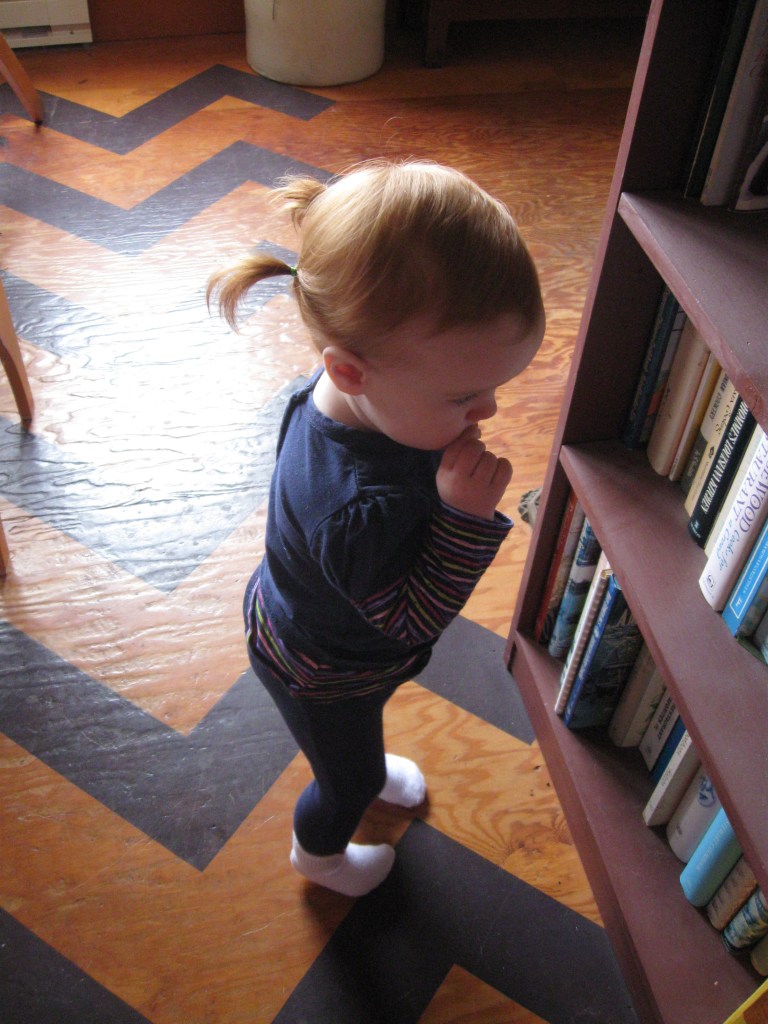
After high school: friendships, marriage, teaching, moving to Oregon, judging field trials, making quilts and sweaters and holiday cards and stories and essays and poems, singing harmony with a more talented friend, sharing the world with my husband who loves me, birthing children, teaching, becoming a runner, writing a novel (and then several more), earning an MFA but not in visual arts, getting old, and scrubbing the kitchen floor. I can’t explain why that last is a high point, but it is. The kitchen floor has an out-sized black checker pattern on the vertical fir ply I laid down and then sealed, painted, and varnished myself. It’s a beautiful floor and I did it by drawing pencil lines and painting the alternate squares with black paint freehand.
Every single time, scrubbing that beautiful floor is better than high school.
 IMPERFECT PATIENCE
I have been told that I was there too and that I had a good time along the way—you know you remember—more fun than being kicked by an elephant, and somehow I blame our teachers at Cordell Hull and Shoreline for making us realize that we had to care ’cause that was part of the deal—part of the commitment and that’s what we passed on to the offspring
LikeLike
Ah! The elephant stories that people doubt and they are absolutely true.
LikeLiked by 1 person